
The discursive construction of literacy in a disadvantaged school
72
0
0
Full text
(2) Chapter 8 Constructing schoolliteracies: Quality, information and social critique. 8.1 Introduction Banfield teachers frequently stated that they didn't feel they were 'doing enough', that they didn't get lime to do 'the imponant things'. Literacy was one of the 'important things' which teachers continually struggled to make a high priority. The principal's view, that literacy education should be liberating for socially disadvantaged groups, was. well known and several teachers employed a vocabu lary of empowermenl to describe their work as literacy educators. Yet as I have shown, the everyday classroom practices of literacy lessons were sometimes of more mundane stuff.. [n Chapter Seven I presented an analysis of the ways in which teachers managed students in the literacy classroom and how this exercise of power governed who students could be. how they could ac t, what they could do. The student subject was self-regulating, hard working, responsible and well-behaved. All teachers expressed corrunitment to the school's explicit social j ustice agenda (of which literacy was seen as a key element), and producing doci le students was alien to the stated pol itics of at least two of the teachers. Indeed, not all literacy lessons were dominated wi th behaviour control and managerial training nor interrupted by administrative tasks or fami ly crises. In this Chapter, I consider what teachers did when they made time for literacy. I discuss the literacies produced when teachers did what they considered the 'important thin gs'. Despite the teachers' protestations about the differences in their approaches to literacy teaching, as is already clear, they shared many similarities. My analysis of the corpus of the transcripts indicated that all teachers emphasised the quality of student work and the production and interpretation of information texts. It also showed that one teacher made time for social critique in a number of literacy lessons. On such occasions students were given time to talk, read and write about textual practices relating to race, gender and childhood. In this chapter I discuss the common practices of literacy lessons - quality and information - and also the uncommon practice of one teacher who was working on 'critical literacy'.. Page 291.
(3) Chapter 8 Constructing schoolliteracies. In selecting these foci it may seem that I have avoided current academic debates about process and genre, which have flourished for a decade. In part this is so. My justification is that I did not fi nd the debates, as such, significant in this si te. Teachers took from different pedagogical approaches whatever they found useful in meeting the often contradictory expectations of the principal, colleagues, parents and students. The literacy pedagogies 1 encountered represented an amalgam of ski lls, process, genre, critical approaches and positions. Focussing upon quality, information and critical literacy allows me to illustrate contrastive subject positions and literacies taken up by these teachers. The chapter proceeds in five sections. First I discuss in more detail the broad analysis of classroom Iiteracies and the emergence of quality work and infonnation production as key schoolliteracies at this time. In the second section I examine specific instances where teachers took issue with the quality of students' literate work. In the third section I consider teachers ' constructions of li teracy as information production. In the fourth section I illustrate and briefly discuss one teacher's explorations in critical literacy. I conclude the chapter by raisi ng questions about what ki nds of literacies and student subjectivi ties might be produc ti ve and positive in disadvantaged schools.. 8,2 Language work: a profile of the literacies in four classrooms An advantage of working in one school over an ex tended period of time is the. opportunity to get a sense of common everyday practices. An advantage of working in different classrooms is the opportunity to identify the uncommon practices. While my interest is in the micro analysis of the construction of literacies through classroom talk, I believe it is useful to provide a broad picture of the literacy cu rriculum on offer. Such a picture provides the context for the analyses of selected lessons which follow. What is interesting, if nOl surprising, is that I could not simply describe the teachers as adhering to a traditional, or a whole language, or a genre or a critical approach. Most teachers sampled from all of these positions, employing techniques and strategies from these and othe r broader educational and psychological discourses. Finding ways of neatly summari sing what went on in the literacy lessons I observed in four different classrooms over the eighteen month period was a daunting, if not impossible task. In my teacher education work, I was confronting a similar problem. Wanting to avoid constructions of literacy pedagogy which locked teachers into sets of binalY choices (whole language or genre) or simple labels (best practice, good practice), 1 constructed, with a colleague, a frame which we hoped might be useful to teachers in identifying sites. Page 292.
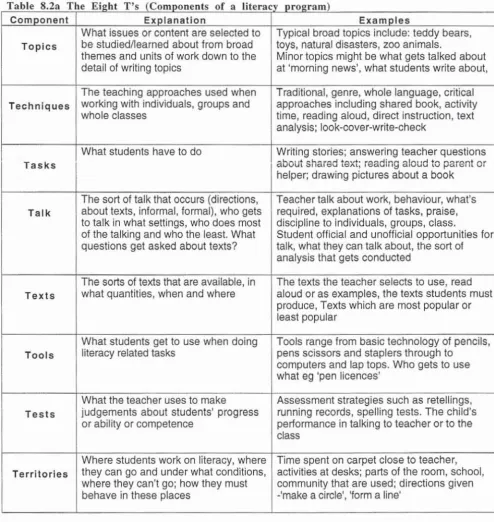
(4) Chapter 8 Constructing school literacies. through which to review their classroom literacy programs (see Table. 8.2a). Drawing on our readi ng of critiques of school literacy practices we developed a grid - the 'eight Ts 'the topics. texts , talk. tasks. techniques. tools, territories and tests of literacy lessons (Comber & Connack 1995). This mnemonic device we hoped might be a useful way of reminding ourselves and teachers of key areas where researchers have suggested that the enacted literacy curriculum may be problematic for disadvantaged students. Ta ble 8.2a The Eight T's (Components of a literacy pro~ ra m ) Co mp o nent Expla nat ion Exam pl es What issues or content are selected to Typical broad topicS include: teddy bears , be studiedllearned about from broad toys, natural disasters, zoo animals. To pics themes and units of work down to the Minor topics might be what gets talked about detail of writing topics at 'morning news', what students write about, The teaching approaches used when working with ind ividuals, groups and whole classes. Traditional , genre, whole language, critical approaches including shared book, activity time, reading aloud , direct instruction, text analysis; look-cover-write-check. What students have 10 do. Writing stories; answering teacher questions about shared text; reading aloud to parent or helper; drawing pictures about a book. The sort of talk that occurs (directions, about texts, informal, formal), who gets to talk in what settings, who does most of the talking and who the least. What questions get asked about texts?. Teacher talk about work, behaviour, what's required , explanations of tasks, praise, discipline to individuals, groups, class. Student official and unofficial opportunities for talk, what they can talk about, the sort of analysis that gets conducted. Tex t s. The sorts of texts that are available, in what quantities, when and where. The texts the teacher selects to use, read aloud or as examples , the texts students must produce, Texts which are most popular or least popular. Tools. What students get to use when doing literacy related tasks. Tools range from basic technology of pencils, pens scissors and staplers through to computers and lap tops. Who gets to use what eg 'pen licences'. What the teacher uses to make judgements about students' progress or ability or competence. Assessment strategies such as retellings , running records, spelling tests. The child's performance in talking to teacher or to the class. Where students work on literacy, where they can go and under what conditions, where they can't go; how they must behave in these places. Time spent on carpet close to teacher, activities at desks; parts of the room, school, community that are used; directions given -'make a circle', 'form a line'. Techni qu es. Tasks. Talk. Tes t s. Te rri tories. (Comber & Cormack 1995). Here however r use an abridged version of that device in summarising the literacy program in each classroom over a term. In particular I focus on the topics, texts.. Page 293.
(5) Chapter 8 Constructing schoolliteracies. techniques and tasks of the literacy lessons at Banfield to get a wide view of the content and teacher and student activi ties. The talk, tests, tools and territories I consider in the context of specific situations and institutional practices (see later sections of this chapter and Chapters Seven and Nine). I turn now to the framework - topics, texts, tec hniques and tasks - I used to establish the repeated themes and act ivi ties across the classrooms. Begin ning with texts, I briefly explain why I decided to use these four lenses to examine the corpus of literacy lessons. The texts of early literacy lessons may excl usively portray white middle class worlds, where mothers and fathers and boys and girls behave in ways which mai ntain gendered, generational, classed and raced versions of the world (Baker & Davies 1993; Baker & Freebody 1989; B igelow 1992; Luke 1988). Selection of texts therefore, is one site for analysis when it comes to considering the construction of a literate culture in a school community. Similarly the topics of the school curriculum contribute to the constitution of particular versions of chi ldhood literacy (Christie 1988; Luke 1988; Marti n 1984; Unsworth & Williams 1990). T he topics selected fo r study in the literacy classroom are not neutral vehicles through which chi ldren develop their literacy skills, bur actualJy construct areas of knowledge and the literate practices associated with different discipli nes. Hence what is written, researched, read and talked about is central in the literacies which are produced. At the centre of debate about literacy is often the repertoire of techniq ues which teachers employ to do their teachi ng. By techniques I mean what the teacher does. Thus whether teachers give direct phonics instruction, read stories aloud, conduct writi ng conferences, publish children's work, hear childre n read, and so on, conti nue to be matters of discussion. The teacher's role is sometimes characterised as the sum total of these techniques (see for example the Early Literacy Inservice Course, Education Deprutment of South Austral ia 1984). As I have disc ussed in Chapter Four, the naming of particular techni ques often comes to represent, however unfairly, a partic ular theory or philosophy. For example Whole Language may be reduced to Shared Book Experience or writing stories. Genre pedagogy may be reduced to a formula for writing procedures. My interest here is simply to get a picture of the reperto ire of techniques teachers employed, whi lst recognising that how these are enacted in particular situations is another story agai n. Another way of working out what is valued in a school curriculum is to examine the tasks set for childre n. By tasks r mean what it is that the children are req uired to do. When c hildren do tasks, they enact the ir roles as particular kinds of student workers. Here they prac tise what is deemed valuable for them to do. As I discussed in Chapter Four, there has been heated debate abou t how the school literacy curriculum should look and how it. Page 294.
(6) Chapter 8 Constructing schoolliteracies. should be delivered. Critique of so-called traditional approaches to literacy pointed to the problems with children doing meaningless exercises and work sheets which decontextualised language use (Cambourne 1987; Edelsky 1991). Martin's (1984) criticism of natural approaches to writing instl1lction emphasised the dominance of narrative writing. With regard to reading, other studies have suggested that children spend considerable class time learning to answer questions in Shared Book Experience lessons and that often such questions may have little direct connection with the text itself or with children reading as such (Baker & Freebody 1989; Freebody et at. 1995). In examining tasks set for children over a period of time we can begin to see what counts as the enacted literacy curriculum in school. Reviewing the corpus of lesson transcripts focussing on topics, texts, techniques and tasks, I hoped then to get a wide view of what was typically done in literacy lessons and in this way to consider the kinds of literacies to which children were given access and practice. Using this frame, I analysed the entire corpus of transcripts and classroom artifacts produced in each literacy lesson (See Tables 8.2b-S.2e). For each class I tabulated: •. topics talked, read or written about (eg zoos, whales, volcanoes, friendship, racism). •. techniques used by teachers (eg shared book experience, jointly constl1lcted text, hearing reading, deconsttu cting the text). •. texts talked, read or written about (eg Snow White and the Seven Dwarfs, NaturaL Disasters, Whales, alticle on children's book awards from Saturday newspaper). •. tasks students did (eg. maki ng journal entries, writing self-assessments, reading aloud to teacher, writing autobiographies, acting in reader's theatre, writing reports, practising handwriting, writing a critical letter to an author).. Tables 8.2b - 8.2e are indicative of the kinds of informa tion yielded from such an analysis over a two week block from each of the four classrooms.. Page 295.
(7) Chapter 8 Constructing schoolliteracies T a b Ie 8.2b Reception/o ne class profil e Topics Te x ts Tec hniques Home reading Book taken home to Hearing individuals read to parent read. Zoos. Zoo looking. Big cats. Going on a lion hunt The tiger who came for lea. Spelling Tigers. Reference book on tigers (name not known) The monkey and the crocodile Bubble gum The great zoo race. Tasks. Read to teacher and write entry in reading journal about home reader (daily event). Shared book experience. Usten to stories. Reading stories aloud. Look, cover, write, check (weekly). Look, cover, write, check (Whole class spelling game). Listen to excerpts from reference books Answer questions Singing Choral reading Reciting of poems and rhymes. Choral reading Oral cloze Modelled writing. Writing a recount of weekend outing. Weekend outing. Student journal entry. T igers. Tigers (teacher·made big book). Individual conference. Teacher made chart about tigers labelled description, behaviour, habitat and diet with a picture 01 a tiger in the centre. Teacher reads excerpts aloud Deconstruction of report genre Joint construction of report genre. Write report on chosen animal. Teacher demonstrates how to put information about tigers under the right headings on chart.. Students to find two pieces of information for each heading in tiger reports and write it on their tiger charts. Students make own chart modelled on teachers'. Teacher shows each student's chart and questions students about the meanings of technical terms such as habitat, behaviour etc.. Page 296.
(8) Chapter 8 Constructing schoolliteracies Tab le 8.2c Rece ptio n/one/tw o class profil e Topics Home reading. T exts Technique s Picture books such as Teacher hears reading while other children Storybox and Bookshelf children take make journal entry home to read to parents. T as ks Reading joumal: write entry- title, author, illustrator, comment and picture (daily event). View Puppet show 'Monster from out of space' Agenda for lesson. Teacher scribed agenda. Teacher reads aloud and asks questions Teacher and students jointly construct agenda. Volcanoes. Natural disasters. Shared book experience. Unknown tourist information book about Pompeii parent has sent in. Avalanche. Teacher reads aloud. Student join in reading familiar text Students listen, answer and ask questions. Teacher reads section on avalanches Teacher recounts her experience of an avalanche in Switzerland. Students listen and answer questions. Teacher models spelling strategies. Brainstorm volcano words. orally and scribes students' words Teacher -reviews section on volcanoes Teacher scribes list of volcano words. Volcanoes. Natural disasters. The betrayal of Jesus. New Testament. Teacher reads excerpt and asks questions Teacher scribes students answers. Students answer questions about Jesus' feelings. Earthquakes. Natural disasters. Shared book experience Teacher questions about text eg number of times the word 'earthquake appears Teacher scribes 'earthquake words'. Students listen, ask and answer questions. The betrayal of Jesus. Students to write information about volcanoes using scribed list. Teacher-led discussion about the betrayal of Jesus. Page 297.
(9) Chapter 8 Constructing schoolliteracies. T a ble 8.2d Three/four class profil e Tooic s. Whale-watching at Victor Harbou r. Something that happened last night or previous school day Review yesterday's work Spelling lists. Something that happened Jast night or something you'd like to remember Whales. Spelling test. T hings that scare you. Recount of previous school day. Texts. Information sheet on whales. Te c hnique s. Brainstorm words for report Teacher conducts individual checks Teacher models journal entry. T as k s. Write recount of excursion to Victor Harbour Journal entry. Self-correction of writing. Ability group weekly spelling lists. Copy spelling fists into own book Peer spelling test in pai rs Journal entry Proof-read journal entry. Teacher produced Teacher questionsl sheet of words in linked students answer scripi Teacher modelling information under headings e.g. Diet: tiny fish; Whales: Humpback; Appearance: short; Behaviour Teacher works with 'low ability group' on the mat while rest work individually. Ability groups, but tested in whole class context; ie says 'Group 1 words' 'Group 2 words' Points out similar spellings. Teacher scribes sentence beginnings on blackboard, e.g. 'Before recess I Before lunch t '. Circle unknown words Circle words don't understand Underline words that start sentences Count paragraphs Student volunteers read aloud sentence by sentence Count words in statement Point to words Students take proforma with headings and whale information sheet. Put information under the correct headings.. Tell partner things that scare you Ask partner questions Pairs join other pairs and report what partner said. Journal entry - recount of yesterday Re-read journal rules. Page 298.
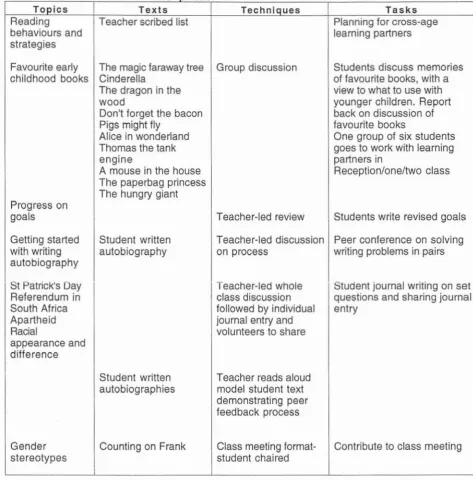
(10) Chapter 8 Constructing schoolliteracies. Table S.le Five/s ix/seven c ass profil e TQplcs. Texts. Reading behaviours and strategies. Teacher scribed list. Favourite early childhood books. The magic faraway tree Cinderella The dragon in the wood Don't forget the bacon Pigs might fly Alice in wonderland Thomas the tank engine A mouse in the house The paperbag princess The hungry giant. Progress on goals Getting started with writing autobiography. Student written autobiography. Ta sks. Planning for cross-age learning partners Group discussion. Students discuss memories of favourite books, with a view to what to use with younger children. Report back on discussion of favourite books One group of six students goes to work with learning partners in Reception/one/two class. Teacher-led review. Students write revised goals. Teacher-led discussion Peer conference on solving on process writing problems in pairs Teacher-led whole class discussion followed by individual journal entry and volunteers to share. St Patrick's Day Referendum in South Africa Apartheid Racial appearance and difference. Gender stereotypes. TechniQues. Student written autobiographies. Teacher reads aloud model student text demonstrating peer feedback process. Counting on Frank. Class meeting formatstudent chaired. Student journal writing on sei questions and sharing journal entry. Contribute to class meeting. 8.2.1 Classroom Literacies: Enacted priorities Havi ng conducted this detailed analysis across the term's work for each class I was in a position to identify key trends in the use of classroom time in literacy lessons at Banfield during that period. The full profiles summarising ten to twenty weeks in each classroom made teachers' priorities clear: an emphasis on quality work and a move to literacy as infOimation production. A review of common practices also indicated that teachers assembled their li teracy pedagogy through combining the discourses and practices of competing pedagogical approaches. Before moving. lO a. micro analysis of specific. classroom events. I briefly discuss each of these broad trends.. Page 299.
(11) Chapter 8 Constructing schoolliteracies. I take up the issue of quality work firs t. Banfield teachers constructed quality in terms of the standard of students' wrinen work, the appropriateness of their oral performance and their physical disposition to work. In everyday classroom li fe teachers employed a discourse of quality with an emphasis on correctness and presentation. Despite media reports to the contrary at that time, I found no evidence tllat correct spelling, granunar and neat handwriting were ignored. In fact, in each classroom I saw almost daily attention to these matters. How teachers dealt with correctness varied. Taking spelling as an example, a quick scan of the two week classroom profiles (see Tables 8.2b - 8.2e) makes it clear that teachers used a variety of approaches which included formal spelling tests, look-cover-writecheck on topic words, teacher modelling, personal spelling lists and dictionaries and peer reviews. While methods varied, the full analysis of the literacy programs in each classroom indicated that a combination of techniques addressing correctness (both in context and as a separate foc us of study) was employed by all teachers. While a teacher might display a progressive approach to dealing with mistakes in the context of children's writing or demonstrating phonemic awareness study whilst reading an enlarged text, they also addressed these skills, as they described them, through specific attention to phonics, word patterns, handwriting practice, dictati on, proof-reading through pre-programmed and sometimes decontextualised activities. Teachers worked to improve the standards of students' spelling in whatever ways they found practical and to which students responded positively, regardless of whether it was the approved, trendy method or not. And students often responded in ways that I had not anticipated. For instance, students who had in many cases not previously experienced spelling tests, dictation, or 'correct the errors in the following passage' exercises responded with requests to 'do thal again' (see Table S.2d). As well as resurrecting techniques from their own schooldays, teachers re-formulated methods for their own. contexts. For example, the 'look-cover-write-check' spelling approach (see Table 8.2b) was designed as a form of regular independent spelling practice to improve children's visual memory. In its original design children were to write out the list of words, rehearse them individually, cover them over, write them as the teacher called them out and them check them against their correct list. One teacher reframed this approach as a whole-class activity, in a manner reminiscent of a quiz show, with participants selected from the audience. In this classroom look-cover-write-check became an occasion of some excitement, with students eager to be chosen for the roles of contestant and judge. My poim is simply to note that quality emerged from this broad analysis as a consistent area of attention in the literacy classroom and to suggest that while it was dealt with. Page 300.
(12) Chapter 8 Constructing schoof literacies. diligently by teachers, they did so often in unpredktable and innovative ways. FUl1her, I fou nd no evidence that an emphasis on quality necessarily cOlTesponded to any pedagogical approach. I return to a discussion of quality and how it was constructed in the next section of this chapter (see section 8.3). The second shared priority was the move towards construing literacy as information production, as was illustrated in the teacher's choice of topics and texts. For example in the excerpts from the classroom profiles above ropics include zoos, tigers, volcanoes, avalanches, whales, apartheid (see Tables 8.2a - 8.2d). The list of texts includes reference books, enlarged non-fiction texts, charts and diagrams. The move to literacy as information production was also evident in the use of teaching techniques, such as identifying key words, reading information texts aloud and identifying and analysi ng the features of information texts; and in students' production of genres such as reports, recounts, explanations, charts and autobiographies. The focus of explicit whole class teaching was on reading and writing particular information in specific genres. The emphasis on information did not mean that story writing disappeared completely but it did become a rare event. Progressive practices were still evident, in that time was occasionally made for reading and writing stories (see Table 8.2a & 8.2d). However such events were constructed as pleasure - as a break from the hard work. For instance, students were given free time to read when they had finished set work. Teachers read stories at the end of language workshop. Free writing or story writing was often presented as an option for individuals who had completed the teacher set tasks. Reading across the full profiles fro m each of the four classrooms, I found that while narrative still enjoyed a place in the language workshop, explicit teaching and discussion time was more often devoted to other literacy practices. The stress on information literacy did not mean the demise of the literary, the personal or the narrative, but a displacement in what was given prominence. In addition, other literacy events associated with progressive literacy approaches were re-deployed to new ends. For instance, journal writing became a site for student self-assessment and aspects of storying and personal narrative intersected with the forma tion of infonnation literacies (see 8.4.5). The other major generalisation across the classroom data was that all teachers combined discourses and practices from competing pedagogical approaches. Although academic debates have varioUSly divided, labelled and evaluated literacy pedagogies, at Banfield teachers could not be described as 'traditional', 'whole language', 'genre' or 'critical' . As consumers of educational technologies and discourses, Banfield teachers assembled. Page 301.
(13) Chapter 8 Constructing schoolliteracies. composite pedagogies in ways that represented often an unpredictable amalgam of their professional and personal histories. While there was evidence that genre pedagogy had an impact on Banfield teachers' constructions of the literacy curriculum in the move to infonnation literacy, how this was produced in classrooms was not simply an enactment of academic blueprints nor curricu lum documents. One teacher, for instance, spent a considerable part of one school teml teaching students to write autobiography, combin ing principles and strategies from a process wri ting approach, life history and genre pedagogy. On other occasions, teachers seemed to merely draw on the new vocabulaly to redescribe and justi fy old practices they saw no reason to change. For example one teacher renamed the daily personal journ al entry as recount, wholeheartedly taking on board the genre iexis, if not the pedagogy. As I had worked intensively wi th teacher researchers over a number of years I was not surprised by this eclecticism. What interested me in this study were the ways in which such assembling of pedagogical discourses and practices was done in this context at this time. Teachers' eclecticism raises some urgent questions for teacher education where many academic theorists continue to see eclecticism as negative, as somehow impure, misguided and as in need of remediation. I have no wish to promote eclecticism as a solution for literacy pedagogy, nor do I celebrate re lativism or privilege teachers' practices at all costs. Rather my position is that wh ile theorists, educators and researchers continue to take essentialist positions regarding literacy pedagogy it may be difficult to produce positive pedagogies which take local contexts into account. The broad profil es of classroom literacy programs also ass isted me in identifying less common practices in literacy classrooms. For example a review of the topics indicated that the teacher of the senior class included social and pol itical issues as the Objects of study (see section 8.5). This was in contrast to the topics generally studied, which centred around the natural sciences, such as animals, disasters, diet or upon cultural, sporting and relig ious events. Thus it was nOl only the production of infonnation that was lypically valued in classrooms, but information of particular kinds. For the most part, in choosing topics teachers worked from the premise that there are some things in which all children are interested, such as animals, and that there are some th ings which all children should know abou t such as Christmas, or the Olympic Games and so on. Such topics became the themes around which children were to develop literate competencies and for the most part they were treated as unproblematic areas of general knowledge and cultural interest. The broad profiles of classroom activity were useful in helping me to identify the typical and the rare literacy events.. Page 302.
(14) Chapter 8 Constructing schoolliteracies. These profiles provide but a limited picture of how literacy was constructed at Banfield at this time. Such an analysis indicates in broad terms what teachers and students did during literacy lessons. It can be seen that this group of teachers drew on skills, process, genre and critical pedagogies in putting together the literacy curriculum. It can be seen that teachers programmed for activities which focussed on correctness. It can also be seen that 'factual' topics are the preferred objects of study. However, in order to consider what kinds of literacy are constructed it is necessary to go beyond these labels to an analysis of the classroom discourse. In the next three sections I discuss formations of literacy and the concomitant literate student fabricated at Banfield at this time.. 8.3 Raising the standards: 'Focus on quality' 'Quality' has been a key word in educational discourses across the sectors in Australia in the last five years. as evidenced by investigations into the quality of teaching, moves for national standards in the Statements and Profiles for Australian Schools and recent 'quality audits of Australian universities. Such projects operate on the assumption that quality can be identified and further that institutions (along with their human resources) can be ranked comparatively. In Chapter Four, I discussed the issue of quality in public policy and in Chapter Six I described how a discourse of quality featured in the teacher interviews I conducted. To summarise, teachers expressed concern about the quality or standards of students' work, and their work habits generally. Raising the standards was seen as an urgent task across the school community. In Chapter Seven, I showed how teachers continually directed students' attention to spelling, copy ing accurately, proofreading and neatness as they patrolled the classroom. The emphasis on raising standards was also evident in my analysis of the Banfield classroom profi les. The time given to spelling, proof·reading and handwriting was indicative of the priority given to correctness - a key feature of the quality discourse as it was appljed to Banfield students' literacy. I do not suggest, however, that achieving quality was limited to a focus on correctness. While this was the object of vigilant attention, each teacher worked with her class on the serious and complex task of defining what would count as quality. Quality is a situation specific phenomenon, yet as I have argued previously, it is often taken as a shared and self-evident entity in public policies, including those concerned with education and social justice. Thus it becomes crucial to examine how teachers constitute quality in actual classroom events. I see quality as a problem for teachers and in the analysis which follows, I track their different struggles to give students access to an analysis of quality. I look particularly at how quality was made an issue in the production of the literate. Page 303.
(15) Chapter 8 Constructing schoof fiteracies. student. I investigate how quality and standards are talked about and dealt with by each teacher in tum, starting with the most senior class moving next to the middle primary class and then to the two junior classes.. 8.3.1 Peer evalua1ion: 'Not a judgement'? I begin with an extended transcript of part of a lesson in the grade five/s ix/seven class, as here some of the teacher's dilemmas in helping students understand the criteria for success in writing are foregrounded. The teacher began by explaining to students that she wants them to work in pairs to evaluate each others' amobiographies. Her stated rationale was that peer evaluation was one way of students' wri ti ng being read by a wider aud ience than the teacher and the students' parents. I pick up the transcript as she outlines the process. Teacher. So today we can get feedback from each other, how I want to organise it is that 1 have an evaluation sheet and we'll work in pai rs, you'll work in groups of four but two pa irs will make up that group of four so say for example Joel, Benjamith, Kylie and Rachel are a group of four, say Joel and Benjarnith work together they will evaluate Kylie's and Rachel's, Rachel and KyJie will work together and evaluate Joel and Benjamith's. Does that make sense to you?. Students. Yes. Mandy. No. Teacher. Well say Mandy you're with Tatiana. Together you two will evaluate - say Ryan and Julia. You will be read ing their autobiography and making a comment. Then they will do yours, does that make sense to you. Yes An ne.. Anne. What's evaluate?. Teacher. Evaluate means to look at your work and make a comment about it, you know the leuer you're writing home to your parents, you're eval uating you r work in that. You're saying how you went, you're evaluating your efforts.. Student. Sums it up.. Teacher. Slimming it up, but you're also maki ng a comment about it. I suppose you're making a, not a j udgeme nt, but you're writing down your impressions of that person's work. Ac tually 1 have a few to show you from my other, what other schools have done. A bi t like your ... (inaudible) ... the end product that they've done. This is the Page 304.
(16) Chapter 8 Constructing schoolliteracies. sheet. So each pair, this is for one person's work, so say it's Joel and Benjamith, you take this one and do Rachel's and then you take this one and do Kylie's. The reason why I want you to work in pairs is so that you talk abom it before you make a comment, so you look at the work together and say, 'What do you think'? 'Well I don't like this part blah, blah, blah'. So you need to put the name. Not your name the name of the person you're evaluating, loday's date and the unit of work. We'll probably do this regularly and then when you get your sheets after the two people have done your piece they'll cut it off and give it to you and then you can put it in your journal book. Yes. Student. What's a unit of work?. Teacher. Well the unit of work that we did was autobiography. So at another stage it might be research.. In this description of a peer evaluation procedure, a number of issues are introduced which are central. EO. the question of 'standards' or quality in school curricu lum. The. teacher has prepared a new set of practices for training students in peer evaluation. She inculcates students with the vocabulary of the professional educator ·evaluation, evaluate. From the outset, smdents question the procedure and the vocabulary used to install it. For at least these two students, the logic of the proposed approach and the teacher's language is unfamiliar territory. Not only is the tenn 'evaluation' a problem for the students, it also presents difficulties for the teacher. In her response to Anne's question the teacher struggles to find a synonym for evaluate. She tries 'comment'. Not content with that she refers to the letter they're writing to their parents as an example of evaluation, however in so doing she reverts to the word 'evaluati ng' again. She continues. expanding with 'saying how you went' as equivalent to 'evaluati ng you r efforls'. At this point, one of the students tries to help and suggests, 'S ums it up'. The teacher infers the student intends a neutral 'summing up' and adds that it's also 'a comment'. She continues, sti l1 struggling for the words and almost suggests that evaluating is 'making a judgement'. Mid sentence she reverts to a less charged vocabulary. It's 'not a judgement', but 'writi ng down your impressions of that person's work'. The teacher's dilemma is to find a vocabulary that will produce her preferred kinds of peer evaluation. She anticipates negative effects from 'judgement'. However 'impression' doesn't take her much further and she promises that she has so me examples produced by students from other schools. Using her blank proforma she explains how it. Page 305.
(17) Chapter 8 Constructing schoof literacies. should work. She begins to play out the kind of conversation that the pair might have about their peer's work. Her example, 'Well I don't like this pa rt', suggests that students shou ld be specific in their talk and feedback and identify particular 'parts'. However she does not elaborate, continuing her mock conversation with 'blah, blah, blah' as though the content of such a conversation may be self-evident. She then moves back to the organisational elements of the process, such as dates, the name of the unit of work, where to do it, how to cu t it up and 'the name of the person you're evaluating'. The word 'work' (or 'writing') has slipped from this instnlction, so that it sounds as if the students are to evaluate the person in this instance. At this point a student again quest ions the use of the teacher's professional vocabulary, in asking about 'a uni t of work'. T he teacher explains that in this case the unit of work is the piece of writing, the autobiography, they have been doing, whereas at another time it might be research. She explai ns that she wants them to write, 'what impressed us most', and areas that you think that person could improve on (as spell out on the proforma). She then reads aloud her examples from the other school. I return to the transcript at the point where the teacher questions students about what they 'need to look at eac h other's work for', What criteria will they use in evaluating what their peers have done in the written autobiography? Teacher. So what do you think, now you have to remember you're goi ng to get feedback from other people too. OK. So what do you thi nk we need to look at each ot her's work for?. Student. Say what they did good and say what they did bad ... (inaudible) .... Teacher. OK. So how would you tell someone they need to improve in something?. Student. Give a suggestion.. Teacher. So you cou ld offer a suggestion of how they could improve, that's a good idea. [Teacher writes it on the blackboard.]. Here the teacher begins to negotiate with students on what needs to be looked for in people's work. How the autobiographies wi ll be evaluated is elicited from the students. The initial student response offers the ultimate binary 'what they did good' and 'what they did bad' as a frame for the feedback. The teacher accepts this answer, but in questioning abou t the 'what they did bad', she transforms the 'bad' into that which the student 'needs to improve in', The teacher's discourse here draws on progressive literacy. Page 306.
(18) Chapter 8 Constructing schoof Jiteracies. pedagogy in its exhortations to teacbers to focus on student strengths and then move to areas which require improvement. 'What they did bad' is replaced euphemi sticall y with the vague, 'they need to improve in something'. The teacher then shifts the focus to the question of how they will give the feedback: 'So how would you tell someone they need to improve in something?'. Here not only what cou ld be said is addressed but 'how you would tell someone'. The teacher constructs a general hypothetical case: how the generic student evaluator might tell any other student t.hey need to improve in something. A student responds with, 'Give a suggestion ', sustaining the general hypothetical case and the teacher preferred positive tone of progressive discourse. At this point the teacher questions direct student to be more specific about the 'w hat'. Teacher. What kinds of things, perhaps we should look at, what kinds of things do you base your evaluation on. For example are we, on ly going to talk about what it looks like? Julia.. Julia. The amount of understanding that you cou ld understand in it. And when YOll read it could you understand it?. Teacher. So, 'Could you understand the' . can we call the pieces of work the kids have done a - 'tex t'.. Student. Yes.. Teacher. Meaning actual writing. Yes Jenny.. Jenny. Effort.. Teacher. Effon. Yep. [Teacher writes 'effon'.J Especially if you know people.. Student. You could put how they write, neatness.. Teacher. When you're looking at someone's visual di splay you're going to look at neatness.[Teacher writes 'neatness'. ]. Student. Punctuation.. Teacher. Neatness, punctuation. [Teacher writes 'punctuation'.] What else? You know this well. Ryan.. Ryan. Spelling. Page 307.
(19) Chapter 8 Constructing schoolliteracies. Teacher. OK. Spell ing. [Teacher writes 'spelling'.] What else? Tatiana.. Tatiana. Design, layout.. Teac her. Layout , design. [Teacher writes 'layout', 'design'.] Yes. Emily.. Emily. Grammar. (Teacher writes 'grammar'.]. Teacher. O K h might have a lot to do with whether or not you can understand the text. Wouldn't it? Good point. Anything else? Tahlia.. Tahlia. Headi ngs. [Teacher nods and writes 'headi ngs'.J. This series of exchanges foregrounds preferred characteristics of student autobiographies: whether the text can be understood, effort, neatness, punctuation, spelling, design, layout, headings and grammar. The teacher renames 'the pieces of work the kids have done' as 'texts', employing a professional discourse. The students' answers draw on teachers' evaluative vocabularies including the language of progressive and traditional. pedagogies. As the teacher comments students 'know this well'. They are weU schooled in what counts. Many of their answers address issues of correctness (spell ing. punctuation, grammar) and the look of the text (neatness, design, layout) as well as the moral imperative. 'effort'. The teacher accepts most answers without comment and adds them to the list. Expanding on neatness she again introduces a professional modern. vocabulary. one of 'visual display'. Where effort is conce rned she suggests that such a judgement can be made 'especially if you know people'. The unstated logic here is that evaluation of effon requires more than attention to the text; a knowledge of the individual is necessary in order to assess whether enough 'effon' has been made. What counts as 'effort' will vary from individual to individual. The teacher comments that grammar 'might have a 1m to do with whether or not you can understand the text'. When the students stop generati ng criteria the teacher continues, suggesting what else they need to. look for. Teacher. Interest. If it interests you. That would be when you're reading. In a way whether or nO( that person was able to keep your interest, whether their writing kept your interest. We'll call you the author OK? 'Whether the au thor keeps interest.' [Teacher writes.] OK. What about all those things we did about autobiographies? That list. For example, has it got pictures, photographs, the person's history, the person's, the person's time line, their memories? Could you go. Page 308.
(20) Chapter 8 Constructing school Jiteracies. through that and see whether they've included some of those things.. So what would you look for? Tell me one, Benjamith . Benjamith. ... (inaudible) .... Teacher. OK. Tell me another one. Dan.. Dan. Hopes.. Teacher. Have they included their hopes and dreams? Yep, got that. Have they included things about their friends and family? Yep Carlo. Do sit properly thankyou.. Carlo. Have they used photos?. Teacher. [f people have chosen not to use photos, is that a bad thing?. Students. No.. Teacher. So what else will probably be needed to supporlthe text a bit?. Student. Pictures.. Teacher. Right. What if someone wrote something fu nny and you laughed at. the funny bits, would you include that? Student. Yep.. Teacher. What if after you read someone's autobiography and you knew. nothing about their life. That would be a bit of a problem wouldn't it. So have they included inforrnation?[Teacher writes 'info'.] Swdent. On themselves.. Teacher. Yes.. Student. See that, there, 'info'? What's that? [Student points to 'info' and asks what it means.]. Teacher. I'm writing quickly so I've just put 'info' which means information.. Student. ... (i naudible) ... abbreviation.. Teacher. Oh it's a made up one. OK what about, whether you enjoyed it, whether you liked it. Yes, I think that's very important. Now how. Page 309.
(21) Chapter 8 Constructing schoof fiteracies. would you write a general comment? Please give me an example of one. Well hang on. You've got one on the sheet. In this part of the lesson, the teacher moves the focus from correctness and the surface appearance of students' autobiographies. Progressive discourses of the later seventies and eighties recast 'quali ty' in temlS of authenticity. relevance, interest and enjoyment. Here she draws on progressive educational pedagogies - reader response theory in naming 'interest' as a criteria and process writing theory in naming the student as 'author'. As 'author' the student writer must be able to keep the interest of their readers. As evaluators they are to treat the ir peers as 'au thors', thei r peers' pieces of work as 'texts' and themselves as readers. As readers, they have the right {Q expect authors to keep their interest. Given thar these texts are autobiographical, the ethics of evaluation are complex. The extent to which the student is able represent his or her life as an interesting text is problematic. Referring to a previous list about autobiographies, she mentions a number of genre specific possible text features which they can check for. Reader enjoyment and access to infonnation are named as possible criteria for feedback. Student. ... (inaudible) ... [Suggestion about gene ral comment]. Teacher. Yeh you're on the right track. On the sheet here you've got an area to put what they can improve on. The overall comment will probably be something very positive and encouragi ng so you cou ld look at someone and say, 'Generally I thought your autobiography work was fa ntastic. You obviously put a lot of work into it. I can tell because suc h and such and such. It's very interesting and I learnt a lot about you'. OK Then, 'What impressed us most is your border designs. They were really intricate and clever'. Something that you can improve on, 'It was a li nle bit long and you raved on a bit. Maybe next time you could shorten it'. Or something, it's up to you. No you have to write small in there and you'll have to think about what you're going to write firs t so that you don't rave on forever.[Students laugh] Also very nice ... (inaudible) ... You do know each other, most of you know eac h other quite well and you will know already some people's strengt hs. Dan. And where some people are having difficulties so you need to be sensitive to that, won't YOll. Try not to compare one against the other. Try and look at each one just for its own merits. OK. Look at that person's work. Look at that person and think yes this is - in year five. Not compare to someone who is in year seven. [The teacher works out the pairs and fours.]. Teacher. One sheet. Just a minute. One sheet, one side is for Rosie. So together you go and read Rosie's. The ot her side is for Max the. Page 310.
(22) Chapter 8 Constructing school fiteracies. same for Max. Read it all. Really investigate. Give it some quality time. T he teacher's example begins with the positive, 'Generally I thought your autobiography work was fa ntastic'. What might count as 'fantastic' is implied in what follows: 'put a lot of work into it', 'i nteresting and I learnt a lot about you'. The teacher prov ides an example of what students might say in the 'something you cou ld improve on' section. Here, her example refers to the length of the autobiography. In summi ng up and modelling for students how they m ight write an evaluation, she moves between professional and conversational discourses - teacher talk and colloqu ial isms. She then adds a warning. Because they already know eac h other they know each other's 'strengths' and 'difficulties', she reminds them they should be sensitive abou t other people's d ifficulties. She goes on to explain that they should not make comparisons, but look at each autobiography 'for its ow n me rits'. Further she reminds them that a year five person cannot be compared to a year seven. Finall y, she explai ns how they should proceed and sends them off in pa irs with the advice, 'Read it all. Really in vestigate. Give it some quality time.' I n privileging the interests of readers and constlUct ing evaluation as positive and ind ividualised the teacher employs a progress ive discourse. Here students' work is subjected to peer examination. As authors their texts become the objects of the ir readers' critical gaze. Students are trained to evaluate each other's writing in ways that are posi tive and individualised. Peer evaluation is one of a repertoire of discipli nary practices, which the teacher employs in raisi ng literacy standards. In outlini ng the process of peer evaluation, the teac her makes explicit her own standpoint on evaluation. It must be positive and individ ualised and deal with the surface fea tures of texts, the substan tive content and the effects of the text on the reader assessor. Fmther assessment must take into account an estimate of what the indiv idual is capable. Here the teacher tries to protect younger and less able students from the critical judgements of their peers. In defining quality in this context, the teac her first of all charts a generic list which applies to all student texts, includ ing spell ing, neatness, correct grammar and so on. Then she directs students in constructing a genre specific set fo r the autobiography. What cou nts as quality here is defined by the extent to which the student writer has been able to make their lives interesting for other student readers. This extended transcript illustrates the kinds of issues which must be negotiated between students and teachers in spec ific literacy events. They require shared language, criteria, and ethics in evaluati ng what will. Page 31 1.
(23) Chapter 8 Constructing school literacies. count as a quality product for each slUdent. When the standard of slUdent outcomes is made a sociaJ justice issue, teachers must find ways of making this happen for diverse student groups. How this is done depends on teachers' and slUdenrs' discursive resources. In the grade three/four class the teacher also worked to explicate quality and to make time for different students to achieve this.. 8.3.2 Aiming for quality: Setting achievable goals The grade three/four class included a number of children who were seen as having major difficulties with academic work. While this was true for all the Banfield classes, in this class there were a significant group who did not operate independently with texts. This was all the more worryi ng for this teacher who reported that literacy teaching was not one of her strengths. In this section I consider three instances where she tried {Q ensure that all students could achieve a quality outcome. On the first occasion it is the beginning of the school day and the teacher waits for silence and for students to sit on the carpeL Adam. I'm wagging school tomorrow. Yeh. [Teacher ignores Adam's statement.]. Teacher. OK. Would you open up to your goals from yesterday. Would you like to read through your goals from yesterday.. Adam. OK [Adam stalts to read aloud]. Teacher. To yourselves. Read your goals to yourselves. Would you also like to read through any comment to you about your writing in your books I made yesterday. Would you put your hand up if you achieved your goal for getting into the garden. I thought that was a fairly clever comment [Repeats instruction.] Was there anybody who didn't achieve their goal? With their learning goal who found that a little bit difficult to get through yesterday? [Sam puts his hand even tough he had been absent from school. He does this twice and laughs. Teacher ignores this.]. Teacher. Who wasn't able to achieve it because it was expecting too much? [One student, Cindy, puts up her hand]. Teacher. Thanks Cindy. Did people actually achieve their learning goal yesterday? Minh did you? Minh could you read out your goal, learning goal for yesterday. [Minh cannot find the relevant bit. He looks worried, but he does not answer.] Page 312.
(24) Chapter 8 Constructing school fiteracies. Teacher. When I went around and conferenced people and I noticed that a lot of people had not finished their goal so perhaps it was too difficult. So what I'm going to ask you to do lOday is write you r own learning goal. We'll have three sections of the morni ng. We'll start off with spelling and one group I worked on the fl oor on a spelling contract. The other group, I'm going to work with you today. Your goal today might be that you complete three of your spelling contract sections. So the people doing the spe lling contract, you might even complete it. So your learning goal, today you start out with the words, 'My goal today is to complete my spelling contract'. If you think that is too much make it two. Try not to set your goals so that you're giving yourself too much to do, because we want to focus on quality.. [n the transcript above the teacher connects the everyday practice of goal setting with a focus on qualhy. What is impl ied here, but never directly stated is that achieving quality may be contingent upon not planning to do too much. She thanks the student who actu ally admits she was unsuccessful in meeti ng her goals on the previous day. She repOJ1s to the students that she had noticed that many of them were not completing their goals and suggests that in aiming for quantity they had constructed goals that were too difficult. On this occasion she gives them pennission to cut back on the amount in order focus on quality. What is of interest here is that the achievement of quality may involve cutting back on qu antity. Unaware of the teacher's intentions, the majority of the students are cautious abou t confessing that yesterday's goals were not met. In this situation we can observe the teacher struggling to make something different count. Here she tries to shift her definition of what counts from the achievement of listed goals to the achievement of quality. For students, this produces a period of uncertainty as they work out from classroom events and teacher feedback what counts in practice. I return to the same teacher severa! days later as she continues to work on the quality discourse, this time through reference to the homework of two students, Adrianna and Larry. Teacher. I have some really exci ting things that have happened. Now how can we sit. If we fonn a semi circle around this way - a bit like an auditorium. Jake, I thought you might be interested in looking at this. (Teacher hands him a large hardcover illustrated book, entitled 'Cowboys and Indians'. ] Can you move around a bit please. This is how as adults, we learn at the college where I go to. The exci ting pan was, I had two people come up to me before school and presented me with the most brilliant pieces of work. They presented me with good copies of their work. Those people were Adri an na Page 313.
(25) Chapter 8 Constructing schoolliteracies. and Larry. [Teac her holds up the two pieces of decorated writi ng without further corrunenl.] Teacher. Hands up the people who achieved their goa ls yesterday. [Some students put hands up.). Teacher. Clara what was your goal?. Clara. ... (inaudible) .... Teacher. Hands up those people who are at the stage where they real ly need someone to conference them today. [Many students put hands up.]. Jake. What do you do wi th your second story?. Teacher. Geoff did you hear that?. Geoff. No.. Teacher. Jake had a really important question to ask me. Would you like the opportunity to select your own fOffilats for your second story? [Several nods) Isn't it personal choice as to have you do that? Check. [Referri ng to Adrian na's and Larry's papers again.] 1 actually took these into the staff room and the staff were really excited. Story line is really good and the presentation is really good. There's a real effort. There's quality here.. He re quali ty has to do with: 'presenting brilliant pieces of work', 'good cop ies of the ir work',' storyline was really good', 'the presenlation is really good', there's real effort'. However it is important to know the classroom contexl 10 fully appreciate the import of her references to the 'bri ll iant pieces of work' presented by Adrianna and Larry. Both students struggled with the set academic work. Both received extra help from an ESUSpecial Education teacher and both had been placed in a group receiving extra assistance within the classroom whenever the class teacher could manage it. They were part of a group that had a different spelling contract. Other students in the class were very much aware that Adrianna and Larry were unsuccessful students by the usual, if unspoken, standards of correctness, neatness and productivity. I was [Old by her peers for example that 'Adrianna cannot read' and Larry's friends were equally aware of his difficulties, but less verbal about it. It was said that Larry had quite a temper and may seek retribution in the yard for any. i n ~class. teasing.. The teacher constructs qual ity as an inclusive goal, someth ing for which everyone can and should aim. Her message to the rest of the class and indeed these two students is that. Page 314.
(26) Chapter 8 Constructing schoolliteracies. proper effOlt will resull in quality. She reports iliat other staff had been 'exci ted' by this work. Thus she has taken it into the public forum of the staffroom and the students' efforts had been recogni sed. In a series of events across the weeks, this teacher worked hard to make quality a target for each of the students. In this classroom, palticular emphasis was placed on. presentation of 'good copies' where evidence of student work could be seen in neatness. correct spelli ngs and having completed the task. All students could achieve these goals with (he right amount of effort. In addition to regular pep talks with students about quality, this teacher also began to devise written checklists for students to use in evaluating their work. In ways not unlike the grade five/six/seven teacher's peer evaluation fOlm, this teacher constructed assignment specific self evaluation sheets which made explicit (he criteria by which a particular product would be judged. The self evaluation sheet below for example, lays au( what was required in the project on whales (see Figure 8.3.2a). Fi ul"e 8.3.2 Self evaluation sheet for. ro 'ects. 11 th September 1992 Whales Yr 3/4 Self evaluation for projects 1. What was the purpose of this project? 2.. Did I achieve this?. 3.. How is my research information? Is it in my own words? Is il accurate? Have I copied? Have I used technical terms?. 4.. How is my organisation Do I have a title? Do I have headings? Did I use paragraphs? Do I have diagrams with labels?. 5.. How is my language? Do my sentences make sense? Are my sentences in correct order? Are my words spelt correctly?. 6.. Haw is my presentation? Is my handwriting neat and readable? Is my design and layout pleasing?. 7. Comment· Classifying, note-taking, reading for information, summarising, organising information, writing sentences etc.. Things I did well: Thin s I could im rove:. Page 315.
(27) Chapter 8 Constructing schoolliteracies. This self-c heck sheet was meant as a mnemonic aid to students about their responsibiJities as writers. T he view of the student writer constructed in this text draws on a number of pedagogical approaches. Beginning with the question about the purpose of the project, the teacher adheres to the rhetoric of both whole language and genre pedagogies that writing is a purpose driven activity. In addition she checks whether students have understood and remembered the purpose she has negotiated with them allhe beginning of the assignment. Thus the idea that writing should be purposeful is emphasised and monitored. Students must know the reasons, even if they are teacher-constructed reaso ns, for an assignment. The teacher then moves to the topic of information. Here we can see a combination of old and new trends in her choice of vocabulary. T he heading, 'How is my researc h information?' includes the word 'research' as an adjective to describe 'information'. Student research was a key emphasis in both the Literacy and Learning in the Middle Years program (Campagna et at. 1989) and also in the resource-based-learning movement. The idea was to move studems away from the traditional 'project'. This teacher has the same concerns as is evident in the two questions relating to whether the students have actually written the project themselves: 'Is it in my own words?' and 'Have I copied?'. The major crime a studenr can commit in regard to the modern project is copying. This rule was not restric ted to this classroom. For example, in a lesson on writi ng reports in the grade reception/one class, the follow ing interaction occurred. Teacher. Why can't you do that?. Ryan. Because there might be a copyright. But you copied it.. Teacher. I copied it so we could all look at it. I did some so we could all have a look and a bit more. Probably a bit naughty aren't I. We can look at some special words. It's a bit naughty really, so if I'm go ing to do a project on tigers I wouldn't copy all these wo rds, all the infonnm ion straight from here. You have got to do it in your ow n special words. OK.. The student project writer must be able to paraphrase and synthesise. In produci ng information studems have to learn the fi ne line between copyi ng and synthesising. This is not obvious as on ot her occasions in li teracy lessons students are required to copy carefully. Yet the project wri ter mLlst have accurate infonnation and students learn that this comes from reading authoritative texts. The language game is to reproduce existi ng information from other texts accurately, but in one's own words.. Page 316.
(28) Chapter 8 Constructing school literacies. In the sel f evaluation profOlma, the teacher's other questions concerning in fonnatio n make it clear that accuracy and specialised topic vocabulary are also required. The use of the technical tenns has been an emphasis in genre theory. The teacher's other questions relate to the ordering of the information and the correctness o f the sema ntics, syntax, handwriting, design and orthography. This se lf-eva luati on sheet illustrates how teachers draw on multiple theories in order to define what a quality performance might be on any one literacy task. Progress ive, traditional and genre pedagogies each con tribute to the cumulative specification of the quality perfonnance in this instance. Written statements of cha rts and guides, which explicitly defined what counted for successful performance, became popular at Banfie ld at this time and recorded for students' later reference the content of spoken pep talks, di scussions and agreements which had occurred in class. I take up this issue furthe r in section 8.3.4. Now I move to one of the j unior classes to ill ustrate how the stress on raising students' standards in literacy impacted in early reading lessons.. 8.3.3 Touch and read: Not 'just pretending' On this occas ion the teac her had printed a cl ass writte n information text on 'cycl ones' so that one copy could be shared between every two students. In the transcript which fo llows, stude nts who suggested specific 'pieces of information' in an earlier language experience lesson are asked to read their conLribulion aloud . T he cl ass then reads it together. It is not an unconunon strategy in the early years of schooling fo r teacher made texts to become the objects for shared book experie nce. However thi s teacher made use of the one Macintosh computer and printer (in her classroom at this ti me) and made multiple copies of the text in order that the chil dren cou ld see it more easily. W hile she conti nued to point and read from her copy on the easel each student was expected to follow on the copy in front of them. Teacher. M ake sure you move to where you can see a book and we'll do sharing of those books. Rosy YO ll go and share with Paul. Jamie can share with .. .(inaudi ble)... Good girl Nida. All right OK. Finger on the title on our first page and we can all read it. 'Cyclones'. OK. T his is the firs t subtitle. Let's read it together. 'Defin it ion of a cyclone'. W hat do we mean by definition?. Student. What happens.. Jerome. What it is.. Teacher. If it's a defi nition, what word has it gOl in it? Nida could you please watch the text and you too Tony. There's no point in this if you Page 317.
(29) Chapter 8 Constructing schoof fiteracies. don't watch the text. OK. Let's read the. OK we're going to read it again and this time we're going to touch the definition. If ever we write a definition we write 'is'. [Teacher writes as she talks: 'a girl is ... a boy is ... a teacher is ... a mouse is a small furry member of a rodent family'.] Teacher. OK. Let's go back to the definition and touch it as we read it.[They read together.] Very well read. Are you touching it Rosy? Are you touching Paul's [text]?. Rosy. Paul's nO( letting me.. In this first part of the lesson a panicular set of bodily practises for this kind of reading is introduced. Students are required to touch the text as they read it. This immediately creates a problem for Rosy who is sharing with Paul and not able to get near enough to the copy to touch it as her teacher requires. Teacher. Let's look at our next title, our next sub-heading. Now there's some hard reading here, very hard. but we can do it. Are we ready to do it? OK Nida will you read us the title please.. Nida. [She reads quietly.]. Teacher. What do the two dots mean Justin?. Justin. There's a list following.. Teacher. How did we show our list? Not numbers. We used dots to show our list. Put your finger on the first dot that's following. Whose piece of information was this? Would you like to read it Mark L.. Mark L.. [He reads quietly.]. Teacher. OK. Let's read it together. Put your finger on our second special piece of infOimation. [They read in unison lead by teacher.] Excellent reading. What wonderful reading. Look at it when you read it Paul. That's why we touch the words. Who'd like to read the next one?. Jaymie. [Jaymie reads the next sentence.]. Teacher. Excellent reading. Who'd like to read the next one, touch it and read it. Look at it sweetheart. It's not written on my face. Who'd like to read the next one?. Rosy. [Rosy reads the next sentence.]. Page 318.
(30) Chapter 8 Constructing schoolliteracies. Teacher. OK. All read it [Ogether. [They read in unison lead by {eacher.] Let's see how many pieces of information we've got on this page [They count aloud.] Before we turn over, I just want [0 show you Simon's illustrations. He's put a different illustration fo r each th ing. Phi ll ip wou ld you watch the text please. He's met the important criteri a our velY important criteria which was to make the illustration match what the words say. Over the page and read the first piece of information to your friend. [A vis itor comes into the room.]. There is much which could be said about the teacher's explicit use of a meta- language for reading informationa l texIS, including definition, tille, text, sub-headings and so on. My interest for the moment is in her vigilan t observation of the student readers in terms of touching the text. In her COllunent to one student, 'Look at it sweetheart. It's not written on my face', she makes it clear that a particular kind of orientation to the text is required here. This is not a situation for eye contact with the teacher or watching to see what the teacher might do. What must be attended to here is the shared text. When she is interrupted by a visitor she encourages the students to read the next piece of information to their frie nd. On her return she conti nues with her explicit directions about where. [0. look and how to. read. Teacher. Let's all read the next one together. Tim how about looking at Mark's page. Tim I'm serious about this. Let's read the next one together. [They read text] Next one together. [They read tex t] The next one together. Touch it and read it together.[They read text] We've got our last page now and it's got a different title. Touch it and read it to yourself. Lovely reading Phillip. Lovely reading Laura. OK [Ouch it and we'll all read it together.[They read text.]. Teacher. 'Duri ng a cyclone people need to remember'.[Teacher begins reading. ] Let's read the first one together.[They read text.] The next one together. Paul touch it darling and look at it, because it is not written on my face.. As they work through the text, the teacher continues to insist that each student watches and touches the text in front of them. As she puts it to Tim, she is 'serious abou t this'. Whi le the whole class reads together in this situalion individuals are closely monitored for the correct reading behaviours. As a fonner Early Literacy [nservice Course tutor, this teacher subscribes to the theory that fi nger-poi nting is a key strategy for emergent readers and her approach here is to insist upon it. However, she had not anticipated the physical awkwardness of two young readers, often with very different understandings of. Page 319.
(31) Chapter 8 Constructing schoof literacies. the reading process, coordinating this together, apart from the fac t that they may not know which words to touch. This strategy was part of a campaign on this teac her's part lO move the children into word identification rather than recited readings. Aware that the second term of the year was almost over she began to increase her expectations fo r real reading. In a lesson a few days later she was consis tently taking tbe same line. Teacher. I would like to congratulate those people who had thei r eyes on the words and were trying lO work them out There were some people who were just pretending. Readi ng is looking at the words and the letters and thinking about the words that come next.. In the same lesson students were encouraged to employ this strategy with their ow n writ ing. Teacher. What I suggest is that everyone SlOp. We SlOp and we re-read our work and touch each word. Everybody do that. Read aloud eac h word and lOuch each word.. While the teacher used a version of shared reading she continually insisted on a set of physical behaviours to go with it Here shared reading did not consist of the competent readers participating and other students going through the motions -'just pretending'. All studen ts were required to behave like 'serious' readers, whether in fact they could already read o r not This disciplining of the early reader was not in any sense done in a malicious way. Rather the teacher was working hard to move the students along more quickly. In her view, all of the children had been at school for a minimum of nearly two terms and some over a year and the time for 'j ust pretendi ng' had passed. Hence in hearing children read, editing their writing, reading enlarged texts and in scribing for them, she emphas ised for a period of several months the concept of the 'word', until she was sure that everyone had it. Raisi ng the standards or quality of children's li terate performances took on a particular kind of urgency. She employed her considerable knowledge and experience with theory and practice of literacy education to watch for children whose participation in the literacy events was minimal. What the teacher of the transcript may be heard as harsh, it is important to note here this teacher's extremely high success rate in helpi ng ch ildren read and write independently, across a long career, in many different schools. What is also of interest is the way in which she modified techniques and approaches she herself had advocated as an Eru·ly Literacy Inservice Course tlltor for use in the Banfie ld context. Having taken on board the principal's challenge to raise the literacy standards in the school, she made her expectations for the studem reader explici t and direct.. Page 320.
(32) Chapter 8 Constructing schoolliteracies. 8.3.4 Me as a learner I mentioned previously that Banfield teachers used charts and profOImas to record the outcomes of discussions, pep talks and class meetings. In the early childhood classrooms this often consisted of teacher scribed posters. Earlier in 1992, this teacher for example had made a number of charts on topics such as the following: 'Good listeners .. .', 'Good speakers ...', Good wri ters .. .'. This kind of practice was suggested in gu ides to assessment written by local teachers and advisors and very popular with teachers (Weeks & Leaker 1992). Below are example of four different posters, which were made earlier in. the year. F' , lI!urc 834 .. F our posters a bo ut tWo d stu d cuts What good writers do .... Wh at good spea kers do .... • have good manners concentrate gel help talk nicely talk with a quiet voce do a rough copy • have eye contact with the person talking make mistakes • be on task • talk with a clear voice so that others can • think about what to write understand what they are saying • give idaaslinformation • not \".;'asle lima • not distract others • ask questions • cross out words • answer questions • add words in (use a caret) • think of better words for their story • read their story over and over to make sure that it makes sense • read story to a friend • use different ways to spell words On t ask me<' ns .... What good li steners do .... • doing your work • has eye contact with the person talking • not talking to anyone except when it's • listens to instructions • concentrates on what the talker is saying 'work talk' • does not fidget or muck around • listening to instructions • concentrating • they involve themselves in discussions • they answer questions • being organised • being a responsible, hard worker • they give ideas • thinking about what your task is. ·· ··. ··. Teachers regularly refened to such charts in reviewing students' behaviour and progress. In a sense these documents came to ac t as written benchmarks against which students' cun'ent performances could be assessed. In the rranscript below the teacher explains to students that they are going to write something similar for their parents as part of their end of year school report. Teacher. Now before you went home yesterday I was talking {Q you about writing a report, not about your habitat ... (inaudible) ... but about yourself as a learner and your behaviour at school. This is what we're going to do. We're going £0 take a piece of black cardboard, silk ... (inaudible) .... About what you think you have learnt this year. at school. It's going 10 be called me as a learner in 1992. You're going to have lots of things you have to write about. You really need Page 321.
Figure
Related documents
Copyright © 2017, Scholarly Research Journal for Interdisciplinary Studies.. In Christianity, the doctrines in the Old Testament speaks about God’s creation of
vii.. Copyright © 2017, Scholarly Research Journal for Interdisciplinary Studies इं
Average person risk factor data from the University College Diabetes and Cardiovascular Study (UDACS) used to determine average person comparator in intervention coronary heart
In our study, consumption of high zinc biofortified wheat flour for 6 months compared to low zinc bioforti- fied wheat resulted in statistically significant reduction in days
For five specimens whose serotyping and genotyping results were discordant, sequencing revealed that the sequence of the V3 domain was equally similar to more than one subtype-
CE: European Conformity; CI: Confidence interval; Cis: Cisplatin; CPS: Combined positive score; HNSCC: Head and neck squamous cell carcinoma; IC: Immune cell; IC ICArea, :
The multivariate methods which were applied for the regression of spectral data include: • SMLR: stepwise multiple linear regression til SPCR: stepwise principal component regression
5.4.6 Conclusion The results of the present study clearly demonstrate that dietary protein and energy regulate the growth, proximate composition and level of circulating IGF-I
