Theses
Thesis/Dissertation Collections
7-2017
Symbolic and Visual Retrieval of Mathematical
Notation using Formula Graph Symbol Pair
Matching and Structural Alignment
Kenny Davila Castellanos
Follow this and additional works at:
http://scholarworks.rit.edu/theses
This Dissertation is brought to you for free and open access by the Thesis/Dissertation Collections at RIT Scholar Works. It has been accepted for inclusion in Theses by an authorized administrator of RIT Scholar Works. For more information, please [email protected].
Recommended Citation
by
Kenny Davila Castellanos
A dissertation submitted in partial fulfillment of the
requirements for the degree of
Doctor of Philosophy
in Computing and Information Sciences
B. Thomas Golisano College of Computing and
Information Sciences
Rochester Institute of Technology
July 2017
Signature of the Author
Certified by
ROCHESTER, NEW YORK
CERTIFICATE OF APPROVAL
Ph.D. DEGREE DISSERTATION
The Ph.D. degree dissertation of Kenny Davila Castellanos has been examined and approved by the
dissertation committee as satisfactory for the dissertation required for the
Ph.D. degree in Computing and Information Sciences
Dr. Richard Zanibbi, Dissertation Co-Advisor
Dr. Stephanie Ludi, Dissertation Co-Advisor
Dr. Daniel Phillips, External Chair
Dr. Linwei Wang
Dr. Cecilia Ovesdotter Alm
Dr. Christopher Kanan
Date
by
Kenny Davila Castellanos
Submitted to the
B. Thomas Golisano College of Computing and Information Sciences Ph.D. Program in Computing and Information Sciences
in partial fulfillment of the requirements for the
Doctor of Philosophy Degree
at the Rochester Institute of Technology
Abstract
Large data collections containing millions of math formulae in different formats are available on-line. Retrieving math expressions from these collections is challenging. We propose a framework for retrieval of mathematical notation using symbol pairs extracted from visual and semantic rep-resentations of mathematical expressions on the symbolic domain for retrieval of text documents. We further adapt our model for retrieval of mathematical notation on images and lecture videos. Graph-based representations are used on each modality to describe math formulas. For symbolic formula retrieval, where the structure is known we use symbol layout trees and operator trees. For image-based formula retrieval, since the structure is unknown we use a more general Line of Sight graph representation. Paths of these graphs define symbol pairs tuples that are used as the entries for our inverted index of mathematical notation. Our retrieval framework uses a three-stage approach with a fast selection of candidates as the first layer, a more detailed matching algorithm with similarity metric computation in the second stage, and finally when relevance assessments are available, we use an optional third layer with linear regression for estimation of relevance using multiple similarity scores for final re-ranking. Our model has been evaluated using large collections of documents, and preliminary results are presented for videos and cross-modal search. The pro-posed framework can be adapted for other domains like chemistry or technical diagrams where two visually similar elements from a collection are usually related to each other.
A large portion of Chapter 3 was written in collaboration with my advisor Richard Zanibbi, and also Frank W. Tompa and Andrew Kane from University of Waterloo. and it has appeared before in International ACM SIGIR Conference on Research & Development in Information Retrieval (SIGIR 2016 and 2017), and also in the proceedings of the 12th NTCIR Conference on Evaluation of Information Access Technologies. Chapter 4 was also written in collaboration with my advisor Richard Zanibbi, and has been accepted for publication in proceedings of the 14th International Conference on Document Analysis and Recognition (ICDAR 2017). Finally, Chapter 5 was written in collaboration with my advisors Richard Zanibbi and Stephanie Ludi, and has appeared before in the International Conference on Frontiers in Handwritting Recognition (ICFHR 2014).
Dr. Richard Zanibbi and Dr. Stephanie Ludi for their constant support. Dr. Frank W. Tompa and Dr. Andrew Kane for their contributions to the Tangent-3 system, including the original core engine implementation that incorporates iterators trees for fast list merging developed by Andrew Kane. Dr. Douglas Oard and Dr. Kevyn Collins-Thompson who were my mentors during the SIGIR 2016 Doctoral Consortium [23] for their valuable feedback provided. Each member of the Document and Pattern Recognition Lab (DPRL) at Rochester Institute of Technology (RIT) that very often provided useful feedback and new interesting ideas that helped me improved my work. Danilo Dominguez, Marien Ochoa and other PhD students friends who also provided valuable feedback. This material is based upon work supported by the National Science Foundation (USA) under Grant No. HCC- 1218801.
lifetime friends back in Honduras that gave me their support along the way.
1 Introduction 1
2 Background 5
2.1 Mathematical Information Retrieval . . . 5
2.1.1 Symbolic Formula Retrieval . . . 7
2.1.2 Image-Based Formula Retrieval . . . 14
2.2 Content-Based Image Retrieval . . . 15
2.2.1 Bags of Visual Words . . . 15
2.2.2 Sketches and Image Retrieval . . . 18
2.3 Lecture Video Summarization . . . 19
2.3.1 Key-frame Extraction . . . 19
2.3.2 Video Summarization . . . 19
2.3.3 Evaluation . . . 20
2.3.4 Summarizing Lecture Videos . . . 20
2.4 Mathematical Symbol Recognition . . . 23
2.5 Summary . . . 23
3 Retrieval of Mathematical Notation in Documents 25 3.1 Formula Representation . . . 28
3.1.1 Node Types . . . 29
3.1.2 Symbol Layout Tree (SLT) . . . 29
3.1.3 Operator Trees (OPT) . . . 30
3.2 Pair-based Index Model . . . 31
3.3 Formula Retrieval Model . . . 32
3.3.1 Layer 1: Initial Candidate Selection . . . 34
3.3.2 Layer 2: Structural Match Scoring . . . 36
3.3.3 Layer 3: Linear Regression Re-ranking . . . 43
3.3.4 Combining Formula Representations . . . 43
3.3.5 Combining with Keywords . . . 44
3.4 Experiments . . . 44
3.4.1 Experiment Set 1: NTCIR-11 Math-2 Retrieval Task Results . . . 44
3.4.2 Experiment Set 2: NTCIR-12 MathIR Task . . . 50
3.4.3 Experiment Set 3: Combining SLT and OPT in a 3-layer Model . . . 55
3.5 Summary . . . 58
4 Lecture Video Summarization 60
4.1 Methodology . . . 61
4.2 Experiments . . . 67
4.3 Summary . . . 69
5 Mathematical Symbol Recognition 70 5.1 Strategy for Data Generation . . . 71
5.2 Symbol Recognizers . . . 72
5.2.1 Preprocessing of Input . . . 72
5.2.2 Features . . . 73
5.2.3 Classifiers . . . 75
5.3 Adaptations for Off-line Math Symbol Recognition . . . 76
5.4 Experimental Results . . . 76
5.5 Summary . . . 79
6 Retrieval of Mathematical Notation in Lecture Videos 81 6.1 Methodology . . . 82
6.1.1 Preprocessing . . . 82
6.1.2 Graph-based Representation . . . 83
6.1.3 Symbol Pairs Index Model . . . 85
6.1.4 Retrieval . . . 87
6.2 Experiments . . . 91
6.3 Summary . . . 95
7 Conclusion 97 7.1 Contributions . . . 97
1.1 Input Data for Image-Based Formula Retrieval . . . 1
2.1 The min Interface . . . 6
2.2 Examples of Math Expressions Representations . . . 8
2.3 SURF Local Descriptor Example . . . 16
3.1 Example of SLT and OPT Representations . . . 25
3.2 Tangent-3 Formula Retrieval Model . . . 27
3.3 Tangent-S Combining Formula Representations . . . 27
3.4 Tangent-S Full Retrieval Model . . . 28
3.5 Tangent-S Formula Re-ranking Stages . . . 28
3.6 Query Formula with Corresponding SLT . . . 31
3.7 Tangent-S Search Results Page Example . . . 33
3.8 Primary Data Structures used in the Core Search Engine. . . 35
3.9 Example of Re-ranking using MSS . . . 41
3.10 Core Engine Retrieval Times (inms) for NTCIR-11 arXiv Corpus . . . 46
3.11 Queries used for Human Evaluation . . . 49
4.1 Lecture Video Summarization Architecture . . . 61
4.2 Overview of Video Summarization Approach . . . 62
4.3 Binarization Process Overview . . . 63
4.4 CC Stability Analysis Example . . . 65
5.1 Synthetic Data Generation Examples . . . 72
5.2 Crossing Features and Orientation Histograms Example . . . 74
5.3 Effect of Generating Different Data Amounts . . . 77
5.4 Comparison of Global Accuracy using Different Classifiers . . . 78
5.5 Comparison of Average Per-class Accuracies using Different Classifiers . . . 78
5.6 Classes with Accuracy Changed by Synthetic Data . . . 79
6.1 LOS graphs for Image-Based Formula Representation . . . 84
6.2 Raw LOS vs Filtered LOS . . . 84
6.3 Typeset LATEX Evaluation Queries. . . 92
6.4 Handwritten Evaluation Queries. . . 93
6.5 Top-1 match for Query-07 in HW-to-LTX modality . . . 94
6.6 Top-5 Results for Query 10, All Modalities . . . 95
1.1 Symbolic vs Image-based Formula Retrieval . . . 2
3.1 Tangent Model Versions . . . 26
3.2 Tangent-S Wildcard Matching Examples . . . 34
3.3 Tangent-S SLT Greedy Wildcard Expansion . . . 39
3.4 Index Sizes for NTCIR-11 Collections. . . 46
3.5 NTCIR-11 Wikipedia Formula Retrieval Benchmark Results . . . 47
3.6 Human Evaluation Likert Rating for Top-10 NTCIR-11 Wikipedia Hits . . . 49
3.7 Human Evaluation Likert Rating nDCG@10 for Wikipedia Queries . . . 50
3.8 TREC eval Precision@K for NTCIR-12 MathIR arXiv Main Task . . . 52
3.9 TREC eval Precision@K for NTCIR-12 MathIR Wikipedia Task . . . 52
3.10 TREC eval Precision@K for NTCIR-12 MathIR Wikipedia Formula Browsing Task . 52 3.11 Submitted Ranks Precision@K for NTCIR-12 MathIR Wikipedia Formula Browsing Task . . . 52
3.12 Submitted Ranks Precision@K for NTCIR-12 MathIR Wikipedia Formula Browsing Task for Concrete and Wilcard Queries . . . 53
3.13 Tangent-S TREC eval Precision@K for NTCIR-12 MathIR Wikipedia Formula Brows-ing Task . . . 56
3.14 Tangent-S TREC eval Bpref for NTCIR-12 MathIR Wikipedia Formula Browsing Task . . . 56
3.15 Average nDCG@K for Judged NTCIR-12 Wikipedia Formula Browsing Task Formulae 56 3.16 Top-5 Results for each Ranking Stage for Query-12 . . . 57
4.1 Lecture Video Summarization Results . . . 68
5.1 Recognition Accuracy over MathBrush Dataset . . . 79
6.1 Recall and MRR Results per Modality . . . 93
Introduction
Mathematical expressions can be found within many collections of data including papers, encyclope-dias and lecture videos (see Figure 1.1). A student might want to find papers describing algorithms with worst-case complexity O(∗log(∗)) where ∗ can be replaced by any variable. Another student could be watching a math lecture video where the speaker wrote “Recall Ax¯ = ¯b” and wants to find the excerpt in a video collection where this formula appears for the first time. Most popular search engines today provide limited support for such information needs. Based on the notion that visually similar mathematical expressions are likely to be related, we developed scalable models for appearance-based retrieval of mathematical notation to fulfill information needs like the ones previously described. An alternative model is also proposed for cases where the semantics of a math expression are given by operator trees, and we show that improved formula retrieval results are obtained when they are combined with the visual representations.
A single math formula retrieval framework is proposed for two different modalities: Symbolic and Image-based. The first one refers to the case where symbols are known and their structure (visual or semantic) is given. An example of Symbolic formula retrieval is providing the query formulaP
x
P
yI(x, y), related to “Image Moments”, as a LATEX string and retrieving documents containing similar formulae in various formats like LATEX or Presentation MathML (see first row
of Table 1.1). Queries and formulae in the collection are converted to one of our internal
[image:12.612.73.542.516.665.2]repre-(a) Raw video frame (b) Indexed key-frame
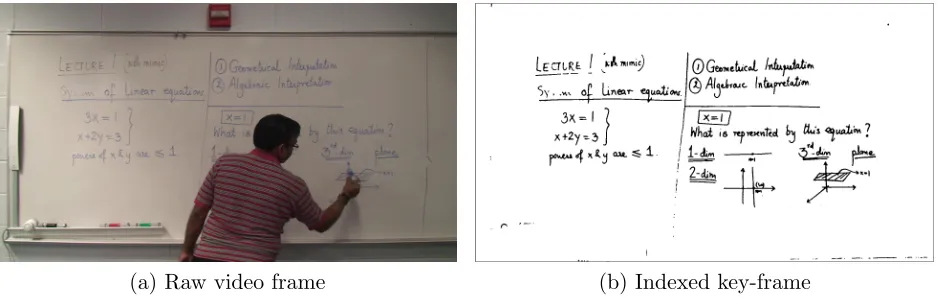
Figure 1.1: Example of input data for image-based formula retrieval. (a) Raw frame from lecture video. (b) Same key frame after binarization and content extraction.
Table 1.1: Symbolic vs Image-based formula retrieval. In the first row, a LATEX query is provided
to a Symbolic formula retrieval system [138], which finds an exact match and another two formulas containing sub-expressions of the query. The graph nodes marked green represent matched symbols while dashed nodes are unmatched symbols. In the second row, the query is a whiteboard image which refers to “system of equations” in the source video. Using an image-based formula retrieval system, we find some matches including the source as well as segments from other videos related to systems of equations matching part of the query.
Query Candidate Matches
Sym b olic P x P y
I(x, y)
()1x2
∑ ∑
x
↓ I
y
↓ x ,
y
P
x
P
y
I(x, y)
()1x2 ∑ ∑ x ↓ I y ↓ x , y
Ip(x, y) = 1
()1x2
I x
↓ ,
y
I(x, y, t)
M!
I x ,
y
Image-Based
sentations, either Symbol Layout Tree (SLT) [138] or Operator Trees (OPT) [26]. Candidates are selected if their structure matches parts of the query graph. In Chapter 3 we describe our approach for symbolic formula retrieval which achieves state-of-the-art results with fast retrieval times and scalable index sizes.
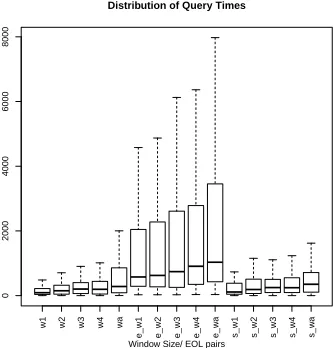
The second modality, Image-based formula retrieval, is harder because only images of math expressions are given while the symbols and their semantic relationships are not provided. An example of this modality is providing a query image including a formula related to “systems of equations” and retrieving math lecture videos containing the same formula in segments where systems of equations are discussed (see second row of Table 1.1). In this case, we also assume that our index stores images containing non-delimited math expressions mixed with text and figures like the one shown in Figure 1.1(b).
Extracting the math expressions found in lecture videos is a challenging problem. The original raw video images need to be binarized and the handwritten content on the whiteboard needs to be separated from other elements in the image. In Chapter 4 we propose a novel lecture video summarization approach that, given lecture videos recorded with a still camera in the classroom, is capable of automatically extracting the handwritten content on the whiteboard as a small set of binary key-frames where the speaker and the background elements have been mostly removed from the images. The extracted images are ready for indexing and retrieval using an image-based approach.
only 67.65% correctly recognized isolated expressions if the symbol classes need to be classified, and up to 84.38% if the correct symbol labels are known beforehand. Such a recognition rate is rather low considering that input data are traces of isolated expressions drawn on a tablet, and temporal information of the tracing process is available. In our case, the content recognition problem is harder because the handwritten math expressions are not isolated as shown in Figure 1.1(b). For this reason, we only rely on isolated symbol recognition results for which our own math symbol recognition approach described in Chapter 5 achieves competitive recognition rates on the CROHME datasets.
Finally, in Chapter 6, we propose our method for image-based formula retrieval, which avoids full recognition of the structure of math expressions, and is able to achieve promising results for image-based formula retrieval purely based on the appearance of math expressions.
Appearance-based math formula retrieval models are expected to have some limitations. For example, a purely visual approach could miss that two expressions are equivalent based on math-ematical identities or notation usage. Also, math expressions are polysemic which means that identical formulas might represent different concepts depending on the context in which they ap-pear [137]. In handwritten math expressions, the apap-pearance of math symbols varies between writers. Despite these limitations, these retrieval models can be expanded, allowing users to find non-identical matches through partial similarity matching, variable substitutions and wildcards. Consider the queryx2+y2=∗, the candidateα2+β2 =γ2 becomes a non-identical perfect match if the wildcard matches γ2 and the variables xand y are replaced withα and β respectively. This type of non-identical match can be relevant for users browsing through formulae in Wikipedia, for example.
Our models are adaptable to other domains such as chemical or technical diagram retrieval where the assumption that visually similar elements are often related holds. For example, two diagrams of circuits might contain identical portions reflecting common modules that they share, and for some applications it might be useful to retrieve such diagrams using an image of the common module. Overall, the main requirement for using our model on a new domain is a graph-based representation that can be built reliably from the input data.
In real life applications, a math-aware search engine handles queries that might contain mixtures of keywords along with math expressions. Matching formulae in documents is a complementary tool to traditional text search engines. To know what is the best way to handle the interaction between text and math expressions remains an open question.
The main research questions that lead us to the proposed methodology in this work are:
1. What are the visual patterns that make us perceive two formulae as being similar?
2. How can we quantify these patterns using similarity metrics?
3. What are the most effective graph-based representations for formula retrieval in terms of primitives (nodes) and graph family (edges)?
4. How do we ensure consistency in graph representations for Image-based formula retrieval when binarization errors are present on the image?
Thesis statement: High quality formula retrieval results can be obtained by identifying
can-didates using symbol pairs in a query formula, and then re-ranking cancan-didates by their structural similarity to the query.
Contributions: In terms of symbolic formula retrieval, we proposed the novel Maximum
and wildcard support, and we achieved state-of-the-art performance on the 11 and NTCIR-12 formula retrieval benchmarks, indicating that our approach is efficient in terms of time and space, and produces effective formula search results. We also proposed a way to combine both formula representations (Visual SLT and Semantic OPT) to obtain improved search results, and we provide some new insights for various similarity measurements between mathematical formulae for ad-hoc query-by-expression.
We also propose a novel approach for retrieval of mathematical notation from images that works with probabilistic math symbol recognition and does not require parsing the structure of math expressions. We provided preliminary results that show that cross-modal search between symbolic expressions and handwritten index image (and vice-versa) is possible using the proposed method.
We also contribute a novel method for lecture video summarization based on analysis of con-flicts between stable connected components that appear on binarized images from sampled video frames, which allows us to extract the handwritten math expressions that appear on lecture videos. The method generates a spatio-temporal structure that contains very detailed information about the video allowing for very dynamic summaries. Using these key-frames and the original spatio-temporal structure, we have created our own navigation tools that let the user click on particular connected components of the key-frames to jump to the video segment where that particular ele-ment was written on the whiteboard.
We also provide a new dataset with 12 fully labeled lecture videos that can be used for bench-marking of approaches for binarization and summarization of lecture videos in the future. Finally, we proposed a shape-based feature set for recognition of on-line and off-line handwritten math symbols along with a method for synthetic data generation for math symbol recognition.
The source code of our symbolic formula retrieval approach is publicly available1. Our initial math symbol recognition code is also publicly available2, and the data labeling tools, labeled videos and source code for image-based formula retrieval approach will be released in the near future as well.
In the next Chapter (Chapter 2) we present related work that informed our approach. This in-cludes previous work in Mathematical Information Retrieval (MIR), Content-Based Image Retrieval (CBIR), mathematical symbol recognition, and video lecture summarization.
1
https://cs.rit.edu/~dprl/Software.html\#tangent 2
Background
Multiple techniques are required to successfully achieve indexing and retrieval of mathematical notation. Many of them will vary according to the search domain. For example, the preprocessing required to index the math notation found in a web document in LATEX or MathML format
will be very different from the preprocessing required for lecture videos. Also, different indexing techniques will be required depending on the amount of information available in each domain. In this chapter we consider four major fields that are related to preprocessing, indexing, and retrieval of mathematical formulae from both web documents and math lecture videos, and these fields are: Mathematical Information Retrieval (Section 2.1), Content-Based Image Retrieval (Section 2.2), Lecture Video Summarization (Section 2.3), and Mathematical Symbol Recognition (Section 2.4). First, Mathematical Information Retrieval is the main field of this research and covers the main principles of indexing and retrieval of mathematical expressions found in the literature. Second, Content-Based Image Retrieval is relevant to our research work since a part of our work, retrieving math formulae from videos, is an application of using images as queries to retrieve related images for a very restricted domain. Third, Lecture Video Summarization is relevant since we need to apply a method to extract and summarize the handwritten content from the whiteboard in lecture videos in order to index and retrieve such content. Finally, math symbol recognition can be useful for preprocessing of collections in cases where the math expressions need to be recognized for indexing, and it is also an important component of interactive search interfaces like min [102] that let the users draw the mathematical expression they want to look for.
2.1
Mathematical Information Retrieval
The field of Mathematical Information Retrieval (MIR) is relatively new [137]. Applications in this field aim to retrieve different types of elements that contain mathematical notation, and in many cases they use math expressions as part of the queries. Practical systems for MIR are few in number [58], but the number of situations where MIR can become a very useful tool is large and keeps growing. For example, we can use a traditional text-based search engine to find articles related to the Pythagoras’s theorem using the keywords “Pythagoras” and “Theorem”, but if we use a math-aware search engine then we could query the system using the formula a2+b2=c2 to find additional articles that use Pythagoras’s theorem without mentioning it explicitly. Additionally, as some authors have pointed out before [133], math-aware search engines can be great tools for mathematicians by helping them find existing proofs as they work on their own proofs. Math search engines can be used to find connections between manuscripts containing math, and even to find
Figure 2.1: Example of themin interface [102] in edit mode. The user draws an expression and the system recognizes the math symbols, parses them, and converts the whole expression to LATEX.
relationships between different fields of study [133].
Traditional text-based search is inadequate for retrieval of Mathematical Information [137]. According to Miller and Youssef [71], text-based systems have some important limitations. Math expressions include combinations of non alphabetical symbols which many text-based systems ignore or cannot handle correctly. Also, the structure found in math expressions delivers meaning and it is hard to encode and match reliably using strings. Another important element in math is the existence of equivalence relationships such as trigonometrical identities. This is similar to the concept of synonyms in text, but it is not feasible to simply store all possible equivalent expressions using a thesaurus the way it is done for a typical text-based application because a single expression has an infinite number of trivially equivalent expressions.
Like any other information retrieval domain, the query language is a very important element of any MIR system. MIR systems require flexible query languages that are natural and easy to specify for its users. Users might be required to write their queries using specialized notation like LATEX or
MathML, but practical systems should provide good user interfaces that facilitate this process. The usage of tools for handwritten math expression recognition can greatly help the creation of such interfaces. An example is the Mathematical Interface min [102, 139] (see Figure 2.1) that allows users to draw math expressions which are then recognized and converted to LATEX and can be used
as queries for multiple search systems including Tangent [112].
Independently of the input format, a good query language should include wildcards to make it easier for the user to find math notation without the need of being specific all the time. The standard definition of wildcards used for traditional text-based search systems is not adequate for MIR [4]. In the work by Altamimi and Youssef [4], three different types of wildcards for MIR are described which we cover later in Section 2.1.1.
In his work [133], Youssef describes some of the basic and long terms goals of math search. The first goal is math awareness which refers to the system capabilities for recognition of mathemat-ical symbols and structures. Second is natural math-query language, which refers to the ability of accepting queries in a format that is common to its users, like for example accepting simple LATEX strings that many users know how to write. Third is fine granularity of searchable and
a given query. Fifth is perfect precision, and it means retrieving only relevant matches. Sixth is perfect relevance ranking which means to prioritize query matches by relevance to the users. Sev-enth is useful highlighting which is allowing the user to know what parts of a query are matched by a given result. Finally, the eighth is minimum hit-redundancy which means to avoid presenting to the users multiple instances of the same match as independent matches because they are redundant. Most MIR systems should attempt to achieve these goals to some extent, and in our work we have achieved many of them already (math-awareness, natural math-query language, fine granularity of searchable and retrievable information units, and useful highlighting), while we have taken steps toward achieving the rest of them (perfect recall, perfect precision, perfect relevance-ranking, and minimum hit-redundancy). In the long term, math search can be useful to discover similarities between fields, computer assisted prof creation and learning aid.
Interest in Mathematical Information Retrieval (MIR) has increased in recent years, as witnessed by math retrieval tasks at the NTCIR conferences [2, 3, 136]. These competitions provide a common ground to evaluate and compare different approaches using medium and large datasets and fixed sets of queries. The MathIR arXiv Main Task at NTCIR-12 [136] consists of finding the most relevant documents from the arXiv1 collection for a set of 29 queries containing keywords and math expressions. The optional MathIR Wikipedia Task includes 30 queries containing keywords and math expressions, and the optional MathIR Wikipedia Formula Browsing Task includes 40 queries for isolated math expressions. Participating teams submitted up to four runs for each task, and the top-20 results from submissions for each query received relevance assessments from evaluators. The data that was produced for these tasks will be very useful in further advancing the field of Mathematical Information Retrieval, and we use this dataset in our experiments in Chapter 3.
In the following sections, we will focus on the Formula Retrieval components of existing MIR systems. We distinguish two major modalities of the formula retrieval problem: Symbolic and Image Based. The first one refers to the case where symbols and structure are known as in the case of LATEX expressions or MathML. The second one refers to the case where only images of the
math expressions are provided and the symbols and their relationships are initially unknown.
2.1.1 Symbolic Formula Retrieval
Symbolic formula retrieval methods work with documents containing math notation represented as text. These representations encode the hierarchical nature of math expressions as strings. Queries can also be provided as strings, but it is possible to use math recognition systems that build a compatible representation from traces or images of math notation for search likemin [102]. During the preprocessing phase, multiple approaches will detect existing expressions on each document in the input collection, and then each expression will be converted to the internal representation of the system and will be stored in the index. Some approaches add normalization and canonicalization steps where expressions are transformed to guarantee that certain non-identical equivalent elements will be matched as equal. For example, the expressionsx+y+ 1 andy+ 1 +x are equivalent and both could be matched by the query 1 +y+xif a canonical representation is used.
There are multiple ways to perform formula retrieval when symbols and their relationships are known. In this subsection, we will concentrate on three major aspects of methods for symbolic formula retrieval: representation, indexing and ranking.
1
(x+y) $ { \left( x + y \right) } ^ 2 $ pow add x y 2 (a) Expression (b) LATEX (c) Flattened
<math> <msup> <mrow> <mo>(</mo> <mi>x</mi> <mo>+</mo> <mo>y</mo> <mo>)</mo> </mrow> <mn>2</mn> </msup> </math>
above ( x + y )
2
Pow
x y
2 Add
(d) Presentation MathML (e) Symbol Layout Tree (f) Operator Tree
pow add x y 2
add x y
x
y
2
pow add id1 id2 const1
add id1 id2
id1
id2
const1
[image:19.612.76.514.68.360.2](g) Tokens (h) Generalized tokens
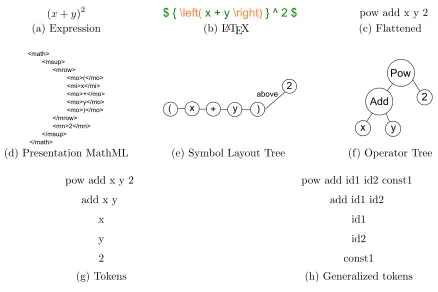
Figure 2.2: Examples of different representations used for math expressions. (a) is the original expression. (b)-(d) and (g)-(h) are string representations. (c) is a type of flattened string represen-tation using prefix norepresen-tation. (e) and (f) are tree-based represenrepresen-tations. The provided tokens are just examples, and different string tokens have been proposed in literature.
Representation
Symbolic formula retrieval systems usually handle collections containing formulas in a text-based representation like Presentation MathML, Content MathML or LATEX. Content MathML is
con-sidered a semantic representation of math expressions because it provides enough metadata to build operator trees [37]. On the other hand, presentation MathML and LATEX are considered
appearance-based because they only describe the symbol layout of math expressions. Figure 2.2 contains examples of different representations for math expressions.
One common issue of appearance-based representations of math expressions is ambiguity. Given a math expression, it is ideal to interpret it according to the meaning intended by its writer. How-ever, math notation can be ambiguous and sometimes the right interpretation of a math expression becomes context dependent. For example, f(x+y) is usually interpreted as the function f with the result ofx+y as input value, but it is also possible to interpret it as the multiplication of the variablef by the sum ofx andy.
impossible to infer the semantics of a given notation without contextual information that defines the meaning of the symbols being used. Many approaches participating in NTCIR-12 MathIR tasks [136] used a combination of both representations.
Independently of the input representation, most MIR systems add preprocessing steps that will transform the original math expressions to a different representation for their index. Most representations fall within one of the following categories: text-based, tree-based, and spectral.
Text-based representations. These use strings extracted from the original format to
rep-resent math expressions. Flattening is required to encode the structural component of math ex-pressions into strings (see Figure 2.2(b)). Approaches using this type of representation tend to be limited in practice, and work well mainly to find exact matches of a query. To increase the likelihood of finding matches, some methods use canonicalization to simplify expressions, and to identify commutative operators and equivalences [59, 99]. It is also common to enumerate identi-fiers to support generalized variable matching and/or unification [33, 99, 116, 135]. Some existing approaches include the seminal work by Miller et al. [71] for search of expressions in the Digital Library of Mathematical Functions (DLMF) using LATEXstrings, and the work by Miˇsutka et al.
[72] which flattens expressions using postfix notation for math search. One advantage of converting math to text is that existing optimizations in text search engines such as ranking by TF-IDF [71], topic modeling, and word embeddings [116] can be used.
Tree-based representations. These approaches consider the structure of math expressions
and index formulas as complete SLTs or OPTs, and tend to be more adequate than text-based representations search. Typically, the hierarchical structures in formulae are mapped directly, and organized within tree-based indexing structures [37, 47, 145]. In some of these approaches, all subexpressions in formulae are indexed to support partial matching, with common subexpressions labeled and shared to reduce index sizes [47]. In some systems, semantic or operator trees (see Figure 2.2(f)) are built from Content MathML [37, 49, 50]. However, appearance representations are common in large collections and multiple systems work with various layout tree representations extracted from LATEX strings [104] and Presentation MathML [47, 52, 60, 110, 138] (see Figure
2.2(c)-(d)). Some authors have made comparisons of the performance of their systems using both semantic and appearance-based representations [80, 100], and conclude that semantic represen-tations should be preferred when they are available. Finally, hybrid approaches exists that use presentation MathML enriched with semantics [32, 58, 125]. In our case, we shown through our experiments in Chapter 3 that better results are obtained if both semantic and appearance-based representations are available and used together.
Spectral or feature-based representations. These methods extract some high level features
Indexing
The math expression indexing method of a MIR system is fundamental because it defines the initial candidate matching procedure and determines query execution time. Many systems take advantage of existing optimizations for text-based search engines and they simply encode math expressions using strings that can be stored and retrieved using a regular text engine. Common text search engines used by MIR systems include Apache-Lucene 2, Solr3 and ElasticSearch 4. Other systems use their own custom engines optimized for tree or spectral representations. One advantage of using a text search engine to store math expressions is to keep text along with formulas in the same index.
There are multiple ways to encode math expressions using strings for indexing with a text engine. One option is to flatten the expression to convert it from the original representation into one or more strings that represent the same expression in a format that the text engine can handle [71, 72] (see Figure 2.2(b)).
A common approach for systems using tree-based representations of math expressions is to apply a tokenization process to represent each tree using multiple text tokens (see Figure 2.2(g)-(h)). The token extraction process is usually different between systems and affects the performance and matching capabilities of each system. Sojka et al. [100, 110] use a compact representation of Presentation MathML to create tokens for each expressions at different depth levels in the tree. MCAT and other systems [52, 80] extract tokens from Presentation MathML based on three types of paths: Ordered paths (opaths), Unordered paths (upaths) and siblings (sisters). The WikiMirs systems [32, 58, 125] builds semantic trees from enriched presentation MathML, and then indexes original and generalized tokens (see Figure 2.2(g)-(h)) representing full subexpressions at different depths of the semantic trees. Lipani et al. [60] also uses generalized tokens to represent math expressions on their index. Finally, in the approach by Pinto et al. [93], strings of features are extracted and stored using the ElasticSearch engine.
Methods that use the substitution tree representation also build their index using the same trees. Examples of this approach are the Math Web Search systems [37, 49, 50] that built substitution trees from Content MathML. Another example is the work by Schellenberg and Zanibbi [104] who use Substitution Trees based on layout instead of semantics.
Systems that use a spectral or feature-based representation of math expressions usually build their own custom indexes. In the work by Nguyen et al. [82], formulas are indexed based on a set of features. In a more recent approach, Nguyen et al. [83] use features to create a lattice-based index of math formulas. Kamali and Tompa [47] treat the node labels of a tree-based representation as bags of words and build an inverted index for fast candidate selection.
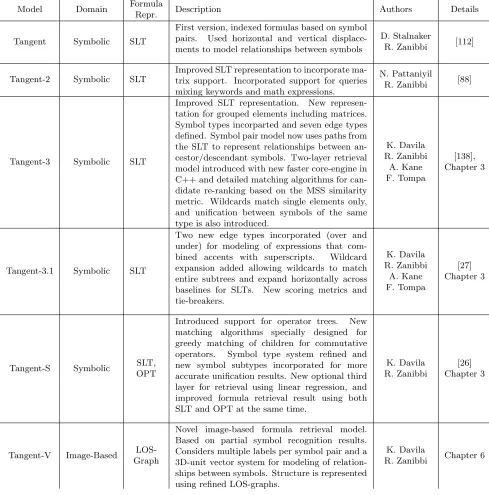
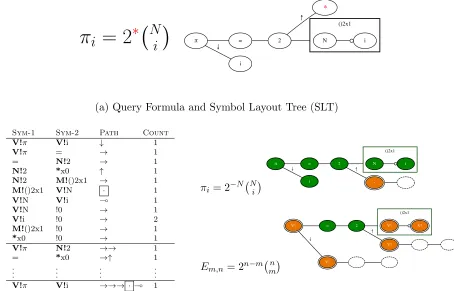
Both the original Tangent formula retrieval model [112] by Stalnaker and Zanibbi, and its second version Tangent-2 by Pattaniyil and Zanibbi, use symbol pairs extracted from a Symbol Layout Tree representation. Two elements are added to the pair to describe the horizontal and vertical distance between the two symbols [88, 112]. Our proposed model, Tangent-S, is an extended and improved version of these models where relative paths between symbols in the SLTs are used instead of the horizontal and vertical distances.
2
http://lucene.apache.org/
3http://lucene.apache.org/solr/
4
Ranking
A good retrieval system produces rankings that satisfy most user queries by listing the most relevant documents first. When exact matches of a query are found in multiple documents, retrieval systems need to prioritize those that are believed to be more relevant to the current query. Math notation is ambiguous by nature, and context is required to understand some expressions [137]. Sometimes an exact match for the query is found in a context that makes it irrelevant to the user. For example, simple patterns containing common variables, like x+ 1, might appear in multiple documents and the same variables might refer to different concepts on each document.
In multiple applications of MIR, search for approximate expressions is required. Using the right canonicalization and normalization techniques multiple approaches can successfully locate exact matches for queries. However, certain variations might be introduced that are harder to handle through preprocessing. Sometimes the users might not remember the exact formula they need to find. In these cases, approximate search becomes a great tool to help users find a wider range of similar expressions, and sometimes exact subexpressions of the query. Approximate search requires the usage of similarity metrics that predict what users might perceive as similar to a given query. Such similarity metrics also play an important role in ranking documents.
In this work, we are more interested in similarity metrics for isolated math expressions. However, many of the MIR approaches discussed here do not distinguish between math formula and text search, and the final metrics proposed by them can only be used to rank entire documents. Such similarity metrics attempt to approximate the relevance of math formulae in the context in which they appear and do not consider partial similarity between isolated formulas.
Notions of similarity between math expressions. According to Youssef [133], tree
rep-resentations can be considered to be the basis for defining similarity functions. In general, the more that two formula subtrees have in common, the more similar they become. Assuming a se-mantic tree representation, the author also suggests that matching internal nodes of the trees is more important than matching the leaves, which tend to be variables names or constants that have less impact on the operations and structure of the math expression. For example, in the operator tree for (x+y)2 shown in Figure 2.2(f), we could swap the labels of the leaves and the resulting
expression (y+x)2 is equivalent to the original, but if we swap the labels of the two internal nodes we obtain a radically different math expression (xy) + 2.
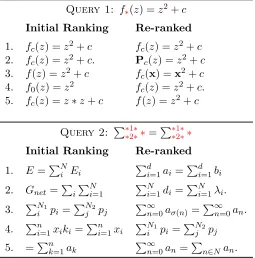
In different work, Youssef [134] discusses concepts about relevance ranking for math search. Metrics like term frequency - inverse document frequency (TF-IDF) that are widely adopted for text search tend to produce bad results for math search. The relevance of a math expression changes with its context, and there are dynamic and static components of the relevance of a math expression. Dynamic elements are query dependent while static components are query independent and can be determined at index time. Some static elements of relevance include the types of the math object (operator, variable, function, etc), the categorical importance of terms (in many cases operators are more important than variable names), and the number and types of cross-references between documents and math expressions. Most of these ideas are in agreement with what is proposed later in this document. For example, the author proposes the usage of relevance vectors for math expressions and the usage of two-stage retrieval for efficiency which are common in other domains in the information retrieval literature. Our Tangent-3 model described in Chapter 3 adopts the usage of multiple scores for math expression re-ranking on a three-layer formula retrieval model.
The taxonomy of functions can be used to define the class of a given function and it is assumed that two functions are more similar if they belong to the same class or mathematical domain. For example, a function containing matrices is likely to be considered similar to other function from the same class of linear algebra functions containing matrices. The data-type hierarchical levels assume that some math objects are more important than others at the time of measuring similarity. According to the authors, we can define four levels: 0 - contants, 1 - variables, 2 - functions and operations, 3 - functionals like integration and differentiation. It is suggested that math objects of a higher level should have larger weights when evaluating similarity. The depth of a match refers to the location of the common elements between two expressions. In this case, the authors suggest that deeply nested matches have lower relevance for a query. Query coverage assumes that the more terms and structure that two terms share, the more similar they are. Finally, formula versus expression assumes that formulas (math expressions containing a comparison operator) are more relevant than non-formula expressions. However, in the final evaluation step, the authors re-used data from the NTCIR-11 competition which contained relevance assessments for entire documents containing multiple formulae using queries that also contained keywords. Ideally, these concepts should be evaluated using relevance data for isolated math expressions, because this will ensure that any observed differences in relevance between candidates for a given query are more likely to be caused by the factors being studied and are not the product of some other factors that are not being studied directly.
Approximate Matching: Unification and Wildcards. Multiple methods allow users to
find fuzzy matches for their original queries which means finding non-identical math expressions that could be relevant for a given query. In other cases, systems allow users to search over broader ranges of math expressions by using wildcards. In multiple contexts, a wildcard can save user time by not having to type a full formula or make the search process easier when the user does not know the exact math expressions that he/she is looking for. Some systems provide functionalities for unification of symbols and wildcard matching, but sometimes these matches are accepted as valid with penalties based on how different they are from the original query [32, 47, 138].
Unification of variables and/or constants can be implemented in multiple ways and some ap-proaches index math expressions in a way that facilitates finding unifiable matches. In particular, approaches that use text search engines tend to use modified or generalized tokens that can be matched by multiple unifiable expressions [32, 58, 72, 110, 125]. Canonicalization of the math expressions is also applied by some of these approaches to ensure that generalized tokens can be matched more easily.
In the case of approaches that implement tree-based matching of math expressions, the unifi-cation process can be more detailed and flexible. Approaches using Substitution trees [37, 49, 50] work directly with hierarchical structures where expressions with the same structure but differ-ent operands will share common ancestors. The concept of unification, allowing substitution of operands and/or operators, is very natural for these approaches. Other methods use tree-based similarity metrics that consider unification during retrieval time. In the work by Kamali and Tompa [47], the tree edit distance is used for similarity matching, and unification of variables is treated as an edit operation where labels of the tree get replaced with a score penalty.
wildcards can be impractical. A single query may contain multiple wildcards, and each could be expanded to match any arbritary subpattern. If the number of math expressions in the index is very large, then finding all possible matches for a wildcard pattern might take too long to be useful in real applications.
In the work by Altamimi et al. [4], the authors define three types of wildcards required for math retrieval systems: term-level, component-level, and bounded. The term-level wildcard can be used to match terms or subexpressions at given locations of the query. For example, they can be used to match a single argument in a function with multiple arguments, but that argument can be a long sub-expression. The component-level wildcard is more abstract and can be used to match multiple terms. For example, they can be used to match all arguments in a function with multiple arguments, or even all elements within a matrix. The last type is the bounded wildcard and can be of any of the two previous types, but it has a name and has the additional restriction of being bounded to other wildcards sharing the same name. This type of wildcard can be used to match arbitrary patterns at multiple locations in a expression, but forces them to be identical or different as specified in the query. For example, if we use the notation ∗x∗ to define wildcards with name wherexis the name of the wildcard, then we can use the query f(∗1∗) =∗1∗+∗2∗to specify that we want all functionsf of any variable name∗1∗that are equal to the sum of the same variable∗1∗
plus another subexpression ∗2∗ which at the same time has to be different from ∗1∗, this means thatf(x) =x+ 1 and f(y) =y+π2 will match the query butf(a) =a+ashould not.
Some MIR systems that consider wildcards only support single symbol replacement while other systems provide greater functionality by allowing matching of sub-expressions. Some approaches use generalized tokens on the index to allow wildcard matching with single symbol replacement [60, 71]. The Tangent 2 system [88] implements wildcard matching by expanding generic tuples in the query that contain wildcards by finding concrete tuples that match the given pattern. In the end, the system is only able to do single symbol replacement.
Other systems implement wildcards allowing subtree matching. Methods based on substitution trees [37, 49, 50] use an index method that already considers that multiple math expressions share a common generic pattern by replacing nodes with arbitrary sub-expressions in the hierarchy of substitutions. Finally, in the work by Altamimi et al. [4], wildcard match is implemented for XML representations of formulae like Presentation or Content MathML using XPath/XQuery engine. However, the XQuery language does not provide ways to define wildcards bounded by name.
In Tangent-3 described in Chapter 3, we start with single symbol matching for wildcards at the first layer of our retrieval model, followed by a very detailed wildcard matching algorithm in the second layer (see Section 3.3.2) that allows matching term-level, component-level and bounded wildcard types as described in the work by Altamimi et al.[4].
Ranking methods. Every retrieval system needs a method to rank the matches found for a
given query. In this section we only discuss methods that consider approximate matches and that require similarity functions to rank these non-identical matches.
using a linear combination of content similarity and structure similarity. The MCAT system gives stronger weights to operators and numeric literals and weaker weights to identifiers. The Wikimirs 2.0 system [58] considers independent scores for similarity between the query and formula, and composite scores between the query and all relevant formula in a document. Their scoring method still uses statistics of term frequency. The ICST retrieval system [32] uses term frequency - inverse formula frequency (TF-IFF) considering penalties for matches against generalized tokens.
Other recent approaches are no longer considering formulas as separate entities, but they also consider the context in which a formula is found. They index additional text tokens extracted from the context of a math expression [125]. These extra tokens can be used for search including keywords, but they can also be used to determine relationships between math expressions.
In the work by Kamali and Tompa [47], tree edit distance is applied to evaluate the similarity between math expressions using a layout-based tree representation of formulae. Since this metric is expensive, the system considers early termination techniques to avoid computing tree edit distance for expressions that are unlikely to be relevant, and it also builds a cache with memoization to avoid computing the tree edit distance between common subtrees multiple times.
In the work by Nguyen et al. [82], two types of features are extracted from Content MathML representations: single features (constant numbers, variable names, function names, etc) and com-bination features (comcom-binations of math operators and operands). These features are then used to train a Passive-Agressive algorithm for learning to rank with ranking perceptron optimization to rank documents. In a different work, Nguyen et al. [83] propose the usage of a concept distance metric to measure similarity using a Lattice of math expressions.
The Tangent [112] and Tangent 2 [88] systems use the Dice coefficient of pairs of symbols matched between symbol layout trees. A tuple was formed by using every two symbols that have an ancestor-descendant relationship in the symbol layout tree, and each tuple adds to the two symbols the horizontal and vertical distance between them. Additional methods and similarity metrics for math recognition and retrieval are covered in the survey by Zanibbi and Blostein [137].
2.1.2 Image-Based Formula Retrieval
Compared to symbolic formula retrieval, there are very few methods proposed for math formulas retrieval directly from images. Existing approaches have very little in common, and there are no standard datasets that can be used to compare them. In particular, we are interested in robust methods that can be applied for retrieval of noisy images of handwritten math expressions.
In the work by Marinai et al. [69], images of mathematical symbols are indexed using a bag of visual words approach. Keypoints of math symbols are described using shape contexts, and the visual dictionary is built using clustering through self-organizing maps. Similarity is measured using the cosine of the angle between weight vectors. In a more recent version [70], the earth mover’s distance (EMD) is used instead of the cosine similarity. This method was designed and tested for retrieval of isolated math symbols, not complete expressions.
The method proposed by Zanibbi and Yuan [141] uses contour and density features extracted from the connected components (CCs) of math expressions images to match similarity. In a different work, Zanibbi and Yu [140] used dynamic time warping to align pixels projections of upper/lower image halves to compare similarity between images of handwritten queries and typeset document images after segmentation via X-Y cutting.
query matches. In a more recent approach, Chatbri et al. [17] use shape features of key-points extracted from foreground and background pixels to match binary images of math expressions.
All these methods described so far avoid recognition because they work with noisy handwritten input data. Optical character recognition (OCR) and other segmentation and parsing techniques might be used to convert these images into symbolic representations of math expressions. However, this task is very difficult when the math expressions are handwritten. For example, state-of-the-art methods participating in the Competition on Recognition of On-line Handwritten Mathematical Expressions (CROHME) [76] achieved only 62.15% correctly recognized isolated expressions. This is rather low considering that input data was online which means that tracing information is available instead of images which tend to be even harder to recognize. However, some methods have used content recognition in the past. In the work by Kanahori et al. [48], document images are processed to identify math content regions and these are recognized using an OCR system for math. We prefer approaches capable of working with noisy handwritten text, for example, in whiteboard images.
2.2
Content-Based Image Retrieval
The field of content-based image retrieval (CBIR) studies methods for search of images based on the actual content in the image pixels. It is always possible to retrieve images if they have meaningful metadata associated with them. However, many applications require finding images that have not been explicitly labeled by users. CBIR methods typically aim to solve this kind of application.
In this work, we briefly study general CBIR techniques because image-based formula retrieval represents a specialized type of CBIR. As explained in Section 2.1.2, using full expression recognition methods is possible but current approaches have very low precision and are not practical for search. Our method proposed in Chapter 6 uses recognition of math symbols only, but avoids recognizing the complete structure of math expressions.
Earlier approaches for CBIR measured similarity between images based on low level features like color histograms and textures [31]. In the case of binary images of whiteboard content, texture and color provide little information compared to spatial layout and shape of the content.
In math notation, the 2D location of each symbol defines part of its meaning in a given math expression. For this reason, in this work we will focus on CBIR methods that consider spatial layout. Many recent approaches still follow the general framework defined by the Bags-of-Features method [109]. Many recent methods add new optimizations to the basic framework and many consider efficient implementations of spatial constraints on their image matching system.
In the following sections we discuss the general bags of visual words approach [109], and describe some improvements proposed to the original approach. We also discuss the connection of sketches with image retrieval since most approaches for CBIR are designed and tested over natural scene imagery, but in our application we have binary images of math expressions where color and texture have little relevance, but shape and layout of the basic elements in the image define its meaning.
2.2.1 Bags of Visual Words
Many recent approaches for CBIR still follow the Bags-of-Features framework [109] also known as Bags of Visual Words (BoVW). Here we discuss only methods that consider the spatial layout of image content.
(a) Key-points (b) Patches described
Figure 2.3: Example of SURF local descriptors (Extracted from original paper [10]). (a) Key-points selected for a sunflower field (b) Size and and rotation of descriptor patches on graffiti scene.
performed over every single image in the collection. For this reason, BoVW methods create visual dictionaries that define clusters of local descriptors called visual words. Dictionaries define entries for inverted indices of images.
Given an image query, the set of visual words it contains are extracted and these are used to identify all images in the collection that share very similar local descriptors. The more visual words that two given images share, the more similar they are considered. After identifying an image as a candidate for a query, additional restrictions like spatial constraints might be applied to validate that it is a good enough candidate for retrieval.
Visual Words
Visual words represent the smallest matching unit in the BoVW approach. A patch of an image can be represented by a single visual word. These are based on local descriptors or features that describe the patch of the image from which they were extracted (see Figure 2.3). Local descriptors can be multidimensional or might require several bits to provide enough discriminative information about the patch they describe. However, thanks to the usage of visual dictionaries, they can be represented in a very compact manner using integers associated with their entry numbers in the visual dictionary.
The performance of the visual words approach is very sensitive to the discriminative power of the local descriptor used and the key-point selection method. Different local descriptors have been used to generate visual words including: SIFT [66], SURF [10], RootSIFT [7], USB [142] and others.
Note that depending on the nature of the data in the input collection, some local descriptors might be more adequate than others. For example, general descriptors like SIFT and SURF were designed for natural scenes imagery and work very well for that kind of images. However, when input images are binary, different local descriptors like USB [142] and Chatbri’s [17] could be better choices. Features that were specifically designed for binary image tend to be more compact [142], and they choose key-points on the image in different ways [17] that could be more adequate for binary images.
used to obtain the most discriminative but consistent set of local descriptors for a given image. Consistency of key-point selection methods is an important component that BoVW approaches require to work well. For example, given several images of one object viewed from different angles, BoVW approaches rely on the ability of their key-point selection method to consistently identify and extract visual words from the same salient points of the object in the images. Otherwise, there would be little or no overlap at all between sets of visual words for different images, and matching would become very difficult or even impossible.
Another important issue is that visual words are typically generated from quantized local de-scriptors. This, however, is prone to quantization errors and does not work very well for descriptors that fall close to the boundaries between clusters. For this reason multiple improvements have been proposed to mitigate these errors including techniques like soft-assignment [45, 92] and Hamming Embedding [45]. In the case of soft-assignment, a local descriptor can be assigned to multiple visual words using a fuzzy membership function [45, 92]. In the case of Hamming embedding [45], a hash-code is generated to refine the location of a quantized descriptor in the feature space, and hamming distance between hash codes will be proportional to the distance of the original descriptors in Euclidean space.
Visual Dictionaries
Visual dictionaries define the set of visual words that will be used for retrieval by a CBIR system. These dictionaries cluster entire regions of the local descriptor feature space into single unique visual words. Different techniques can be used to generate them depending on the underlying local descriptor selected. A simple approach is based on vector quantization, but data driven approaches based on clustering of local descriptors are also very common.
Multiple design decisions can affect the quality of the generated visual dictionaries and ul-timately the performance of the CBIR system. The first option is the quantization or clustering method used to generate the visual words. Some traditional techniques like K-means and hierarchi-cal clustering are widely adopted. In the work by Marinai et al. [69], self-organizing maps generate the clusters of local descriptors. One very important parameter is the size of the dictionary. A small dictionary will not be discriminative enough to differentiate between some images, but if the dictionary is too large then the resulting visual words might become too unique and similar shapes will not be matched. Depending on the local descriptor and the application, the sizes of visual dictionaries tend to vary from a few thousands words to more than a million of them.
In particular, approaches working with natural scenes tend to use very large vocabularies and do not consider that a single visual word is likely to appear multiple times on a single image.
However, certain images containing repeated patterns, like buildings with hundreds of identical windows, might have large numbers of instances of a single rare visual word which only appears in very few images of the collection. This is known as the “burstiness” problem [44]. Many BoVW approaches rely on TF-IDF metrics to give larger relevance to rarer visual words [44]. However, images with repeated patterns might contain many instances of visual words that are rare in the entire collection. In this cases, these rare visual words overweight other relevant patterns and cause some images to have overestimated relevance. Jegou et al. [44] propose dealing with this issue by considering local frequency reducing the relevance of visual words that appear multiple in the same image.
Spatial Verification
Given a query image, candidates are selected by matching common descriptors. Some techniques have been proposed to ensure that two images not only share the same visual elements, but also that these share the same rough visual alignment.
In many approaches, candidates are located first without considering spatial arrangement, and the set of the most promising candidates are then reranked or filtered using spatial verification techniques. The RANSAC algorithm [91] finds correspondences between matching local descriptors very quick. It takes multiple random combinations of matches as reference points that define a transformation, and then evaluates how many of the remaining matches are consistent with the resulting transformation. RANSAC is useful for image alignment, but is also useful to verify the spatial consistency of matching points.
In general, points aligned from one image space to another image space define a transformation. In many cases, two images of the same objects can be aligned by transforming one image through rotation, scaling, and translation. These are affine transformations that can be represented through matrices in Hough space. Some approaches work by finding the most likely transformation from Hough space [8, 55]. In the work by Jegou et al. [45], weak geometric consistency is proposed which verifies how consistent are the transformations of matched local descriptors in terms of scaling and rotation. In the work by Zhang et al. [143]. a new type of topological verification is proposed that works for a wider range of elastic transformations by considering topology of matches instead of Hough space transformations.
While spatial verification during reranking is probably a good practice for efficient retrieval of consistent matches, it is also possible to encode additional information in the index to ensure that the set of initial candidates for reranking already have some spatial consistency with the query. For example, the visual phrases approach [144] stores small groups of visual words (phrases) in their index taking into account the local spatial arrangement between these visual words.
2.2.2 Sketches and Image Retrieval
Different shape-oriented methods have been proposed for sketch and handwriting retrieval. Sketches are basically handwritten which means they are bound to be noisy and imperfect. Sketches have no color or texture; they only have shape. There are different cases where sketches are considered in CBIR, and they include: sketch-based image retrieval, sketch-based sketch retrieval and hand-writing image retrieval. In query-by-example systems, sketches can be provided as either traces (online) or images (offline). In this work, we are more interested in offline sketches since we will work with images of handwritten whiteboard content.
Sketch-based image retrieval uses handwritten sketches to search images in general. One ex-ample of these approaches is the work by Cao et al. [14], where sketches are used to query image collections. The authors define edgels as image edges at a given location with a given orientation. Edgels are extracted from each image in the collection, and these are stored in an inverted index of edgels. Given a query sketch, the system computes the edgels of the query and find similar images. One advantage of this method is that it is fast which makes it good for large collections. One major drawback is that edgels are defined at absolute positions, making it sensitive to affine transformations.
features. The method proposed by Liang et al. [57] has been tested for successful retrieval of technical drawings. The method by Sousa et al. [111] has been tested for retrieval of vector drawings [111].
Finally, handwriting image retrieval refers to methods that find images of handwritten text using feature-based matching instead of attempting to recognize the content first. Keyword spotting methods fall within this group of approaches. For example, in the work by Rath and Manmatha [97], discrete Fourier transform features and dynamic time warping are used for word shape matching along with K-means and agglomerative clustering for word spotting on historical documents.
2.3
Lecture Video Summarization
There are multiple reasons to create video summaries, like providing quick overviews that facilitate user navigation of videos. Summaries can also be used for indexing and retrieval of particular video segments based on their visual content. The survey by Hu et al. [41] provides additional details about many approaches for indexing and retrieval of videos. Detecting handwritten content in video images is a special case of text detection in imagery which is covered in the survey by Ye and Doermann [131]. Also, approaches for text detection, tracking and recognition in videos are covered in the survey by Yin et al. [132].
In order to retrieve mathematical notation from lecture videos, a video summarization approach is required to extract and summarize the handwritten whiteboard content for efficient search. Videos in this particular domain typically represent a single scene with one shot, but some might contain multiple shots when the focus shifts from the whiteboard to a person or an object in the classroom. In this section we cover some key ideas for video summarization, including key-frame extraction and evaluation methods, along with existing work in lecture video content extraction and summarization.
2.3.1 Key-frame Extraction
The problem of creating a video summary is closely related to key-frame extraction from videos. A very simple approach for video summarization is to compute key-frames of the input video and then select those that are the most representative of the entire video. A good set of key-frames has little redundancy and good content coverage [41]. Traditional key-frame extraction techniques are based on the analysis of different types of features like: color histograms, edges, shapes, optical flow, MPEG-7 motion descriptors, MPEG discrete cosine, camera activity and features derived from camera motion [41]. Among different approaches for key-frame selection, some use global comparison between frames to distribute the key-frames by minimizing an objective function that can be application dependent [41]. For example, the work by Li et al. [56] uses minimization of frame reconstruction distortion to select key-frames for video summaries. Our proposed approach falls within this particular type of approach. A survey on key-frame extraction methods can be found in the work by Sujatha and Mudenagudi [113].
2.3.2 Video Summarization
video to create summaries, but we can also generate visualizations describing the content of multiple key-frames. This is particularly useful for representation of dynamic events in static summaries like the work by Nguyen et al. [81] where 3D views are generated to summarize segments of video. Key-frames help to navigate the video in a non-linear way, but most of the dynamics of the content and the audio are lost. Dynamic video skims on the other hand use short segments extracted from the video to create the summaries may be more appealing to the users, and can keep relevant portions of the audio. Note that these two summary types can be combined to create hierarchical summaries [41], where high-level key-frames can be associated with low-level short video segments. Additional information about existing video summarization techniques can be found in the surveys by Truong and Venkatesh [120], and Money and Agius [73].
2.3.3 Evaluation
As noted in the past, ideal key-frames and video summaries tend to be subjective and often their measurement of quality is application dependent [41]. Typical metrics include recall of application-dependent targets extracted in the summary, and video compression ratio where we want to use the smallest possible set of key-frames. Higher recall usually means lower compression ratio by requiring more frames to ensure all targets have been extracted. Choudary et al. [20] uses a recall-based error metric for evaluation of lecture video summaries by identifying missing content by counting connected components for words and lines for graphics. In Chang et al. [16] (1999), the authors proposed a key-frame fidelity measure that is based on a semi-Hausdorff distance.
In some cases, video summarization approaches heavily depend on detecting relevant video segments represented in the summary. This approaches typically measure the quality of split points compared to the ideal partitions of the video. This is particularly necessary in slide-based lecture videos. In the work by Li et al. [54], the evaluation is made in terms of the precision, recall and F-score of the slide transitions detected. In the work by Repp et al. [98], for segmentation of lecture videos based on speech recognition, the computed split points ci are compared against the ideal set in terms of time difference using the mean absolute error rate. In the AMIGO system [30], the Jaccard index is used to evaluate the correctly detected slide transitions within a ±3 seconds error margin.
In our work for lecture video summarization presented in Chapter 4, we use the average number of key-frames generated per video as a measurement of video compression, and using videos where all the whiteboard content has been labeled at the connected component, we compute recall as the percentage of successfully extracted connected components, and precision as the percentage of connected components extracted that are part of the targets.
2.3.4 Summarizing Lecture Videos
In our analysis, we focus on three main elements of methods for lecture video summarization and similar applications: binarization/segmentation, content extraction and summarization. Con-tent extraction refers to techniques used to analyze and separate higher level units of white-board/blackboard/slide content. Finally, summarization refers to methods used to build compact represents of the video using extracted contents. Some method might use binarization or segmen-tation before content extraction, while other approaches attempt to extract the contents di
![Figure 2.1: Example of the min interface [102] in edit mode. The user draws an expression and thesystem recognizes the math symbols, parses them, and converts the whole expression to LATEX.](https://thumb-us.123doks.com/thumbv2/123dok_us/33794.2662/17.612.129.485.73.237/example-interface-expression-thesystem-recognizes-symbols-converts-expression.webp)
![Figure 2.3: Example of SURF local descriptors (Extracted from original paper [10]). (a) Key-pointsselected for a sunflower field (b) Size and and rotation of descriptor patches on graffiti scene.](https://thumb-us.123doks.com/thumbv2/123dok_us/33794.2662/27.612.88.518.66.235/example-descriptors-extracted-original-pointsselected-sunower-descriptor-grati.webp)