Phenomenological approach to
3D spinning waves
D.V. Strunin and S.A. Suslov
Department of Mathematics and Computing, University of Southern Queensland, Toowoomba, Queensland 4350, Australia
e-mail:[email protected], [email protected]
Abstract
The spinning waves occur in solid flames and detonation when the plane uniformly propagating reaction front loses stability. As a re-sult, the front breaks into localized zones of intensive reaction. We study a 3D phenomenological model aimed at modeling such phenom-ena. The model constitutes a nonlinear partial differential equation. This work contains preliminary results demonstrating the capacity of the model to reproduce basic experimental features of the unsta-ble front: metastability of the uniform state and formation of self-sustained regime with predominantly lateral propagation of the front curvature.
1
Introduction
Spinning combustion is an interesting nonlinear phenomenon initially discov-ered in detonation [1] and later on in solid-phase combustion [2]. One should distinguish the meaning of the term “nonlinearity” when applied to combus-tion from its meaning when applied to waves in fluids and other conservative systems. Roughly speaking, small amplitude waves in fluids are linear and the nonlinear effects become significant when the amplitude is relatively large. Any combustion wave is already nonlinear by its nature. However, small perturbations to the traveling wave solution of the original reaction-diffusion equations satisfy linearized equations. If instability develops, the nonlinear effects come into play.
In the present paper we model the nonlinear effects with the phenomeno-logical partial differential equation. Previously, a one-dimensional (involving one independent spatial variable) version of the equation was formulated [11]:
∂tH =∂
6
xH−∂
2
xH(∂xH)
2
+ (∂xH)
4
, (1)
where H is the coordinate of the combustion front which is assumed to be a line separating fresh mixture above it from hot products below. In other words, H(x, t) is the distance traveled by the front through the reacting mixture, depending on the timetand coordinatextransversal to the average propagation.
In deriving model (1) the goal was to reproduce three main qualitative features of the actual process. First, the decay of a front with relatively smooth curvatures. This would correspond to the decay of a front with insufficient initial concentration of energy. Second, the self-sustained non-trivial dynamics of a front with relatively sharp curvatures so that a typical amplitude of the settled curvatures is governed by the equation, not the ini-tial condition. Third, the self-propagating front moving predominantly in lateral direction at any particular moment. These properties are ensured by the dynamical structure of (1): the purely dissipative linear part, nonlinear nature of the source and overall dynamical balance involving all three terms in the right-hand side. equation (1) was shown to give spinning wave solu-tions corresponding to the front moving around a hollow cylinder with thin walls [11].
2
Three-dimensional model
Here we generalize equation (1) to incorporate the second transversal dimen-sion, y, in order to model the front propagation through a 3D continuum. With the distance H measured along the third axis, z, we aim to obtain a three-dimensional pattern. The generalization is:
∂tH =∇
6
H− ∇2H(∇H)2+ (∇H)4, (2)
where
∇=i∂x+j∂y.
experiments we found it convenient to use a modified form of equation (2) with some arbitrary positive coefficients included in each term in the right-hand side:
∂tH =a∇
6
H−b∇2H(∇H)2+c(∇H)4. (3)
Equation (2) is transformed into (3) by rescaling H, t and the spatial coor-dinates. In Cartesian coordinates (3) has the form
∂tH =a ∂6
xH+ 3∂
4
x∂
2
yH+ 3∂
2
x∂
4
yH+∂
6
yH
dissipation
−b(∂x2H+∂y2H) (∂xH)
2
+ (∂yH)
2
source
+c (∂xH)
4
+ 2(∂xH)
2
(∂yH)
2
+ (∂yH)
4
. transfer
(4)
On the right, we label the terms according to their dynamical action (for more detail see [11]). The following conditions are adopted:
∂xH = 0, ∂
2
xH = 0, ∂
3
xH = 0 at x= 0 and x=L ,
∂yH = 0, ∂
2
yH = 0, ∂
3
yH = 0 at y= 0 and y =L .
(5)
The zero first derivatives stipulate zero slope of the front towards the bound-aries and therefore these conditions are associated with the physical condition of adiabaticity. The other conditions are imposed arbitrarily at this stage.
3
Numerical results
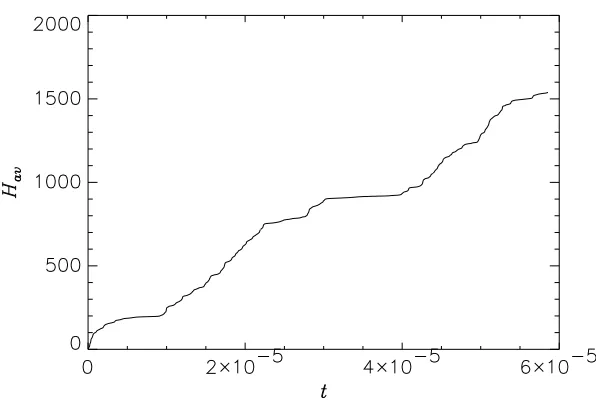
Figure 2: Average front position as a function of time. Parameters as in Figure 1.
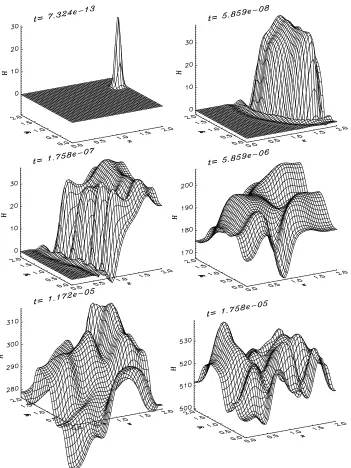
relatively smooth initial front seen in the second snapshot in Figure 1 be-comes unstable and develops secondary fronts as seen in the third snapshot. The nonlinear interaction of these multiple secondary fronts in turn leads to what appears to be chaotic dynamics for sufficiently large time, see snap-shots 4–5 in Figure 1. Despite this overall chaotic behavior of a solution the average position of a front Hav always increases with time as shown in
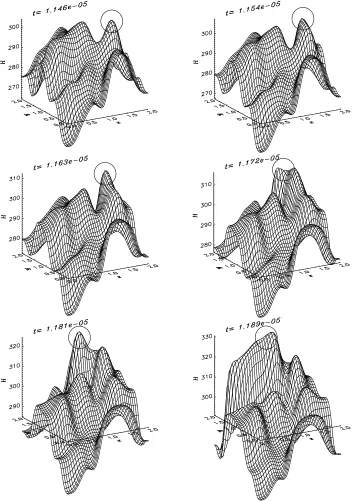
Figure 2 which confirms the relevance of the proposed model to realistic sit-uation of a propagating combustion front. The dynamics of Hav shows that the front propagates with a non-constant speed with periods of slow lami-nar burning dominated by the diffusion terms in equation (4) followed by a rapid turbulent combustion largely determined by interactions of curvilin-ear fronts described by nonlincurvilin-ear terms in equation (4). The computations were performed up to time t≈5.9×10⁻⁵ (80 millions time steps) and show that the front evolution for the chosen set of parameters remains intermit-tently chaotic. However a closer look at some intermediate stages of the front evolution indicates that model (4) admits shortliving solutions representing spinning waves which propagate along the boundaries of the domain. A se-ries of snapshots presented in Figure 3 show a front (circled) propagating along the boundaries counterclockwise for some time before this motion is destroyed by nonlinear collisions with other local fronts corresponding to the maxima of the presented solution.
4
Conclusions
References
[1] Zel’dovich, Ya.B. and Kompaneets, A.S., Theory of Detonation. New York: Academic Press, 1960.
[2] Merzhanov, A.G., Filonenko, A.K. and Borovinskaya, I.P., New phenom-ena in combustion of condensed systems. Doklady Phys. Chem., 1973, vol. 208, pp. 122–125.
[3] Dvoryankin, A., Strunina, A.G. and Merzhanov, A.G., Trends in the spin combustion of thermites. Combust. Explos. Shock Waves, 1982, vol. 18, pp. 134–139.
[4] Strunin, D.V., Strunina, A.G., Rumanov, E.N. and Merzhanov, A.G., Chaotic reaction waves with fast diffusion of activator, Phys. Lett. A, 1994, vol. 192, pp. 361–363.
[5] Ivleva, T.P., Merzhanov, A.G. and Shkadinsky, K.G., Principles of the spin mode of combustion front propagation. Combust. Explos. Shock Waves, 1980, vol. 16, pp. 133–139.
[6] Aldushin, A.P., Malomed, B.A. and Zel’dovich, Ya.B., Phenomenologi-cal theory of spin combustion. Combust. Flame, 1981, vol. 42, pp. 1–6.
[7] Volpert, V.A., Volpert, A.I. and Merzhanov, A.G., Application of the theory of bifurcations in study of the spinning combustion waves. Dok-lady Akad. Nauk SSSR, 1982, vol. 262, pp. 642–645.
[8] Novozhilov, B.V., On the theory of the surface spin combustion.Doklady Ross. Akad. Nauk, 1992, vol. 326, pp. 485–488.
[9] Ivleva, T.P., Private communication, 2002.
[10] Ivleva, T.P. and Merzhanov, A.G., Mathematical simulation of three-dimensional unstable solid-flame combustion, Proc. of Int. Conf. on Combustion and Detonation. Zel’dovich Memorial II, Moscow, 2004.