
Rochester Institute of Technology
RIT Scholar Works
Theses
Thesis/Dissertation Collections
5-17-2017
Adding Security to Control Area Network of
Vehicles by Using SHA-3
Aidin Ameri
Follow this and additional works at:
http://scholarworks.rit.edu/theses
Recommended Citation
ADDING SECURITY TO CONTROL AREA NETWORK OF VEHICLES BY
USING SHA-3
By:
Aidin Ameri
Committee Members:
Professor Sumita Mishra
Hrishikesh Acharya
In partial fulfillment of the requirements for the degree of
Master of Science in Computing Security
Rochester Institute of Technology
B. Thomas Golisano College of Computing & Information Sciences
Acknowledgment
Contents
1 Introduction 6
2 Literature Review 7
2.1 Introduction . . . 7
2.2 Computing Security . . . 7
2.3 Control Area Network and related security concerns . . . 8
2.3.1 Control Area Network . . . 8
2.3.2 Security Concerns . . . 9
2.4 Challenges and Goal . . . 10
2.4.1 Non-Cryptographic methods to secure CAN . . . 12
2.4.2 Cryptographic methods to secure CAN . . . 13
2.5 Literature review conclusion . . . 14
3 Proposed Approach 15 3.1 Why SHA3 . . . 15
3.2 Keccak Algorithm - SHA3 . . . 15
3.3 Assumptions . . . 18
3.4 Security strength of SHA-3 . . . 18
3.5 Using SHA-3 . . . 19
4 Implementation 20 4.1 Implementing SHA3 . . . 20
4.2 CAN Communication . . . 20
4.3 Sender . . . 20
4.4 Receiver . . . 21
4.5 Underlying Infrastructure . . . 21
4.5.1 Enabling CAN interfaces . . . 21
5 Results 24 5.1 SHA3-224 hardware implementation results . . . 24
5.2 SHA3-224 performance results . . . 24
5.3 Send and Receive . . . 24
5.4 Keccak on RFID device . . . 25
6 Discussion 27
8
List of Figures
1 CAN 2.0 Frame[1] . . . 8
2 CAN FD Frame[2] . . . 9
3 In Vehicle Communication[3] . . . 10
4 Sponge function[4] . . . 16
5 Rounds[5] . . . 16
6 Entities defined in Keccak[5] . . . 17
7 CAN interfaces . . . 22
8 Canberry Kit . . . 23
9 Result of SHA3-224 . . . 24
10 Number of messages broadcasted per second . . . 25
11 Number of message received per second . . . 25
Abstract
The lack of security in the vehicles on the road is real and should be taken seriously. Since the lifespan of vehicles has average of eleven years, this means if we start to implement new changes to vehicles today, it would takes eleven years to make sure most vehicles on the road support our implementation. This is important as the number of lines of codes in vehicles are ever increasing and becoming more autonomous with the ability for vehicles to drive themselves. But there is no security implemented in their low level systems such as the Control Area Network which is being used to transfer real time critical information and commands such as engine speed and the brake control. This project attempts to solve the lack of security by using SHA3 hashing algorithm based on the Keccak algorithm. The reason Keccak was chosen to be the SHA3 algorithm because it is hardware friendly and fast. Vehicle’s manufacturers do not share information about the electrical parts used in the vehicles and their specification, this project presents the lowest hardware specification required to use SHA3 on the Control Area Network which is a process with a clock frequency of approximately 400 MHz. It is important to have a real-time communication network for the Control Area Network which also known as CAN. SHA3 is used to create a hash of the CAN message along with a node specific key and an IV to provide authentication and semantic security respectively; The digest will be transferred along with the message. To use the mechanism proposed in this project, all CAN nodes communicate with each other required to support CAN FD and also have the minimum hardware specification.
1 Introduction
It is obvious that the number of physical systems around us that are getting connected to the Internet. As we see more devices internet-assessable, the number of potential vulnerabilities also grows exponentially. Many systems, such as vehicles, when designed were not intended to be connected to other systems, but now the first priority is to connect those devices to Internet to make them accessible. Vehicles are one of many systems that started as strictly mechanical, but have transformed into what are considered today as Cyber-physical devices.1 In any vehicle, there are many connected small electronic nodes that are able to perform computation and the information from these nodes should be transferred to other parts of the vehicle so that they could work. The Control Area Network (CAN) communication protocol is one of the five protocols used in the on-board diagnostics version two (OBD-II) standard, which is mandatory in the United states for all cars and trucks since 1996[7]. The CAN protocol was designed and proposed by Bosch in 1983. The second generation of the protocol, CAN 2.0 was released in 1991. The current version was developed in 2012 and is called CAN Flexible Data-Rate of for short CAN FD. The CAN 2.0 is the most common used in vehicles around the globe. This protocol does not have any security controls to limit the access of a malicious actor to the internal car systems. There has been a lot of research and projects conducted that the vulnerabilities of CAN and also many effort to secure this system, but none of them so far used the newly developed hashing algorithm Keccak sponge function which has recently been standardized by NIST[8]. The goal of this project is to analyze SHA3 and create a report on the overhead of using this hash algorithm which is used for authentication and integrity in the CAN. Also, the minimum hardware requirement for the nodes in a vehicle to be able to use this approach so that the communication be real-time is presented. This is important because the nodes in any vehicle have limited resources such as computational power and memory. The reason for selecting SHA-3 is that this hashing algorithm can computes different length message digests and it has less requirements then any another hashing algorithm in order to add integrity. Up to the advent of the CPS, the average end user did not understand security implications and viewed it as too inconvenient to deploy secure systems. However, now because people’s life can be more in danger because they increasing the attack surface by using more automated and connected devices, they should start to take security seriously. This project is important because securing vehicles would save lives. Not only the people inside the vehicle, but also those around it may depend on the security of it. No vehicle is secure unless the communication between critical nodes is secure. By the end of this project, the minimum requirements to secure CAN via SHA-3 will be analyzed. This project is outlined in the following order: Section II is the literature review, followed by Section III, The Securing mechanism, Section IV testing and experiments, Section V data analysis, and Section VI the conclusion of this project.
1NIST defines it as: Cyber-Physical Systems (CPS) are smart systems that include engineered interacting
2 Literature Review
2.1 Introduction
In the digital age, no system is not guaranteed to be secure. Vehicles started as a purely mechanical device, but through the years they have changed. The vehicle manufacturers try to make their product safer every day, however, the number of lines of code has also significantly increased leading to more potential vulnerabilities. Software made cars more efficient, but unintentionally they also introduced vulnerabilities in this complex system. During this literature review first the definition and basic concerns around computer security are reviewed. Next, the raised security vulnerabilities in vehicles are investigated. Most of these security concerns are around the vehicle’s Control Area Network, which are going to be investigated in depth in this review. Then, the previous solutions along with their pros and cons are investigated. Finally, the proposed solutions and its advantages and disadvantages will be discussed.
2.2 Computing Security
information and commands in vehicles such as engine temperature and brake command. There are also emerging communications systems such as Vehicle-to-Vehicle (V2V) and Vehicle-to-infrastructure (V2X) that enables the intra-vehicle communication which are not in the scope of this project.
2.3 Control Area Network and related security concerns
2.3.1 Control Area Network
[image:10.612.86.518.262.374.2]Control area network is a protocol developed by BOSCH in 1983[12]. This protocol traditionally uses an 8 byte payload as shown in the figure 1 and is used in various industrial automation systems.
Figure 1: CAN 2.0 Frame[1]
This protocol is a broadcast based communication system, which connects the embedded electronic control units (ECUs) in the vehicles to different nodes. Each node is responsible to generate information or execute a set of controls based on the signal detected by its sensor or based on the information received from other nodes[13]. Bousch is still working on the CAN protocol to make it more suitable since they released CAN FD 1.0 back in 2012. This protocol has a flexible data-rate with the maximum payload size of 64 bytes. The CAN FD frame is shown in figure 2. This information and commands include but not limited to, engine speed, temperature of engine, inside and outside temperature, brake pedal, actuator position, tire pressure, and airbag status are all transferred using CAN. There are many decisions made based on the information gathered by the sensors and transferred by CAN, for example, car engine will change its idle speed based on the current engine temperature.If in an accident the airbag system engages, all of the doors automatically would be unlocked to minimize the possible danger to the passengers. Back in mid 1990s car manufacturers started to use more advanced nodes; UNIX-like operating systems used peripherals such as Global Positioning Systems. Using all these different communication systems described placed in any vehicle increases the number of vulnerabilities.
Figure 2: CAN FD Frame[2]
• Class A - Low speed networks, Speed less than 10Kbps which are for non-critical body control functions.
• Class B - Medium speed networks, Speed between 10 Kbps and 125 Kbps, e.g. low-speed CAN.
• Class C- High speed networks, Speed between 125 Kbps and 1Mbps, which is used for critical real time communication, e.g. high-speed CAN.
• Class D- Ultra high speed networks, speed above 1Mbpswhich is used for multimedia systems.
2.3.2 Security Concerns
Figure 3: In Vehicle Communication[3]
picture of the two hackers performing these stunts appeared on the car’s digital display: Charlie Miller and Chris Valasek, wearing their trademark track suits. A nice touch, I thought.”[17] As you can see the security of vehicles has direct connection to the life of people in or around the vehicle. Also, it is important to mention that Jeep Grand Cherokee is not the only vehicle that have been compromised, many other vehicles such as the Ford Escape and Toyota Prius also have been compromised. In addition to these, a series of compromises has been done by Hoppe, Klitz, and Dittman[18]. The electric window lift and warning light compromised by performing Denial of Service (DoS) attack and sending false data about air bag module presented to the other nodes. Additionally, the messages passing through the gateway ECU (those nodes that connect different communication protocols in the vehicle) were captured.
2.4 Challenges and Goal
Many features that made CAN protocol, successful at the beginning also made securing it challenging[19][20][21]:
All messages in the CAN are broadcast to all other nodes that are connected to the CAN. All nodes can read these messages because they are unencrypted; they are only checked against any error such as bit stuffing, redundancy check and packet format, etc. The nodes after reading the message decides if they should process the message further or drop it.
• Source address and Authentication
There is no source address in the messages being sent, so the receiver cannot identify the sender. The only content that can be used to identify the sender is the type of the message. By design, the important part of the system was the information in the message, not the source or destination address. However, the challenge and security risk arises when a message is being sent by a malicious node (which can be an easy made microcontrollers with a can transceiver which cost less than $50). The message range from turning the lights on or off which can be disastrous if the vehicle has a high speed in the middle of a dark highway. Alternatively, an attacker could change the engine temperature, or sudden unwanted brake or can endanger the passenger by providing incorrect information to other system sensors.
• Bus-off mode
CAN protocol has a fault isolation protocol, called buss-off mode which can turn off any nodes selectively if that node generates error messages. This action can be done by sending fake error messages by the malicious node into the CAN.
• Gateways and Super-gateways
and secure, one of them is Hum by Verizon2 which connects directly to the vehicle’s ODBII connection which is directly connected to the CAN. An adversary can bypass the routing table and from anywhere in the world get access to the vehicle’s control area networks.
• Real-Time communication
It is essential that the information and commands reach to the critical node in time because of the nature and criticality of the communication. For example, the communication between the brake pedal and the brake discs should be seamless. En-cryption in general is not a good approach for any real time communication because it will add latency due to the fact that it needs more computation, both for encrypting and decrypting the data.
• Non-Repudiation
There is no mechanism in the CAN bus to identify the sender and receiver so there are no proof of the origin. One such example is an adversary can easily capture any commands such as an acceleration command and use it when the vehicle is located near a cliff.
There are some general security goals that should be achieved in order to have a vehicle more immune to cyber attacks such as integrity, availability, authentications and freshness identified by other researchers like Wolf[24] and D. Nilsson and Larson [25] which most of them need to redesign the whole protocol. So the goal of this project is providing Integrity, authentication and data freshness to the CAN.
2.4.1 Non-Cryptographic methods to secure CAN
There have been research about securing the CAN in the vehicles by using non-cryptographic methods such as Intrusion Detection System (IDS), firewall, which are discussed in depth in the next section.
• Firewall
Back in 2010, Arilou Technologies[26] proposed a standalone hardware that functioned as a firewall between nodes and the CAN. The problem with this approach is the new hardware will add more concerns such as more energy usage, there are more system to update and maintain and the fact that what happens if this node compromise. If the system is backward compatible a malicious attacker can send a spoofed error
2
message, so that the node disables the firewall. On the other hand, if this firewall system is not backward compatible, a malicious actor can cause danger by performing a denial of service attack on the firewalls behind critical nodes which may delays the transmission of critical messages; One example is that a driver hit the brake pedal to avoid accident but that command may reach to the brake pads late which causes the car to crash. In recent years, there have been solutions that claim they will secure any vehicle, VisualThreat is one of many[27] that offer a framework which includes a firewall, a general policy for the whole vehicle, updating the system over the air, and artificial intelligence of the vehicle. The problem with this type of solution is that they are provided by third parties and may not fully supported by the vehicle manufacturers. The vehicle manufacturers and these companies do not communicate well and there is no documentation for vehicles. This may even endanger the life of passengers as these third parties may not know the vehicle well.
• Intrusion Detection System
Another non-cryptographic method to secure the CAN is to have an intrusion detec-tion system which monitors the events and normal behavior of the network and detect any abnormality or possible malicious activity in the system[28]. An IDS needs to scan all messages sent on the CAN and at best, the IDS can detects malicious activity, there are many false positives with any intrusion detection system. An IDS is not a good choice of securing mechanism because vehicle needs real time communication, but IDS adds undesired and unacceptable latency. Also, IDS alone is not effective, we need to have another system to use the data analyzed by the IDS to protect the system. It is life threatening if an IDS identifies the legit brake signal as malicious activity and so that the vehicle does not stop where it should. So, we need a system to be near perfect, no false positive is accepted in cyber-physical devices that can endanger the life of humans and animals.
2.4.2 Cryptographic methods to secure CAN
There have been approaches to add authentication and semantic security to the CAN by using message authentication codes (MACs) [32] which also uses AES to encrypt the session key but again, using AES is vulnerable to the hamming weight and hamming distance attacks which are attacks that can be used against any cipher text encrypted with AES algorithm. The result of these attacks are finding the plain text of encrypted message with analyzing the consumption power of nodes that encrypt or decrypt the message. Also, there other cryptographic approaches to secure the CAN[33]. On the other hand, there are no research on using SHA3 in the CAN.
2.5 Literature review conclusion
3 Proposed Approach
3.1 Why SHA3
There are two important security related characteristics that are not in the Control Area Network of vehicles which can be used against it as we discussed in the previous sections. These are lack of semantic security, and lack of source identifier. Lack of semantic security enables an adversary to capture and replay any packets and get the same effect just like a legit sender send the captured packet. In addition, lack of source enables an adversary to use any nodes on the network or add its own node and use it to send any desired message to the network. The proposed solution in this section tries to address these problems by using SHA3.
SHA3 provide authentication and semantic security if it is used along with unique keys and counter for each node. Authentication is when we can identify the sender, so if each node has a unique key by computing the digest of message + key, the nodes with the key can create compute and recompute the same digest. Because we assume that every time that the vehicle starts, the ECU will generate new sets of key, it is almost computationally impossible that an adversary can test all the possible digest messages in time. In the section ”Security strength of SHA-3” there are more information regarding the security bits of this hashing algorithm. Same outcome is possible when a unique counter is used by each node. The new counter will change the digest as even changing one bit of the message will change all of the digest computed from that message. Thus, if adversary capture a packet it can not be used again because the receiver will compute different digest.
3.2 Keccak Algorithm - SHA3
Keccak (pronounced like ”ketchak”) algorithm is a family of sponge functions as shown in the Figure 4 that has been standardized in the form of SHA3-224 to SHA3-512 hash functions in FIPS 2023. A hash function is a one-way function that has an input called message of variable length sizes and an output called a digest or hash value which has a fixed length based on the hash algorithm.
3
Figure 4: Sponge function[4]
[image:18.612.109.290.471.604.2]The four different SHA-3 hash functions are named SHA3-224, SHA3-256, SHA3-384, and SHA3-512; in each case the suffix after the dash indicates the fixed length of the digest. This algorithm can have seven permutations named KECCAK-f [b], with b=25, 50, 100, 200, 400, 800 or 1600. For the SHA3 the b=1600 is purposed but the smaller the permutation, can be used in lightweight and constrained environments. The Keccak-1600 function has 24 rounds of operation as shown in the Figure 5, where each round has five sequential steps. These 1600 bits are organized in a 3-D array, as shown in the Figure 6. Each bit is addressed with three coordinates, written asS(x, y, z), x, y∈ {0,1,2,3,4}, z ∈ {0,1,2,3, ...,63}..2-D entities, plane, sheet and slice, and 1-D entities, lane, column and row, are also defined in Keccak.
For solution in this paper MAC-Keccak has been purposed which is recommended by the Keccak designers[34] [35]:
M AC(M essage, Key) =Hash(Key||M essage).
As you can see from the MAC function, Keccak does not require the regular key padding that is required in other HMAC4 functions. Using padding makes HMAC immune against length extension attack.
[image:19.612.139.464.223.609.2]HM AC(M essage, Key) =Hash((Key0⊕opad||Hash(Key0⊕ipad)||M essage)).
Figure 6: Entities defined in Keccak[5]
4
3.3 Assumptions
There are two main prerequisites in our proposed solution that are not in the scope of this paper. To provide the source authenticity to the nodes, each node should be identified with a unique key, 112 bits long, which can be computed by the vehicle’s main ECU and distributed as a two-dimensional array to all nodes when a vehicle starts. All nodes should receive this table which also should be encrypted before transferring to the node. The key to encrypt this table can be written inside each node by the manufacturer. Only the certified dealer can update the list inside the main ECU in the case that any nodes needed to be replaced. The other requirement is a counter that can be provided by the vehicle’s main ECU along with the key tables; Both tables also can be distributed using alternative channels. There are other approaches such as implicit counter synchronization or timestamp IV, which can be used. There should be a mechanisms to change each IV after using it once and all nodes should know the current value.
3.4 Security strength of SHA-3
There are several factors that directly connected to the security strength of SHA-3 such as collision, Pre-Image, security levels and capacity.
• Collision:
Find X, Y so that
hash(X) ==hash(Y)
Which is directly related to the capacity of sponge function no the output of the SHA-3. SHA-3 with 224 bit output has a capacity of 256.
• Pre-Image: Given Y, find X so that
hash(X) ==Y
This property is important to the CAN because if an adversary captures the CAN traffic, he has access to both message and its digest. If the hash function lacks pre-Image resistance and the adversary can derive the key.
• Security Level Security level in cryptography is the measure of the strength of a cryptographic primitive which in our case is a hash function.
Mathematically the collision resistance and pre-Image resistance and security level are equal to
2c/2 where c= 256
which means an adversary needs to perform 2128 operations which are more than
3.5 Using SHA-3
4 Implementation
This section will present the implementation of the proposed solution to add security using SHA3-224 to the Control Area Network. This section is divided into 4 different subsections: 1- Implementing SHA3, 2- Sending Procedure, 3- Receiving Procedure, and 4- Underlying Infrastructure.
4.1 Implementing SHA3
So far there is no standard implementation of SHA3 in OpenSSL or any other solution on Linux. Thus, there were two options, first to write the code from scratch, which is normally a good way for any cryptographic solution, or use the available codes. The second approach was used for this project. There are more than 100 solutions in 10 different languages available on the GitHub. Most of the solutions were written in C language because of the importance of the performance, which is also a key factor in our implementation. For this project, a source code from Mattias Andr´ee is selected and modified to fit the purpose of this project and to measure the performance of hashing operations. You can find the information and a link to the code in the 8.1 This program is used standalone to check the performance of SHA3-224 with the infrastructure at hand.
4.2 CAN Communication
To send and receive CAN messages in this project, SocketCAN Functionality of Linux kernel is being used. SocketCAN is a set of drivers and networking stack, which is contributed by Volkswagen Research to the Linux Kernel. SocketCAN supports both CAN 2.0 and also the new version CAN-FD[36]. The main functionality of SocketCan is as follows[37]:
• PF CAN - a protocol layer that provides a kernel for CAN frame sending and receiving.
• CAN RAW - a protocol to copy CAN frame into the kernel space
• socket - creates a socket
• close - eliminate the created socket
• listen - accept incoming connection and receive the communicated data.
4.3 Sender
which will be appended to the original message to be sent. To send the messages, a program called ”cansend” from the CAN-Utils package5 which is written in the language of C is being used. More information can be found in appendices 8.2 and 8.3.
4.4 Receiver
The receiving part of the message is more complicated than the sender’s because the receiver uses more operations to make sure the packet is arriving from the legitimate source. After receiving the CAN message, the receiver will capture the last 224-bits of the message and store it into a variable named ReceivedHash and the rest of the message is stored into the variable named message. Then, the receiver will find the key by using a table that maps common messages to a key that should be used by legitimate node. Also, it will retrieve the counter that the node should use by using another mapping table that has the IV(counter) from previously communicated messages. The receiver appends both the key and the counter to the message and call the SHA3-224 hash function. The receiver will examine the calculated hash with the value in the RecievedHash variable, if they match that means the legitimate node has been sent an uncorrupted message. If the hash values were not equal, the receive should send an error message to notify the sender and other nodes. To receive the messages, a program called ”candump” under the CAN-Utils package is being used. More information can be found at Appendix 8.2.
4.5 Underlying Infrastructure
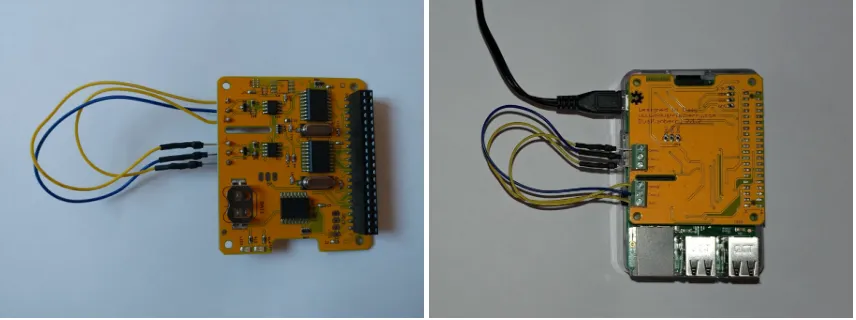
There are three different infrastructures have been used for this project, The first one is Canberry Dual v2.1 which is an extension board for Raspberry Pi. This board is based on MCP2515 SPI controllers and ISO1050 transceivers. This board is being used to test the logic of the algorithm purposed in this project. The only reason Canberry was only used to only test the logic of the mechanism is that only CAN 2.0 are supported by MCP2515 controller 8. CAN interfaces on the Linux platform are like other networking interfaces such as Ethernet as you can see the both physical CAN interfaces and the virtual CAN on the figure 7.
4.5.1 Enabling CAN interfaces
The following commands are to enable CAN interfaces on a Raspberry Pi:
5
Figure 7: CAN interfaces
• Enable the first CAN interface on a Canberry dual-channel:
$ ip link set can0 up type can bitrate 1000000
• Enable the second CAN interface on a Canberry dual-channel:
$ ip link set can1 up type can bitrate 1000000
• Add virtual CAN kernel module:
$ modprobe vcan
• Add Virtual CAN, set the payload size and turn the interface up:
$ ip link add dev vcan0 type vcan
$ ip link set vcan0 mtu 72
$ ip link set vcan0 up
The second infrastructure being used is a Raspberry pi 3 with the following specifications:
• SOC: Broadcom BCM2837
• CPU: 4x ARM Cortex-A53, 1200 MHz (Our implementation only used one core)
• RAM: 1GB LPDDR2(900MHz)
(a) Dual-channel Canberry (b) Canberry on a Raspberry Pi
Figure 8: Canberry Kit
5 Results
In this section the raw result is presented for each infrastructure, the first one is from the FPGA board Sakura-X to show the power of SHA3 base on a hardware design, the second one is the result from testing the SHA3-224 performance and the last one is the result of the performance of sending and receiving CAN FD messages via purposed security mechanism. Also, at the end of this section a performance result of an Keccak implementation of RFID devices is presented to further support the idea of this project.
5.1 SHA3-224 hardware implementation results
The result by running SHA3-224 on 10,000 random input message with a size of 1024-bits is 2 minutes and 34 seconds.
N umberof operations per Second= 10,000total messages
154seconds ≈64 M sg/Sec
The bottle neck is the file I/O. The operation itself only requires 47 clock cycles for single 1024-bits message.
5.2 SHA3-224 performance results
The result in this section is based on running the SHA3-224 program by using a binary data with a size of 256-bits as an input. As you can see the result in the figure 9, SHA3-224sum program operated 100000 times which took approximately 27.79 seconds.
N umberof operations per Second= 100,000total messages
27.79 seconds ≈3598.132M sg/Sec
Figure 9: Result of SHA3-224
5.3 Send and Receive
Send
Sending 10000 CAN FD messages along with the added security took approximately 13.24 seconds, figure 10.
N umber of M essage broad−casted per Second= 10,000total messages
13.24seconds ≈755.21M sg/Sec
Figure 10: Number of messages broadcasted per second
Receive
Receiving 10000 CAN FD messages along with added security took approximately 8.01 seconds, figure 11.
N umber of messages received per Second= 10,000total messages
8.01seconds ≈1248.43M sg/Sec
Figure 11: Number of message received per second
5.4 Keccak on RFID device
6 Discussion
In this section, the information about the baseline specification necessary to satisfy the Class C specification of CAN network is provided. Class C is for critical real-time communication and the speed should be between 125 Kbps and 1 Mbps[14]. Class C has a minimum speed of 125 Kbps which means:
N umber of bits per second= 125Kbps×1024 = 128,000bit/s
In order to satisfy the minimum speed, the sender should transmit 128,000 bits every second which is equal to 250 CAN FD messages per second.
N umber of CAN F D message per second= 128,000bit/s
512bits = 250CAN F D messages
With the current hardware specification, our implementation satisfies the minimum require-ment for the sender.
Secure CAN F D sender T hroughput= 755.21 MSG/s× 512bitsM SG
1024 ≈377.605Kbps
The results are satisfactory, but this is based on the hardware used for this project. The sender used one core of the CPU with the clock frequency of 1200 MHz. If we simplify the relationship of the clock frequency to the performance of computing and transferring CAN FD to be a linear relationship, the lowest CPU clock frequency to satisfy the Class C is approximately 400 MHz.
M in. required CP U clock f requency= 125Kbps
377.605Kbps×1200MHz≈400MHz
The receiver had the same environment as the sender and like the sender satisfied the requirement to be in Class C.
Secure CAN F D receiver T hroughput= 1248.43MSG/s× 512bitsM SG
1024 ≈624.215Kbps
M in. required CP U clock f requency= 125Kbps
624.215Kbps×1200MHz≈240MHz
on the other hand, the result from FPGA shows that we need to have a CPU with the clock frequency of 23.4 MHz to compute SHA3-224 with the throughput of 125Kbps.
M in. required CP U clock f requency f or F P GA= 125Kbps
This value far less than the amount of CPU required to have the same SHA3-224 throughput from the software implementation which is approximately 167 MHz.
(3598.132SHA3-224 MSG/s×256bit/MSG)
1024 ≈900Kbps
125Kbps
900Kbps ×1200 MHz≈167MHz
Still the best way to use a CAN node and implement the mechanism because the relationship between CPU clock frequency and SHA3 computation is complex and also there are other factors such as the speed of memory affecting the result.
The results are all provided in the table below:
Function Message/Second Throughput Note
SHA3-224 3598.132 787.0 Kbps Tested speed
CAN FD Sender 755.21 377.6 Kbps Security enabled CAN FD
CAN FD Receiver 1248.43 624.2 Kbps Security enabled CAN FD
CAN 2.0 Standard N/A 1024 Kbps The currently used CAN standard
CAN FD Standard N/A 3.7 Mbps Max. achieved speed in
7 Conclusion
In this project, a new mechanism is introduced to use SHA3 hashing algorithm to add au-thentication and integrity to the Control Area Network of vehicles. There is no transparency in the Vehicle industry related to the hardware specification they use, nor the software implemented in vehicles, this project utilized the virtual CAN and Canberry kit which uses Raspberry Pi. The simplified mechanism worked on Canberry which only supports CAN 2.0. The reason CAN 2.0 is used is to test the logic of the proposed mechanism since the CAN FD trancievers are not available for public. The results on the Virtual CAN is promising, but the problem is the hardware used in this project is like a supercomputer compared to the micro controller implemented in the actual vehicles. Thus, the mini-mum hardware specification required to use the method in this project is presented. More work needs to be done so the future researche can be in the following areas, but not limited to:
• Hardware Implementation: As it was presented in the FPGA and RFID imple-mentation, SHA3 is far faster; Thus, there are room to implement and test it on a physical CAN node capable of processing CAN FD messages.
• Improving the mechanism: There is always room to make the mechanism perform better. One way is to write the code in binary to make it faster or to use better libraries. The other approach to improve the mechanism is to eliminate all the disc I/O which was the bottleneck in the proof of concept code for this research as on the real CAN node there is no disc I/O.
References
[1] N. Instrument. (2016) Can fd frames. [Online]. Available: https://http://zone.ni.com/reference/en-XX/help/372841L-01/nixnet/canfdframes/
[2] Endres. (2014) Can fd frames. [Online].
Avail-able: https://upload.wikimedia.org/wikipedia/commons/5/5e/CAN-Bus in base format without stuffbits.svg
[3] G. Leen. (2002) One subset of a modern vehicle’s network architecture. [Online]. Available: http://ieeexplore.ieee.org.ezproxy.rit.edu/mediastore/IEEE/content/media /2/21069/976923/976923fig1hires.gif
[4] Armbrust. (2011) Sponge construction. [Online]. Available: https://commons.wikimedia.org/wiki/File:SpongeConstruction.svg
[5] G. Bertoni. (2008) Sponge construction. [Online]. Available: http://keccak.noekeon.org/
[6] E. B. Kavun and T. Yalcin, “A lightweight implementation of keccak hash function for radio-frequency identification applications,” in International Workshop on Radio Frequency Identification: Security and Privacy Issues. Springer, 2010, pp. 258–269. [7] T. Schutte, “Phil 308 research paper privacy implications of vehicular edr and gps
tracking devices.”
[8] “Sha-3standardization,” http://csrc.nist.gov/groups/ST/hash/sha-3/sha-3 standardization.html, 201http://csrc.nist.gov/groups/ST/hash/sha-3/sha-3.
[9] N. Eddy, “Gartner: 21 billion iot devices to invade by 2020.” [Online]. Available: http://www.informationweek.com/mobile/mobile-devices/gartner-21-billion-iot-devices-to-invade-by-2020/d/d-id/1323081
[10] G. Nicholas, Cars 1886-1930. Beekman House, 1985.
[11] K. Koscher, A. Czeskis, F. Roesner, S. Patel, S. Checkoway, D. McCoy, B. Kantor, D. Anderson, H. Shacham, and S. Savage, “2010 ieee symposium on security and privacy experimental security analysis of a modern automobile.” [Online]. Available: http://www.autosec.org/pubs/cars-oakland2010.pdf
[12] R. B. GmbH, “History of can technology.” [Online]. Available: https://www.can-cia.org/can-knowledge/can/can-history/
[14] I. Studnia, V. Nicomette, E. Alata, Y. Deswarte, M. Kaˆaniche, and Y. Laarouchi, “Survey on security threats and protection mechanisms in embedded automotive net-works,” in Dependable Systems and Networks Workshop (DSN-W), 2013 43rd Annual IEEE/IFIP Conference on. IEEE, 2013, pp. 1–12.
[15] C. Leon, M. Leon, R. Hernandez, C. Hernandez, H. Rodriguez, and F. Rodriguez, “Achieving confidentiality security service for can,” in Proceedings of the 15th International Conference on Electronics, Communications and Computers, ser. CONIELECOMP ’05. Washington, DC, USA: IEEE Computer Society, 2005, pp. 166–170. [Online]. Available: http://dx.doi.org/10.1109/CONIEL.2005.13
[16] M. D. Hamilton, M. Tunstall, E. M. Popovici, and W. P. Marnane, “Side channel analysis of an automotive microprocessor,” inIET Irish Signals and Systems Conference (ISSC 2008), June 2008, pp. 4–9.
[17] A. Greenberg, “Hackers remotely kill a jeep on the highway-with me in it.” [Online]. Available: https://www.wired.com/2015/07/hackers-remotely-kill-jeep-highway
[18] T. Hoppe, S. Kiltz, and J. Dittmann, “Security threats to automotive{CAN}networks, practical examples and selected short-term countermeasures,”Reliability Engineering and System Safety, vol. 96, no. 1, pp. 11 – 25, 2011, special Issue on Safecomp 2008. [On-line]. Available: http://www.sciencedirect.com/science/article/pii/S0951832010001602
[19] A. Groll and C. Ruland, “Secure and authentic communication on existing in-vehicle networks,” in2009 IEEE Intelligent Vehicles Symposium, June 2009, pp. 1093–1097. [20] A. Van Herrewege, D. Singelee, and I. Verbauwhede, “Canauth-a simple, backward
compatible broadcast authentication protocol for can bus,” inECRYPT Workshop on Lightweight Cryptography, vol. 2011, 2011.
[21] P. Kleberger, T. Olovsson, and E. Jonsson, “Security aspects of the in-vehicle network in the connected car,” inIntelligent Vehicles Symposium (IV), 2011 IEEE. IEEE, 2011, pp. 528–533.
[22] M. Meier, “Local interconnect network,” 2007.
[23] R. Makowitz and C. Temple, “Flexray-a communication network for automotive control systems,” in 2006 IEEE International Workshop on Factory Communication Systems, 2006, pp. 207–212.
[24] M. Wolf, “Security analysis and characteristical constraints in the automotive domain,” inSecurity Engineering for Vehicular IT Systems. Springer, 2009, pp. 91–103. [25] D. K. Nilsson and U. Larson, “A defense-in-depth approach to securing the wireless
[26] “Feasible car cyber defense by arilou technologies,” inembedded security in cars (escar) conference. (2010), 2010.
[27] “3+1 cyber security protection framework - fuse,”
https://www.visualthreat.com/UIproducts.action, 2016.
[28] C. Miller and C. Valasek, “Adventures in automotive networks and control units,”
DEF CON, vol. 21, pp. 260–264, 2013.
[29] M. Wolf, A. Weimerskirch, and C. Paar, “Security in automotive bus systems,” in
Workshop on Embedded Security in Cars, 2004.
[30] K. Han, S. D. Potluri, and K. G. Shin, “On authentication in a connected vehicle: Secure integration of mobile devices with vehicular networks,” in Cyber-Physical Systems (ICCPS), 2013 ACM/IEEE International Conference on. IEEE, 2013, pp. 160–169. [31] D. K. Nilsson, U. E. Larson, and E. Jonsson, “Efficient in-vehicle delayed data
authen-tication based on compound message authenauthen-tication codes,” inVehicular Technology Conference, 2008. VTC 2008-Fall. IEEE 68th. IEEE, 2008, pp. 1–5.
[32] O. Hartkopp and R. M. SCHILLING, “Message authenticated can,” inEscar Conference, Berlin, Germany, 2012.
[33] J. A. Bruton, “Securing can bus communication: An analysis of cryptographic ap-proaches,” 2014.
[34] G. Bertoni, J. Daemen, M. Peeters, and G. Van Assche, “Keccak sponge function family main document,”Submission to NIST (Round 2), vol. 3, p. 30, 2009.
[35] ——, “The keccak sha-3 submission,” Submission to NIST (Round 3), vol. 6, no. 7, p. 16, 2011.
[36] O. Hartkopp and A. Volkswagen, “The can networking subsystem of the linux kernel,”
Proceedings of the 13th iCC, 2012.
[37] M. Kleine-Budde, “Socketcan–the official can api of the linux kernel,” in Proceedings of the 13th International CAN Conference (iCC 2012), Hambach Castle, Germany CiA, 2012, pp. 05–17.
[38] “Can and can-fd a brief tutorial,”
8
Appendix A: Source Code Information
8.1 SHA3-224
Copyright c2013, 2014 Mattias Andr´ee ([email protected])
This program is free software: you can redistribute it and/or modify it under the terms of the GNU Affero General Public License as published by the Free Software Foundation, either version 3 of the License, or (at your option) any later version.
This program is distributed in the hope that it will be useful, but WITHOUT ANY WAR-RANTY; without even the implied warranty of MERCHANTABILITY or FITNESS FOR A PARTICULAR PURPOSE. See the GNU Affero General Public License for more details. You should have received a copy of the GNU Affero General Public License along with this program. If not, see ¡http://www.gnu.org/licenses/¿.
Copyright c2016, 2017 Aidin Ameri ([email protected])
This program is modified to capture average number of operation per second.
8.2 CAN-Utils
Copyright c2002-2007 Volkswagen Group Electronic Research
All rights reserved. Redistribution and use in source and binary forms, with or without modification, are permitted provided that the following conditions are met:
1. Redistributions of source code must retain the above copyright notice, this list of conditions and the following disclaimer.
2. Redistributions in binary form must reproduce the above copyright notice, this list of conditions and the following disclaimer in the documentation and/or other materials provided with the distribution.
3. Neither the name of Volkswagen nor the names of its contributors may be used to endorse or promote products derived from this software without specific prior written permission.
• CANSEND: https://github.com/linux-can/can-utils/blob/master/cansend.c
• CANDUMP:https://github.com/linux-can/can-utils/blob/master/candump.c
8.3 SHA3-224 on CAN-FD Source Code
![Figure 1: CAN 2.0 Frame[1]](https://thumb-us.123doks.com/thumbv2/123dok_us/33400.2638/10.612.86.518.262.374/figure-can-frame.webp)
![Figure 2: CAN FD Frame[2]](https://thumb-us.123doks.com/thumbv2/123dok_us/33400.2638/11.612.88.515.95.253/figure-can-fd-frame.webp)
![Figure 3: In Vehicle Communication[3]](https://thumb-us.123doks.com/thumbv2/123dok_us/33400.2638/12.612.98.510.95.382/figure-in-vehicle-communication.webp)
![Figure 5: Rounds[5]](https://thumb-us.123doks.com/thumbv2/123dok_us/33400.2638/18.612.109.290.471.604/figure-rounds.webp)
![Figure 6: Entities defined in Keccak[5]](https://thumb-us.123doks.com/thumbv2/123dok_us/33400.2638/19.612.139.464.223.609/figure-entities-dened-in-keccak.webp)
![Figure 12: Performance of Parallel vs Serial Keccak[6]](https://thumb-us.123doks.com/thumbv2/123dok_us/33400.2638/28.612.119.492.103.221/figure-performance-of-parallel-vs-serial-keccak.webp)