DATABASE SEGMENTATION FOR PRODUCT STRATEGY DEVELOPMENT
Hoda McClymont and Jared Young The University of Southern Queensland
Track: Entrepreneurship, Innovation, and Large and Small Business Marketing Keywords: Database marketing, segmentation, product strategy
Abstract
Although the topic of market segmentation has been discussed extensively in the mainstream marketing literature, limited attention has been paid to segmentation for product strategy development in database marketing. In order to provide a framework for how the database is segmented for product strategy, this research undertook in-depth interview and case studies to explore the process. Four main issues were developed for investigation including: what bases and variables, sequence of bases, sources of information and method of segmentation were used during product development. The findings of this research showed that the database is segmented during two stages of product strategy development: product research and testing. The main bases used for research and testing is behavioural data stored in the firm’s database. During research and testing of the product, the database is segmented mainly on behaviour with demographics being added in certain industries. Attitudinal data is merely used to understand the needs of behavioural segments rather than to segment database customers. The sequence of bases applied to segmentation for research and testing is usually that of behaviour followed by demographics.
Furthermore, segmentation for idea generation, testing and research is based solely on data from a firm’s internal database (to the exclusion of external databases) and only the ‘a priori’ segmentation method is applied to the database. The research showed that the industry type only impacted on the types of bases used but not on other aspects of segmentation.
Introduction
Market segmentation is a core application of mainstream (Kotler, Adam, Brown & Armstrong 2001) and database marketing (Master 2000; Drozdenko 2002; Levin & Zahavi 2002). Indeed, this topic has received much attention in the mainstream marketing scholarly literature over the past decades. For example, elements of segmentation which have been discussed in the literature include the appropriateness of bases and variables used for segmentation (Hanson 1996; Vyncke 2002), the focus of the firm and its impact on segmentation processes (Datta 1996; Jenkins &
McDonald 1997), effectiveness and attractiveness of segments (Kotler, Chandler, Brown & Adam 2001) and the sequence of applying bases during segmentation (Sampson 1992).
Grant-Thompson, Harrington, & Singer, 1997) or in relation to promotional strategy development (for example, Carr 1994), however, this coverage has not been comprehensive with authors discussing some issues only and discussing them in isolation from one another. Furthermore, there is no comprehensive study which explores segmentation issues in relation to product strategy development in database marketing. Therefore, in order to cover this gap, this research will address the following problem: how do database marketers use their customer databases to segment the market for product development?
Segmentation elements in database marketing. Given the limited research about segmentation for product strategy development in database marketing, four issues for further research were developed based upon both the mainstream and database marketing literature. The first issue relates to deciding which bases and variables are most relevant for database segmentation for product strategy development. Six bases for segmentation were identified in the literature including demographic, geographic (Keegan, Moriarty & Duncan 1995), geodemographic (Jackson & Wang 1994), psychographic (Nancarrow & Wright 1999) behavioural (Kotler, Adam Brown & Armstong 2001) and attitudinal bases (Greenberg & McDonald 1989), although geodemographics tends to be associated solely with database marketing.
However, although segmentation bases have been discussed in the literature, it is unclear which of these bases are most appropriate for new product development in database marketing. For example, one thought is that the attitudinal base (that is needs and benefits or product functions) is most useful for new product development (Greenberg & McDonald 1989; DeTienne & Thompson 1996; Wu & Wu 2000). Another thought is that behaviour should be used for database marketing segmentation because it is based on ‘concrete reality’ (Rosenfield 1992, p. 16). Yet a third thought is that demographics and psychographics are the best bases for new product development (Nancarrow & Wright 1999). Therefore, there is uncertainty about which bases are most appropriate for database segmentation for product development.
Sequencing of bases. The issue of segmentation bases raises a second issue: what is the sequencing involved in segmentation when more than one base is being used together to segment a market? There is contradiction in the literature. One argument is that behavioural segmentation should precede attitudinal segmentation (Haynes, Helmes & Casavant 1992; Morrall 1996; Adolf et al 1997). Opposing this argument is that attitudinal data should precede behavioural data (Haley 1968). That is, customers should be firstly segmented according to the needs/benefits (attitudinal base) that they have, and then re-segmented based on behaviour, demographics, and/or psychographics (Haley 1968). Therefore, there appears to be some contradiction in the literature about the sequencing of bases and this needs to be investigated in relation to product strategies in database marketing.
1991). In hypothesised segmentation, how and why segments differ is investigated based on primary research (Sampson 1992). Finally, in unstructured segmentation or cluster-based segmentation, what segments exists and how and why are all unknown, and statistical techniques (Wind 1978; Wedel & Steenkamp 1991; Ables 1997) are used to arrive at a segment. While the mainstream marketing literature states that the hypothesised and unstructured segmentation are the most accurate methods (Haley 1968; Wills & Wills 1992; Sampson 1992; Houghton & Oulabi 1993), there is no indication of which method is most appropriate for database segmentation on its own and specifically in relation product strategies.
Information source used to obtain segmentation bases and variables. The final segmentation issue investigated in this paper relates to the various sources from which data can be obtained about each base. Effective segmentation depends on using the most effective bases and this in turn depends on accessing appropriate data sources. Data can be acquired from three sources in database marketing: internal databases, internal field research, and external databases (Jackson & Wang 1994). Internal database usually contain information such as customers’ names, addresses, key demographic variables, past purchasing and payment history (Van Raaij & Verhallen 1994, p. 56). The second source, field research information (such as customer surveys) enhances the internal database information by including internally available information that is not on the database. (Cameron & Targett 1992). Finally, external sources of data usually include outside commercial databases that provide information such as demographics, lifestyles and other behavioural data. (Bickert 1997). The issue that arises from this discussion is that it is unclear which source(s) are most relevant for product strategies in database marketing.
In summary, this research is justified because segmentation related issues outlined above have not been discussed in relation to product strategy development in database marketing.
Methods
Given the gaps in the literature, this research relied on exploratory data to develop and confirm theory about the research problem (King 1994). Therefore, data was collected through case study interviews. Case research was used because this research involved an investigation of a real-life, pre-paradigmatic body of knowledge about a dynamic and contemporary phenomenon where the boundaries between the phenomenon and the context are not clear (Yin 1994). A total of 11 interviews were conducted with managers of 9 firms (cases) in 9 industries. This number of cases was used because it fell within the guidelines for case research. That is, although the there are no rules for the number of cases that should be used in research (Perry 1994), this research
followed the guidelines set out by Hedges (1985) and Eisenhardt (1989) which suggest no more than 12 cases or between 4 and 10 cases should be used,
Findings and discussion
Cases used for analysis. Research results show that product strategy for customers is an important database marketing strategy. Of the 11 firms interviewed, 7 (64%) had segmented their databases for product strategy formulation because they felt that the customer is an important part of the process. The remaining four firms did not implement this strategy through the database because their database was not large enough to allow it or because they did not usually develop new products. Next, how the database is segmented is discussed in relation to the seven firms only.
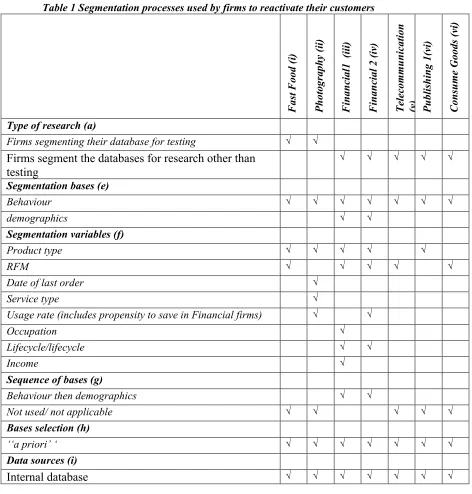
Results of the analysis for the seven firms is summarised in table 1 showing that that the database was used for research and testing in relation to product strategy
development (row a). Five firms (71%) (Financial 1, Financial 2,
Telecommunications, Publishing and Consumer Goods) stated that they used their customer database for research. These firms either used their customer database to identify new product ideas (column iv), or to investigate whether the new product idea would be successful using primary research such as focus groups and surveys (columns i, ii, and vi) or secondary behavioural data in the database (column vii). For example, Telecommunications use their customer database to locate ideas about new products and product improvements suggested by customers. The remaining two firms (29%), Fast Food and Photography, (columns i and ii) used their databases to test whether their customers need a new product.
Furthermore, database segmentation was important part of research and testing because product research or testing was only carried out on a sub-segment of the database rather than the entire customer base (row b). Therefore, selecting relevant segments for research or testing entailed using the behavioural base on its own or in combination with demographics. Behaviour was important for selecting segments to research or test because all seven firms wanted to focus on their most profitable customers and/or customers who have certain product usage patterns such as those who had previously bought similar products to the proposed new product. For example, when developing a new book, Publishing 1 segmented its database to identify all those customers who had previously bought books from the firm (column vi). Similarly, Telecommunications identified its most profitable customers and then searched their records for any new product ideas or suggestions that they had
suggested over time.
Although behaviour was the key segmentation base, demographic segmentation was equally important for segmentation with the two firms (29%) operating in the financial industry (rows d, columns iii and iv). Both finance firms noted that
Table 1 Segmentation processes used by firms to reactivate their customers F as t F ood ( i) P h ot ogr aph y ( ii ) F in an ci al
1 (
ii i) F in an ci al 2 ( iv ) T el ec om m u n ic at ion P u bl is h in g 1( vi ) C on su m e G oods ( vi )
Type of research (a)
Firms segmenting their database for testing √ √
Firms segment the databases for research other than testing
√ √ √ √ √
Segmentation bases (e)
Behaviour √ √ √ √ √ √ √
demographics √ √
Segmentation variables (f)
Product type √ √ √ √ √
RFM √ √ √ √ √
Date of last order √
Service type √
Usage rate (includes propensity to save in Financial firms) √ √
Occupation √
Lifecycle/lifecycle √ √
Income √
Sequence of bases (g)
Behaviour then demographics √ √
Not used/ not applicable √ √ √ √ √
Bases selection (h)
‘‘a priori’ ‘ √ √ √ √ √ √ √
Data sources (i)
Internal database √ √ √ √ √ √ √
Source: analysis of interview data
assertion that behaviour is the most important base but goes further to state that depending on the industry, the demographic base is also just as important.
Variables used. Although all firms used behavioural variables, not all firms used similar behavioural variables (row f). Three (43%) firms identified customers whom they believed had a need for the product, regardless of whether or not these customers were profitable (column i, ii, and vi). For example, Publishing 1 selected all book buyers in its database to develop a new product form. However, four (57%) firms (Telecommunications, Consumer Goods, Financial 1 and Financial 2) identified the most profitable customers using RFM and then researched them to elicit their new product ideas and needs (column ii, iv, v, vii).
Sequence of bases. The segmentation element of sequencing was irrelevant for all cases except the two (29%) financial firms where two bases were used (row g, columns iii and iv). In both firms, behaviour was used before demographics. That is, behaviour was used first to identify customers using similar products to the new product idea or using products that may be related to the new product idea. Next, the more profitable customers were sought out from these segments. Finally, these profitable customers were profiled demographically to make sure that their demographic characteristics were the right ones for the new product idea.
Method of selecting bases. Regardless of whether firms segmented their databases for research or testing, all firms used the ‘a priori’ method for segmentation (row h). The ‘a priori’ method was used because firms understand their customers and know through knowledge and experience which customers are most likely to be interested in the new product (Financial 1, Financial 2). Therefore, the database is used only as a means to find all those customers who have the right characteristics required for the new product, and to estimate the size and thus profitability of the segment. The findings of this research contradict the literature by stating that the ‘a priori’ rather than the hypothesised or cluster based methods is more appropriate for new product development in database marketing.
Sources of information. Lastly, the internal database was used in all seven cases (row h). This database was the only one used for segmentation because almost all
segmentation variables were behavioural or attitudinal data gathered by the firm about its customers. In some industries (Telecommunication and Financial 2) demographic data was also collected from customers and stored and so, there was no need for additional information from external databases. In brief, although the literature outlines three sources of data, only one of these is relevant for new product development in database marketing.
Conclusion
In conclusion, this research aimed to investigate how database segmentation is
conducted for products strategy. The results showed that the database is segmented to identify the relevant segments for product research and testing. Behaviour and
demographics were the only bases used for segmentation with behavioural
List of References
Ables, G 1997, ‘Predictive modelling for non-statisticians’, Target Marketing, vol. 20, no. 3, pp.
114-115, viewed, 21 Aug 1997. Available from Business ASAP International, Infotrac/SearchBank.
Adolf, R, Grant-Thompson, S, Harrington, W & Singer, M 1997, ‘Current research: what
leading banks are learning about big databases and marketing’, The McKinsey Quarterly,
Nov, pp. 187-192.
Bickert, J 1997, ‘Cohorts II: a new approach to market segmentation’, Journal of Consumer
Marketing, vol. 14, no. 5, pp. 362-379.
Botschen, G, Thelen, EM & Pieters, R 1999, ‘Using means-end structures for benefit segmentation: an application to services’, European Journal of Marketing, vol. 33, no.1/2.
Cameron, R & Targett, D 1992, ‘Computerized marketing databases: their role now and in the
future’, Journal of Information Technology, vol. 7, no. 4, pp. 223-232. Carr, M 1994, ‘Database marketing: talking directly to our listening customers’, Marketing
Intelligence and Planning, vol. 12, no. 6, pp. 12-14.
Datta, Y 1996, ‘Market segmentation: an integrated framework’, Long Range Planning, vol. 26,
no. 6, pp. 797-811.
DeTienne, KB & Thompson, JA 1996, ‘Database marketing and organizational learning theory:
towards a research agenda’, Journal of Consumer Marketing, vol. 13, no. 5, pp. 12-34.
Dick, B 1990, Convergent Interviewing, Version 3, Chapel Hill, Brisbane.
Drozdenko, RG, Drake, PD, 2002, Optimal Database Marketing (book), Journal of Marketing
Research, Nov. 2002, vol. 39, iss. 4, pp. 499-502.
Eisenhardt, KM 1989, ‘Building theories from case study research’, Academy of Management
Review, vol. 14, no. 4, pp. 532-550.
Greenberg, M & Donald, SS 1989, ‘Successful needs/benefits segmentation: A user’s guide’,
The Journal of Consumer Marketing, vol. 6, no. 3, pp. 29-36.
Green, PE & Krieger, AM 1991, ‘Segmenting markets with conjoint analysis’, Journal of
Marketing, Oct., vol. 55, pp. 20-31.
Haley, RI 1968, ‘Benefit segmentation: a decision oriented research tool’, in Marketing Visions,
eds. D. Bradmore, J Sally & K Chris, Prentice Hall, Sydney.
Haynes, PJ, Helms, MM & Casavant, RA 1992, ‘Creating a value-added customer database:
16-20.
Hanson, E 1996, ‘The application of market segmentation principles to residential housing
developments: a case study of an inner western Melbourne suburb’, MBus thesis,
Monash University.
Haughton, D & Oulabi, S 1993, ‘Direct marketing modeling with CART and CHAID’, Journal
of Direct Marketing, vol. 7, no. 3, pp. 17-26.
Hedges, A 1985, ‘Group interviewing’, in Applied Qualitative Research, eds. R Walker, Gower,
Alserhot.
Jackson, R & Wang, P 1994, Strategic Database Marketing, NTC Business Books, Illinios.
Jenkins, M & McDonald, M 1997, ‘Market segmentation: organizational archetypes and
research agendas’, European Journal of Marketing, vol. 31, no. 1, pp. 17-32. Keegan, WJ, Moriarty, SE & Duncan, TR 1995, Marketing, 2nd edn, Prentice Hall, Inc., New
Jersey.
Levin, N & Zahavi, J 2001, Predictive modelling using segmentation, Journal of Interactive
Marketing, Spring, vol. 15, no. 2, pp. 2-22.
Master, H 2000, Database Marketing Segmentation for Strategy Development in Australian
Industries, PhD thesis, The University of Southern Queensland.
Morrall, K 1996, ‘Market research helps home in on high potential segments’, Bank Marketing,
vol. 28, no. 6, pp. 36-38, viewed 3 Sep 1997. Available: ABI/INFORM. Nancarrow, C & Wright, L 1999, Top gun fighter pilots provide clues to more effective database
marketing segmentation: the impact of birth order, Journal of Marketing Management,
Jul., vol. 15, iss. 6, pp. 449-462.
Kotler, P, Armstrong, G. Brown, L & Adam, S 2001, Marketing, 4th edn, Pearson Education
Australia Pty Ltd, Frenchs Forest, Australia.
Perry, C 1994, ‘A structured approach to presenting PhDs: notes for candidates and their
supervisors’, ANZ Doctoral Consortium, University of Sydney, 4-6 Feb. Rosenfeld, J 1992, ‘Classical direct marketing versus database marketing’, The Journal of
Australian Direct Marketing Association, Winter, pp. 13-14.
Sampson, P 1992, ‘People are people the world over: the case for psychological market
segmentation’, Marketing and Research Today, Nov., pp. 236-244. Schoenbachler, DD, Gordon, GL, Foley, D & Spellman, L 1997, ‘Understanding consumer
Van Raaij, WF & Verhallen, TM 1994, ‘Domain-specific market segmentation’, European
Journal of Marketing, vol. 28, no. 10, pp. 49-66.
Vyncke, P 2002 Lifestyle segmentation, European Journal of Communication, vol. 17, iss. 4, Dec, p. 445, viewed 26 Jul 2003. Available from Academic Search Premier,
EBSCOhost.
Wedel, M Steenkamp, JE 1991, ‘A clusterwise regression method for simultaneous fuzzy
market structuring and benefit segmentation’, Journal of Marketing Research, Nov., vol.
XXVIII, pp. 385-96.
Wills, G & Wills, J 1992, ‘Journey to marketing Clubland’, Marketing Intelligence & Planning’, vol. 10, no. 2, pp. 22-36.
Wind, Y 1978, ‘Issues and advances in segmentation research’, Journal of Marketing Research,
Aug., vol. XV, pp. 317-337.
Wu, S & Wu, CA new market segmentation variable for product design – functional requirements, Journal of International Marketing & Marketing Research, vol. 25, iss. 1,
p. 35, viewed 26 Jul. 2003. Available from Business Source Elite, EBSCOhost.
Yin, RK 1994, Case Study Research - Design and Methods, Applied Social Research, Methods