This is a repository copy of Exploring interpersonal judgements between pedestrians.
White Rose Research Online URL for this paper: http://eprints.whiterose.ac.uk/81132/
Version: Accepted Version
Proceedings Paper:
Fotios, S. and Yang, B. (2013) Exploring interpersonal judgements between pedestrians. In: Proceedings of Lux Europa 2013. Lux Europa , 17-19 September 2013, Krakow, Poland. , 231 - 236.
[email protected] https://eprints.whiterose.ac.uk/
Reuse
Unless indicated otherwise, fulltext items are protected by copyright with all rights reserved. The copyright exception in section 29 of the Copyright, Designs and Patents Act 1988 allows the making of a single copy solely for the purpose of non-commercial research or private study within the limits of fair dealing. The publisher or other rights-holder may allow further reproduction and re-use of this version - refer to the White Rose Research Online record for this item. Where records identify the publisher as the copyright holder, users can verify any specific terms of use on the publisher’s website.
Takedown
If you consider content in White Rose Research Online to be in breach of UK law, please notify us by
- 1 -
Steve Fotios, Biao Yang
School of Architecture, University of Sheffield, Sheffield, UK [email protected]
ABSTRACT
Interpersonal judgements have been explored in three studies reported here. The first investigated the visual information extracted about other pedestrians at a range of interpersonal distances. The second study examined judgements of threat intent based on facial expressions and body postures and found that only a few expressions/postures were judged repeatedly to present, or not present, a threat – the level of consistency is low. The third experiment sought forced choice judgements of emotion or gaze direction after 1000 ms exposure with 18 combinations of lamp, luminance and interpersonal distance. Results for judgements of emotion from facial expression suggest a minimum luminance on the face of 0.1-1.0 cd/m2 if facial expressions are to be recognised at 4 m, but above 1.0 cd/m2 for identification at 10m.
Keywords: Road lighting, Pedestrian, Facial Recognition, Intent
1. INTRODUCTION
Lighting in residential roads is intended to enhance the safety and perceived safety of pedestrians. One aspect of safety is the ability to make judgements about the intent of other pedestrians, i.e. whether or not they present a threat (Simon et al, 1987). A basis of current guidance is that lighting should enable facial recognition at a minimum distance of 4m, suggested to be the minimum distance at which an alert person would be able to take defensive action if threatened (Caminada and van Bommel, 1980). Hence, past work has frequently attempted to establish whether facial recognition is effected by the spectral power distribution (SPD) of lighting. The findings so far are inconclusive, with some studies suggesting a significant effect whilst others do not. Furthermore, these findings may be of limited value as recognition is not the same as judgement of intent so there may be different effects of lighting (Fotios & Raynham, 2011). Also, the literature does not conclusively support the assumption of the 4m critical distance, with clear variations in comfortable interpersonal distance with the procedure by which it is measured (Fotios & Yang, 2013a).
This paper investigates the judgements that pedestrians might make about other people when walking after dark and how these judgements may be affected by characteristics of road lighting, primarily the amount and SPD of light. Such data are sought to contribute to investigations of design criteria for lighting in residential roads.
2. INTERPERSONAL DISTANCE AND PERCEIVED FEATURES
S. FOTIOS & B. YANG EXPLORING INTERPERSONAL JUDGEMENTS
[image:3.595.76.530.210.350.2]wall surrounding the target images had a mean luminance of 1.0 cd/m2. The luminance of the neutral surround on each image was approximately 0.5 cd/m2. Following 15 min. adaptation participants observed four images in sequence: each of the four target images was seen at one of the four target distances, and these were presented in a semi-random order. Participants were instructed to report all the information they could about the target person without a time limit. The experimenter recorded which items were correctly reported. A practise image was presented before any trials. Twenty test participants carried out the test: nine were male; 15 were young (aged 18-34 years old) and five were in the 35-54 age group.
Figure 1 – The Four Targets used in Interpersonal Distance and Perceived Features
Trials
Figure 2 – Schematic Diagram of Interpersonal Distance and Perceived Features Trials
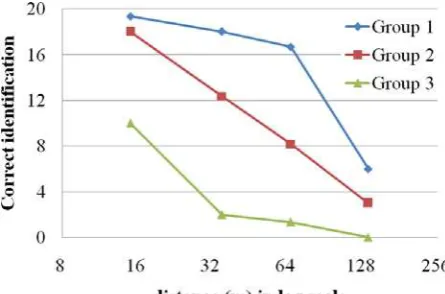
Reported features were placed into one of 14 categories of features (Yang & Fotios, 2012) to enable analysis by the frequency with which each feature was correctly identified during trials. At 15 m most features (except hair colour and facial expression) were mentioned correctly in at least 50% of trials; at 66 m, only gender, hair length, type of lower clothing and build were correctly reported in more than 50% of trials, and at 135 m no features were correctly reported more than 50%.
Figure 3 shows the relationship between distance and frequencies by which individual features were mentioned, grouped according to the apparent trend. For group 1 (gender, hair length, and build) correct responses were gained at an approximately consistent level of between 75% and 100% for the nearer three distances. It was only at the longest distance, 135 m, that a large reduction was found. For group 2 (type and colour of clothing on upper and lower body, age group, and shoe colour) there is an approximate linear relationship between log distance and frequency of correct mention and for all six items there is a high frequency of correct identification at the nearest distance. For group 3 (ethnic group, shoe type, and facial expression) correct mention at the nearest distance is only approximately 50%, and subsequently decreases to less than 25%.
[image:3.595.83.306.633.780.2]These data provide some clue as to what features of other pedestrians might be important and whether these features are distinguishable at different distances.
3. EXPLORING JUDGEMENTS OF THREAT
Past work suggests that visual cues as to intent include facial expression (Etcoff & Magee, 1992) and body posture (Ekman & Friesen, 1969), but the performance of these tasks under low light levels and different SPD is yet to be examined. A problem with evaluation is that judgements may vary within/between subjects, and such inconsistency may confound interpretation of the effect of lighting, if any. Thus a study was carried out to determine the repeatability of judgements of intent based on facial expression or body posture.
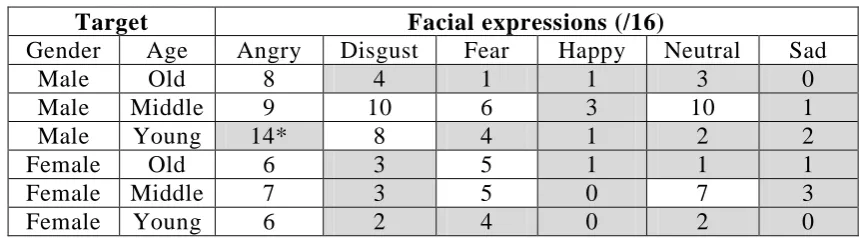
Test participants were presented with 120 images in random order, these being 72 facial expressions and 48 body postures, and asked to state whether or not the target would be considered threatening if encountered alone after dark. For facial expressions there were 12 targets (6M, 6F) with two each in the young, middle and older age groups. For each target there were six expressions, angry, disgust, fear, neutral, happy and sad. Participants were required to make rapid judgements on a set of 12 expression and 12 postures and this was typically within 2s per image. Each facial expression of a particular target person was seen by eight participants. Trials were carried out under daylight or office lighting. Figure 4 shows examples of the target facial expressions. The size of the targets was chosen to present the images at the visual size at 4 m for facial expression. The 48 participants (27M, 21F) included 37 younger (18-34 yrs) and 11 older (35-59 yrs).
[image:4.595.71.207.353.439.2]Table 1 shows the results of trials for facial expressions. These are the frequency by which a target was considered to be a threat from the 16 trials (two target images in each expression category). A frequency of ≥12 (≥75%) was considered to present a consistent threat and a frequency of ≤4 (≤25%) was considered to be consistently non-threatening. It can be seen that happy and sad facial expressions yielded a consistent judgement of not-threat; disgust and neutral were near consistent (4 of the 6 types of target); but anger and fear did not lead to consistent judgements of threat. A similar low level of consistent responses was found for judgements of body posture.
Table 1 – Results of Threat Judgements: Facial Expression
Target Facial expressions (/16)
Gender Age Angry Disgust Fear Happy Neutral Sad
Male Old 8 4 1 1 3 0
Male Middle 9 10 6 3 10 1
Male Young 14* 8 4 1 2 2
Female Old 6 3 5 1 1 1
Female Middle 7 3 5 0 7 3
Female Young 6 2 4 0 2 0
*NOTE: items with grey background denote consistent judgements
Further study was carried out using happy and angry facial expressions (and happy, fear, and angry body postures), these being the most likely to lead to consistent judgements (Fotios and Yang, 2013b). While happy expressions led to judgement of not-threat in all cases, this was less certain for angry expressions and threat judgements. For body
[image:4.595.88.518.584.703.2]S. FOTIOS & B. YANG EXPLORING INTERPERSONAL JUDGEMENTS
postures, happy postures led to non-threat judgements, but judgements based on fear and angry postures were not consistent.
It was concluded that universally recognised facial expressions or body postures do not map directly to judgements of intent. Using such evaluation to investigate the effects of lighting, as suggested by Fotios and Raynham (2011), would therefore be confounded by the inconsistent responses and is unlikely to work.
4. RECOGNITION OF EMOTION AND GAZE DIRECTION
A third experiment was carried out to interpret how lighting may affect visual cues to inter-personal judgements (Fotios and Yang, 2013a). One part examined ability to recognise gaze direction (with head and eye movements), following suggestion that another person looking at you can be perceived to present a threat (Argyle et al, 1974). The second part again used facial expression and body posture targets but sought judgements of expression rather than threat intent. This was because the previous study did not suggest that judgements of intent based on these targets were repeatable.
Target images were photographs of actors expressing a range of facial expressions, body postures and gaze directions, and these were used with permission from three databases. The FACES database is a set of images of naturalistic faces of 171 younger, middle-aged and older women and men, displaying each of six facial expressions: anger, disgust, fear, happiness, neutrality and sadness (Ebner et al., 2010). Twenty four images were used, these being six expressions from each of four targets: a young male, a young female, an old male and an old female. The BEAST database comprises 254 whole body postures from 46 actors expressing four emotions; anger, fear, happiness, and sadness (de Gelder and van den Stock, 2011). 16 images were selected, these being four postures from four target people, two males and two females. Note that in these images the target faces are covered by neutral shading. Gaze direction targets were selected from the head pose and gaze database developed by Institute of Neural Information Processing University of Ulm (Weidenbacher et al., 2007). Sixteen images of four target people were used, these being two males and two females with one male and one female wearing glasses. For each target person there were four combinations of head pose and gaze direction: straight or rotated head position and direct or averted gaze.
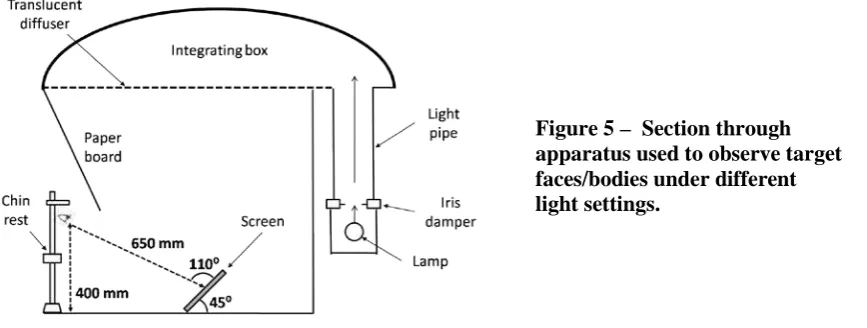
Target stimuli, colour photographs of faces or bodies, were presented on a non-self-illuminated screen (Pixel Qi® PQ3Qi-01, 10.1’’). It was subsequently found that at the low light levels of the current study the target images were apparently grey scale. The screen was observed inside a test booth (Figure 5), this designed to permit changes in luminance (by adjustment of an iris) and spectral power distribution (by changing lamp type) with negligible change in spatial distribution. The screen was placed on the floor of the booth and lit from overhead. It was observed from a distance of 0.65 m and this was fixed using a chin rest with forehead restraint.
The sizes of target images were manipulated to represent different observation distances. These were 4 m, 10 m and 15 m for facial expression; 2 m, 4 m and 10 m for gaze direction; and 10 m, 30 m and 135 m for body postures. Six lighting conditions were used. There were two types of lamp, high pressure sodium (HPS; 2000K, S/P= 0.57, Ra = 25 Ra) and metal halide (MH: 4200K, S/P = 1.77, Ra = 92). Three light levels were used, a luminance on the screen of 0.01 cd/m2, 0.1 cd/m2 and 1 cd/m2.
posture targets, and gaze toward or away from the observer (test participant) for the gaze direction targets. Each target was presented for 1000 ms, this being chosen to simulate the rapid observation of an unknown approaching person expected in real situations, with no time limit for input of the subsequent response. The sequence in which the three tasks (categorical perception of facial expression, body posture and gaze direction) were used was counterbalanced, and within each task the images with different sizes, and emotions or gaze directions, were mixed and presented in a semi-random order. 30 test participants completed the trial (16M, 14F); 15 were young (18-40 yrs old) and 15 older (40-65 yrs).
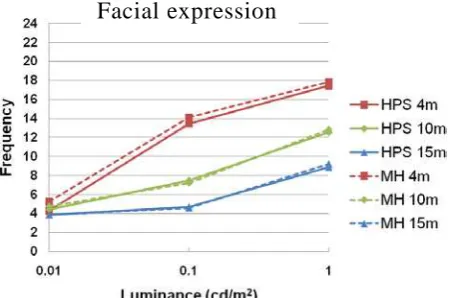
These results are shown in Figure 6. As expected when using achromatic, centrally fixated tasks, there is little difference in performance between the HPS and MH lamps.
As luminance increases, there is an apparent increase in probability of identifying emotion exhibited by facial expression or body posture; for gaze direction, luminances of 0.01 and 0.1 cd/m2 lead to performance at the chance level, and a luminance of 1.0 leads to just above chance level performance. At 0.01 cd/m2 the only targets identified at above chance level were body postures at 10 m. Shorter inter-personal distances led to increased probability of identifying emotion exhibited by facial expression or body posture: this may be as expected due to the larger visual size subtended. For gaze direction, at low light levels (0.01 and 0.1 cd/m2) there is no apparent difference between the three simulated distances: for the higher light level (1.0 cd/m2) there is a higher probability for detecting gaze direction of the closer targets than the distant targets.
If identification of gaze direction is important, these data suggest a need for target luminances of at least 1.0 cd/m2 to ensure probability of correct identification above the chance level. The facial expression and body posture data suggest a plateau-escarpment relationship, and the knee in these curves provides one estimate of minimum light level. The maximum identification probabilities found in the current data (73% for facial expression and 89% for body posture) approach those exhibited (81.3% for facial expression (Ebner et al, 2010) and 92.6% for body posture (de Gelder and van den Stock, 2011)) when the databases were validated under good lighting conditions with longer exposure durations (4 s for body, unlimited for face). For facial expressions at 4 m this is somewhere in the range of 0.1-1 cd/m2 increasing to >1.0 cd/m2 for identification at 10m. For body posture, a luminance of 0.1 cd/m2 is needed for identification at 10 m.
[image:6.595.76.510.210.374.2]Repeating these trials using colour targets may reveal differences in performance between lamps and may affect performance thresholds. It is apparent that using these data to suggest design light levels requires further discussion as to which task(s) is the more critical and at which distance the critical task needs to be carried out.
S. FOTIOS & B. YANG EXPLORING INTERPERSONAL JUDGEMENTS
REFERENCES
ARGYLE, M., LEFEBVRE, L. & COOK, M. The meaning of five patterns of gaze. European Journal of Social Psychology, 1974, 4, pp.125-136.
CAMINADA, J. & VAN BOMMEL, W. New lighting considerations for residential areas. International Lighting Review, 1980, 3, pp.69-75.
DE GELDER, B. & VAN DEN STOCK, J. The bodily expressive action stimulus test (BEAST). Construction and validation of a stimulus basis for measuring perception of whole body expression of emotions. Frontiers in Psychology, 2011, 2, pp.1-6.
EBNER, N., RIEDIGER, M. & LINDENBERGER, U. 2010. FACES—A database of facial expressions in young, middle-aged, and older women and men: Development and validation. Behavior Research Methods, 42, pp.351-362.
EKMAN, P. & FRIESEN, W. The repertoire of nonverbal behavior: categories, origins, usage, and coding. Semiotica, 1969, 1, pp.49-98.
ETCOFF, N. & MAGEE, J. Categorical perception of facial expressions. Cognition, 1992, 44, pp.227-240.
FOTIOS, S. & RAYNHAM, P. Correspondence: Lighting for pedestrians: Is facial recognition what matters? Lighting Research and Technology, 2011, 43, pp.129-130.
FOTIOS, S. & YANG, B. Measuring the Impact of Lighting on Interpersonal Judgements of Pedestrians at Night-time. CIE mid-term conference, Paris, April 2013a, pp.990-998.
FOTIOS, S. & YANG, B. Exploring Interpersonal Judgements between Pedestrians. In: 7th Lux Pacifica, March 6-8 2013b, Bangkok, Thailand. pp.248-251.
SIMONS, R., HARGROVES, R., POLLARD, N. & SIMPSON, M. Lighting criteria for residential roads and areas. CIE, Venice, 1987, pp.274-277.
WEIDENBACHER, U., LAYHER, G., STRAUSS, P. M. & NEUMANN, H. A comprehensive head pose and gaze database. In: 3rd IET International Conference on Intelligent Environments 2007 Ulm, Germany. pp.455-458.
[image:7.595.309.536.73.222.2]YANG, B. & FOTIOS, S. Inter-personal judgements for pedestrians at night: exploring information perceived at different distances. Ingineria Iluminatului, 2012, 14, pp.31-44.
Figure 6 – Average frequency for correctly identifying emotion from observation of the emotion and gaze direction.
Emotion: four (body) / six (face) possible emotions and four target people for emotion: maximum frequency = 16 (body) / 24 (face); chance frequency = 4 for both targets.
Gaze direction: two possible directions (toward or averted), two head pose and four target people: maximum frequency = 16; chance frequency = 8.
Body posture Facial expression