
Distinct Quantum States Can Be Compatible with a Single State of Reality
Peter G. Lewis,1,*David Jennings,1Jonathan Barrett,2and Terry Rudolph11Controlled Quantum Dynamics Theory Group, Imperial College London, London SW7 2AZ, United Kingdom 2Department of Mathematics, Royal Holloway, University of London, Egham Hill, Egham TW20 0EX, United Kingdom
(Received 14 June 2012; published 9 October 2012)
Perhaps the quantum state represents information about reality, and not reality directly. Wave function collapse is then possibly no more mysterious than a Bayesian update of a probability distribution given new data. We consider models for quantum systems with measurement outcomes determined by an underlying physical state of the system but where several quantum states are consistent with a single underlying state—i.e., probability distributions for distinct quantum states overlap. Significantly, we demonstrate by example that additional assumptions are always necessary to rule out such a model.
DOI:10.1103/PhysRevLett.109.150404 PACS numbers: 03.65.Ta, 03.65.Ca, 03.67.a
Broadly speaking, physicists today view the quantum state in one of two ways: in correspondence with the real physical state of affairs or as representing only an agent’s knowledge or information about some aspect of the physical situation. The latter ‘‘epistemic’’ viewpoint is primarily motivated by the obvious parallel between the quantum process of instantaneous wave function collapse and the classical procedure of instantaneous updating of a proba-bility distribution, both of which occur upon the acquisition of information regarding the outcome of a measurement process. The epistemic view has a long history of illustrious advocates [1–8]. In recent times, a research program has arisen aimed at not only philosophically justifying the epistemic view, but potentially deriving quantum theory from more primitive considerations about information and/or Bayesian reasoning [8–16].
At least two versions of the epistemic view can be distinguished. One is operational: the quantum state rep-resents information about which outcome will occur if a measurement is performed on the system. Measurement itself is treated as a primitive. The other is that the quantum state represents information about some underlying physi-cal state of the system, where this underlying state need not be described by quantum theory.
In his 1935 letter to Schro¨dinger, in an attempt to explain what he really meant in the EPR paper, Einstein writes ([17,18], p. 26): ‘‘But then for the same [real] state of [the system] there are two (in general arbitrarily many) equally justified, which contradicts the hypothesis of a one-to-one or complete description of the real states.’’ Einstein came to this conclusion, which he termed ‘‘incomplete-ness’’ of the quantum state, using an argument based on what we now call (following Schro¨dinger [19]) steering
[20]. Note that the question he raises here isnotwhether there are multiple states of reality associated with a single wave function (one possible type of incompleteness) but rather whether there are multiple wave functions associ-ated with a single real state. A natural way to understand this is as an expression of the second kind of epistemic view above—that a quantum state represents an agent’s information about an underlying reality but is not part of that reality itself.
Unfortunately, as shown later by Bell [21], Einstein’s specific argument for incompleteness was based on a false premise (locality). However, a question that stands on its own and is the topic of this article remains: is it even mathematically possible to find an embedding of quantum theory in some deeper theory where the quantum states are not always uniquely determined given the underlying physical state? Following [20], we refer to such a possi-bility as ac-epistemicinterpretation of the quantum state. Recently, a no-go theorem was proven [22] showing that a c-epistemic interpretation is impossible. It is important to note that a key assumption of the argument is prepara-tion independence—situations where quantum theory as-signs independent product states are presumed to be completely describable by independently combining the two purportedly deeper descriptions for each system. Here, we will show via explicit constructions that, when this assumption is dropped, c-epistemic models can be con-structed with all quantum predictions retained. Hence, we show that not only is the ‘‘preparation independence’’ assumption of that particular no-go theorem necessary, but also any similar no-go theorem will also require non-trivial assumptions beyond those required for a well-formed ontological model.
One of the most compelling motivations for exploring the c-epistemic view is the amazing range of phenomena, normally considered uniquely quantum, that can be derived by imposing only a simple principle restricting an agent’s knowledge about a presumed underlying reality [8,23,24]. It is clear that the primary reason these theories do manage Published by the American Physical Society under the terms of
to reproduce so many quantumlike phenomena is that the states of knowledge (probability distributions) overlap on a nontrivial subset of the underlying space of ‘‘hidden’’ states, even when the agent’s knowledge is maximal (the equivalent of a quantum pure state).
These toy theories do not, however, reproduceall quan-tum states and measurement statistics. About such theories which do reproduce all of quantum theory, much less is known—the main examples and constraints are outlined in [25]. In [26], Hardy showed that the underlying mathe-matical space of real states on which such theories are defined—the ‘‘ontic state’’ space—must have at least the cardinality of the integers. Spekkens [27] showed that the models must be preparation contextual in addition to measurement contextual [28]. The manifold dimension of the ontic state space was shown by Montina [29] to be necessarily exponential, assuming that the dynamics of the ontic states is Markovian; he then went on to show the intriguing result that it is possible to reduce the manifold dimension by one [30,31]. This latter construction results in probability distributions that intersect in the ontic state space; however, they do so only on a set of measure 0. The question of economic representation of finite data in such models [15,32–34] has also received some attention.
In another pair of recent works [35,36], Colbeck and Renner have argued that, given additional assumptions of experimenters’ free choice in choosing measurement set-tings and no superluminal signaling of the choice at the ontic level, the ontic states must be in one-to-one corre-spondence with the quantum states. The models of the present Letter are explicitly constructed for single systems only and, if applied to systems composed of multiple separated subsystems, would involve superluminal influ-ences of measurement choices upon ontic variables. Hence, our results are consistent with those of [35,36].
Formal statement of the problem.—Following [20], an
ontological modelfor a quantum system defines a measure space, the elementsof which are termedontic states. These should be thought of as the underlying physical states that a system can be in at a given time. A pure quantum statejci corresponds to an equivalence class of experimental preparations and is represented within an ontological model as a probability distribution cðÞ over. The distributionc is called anepistemic state. It represents the information that an agent has about the ontic state of a system, given that it was prepared in a particular way. Dynamics correspond to trajectories of ontic states through , and these map to dynamical changes in the probability distributions over. This setting includes the standard Hilbert space description through the trivial assignment of as the complex projective space
CPd1 (the boundary of the quantum state space), with
cðÞbeing a delta-function distribution centered at¼
jcihcj[37]. It is for this reason the term ‘‘ontic’’ is used— as opposed to ‘‘hidden,’’ for example.
Throughout, we shall consider only projective measurements on a finite d-dimensional quantum system, described as a string of rank-one projectors ¼ fj0ih0j;. . .;jd1ihd1jg, where
P
kjkihkj ¼1. If
a measurement is performed, the probabilities for different outcomes are defined by the ontic state of the system. Hence, each measurement is associated with a set of d
response functions fk:! ½0;1g, wherekðÞ is the probability of obtaining the outcome jkihkj when the
ontic state of the system is. The response functions are positive semidefinite and normalized so that PkkðÞ ¼ 1;8. If thekðÞtake values only inf0;1g, the model is
deterministic. By the Kochen-Specker theorem [28], a deterministic ontological model for a quantum system must be measurement contextual [25] if the system has dimension d3. This means that the response function
kdepends on the complete set of comeasured projectors in . We do not indicate this dependence for notational simplicity.
An ontological model is successful in explaining quan-tum measurement statistics for measurementand prepa-rationjciif and only if it is the case that8k:
Z
kðÞdc ¼
Z
cðÞkðÞd¼ jhkjcij
2: (1)
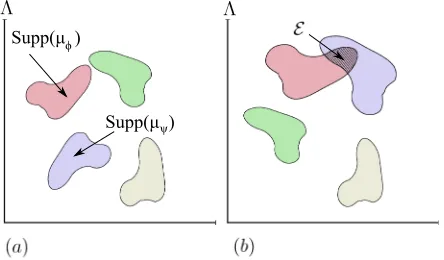
With these basic ingredients in place, an ontological model isc-epistemic if at least two distinct quantum states jc1iandjc2iare described by distributionsc1 andc2
such that the intersection of their supports has nonzero measure, as shown schematically in Fig.1. An ontological model is c-ontic otherwise [20,27]. The idea here is that, in a c-ontic model, the quantum state is uniquely deter-mined by the ontic state , since, for any, there is only onejcisuch thatis contained in the support ofc. In
[image:2.612.328.550.491.621.2]this case, although the quantum statejciplays an episte-mic role in defining a distributionc, the quantum state is also a function of the ontic state and hence can justifiably be thought of as a physical property of the system. Informally, the whole of the quantum statejciis ‘‘written into’’ the real state of affairs.
In ac-epistemic model, on the other hand, there are at least some circumstances in which two different quantum states describe systems in the same ontic state . In this case, it is defensible to claim that the quantum state ‘‘merely’’ represents an agent’s information. A stronger definition of the termc-epistemic would require that, for
anynonorthogonal states,jc1iandjc2i, the distributions
c1 and c2 overlap. In this Letter, we stick with the
weaker definition above.
The original Bell model.—As a counterexample to ‘‘von Neumann’s silly assumption,’’ Bell [21] described a simple ontological model capable of describing a quantum system of dimension d. The ontic state space consists of pairsðji; xÞ, wherejiis an element ofCPd1andxis an
element of the interval [0,1]. For the moment, consider
d¼2. The ontic state space is then isomorphic to ¼
S2 ½0;1, whereS2is the two-dimensional Bloch sphere. The quantum state jci corresponds to a distribution
cð; x^ Þ ¼ð^c^Þ, where the convention here, and in what follows, is to denote the unit Bloch vector associated tojciasc^. This choice of distribution is uniform over the subset fðc^; xÞ: 0x1g. The model is deterministic, with response functions given by
kð; x^ Þ ¼½ðjhj0ij
2xÞð1Þk; (2)
where is the Heaviside step function. For a projective measurement outcomejihjand a quantum statejci, the Born rule is satisfied, since
Z
ddx^ cð; x^ Þð; x^ Þ ¼ jhcjij2: (3)
Note—as Bell did—that there are many possible choices for the response functions that would work equally well. The only requirement is that the support over the subset fð; x^ Þ: 0x1g has measure equal to the probability occurring in the Born rule; how this support is distributed is entirely arbitrary.
A c-epistemic modification of the Bell model for a qubit.—The Bell model isc-ontic, since no two epistemic states, corresponding to distinct quantum states, overlap. A different ontological model for qubit systems was described by Kochen and Specker [28], which is c-epistemic. To date, however, no one has extended Kochen and Specker’s model to systems of higher dimen-sion than two [38]. Here, we show how the Bell model can be modified in order to obtain a c-epistemic model for qubits. Later, this model is extended to obtain a c-epistemic model for quantum systems of arbitrary finite dimension.
A simple visualization of the ontic state spaceas an annulus with ^ specifying the direction and x the radial distance is depicted in Fig. 2(a). Letz^ correspond to the north pole of the Bloch sphere, and let ^z^¼cosðÞ,
where is the polar angle of the Bloch vector^. Label
the upper (< =2) hemisphere R0 and the lower
(> =2) hemisphereR1. Given a projective
measure-ment¼ fj0ih0j;j1ih1jg, assume that the outcomes
are labeled such thatjh0jzij2 jh1jzij2.
With response functions defined as in Eq. (2), the ontic states in the set
E0¼ fð; x^ Þ:^2R0 and 0x <ð1sinÞ=2g (4)
all result in the ^0 outcome for any measurement .
Similarly, those in the set
E1¼ fð;x^ Þ:^2R1 and ð1þsinÞ=2< x1g (5)
all result in the ^1 outcome. These sets are illustrated in
Fig.2(b).
In order to construct a c-epistemic model, note that, if an epistemic state c assigns nonzero probability to the subsetE0, then this much probability weight can be redis-tributed overE0 without changing the Born rule statistics. This is because ontic states in E0 behave identically to one another, as far as predictions for quantum measure-ment outcomes go. The same argumeasure-ment applies to the subsetE1. Hence, define a modified Bell model such that, for c^ 2R0,
cð; x^ Þ ¼ð^c^Þ½x12ð1sincÞ
þ1
2ð1sincÞE0ð; x^ Þ;
where c is the polar angle of c^ and E0 is essentially
arbitrary but can be taken to be the uniform distribution
FIG. 2 (color online). (a) Modified Bell model ontic state space along with supports of a response function for the outcome
^
0 [inner shaded (green) area],^1 [outer shaded (blue) area],
[image:3.612.333.541.497.606.2]overE0. A similar expression defines c for states with ^
c 2R1.
The modified Bell model still reproduces the Born rule, but now the model isc-epistemic. Any two quantum states in the same hemisphere are described by distributions that overlap, either inE0 or in E1. The preparation of an ontic state from either of these regions does not reveal a unique quantum state but only reveals in which hemisphere the quantum state resides.
Generalization to higher dimensions.—Here, we modify the Bell model to produce a c-epistemic model for an arbitrary finite dimension. The ontic state space for the
d-dimensional Bell model is ¼CPd1 ½0;1. The distribution corresponding to a quantum statejciis given by cðji; xÞ ¼ðji jciÞ. Response functions for a measurement are defined such thatk has support of lengthjhkjij2 on the line segmentfðji; xÞ:0x1g.
Up to this constraint, the response functions are arbitrary. This model is c-ontic, since the delta functions do not overlap for distinctjci.
In order to construct ac-epistemic model, fix an arbi-trary preferred statej0i. For each measurement, assume that the outcomes are ordered such that jh0j0ij2
jh1j0ij2 jh
d1j0ij2. Fix the response functions
so that
kðji; xÞ ¼1 if
X k1
i¼0
jhjiij2x < Xk
i¼0
jhjiij2 (6)
and
kðji; xÞ ¼0 otherwise: (7)
In Eq. (6),Pki¼11jhjiij2is taken to be 0 whenk¼0. For
completeness, let us specify that, forx¼1,kðji;xÞ ¼1 if and only ifk¼d1.
Now, the aim is to define a subsetE0of, such that ontic states in E0 predict the same outcomes for all measure-ments. To this end, note thatjh0j0ij2 1=d. Given this, it
is easy to show that, ifjhj0ij2>d1
d , thenjh0jij2>0.
For arbitraryji, let
zðjiÞ ¼ inf
ji: jhj0ij21=d
jhjij2; (8)
where an explicit expression is easily found but not needed. Define
E0¼
ðji; xÞ:jhj0ij2>d1
d and 0x < zðjiÞ
:
(9)
Any ontic state 2E0 has the property that, whatever
measurement is performed, the outcome isj0ih0j. The
epistemic states can therefore be modified as above to produce a c-epistemic model. Informally, the idea is the same: any probability thatcassigns to ontic states within the setE0can be redistributed over the whole ofE0without
changing the Born rule statistics. More specifically, when jhcj0ij2 ðd1Þ=d, let
cðji; xÞ ¼ðji jciÞ; (10)
and, whenjhcj0ij2>ðd1Þ=d, let
cðji; xÞ ¼ðji jciÞ½xzðjciÞ
þzðjciÞE0ðji; xÞ; (11)
where, as above,E0 is arbitrary but could be taken to be
the uniform distribution over E0.
This model is clearly very contrived. A degree of sym-metry could be restored by postulating a preferred basis j0i;. . .;jd1i, instead of a preferred state. Ifjhjjij2> ðd1Þ=dfor somej, then relabel measurement outcomes such that jh0jjij2 jh1jjij2 jhd1jjij2. In
this case,jh0jij2>0, and the setsEjcan be defined in
analogy withE0 above. For any statejciwithjhcjjij2> ðd1Þ=d, any probability assigned to ontic states within
Ejcan be redistributed overEj. This results in a model that
is ‘‘more epistemic’’ than the one above. It is an open question whether more natural models can be found.
Discussion.—Our results are particularly pertinent, given the recent no-go theorem of [22]. The theorem shows that it is not possible to construct c-epistemic models of quantum theory, given an assumption that independent preparations produce uncorrelated ontic states. The present Letter shows that c-epistemic models are possible if that assumption is given up. None of these models is intuitive or motivated by physical principles or considerations. The primary motivation for exploring the possibility of c-epistemic models is to understand the formal limitations of reproducing quantum theory from a deeper theory.
Such models may also play a useful role in other areas of quantum information. The remarkable protocols of Toner and Bacon [39] for recovering the bipartite measurement statistics of a singlet state and classical simulation of tele-portation—using only 1 and 2 bits (respectively) of classi-cal communication—make use of shared randomness in a way that lets the problem be recast in terms of correlated single qubit ontological models that are c-epistemic. A related result has been obtained by Montina [40], who has also put bounds on the classical simulation cost for an arbitrary number of qubits.
There remain many open questions. In the models pre-sented, it is not the case thatc has nonzero overlap with
The authors gratefully acknowledge support from the Engineering and Physical Sciences Research Council (P. G. L., J. B., and T. R.), the Leverhulme Foundation (T. R.), and the Royal Commission for the Exhibition of 1851 (D. J.).
[1] A. Einstein, B. Podolsky, and N. Rosen,Phys. Rev.47, 777 (1935).
[2] K. R. Popper,Quantum Theory and Reality, edited by M. Bunge (Springer, New York, 1967), Chap. 1.
[3] L. E. Ballentine,Rev. Mod. Phys.42, 358 (1970). [4] R. E. Peierls,Surprises in Theoretical Physics(Princeton
University Press, Princeton, NJ, 1979), p. 32.
[5] E. T. Jaynes, Foundations of Radiation Theory and Quantum Electrodynamics(Plenum, New York, 1980). [6] M. Gell-Mann, J. Hahtle, R. B. Griffiths, A. Zeilinger,
R. T. Nachtrieb, J. L. Anderson, A. C. Dotson, W. G. Hoover, H. M. Bradford, and S. Goldstein, Phys. Today 52, No. 2, 11 (1999).
[7] C. M. Caves, C. A. Fuchs, and R. Schack,Phys. Rev. A65, 022305 (2002).
[8] R. W. Spekkens,Phys. Rev. A75, 032110 (2007). [9] C. Brukner and A. Zeilinger, Phys. Rev. A 63, 022113
(2001).
[10] C. A. Fuchs,arXiv:1003.5209.
[11] M. S. Leifer,Phys. Rev. A74, 042310 (2006). [12] M. S. Leifer and R. W. Spekkens,arXiv:1107.5849. [13] M. S. Leifer and R. W. Spekkens,arXiv:1110.1085. [14] H. Barnum and A. Wilce,arXiv:0908.2352. [15] L. Hardy,arXiv:quant-ph/0101012. [16] J. Barrett,Phys. Rev. A75, 032304 (2007).
[17] A. Einstein, unpublished letter to E. Schro¨dinger, EA 22-047, 19th June 1935.
[18] D. Howard, Revising the Einstein-Bohr Dialogue,http:// www.nd.edu/~dhoward1/Revisiting%20the%20Einstein-Bohr%20Dialogue.pdf.
[19] E. Schro¨dinger,Math. Proc. Cambridge Philos. Soc.31, 555 (1935).
[20] N. Harrigan and R. Spekkens, Found. Phys. 40, 125 (2010).
[21] J. S. Bell,Rev. Mod. Phys.38, 447 (1966).
[22] M. F. Pusey, J. Barrett, and T. Rudolph, Nature Phys.8, 476 (2012).
[23] L. Hardy,arXiv:quant-ph/9906123.
[24] S. D. Bartlett, T. Rudolph, and R. W. Spekkens,Phys. Rev. A86, 012103 (2012).
[25] N. Harrigan and T. Rudolph,arXiv:0709.4266. [26] L. Hardy,Stud. Hist. Phil. Mod. Phys.35, 267 (2004). [27] R. W. Spekkens,Phys. Rev. A71, 052108 (2005). [28] S. Kochen and E. P. Specker, J. Math. Mech.17, 59 (1967). [29] A. Montina,Phys. Rev. A77, 022104 (2008).
[30] A. Montina,Phys. Rev. A83, 032107 (2011). [31] A. Montina,Phys. Lett. A375, 1385 (2011). [32] E. F. Galva˜o,Phys. Rev. A80, 022106 (2009).
[33] B. Dakic´, M. Sˇuvakov, T. Paterek, and C. Brukner,Phys. Rev. Lett.101, 190402 (2008).
[34] S. Wehner, M. Christandl, and A. C. Doherty,Phys. Rev. A 78, 062112 (2008).
[35] R. Colbeck and R. Renner,Nature Commun.2, 411 (2011). [36] R. Colbeck and R. Renner,Phys. Rev. Lett.108, 150402
(2012).
[37] E. G. Beltrametti and S. Bugajski, J. Phys. A 28, 3329 (1995).
[38] T. Rudolph,arXiv:quant-ph/0608120v1.
[39] B. F. Toner and D. Bacon, Phys. Rev. Lett. 91, 187904 (2003).
[40] A. Montina,Phys. Rev. A84, 042307 (2011).
![FIG. 2 (color online).(a) Modified Bell model ontic stateand the epistemic stateprobability weight thatspace along with supports of a response function for the outcome�^0 [inner shaded (green) area], ^�1 [outer shaded (blue) area], �c (thick red line)](https://thumb-us.123doks.com/thumbv2/123dok_us/7990947.205499/3.612.333.541.497.606/modied-stateand-epistemic-stateprobability-thatspace-supports-response-function.webp)
