This is a repository copy of Discourses of conflict and collaboration and institutional context in the implementation of forest conservation policies in Soria, Spain.
White Rose Research Online URL for this paper: http://eprints.whiterose.ac.uk/83368/
Version: Accepted Version
Article:
Pecurul-Botines, M, Di Gregorio, M and Paavola, J (2014) Discourses of conflict and collaboration and institutional context in the implementation of forest conservation policies in Soria, Spain. Biodiversity and Conservation, 23 (14). 3483 - 3499. ISSN 0960-3115
https://doi.org/10.1007/s10531-014-0823-2
[email protected] https://eprints.whiterose.ac.uk/ Reuse
Unless indicated otherwise, fulltext items are protected by copyright with all rights reserved. The copyright exception in section 29 of the Copyright, Designs and Patents Act 1988 allows the making of a single copy solely for the purpose of non-commercial research or private study within the limits of fair dealing. The publisher or other rights-holder may allow further reproduction and re-use of this version - refer to the White Rose Research Online record for this item. Where records identify the publisher as the copyright holder, users can verify any specific terms of use on the publisher’s website.
Takedown
If you consider content in White Rose Research Online to be in breach of UK law, please notify us by
1
Discourses of conflict and collaboration and institutional context in
1
the implementation of forest conservation policies in Soria, Spain
2
Mireia Pecurul-Botines1, Monica Di Gregorio, Jouni Paavola
3
Abstract
4This article examines the emergence of conflict and collaboration in the implementation of forest
5
conservation policies in Soria, Spain. We draw insights from discursive institutionalism and use a
6
comparative case study approach to analyse and compare a situation of social conflict over the
7
Natural Park declaration in the Sierra de Urbión, and a civil society led collaborative process to
8
develop management plans for the “Sierra de Cabrejas” in Soria. The implementation of the EU 9
Habitats Directive generated different outcomes in these two cases, which unfolded in the context
10
of the same nature conservation legislation and national and provincial administrative structures
11
but differed in terms of types of forests involved, property rights arrangements and forest use
12
histories. We critically examine the influence of the institutional context and dominant discourses
13
on the emergence of outcomes: Conflict emerged where local institutions and discourses were
14
threatened by the EU directive, while collaboration was possible where local institutions and
15
counter-discourses were weak. We find that the institutional context plays an important part in
16
determining local discourses in the implementation of forest conservation policies. Yet local
17
counter-discourses have limited influence in the implementation and policy processes in the face
18
of contestation by the discourses of regional civil servants conservation activists.
19 20
1
2
Introduction
1
This article examines the implementation of the Habitats Directive (CD 92/43/EEC) and the Birds
2
Directive (CD 79/409/EEC), which underlie the European network of protected areas called
3
Natura 2000. Within the context of participatory processes linked to the implementation of Natura
4
2000, we investigate the role of the institutional context and discourses in explaining distinct
5
outcomes of conflict and collaboration in two localities in Spain.
6
The first phase of implementation of Natura 2000 included the transposition of the Habitat
7
Directive into national legislation and the designation of a network of protected areas by the
8
member states. A second phase involved the development of management plans for the
9
designed areas. Controversies emerged over site designation in many member states in the late
10
1990s and early 2000s (Bjorkell, 2008; Hiedanpää, 2002; Krott et al., 2000; Paavola, 2003;
11
Pinton, 2001; Rojas-Briales, 2000; Stoll-Kleemann, 2001; Wurzel, 2008). The controversies
12
highlighted the importance of compensating land owners for adverse changes in their property
13
rights, such as reduced access or management constraints (European Commission, 2003). But
14
as it would be difficult to compensate all landowners affected by Natura 2000 (Julien et al., 2000),
15
the European Commission decided to promote participation as a tool for facilitating policy
16
implementation (Europarc-españa, 2007; European Commission, 2005).
17
Participation provides the physical and organisational spaces for dialogue, collaboration and
18
policy change (Keough & Blahna, 2006). Collaborative planning in environmental decision-making
19
makes use of participatory approaches particularly in situations where there are multiple actors
20
with conflicting interests (Saarikoski, Raitio, & Barry, 2013). Conflict and collaboration might
21
impact on the policy process, driving change in the broader institutional context (Raitio, 2012b).
22
Studies at the EU and national level have explained how new discourses are brought into policy
23
processes and are eventually institutionalized in policy arrangements and social practices (den
24
Besten, Arts, & Verkooijen, 2013; Pistorius et al., 2012; Somorin et al., 2011). However, these
25
studies do not contextualise discourses within their local institutional setting, and do not look at
26
the local discourses. Yet, local actors can exert influence in institutionalization processes initiated
27
at national or international level through discursive contestation resulting in either conflict or
28
collaboration. This contributes by article investigating broader and local discourses in the
29
implementation of EU conservation policies in two institutional settings and by providing new
3 empirical evidence on the implementation of conservation policies at the local level in Spain.
1
In the first case study in Sierra de Urbión, local inhabitants and the local administration contested
2
the designation of a new Natural Park. In the second case, in Sierra de Cabrejas, a bottom-up
3
participatory process emerged to support and facilitate the enlargement of a protected area. We
4
use discourse analysis to investigate how institutional factors affected discourses of forest
5
conservation and planning in the two cases studies and then compare the two cases helps to
6
shed light on their respective institutional conditions.
7
Our results highlight how it is easier for new discourses and ideas regarding forest conservation
8
to emerge when forest-related institutions such as property rights arrangements, governance
9
structures, and forest management plans are weaker or less traditional. In these circumstances,
10
rural development policies and other non-forestry sources can inform actors’ strategies and
11
discourses. We find that where enduring forest-related institutions prevail and dominate, they are
12
likely to inform discursive struggles over forest conservation. Such conditions leave little room for
13
new discourses and ideas to emerge and for institutional change to take place.
14
In what follows, we will first outline the conceptual framework that informs our research and then
15
introduce case studies and explain the methods we use to examine the emergence of conflict and
16
collaboration. We then analyse the conflict in Sierra de Urbión, highlighting how the historical
17
institutional context informs local actors’ discourses on forest conservation. Then we examine the
18
emergence of collaboration in the form of participatory planning in Sierra de Cabrejas. In the
19
discussion we summarise how the dominant discourses and the institutional context influence
20
actors’ discourses, and relate our findings to the existing literature. We conclude by reflecting on
21
the implementation of conservation policies and future research needs.
22
Discursive Institutionalism, conflict and collaboration
23Discursive institutionalism is increasingly used in the field of forestry and conservation policy
24
analysis to understand how actors’ ideas become institutionalized (Arts & Buizer, 2009; Raitio,
25
2012a; Rydin, 2003; Sotirov et al., 2012; Saarikoski et al., 2013). We employ the insights of
26
discursive institutionalism to explore the emergence of conflict and collaboration in the
27
implementation of conservation policies in Soria, Spain.
28
Discursive institutionalism is a powerful approach for explaining policy outcomes because it
4 combines the analysis of structural aspects determined by pre-existing institutions with the more
1
process oriented ideas and discursive practices of actors that shape the meaning of forest
2
conservation plans. This dualism is explained in the discursive institutionalism literature as
3
“constraining structures and enabling constructs of meaning, which are internal to agents whose
4
background ideational abilities explain how they create and maintain institutions at the same time
5
that their foreground discursive abilities enable them to communicate and change them” (Schmidt
6
2010). Discourses are translated into discursive practice through communicative processes within
7
which actors form and exchange their ideas, often through contestation with others (den Besten,
8
et al., 2013; Schmidt, 2010). Discourse analytical approaches are increasingly used to examine
9
European forest and biodiversity policies (Leipold, 2014).
10
Following the above line of thought, collaboration and conflict can be seen as resulting from
11
processes of policy argumentation within a specific institutional context. Policy outcomes emerge
12
from the interaction between the policy processes and their context (Cashore, et al., 2001;
13
Saarikoski, et al., 2013). Few studies have examined the dynamics between local discourses and
14
broader social structures in policy processes. Research often focuses on internal processes of
15
conflict or collaboration instead of relating them to their wider institutional and cultural contexts
16
(Hillier, 2003; Soini & Aakkula, 2007). For instance, Idrissou et al. (2011) acknowledge the role of
17
institutions in participatory natural resources management. They conceptualize participation as
18
interaction between frames, social cohesion and institutions, attributing successful natural
19
resource management to social cohesion and effective informal institutions created in
20
participatory processes. Yet, there is a need to understand how local institutions have informed
21
the frames and discourses used in the collaborative process.
22
Leach (2008) argues that there is a need for new analytical approaches that take seriously the
23
human-ecological dynamics, history, path dependency, and the ways in which different people
24
frame or construct problems. The historical context is important for understanding how institutions
25
resist change, and how new institutions are built on existing ones (Leach et al., 1999; North,
26
1990). Historical institutionalism uses the concept of “path dependency” (Hall & Taylor, 1996) to
27
connect the past, present and future of institutional development. Its view of punctuated continuity
28
of institutional development has been criticized for its emphasis on stability rather than change.
29
Amalgamating key insights of discursive institutionalism can help to explain how ideas and
30
agency influence institutional change and policy outcomes (Peters, et al., 2005).
5 Raitio (2012) suggests that forest planning involves a set of informal rules (such as an obligation
1
of the public forest agency to provide economic benefits to the State as land owner as well as to
2
the local economy) that reinforce formal rules regarding e.g. timber production, at times at the
3
expense of other social obligations. In her study, institutional context reinforces the role of the
4
forest agency as a timber producer rather than as a facilitator or broker between different
forest-5
related interests. Thus, despite talk about and investment in collaborative forest planning,
6
prevailing practices reinforce existing institutional structures. In contrast, Hiedanpää (2005)
7
assesses the collaborative planning for the regional Finnish forestry plans as a success.
8
According to his interpretation, the regional forest planning process could be collaborative
9
because it did not disturb the prevailing communal and regional institutions and because at the
10
same time was open to environmental agencies’and activists’ discourses.
11
We apply the above described conceptual framework and insights to two case studies below by
12
first identifying historical institutions which influence current local discourses on forest
13
conservation. Then we contrast the local discourses with dominant discourses which might
14
enable or constrain different policy outcomes, originating from for example regional public
15
authorities and the Commision of the European Union.
16
Case studies, materials and methods
17We combine discursive and historical institutional approaches in two case studies on the
18
implementation of conservation policies in Soria, Spain. In the first case, a conflict emerged over
19
the designation of a Natural Park in the Sierra de Urbión. In the second case, a collaborative
20
participatory process emerged in a bottom-up way for the development of management plans for
21
the Sierra de Cabrejas. The two cases were selected because they manifested different policy
22
outcomes despite sharing many other important aspects. We seek to explain different policy
23
outcomes using the logic of case comparison.
24
The province of Soria lies in the North-East of the Castille and Leon Autonomous Community.
25
Forest covers about 58 % or 600 000 hectares of the province (Lucas Santolaya, 2000). The
26
north-western part is covered by conifer forests although there are also scattered stands of mixed
27
and hardwood trees (Segur, 2007). There is a long history of forest exploitation and conservation
28
in the upper region of Soria - la Sierra de Urbión. Lagoon ecosystems and surrounding forests
29
are protected under the Natura 2000, the Plan de Ordenación de Recursos Naturales (PORN)
6 [Natural Resources Management Plan] and Natural Park designation. It was the designation of a
1
Natural Park in 2010 that sparked the conflict in the Sierra de Urbión.
2
In the South of Soria, la Sierra de Cabrejas is covered by Spanish juniper forest, the largest of its
3
kind in Europe. In 2006, 32 000 hectares of la Sierra de Cabrejas were included into Natura 2000.
4
Earlier only 263 hectares of the juniper forest were protected. Local Action Groups (LAGs are
5
associations of municipalities) and regional administration produced a management plan for the
6
Natura 2000 site in a participatory process. The LGAs were originally formed for the
7
implementation of the European rural development plans. What makes the case of la Sierra de
8
Cabrejas unique is that the development of management plans was not lead by the regional
9
administration but by LAGs. Sierra de Cabrejas differs from the Sierra de Urbión because of the
10
former’s lower population density and history of forest abandonment.
11
The two cases share some important institutional characteristics, including being governed by the
12
same nature conservation legislation and the same national and provincial administrations. But
13
there are also important differences related to types of prevailing forests, property rights and
14
forest use histories. These diverse conditions enable us to examine differences in argumentative
15
processes about conservation policies and their interaction with the institutional and discursive
16
contexts. A comparison of the two cases helps to explain conflict and collaboration as policy
17
outcomes.
18
Fieldwork in the case study communities was undertaken over a three-month period from May
19
2009 to September 2009. It included the collection documentary material, qualitative interviews
20
and keeping a field diary. Documentary material such as media coverage and policy documents
21
was analysed to discern socially embedded rules and formal bureaucratic institutions (Cleaver,
22
2000). This distinction allowed us to consider cross-level regulatory arrangements from local
23
ordinances to forest management plans and European directives, and to analyse how these
24
institutions inform the frames and ideas that actors used as discursive devices. We interviewed
25
32 representatives of: i) local administration and villagers affected by protected areas (n = 17), ii)
26
regional civil servants responsible of the implementation of conservation policies (n = 7); and; iii)
27
conservation activists, academics and environmental consultants (n = 8).
28
The first group of actors includes inhabitants that have been exposed to the present institutional
29
context. In their discourses they often mentioned facts related to the history of the site. Our task
7 has been to investigate the links between these facts and their discourses on conservation and
1
forest management. The second group includes civil servants working at the Protected Areas
2
Department. This service operates under the General Directorate of Natural Environment of
3
Castille and Leon. Technical assistance is, however, devolved to the Territorial Services. There is
4
one Territorial Service for each of the nice provinces in Castille and León. Soria is one of these
5
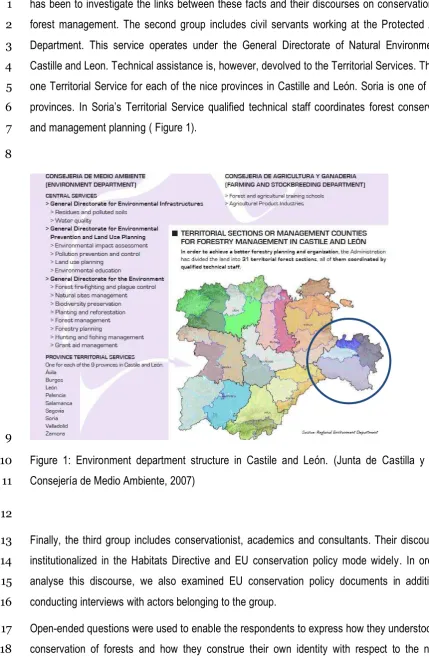
provinces. In Soria’s Territorial Service qualified technical staff coordinates forest conservation 6
and management planning ( Figure 1).
7 8
9
Figure 1: Environment department structure in Castile and León. (Junta de Castilla y León.
10
Consejería de Medio Ambiente, 2007)
11
12
Finally, the third group includes conservationist, academics and consultants. Their discourse is
13
institutionalized in the Habitats Directive and EU conservation policy mode widely. In order to
14
analyse this discourse, we also examined EU conservation policy documents in addition to
15
conducting interviews with actors belonging to the group.
16
Open-ended questions were used to enable the respondents to express how they understood the
17
conservation of forests and how they construe their own identity with respect to the natural
[image:8.595.55.485.74.746.2]8 environment (Fischer & Marshall, 2010; Buijs, et al., 2011). Material collection was undertaken in
1
several stages, starting with exploratory interviews and following with the collection and analysis
2
of documentary material and the bulk of in-depth interviews. Initial interviewees were selected
3
from the lists of participants of policy and other meetings to do with the implementation of
4
conservation policies. Later interviewees were asked to name further potential participants
5
(snowballing). All interviews were recorded and transcribed for analysis. Open coding on the
6
transcripts provided the basis for the discourse analysis. Discourse analysis focused on four main
7
themes: actors’ interests and strategies; discourses on nature conservation; discourses on their 8
environment; and, how actors understood governance of the above-mentioned environment, and
9
their role in their general picture.
10
The conflict in the Natural Park of the Sierra de Urbión
11In Sierra de Urbión, forests have traditionally provided subsistence and income. In the last
12
century, the role of forests underpinned complex relations between the local communities and the
13
state, which created tensions between levels of governance and can still spark conflicts. In what
14
follows, we will first discuss how actors frame the conflict over the designation of the Natural
15
Park, then describe the relevant past and current institutions and in the end explain how the
16
institutions are related to actors’ discourses in the conflict.
17
In June 2009, the inhabitants of the village of Covaleda in Sierra de Urbión were polled over the
18
potential designation of 2,200 hectares of forest as a Natural Park. About half of the people, 848
19
out of 1,678 inhabitants participated in the poll (La Voz de Pinares [local newspaper], 31 July
20
2009). The villagers opposed the designation of the Natural Park by a small majority of only 25
21
votes. The forest was designated as a natural park in February 2010 despite public opposition.
22
In order to analyse how the conflict has been framed, we examined views expressed in a public
23
hearing organized by the head of the Territorial Services in Soria to clarify the controversy over
24
the Natural Park in February 2008 (e.g.: La Voz de Pinares, 11 February 2008) and in public
25
debates to which town council representatives for the environment where summoned to explain
26
the advantages and disadvantages of the Natural Park on the eve of the poll held on the 25th of
27
July of 2009. Furthermore, other views regarding the designation of the Natural Park were
28
collected from local press texts.
29
The conflict over the Natural Park declaration has been framed in economic and property rights
30
terms. Discourses in favour of the declaration emphasised economic opportunities associated
9 with the park, whereas discourses against it were at odds with the constraints to forest access
1
and decision-making rights. In contrast, Natural Park supporters made an effort to separate the
2
discussion on decision-making rights and forest ownership from the debate on forest
3
conservation. For example, some local and regional public authorities highlighted that “regardless
4
of the result of the consultation, property rights will not change”. 5
The village of Covaleda made a formal complaint about the conflict between local and regional
6
competences regarding the Natural Park to the Spanish Constitutional Tribunal (La Voz de
7
Pinares, 8 October 2010). Through this complaint, the village of Covaleda sought recognition of
8
its legal right to manage land within the boundaries of the Natural Park in its jurisdiction. The then
9
Mayor of Covaleda assessed the situation as follows:
10
"They want to make a natural park by law ... and that's what is good ... we’ve had
11
consultations, I don’t know if you were aware, but I made the villager decide, because it’s
12
clear that the mayor can often be wrong when making a decision, so I left the
13
responsibility … about whether to … be part of the park or not to the villagers… the
14
concept that they have of their forest is as their property ... and in the end it turned out
15
that local villagers did not want to belong to this park..."
16
Is the current conflict over the Natural Park just a reincarnation of older struggles around local
17
control over the environment? What can history tell us about the role of institutions, such a forest
18
ownership and the authority to make decisions on forest management in this conflict? In what
19
follows, we will explore in more detail forest ownership and management and how these
20
institutions are embedded in discursive practices on the conflict over the Natural Park designation
21
in the Sierra de Urbión.
22
The historical relationship of Covaleda villagers with forests is important for understanding the
23
conflict over the Natural Park declaration. The designation mostly affects “Public Utility Forests” in
24
the area. Public Utility Forests originate to the establishment of the Public Forest Service (PFS)
25
and the expropriation [Desamortización] of Royal, clerical and municipal land by the State and its
26
subsequent privatisation. PFS, a technocratic unit of professional forest engineers, succeeded in
27
excluding Public Utility Forests from privatisation in 1855 because of the importance of timber and
28
fuel wood as strategic resources (Marraco-Solana, 1991). PFS was given a formal role in the
29
development of forest management plans for Public Utility Forests.
10 A century later, the regional level of Public Forestry Administration (PFA) is still responsible for
1
the management of Public Utility Forests. Yet, most Public Utility Forests are still owned by local
2
communities and managed under long-established local ordinances. The new layer of forest
3
management involving PFS and later PFA was simply added on top of the older communal
4
regime of forest management. Over time many villagers have adopted the technical jargon of
5
those forest management plans. Furthermore, they associate forest conservation to forest
6
management, which aims at maintaining the continued existence of forests by using the
7
maximum sustainable yield criterion for harvesting decisions and by ensuring that forests are
8
regenerated after harvesting. These similarities between discourses on forest conservation
9
between civil servants and villagers in Sierra de Urbión reflect local attempts at gaining legitimacy
10
in front of the public authorities regarding their competence to manage and protect the forests. As
11
a result, the conflict is more about who has the right to manage the forest rather than how the
12
forest should be managed. Villagers’ discourses on their “right to decide” refer to the past as
13
evidence that “they know how to manage their forest”: 14
“We do not want to give away the decision making power over the forest… that we
15
consider as ours… […] they should transfer more... to the local city councils, because…
16
they have demonstrated that they manage their forests well” (Villager).
17
In the study area, a Royal Decree of 1901 entitled villagers to harvest 1500-3500 units of timber
18
depending on the size of their villages (Domínguez-Lerena, 2007; Kleinpenning, 1962). Income
19
from forestry was particularly important after 1950, because poor soil fertility and frequent frosts
20
meant agriculture was not a viable source of income. In the village of Covaleda, the value of each
21
set of pines assigned to a family (approx. 30 m3) could reach the equivalent of 240 euros per
22
annum in 1955-59, when the average annual salary was equivalent to 140 -180 Euros
23
(Kleinpenning, 1962; p. 146). The local administration was responsible for apportioning timber
24
among entitled inhabitants. However, a civil society organization, the local wood board, [junta de
25
maderas], selected the trees to be harvested and sold them ( Lucas-Santolaya, 2000). Junta de
26
maderas usually selected the best pine trees from the forest. Its practices were not always in line
27
with the silvicultural practices approved by forest officers, which was a source of conflict between
28
the villagers and forest authorities (Kleinpenning 1962:87). To sum up, local informal rules and
29
formal rules for over a century have generated a current complex system of forest management
30
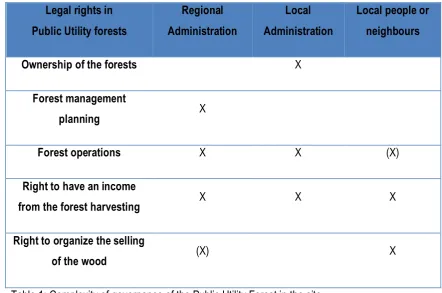
and property rights (Table 1):
11 1
Legal rights in
Public Utility forests
Regional
Administration
Local
Administration
Local people or
neighbours
Ownership of the forests X
Forest management
planning X
Forest operations X X (X)
Right to have an income
from the forest harvesting X X X
Right to organize the selling
[image:12.595.74.517.99.392.2]of the wood (X) X
Table 1: Complexity of governance of the Public Utility Forest in the site
2
Although public administration has taken over forest management, local communities remain the
3
legal owners of Public Utility Forests. The villagers as individuals are not legal owners of the
4
forests, but they are entitled to a share of forest income through each set of pines assigned to a
5
family. The local ordinances defined who is a local and who is not, and who is entitled to benefit
6
from the forest and who is not, in an effort to exclude outsiders from the common forest and the
7
social and political dynamics of the villages. The same logic underlies villagers’ discourses on
8
their right to manage the forest by drawing a boundary between the people who belong to the
9
community and outsiders such as environmental activists, and therefore between those who can
10
legitimately make decisions regarding the forest and those who cannot.
11
“If the environmentalists came here to impose their views ... the same thing would
12
happen as with the government: people would not … be so easily convinced. They can
13
come and see, and give their opinion… [but] we still think that we are the ones that
14
should manage these forests... Not the environmentalists, or the government” (Villager)
15
In addition to being entitled to a share of forest income, the villagers had obligations and
16
responsibilities to participate in communal work in the forests. Local communities also benefited
12 indirectly from publicly funded forest operations and regeneration after logging because villagers
1
were employed in these activities. Property rights are associated with forest income and have
2
substantial economic implications. However, property rights have also other socio-political
3
dimensions which informed i) discourses on the above described past institutional struggles; and
4
ii) villagers’ discourses on their relation with forests due to social and work obligations tied to the
5
entitlement to forest income.
6
Past and present institutions are thus intimately related to the dependency of villagers on natural
7
resources and to the State’s desire to maintain control over them. One local interviewee noted
8
that “the State has always tried to get things from the public… and with forests it was very easy”
9
(Villager). Villagers had already earlier framed the Law 08/1991 on the Protected Natural Areas of
10
Castile and León as “usurpation of their forests” (Villager). Local discourses suggest that forest
11
conservation policies were a threat to their right to decide on Sierra de Urbión:
12
“These new natural parks have a problem: they are managed by the regional
13
government, and so, the link is lost with the people who live in these areas... Because
14
they are not managing them… it should be made clear in the statutes of these national
15
areas and parks, that the management responsibilities should be shared… and that the
16
rights of the villagers should be maintained... because if this area is to maintain its
17
population it will be because of this.” (Villager).
18
The local discourses confront discourses of the civil servants in the Protected Areas Department
19
and the General Directorate of Natural Environment of Castille and Leon. The regional
20
administration uses technical and legalistic discourse to maintain control over decisions on
21
forests and right to intervene despite local opposition. On the other hand, public resources
22
invested in forests are seen by the regional administration and local villagers to guarantee the
23
continued existence of the forest as well as to support local jobs. A public servant responsible for
24
protected areas highlighted that the legal framework determines what is feasible and what is not,
25
and the risk that participatory processes could raise false expectations.
26
“I think we should consider to what extent the requirements fit with the existing structures,
27
or if these could be changed… However, regarding competences or administrative
28
structures... this is a huge qualitative leap… there may be things that are totally
29
impossible… and it’s very important to have this framework clear from the beginning of
30
the process to avoid false expectations or unfeasible things …” (Civil servant).
13 Local discourses also contest Natura 2000 discourses on nature conservation which they define
1
in terms of species and habitats. For instance, a report on the implementation of the Directive
2
92/43/EEC on the conservation of natural habitats and of wild fauna and flora defines the aim of
3
the Natura 2000 as “ensuring biodiversity in the European territory through the adoption of
4
measures for the conservation of natural habitats and wild animals” (Commission of the European
5
Communities, 2004). Before 2001, environmental NGOs developed shadow lists which were used
6
as an input for finalising the lists of designated areas to be protected under the Natura 2000
7
(Weber & Christophersen, 2002). After 2001, environmental NGOs have shifted emphasis to the
8
drafting of guidelines for the preparation of management plans. However, these guidelines do not
9
necessarily integrate forest management plans for habitat conservation.
10
To sum up, our analysis of the conflict in Sierra de Urbión uncovered a long struggle over who
11
should be entitled to make decisions over forests between the regional administration on the one
12
hand, and the local administrations and the villagers on this other. The struggle is rooted in the
13
imposition of forest management plans on communally owned forests, which has weakened the
14
role of local ordinances in forest management. Both institutions inform discursive practices that
15
are used to gain control over forests. Over more than a century, the discourses of civil servants
16
and villagers on forest conservation and management have become intertwined. However, a
17
conflict persists over who has the right to make decisions. Path-dependency and institutional
18
stickiness have reinforced the conflict and other local discourses on forest conservation have not
19
emerged. However, discourses on forest conservation policies emphasising species, habitats and
20
ecosystems are implemented and hegemonic discourses by their protagonists (conservationists
21
and the regional administration) act as barriers to institutional change which would enhance local
22
control over the forests.
23
The collaborative planning process in the Sierra de Cabrejas
24In Sierra de Cabrejas, two local action groups (LAGs, associations of municipalities) promoted
25
the development of the first management plan for a Natura 2000 site in Castile and León. The
26
LAGs were created as mandatory local governance structures required to access EU rural
27
development funds. They involve public and private parties working together on local
28
development strategies and activity portfolios (Fischler, 2000). LAGs have expertise and
29
experience to tap into resources other than the Leader (Tvrdonova, 2008) from sectors such as
30
tourism, cultural legacy, and nature conservation.
14 When the rumours about possible Natura 2000 designation of Sierra de Cabrejas started
1
circulating, a LAG raised awareness by publishing a book on the Natura 2000 sites of importance
2
in the Soria Province and by distributing it to local administration and villagers potentially affected
3
by the protected area. The LAGs also promoted local debates on Natura 2000 through meetings,
4
guided tours to juniper forests, public information material, an information bulletin broadcast in
5
local radio and public discussions. The debates focused on uncertainties such as whether funds
6
will be available; who should be responsible for forest planning and management; and what
7
mechanisms should be used for participation, education and information exchange.
8
In 2003, a synthesis of these debates was presented to the representatives of the State and the
9
EU. The executive manager of the Cid’s Sorian Land Association asked whether a management
10
plan based on civil society involvement would be accepted for the prospective Natura 2000 site.
11
This was the starting point of collaboration for the development of the management plan in Sierra
12
de Cabrejas (Campos-Fernandez & Martín-Olmos, 2006).
13
LAGs’ discourse on Natura 2000 as an opportunity for a participatory process emerged in the
14
socio-economic context of forest abandonment (for more detailed description see below). The
15
absence of economic activity in forests meant the absence of conflict in Sierra de Cabrejas. One
16
LAG representative explained that:
17
“Natura 2000 was something that failed here, we didn’t know what it was and what it was
18
for… how it would affect us… but the very structure of Natura 2000 talked about
19
participation, although the lines were drawn in the land without mentioning it to anyone
20
[…] Then we started to talk to people about how they perceived the conservation of
21
natural spaces, and we decided to move from a general perspective of Natura 2000 to a
22
more specific space… we tried to take advantage of what Natura 2000 can offer… we
23
chose a space that was not very conflictive… because the land use there is minimal and
24
then we decided to act upon a space that practically nobody lives in ”
25
Sierra de Cabrejas had been suffering from rural exodus for the past several decades. For
26
instance, in Calatañazor, one of the biggest villages in the Sierra de Cabrejas, there are only 70
27
inhabitants left and most of them are retired (Instituto Nacional de Estadística, 2010). Avioncillo,
28
a village located in the protected area, had only 10 inhabitants in 2010 (ibid.).
29
However, collaborative planning did not mean that there was no conflict in Sierra de Cabrejas.
30
The Forest Owners’ Association (FOA) opposed the Natura 2000 designation in Sierra de
15 Cabrejas at first with discourses about the burdens to private ownership. FOA and LAG shared
1
the same framing of the problem but had different views on the solutions. While LAG advocated a
2
collaborative process to develop management plans for the Natura 2000 site, FOA promoted
3
enhanced forest management. Interviewed forest owners used economic discourses to call for
4
improved forest management in the area:
5
“It is necessary to take advantage of our assets and to get some money, whatever this
6
money is, to take advantage of the land”
7
In 2010, the FOA initiated a project called “Montes de Socios” to find the successors of the
8
original owners of the forest because under prevailing rules it was becoming impossible to
9
manage the forest when only a minority of owners were known. The idea was to create a
10
management board based on a legal agreement among all co-owners to facilitate
decision-11
making and management of the forest. A national newspaper (El Pais, 28 November 2011)
12
commented on this project as follows:
13
“Natural forests are a very emotive issue; everything that our ancestors did with so much
14
love should be maintained to ensure their survival. And it should be very clear that there
15
is no economic interest, this is more to preserve what our ancestors did”
16
Next, we analyse how the institutional context inherited from the past relates to contemporary
17
discourses. Sierra de Cabrejas was also affected by the State appropriation of Royal, clerical and
18
municipal land. However, in Sierra de Cabrejas only a very limited proportion of forest was
19
declared Public Utility Forest. The appropriated land was auctioned off but municipalities were
20
excluded from buying their own land back. The only way for villagers to maintain access to forests
21
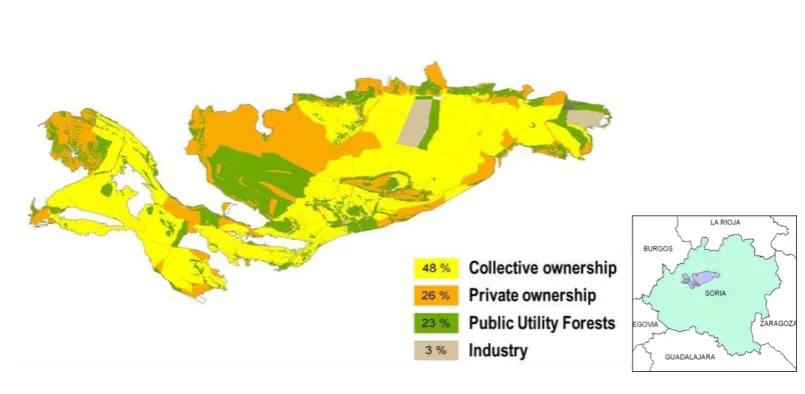
was to buy it back collectively. Collective ownership prevails on 48 % of the land and private
22
ownership accounts for another 23 % (see Figure 2). Today there are 11250 co-owners of the
23
forest, while the villages only have 2822 inhabitants. Many original owners and their descendants
24
have migrated elsewhere without necessarily knowing that they are legal owners of the forest.
25
Many local inhabitants have in turn lost their ownership rights. As all co-owners need to agree on
26
the management of the forest, forest management has become nearly impossible.
16 1
Figure 2: Structure of ownership in the Sierra de Cabrejas. Source: (CESEFOR, 2008).
2
The average size of a parcel of forest is 3.6 hectares. Forest income is estimated to be less than
3
12 Euros per hectare per year. The FOA considered that low productivity and the small proportion
4
of landowners resident in the area explain the abandonment of forest (ibid). About 3% of the
5
protected area (in grey) belongs to truffle industry. The remaining 26 % of the land consists of
6
Public Utility Forests which have a mean plot size of 239 hectares. The Public Utility Forests are
7
located between Sierra de Urbión and Sierra de Cabrejas, and their tree species composition is
8
mainly pine with some oak. The only Public Utility Forest where Spanish juniper is the main tree
9
species is in the village of Cabrejas.
10
Juniper forests have not been traditionally object of forest management planning in the province
11
(Lucas Santolaya, 1998), because of their slow growth of only about 0.5 m3/ha per annum. More
12
recently, a public utility forest with Spanish juniper as the main specie has adopted innovative
13
forest management planning to reconcile habitat conservation, provisioning of wood, grazing and
14
game, and recreational use (Sabin & Fernández, 2006). In privately owned land, Spanish juniper
15
is harvested without management plans or guidelines although harvesting needs a permit and in
16
most cases a forester would choose the trees to be harvested.
17
Here, governance system on the forests is simpler than in Public Utility forests, since most of the
18
legal rights are devolved in private and collective owned forests (Table 2).
17 1
Legal rights in private and
collective owned forests
Forest
Administration
Local
Municipalities
Local people or
neighbours
Ownership of the forests X
Forest management planning X
Forest operations (X)
Right to have an income from
the forest harvesting X X X
Right to organize the selling
[image:18.595.60.518.108.551.2]of the wood X
Table 2: Governance and rights in private and collective owned forests (Montes de Socios)
2
The lack of strong forest institutions and institutional struggles for the right to decide translates to
3
the dominance of economic discourses in the case study. Despite the low economic productivity
4
of the forest, local counter-discourses call for compensation for limited access to forest resources.
5
This claim is in line with international discourses on payments for carbon sequestration. Many
6
owners argue that if their forests are carbon sinks, they must receive a payment for this service.
7
“The forests are giving enough to the society, enough to take us into account, aren’t
8
they? We are not asking for subsidies, we only want them to pay for our contribution…
9
this would be the logical thing…” (Forest owner)
10
This discourse on payments for carbon sequestration is present in both cases. But in Sierra de
11
Cabrejas, the forest is conserved because of its abandonment rather than management,
12
weakening the argument about environmental services provided:
13
“If this area has been protected it is for a reason… it’s because it’s very well preserved…
14
it is precisely an area where there is no activity… there are no people, there is nothing”
15
Despite its initial opposition to Natura 2000, FOA participated actively in the collaborative
16
planning process initiated by the LAGs. Private forest owners’ discourses on private property
18 were absorbed into participatory process through the creation of a thematic area on property.
1
In the case the alignment of LAGs’ discourse on conservation with participation became
2
institutionalized as a practice because it was in line with emerging official EU discourses on public
3
participation. Furthermore, small population living in the area weakened the chances of
counter-4
discourses. But although the developed Natura 2000 management plans enjoy legitimacy in the
5
eyes of all involved actors, LAGs remain in a weak position since they are dependent on regional
6
administration’s acceptance and support. In 2012, the LAGs considered that it would be difficult to
7
obtain any national or regional funds for further activities in the protected area due to the
8
economic crisis in the country. One LAG member assessed the situation as follows: i) finance is
9
coming to an end and therefore they cannot afford the staff or consultancy payments; ii) there is
10
no clear signal from the regional administration about the next step after the approval of the plan;
11
and iii) there is no strong interest in the local administration to follow up the process.
12
To conclude, abandonment of land and low forest income favoured the framing of Natura 2000 as
13
an opportunity for involving villagers in the development of management plans for the protected
14
area and or increasing their voice over the implementation of forest conservation policies. The
15
new management plan would have had a chance to set a new agenda for forest conservation in
16
the Sierra de Cabrejas. However, legal and economic contexts undermined it in the end.
17
Discussion
18In Sierra de Urbión, discourses highlighting economic concerns and the right to make decisions
19
about forests were in conflict with forest conservation. Other studies on Soria have demonstrated
20
that forest heritage influences land tenure, land ownership and land use rights, as well as social
21
conflicts over them (Montiel, 2007). In Sierra de Urbión, historical property rights largely explain
22
the conflict over the designation of the Natural Park. Although the forest management discourse
23
is shared by the villagers and the regional administration, the struggle over who is entitled to
24
make decisions on forest remains unsettled and is at the root of the conflict. 25
New institutional scholars have shown how common property is structured by formal and informal
26
institutions, and how these institutions can play a role in preventing environmental degradation by
27
sanctioning mechanisms and by enhancing communication and cooperation (Berkes, 2004;
28
Laerhoven & Ostrom, 2007; Ostrom, et al., 1994; Ostrom, 1990). Self-organized rule making
29
partly explains why some groups govern their forests successfully (Andersson, et al., 2014).
19 In Sierra de Urbión, such institutions are embedded in local discourses that have shaped: i) the
1
shared understanding of forest management among regional administration and villagers; and ii)
2
the struggle over who should have decision-making authority on forests. Here, the historical
3
institutional context has impacted on the implementation of forest conservation policies leading to
4
discourses on ownership and local control. In Sierra de Urbión, path-dependency has reinforced
5
the frame on who has the right to make decisions over forests. Raitio (2012) has similarly found
6
that traditional forest planning involves a set of informal rules reinforcing formal rules for timber
7
production even at the expense of other rules regarding participation.
8
In contrast, forest conservation was framed as an opportunity in Sierra de Cabrejas and as a
9
result a collaborative process emerged. Sierra de Cabrejas differs from Sierra de Urbión in three
10
key respects: In the former there is i) limited dependency on forests as most income is obtained
11
from agriculture and rural development funds; ii) limited role of public utility forests and forest
12
management plans; and, iii) substantial abandonment of forested land.
13
Limited dependency on forests explains why EU rural development and nature conservation
14
policies had a bigger influence in Sierra de Cabrejas than forest policies. Limited dependency on
15
forests and limited role of public utility forests and forest management plans translate to fewer
16
formal and informal forest-related rules operating at local level, and therefore to bigger
17
permeability to rules originating from other policy areas. Collaboration in Sierra de Cabrejas was
18
influenced by experiences gained from the implementation of European rural development
19
programmes. The formal and informal rules adopted by the LAGs and leadership were crucial for
20
the emergence of collaborative planning.
21
Second, the weakening of historical forest management institutions led to openness to new
22
discourses on forest conservation and rural development. New actors involved in forest
23
conservation introduced new frames on species and habitats, disassociated from rules that have
24
been part of forest policies in the past. This institutional vacuum created space for new ideas that
25
have been been institutionalized in policy arrangements and practices (den Besten et al., 2013).
26
Third, the abandonment of forest and the lack of dissenting views on forest use planning in Sierra
27
the Cabrejas facilitated the adoption of other frames and the emergence of collaboration.
28
In both cases economic discourses are accepted and shared among most actors. However, they
29
are decoupled from conventional forest production in the Cabrejas Mountains. Instead, LAG
30
seeks European Union funding and conservation discourses are integrated into broader
20 discourses of rural development policy. LAGs’ discourse is coherent with the on-going discourses
1
and practices on rural development. LAG became an agent of rural change, with knowledge of
2
EU procedures and pro-active attitude for fundraising and rural development.
3
Finally, legalistic discourse on forest conservation prevented local discourses from achieving
4
institutionalisation in the sense of institutional change in both cases. Regional civil servants and
5
environmentalists have aligned positions and discourses. The State and its bureaucracy are
6
considered responsible for the implementation of forest conservation policies The implementation
7
of nature conservation policy in Europe has been criticized for giving little attention to local
8
stakeholders since implementation of conservation has been based on ecological criteria rather
9
than on local knowledge (Beunen & Vries, 2011; Buijs et al., 2011; Ferranti, et al., 2013). The
10
legalistic interpretation of Natura 2000 has resulted in overly formal and bureaucratic translation
11
of its directives into local management plans (Beunen & Vries, 2011) which leaves limited space
12
for stakeholder participation (Ferranti, et al., 2010; Stoll-Kleemann, 2001). So despite the
13
adoption of participatory policy planning in Sierra de Cabrejas, what should be protected and how
14
is prioritised by scientific discourses over who has the right to decide on forests.
15
Conclusions
16This article shows that differences in the local institutional contexts influence discursive practices
17
and dominant discourses in the two examined cases. In Sierra de Urbión, path dependencies
18
related to property rights and governance arrangements act as a double-edged sword: actors
19
resisting the National Park claimed rights to manage their forest, while actors in favour of the Park
20
confined the public debate to economic benefits and compensation. Resurgence of past
21
institutional struggles over the forests directly challenged who has the right to decide on forests
22
and as a result the conflict persisted. In Sierra de Cabrejas, discourse on participation enabled
23
the framing of forest conservation policy as an opportunity. This, together with limited
24
dependency on forests, limited role of forest institutions and depopulation, enabled the
25
emergence of a collaborative planning process.
26
We demonstrated how the local institutional context explains the emergence of conflict or
27
collaborative planning. However, we also demonstrate that local counter-discourses are
28
prevented from achieving institutional change by the legalistic and scientific discourses of
29
regional authorities and environmental organisations.
21
References
1
Agrawal, A. (2001). Common property institutions and sustainable governance of resources.
2
World Development, 29(10), 1649–1672.
3
Andersson, K., Benavides, J. P., & León, R. (2014). Institutional diversity and local forest
4
governance. Environmental Science & Policy, 36, 61–72.
5
Arts, B., & Buizer, M. (2009). Forests, discourses, institutions: A discursive-institutional analysis
6
of global forest governance. Forest Policy and Economics, 11, 340–347.
7
Berkes, F. (2004). Rethinking Community-Based Conservation. Conservation Biology, 18(3),
8
621–630.
9
Beunen, R., & Vries, J. R. De. (2011). The governance of Natura 2000 sites : the importance of
10
initial choices in the organisation of planning processes. Journal of Environmental Planning
11
and Management, 37–41.
12
Bjorkell, S. (2008). Resistance to Top-Down Conservation Policy and the Search for New
13
Participatory Models The Case of Bergo-Malax’ Outer Archipelago in Finland. In J. Keulartz
14
& G. Leistra (Eds.), Legitimacy in European Nature Conservation Policy: Case Studies in
15
Multilevel Governance (Vol. 14, pp. 109–126).
16
Buijs, A., Arts, B., Elands, B., & Lengkeek, J. (2011). Beyond environmental frames: The social
17
representation and cultural resonance of nature in conflicts over a Dutch woodland.
18
Geoforum, 42(3), 329–341.
19
Campos-Fernandez, S., & Martín-Olmos, J. (2006). Enebrales de la sierra de Cabrejas (Soria): el
20
valor social de la gestión participada en Natura 2000. In III Coloquio Internacional sobre
21
sabinares y enebrales (género Juniperus): Ecología y gestión forestal sostenible. (pp. 13–
22
23).
23
Cashore, B., Hoberg, G., Howlett, M., Rayner, J., & Wilson, J. (2001). In Search of Sustaina-
24
bility: British Columbia Forest Policy in the 1990. Vancouver: University of British Columbia
25
Press.
26
CESEFOR. (2008). Estudio del régimen de propiedad del LIC Sabinar Sierra de Cabrejas.
27
“Aplicación a la gestión de Espacios pertenecientes a la Red Natura 2000” (p. 12).
28
Cleaver, F. (2000). Moral Ecological Rationality , Institutions and the Management of Common
29
Property Resources, 31, 361–383.
30
Commission of the European Communities. (2004). REPORT FROM THE COMMISSION on the
31
implementation of the Directive 92/43/EEC on the conservation of natural habitats and of
32
wild fauna and flora (pp. 1–32). Brussels.
33
Den Besten, W. J., Arts, B., & Verkooijen, P. (2013). The evolution of REDD +: An analysis of
34
discursive- institutional dynamics. Environmental Science and Policy, 1–9.
22 Domínguez Lerena, S. (2007). Pinar grande. 100 años de gestión sostenible: 1907-2007.
1
(Mancomunidad de los 150 pueblos & Ayuntamiento de Soria, Eds.) (p. 179). Soria.
2
Europarc-españa. (2007). EnREDando. Herramientas para la comunicación y la participación
3
social en la gestión de la red Natura 2000 (Fundación ., p. 216). Madrid.
4
European Commission. (2003). Natura 2000 and forests. Challenges and opportunities.
5
Luxemburg: European Communities.
6
European Commission. (2005). LIFE Focus / Integrated management of Natura 2000 sites. The
7
contribution of LIFE projects. (p. 51). Luxemburg.
8
Ferranti, F., Beunen, R., & Speranza, M. (2010). Natura 2000 Network: A Comparison of the
9
Italian and Dutch Implementation Experiences. Journal of Environmental Policy & Planning,
10
12(3), 293–314.
11
Ferranti, F., Turnhout, E., & Beunen, R. (2013). Shifting nature conservation approaches in
12
Natura 2000 and the implications for the roles of stakeholders. Journal of Environmental
13
Planning and Management, 1–16.
14
Fischer, A., & Marshall, K. (2010). Framing the landscape: Discourses of woodland restoration
15
and moorland management in Scotland. Journal of Rural Studies, 26(2), 185–193.
16
Fischler, R. (2000). Communicative planning theory: a Foucauldian assessment. Journal of
17
Planning Education and Research, 19, 358–368.
18
Forestiere, C. (2008). New Institutionalism and Minority Protection in the National Legislatures of
19
Finland and Denmark. Scandinavian Political Studies, 31(4), 448–468.
20
Hall, A., & Taylor, R. C. R. (1996). Political science and the three newinstitutionalisms. Political
21
Studies, 44, 936–957.
22
Hiedanpää, J. (2002). European-wide conservation versus local well-being: the reception of the
23
Natura 2000 Reserve Network in Karvia, SW-Finland. Landscape and Urban Planning,
24
61(2-4), 113–123.
25
Hiedanpaa, J. (2005). The edges of conflict and consensus: a case for creativity in regional forest
26
policy in Southwest Finland. Ecological Economics, 55(4), 485–498.
27
Hillier, J. (2003). Agonizing over consensus: why Habermasian ideals cannot be “real.” Planning
28
Theory, 2, 37–59.
29
Idrissou, L., van Paassen, A., Aarts, N., & Leeuwis, C. (2011). From cohesion to conflict in
30
participatory forest management: The case of Oueme Superieur and N’Dali (OSN) forests in 31
Benin. Forest Policy and Economics, 13(7), 525–534.
32
Instituto Nacional de Estadística. (2010). INEbase / Demografía y población / Padrón. Población
33
por municipios. Retrieved October 06, 2014, from
34
http://www.ine.es/inebmenu/mnu_cifraspob.htm
23 Julien, B., Lammertz, M., Barbier, J., Jen, S., Ballesteros, M., & Bovis, C. de. (2000). VOicing
1
Interests and Concerns : NATURA 2000 : An ecological network in conflict with people
2
Contributions from : Forest Policy and Economics, 1, 357–366.
3
Junta de Castilla y León. Consejería de Medio Ambiente. (2007). Forest: signs of life in Castile
4
and Leon.
5
Keough, H. L., & Blahna, D. J. (2006). Achieving integrative, collaborative ecosystem
6
management. Conservation Biology : The Journal of the Society for Conservation Biology,
7
20(5), 1373–82.
8
Kleinpenning, G. (1962). La región pinariega. Estudio geográfico del noroeste de Soria y Sudeste
9
de Burgos (España) [The pinewood region. Geographic study of the northeast of Soria and
10
Southeast of Burgos].
11
Krott, M., Julien, B., Lammertz, M., Barbier, J.-M., Jen, S., Ballestreros, M., & de Bovis, C. (2000).
12
Voicing interests and concerns: NATURA 2000: An ecological network in conflict with
13
people. Forest Policy and Economics, 1, 357–366.
14
Laerhoven, F. Van, & Ostrom, E. (2007). Traditions and Trends in the Study of the Commons,
15
1(1), 3–28.
16
Leach, M., Mearns, R., & Scoones, I. (1999). Environmental entitlements: Dynamics and
17
institutions in community-based natural resource management. World Development, 27(2),
18
225–247.
19
Leipold, S. (2014). Creating forests with words — A review of forest-related discourse studies.
20
Forest Policy and Economics, 40, 12–20.
21
Lucas Santolaya, J. A. (1998). Gestión, Aprovechamiento y desarrollo sostenible de las masas
22
de enebro, jabino o sabina albar (Juniperus thurifera L) en Soria. Montes, (52).
23
Lucas Santolaya, J. A. (2000). El modelo Soria: las suertes de pino y la ordenación forestal de la
24
comarca pinariega Burgos-Soria, bases del desarrollo rural, de la conservación de los
25
bosques y modelo de gestión sostenible del patrimonio natural.
26
Marraco Solana, S. (1991). La política forestal española: evolución reciente y perspectivas.
27
Revista Estudios Agro-Sociales, 158.
28
Montiel Molina, C. (2007). Cultural heritage, sustainable forest management and property in
29
inland Spain. Forest Ecology and Management, 249(1-2), 80–90.
30
North, D. C. (1990). Institutions, Institutional Change and Economic Performance. Cambridge:
31
Cambridge University Press.
32
Ostrom, E. (1990). Governing the Commons: The Evolution of Institutions for Collective Action.
33
Cambridge and New York: Cambridge University Press.