promoting access to White Rose research papers
White Rose Research Online [email protected]
Universities of Leeds, Sheffield and York
http://eprints.whiterose.ac.uk/
White Rose Research Online URL for this paper: http://eprints.whiterose.ac.uk/42845/
Published paper:
REACHING THE MDG TARGET FOR SANITATION IN AFRICA
– A CALL FOR REALISM –
Good Practice Notes 2010
Ministry of Foreign Affairs Danida
Reaching the MDG target for sanitation in Africa – A call for realism
February 2010
Publisher
Ministry of Foreign Affairs Asiatisk Plads 2
DK 1448 Copenhagen K Denmark
Phone: + 45 33 92 00 00 Fax: + 45 32 54 05 33 Email: [email protected] Internet: www.um.dk
Design
Technical Advisory Services
Cover photo: Jørgen Schytte / Danida
The publication can be downloaded or ordered from: www.danida-publikationer.dk
The text of this publication can be freely quoted
3
Preface
This leaflet contains a set of Good Practice Notes on challenges in connection with provision of sanitation services from the perspective of international development assistance. It contains a synthesis paper:
• Reaching the MDG Target for Sanitation in Africa – A Call for Realism
and four issue papers:
• Building political commitment for sanitation in a fragmented institutional landscape • Hooked on sanitation subsidies
• Challenges in supporting hygiene behavior change • Measuring progress in sanitation
The general purpose of Danida’s Good Practice papers is to provide operational and technical guidance for use within Danish development assistance.
The synthesis paper has been prepared by the Technical Advisory Services (UFT) of the Danish Ministry of Foreign Affairs with assistance from Flemming Konradsen, Jens Bjerre and Barbara Evans. The authors of the issues papers are credited in the respective papers. A draft version of the papers was discussed during the Danida Water & Sanitation Sector Seminar in Livingstone, Zambia in October 2009. The participants comprising Danish Embassy staff, partner country officials, sector technical advisors, researchers and consultants provided comments and suggestions that have contributed to the final version of the papers. The Technical Advisory Service would like thank all those that have contributed for their valuable input, time and assistance.
4
5
Contents
LIST OF ABBREVIATIONS 7
REACHING THE MDG TARGET FOR SANITATION IN AFRICA – A CALL FOR
REALISM 8
Introduction 8
An historical review of sanitation 8
The Sanitation Challenge – Globally and in Africa 10
Political Barriers 10
Economic Barriers 11
Participatory and Technological Barriers 12
Monitoring Barriers 13
The Response 13
Political Approaches to Improved Sanitation 13
Coordination and alignment 14
Improving Funding and Resource Practices to Improve Sanitation 14
Use of funds within the sector 14
Concepts and approaches 15
Monitoring Approaches to Improved Sanitation 15
Conclusions 15
References 16
BUILDING POLITICAL COMMITMENT FOR SANITATION IN A FRAGMENTED
INSTITUTIONAL LANDSCAPE 19
Lack of political commitment to sanitation 19
Lack of funding to support sector needs 19
Decentralisation and a diversified institutional landscape 20
The cost of inaction 20
The many actors in sanitation 20
How to build political commitment 21
A way forward 21
References 22
HOOKED ON SANITATION SUBSIDIES 24
Background 24
The rationale behind subsidies 24
Do Hardware Subsidies Work? 26
What goes wrong with hardware subsidies for rural sanitation? 27
Are hardware subsidies the most effective use of public money? 28
Subsidies that work 29
Conclusions 30
References 30
CHALLENGES IN SUPPORTING HYGIENE BEHAVIOUR CHANGE 32
The rationale for hygiene promotion 32
6
Approaches in Hygiene Promotion and Hygiene Behaviour Change 33
The need for focus 35
The challenge of coordination and delivery 36
Identifying golden opportunities for hygiene promotion 37
How can aid make a difference in hygiene promotion? 38
Conclusion: A Way Forward? 38
References 39
MEASURING PROGRESS IN SANITATION 42
Introduction 42
Current Global Monitoring Programme Description 42
Toward the Future: Improving Monitoring Systems to Meet the MDG Target for Sanitation 46
Conclusion 49
7
List of Abbreviations
CHC Community Health Clubs
CLTS Community-Led Total Sanitation
DALY Disability Adjusted Life Years
DCD-DAC Development Cooperation Directorate
IEC Information, Education and Communication
IDE International Development Enterprises
IMCI Integrated Management of Childhood Illnesses
JMP Joint Monitoring Programme
GDP Gross Domestic Product
GWP Global Water Partnership
MDG Millennium Development Goals
OECD Organisation for Economic Co-operation and Development
ORT Oral Rehydration Therapy
PHC Primary Health Care
PHAST Participatory Hygiene and Sanitation Transformation
SWAps Sector-wide approaches
TPPF Twin Pit Pour Flush Latrines
VIP Ventilated Improved Pit Latrines
WHO World Health Organisation
WSP Water and Sanitation Programme
8
Reaching the MDG target for sanitation in Africa – A call for realism
Introduction
It is estimated that 2.5 billion people (app. 38% of the global population) do not have access to basic sanitation. Globally, the shortage of such essentials contributes to the estimated 2.2 million annual deaths related to poor personal hygiene, lack of sanitation and insufficient water supply (1). In 2006, 62% of the population in Africa lacked access to improved sanitation facilities with only five of the 54 African countries on track to meet the Millennium Development Goals (MDG) sanitation target (2). For Africa, to meet its MDGs for sanitation, the number of persons reached must double from 350 million to 700 million by 2015; even if achieved; this will still leave 200 million people unserved. The low sanitation coverage is illustrated by countries that have such programmes supported by Denmark: Bénin 19%, Burkina Faso 10%, Niger 5%, Ghana 31%, Kenya 43%, Uganda 58% and Zambia 13% (3).
Denmark has a long history of support to the sanitation sub-sector and played a proactive role in setting the MDG target on sanitation in Johannesburg in 2002. Danish assistance to sanitation and hygiene comprises both bilateral and multilateral support. Despite significant efforts to push the sanitation agenda – in particular in rural areas - a recent evaluation of Danish bilateral support to this sector highlighted sanitation as an area that has not received adequate attention from either Danida or the recipient country governments and stakeholders (4). This assessment mirrors the current global situation in the sanitation sub-sector, i.e. not enough has been done. The current global response is that “we must do more” if we are to reach the MDG targets for sanitation. The questions are what exactly should and can be done, and what aid modality for support to the sector would be the most effective to follow considering the lessons learned – good or bad – over the past 30 years.
The purpose of this paper is to discuss central challenges in connection with providing sanitation services from the perspective of international development assistance.
Environmental sanitation encompasses management of human excreta, storm water, grey water, solid waste, hazardous, and industrial wastes. For public health reasons this paper will focus on management of human excreta and the prevention of diseases associated with the faecal-oral transmission route.
The discussion in this paper will primarily concentrate on sanitation interventions to separate, contain and dispose of human excreta focusing on the construction, use and proper management of some sort of latrine. Key hygiene behaviour will also be considered, especially hand washing at critical times and disposal of children’s faeces. The technological and institutional aspects of central treatment options for human excreta or issues of reuse will not be covered in any detail.
An historical review of sanitation
Industrialised nations
9
provided to stimulate the provision of public sanitation services in dense industrialized urban settlements in the interest of public health. The typical pattern saw local authorities providing main sewers or dry sanitation systems, storm-water drainage and solid waste management services. Provision of in-house facilities was either left to individual households or landlords, with some enforcement of legislation to encourage this investment, or provided through public finance. Full coverage of networks of water borne sewerage systems took many decades to achieve. Meanwhile, many households continued to use dry privies or shared facilities. Once urban areas were fully covered, systems expanded outwards into rural areas, although generally with a lower level of public finance. Today, in most of the industrialized world, coverage of hygienic sanitation is universal and enforced by legislation.
Transfer to Africa and Asia – The international decade
In the 1960s and 1970s, the dominant paradigm of urban industrialised sanitation was transferred through development projects and international support to countries in Africa and Asia – which had already by and large inherited the associated technical norms and standards. It was only in the 1980s, due to the work of a few pioneering thinkers, that the realisation dawned that rural sanitation in Africa bore little resemblance to urban sanitation in Manchester (5).
During the late 1970s, development of new, simpler and more appropriate technologies (for example Ventilated Improved Pit Latrines, VIP, and Twin Pit Pour Flush Latrines, TPPF) began. Subsequently, there was increased thinking about how to improve long term operational sustainability through, for example, community management. In the water sector this was most notably characterised by the concept of Village Level Operation and Maintenance or VLOM Handpumps. At this time, most sanitation programmes had some kind of subsidy for the hardware and often subscribed to one choice of technology.
The 1980s and 1990s: Questions of scale and sustainability
During the 1980s and early 1990s, the approach of supply-driven latrine construction with subsidies provided to a target group who satisfied certain preconditions was highly successful in boosting the coverage numbers. This method was particularly successful in South Asia where sanitation latrine construction targets of tens of thousands per year were common. However, in the early 1990s there was growing concern that even with the availability of new, ‘appropriate’ technologies, water supply and sanitation systems were not being used or maintained, but were frequently falling into disrepair. Later, the approach to sanitation changed to include not only subsidies, but also hygiene education, including mass media campaigns, however, increased access to latrines and water facilities plus increased knowledge about hygiene was not necessarily sufficient to motivate hygiene behaviour change.
10
Into the new millennium
In the late 1990s and 2000s, a pioneering approach to rural sanitation emerged in Bangladesh. Community-Led Total Sanitation (CLTS) moved away once more from the use of hardware subsidies and focused on community-wide empowerment and joint action to eliminate open defecation. Successful examples are now seen in Asia and recent programmes like the one in Choma District, Zambia offer examples of Africa’s success in this area also (8). While CLTS has proved highly effective at triggering a shift away from open defecation, the question of how to provide long term support for continued behaviour change and improved sanitation provision remains to some extent unanswered (9). A major challenge of the new era is how to achieve widespread, national sanitation coverage using a model that is inherently time consuming and requires a high level of effort at the community level
The UN declared 2008 the International Year of Sanitation (10), which resulted in increased political focus on the issue. It also provided an opportunity for reflection on progress towards meeting the MDG targets and afforded involved actors an opportunity to review past efforts and gather lessons learned. Currently, there is a global acknowledgment that the major share of the responsibility to improve sanitation rests firmly with the African and South Asian regions. To that end, a number of African countries have or are developing sanitation policies and sanitation implementation programmes.
The Sanitation Challenge – Globally and in Africa
Having discussed the historical development of urban and rural sanitation, it is also necessary to clearly understand the context and contributors to the global sanitation challenge. These challenges can be grouped into political, economic, participation, technical and monitoring barriers, each of which is addressed below.
Political Barriers
Lack of political commitment
Sanitation is not given the attention it requires by governments, civil society or donors as evidenced by the meagre priority assigned to the issue in most poverty reduction strategies. It is often stated that water is life but sanitation is dignity. If so, then it is a puzzle why sanitation so often is “left behind”. Why schools and health centres are still built without toilets; and access to toilets lags behinds access to water supply; and that sanitation has failed to be translated from commitments to national policy and into budget lines in the ministries of finance in most countries.
11
Economic Barriers
Limited economic growth and restricted social development
Without accelerated economic growth and social development it is unrealistic to expect significant advances in rural sanitation coverage. As long as communities and governments have limited resources, the available funds will most likely be directed to productive activities. Awareness about sanitation and hygiene issues may often be present, however, for the households and for governments the priority would be on feeding the family and creating an environment for growth, respectively. Unfortunately, few governments and households identify poor sanitation as an impediment to economic growth and seem to not to have acknowledged that investing in sanitation brings very significant economic returns (8). As a result of modernization in some Asian countries, sanitation coverage has increased gradually as economic growth spread in Asia’s poorer countries. It remains to be seen if the same will happen in Africa.
Lack of funds
According to the Development Cooperation Directorate (DCD-DAC) of the OECD, aid for water supply and sanitation has increased since 2001 following a temporary decline in the 1990s. The combined annual bilateral and multilateral support to water supply and sanitation in 2007 was USD 6.2 billion, with approximately 26% for support to Sub-Saharan Africa. Unfortunately, the information from the OECD does not allow for a breakdown of the support into separate components of water, sanitation and hygiene promotion. However, a closer review of a sub-sample of programs found an estimated 50% for water supply, 20% for sanitation and 30% for activities combining water supply and sanitation. Separate information on hygiene promotion cannot be obtained. The Global Water Partnership (GWP) estimates that the expenditure for basic sanitation to meet the 2015 MDG sanitation target is USD 17 billion annually, indicating a significant deficit in the current funding allocation before the targets can be achieved (13). It is estimated that basic sanitation improvement in Africa needs an investment of between 40 and 90 USD per capita and between 26 and 50 USD in Asia.
Inappropriate use of funds
A study by the World Bank in the late 1990s found that investments in sanitation tended to be skewed towards urban sewerage and wastewater treatment. These are services which tend to serve small sections of society (usually the rich) and have little or no public benefit unless universal access is achieved. Studies have noted that public funding for rural sanitation has tended to be poorly targeted (14;15) and there is insufficient attention to recurrent budgets to support extension work and long term support to communities (16).
12
Insufficient private sector involvement
When compared with sanitation, water remains a more attractive field for investment (by donors, government and community) and the lack of a commercial market for sanitation services undermines the sustainability of the sector. Sanitation is often seen as a field with low creditworthiness and low potential for income generation and aid programs and governments may lack the focus on policies and incentives that make sanitation services more attractive for the commercial sector. A recent study of WaterAid programmes in Bangladesh, Nepal and Nigeria found that the reach of the private sector was a significant factor in improving the cost effectiveness and scale of the programme in Bangladesh (9).
The demand problem
Cultural barriers, market failure and lack of information, hamper households from making informed decisions about sanitation (18). Traditional approaches to improving sanitation, which are aimed at building facilities, have not resulted in significant and sustained coverage. Where sanitation coverage is low, demand may be ‘latent’ – that is, demand may not emerge until an external stimulus is applied. Changing sanitation behaviours requires and understanding of the market stimuli that will enable increased use of improved sanitation. Recent promising strategies have focused on creating demand for improved sanitation by changing behaviours while simultaneously strengthening the availability of supporting products and services (19). The experiences with CLTS illustrate this effect particularly well. To make progress, households must prioritise sanitation and allocate resources out of an often tight household budget. Demand for improved sanitation is usually only expressed by those who have some type of sanitation already and who have surplus in the “household budget”.
Participatory and Technological Barriers
Choice of appropriate technologies
Choice of technology and the demand problem are closely linked. Latrine designs are hardly rocket science, but deciding what solutions to promote still causes much controversy. For both rural and urban areas, it is still difficult to strike a balance between cost, functionality, security, risk, and adaptability to local context (both technically and culturally.) It is further difficult for technocrats to agree on the definition of improved sanitation - improved according to whose standard? Piped sewerage or individual septic tanks are often preferred by utility engineers, but both are expensive solutions. Onsite sanitation is frequently considered to be a suitable solution for the urban poor (and in so-called peri-urban areas,) but there is often insufficient space and no facilities for managing sludge. In rural sanitation the problem is often less about technology choice and more about good engineering. Many thousands of latrines are built in rural Africa that are neither properly designed nor built well enough to provide real protection.
13
Monitoring Barriers
What is being measured?
The defined target for MDG 7 is to reduce by half the proportion of people without sustainable access to safe drinking water and basic sanitation. As defined, the indicators used to measure the achievement of this target are: 1) Proportion of the population using an improved drinking water source; and 2) Proportion of the population using an improved sanitation facility. While the indicators properly designate usage as the measured variable, coverage is most often what is actually measured. The WHO/UNICEF Joint Monitoring Program for water supply and sanitation seem to use the terms usage and coverage interchangeably, but the actual measurement used is coverage (i.e. the physical presence of an improved sanitation facility.) The use of this rather simplistic indicator may be leading to short term strategic choices that compromise long term sustainability. Counting only the number of available latrines may be masking the extent of the real global sanitation problem. For example, in South Africa the very rapid scale up of sanitation in urban areas has resulted in millions of single pit latrines being constructed in municipalities that have neither developed strategies nor capacities to empty them. A study by UN Habitat in the Lake Victoria region also suggests that coverage figures significantly overestimate those with ‘adequate’ sanitation (20).
Even if the target for MDG 7 is reached by 2015, millions will remain uncovered and many of the latrines that ‘count’ as coverage for target tracking purposes will still offer only very limited disease protection. Also, for investments in sanitation to reach their full potential, appropriate personal and sanitary hygiene practices will be needed, requiring a long term effort and much greater focus on effective hygiene promotion than in the past.
The Response
There are a number of important steps that can be taken to address the global sanitation challenge in each of the discussed areas. Political, financial, technological and monitoring approaches are addressed below.
Political Approaches to Improved Sanitation
Increased policy focus
14
Coordination and alignment
The emerging new development assistance architecture in the form of Sector-wide approaches (SWAps) and joint funding mechanisms opens new possibilities in sanitation development. The adoption of a SWAp creates the opportunity for reaching consensus around the best national strategic sanitation development policies and programmes and facilitates improved government leadership of sanitation development. The SWAp is a tool to coordinate the contributions of development partners and other stakeholders within a common framework. It identifies whether and how partners can support the national strategy and ensures that contributions from all partners are consistent and complimentary with each other (21).
Advocacy
Too often sanitation takes a backseat in the national reform agenda and does not attract the necessary attention among decision makers or in the public at large. It is clear that, to facilitate an increased demand for sanitation and to secure public investments in the sector, more professional and well targeted advocacy initiatives need support. This will demand a dialogue between civil society organisations and departments responsible for water, sanitation and hygiene promotion, support to media activities dissemination of studies highlighting the benefits of sanitation and documented successful approaches for a sanitation transformation
Improving Funding and Resource Practices to Improve Sanitation
Use of funds within the sector
Because funds are so scarce, it is clear that the focus in national policies will have to shift towards investments in demand creation and to supporting a private sector capable of providing a commercially viable service. The problem for poor households may not be the unwillingness to pay, but that the upfront investment may be cost prohibitive for them. In such a situation, government or international support for the establishment of community based or commercial microfinance schemes for household latrines, construction of public toilets, latrine cleaning services etc., may provide significant opportunities to close the financial gap encountered by most families in the start-up phase (22). In this context, subsidies may be used to offer low interest rates on loans or to be exempted from certain administrative charges. However, subsidies should never be used in a way that undermines the existing private providers in the market or the established credit organisations.
In some urban municipalities, models that allow cross subsidies from water into sanitation could be further explored. Even if financing the construction of household level latrine systems in urban areas is achieved, ensuring the revenue for the operation and maintenance of sewerage and pit waste collection and management and treatment systems may still be an enormous challenge for public budgets. Revenues from the water sector could potentially be used to support the long term operation of sludge management in many urban areas, although this does require the political willingness to levy realistic water tariffs. In urban areas, the relationship between land tenure and the right to access basic services must also be clarified if we are to create incentives for investments in sanitation for the millions of rented and informally settled homes that remain without sanitation.
Increasing the human resource capacity
15
within the education system needs to be increased to raise both the number of professionals and the relevance and quality of the graduates. Also, it has to be acknowledged that human resources need to be available within the government system at the decentralised level to ensure essential coordination and monitoring.
Concepts and approaches
Using Modern Approaches
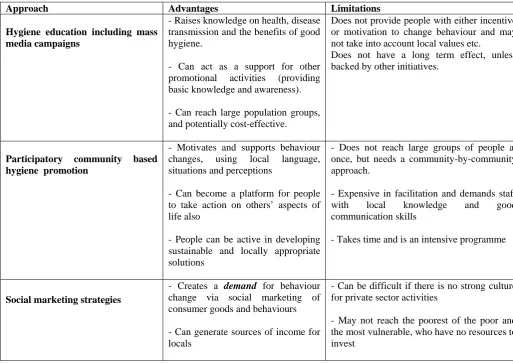
The sanitation sector should make better use of hybrid solutions including a combination of gender sensitive community-based participatory interventions and marketing based promotion such as Participatory Hygiene and Sanitation Transformation (PHAST), CLTS, Community Health Clubs, and social marketing strategies. In 2008, The Water and Sanitation Program launched a framework designed to assist sanitation project managers and staff design research methods and strategies aimed at eradicating open defecation and strengthening the supply of sanitation products and services (19). It has been successfully deployed in Tanzania, India and Indonesia and is a good representative of innovative hybrid approaches. Also, embedding hygiene promotion in the work of health professionals and schools is critical may further support the participatory approaches.
Monitoring Approaches to Improved Sanitation
Improved monitoring systems
Many countries have unreliable systems to report status, progress and to feed this information into the development planning process. Monitoring systems tend to be unreliable and often measure the wrong things (facilities built rather than working services for example). This is a missed opportunity since good quality monitoring and benchmarking can often create strong incentives for local administrations to improve their performance. Locally-agreed definitions of ‘improved’ ‘adequate’ ‘basic’ sanitation etc. are essential to avoid needless debates which only serve to slow down progress. For example, recent disagreements in Bangladesh about the speed of progress in rural sanitation were largely fuelled by the fact that the government was measuring the shift away from open defecation while the UN system was measuring the availability of ‘improved’ sanitation in line with the definitions used by the Joint Monitoring Programme (JMP). Both are important developments and a mature monitoring system would be able to capture both with a key focus on measuring use of sanitation services, quality of the services, and sustainability of the services.
So far, the focus has been on the generation of coverage information and less emphasis given to the generation of information assessing the actual use of sanitation infrastructure and hygiene behaviour change. However, new methodologies to facilitate participatory monitoring and assessment of hygiene behaviour change have been developed to generate data providing insights into the range of actions that should improve sustained access to water and sanitation services. Such approaches need wider implementation to make sure that the investments made in sanitation infrastructure and hygiene promotion actually results in behaviour change and improved health outcomes.
Conclusions
16
for the sector. However, an exclusive focus on reaching the MDG targets may cause development agencies and governments to focus exclusively on coverage. This will have a detrimental effect on the sustainability of the established infrastructure and may leave out the most important components of sanitation programs i.e. the motivation to use sanitary facilities and the need to change personal hygiene practices to improve health status.
The best use of public resources in the sanitation sector is likely to focus on building demand for sanitation, establishing clear policies on subsidies, building capacity among local government entities to enable coordination and monitoring of progress and quality of service, facilitating the creation of a commercially viable private sanitation service, allocating financial resources to essential large scale sanitation infrastructure and supporting educational institutions to produce a new generation of professionals in the sanitation sector. Once the financial regime for these long term elements has been worked out, additional funding can be earmarked or sought for specific short term interventions, including hardware subsidies based on micro-credit schemes or subsidised hardware sold through commercial outlets.
Continued innovation is crucial in the field of health promotion in close collaboration among decentralised government departments, NGOs and research organisations. Overall, there is an urgent need for investment in human capacity at decentralised levels of local government, and in a broader sense, the need to build up a cadre of professional promoters to deliver well-coordinated national programmes.
International aid organizations and donor agencies can support sanitation and hygiene promotion most effectively by allocating an increased level of funds to the sector, supporting line ministries with technical expertise, assisting with the establishment of best practices manuals, building on international experiences and providing support to civil society organizations. Building regional networks and investing in research will be another important avenue in the interest of sanitation. Support to international and national NGOs may be a feasible approach to facilitate innovation and to build an advocacy base for sanitation.
References
(1) Pruss A, Kay D, Fewtrell L, Bartram J. Estimating the Burden of Disease from Water, Sanitation, and Hygiene at a Global Level. Environmental Health Perspectives 2002; 110:537-42.
(2) WHO/UNICEF. Progress on Drinking Water and Sanitation: Special. Geneva, New York: WHO and United Nations Children's Fund Joint Monitoring Programme for Water Supply and Sanitation; 2008.
(3) Ministry of Foreign Affairs. Evaluation of Danish Support to Water Supply and Sanitation 1999-2005. Copenhagen, Denmark; 2007.
(4) Danida. Review of Karnataka Rural Water Supply and Sanitation Project. Copenhagen, Denmark: Ministry of Foreign Affairs; 2000.
17
(6) Jenkins M, Sudgen S. Rethinking Sanitation: Lessons and Innovation for Sustainability and Success in the New Millenium. UNDP; 2006. Report No.: 2006/27.
(7) WSP. Marketing Sanitation in Rural India. New Delhi, India: Water and Sanitation Program; 2000.
(8) Harvey PA, Mukosha L. Community Led Total Sanitation: Lessons from Zambia. www.communityledtotalsanitation org 2008:1-6.
(9) Evans B, Colin J, Jones H, Robinson A. Sustainability and Equity Aspects of Total Sanitation Programmes: A Study of Recent WaterAid Supported Programmes in Three Countries. London,UK: WaterAid; 2009.
(10) World Water Assessment Program. The 3rd United Nations World Water Development Report: Water in a Changing World. www.UNESCO. org 20093
(11) Newborne P, Smet J. Promoting Sanitation and Hygiene to Rural Households: The Experience of the Southern Nations, Nationalities and People's Regions. Addis Ababa, Ethiopia: Research-inspired Policy and Practice Learning in Ethiopia and the Nile region; 2008.
(12) UNICEF. Case Study of Community-Led Total Sanitation in Nigeria. www UNICEF org 2007:1-5.
(13) Mheta M, Knapp A. The Challenge of Financing Sanitation for Meeting the Millenium Development Goals. Nairobi, Kenya: The Water and Sanitation Program; 2004.
(14) Foster V, Pattanayak S, Stalker-Prokopy L. Distributional Incidence of Current and Potential Water Tarrifs and Subsidies in Bangalore, India and Kathmandu, Nepal. World Bank 2002:1-5.
(15) Yepes G. Do Cross-Subsidies Help the Poor to Benefit from Water and Wastewater Services? Lessons from Guayaquil. Washington DC: UNDP-World Bank; 1999.
(16) Evans B, Van der Voorden C, Peal A. Public Financing for Sanitation: The Many Faces of Sanitation Subsidies, A Primer. IRC 2009 September 21 [cited 2009 Mar 10];1-44.
Available from: URL: http://www.irc.nl/page/49930
(17) The Water and Sanitation Program. Community-Led Total Sanitation in Rural Areas: An Approach that Work. New Dehli, India: The Water and Sanitation Program; 2007.
(18) Scott P. An Investigation into the Linkages Between Tenure and Urban Sanitation. Jul 3; 2008.
18
(20) UN Habitat. Lake Victoria Water and Sanitation Initiative. www unhabitat org 2008Available from: URL:
http://www.unhabitat.org/content.asp?cid=2289&catid=462&typeid=24&subMenuId=0
(21) Boesen N, Dietvorst D. Swaps in Motion: Sector Wide Approaches from an Aid Delivery to a Sector Development Perspective. Reflections from the Joint Learning Programme on Sector Wide Approaches, January 2006 to April 2007. Train4dev net 2007:1-53.
19
Building political commitment for sanitation in a fragmented institutional
landscape
Authors: Flemming Konradsen(1),Wim van der Hoek(1), and Barbara Evans (2)
(1) Copenhagen School of Global Health, University of Copenhagen, Denmark; (2) School of Civil Engineering, University of Leeds.
This note forms part of a set of Good Practice Notes prepared by Danida.
Lack of political commitment to sanitation
In public statements, the terms water supply and sanitation often appear together as an inseparable concepts and are occasionally paired with the term “hygiene” as a general term for personal cleanliness. There is a disparity, however, between the relative importance of each in public statements and the importance assigned to each during policy-making, planning, budgeting and implementation. In these processes, sanitation and hygiene promotion usually disappear (1), while water supply remains a prioritized focus area. In this seemingly global trend, sanitation generally takes a secondary role in national reform agendas and political leadership on the subject is mostly absent. In addition, the economic burden and hardships associated with the lack of sanitation are not sufficiently discussed in national public debates creating an information deficit which results in a negative cycle where pressure to change is not sufficiently applied to political systems and the public demand for sanitation is accordingly not adequately expressed.
The UN Secretary-General Advisory Board on Water and Sanitation has stated that one of the primary reasons Africa is not on pace to meet in the MDG targets for sanitation is because of the lack of political commitment from national leadership in Africa (2). The practical manifestations of this leadership gap include: inefficient government institutions, policy and legal obstacles to sector expansion and coordination, insufficient will for private sector involvement and inadequate budget allocations to local governments. Further, support to research organisations and civil society to innovate around technologies and approaches to create demand for sanitation is not sufficiently encouraged to meet the challenges faced by the global South.
Lack of funding to support sector needs
20
appealing to both the private sector and government institutions. Also, water supply may be compared with the services provided by a power company distributing electricity as an essential input to all productive sectors of society where the benefits of sanitation may be less apparent to the decision makers and the communities at large.
Decentralisation and a diversified institutional landscape
Organizationally, a lead agency for sanitation is lacking in most countries and without a strong steward, sanitation usually disappears from the agenda. The institutional landscape is fragmented and sanitation is often delegated to the lowest level of governance, i.e. struggling municipalities. Prior to 1990, water and sanitation industries were national monopolies in many countries. Since then, an impressive and unparalleled reform has taken place, not from public to private operation, but from centralized to decentralized public provision (6). Drastic and rapid decentralization has taken place in Asia, Latin America, Eastern Europe and Central Asia. Also, in Africa many countries are now transferring the responsibility of service provision to local authorities. However, decentralization was not a studied response to the specific problems of the sector but the by-product of a wider reform of the state. As a result, local governments found themselves in charge of service delivery while lacking the capacity to step up to their role. Private sector participation has proved difficult to implement. In larger urban centres, this is primarily for political reasons, while in smaller cities and rural areas there is the additional problem of commercial viability. The real transition for most consumers has not been from public to private but from unregulated centralized
public provision to regulated decentralized public provision.
The cost of inaction
Failure to implement the MDG target for water and sanitation would have an economic cost of around US$38 billion per year, with sanitation accounting for 92% of this value (10). In cost-benefit analysis, total benefits of the interventions include time savings due to easier access, gain in productive time and treatment costs saved due to less illness, and the value of prevented deaths. The results showed that water and sanitation improvements are cost-beneficial in all developing world sub-regions (5; 11). In developing regions, the return on a US$1 investment was in the range of US$5 to US$46, depending on the intervention. The global return on investments in low-cost sanitation provision may be around US$9 for each US$1 spent. Achieving MDG target 10 would, therefore, outweigh the investment cost by a ratio of 8:1. The main contributor to economic benefits was time savings associated with better access to water and sanitation services, contributing at least 80% to overall economic benefits.
The many actors in sanitation
21
real and lasting change to take place, it is important that ownership of policies, strategies and the change process are in the hands of national public, private and civil society institutions.
How to build political commitment
Several organizations in their efforts to build political commitment for sanitation focus on three communication elements originally proposed by McKee in 1992 (7), I) advocacy II) social mobilization and III) program communication. Advocacy is seen as the action of presenting an argument to gain commitment from political and social leaders and to educate the public about issues of importance for hygiene (8). Social mobilisation emphasizes the establishment of partnerships across sectors to assist with the generation of resources, services, knowledge sharing and community participation and contributions. Program communication involves the targeting of specific groups with specific messages or training activities. The Sanitation for All in Bangladesh program that followed these three communication strategies aimed at building political commitment, managed to build effective alliances in support of sanitation and achieve a tremendous increase in the coverage and use of latrines (8). Experiences show that an essential first step in the advocacy process is the identification of all stakeholders of importance to reach the target. Here, the essential stakeholders beyond the families will be the local and national government, private sector representatives, donors, NGOs and other civil society groups.
Although interpersonal meetings may be the most effective and participatory advocacy tools, the cost, the limited availability of advocates in the field and the potentially very large number of people to be reached makes this a less feasible approach. An effective advocacy strategy is likely to include an alliance of stakeholders, who, based on a well researched agenda, communicate through targeted meetings, letters, and seminars or by the use of mass media with the aim of building awareness and consensus on sanitation issues. Skilled organizations advocating sanitation may also include specific lobbying experts communicating with key individuals in the political and government structure trying to influence decisions and may provide specific comments to legal and policy documents.
Increasingly, advocacy initiatives involve members of the general public and mass media, hoping that increased public attention and media coverage may influence policy makers to give more attention to sanitation and hygiene issues. An approach that will work best in a policy process based upon democratic processes.
Communication with district and local governments gain increased attention by advocacy groups as they play a vital role in coordinating, allocating resources, facilitating the involvement of other stakeholders, providing support to local institutions and may support local business through proactive tender processes. At the same time that NGOs communicate with local governments, the commercial interest groups may lobby for a more active role for the private sector in the provision of sanitation services and the support to household level access to the best and cheapest spare parts.
A way forward
22
the 54 African countries on track for meeting the MDG sanitation target, 32 African Ministers decided to take action (9). In February 2008, they signed the eThekwini Declaration in which, among other undertakings, they pledged to create separate budget lines for sanitation and hygiene in their countries and to commit at least 0.5% of GDP to sanitation and hygiene. International funding also seems to be improving with contributions from a number of countries to the Global Sanitation Fund, which was recently launched by the Water Supply and Sanitation Collaborative Council to help meet the MDG sanitation target. The UN General Assembly declared 2008 as the International Year of Sanitation in response to one of the recommendations of the Hashimoto Action Plan launched in March 2006 at the 4th World Water Forum and in so doing aims to increase attention on global sanitation challenges.
At the national level, governments should follow up on commitments to the sanitation sector through the drafting of policies that formulate standards on subsidies to the sector, review and update policies and institutional arrangements governing its promotion, and sale and construction of sanitary infrastructure. In discussions with bilateral donors, the government should also ensure that sanitation and hygiene programs are included as priority areas and the governments themselves can, through the inclusion of sanitation and hygiene into the national poverty reduction strategies, facilitate funding allocation to the sector and supports the demand creation by the public. Increased direct budget allocations to national and local programs and institutions aimed at sanitation and hygiene improvements that will significantly support the sector are still needed. Also, specialized training institutions and universities need to be included as a significant resource to educate the next generation of professionals and leaders in the sector and government need to be active partners in promoting research, innovation and documentation in the sector.
International organizations and donor agencies can support the sector most effectively by allocating funds to the sector, supporting line ministries with technical experts, assisting with the establishment of best practices manuals, and building on international experiences and provide support to civil society organizations. Building regional networks and investing in research will be another important avenue in the interest of sanitation.
We live in exciting times for sanitation, with some signs of increasing political commitment. In some African countries (notably South Africa and Ethiopia) a sound policy and institutional framework for sanitation has been created. Models that can increase the mobilisation of resources for sanitation have been developed and new approaches to sanitation demand creation have been implemented. Further scaling up of new approaches depends on the commitment to and ownership of sanitation as a household issue. With good leadership at top levels, willingness to experiment and stimulated ownership of the problem by households and communities, progress in sanitation can be made. If the decision makers miss the opportunity of the time huge development potentials will be missed!
References
(1) WHO (2004). Sanitation challenge: turning commitment into reality
23
(2) UNSGAB (2008). Keynote speech to the CSD-16 Round Table Discussion "Investing in Africa to achieve Millennium Development Goals and Sustainable Development.
(www.unsgab.org/about/docs/chair_080514.htm [cited December 2009]
(3) Parliamentary office of science and technology (2002) Access to Sanitation in Developing Countries (wwwparliament.uk/post/home).
(4) UNDP (2006). Human development report 2006. New York, UNDP.
(5) Hutton G, Haller L, Bartram J (2007). Global cost-benefit analysis of water supply and sanitation interventions. Journal of Water and Health, Vol. 5, pp. 481-502.
(6) Van Ginneken M, Kingdom B (2008). Key topics in public water utility reform. Bank Netherlands Water Partnership. Washington DC, The World Bank.
(7) McKee (1992). Social mobilization and social marketing in developing communities: lessons for communicators. Penang, Malaysia: Southbound. Water and sanitation program – South Asia
(8) IRC (2003). Understanding advocacy, social mobilization and communication. The Hague, the Netherlands.
(9) WHO/UNICEF (2008). A snapshot of sanitation in Africa. WHO/UNICEF Joint Monitoring Programme for Water Supply and Sanitation.
(10) Kemeny T (2007). Sanitation and economic development: making the case for the MDG orphan. London, WaterAid
24
Hooked on sanitation subsidies
Authors: Barbara Evans (1), Jens Bjerre (3), Michael J. Calopietro (2), Andy J. Peal (4) and Flemming Konradsen (2)
(1) School of Civil Engineering, University of Leeds; (2) Copenhagen School of Global Health, University of Copenhagen, Denmark; (3) RDC-consultants; (4) Independent Consultant
This note forms part of a set of Good Practice Notes prepared by Danida.
Background
Some estimates suggest that in Africa, at its current rate of progress, the MDG target for sanitation will not be met until 2076 (1; 2) and, even then, there will still remain millions of households that do not have access. While reaching the target now looks increasingly unlikely, it is still be possible to accelerate its progress. This depends, at least in part, on the availability of finances to cover the capital costs of new infrastructure and the significant investment in demand creation, feasibility studies, ongoing operations and maintenance and general capacity building in the sector.
One area of sanitation financing that attracts strong debate is the use of public money to finance household investments in sanitation (usually referred to as ‘hardware subsidies’). Subsidized latrines, either alone or combined with other promotional tools, have been used in many national rural sanitation programmes, notably in Malaysia, Thailand, India and many countries of Africa, for over 30 years.
This paper aims to briefly highlight the rationale behind the use of subsidies, the experiences from the use of these subsidies and highlights alternatives to the use of subsidies in future financing and sanitation promotion models.
The rationale behind subsidies
There are a number of economic and ethical theories which argue in favour of the use of subsidies as a positive sanitation development solution. The following section provides a brief overview of these arguments.
Economic arguments
Proper sanitation results in the removal of harmful pathogens from the environment and as a result has broad health benefits. For this reason, governments have a strong positive motivation to support the sanitation sector. Poor health carries with it the significant cost associated with health care provision and reduces income generating potential (i.e. reduced productivity.) Sanitation related morbidity is also associated with a reduction in school attendance and childhood development, which creates a generational cycle of disadvantage (3). Accounting for these factors, various cost benefit analysis on the expansion of sanitation services has estimated that the benefits of effective sanitation to the national economy often far outweigh the costs. Globally, the WHO estimates that a dollar invested in sanitation yields an annual benefit of around $9 (4).
25
is considered a ‘merit’ good – something that most governments or societies value more highly than it is valued by an individual or household. Many elements of a sanitation system, for example, the long term management of excreta in urban areas, are also public goods – the benefits of which accrue to everyone irrespective of their individual behaviour. This is particularly true and of particular importance in realizing widespread benefits when sanitation coverage is low. This is because individual investments in toilets and management of excreta at the home have little benefit, even to the implementing household, if others in the community do not make similar investments. Governments are therefore motivated to intervene to change community sanitation at a scale that impacts the entire population positively.
Cost Barriers
An analysis by the WSP estimates that the investment cost for latrines is typically USD 30 to 60 per capita with an annual operational cost of USD 3 to 10 per capita. Capital costs of a sewer based system range from USD 120 to 160 per capita with an annual operating cost of 5 to 15 USD per capita. This constitutes a very significant expenditure for many households in low income countries and is cost prohibitive for large portions of the population. The costs associated with the building and maintenance of improved latrine facilities may, therefore, undermine the aim of achieving full sanitation coverage (5). As a result, it is frequently argued that a subsidy that reduces this cost to the household will increase both the ability and willingness of poor households to invest in improved sanitation.
Equity and Moral Duty
Some advocates of sanitation sector subsidies argue that the cost of improved sanitation is a significant barrier for poorer households, which disproportionately affects the most vulnerable members of society since this population is least likely to be able to access improved sanitation facilities. This dynamic promotes continued social inequity in many developing countries. Subsidization advocates, therefore, promote the use of targeted hard ware subsidies in order to reduce such systemic inequities and protect the most vulnerable social populations.
Finally, many commentators suggest that governments have a moral duty to ensure that everyone has the potential to live in a clean, healthy and dignified environment. Moral imperative proponents argue that subsidies for sanitation facilities are an obligation of governments because they promote human dignity, equity, compassion and solidarity, which are longstanding values shared the world over.
The arguments briefly reviewed above make a convincing case for government intervention in sanitation. However, before employing a subsidization strategy, it is important to look more deeply at both the history and legacy of sanitation subsidization. Two critical questions need to be answered before undertaking a public subsidization program:
Firstly, do hardware subsidies work and, if so, under what conditions do they work best?
26
Do Hardware Subsidies Work?
Historically, both water supply and sanitation infrastructures have been heavily subsidised in developed and developing countries. In the UK and other European countries these investments were made relatively late in the process of industrialisation and urbanisation. This can, in part, be explained by the poor state of knowledge about the mechanisms of disease transmission until the latter part of the nineteenth century but was also a product of the very low value placed on the health and welfare of the labouring population in the early period of industrialisation.
Later, proper investment in sanitation and water supply came to be seen as a precondition for healthy living and a core element of civic responsibility (many of the leading proponents of investments having already made their fortunes and many of the cities have robust tax bases from which to finance these major investments). The outcome was undoubtedly an impressive, albeit expensive, system which effectively guaranteed access to adequate sanitation for all.
The experience of the late twentieth century has been rather different. Reticulated sewerage is a costly technology (with high capital and operating costs) and tends to require high water and energy. However it has been the technology of choice for the vast majority of cities and towns in Africa, even where the municipality or utility is small, inexperienced and lacking in strong financial underpinnings. Often households were not asked to pay more than a fraction of the cost for services (following the financial models seen elsewhere and also for legitimate reasons discussed above,) but this has tended to result in financially starved systems with inadequate maintenance and sometimes even insufficient funds for basic operations (5). There have been exceptions, but these are invariably linked to strong management of urban services as a whole and a rigorous attention to the long term financing requirements of the system.
In rural sanitation, the experience is less dominated by the experiences of Europe. It is likely, however, that the strong government role in sanitation financing in high income countries did influence the promotional strategies followed by the international donor agencies in the 1970s and 1980s. Notable successes of rural sanitation programmes with limited subsidies (Lesotho for example) have been eclipsed by massive national programmes that have tended to use subsidies. These have had mixed success. In Malaysia and Thailand the use of subsidies for rural toilets have been integral to what can only be described as very successful national programmes. The experience in India, to take a contrasting example, was less successful; in the mid 1990s relatively few latrines had been constructed compared to the scale of the national rural sanitation programme.
In the face of some high profile ‘failings’ of subsidised sanitation in the 1990s donors increasingly promoted systems where the users would bear a greater share of the cost of sanitation services. Nevertheless, requesting such contribution from the community for water supply and sanitation services has been a politically sensitive issue. It rapidly became clear for example that it is neither feasible nor economically progressive to ask new users to bear the full cost of capital investment in expensive urban sewerage and treatment systems.
27
What goes wrong with hardware subsidies for rural sanitation?
Evans (5), in a review of literature, concludes that public subsidy does not fail per se, but fails when it is closely associated with a supply-driven approach that does not take into consideration household preferences, behaviour and access to capital. Many private organisations and government departments have focused on providing toilets aimed at achieving a high coverage rather than motivating their use and maintenance (6).
The key argument for a shift away from pushing sanitation hardware is the growing evidence that supply driven approaches to build more toilets with household subsidies often end up financing toilets where they are either not wanted or inappropriate or unused.
Lack of motivation for use and Sustainability
The first problem is that building a toilet does not necessarily mean it will be properly used or used at all. A number of studies (7, 8), have shown that many subsidised toilets are built but never used.
Even where toilets are used initially, their continued use, proper maintenance, emptying and management of the excreta (if relevant) remains in doubt. An unwanted latrine may be used until if fills up, but this is no guarantee that behaviour has been permanently changed. If the households are unwilling or unable to bear the cost or technical requirements of maintaining the toilet, the significant investment in increasing coverage will, in effect, be a waste.
Problems with targeting
Targeting the poorest or most disadvantaged households with subsidies may be a challenge. Adverse power relations, political influence and even outright prejudice may make it difficult to reach a specific group within the community. In such cases the program may become more costly as the entire community may need to be targeted with a subsidy. Often the neediest do not access subsidies because they may be least able to fulfil the requirements of the programmes, for example, by completing an application or digging the initial pit before accessing a subsidy. The assessment and monitoring of targeted subsidies can be expensive and difficult and is sometimes subject to ‘capture’ by influential groups. Considerable additional resources (money and staff) may be required.
Dependency
Jenkins and Sugden (9) point out a further perverse outcome of highly subsidised national sanitation programmes; where communities prefer to wait for hardware, cash incentives or other forms of subsidies to be provided rather than take the initiative to begin the construction themselves. This will potentially undermine community initiative
Lack of financial resources to back a subsidised program
28
analysis of what is possible is needed and solutions beyond public hardware subsidies are more likely to sustainably meet the challenges faced by the sanitation sector. A recent study by OECD for the water sector as a whole (including water supply and sanitation) suggested that some countries have funding gaps that have actually been increasing since the Millennium Declaration (10). It seems that few African governments will have sufficient funds to finance all or even part of the costs of hardware required to meet the targets. It is all too likely that programs based on subsides will run dry of cash after a relatively short period and the available finances will be insufficient to meet the demand (7).
Undermining the business potential and distorting the market
Finally, large scale infrastructure and operational subsidies may distort the non-public financing of the sector by ‘crowding out’ other sources of funds including direct household investments and market-based financing. Mehta and Knapp (11) point out that public money could rather be used to leverage these additional funds, which might flow into the sector if the policy environment were more conducive.
Are hardware subsidies the most effective use of public money?
The starting point for thinking about subsidies is to stop focusing on subsidizing the construction of private home sanitation facilities and to begin focusing on ways to use public finance (16). The overall aim is to achieve public health gains and ensure human dignity and adequate living conditions with respect to sanitation. Commentators at Hygiene Central argue that the approach must be to encourage home owners to build latrines themselves and to find financing and promotional models that encourage the use and maintenance of the sanitation infrastructure. The same opinion is put forward by Mehta and Knapp (11) who argue that focus needs to be shifted from subsidies and grants for sanitation facilities to funding sanitation promotion and leveraging resources. Increasingly, strategies should consider both the demand and supply side within a marketing approach. Greater investments by household and community are asked for, including user fees for public toilets and cross tax from water to sanitation, while greater public investments are made in building a market for sanitation.
The market approach and building demand
Cairncross (7), in a review of experiences, argues one set of actions that are often neglected relate to the effective marketing of a range of sanitation products so that people can choose what they want and are willing to pay for. This often means accepting and even promoting a greater diversity in sanitation designs and prices. What is needed are latrines that are suitable for the consumer, are linked to a workable system of pit waste management (for example, an emptying service), if required, and can be delivered within a sustainable business model to ensure a regular supply of hardware and services. Cairncross argues that communities already do invest tremendous resources in sanitation and that we have to support this effort even further and enable the environment for further investment.
29
In many settings it is argued that significant investment may have to be made to mobilize the interest of the community before a demand is generated and this may be where outside investments are most needed. A review of the experiences in Asia with community-led total sanitation shows that the move away from subsidy-led toilet construction towards encouraging behaviour change at the community level, and a focus on creating “open defecation-free” villages has been both successful and cost-effective (13). The motivation for this shift in approach has been, as argued above, that individual level subsidies aimed at increasing coverage have not necessarily translated into usage of the infrastructure (6).
Micro credit
Where demand exists but upfront costs are relatively high, poor people may benefit from micro finance services. For the poor however it may be a challenge to gain access to credit through traditional channels. Even for households with relatively good creditworthiness, lenders may be unwilling to offer loans for sanitation as it is not perceived as generating an income that would influence the capacity to repay. For a costly investment in sanitary infrastructure, the lack of formal land tenure in urban informal settlements may also hamper access to credit (7).
However, in such a situation, government or international support for the establishment of community based or commercial microfinance schemes for household latrines, construction of public toilets, latrine cleaning services etc., may provide great opportunities. In this context, subsidies may be used to offer low interest rates on loans or to be exempted for certain administrative charges provided these do not introduce unsustainable distortions in the market (7). Governments may enact schemes that provide incentives to micro-credit lenders to serve poor communities and households who wish to improve their sanitation situation. Such schemes could take the form of tax credits to lenders or limited public insurance programs which help offset the risk of such lending practices. In urban areas, public financing can assist in the creation of Joint Liability Groups who borrow money together to build and maintain shared sanitation facilities which may also help reduce risk by spreading repayment responsibility and therefore increase market based micro-financing.
In a presentation of the introduction of low-cost sanitation in Lesotho, Blackett (14) highlighted the important factors for the success of a microcredit approach to the sanitation sector, including the access to affordable and acceptable latrine designs; minimal general direct grants or subsidies to households; a comprehensive program of Ventilated Improved Pit latrine promotion; integration of projects into existing government structure and coordination among departments in promoting sanitation.
Subsidies that work
Having identified marketing, demand and micro-finance as possible areas for public funding, many governments may still feel that there are situations which justify hardware subsidies. A recent study by WSP suggests that hardware subsidies remain an essential part of the strategy to accelerate progress towards the sanitation MDG (15). Considering the problems with subsidies outlined above it seems reasonable to say that where they are used hardware subsidies need to be:
Simple and transparent to ensure that the intended beneficiaries can access them
30
Well targeted to ensure that the subsidy achieves these objectives (this could mean targeting on grounds of income, levels of service, geography or any number of other factors)
Time bound and well monitored – to ensure that market distortions are kept to a minimum
Tightly monitored and frequently reviewed.
Some relatively more successful hardware subsidy regimes include:
Subsidised or amortised connection fees for urban sanitation
Subsidised credit for on-site sanitation in rural and urban areas linked to a wide range of sanitation options and focusing on outcomes not standardised latrine designs
Fully subsidised waste management (pit emptying and treatment for example) in urban areas
Output-based subsidies to encourage service providers to extend access to less-favoured communities
Output-based subsidies for effective waste management
Conclusions
The debate on subsidies has tended to be characterized as a yes-no dichotomy, but in fact it is clear that there are strong justifications for public finance in sanitation, a strong historical track record of success and an enduring interest on the part of policy makers to put money into the sector. Therefore, rather than focusing exclusively on the question of hardware subsidies a much more important and useful debate is needed on the best use of scarce public resources.
Governments need sanitation programmes which are effective (reaching the intended objectives), efficient (cost-effective) and affordable (at a scale that can be financed in the long term). This means that the starting point must be a thorough understanding of available (long term) funding which will primarily come from the government and householders. This money is needed to pay for the ongoing costs of the programme in the long run – the costs of operating latrines, cleaning them, maintaining them, managing the waste stream and the costs of long term promotional activities and support. Costs also include the salaries of health extensionists or sanitation workers, local government staff who support community-led programmes, and the costs of monitoring. Once the financial regime for these long term elements has been worked out, additional funding can be earmarked or sought for specific short term interventions including, where they are deemed necessary, hardware subsidies.
The key problem historically seems not to have been with the hardware subsidy per se, but with its application in a non-sustainable manner and the relatively poor performance of some of the programmes within which subsidies were embedded. Improved attention to overall issues of public finance and more careful design of well-monitored sanitation programmes could be an important element in the battle to accelerate progress towards the MDG sanitation target.
References
(1) Mara, D. and Alabaster, G. (2008). A new paradigm for low-cost urban water supplies and sanitation in developing countries. Water Policy Vol 10 No 2 pp 119– 129 © IWA Publishing, UK.
31
(3) Watkins, W. Cruz, J. and Pollitt, E. (1996). The Effects of Deworming on Indicators on School Performance in Guatemala. Transactions of the Royal Society of Tropical Medicine and Hygiene 90, 156-161.
(4) Haller L, Hutton G, and Bartram J. (2007). Estimating the costs and health benefits of water and sanitation improvements at global level. Journal of Water and Health 5:4, 476-480
(5) Evans, B., Van der Voorden, C. and Peal, A. (2009). Public Financing for Sanitation; the Many Faces of Sanitation Subsidies. Water Supply and Sanitation Collaborative Council, Geneva, Swizerland.
(6) WSP (2007). Community-led total sanitation in rural areas. An approach that works. Water and Sanitation Program, South Asia. New Delhi, India.
(7) Cairncross, S. (2004) The Case for Marketing Sanitation. Field Note. Water and Sanitation Pogram – Africa. The World Bank, Nairobi, Kenya
(8) Robinson, A. (2005). Scaling Up Rural Sanitation in South Asia – Lessons Learned from Bangladesh, India and Pakistan. WSP South Asia, New Delhi, India
(9) Jenkins, M. and Sugden, S. (2006). Rethinking Sanitation: Lessons and Innovation for Sustainability and Success in the New Millennium. Human Development Report Office. Occasional Paper for the Human Development Report 2006 (2006/27). UNDP and LSHTM, London, UK.
(10) United Nations General Assembly Resolution 2 session 55 United Nations Millenium Declaration on 8 September 2000
(11) Mehta, M. and Knapp, A. (2004). The challenge of financing sanitation for meeting the Millennium Development Goals. Water and Sanitation Program (WSP) - Africa, Nairobi, Kenya.
(12) Sijbesma, C. (2008). Sanitation and Hygiene in South Asia: Progress and Challenges. Chapter 25 from Beyond Construction Use by All. IRC, WaterAid and the
WSSCC,Delft, Netherlands.
(13) Wateraid (2009) Sustainability and Equity Aspects of total sanitation programs - a study of recent WaterAid-supported programmes in three countries. Global synthesis report. WaterAid, London, UK
(14) Blackett, I C., (1994). Low-Cost Urban Sanitation in Lesotho, UNDP -World Bank Water and Sanitation Program, Washington DC, USA
(15) Evans, B. van der Voorden, C and Peal A. (2009).Public Funding for Sanitation. WSSCC. Geneca, Switzerland.
(16) Hygiene Central website available at: