promoting access to White Rose research papers
White Rose Research Online
[email protected]
Universities of Leeds, Sheffield and York
http://eprints.whiterose.ac.uk/
This is an author produced version of a paper published in
Tetrahedron.
White Rose Research Online URL for this paper:
http://eprints.whiterose.ac.uk/77266/
Paper:
Kinnell, A, Harman, T, Bingham, M, Berry, A and Nelson, A (2012)
Development
of an organo- and enzyme-catalysed one-pot, sequential three-component
reaction.
Tetrahedron, 68 (37). 7719 - 7722.
To create your abstract, type over the instructions in the template box below. Fonts or abstract dimensions should not be changed or altered.
Development of an organo- and
enzyme-catalysed one-pot, sequential
three-component reaction
Angela Kinnell
a,b, Thomas Harman
a,b, Matilda Bingham
c, Alan Berry*
b,dand Adam Nelson*
a,ba
School of Chemistry, University of Leeds, Leeds, LS2 9JT, UK.
bAstbury Centre for Structural Molecular
Biology, University of Leeds, Leeds, LS2 9JT, UK.
cMerck Sharp and Dohme, Newhouse, Motherwell, ML1
5SH, UK.
dInstitute for Molecular and Cellular Biology, University of Leeds, Leeds, LS2 9JT.
1
Tetrahedron
j o u r n a l h o m e p a g e : w w w . e l s e v i e r . c o m
Development of an organo- and enzyme-catalysed one-pot, sequential
three-component reaction
Angela Kinnell
a,b, Thomas Harman
a,b, Matilda Bingham
c, Alan Berry*
b,dand Adam Nelson*
a,baSchool of Chemistry, University of Leeds, Leeds, LS2 9JT, UK
bAstbury Centre for Structural Molecular Biology, University of Leeds, Leeds, LS2 9JT, UK cMerck Sharp and Dohme, Newhouse, Motherwell, ML1 5SH, UK
dInstitute for Molecular and Cellular Biology, University of Leeds, Leeds, LS2 9JT
1. Introduction
Cascade reactions can enable the highly efficient synthesis of complex organic molecules from multiple components, reducing the number of work-up and purification steps required.1 Many combinations of catalyst types have been exploited in bicatalytic processes including pairs of organocatalysts;2a-b pairs of enzymes;2c-d organometallic and organo- catalysts;2e-f and organometallic catalysts and enzymes.2g In addition, an aldolase variant has been used to catalyse two sequential aldol reactions to yield a precursor of the statin side-chain.3 The combination of organocatalysts and enzymes is, however, rare.4 Here, we report the first example of a three-component reaction in which two carboncarbon bond-forming steps are catalysed using the specific combination of an organocatalyst and an enzyme.
We have previously exploited directed evolution in the discovery of aldolases with modified, synthetically-useful properties.5 Wild type N-acetylneuraminic acid lyase (NAL) catalyses the reversible aldol condensation between pyruvate and
N-acetyl mannosamine to give N-acetylneuraminic acid. However, we discovered that the E192N variant of NAL can accept a range of alternative aldehydes 2; thus, ozonolysis of the alkenes 1 (2), and condensation with pyruvate, gave the aldol products 3 (Scheme 1).5c We have also used directed evolution to create stereochemically complementary aldolases that enable
the stereoselective synthesis of both (4R)- and (4S)-configured products 3.5d
Scheme 1. Aldolase reaction catalysed by an aldolase variant A R T I C L E I N F O A B S T R A C T
Article history:
Received
Received in revised form Accepted
Available online
A one-pot, three-component process is described which involves both organo- and enzyme-catalysed carboncarbon bond-forming steps. In the first step, an organocatalyst catalyses the aldol reaction between acetaldehyde and a glyoxylamide. After dilution with additional aqueous buffer, and addition of pyruvate and an aldolase enzyme variant, a second aldol reaction occurs to yield a final product. Crucially, it was possible to develop a reaction in which both the organo- and enzyme-catalysed reactions could be performed in the same aqueous buffer system. The reaction described is the first example of a one-pot, three-component reaction in which the two carboncarbon bond-forming processes are catalysed using the combination of an organocatalyst and an enzyme.
2009 Elsevier Ltd. All rights reserved Aldolase
A drawback of our chemoenzymatic synthesis of the aldol products 3 was that the synthesis of the alkenes 1 was rather lengthy (6 steps from ribonolactone).5c,6 We envisaged, however, that it might be possible to develop a three-component synthesis of similar products (such as 7) in a single pot (Scheme 2). Thus, it was hoped that organocatalysed condensation7 between a glyoxylamide 4 and acetaldehyde would yield an aldol product 6. The structure of complexes between the E192N NAL variant, pyruvate and a substrate analogue suggested that a hydroxyl group to the aldehyde may not be essential for binding.8 Accordingly, it was hoped that the aldol products 6 would be viable substrates for the E192N variant, enabling the synthesis of the final products 7 by enzymic addition of pyruvate. The condensation of the aldehyde 4, acetaldehyde and pyruvate (5), to give 7, would constitute the first example of a three-component reaction in which two carboncarbon bond-forming steps were catalysed using the specific combination of an organocatalyst and an enzyme.
Scheme 2. Overview of the proposed organo- and enzyme-catalysed cascade
2.Development of a viable three-component reaction
2.1 Synthesis and evaluation of potential products of aldolase-catalysed reactions
We first determined whether the compounds 7 were viable substrates for retro-aldol reactions catalysed by variants of NAL. The synthesis of the ammonium salts, 12, of the carboxylic acids,
7, is described in Scheme 3 and Table 1.
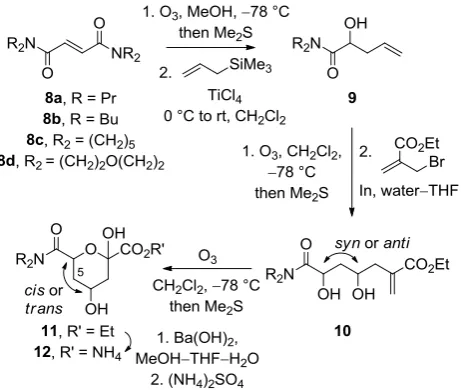
Scheme 3. Synthesis of the potential enzyme substrates 12 (see Table 1)
Ozonolysis of the fumaric amides 8, and allylation by treatment with allyltrimethylsilane and titanium tetrachloride, gave the racemic homoallylic alcohols 9. Ozonolysis of the
homoallylic alcohols 9, and indium-mediated condensation with ethyl -(bromomethyl) acrylate, gave the diols 10 with modest
[image:4.595.39.269.259.362.2]anti diastereoselectivity.9 Finally, ozonolysis of the diastereomeric mixtures of the diols 10 gave the diastereomeric esters 11 which were at least partially separable by column chromatography. Ester hydrolysis and cation exchange, gave the ammonium salts 12. The relative configuration of the major diastereomers of the diols 10 was determined by careful analysis of diagnostic geminal coupling constants in their derivatives 11. Table 1. Synthesis of the potential enzyme substrates 12 (see Scheme 3).
Substrate Yield, 9 / % Yield, 10 / % [anti:syna]
Yield, 11b / %
[cis: transa]
Yield, 12 / % [cis: transa]
8a 91c 24 [70:30] 59 [95:5] >98 [95:5]
8b 46 12 [80:20] 62 [95:5] >98 [95:5]
8c 30 33 [68:32] 27 [88:12] >98 [90:10]
8d 60 18 [74:26] 49 [78:22] 83 [78:22]
a
Determined by 500 MHz 1H NMR spectroscopic analysis of the isolated products.
b
Column chromatography gave mixtures that were enriched in the cis
anomers. The relative configuration of the products was determined by analysis of diagnostic geminal coupling constants.
cYield from the isolated glyoxylamide derived from 8a.
A coupled enzyme assay was used to determine assess the efficiency of aldolase-catalysed cleavage of the substrates.5b In this assay, aldolase-catalysed cleavage to yield pyruvate would be followed by lactate dehydrogenase-catalysed reduction; the concomitant oxidation of NADH may be detected spectroscopically by monitoring the change in absorption at 340 nm. The steady state kinetic parameters for the cleavage of 3a-d
[image:4.595.42.273.502.697.2]and 12a-d by the E192N NAL variant are presented in Table 2. Crucially, the aldols 12a-d were all substrates for the E192N NAL variant, albeit with up to ~10-fold reduced kcat/KM relative to the substrates 3a-d which bear an additional hydroxyl group at C-5.
Table 2. Steady state kinetic parameters for enzyme-catalysed cleavage by the E192N NAL variant.
Substrate R2 kcat / min-1 KM / mM kcat/KM
/ min-1mM-1-1
3aa Pr 202 ± 2 0.10 ± 0.01 1960
3ba Bu 61 ± 2 0.11 ± 0.02 580
3ca (CH2)5 331 ± 6 0.34 ± 0.06 850
3da (CH
2)2O(CH2)2 162 ± 8 0.70 ± 0.20 230
12a Pr 130 ± 3 0.39 ± 0.04 340
12b Bu 90 ± 6 0.25 ± 0.04 360
12c (CH2)5 95 ± 1 0.57 ± 0.02 167
12d (CH2)2O(CH2)2 73 ± 2 3.4 ± 0.2 22 aSee reference 5b.
2.2 Effect of removal of an -hydroxyl group on the stereoselectivity of aldolase-catalysed reactions
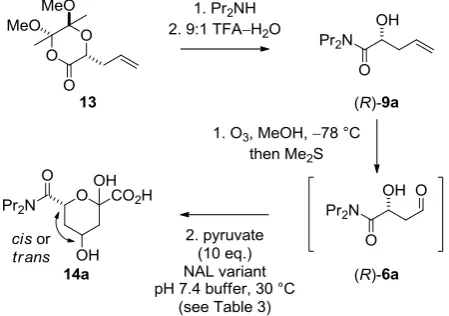
The effect of removing the -hydroxyl group from the aldehyde substrate 2a on the stereoselectivity of aldolase-catalysed reactions was investigated. Both enantiomers of 9a
3
The stereoselectivity of the aldolase-catalysed condensations of three substrates – the aldehyde 2a, and the enantiomeric aldehydes (R)- and (S)-6a – was determined by 1H NMR spectroscopy in deuterated sodium phosphate buffer (pH 7.4) (Table 3). We investigated the stereocontrol exerted by the E192N variant, as well as two stereochemically complementary variants that we had previously discovered using directed evolution: E192N/T167G and E182N/T167V/S208V.5d As expected, the condensation of the aldehyde 2a with pyruvate was highly stereoselective with the stereochemically complementary variants E192N/T167G ( >95:<5 cis:trans-3a) and E182N/T167V/S208V ( <13:>87 cis:trans-3a). Unfortunately, stereocontrol in the condensations of the aldehydes (R)- and (S
)-6a was modest in all of the aldolase-catalysed condensations. Evidently, the -hydroxyl group in the aldehyde 2a
(corresponding to the hydroxyl group at C-5 in 3a) plays a crucial role in stereocontrol.
[image:5.595.52.277.246.404.2]Scheme 4. Investigation of the stereoselectivity of reactions of aldehydes 9a catalysed by NAL variants. The enantiomeric substrate (S)-9a was also prepared and studied. The stereoselectivity of the aldolase-catalysed condensation was determined in pH 7.4 deuterated sodium phosphate buffer; the structures 6a and 14a are drawn in protonated form for convenience.
Table 3. Kinetic and thermodynamic stereoselectivity of aldol reactions catalysed by NAL variants.
Enzyme Substrate and product
2a3a
cis:transa
[re:sib]
(R)-6a14a
cis:transa
[re:si b]
(S)-6a14a
cis:transa
[re:si b]
thermodynamic ratioc 69:31 74:26 74:26
E192N 79:21 [79:21]
58:42 [42:58]
62:38 [62:38] E192N/T167G >95:<5
[>95:<5]
60:40 [40:60]
58:42 [58:42]
E182N/T167V/ S208V >13:<87 [>13:<87]
29:71 [71:29]
63:27 [63:27]
aDetermined by integration of the 500 MHz 1H NMR spectrum.
bKinetic facial control in the attack on the respective aldehyde.
cRatio after equilibration. After 1 week, a second aliquot of enzyme was
added and the reaction incubated for a second week.
2.3 Identification of reaction medium in which both organo- and enzyme catalysis are possible
We investigated the possibility of performing an organocatalysed aldol condensation under the buffered conditions
needed for enzymic catalysis. The diamine 16 has been developed as an organocatalyst for asymmetric aldol reactions performed in water.11 Remarkably, we found that, with 10 mol%
16, organocatalysed aldol condensation was possible under buffered conditions, and after reduction, the diols 15 were obtained (Scheme 5); in contrast with just 1% 16 at pH 7.0, no product was detected. The diastereoselectivity of the condensation was modest, and varied significantly with pH. The relative configuration of the diols was determined by analysis of diagnostic coupling constants in the corresponding acetonides.
Scheme 5. Study of the organocatalysed condensation of 3a and propionaldehyde (10 eq.) in aqueous buffer.
With an organocatalysed aldol reaction in hand that operated under appropriately buffered conditions, we investigated the effect of various additives on the activity of the E192N enzyme. In each case, we assayed enzyme activity by monitoring condensation of the aldehyde 2a and pyruvate to give 3a
(Scheme 1): the formation of 3a was assayed by periodic cleavage and condensation with thiobarbituric acid.12 At the concentrations of propionaldehyde and the glyoxylaldehyde 4a
needed for aldol condensation, the enzyme was still fully active. However, in the presence of the concentration of the organocatalyst 16 that had corresponded to a 10 mol% loading (see Scheme 5), the activity of the enzyme was very significantly impaired.
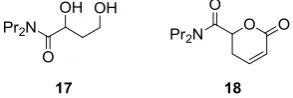
We decided, therefore, to develop a one-pot, three component process in which the reaction mixture was diluted after the organocatalysed step (Scheme 6). In order to gain insight into the stereoselectivity of the overall process, we determined the enantiomeric excess of both the intermediate aldehyde 6a (R = Pr) and the final product 7a. Thus, 6a and 7a were converted into the diol 17 (by reduction with NaBH4) and the lactone 18 (by oxidative cleavage, lactonisation and dehydration) respectively. The diol 17 was found to be essentially racemic (<5% ee), and, at completion, the lactone 18 was also racemic (<5% ee).
3.Determination of the scope of the one-pot, three component reaction
thermodynamically controlled. Our studies demonstrate the value of the specific combination of organo- and enzymic catalysis in three-component reactions leading to heterocyclic products.
Scheme 6. Organo- and enzyme-catalysed condensation of the glyoxylamides 4, acetaldehyde and pyruvate to give products 7
[image:6.595.42.271.106.224.2](see Table 4).
Table 4. One-pot, three-component reactions (see Scheme 6).
Substrate R1,R2 Yielda7
/ %
cis:transb
4a Pr,Pr 40 78:22c)
4c -(CH2)5- 48 6 6 : 3 4
4e Me,Pr 48 57:43
4f Me,Me 43 71:29
4g Et,Et 51 61:39
aBased on the limiting reactant 4. Products were purified by preparative
HPLC.
bDetermined by integration of the 500 MHz 1H NMR spectrum of the purified
product.
cThe product had <5% ee.
Figure 1. Derivatives used to determine the enantioselectivity of the one-pot process: the diol 17 and the lactone 18 were derived from the aldehyde intermediate 6a and the product 7a
respectively.
4.Summary
In summary, we have shown that the combination of organo- and enzymic catalysis may be exploited in one-pot reactions with two carboncarbon bond formation steps. Crucially, it was possible to identify buffered aqueous conditions under which both of the catalysed steps were possible. A range of glyoxylamides 3 were condensed with both acetaldehyde and pyruvate to give the corresponding heterocyclic products 7. Unfortunately, in this specific case, the stereoselectivity of the overall process was poor, both because the organocatalysed step was not enantioselective, and because the aldolase-catalysed reactions of the intermediate aldehydes 6 (lacking an -hydroxy group) were poorly diastereoselective. Nonetheless, this study demonstrated the possibility of combining organo- and enzymatic catalysis in bicatalytic chemistry: the combination of organo- and enzymatic catalysis is powerful, and is likely to find further
application in one-pot reactions involving two or more carboncarbon bond-forming steps.
5.Experimental section
The glyoxylaldehyde 3g (13.5 mg, 95.5 µmmol) was dissolved in buffer (308 µL, pH 7.4, 20 mM potassium phosphate), and was added to the diamine 16 (1.81mg, 4.76 µmol). Acetaldehyde (54µL, 0.955 mmol) was added and reaction mixture was stirred at room temperature for 20 hr, diluted with a pH-adjusted solution (pH 7.4) of sodium pyruvate (105 mg, 0.955 mmol) in buffer (115 µL, pH 7.4, 20 mM potassium phosphate), the E192N aldolase variant (416 µL, 6.98 mg/mL in pH 7.4, 20 mM potassium phosphate) added, and incubated at 35 ºC for 70 hr. The pH of the reaction mixture was lowered to pH 2 by addition of an aqueous solution of 2M formic acid, and after 5 min, raised to pH 7 by addition of an aqueous solution of 2M NH4OH. The reaction mixture was filtered through Celite, and purification by preparative HPLC (gradient elution: 0:10030:70 1% TFA in H2O–1% TFA in MeCN) over 30 min gave the product 7g (13.2 mg, 51%; cis:trans 61:39) as a colourless film, νmax/cm
−1
(liquid film) 3369, 2979, 1761, 1627, 1462 and 1202 cm-1; δH (500 MHz, D2O) 5.13 (0.20H, dd, J 9.2 and 3.4 Hz, 6-Htrans(maj)), 5.07 (0.20H, dd, J 6.4 and 4.2 Hz, 6-Htrans(min)), 4.84 (0.53H, dd, J 11.7 and 1.6 Hz, 6-Hcis(maj)), 4.56-4.51 (0.28H, m, 6-Hcis(min) and 4-Htrans(min)), 4.26 (0.20H, br s, 4-Htrans (maj)), 4.14-4.04 (0.53H, m, 4-Hcis(maj)), 3.94-3.84 (0.08H, m, 4-Hcis(min)) 3.40-3.06 (2H, m, NCH2), 2.15-1.48 (2H, m, H-5 and H-3), 1.12-1.02 (3H, m, CH3), 0.96 (3H, t, J 6.8 Hz, CH3); δC (100 MHz, D2O, cis(maj) only) 163.2 (amide or 1-C), 67.2 and 62.7 (6-C and 4-C), 42.5, 14.2, 39.1 and 35.3 (5-C, 3-C and NCH2), 13.4 and 11.7 (CH3); m/z (ES
─
) 260.1 (100%, [M–H]─); HRMS (EI) M–H─, found 260.1152. C11H20NO6 requires 260.1140. Correlation of the 1H NMR spectrum with that of the acid 7a allowed the identification of the anomers of the cis and
trans diastereoisomers. The ratio of the species were determined by the integration of the following signals: 5.13 ppm (trans(maj)), 5.07 ppm (trans(min)), 4.14-4.04 ppm (cis(maj)),
3.94-3.84 ppm (cis(min)). Analysis by 500 MHz 1H NMR spectroscopy revealed that a 61:39 mixture of cis and trans
diastereomers was present and that the cis isomer existed as an 87:13 mixture of anomers and the trans isomer existed as a 50:50 mixture of anomers.
Acknowledgments
We thank EPSRC, BBSRC and Merck Sharp and Dohme for funding, and Nicole Timms and Adam Daniels for helpful discussions.
References and notes
1. For example see: a) Ramon, D. J.; Yus, M. Angew. Chem. Int. Ed.
2005, 44, 1602-1634; b) Wasilke, J. C.; Obrey, S. J.; Baker, R. T.; Bazan, G. C. Chem. Rev.2005, 105, 1001-1020.
2. For examples of specific combinations of catalyst types, see: a) Simmons, B.; Walji, A. M.; MacMillan, D. W. C. Angew. Chem. Int. Ed. 2009, 48, 4349-4353; b) Huang, Y.; Walji, A. M.; Larsen, C. H.; MacMillan, D. W. C. J. Am. Chem. Soc. 2005, 127, 15051-15053; c) Thiem, J.; Wiemann, T. Angew. Chem. Int. Ed. Engl.
1991, 30, 1163-1164; d) Herrmann, G. F.; Ichikawa, Y.; Wandrey, C.; Gaeta, F. C. A.; Paulson, J. C.; Wong, C.-H. Tetrahedron Lett.
1993, 34, 3091-3094; e) Zhao, G.-L.; Ullah, F.; Deiana, L.; Lin, S.; Zhang, Q.; Sun, J.; Ibrahem, I.; Dziedzic, P.; Córdova, A.
[image:6.595.90.237.462.511.2]5
3. Greenberg, W. A.; Varvak, A.; Hanson, S. R.; Wong, K.; Huang, H.; Chen, P.; Burk, M. J. Proc. Natl. Acad. Sci. USA 2004, 101, 5788-5793.
4. Baer, K.; Kraußer, M.; Burda, E.; Hummel, W.; Berkesse, A.; Gröger, H. Angew. Chem. Int. Ed. 2009,48, 9355-9358. 5. a) Williams, G. J.; Domann, S.; Nelson, A.; Berry, A. Proc. Natl.
Acad. Sci. USA2003, 101, 3143-3148; b) Williams, G. J.; Woodhall, T.; Nelson, A.; Berry A. Prot. Eng. Des. Sel. 2005, 18, 239-246; c) Woodhall, T.; Williams, G. J.; Berry, A.; Nelson, A.
Angew. Chem. Int. Ed. 2005, 44, 2109-2112; d) Williams, G. J.; Woodhall, T.; Farnsworth, L. M.; Nelson, A.; Berry, A. J. Am. Chem. Soc. 2006, 128, 16238-16247; e) Hao, J.; Berry, A. Prot. Eng. Des. Sel. 2004, 17, 689-697.
6. Woodhall, T.; Williams, G.; Berry, A.; Nelson, A. Org. Biomol. Chem. 2005, 3, 1795-1800.
7. For similar crossed organocatalysed aldol reactions, see: Kano, T.; Noishiki, A.; Sakamoto, R.; Maruoka, K. Chem. Commun. 2011,
47, 10626-10628.
8. The -hydroxyl group interacts with Asp191 in three of the four subunits, but does not interact directly with the protein in the fourth subunit: Campeotto, I.; Bolt, A. H.; Harman, T. A.; Dennis, C.; Trinh, C. H.; Phillips, S. E.; Nelson, A.; Pearson, A. R.; Berry, A. J. Mol. Biol.2010, 404, 56-69.
9. For examples of indium-mediated allylation reactions, see: a) Chan, T. H.; Li, C. J. J. Chem. Soc. Chem. Commun. 1992, 747-748; b) Chappell, M. D.; Halcomb, R. L. Org. Lett. 2000, 2, 2003-2005.
10. Ley, S. V.; Diez, E.; Dixon, D. J.; Guy, R. T.; Michel, P.; Nattrass, G. L.; Sheppard, T. D. Org. Biomol. Chem.2004, 2, 3608-3617. 11. Mase, N.; Nakai, Y.; Ohara, N.; Yoda, H.; Takabe, K.; Tanaka, F.;
Barbas, C. F. J. Am. Chem. Soc. 2006, 128, 734-735.
12. a) Warren, L. Methods Enzymol. 1963, 6, 463-465; b) Warren, L.