A DIFFERENTIAL TURBO DETECTION AIDED SPHERE PACKING MODULATED
SPACE-TIME CODING SCHEME
Osamah Alamri, Nan Wu and Lajos Hanzo
∗School of ECS, University of Southampton, SO17 1BJ, UK.
Email:
[email protected]
http://www-mobile.ecs.soton.ac.uk
Abstract - A signal construction method that combines orthogonal design with sphere packing has recently shown useful performance improvements over the conventional or-thogonal design. In this contribution, we extend this concept and propose a novel Sphere Packing (SP) modulated differ-ential Space-Time Block Coded (DSTBC) scheme, referred to here as (DSTBC-SP), which shows performance advan-tages over conventional DSTBC schemes. We also demon-strate that the performance of DSTBC-SP systems can be further improved by concatenating sphere packing aided mo-dulation with channel coding and performing SP-symbol-to-bit demapping as well as channel decoding iteratively. We also investigate the convergence behaviour of this concate-nated scheme with the aid of Extrinsic Information Trans-fer (EXIT) Charts. The proposed turbo-detected DSTBC-SP scheme exhibits a ’turbo-cliff’ atEb/N0 = 6dBand
pro-videsEb/N0gains of23.7dBand1.7dBat aBERof10−5 over an equivalent-throughput uncoded DSTBC-SP scheme and a turbo-detected QPSK modulated DSTBC scheme, re-spectively.
1. INTRODUCTION
During the late 1990s, space-time coding invoking multiple an-tennas both at the transmitter and the receiver has become a pop-ular technique of attaining transmit diversity [1]. Since then, the pursuit of designing improved space-time modulation schemes has attracted considerable further attention [2]. However, most proposed schemes assumed the availability of perfect channel knowledge at the receiver. In practice the channel impulse re-sponse (CIR) recorded for each transmit and receive antenna pair has to be estimated at the receiver using training symbols. How-ever, channel estimation increases both the cost and complex-ity of the receiver as well as imposing an undesirable transmis-sion overhead and wasting some of the valuable transmit power. As attractive design alternatives, non-coherent schemes that re-quire no CIR knowledge were developed. For example, Tarokh and Jafarkhani [3] proposed differential encoding and decoding for Alamouti’s two-transmitter diversity scheme [4], where the transmitted signal can be demodulated both with and without channel state information at the receiver. The non-coherent re-ceiver performs within3dBof the coherent receiver. The scheme advocated in [3] was extended to QAM constellations in [5]. In 2000, Hochwald and Sweldens [6] proposed a differential mod-ulation aided transmit diversity scheme based on unitary space-time codes [7], which can be employed in conjunction with an arbitrary number of transmit antennas. At about the same time, a similar differential scheme was also proposed by Hughes [8] that is based on group codes.
∗The financial support of the Ministry of Higher Education of Saudi
Arabia as well as that of the EPSRC, UK and the European Union under the auspices of the Newcom and Phoenix projects is gratefully acknowl-edged.
Iterative decoding of spectrally efficient modulation schemes was considered by several authors. In [9], the employment of the turbo principle was considered for iterative soft demapping in the context of multilevel modulation schemes combined with chan-nel decoding, where a soft demapper was used between the mul-tilevel demodulator and the channel decoder. Recently, study-ing the convergence behaviour of iterative decodstudy-ing has attracted considerable attention. In [10], ten Brink proposed the employ-ment of the so-called extrinsic information transfer (EXIT) char-acteristics between a concatenated decoder’s output and input for describing the flow of extrinsic information through the soft-in/soft-out constituent decoders.
The concept of combining orthogonal transmit diversity de-signs with the principle of sphere packing was introduced by Suet al. in [11], where it was demonstrated that the proposed Sphere Packing (SP) aided Space-Time Block Coded (STBC) system, referred to here as (STBC-SP), was capable of outper-forming the conventional orthogonal design based STBC schemes of [4, 12]. The authors of [13] proposed a novel system that exploits the advantages of both iterative demapping and decod-ing [9] as well as those of the STBC-SP scheme of [11]. The STBC-SP demapper of [11] was modified in [13] for the sake of accepting thea prioriinformation passed to it from the channel decoder as extrinsic information.
Motivated by the performance improvements reported in [11] and [9], we propose a novel DSTBC scheme that exploits the advantages of both sphere packing modulation as well as those of iterative demapping and decoding. As a benefit of the posed solution, it will be demonstrated in Section 5 that the pro-posed turbo detection aided DSTBC-SP scheme is capable of providingEb/N0 gains of23.7dB and1.7dBat a Bit Error Rate (BER) of 10−5 over an equivalent-throughput uncoded DSTBC-SP scheme and over a turbo-detected conventionally mod-ulated system based on the DSTBC scheme of [3, 5].
This paper is organised as follows. In Section 2, a brief de-scription to orthogonal design using sphere packing modulation is presented, followed by a system overview in Section 3. Sec-tion 4 provides our EXIT chart analysis, while our simulaSec-tion results and discussions are provided in Section 5. Finally, we conclude in Section 6.
2. ORTHOGONAL DESIGN WITH SPHERE PACKING MODULATION
Orthogonal transmit diversity designs can be described recur-sively [14] as follows. LetG1(g1) =g1I1, and
G2k(g1, . . . , gk+1) =
G2k−1(g1, . . . , gk) gk+1I2k−1
−gk∗+1I2k−1 GH2k−1(g1, . . . , gk)
,
fork = 1,2,3, . . .,where g∗k+1 is the complex conjugate of
gk+1,GH2k−1(g1, . . . , gk)is the Hermitian ofG2k−1(g1, . . . , gk) andI2k−1is a (2k−1×2k−1) identity matrix. Then,G2k(g1, g2,
. . . , gk+1)constitutes an orthogonal design of size (2k×2k), which maps the complex variables representing(g1, g2, . . . , gk+1) to2ktransmit antennas. In other words,g
1, g2, . . . , gk+1
repre-sentk+ 1complex modulated symbols to be transmitted from
2ktransmit antennas inT = 2ktime slots. It was shown in [11]
that the diversity product quantifying coding advantage1 of an
orthogonal transmit diversity scheme is determined by the mini-mum Euclidean distance of the vectors (g1, g2, . . . , gk+1). There-fore, in order to maximise the achievable coding advantage, it was proposed in [11] to use sphere packing schemes that have
the best known minimum Euclidean distance in the2(k+ 1)
-dimensional real-valued Euclidean spaceR2(k+1)[15]. In this contribution, differential space-time systems [3, 5] em-ploying two transmit antennas are considered, which are charac-terised by the generator matrix of [4]
G2(g1, g2) =
g1 g2
−g∗2 g1∗
, (1)
and the rows and columns of Equation (1) represent the temporal and spatial dimensions, corresponding to two consecutive time slots and two transmit antennas, respectively. The transmission is initialised by sending arbitrary symbolsg1(1)andg2(1)using Equation (1) during the1stand2ndtime slots from the1stand 2ndtransmit antennas. At time2t+1,t= 1,2, . . ., a block ofB bits arrives at the encoder, where eachB2 bits are independently
modulated using a2B2-ary modulation constellation producing
x1(2t+ 1)andx2(2t+ 1). Now, fort ≥ 1the transmission symbolsg1(2t+ 1)andg2(2t+ 1)are calculated as follows [5]:
g1(2t+ 1) = nf·
x1(2t+ 1)g1(2t−1)−x2(2t+ 1)g∗2(2t−1)
g2(2t+ 1) = nf·x1(2t+ 1)g2(2t−1) +x2(2t+ 1)g∗1(2t−1),
(2)
wherenf = 1/
|g1(2t−1)|2+|g2(2t−1)|2. More specifi-cally,g1(2t+1)andg2(2t+1)are transmitted from the1stand 2ndtransmit antennas, respectively, at time2t+ 1. By contrast,
−g∗
2(2t+ 1)andg∗1(2t+ 1)are transmitted from the1stand 2ndtransmit antennas, respectively, at time2t+ 2.
It was shown in [5] that when the received signals are differ-entially decoded, the resultant signals will be scaled versions of
x1(2t+ 1)andx2(2t+ 1), which are corrupted by complex
Ad-ditive White Gaussian Noise (AWGN) similar to theG2
space-time block code of [4, 12]. This observation implies that the di-versity product of DSTBC schemes [3, 5] is determined by the minimum Euclidean distance of all legitimate vectors (x1, x2), where the time index is removed for notational simplicity. Ac-cording to [3, 5] for example,x1andx2represent independent conventional BPSK modulated symbols and no effort is made to jointly design a symbol constellation for the various combina-tions ofx1 andx2. For the sake of generalising our treatment, let us assume that there are L legitimate vectors (xl,1, xl,2),
l= 0,1, . . . , L−1, whereLrepresents the number of sphere-packed modulated symbols. The encoder, then, has to choose
the modulated symbol associated with each block ofBbits from
theseLlegitimate symbols, which determines the signals to be
transmitted over the two antennas in two consecutive time slots using Equation (2), where the throughput of the system is given
1The diversity product or coding advantage was defined as the
esti-mated gain over an uncoded system having the same diversity order as the coded system [11].
Output
DSTBC
DSTBC
+
+
Source
s c
Interleaver Binary
Encoder Encoder PackingMapper
Sphere
LD,a LM,eLM,p
LM,a
LD,e
LD,p
Decoder Demapper
Sphere
Packing Decoder
-- Rx1
RxN
-1 Deinterleaver
Interleaver
Conv.
LD,i,p
DecisionHard
Conv. b
T x1
T x2
[image:2.595.312.540.47.193.2]r
Figure 1: Turbo Detection DSTBC-SP System.
by(log2L)/2bits per channel use. In contrast to the indepen-dent design ofxl,1andxl,2[3, 5], our aim is to designxl,1and
xl,2jointly, such that they have the best minimum Euclidean dis-tance from all other(L−1)legitimate symbols, since this min-imises the system’s error probability. Let(al,1, al,2, al,3, al,4),
l = 0,1, . . . , L−1, be phasor points selected from the
four-dimensional real-valued Euclidean spaceR4, where each of the
four elementsal,1, al,2, al,3, al,4gives one coordinate of the complex-valued phasor points. Hence,xl,1andxl,2may be written as
{xl,1, xl,2} = T(al,1, al,2, al,3, al,4)
= al,1+jal,2, al,3+jal,4. (3)
In the four-dimensional real-valued Euclidean spaceR4, the latticeD4is defined as a sphere packing having the best
mini-mum Euclidean distance from all other(L−1)legitimate
con-stellation points inR4[15]. More specifically,D4 may be de-fined as a lattice that consists of all legitimate sphere packed constellation points having integer coordinates [a1 a2 a3 a4] uniquely and unambiguously describing the legitimate combina-tions of the modulated symbolsxl,1andxl,2, but subjected to the sphere packing constraint ofa1+a2+a3+a4=k, wherekis an even integer. Assuming thatS={sl= [al,1, al,2, al,3, al,4]
∈ R4 : 0 ≤ l ≤ L−1} constitutes a set ofL legitimate
constellation points from the latticeD4 having a total energy
ofE = Ll=0−1(|al,1|2+|al,2|2+|al,3|2+|al,4|2), and upon introducing the notation
Cl=
2L
E(xl,1, xl,2), l= 0,1, . . . , L−1, (4)
we have a set of complex constellation symbols,{Cl:0 ≤l ≤
L−1}, whose diversity product is determined by the minimum
Euclidean distance of the set ofLlegitimate constellation points in S.
3. SYSTEM OVERVIEW
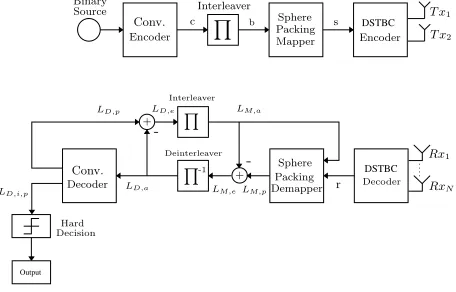
The schematic of the entire system is shown in Figure 1, where the transmitted source bits are convolutionally encoded and then
interleaved by a random bit interleaver. A rateR = 12
recur-sive systematic convolutional (RSC) code was employed. Af-ter channel inAf-terleaving, the sphere packing mapper first maps
B channel-coded bitsb= b0,...,B−1 ∈ {0,1}to a legitimate constellation pointsl ∈ Sfrom the latticeD4, where we have
B = log2L. The mapper then maps the constellation pointsl
transmitted according to Equation (2) overT = 2consecutive time slots using two transmit antennas, as shown in Equation (1).
In this treatise, we considered a correlated narrowband Ray-leigh fading channel, associated with a normalised Doppler fre-quency offD = fdTs = 0.01, where fd is the Doppler
fre-quency andTs is the symbol duration. The complex fading
envelope is assumed to be constant across the transmission
pe-riod of two sphere packing symbols spanningT = 4time slots.
The complex Additive White Gaussian Noise (AWGN) ofn=
nI +jnQ is also added to the received signal, wherenI and
nQare two independent zero mean Gaussian random variables
having a variance ofσn2 =σn2I =σn2Q =N0/2per dimension,
whereN0/2represents the double-sided noise power spectral
density expressed inW/Hz.
As shown in Figure 1, the received complex-valued symbols are first differentially decoded by the DSTBC decoder. Then, the decoded symbols are passed to the sphere packing demapper, where they are demapped to their Log-Likelihood Ratio (LLR)
representation for each of theB coded bits per sphere packing
symbol. Thea prioriLLR values of the demodulator are
sub-tracted from thea posterioriLLR values for the sake of
gen-erating the extrinsic LLR valuesLM,e, and then the LLRsLM,e are deinterleaved by a soft-bit deinterleaver, as seen in Figure 1. Next, the soft bitsLD,aare passed to the convolutional decoder
in order to compute thea posterioriLLR valuesLD,pprovided
by the Max-Log MAP algorithm [16] for all the channel-coded
bits. During the last iteration, only the LLR valuesLD,i,pof
the original uncoded systematic information bits are required, which are passed to a hard decision decoder in order to determine the estimated transmitted source bits. The extrinsic information
LD,e, is generated by subtracting thea prioriinformation from thea posterioriinformation according toLD,p−LD,a, which
is then fed back to the DSTBC-SP demapper as thea priori
informationLM,aafter appropriately reordering them using the
interleaver of Figure 1. The sphere packing demapper exploits thea prioriinformation for the sake of providing improveda posterioriLLR values, which are then passed to the channel de-coder and in turn back to the sphere packing demodulator for fur-ther iterations. More detailed discussions on the iterative demap-ping process and how the sphere packing demapper is modified
for exploiting thea prioriknowledge provided by the channel
decoder are provided in [13].
4. EXIT CHART ANALYSIS
The main objective of employing EXIT charts proposed by ten Brink [10], is to predict the convergence behaviour of the it-erative decoder by examining the evolution of the input/output mutual information exchange between the inner and outer de-coders in consecutive iterations. The application of EXIT charts is based on two assumptions, firstly that upon assuming a
suf-ficiently large interleaver length, thea prioriLLR values
be-come fairly uncorrelated; and secondly that the probability
den-sity function (PDF) of thea prioriLLR values is Gaussian,
al-though in practice these assumptions may not always hold.
The mutual information ofIAM =I(b;LM,a),0≤IAM ≤ 1, between the outer coded and interleaved bitsbof Figure 1 and the LLR valuesLM,ais used to quantify the information content
of thea prioriknowledge at the input of the demapper [17]. By
contrast, in order to quantify the information content of the
ex-trinsic LLR valuesLM,eat the output of the demapper, the
mu-tual informationIEM =I(b;LM,e)can be used. Considering
IEM as a function of bothIAM and theEb/N0 value encoun-tered, the demapper’s extrinsic information transfer characteris-tic is defined as [10]IEM =TM(IAM, Eb/N0).
The extrinsic transfer characteristic of the outer channel de-coder describes the relationship between the outer channel coded inputLD,aand the outer channel decoded extrinsic outputLD,e. The input of the outer channel decoder is constituted by the
a priori inputLD,a provided by the sphere-packing demap-per. Therefore, the extrinsic information transfer characteris-tic of the outer channel decoder is independent of theEb/N0
-value and hence may be written as IED = TD(IAD), where
IAD=I(c;LD,a),0≤IAD ≤1, is the mutual information
be-tween the outer channel coded bitscand the LLR valuesLD,a.
Similarly,IED =I(c;LD,e),0≤IED ≤1, is the mutual
in-formation between the outer channel coded bitscand the LLR
valuesLD,e.
0.0 0.2 0.4 0.6 0.8 1.0 A priori input IAMof the demapper 0.0
0.2 0.4 0.6 0.8 1.0
Extrinsic
output
IEM
of
the
demapper
(a)
. . .
. . . .
. . . .
(Eb/N0= 6.0dB)DSTBC-SP, L=16
AGM 5 AGM 4 AGM 3
.
AGM 2AGM 1 GM
0.0 0.2 0.4 0.6 0.8 1.0
IED becomes IAM 0.0
0.2 0.4 0.6 0.8 1.0
IEM
becomes
IAD
(b)
L=16 DSTBC-SP, Exit Chart
RSC Code AGM-4
5 dB 6 dB 7 dB
Eb/N0
[image:3.595.311.540.193.307.2]= 8dB
Figure 2:(a) Sphere packing demapper EXIT characteristics for Gray mapping (GM) and different bits to sphere-packing symbol Anti-Gray mapping (AGM)schemes atEb/N0 = 6.0dBforL= 16. (b) EXIT chart of a turbo-detected RSC channel-coded DSTBC-SP scheme em-ploying Anti-Gray mapping (AGM-4) in combination with the parame-ters outlined in Table 1.
Figure 2a shows the extrinsic information transfer character-istics of the sphere-packing symbol-to-bit demapper in
conjunc-tion withL = 16and different mapping schemes between the
interleaver’s output and the sphere packing mapper. Observe that Gray mapping does not provide any iteration gain upon in-creasing the mutual information at the input of the demapper, which was also reported in [9]. The reason for this observation is that the adjacent Gray-coded symbols differ from the one con-sidered in a single bit-position and hence no extrinsic informa-tion is gleamed from the remaining identical bits. This situainforma-tion is reversed, when using different Anti-Gray Mapping (AGM) schemes [9], resulting in different EXIT characteristics, as illus-trated by the different slopes seen in Figure 2a. The five different AGM mapping schemes shown in Figure 2a are specifically
se-lected from all the possible mapping schemes forL = 16in
order to demonstrate the different extrinsic information transfer characteristics associated with different bit-to-symbol mapping
schemes. There are a total of16!different mapping schemes.
Figure 2b shows the EXIT chart of a turbo-detection aided, channel-coded DSTBC-SP scheme employing the Anti-Gray ma-pping (AGM-4) of Figure 2a in conjunction with the outer RSC code and the system parameters outlined in Table 1. Ideally, in order for the exchange of extrinsic information between the sphere-packing demapper and the outer RSC decoder to con-verge at a specific Eb/N0 value, the extrinsic transfer curve
of the sphere-packing demapper recorded at the Eb/N0 value
of interest and the extrinsic transfer characteristic curve of the outer RSC decoder should only intersect at the(IAD, IED) =
(1.0,1.0)point. If this condition is satisfied, then a so-called
convergence tunnel[10] appears in the EXIT chart. Even if there is no open tunnel in the EXIT chart, but the two EXIT curves intersect at a point infinitesimally close to theIED = 1.0
line rather than at the(1.0,1.0) point, then a sufficiently low
BERmay still be achievable. These types of tunnels are
Modulation Sphere Packing withL= 16
No. of Transmitters 2
No. of Receivers 1
Channel Correlated Rayleigh Fading
Normalised Doppler
frequency 0.01
Outer channel RSC,(2,1,5)
code (Gr, G)=(35,23)8
System throughput 1bit/symbol
Table 1: System parameters
tunnel, the closer the system operates to the Shannon limit and hence a high number of iterations are required for reaching the intersection point. Observe in Figure 2b that a semi-convergent tunnel exists atEb/N0= 6.0dB. This implies that according to the predictions of the EXIT chart seen in Figure 2b, the iterative
decoding process is expected to converge and hence a lowBER
may be attained atEb/N0 = 6.0dB. The validity of this pre-diction is, however, dependent on how accurately the two EXIT chart assumptions outlined at the beginning of Section 4 are sat-isfied. These EXIT chart based convergence predictions will be verified by the actual iterative decoding trajectory in Section 5.
5. RESULTS AND DISCUSSION
Without loss of generality, we considered a sphere packing
mod-ulation scheme associated withL= 16using two transmit and a
single receiver antenna in order to demonstrate the performance improvements achieved by the proposed system. All simulation parameters are listed in Table 1.
0.0 0.2 0.4 0.6 0.8 1.0
0.0 0.2 0.4 0.6 0.8 1.0
IEM
becomes
IAD
(a)
RSC Code
AGM-4, (Eb/N0= 6.0dB)
Decoding trajectory
(Interleaver size = 103bits)
0.0 0.2 0.4 0.6 0.8 1.0
0.0 0.2 0.4 0.6 0.8 1.0
(b)
(Interleaver size = 104bits)
0.0 0.2 0.4 0.6 0.8 1.0
IED becomes IAM
0.0 0.2 0.4 0.6 0.8 1.0
IEM
becomes
IAD
(c)
(Interleaver size = 105bits)
0.0 0.2 0.4 0.6 0.8 1.0
IED becomes IAM
0.0 0.2 0.4 0.6 0.8 1.0
(d)
(Interleaver size = 106bits)
Figure 3:Decoding trajectories of turbo-detected RSC channel-coded DSTBC-SP scheme employing Anti-Gray mapping (AGM-4) in combi-nation with the outer RSC code and the system parameters outlined in Table 1 and operating atEb/N0 = 6.0dB, when using different inter-leaver depths.
Since the set of complex constellation symbols, which is con-structed from the set of legitimate sphere packing constellation points using Equations (3) and (4) is multiplied by a factor that
is inversely proportional to√E, namely by
2L
E, it is desirable to choose a specific subset ofL= 16points from the entire set of legitimate constellation points hosted byD4, which results in the minimum total energy. It was shown in [15] that there is a
total of24legitimate symbols2 hosted by D4 having an
iden-tical minimum energy ofE = 2. We used a computer search
for determining the optimum choice of theL = 16points out
of the possible24points, which possess the highest minimum
[image:4.595.72.275.42.143.2]Euclidean distance, hence minimising the error probability.
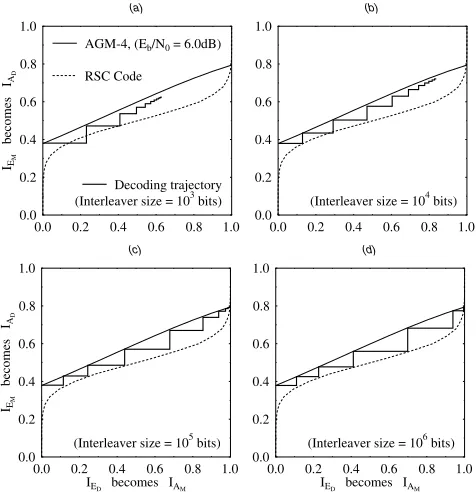
Figure 3 illustrates the actual decoding trajectories of the
turbo-detected RSC-coded DSTBC-SP scheme of Figure 2b atEb/N0
= 6.0dB, when using different interleaver depths. The zigzag-path seen in Figure 3 represents the actual extrinsic informa-tion transfer between the sphere-packing demapper and the outer RSC channel decoder. Observe in Figures 3c and 3d that since long interleavers are employed, the assumptions outlined at the beginning of Section 4 are justified and hence the EXIT chart based convergence prediction of the step-wise linear actual de-coding trajectory is quite accurate. By contrast, the dede-coding trajectories shown in Figures 3a and 3b more substantially devi-ate from the EXIT chart prediction, because shorter interleaver lengths are used. Observe also the difference between Figures 3c and 3d, where more iterations are required for approaching the
intersection point, when the interleaver depth drops from 106
bits to105bits. The influence of interleaver depth on system’s attainable performance is further highlighted in Figure 4. More specifically, Figure 4 illustrates the achievableBERof the turbo-detected RSC channel-coded DSTBC-SP scheme of Figure 3, when operating atEb/N0 = 6.0dBand using different inter-leaver depths as well as different number of iterations.
Accord-ing to Figure 4, f ourmore iterations are necessitated by the
system employing an interleaver depth of105 bits in order to
achieve a BERcomparable to that of the system employing
an interleaver depth of 106 bits, when operating at Eb/N0 =
6.0dB.
0 1 2 3 4 5 6 7 8 9 10
Number of Iterations
10-5 10-4 10-3 10-2 10-1 100
BER size:
Interleaver
[image:4.595.54.292.408.654.2]106 105 104 103
Figure 4: Achievable BER of turbo-detected RSC channel-coded
[image:4.595.327.507.448.591.2]DSTBC-SP scheme employing Anti-Gray mapping (AGM-4) in com-bination with the outer RSC code and the system parameters outlined in Table 1 and operating atEb/N0= 6.0dBwith different interleaver depths and number of iterations.
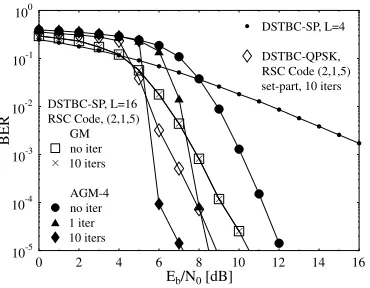
Figure 5 compares the attainable performance of the proposed RSC-coded DSTBC-SP scheme employing both Anti-Gray Map-ping (AGM-4) and Gray MapMap-ping (GM) against that of an
iden-2In simple terms, the sphere centred at (0,0,0,0) has24spheres
around it, centred at the points
0 2 4 6 8 10 12 14 16
Eb/N0[dB]
10-5
10-4
10-3
10-2
10-1
100
BER
. . . .
. . . . .
. . . .
.
set-part, 10 iters RSC Code (2,1,5) DSTBC-QPSK,
.
DSTBC-SP, L=4RSC Code, (2,1,5) DSTBC-SP, L=16
[image:5.595.73.258.65.209.2]10 iters 1 iter no iter AGM-4 10 iters no iter GM
Figure 5: Performance comparison of Anti-Gray Mapping (AGM-4)
and Gray Mapping (GM) based RSC-coded DSTBC-SP schemes in con-junction withL = 16against an identical-throughput 1 bit/symbol (BPS) uncoded DSTBC-SP scheme usingL= 4and against RSC-coded QPSK modulated DSTBC scheme, when employing the system param-eters outlined in Table 1 and using an interleaver depth ofD = 106
bits.
tical-throughput 1 Bit Per Symbol (1BPS) uncoded DSTBC-SP
scheme usingL = 4 and against an RSC-coded QPSK
mod-ulated DSTBC scheme, when employing the system
parame-ters outlined in Table 1 and using an interleaver depth ofD =
106bits. The QPSK modulated DSTBC system employs a
set-partitioning mapping scheme reminiscent of Trellis Coded Mod-ulation (TCM) [18]. Observe in Figure 5 by comparing the two
Gray Mapping (GM) DSTBC-SP curves that noBER
improve-ment was obtained, when10turbo-detection iterations were
em-ployed in conjunction with Gray Mapping. This phenomenon was also reported in [9] and it becomes evident from the hor-izontal curve characterising Gray mapping in Figure 2a. By contrast, Anti-Gray Mapping (AGM-4) of Figure 2a achieved a useful performance improvement in conjunction with iterative demapping and decoding. Explicitly, Figure 5 demonstrates that
a coding advantage of about23.7dBwas achieved at a BER of
10−5after10iterations by the RSC-coded AGM-4 DSTBC-SP
system over the uncoded DSTBC-SP for transmission over the correlated Rayleigh fading channel considered. Additionally, a coding advantage of approximately3.3dBand1.7dBwere at-tained over the 1BPS-throughput RSC-coded GM DSTBC-SP scheme and the RSC-coded QPSK modulated DSTBC scheme, respectively.
6. CONCLUSION
In this paper we proposed a novel system that exploits the advan-tages of both iterative demapping and turbo detection [9], as well as those of the sphere packing modulation proposed in [11]. Our investigations demonstrated that significant performance impro-vements may be achieved, when the AGM DSTBC-SP scheme is combined with outer channel decoding and iterative demap-ping, as compared to the Gray-Mapping based systems. Subse-quently, EXIT charts were used to search for the optimum bit-to-symbol mapping schemes that converge at the lowest
possi-bleEb/N0 values. Several DSTBC-SP mapping schemes
cov-ering a wide range of extrinsic transfer characteristics were in-vestigated. When using an appropriate bit-to-symbol mapping scheme and10turbo detection iterations,Eb/N0gains of about
23.7dBand1.7dBwere obtained by the RSC-coded
DSTBC-SP scheme over the identical-throughput 1 bit/symbol uncoded DSTBC-SP benchmarker scheme and over a turbo-detected sys-tem based on the DSTBC scheme of [3, 5]. Our future research includes the employment of novel precoding techniques between the outer channel code and the sphere packing mapper for the sake of improving the system’s performance while, maximising its throughput and minimising its delay.
7. REFERENCES
[1] L. Hanzo, T. H. Liew, and B. L. Yeap,Turbo Coding, Turbo Equal-isation and Space-Time Coding: for Transmission over Fading Channels. Chichester, England: John Wiley and Sons Ltd and IEEE Press, NY, USA, 2002.
[2] B. M. Hochwald, G. Gaire, B. Hassibi, and E. T. L. Marzetta, “Spe-cial issue on space-time transmission, reception, coding and signal processing,”IEEE Transactions on Information Theory, vol. 49, pp. 2329–2806, Oct 2003.
[3] V. Tarokh and H. Jafarkhani, “A differential detection scheme for transmit diversity,” inIEEE Journal on Selected Areas in Commu-nications, vol. 18, pp. 1169–1174, July 2000.
[4] S. Alamouti, “A simple transmit diversity technique for wireless communications,”IEEE Journal on Selected Areas in Communi-cations, vol. 16, no. 8, pp. 1451–1458, 1998.
[5] C.-S. Hwang, S. H. Nam, J. Chung, and V. Tarokh, “Differential space time block codes using nonconstant modulus constellations,” inIEEE Transactions on Signal Processing, vol. 51, pp. 2955– 2964, Nov 2003.
[6] B. Hochwald and W. Sweldens, “Differential unitary space-time modulation,” IEEE Transactions on Communications, vol. 48, pp. 2041–2052, Dec 2000.
[7] B. Hochwald and T. Marzetta, “Unitary space-time modulation for multiple-antenna communications in Rayleigh flat fading,”IEEE Transactions on Information Theory, vol. 46, pp. 543–564, Mar 2000.
[8] B. Hughes, “Differential space-time modulation,”IEEE Transac-tions on Information Theory, vol. 46, pp. 2567–2578, Nov 2000.
[9] S. ten Brink, J. Speidel, and R.-H. Yan, “Iterative demappping and decoding for multilevel modulation,” inIEEE Global Telecommu-nications Conference, vol. 1, (Sydney, Australia), pp. 579–584, 8-12 Nov 1998.
[10] S. ten Brink, “Designing iterative decoding schemes with the ex-trinsic information transfer chart,”AEU¨ International Journal of
Electronics and Communications, vol. 54, pp. 389–398, Nov 2000.
[11] W. Su, Z. Safar, and K. J. R. Liu, “Space-time signal design for time-correlated Rayleigh fading channels,” inIEEE International Conference on Communications, vol. 5, (Anchorage, Alaska), pp. 3175–3179, 2003.
[12] V. Tarokh, H. Jafarkhani, and A. Calderbank, “Space-time block codes from orthogonal designs,”IEEE Transactions on Informa-tion Theory, vol. 45, pp. 1456–1467, Jul 1999.
[13] O. Alamri, B. L. Yeap, and L. Hanzo, “Turbo detection of channel-coded space-time signals using sphere packing modulation,” in IEEE Vehicular Technology Conference, vol. 4, (Los Angeles, USA), pp. 2498–2502, Sep 2004.
[14] W. Su and X. G. Xia, “On space-time block codes from complex orthogonal designs,”Wireless Personal Communications, (Kluwer Academic Publishers), vol. 25, pp. 1–26, April 2003.
[15] J. H. Conway and N. J. Sloane, Sphere Packings, Lattices and Groups. Springer-Verlag, 1999.
[16] P. Robertson, E. Villebrun, and P. Hoeher, “A comparison of op-timal and sub-opop-timal MAP decoding algorithms operating in the log domain,” inProceedings of International Conference on Com-munications, (Seattle, USA), pp. 1009–1013, Jun 1995.
[17] T. M. Cover and J. A. Thomas,Elements of information theory. New York: Wiley, 1991.