
Algorithms for Pseudo-Boolean Optimization
Vasco Manquinho and Jo˜ao Marques-Silva
Technical University of Lisbon, IST/INESC-ID, Lisbon, Portugal
{vmm, jpms}@sat.inesc-id.pt
Abstract. The utilization of cutting planes is a key technique in Integer Linear Programming (ILP). However, cutting planes have seldom been applied in Pseudo-Boolean Optimization (PBO) algorithms derived from the Davis-Logemann-Loveland (DLL) procedure for Propositional Satis-fiability (SAT). This paper proposes the utilization of cutting planes in a DLL-style PBO algorithm, which incorporates the most effective techniques for PBO. We propose the utilization of cutting planes both during preprocessing and during the search process. Moreover, we also establish conditions that enable clause learning and non-chronological backtracking in the presence of conflicts involving constraints generated by cutting plane techniques. The experimental results, obtained on a large number of classes of instances, indicate that the integration of cut-ting planes with backtrack search is an extremely effective technique for PBO.
1
Introduction
In this paper we address algorithms for Pseudo-Boolean Optimization (PBO) and focus on exploiting effectively the information provided by the cost func-tion. Our objective is to use this information for pruning the search space. Hence, we propose to augment SAT-based PBO algorithms with bounding ca-pability, associated with information obtained from the Pseudo-Boolean (PB) constraints and from the cost function1. Moreover, we propose to extend a SAT-based PBO algorithm with lower bounding, that uses linear programming relax-ation for compute lower bounds [2], and integrate the identificrelax-ation of cutting planes in this algorithm. We also establish conditions for learning new con-straints from conflicts associated with cutting planes. Furthermore, we show that these new constraints can be used for performing non-chronological back-tracking. Experimental results, obtained on representative problem instances, illustrate the effectiveness of integrating cutting planes in SAT-based algorithms for PBO.
1 An extended version of this paper is available in [1].
F. Bacchus and T. Walsh (Eds.): SAT 2005, LNCS 3569, pp. 451–458, 2005. c
2
Preliminaries
An instanceP of the Pseudo-Boolean Optimization problem can be defined as follows:
minimize
j∈Ncj·xj subject to
j∈Naijlj≥bi,
xj∈ {0,1}, aij, bi∈N+0, i∈M N ={1, . . . , n}, M ={1, . . . , m}
(1)
where cj is a non-negative integer cost associated with variablexj, j ∈ N and aij denote the coefficients of the literalslj in the set ofmlinear constraints.
Every pseudo-boolean formulation can be rewritten such that all coefficients aij and right-hand side bi be non-negative. In a given constraint, if all aij co-efficients have the same valuek, then it is called a cardinality constraint, since it only requires thatbi/kliterals be true. A pseudo-boolean constraint where any literal set to true is enough to satisfy the constraint, can be interpreted as a propositional clause. This occurs when the value of allaij coefficients are greater than or equal to bi. If every constraint can be interpreted as a propositional clause then P is an instance of the binate covering problem (BCP). Covering formulations have been the subject of thorough research work [3].
Notice that a linear pseudo-boolean optimization problem can also be viewed as a special case of linear integer programming problem. The linear integer pro-gramming formulation for the constraints can be obtained if we replace literals ¯
xj by 1−xj. Throughout the paper we refer extensively to backtrack search algorithms. In addition, the PB inference techniques of [4] are assumed.
3
Pseudo-Boolean Optimization Algorithms
Given that PBO is a restriction of generic ILP, all algorithms proposed in the past for ILP can also be used for PBO. Among these, complete approaches include branch-and-bound with linear programming relaxations [5], cutting planes [6], branch-and-cut [7], and branch-and-bound [3]. Besides algorithms for generic ILP, algorithms specific to PBO have also been proposed. These include SAT-based algorithms [4, 8, 9], branch-and-bound algorithms [3] and SAT-SAT-based al-gorithms with lower bounding [2]. A survey of these alal-gorithms is available, for example, in [1]. In the reminder of this section we address the utilization of linear programming relaxations.
minimize zlpr=cx
subject to Ax≥b, 0≤x≤1 (2)
where vectorcdefines the non-negative integer cost associated with every deci-sion variable in vector x. Entries of matrix A define the constraint coefficients and vectorb the right-hand side of every constraint. It is well-known that the solution of (2) is a lower bound on the solution of (1) [5].
4
Cutting Planes
Integer Linear Programming algorithms use linear programming relaxations (as formulated in (2)) for estimating lower bounds on the value of the cost function. However, linear programming relaxations have other applications, including the identification of cutting planes.
The work on cutting planes can be traced to Gomory [6]. Gomory introduced a cutting plane technique that derives new linear inequalities in order to exclude some non-integer solutions from (2). However, the new linear inequalities are valid for the original integer linear program and so can be safely added to the original problem. Moreover, solving (2) with the added inequalities may yield a tighter lower bound estimate.
Since Gomory’s original work, a large number of cutting plane techniques have been proposed [5, 10, 12]. This section addresses Gomory fractional cuts and clique cuts, which are integrated in a SAT-based PBO solver.
In simplex-based solutions for solving the LPR from (2), the simplex method adds a setS of slack variables such that each constraint can be formulated as:
j∈N
aijxj−si =bi si≥0 (3)
This formulation is called the slack formulation and it is used to create the original simplex tableau [5].
If the solutionx∗of the LPR is integral, thenx∗provides the optimal solution to the original problem. Otherwise, choose a basic2variablexjsuch that its value on the LPR solution is not integral. Sincexj is a basic variable, after the pivot operations performed by the simplex algorithm on (3), there is a row in the simplex tableau of the form,
xj+ i∈P
αixi+ i∈Q
βisi=x∗j (4)
whereP andQare the sets of indexes of non-basic variables (problem variables and slack variables, respectively). In [6], Gomory proves that the inequality,
i∈P
f(αi)xi+
i∈Q
f(βi)si≥f(x∗j) (5)
wheref(y) =y− y, is violated by the solution of the LPR, but satisfied by all non-negative integer solutions to (4). Hence, it is also satisfied by all solutions to the original problem as formulated in (1) and can be added to the LPR. Solving the LPR with the new restriction (known as a Gomoryfractional cut) will yield a tighter lower bound estimate on the value of the PBO instance. Observe that several methods for strengthening the original Gomory fractional cuts have been proposed [13, 14, 15], but are beyond the scope of this work.
Notice that we can use (3) to replaces each slack variable in (5) so that the constraint only contain variables from the original PBO problem. Afterwards, if we apply the rounding operation on the non integer coefficients we obtain a new pseudo-boolean constraint valid for the original PBO instance as defined in (1), since the rounding operation will only weaken the constraint.
Like the Gomory fractional cuts, clique cuts [5, 10] also provide a method that adds new inequalities in order to cut non-integral solutions from the LPR, hence improving the tightness of lower bound estimates.
In general, we can build a conflict graph in order to represent all incompati-ble assignments for a pseudo-boolean formula. In the conflict graph, each node represents an assignment to a problem variable and each edge between two nodes represents an assignment incompatibility. For each cliqueCin the conflict graph we can add a new constraint of the formi∈Cli ≤1, where li is the literal at nodei of cliqueC. One should note that we are interested in finding all maxi-mum cliques in the conflict graph, but it is well-known that that the problem of finding a maximum clique in an undirected graph is NP-Hard [5]. As a result, a heuristic greedy procedure is often used.
5
Cutting Planes in SAT-Based PBO
In a modern SAT-based algorithm, a conflict analysis procedure is carried out whenever a conflict arises [16]. Therefore, if the generated cutting plane is in-volved in the conflict analysis process, it must be able to determine its logical dependencies in order to backtrack to a valid node of the search tree. This sec-tion proposes condisec-tions for associating dependencies with computed cutting planes, thus enabling clause learning and non-chronological backtracking from constraints inferred with cutting plane techniques.
In order for the generated cut to be safely added to the set of pseudo-boolean constraints, we must add all literals lj ∈ ωcut to the cut. The coefficient of each added literal lj must be large enough to satisfy the constraint whenever lj= 1. Although this approach guarantees the completeness of the algorithm, if a conflict occurs involving the generated cuts at a nodeN of the search tree, the search cannot backtrack to a node higher thanN.
Another technique would be to associate dependencies with cuts following the ideas proposed in [2] for LPR. Since each cut is derived from the outcome of solving the LPR formulation, then we can associate with each cut the same dependencies we associate with lower bound conflicts. However, one should note that the tableau constraint (4), from which the Gomory fractional cut is inferred, depends on the pivot operations performed while solving the LPR. As a result, the tableau constraint (4) contains the slack variables assigned value 0 from the constraints from which it depends.
LetS be the set of constraints with slack variables assigned value 0 in the tableau constraint (4). If the literals assigned value 0 in these constraints were to have a different value, the tableau constraint might not be inferred in the LPR. Therefore, we can consider the assignments to those literals as the responsible for inferring the cut and we can defineωcut as:
ωcut={l:l= 0∧l∈ωi∧ωi∈S} (6) Notice that the generated cut might not depend on all decision assignments. Hence, if a conflict occurs involving generated cuts at nodeN with its depen-dences determined as in (6), it is possible to backtrack to a node higher thanN in the search tree, i.e. a non-chronological backtrack step. Moreover, the gener-ated cuts can also be used in different parts of the search tree, in addition to the subtree with root at the nodeN.
6
Results
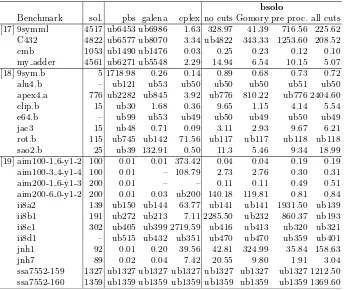
In order to empirically evaluate the techniques described in the paper, we ran our solver (bsolo) on representative sets of PBO instances [17, 18, 19]. Besides bsolo, we also ran PBS [8], Galena [4] and the commercial MILP solver CPLEX (version 7.5). The CPU times presented are from a AMD Athlon processor at 1.9 GHz and the time limit for each instance was set to one hour. If the time limit was reached, we provide an indication of which was the best upper bound value found when the search was stopped. Additional results and details on the experimental procedure can be found at [1].
Table 1.Experimental Results
bsolo
Benchmark sol. pbs galena cplex no cuts Gomory pre proc. all cuts [17] 9symml 4517 ub6453 ub6986 1.63 328.97 41.39 716.56 225.62 C432 4822 ub6577 ub8070 3.34 ub4822 343.33 1253.60 208.52 cmb 1053 ub1490 ub1476 0.03 0.25 0.23 0.12 0.10 my adder 4561 ub6271 ub5548 2.29 14.94 6.54 10.15 5.07 [18] 9sym.b 5 1718.98 0.26 0.14 0.89 0.68 0.73 0.72 alu4.b – ub121 ub53 ub50 ub50 ub50 ub51 ub50 apex4.a 776 ub2282 ub845 3.92 ub776 810.22 ub776 2404.60 clip.b 15 ub30 1.68 0.36 9.65 1.15 4.14 5.54 e64.b – ub99 ub53 ub49 ub50 ub49 ub50 ub49 jac3 15 ub48 0.71 0.09 3.11 2.93 9.67 6.21 rot.b 115 ub745 ub142 71.56 ub117 ub117 ub118 ub118 sao2.b 25 ub39 132.91 0.50 11.3 5.46 9.34 18.99 [19] aim100-1 6-y1-2 100 0.01 0.01 373.42 0.04 0.04 0.19 0.19 aim100-3 4-y1-4 100 0.01 – 108.79 2.73 2.76 0.30 0.31 aim200-1 6-y1-3 200 0.01 – – 0.11 0.11 0.49 0.51 aim200-6 0-y1-2 200 0.01 0.03 ub200 140.18 119.81 0.81 0.84 ii8a2 139 ub150 ub144 63.77 ub141 ub141 1931.50 ub139 ii8b1 191 ub272 ub213 7.11 2285.50 ub232 860.37 ub193 ii8c1 302 ub405 ub399 2719.59 ub416 ub413 ub320 ub321 ii8d1 – ub515 ub432 ub351 ub470 ub470 ub359 ub401 jnh1 92 0.01 0.20 39.56 42.81 324.99 35.84 158.63 jnh7 89 0.02 0.04 7.42 20.55 9.80 1.91 3.04 ssa7552-159 1327 ub1327 ub1327 ub1327 ub1327 ub1327 ub1327 1212.50 ssa7552-160 1359 ub1359 ub1359 ub1359 ub1359 ub1359 ub1359 1369.60
Among the SAT-based PBO algorithms, bsolo is by far the most effective algorithm, for the instances in this paper and for the instances in [2]. In fact, bsolo without the utilization of cutting planes is already significantly more ef-fective than the other SAT-based algorithms. The utilization of cutting planes further improves the results of bsolo, making it more robust than the com-mercial ILP solver cplex. Observe that the worst results for cplex occur for instances of the minimum-size prime implicant problem. These instances are derived from CNF formulas, where SAT-based techniques are particularly relevant.
7
Conclusions
that the utilization of cutting plane techniques can be extremely effective in PBO. Moreover, the results are also clear in demonstrating that lower bounding techniques are essential for hard instances of PBO. The experimental results for the most well-known PBO solvers that do not integrate lower bounding tech-niques, clearly demonstrate that lower bounding is essential for representative instances of pseudo-boolean optimization.
References
1. Manquinho, V., Marques-Silva, J.: On applying cutting planes in dll-based al-gorithms for pseudo-boolean optimization. Technical Report RT/003/05-CDIL, INESC-ID (2005)
2. Manquinho, V., Marques-Silva, J.P.: Effective lower bounding techniques for pseudo-boolean optimization. In: Design, Automation and Test in Europe Confer-ence. (2005)
3. Coudert, O.: On Solving Covering Problems. In: Design Automation Conference. (1996) 197–202
4. Chai, D., Kuehlmann, A.: A Fast Pseudo-Boolean Constraint Solver. In: Design Automation Conference. (2003) 830–835
5. Nemhauser, G.L., Wolsey, L.A.: Integer and Combinatorial Optimization. John Wiley & Sons (1988)
6. Gomory, R.: Outline of an algorithm for integer solutions to linear programs. Bulletin of the American Mathematical Society64(1958) 275–278
7. Mitchell, J.: Branch-and-cut algorithms for combinatorial optimization problems. In: Handbook of Applied Optimization. Oxford University Press (2002) 65–77 8. Aloul, F., Ramani, A., Markov, I., Sakallah, K.: Generic ILP versus specialized 0-1
ILP: An update. In: International Conference on Computer Aided Design. (2002) 450–457
9. Barth, P.: A Davis-Putnam Enumeration Algorithm for Linear Pseudo-Boolean Optimization. Technical Report MPI-I-95-2-003, Max Plank Institute for Com-puter Science (1995)
10. Bixby, R.E.: Progress in linear programming. ORSA Journal on computing 6 (1994) 15–22
11. Liao, S., Devadas, S.: Solving Covering Problems Using LPR-Based Lower Bounds. In: Design Automation Conference. (1997) 117–120
12. Chv´atal, V.: Edmonds polytopes and a hierarchy of combinatorial problems. Dis-crete Mathematics4(1973) 305–337
13. Balas, E., Ceria, S., Cornu´ejols, G., Natraj, N.: Gomory cuts revisited. Operations Research Letters19(1996) 1–9
14. Ceria, S., Cornu´ejols, G., Dawande, M.: Combining and strengthening Gomory cuts. In Springer-Verlag, ed.: Lecture Notes in Computer Science. Volume 920. E. Balas and J. Clausen (eds.) (1995)
15. Gomory, R.: An algorithm for integer solutions to linear programs. In Graves, R., (eds.), P.W., eds.: Recent Advances in Mathematical Programming. McGraw-Hill (1963) 269–302
17. Zhu, Z.: Synthesis for mixed ptl/cmos circuit.
(http://www-unix.ecs.umass.edu/-∼zzhu/)
18. Yang, S.: Logic Synthesis and Optimization Benchmarks User Guide. Microelec-tronics Center of North Carolina (1991)
![4 Chloro N [(E) 2,4 dichlorobenzylidene]aniline](data:image/gif;base64,R0lGODlhAQABAIAAAP///wAAACH5BAEAAAAALAAAAAABAAEAAAICRAEAOw==)