Chained Negotiation for Distributed Notification Services
Richard Lawley
Michael Luck
Luc Moreau
School of Electronics and Computer Science
University of Southampton
{
ral01r, mml, L.Moreau
}
@ecs.soton.ac.uk
Abstract
Distributed notification services allow consumers and publishers of notifications to interact with different notification services. However, such a distributed infrastructure makes it difficult to share notifications between consumers when consumers are allowed to specify Quality of Service levels. In this paper, we present a chained negotiation engine, enabling distributed notification services to support negotiation and to reuse existing subscriptions. We demonstrate the benefit to the system as a whole by reducing load on service providers and enabling content to be shared.
1
Introduction
Notification services (NSs) are messaging
middle-ware components providing asynchronous commu-nications between services and/or users in a dis-tributed environment. They are responsible for the delivery of messages between publishers and sub-scribers; publishers (such as information services) provide information that is then filtered and deliv-ered to subscribed consumers [7, 8, 12] based on a specification of topic and delivery parameters.
Publishers and consumers of notifications may have different and conflicting requirements in terms of delivery parameters. For example, subscribers to a service may wish to filter the notifications based on a set of criteria, or specify minimum intervals between notifications. These are essentially mea-sures of Quality of Service (QoS), and different sub-scribers may demand or request different levels of QoS. As the publisher may not be able to meet these requirements for reasons of policy or system load, a mechanism is required to resolve the difference between the preferences of the consumer and the provider.
In previous work [14], we determined that a com-petitive approach using negotiation would enable differences between the requirements of publisher and consumer to be resolved. A bi-lateral nego-tiation model was presented enabling mutually ac-ceptable values for notification parameters to be au-tomatically determined. We demonstrated that, by using this negotiation model to manage client de-mands, the load on the service provider could be re-duced, enabling more clients to use the same service.
The requirement to negotiate over QoS levels in a distributed service-oriented computing environment has also been recognised by the Grid community [1]. NSs can be distributed to address security and scalability issues. Here, multiple instances of a NS are hosted at different locations on the grid [13]. Publishers and consumers interact with differ-ent NSs; typically, they publish messages at or con-sume them from the NS located at their institution. Distributed NSs ensure that messages are routed be-tween them to propagate notifications from publish-ers to the relevant consumpublish-ers. If multiple consumpublish-ers are subscribed to the same topic, the same notifica-tions will be sent to all of them. When multiple con-sumers at the same site are receiving the same noti-fications, it becomes sensible to reuse the subscrip-tions in order to reduce network traffic and poten-tial delays. However, if each consumer is allowed to specify different QoS parameters for a subscription, it may become difficult to share notifications.
A key aspect of distributed NSs is that intermedi-aries can exist between publishers and consumers in the form of other NSs. In order to negotiate qual-ity of service between a publisher and a consumer, a more complex form of negotiation is required. Since the publisher and consumer no longer communicate directly, the negotiation has to take place through intermediaries, or middlemen. These middlemen pass on proposals or suggest existing commitments that can be reused to satisfy the consumer’s require-ments, which can impact on the negotiation outcome for the consumer or the publisher.
of notifications, we have designed an extended ne-gotiation model to support chained nene-gotiation. In this model, publishers and subscribers do not need to know whether they are negotiating directly or through a middleman — the interactions in which they participate remain identical in both cases. Ne-gotiations take place between negotiation compo-nents built into publishers and consumers through a number of middlemen. The publisher is a NS pub-lishing notifications on a topic the consumer is in-terested in. In situations in which the consumer is connected to a different notification service, chained negotiation is required to mediate the differing re-quirements of the two.
In this paper, we discuss the design and prelimi-nary evaluation of a negotiation engine implement-ing chained negotiation. To demonstrate its effec-tiveness we have designed a series of experiments which aim to show that using a chained negotiation system in conjunction with a distributed notification service enables more consumers to be serviced by a given set of notification services, and that this can be done at the same time as reducing the load on service providers. We have already shown that ne-gotiation can reduce the load on a service provider in a directly connected scenario — we aim to show improved results using a distributed system.
2
Notification Services
Over recent years, there has been a significant in-crease in the number of computers and other de-vices that access and run remote serde-vices over a net-work. Traditionally, this would have been accom-plished with remote-procedure calls (RPC), where a remote service is invoked by a client that issues the requests and stays connected waiting for it to com-plete. This has turned out to be an unsuitable model as it has become a common requirement to be able to issue requests, disconnect, and reconnect again later to receive the outcome of the request. This is needed when a permanent connection is not avail-able, or where a job is long running or continuous and it is not practical to stay connected while wait-ing for results.
Various message-oriented middleware solutions enable asynchronous, reliable communications and are suitable for the role of handling remote requests. Queuing products such as Microsoft Message Queue (MSMQ) [10] and IBM’s MQSeries are robust com-mercial implementations that allow reliable asyn-chronous communication within guaranteed delivery constraints.
A notification service (NS) is a form of message-oriented middleware utilising the Publish-Subscribe
model, acting as an intermediary responsible for the asynchronous delivery of messages between publishers and subscribers. (A NS is also re-ferred to as Notification broker in the recent WS-Notification specification [6].) Publishers are infor-mation sources — they publish inforinfor-mation about a given topic. Published information is delivered to anyone that has subscribed to that topic. Topics can be subscribed to by many subscribers, and published to by many publishers. The notification service takes the notifications from the publisher and handles their delivery to the subscribed consumers [7, 8, 12]. As well as simply passing on the messages, notification services can also filter and collect the notifications, allowing consumers to specify that they only want notifications matching certain criteria, from partic-ular sources, or that they want to receive all of the notifications over a period in a single digest.
It is the responsibility of the notification service to ensure that the notifications are distributed to all of the subscribers — a publisher does not need to know who has subscribed to a topic. Notification services are able to offer persistent, reliable delivery of notifications, meaning that if a subscribed con-sumer cannot be reached (for example if they have disconnected or the network is down), the notifica-tion service can attempt to deliver the notificanotifica-tion when they can be reached.
The notifications can, for instance, include an-nouncements of changes in the content of databases [15], new releases of tools or services, and the ter-mination of workflow execution. As such, the Grid community has recognised the essential nature of notification services such as the Grid Monitoring Architecture [17], the Grid Notification Framework [9], the logging interface of the Open Grid Services Architecture [4] and peer-to-peer high performance messaging systems like NaradaBrokering [5].
A notification service is also a core architectural element within the myGrid project [13]. myGrid (www.mygrid.org.uk) is an e-Science project that aims to help biologists and bioinformaticians per-form workflow-based in silico experiments and also help them in automating the management of such workflows through personalisation, notification of change and publication of experiments. It focusses increasingly on data-intensive bioinformatics, and the provision of a distributed environment to support the in silico experimental process.
be connected to different NSs. Message routing is handled by the NSs to ensure that notifications reach their destinations.
Potentially, distributed NSs enable the number of messages being transmitted to be optimised. Con-sider two NSs, NS1 and NS2. NS1 has one pub-lisher, and NS2 has two subscribers, both wanting to subscribe to the same topic. The two available options are for NS2 to make a subscription for each connected subscriber and have messages transmitted twice, or for NS2 to recognise that both subscribers are subscribed to the same topic and to reuse the same subscription to NS1 to serve both of them.
To address the distributed NS issue, the myGrid notification service [13] supports federated
notifica-tion topics. At each NS, individual topics have
meta-data attached marking them as part of a federated notification topic. Information about federated top-ics and the local member toptop-ics is stored in a topic registry. When a consumer subscribes to a federated topic, the NS contacts the topic registry to find all other NSs that have a topic in the federated topic, and subscribes to these topics. This enables a con-sumer to receive notifications on a topic at one NS that were published at another NS.
In a distributed NS, it is still desirable to be able to request levels of QoS. However, as different lev-els are requested by many different consumers at the same NS, it becomes difficult to reuse existing scriptions. For example, if a consumer has a sub-scription for notifications about database changes and has specified that notifications should be sent five hours apart, a second subscriber requesting no-tifications every hour is not going to be able to reuse the subscription. A form of negotiation is required to allow the subscriber to request appropriate levels of QoS and the NS to respond with alternative propos-als that can put existing subscriptions to better use. To this end, we proposed chained negotiation, which we describe in the next section.
3
Negotiation
Negotiation is the process by which two or more parties communicate in order to reach a mutually acceptable agreement on a particular matter [11]. More specifically, negotiation can be described in terms of protocols and strategies [16]: protocols de-fine the set of rules governing a negotiation such as the types of participants and valid negotiation states; and strategies determine how a single participant be-haves within that protocol, including how it gener-ates and responds to offers and when to bid.
3.1
Automated Negotiation
There are many situations where a developer would like to support negotiation over certain parameters without needing to know details of how to negotiate. Automated negotiation frameworks make this possi-ble by defining the particulars of how to negotiate [2], in terms of protocols and strategies.
Although there is plenty of existing work on auto-mated negotiation, we are not aware of any address-ing our concern of chained negotiation. For exam-ple, in previous work [14], we introduced an auto-mated negotiation engine based on a bilateral negoti-ation framework [3] intended for use in a notificnegoti-ation service. Bartolini et al.[2] developed a framework for negotiation enabling different types of negotia-tion to be specified using rules. Jennings et al.[11] discuss another framework for automated negotia-tion focussing on rules of negotianegotia-tion and allowing different types of negotiation to be carried out in the same framework.
3.2
Chained Negotiation
Direct negotiation takes place between one or more consumers and one or more suppliers. The sumers attempt to negotiate a price or set of con-straints for a product or service they will obtain from the supplier. Chained negotiation is an extended form of negotiation where there is one or more inter-mediary (or middleman) between the consumer and the supplier. Chained negotiation enables middle-men to provide value-added services on top of an already provided service, or to make a service avail-able more efficiently for a number of consumers. A middleman can exist for the purpose of making a profit or for increasing the social welfare of the com-munity. In the situation where the subject of nego-tiation is information, a middleman is able to redis-tribute this to multiple consumers without each of them needing an individual agreement with the in-formation provider.
Chained negotiation is suitable for use in a dis-tributed notification service. Consumers subscribe to their local NS, but the provider may be connected to another NS. The distributed NS handles sending the messages between the various NSs, but has trouble when multiple consumers request different delivery constraints. For example, if one consumer requests updates to a database every day, and another con-sumer requests hourly updates, there is no way the existing notifications could be reused. Chained ne-gotiation could be used for each consumer to find a set of mutually acceptable QoS values that could make use of subscriptions already in place.
of our previous negotiation engine and then discuss the extensions made to support chained negotiation.
3.2.1 Bilateral Negotiation Engine
In previous work [14], we introduced a bilateral ne-gotiation engine, in which nene-gotiations take place for a negotiation item. In a notification service, this would be a subscription to notifications on a partic-ular topic. The attributes of the item are called
nego-tiation terms, which would be various QoS aspects
such as message frequency, message size, granular-ity or cost of notifications.
The system as a whole is referred to as the
nego-tiation engine. While conceptually it could be
re-garded as a single shared entity, it is split into a
ne-gotiation component (NC) at each party in the
nego-tiation to maintain privacy of preferences and util-ity functions and enabling local information such as system load to be taken into consideration during the negotiation.
There are four types of messages used in the nego-tiation. Proposals are exchanged to find acceptable values. When one party receives a proposal they are prepared to accept, they respond with an accept mes-sage. This does not immediately commit them, but it does mean they have to commit if the other party replies with a confirm accept message. Negotiations can be terminated with a terminate message.
Due to space limitations, we omit details of how proposals are generated and evaluated — see [14] for details.
Selection of potential negotiation partners is be-yond the scope of this negotiation model; we assume there is a fixed chain between a consumer and a sup-plier. For testing purposes we have used a fixed set of partners — these will be discovered using a suit-able service discovery mechanism in future.
3.2.2 Chained Negotiation Extension
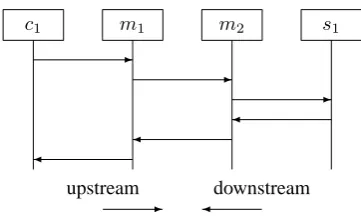
In a chained negotiation, there are three types of par-ticipants. Consumers attempt to obtain products or services from suppliers, but instead of contacting them directly, they go through a middleman that is likely to be local to them. Messages are exchanged sequentially between the involved parties. A typical sequence of message exchanges is shown in Figure 1, in which a distinction is made between messages travelling away (upstream) from the consumer (c1)
and towards the consumer (downstream). Messages travel from one end of the negotiation chain to the other via the middlemen (m1andm2). If one of the
middlemen can satisfy the request themselves, they reply to the incoming request instead of forwarding the message on.
c1 m1 m2 s1
-upstream
downstream
[image:4.595.315.496.85.196.2]
Figure 1: Message exchange in chained negotiation
One of the requirements we established when extending our bilateral negotiation model to cover chained negotiation was that the consumer and sup-plier should not have to know whether they are par-ticipating in a chained negotiation or not. This needed some changes to the model — mainly due to the time taken for negotiations. In the evaluation of our previous model, we used a simple interval-based time model in which the sending of one mes-sage takes one interval, rather than using the actual transmission time. If there was no successful pro-posal found by the time the deadline expired, the gotiation would fail. Using this system, chained ne-gotiation could fail very easily because participants would make their final concessions as the deadline expires, but there might not be enough time to get the message to its destination.
To solve this we included an extra field in each message holding the distance (in number of hops) away from the consumer (furthest downstream) the sender of the message is. This is combined with a new rule stating that messages can only be sent up-stream if there is enough time for the reply to reach the consumer:timeremaining≥dist+2. This is
be-cause it is impossible to determine how far upstream a message needs to go — a proposal could be ac-cepted by the closest middleman, or it could be sent on further. Because of this uncertainty, the rule is only for sending to the closest party.
3.2.3 Proximity and Scoring Functions
A key part of chained negotiation is a proximity function, determining whether one proposal is
sat-isfiable by another. Proposalp1is satisfiable byp2
if each element ofp2is at least as good as its
coun-terpart inp1(from the point of view of the sender of
p1), and the negotiation object (the notification
sub-ject in our case) of each proposal is the same.
prox(p1, p2) =
−1 if Subj(p1)6=Subj(p2)
0 if QoS(p1) =QoS(p2)
<0 ifp1not satisfiable byp2
≥0 ifp1satisfiable byp2
Proximity functions are used to determine appro-priate existing commitments. Scoring functions are used to determine the best action to take each time a message is received by a middleman. An action could be either to offer a counter-proposal or to ac-cept a received proposal from either direction. Ac-tions are generated in two ways: selecting appropri-ate existing commitments using proximity functions and taking the last received proposals from each di-rection and passing them across. In this case the middleman can adjust values in the proposal, poten-tially to take a cut if there is a monetary aspect in the proposal. Using these two methods enables negotia-tion to take place through the middleman while mak-ing it possible to reuse existmak-ing commitments should one be close enough to the proposals.
The key to chained negotiation is in having good scoring functions. The framework has been devel-oped to allow extra scoring functions to be plugged in, but in order to evaluate it we used three scoring functions. The first scoring function uses the prox-imity function to determine how close an action is to being acceptable. The second scoring function is one that favours actions that would lead to an ac-ceptable state above ones that would not, and also to favour actions that are matched to an existing com-mitment, as this would incur less cost1 upstream.
The final scoring function we have used is one that increasingly favours actions in directions that have not been used recently. For example, if in two rounds of messages a downstream action is chosen, an up-stream action will get a higher score from this func-tion next time around. Acfunc-tions are evaluated using a combination of all of the scoring functions.
If the deadline passes for a negotiation without a successful proposal being accepted, the negotiation is terminated. Negotiations can also be explicitly ter-minated for other reasons, such as no longer requir-ing the service, system shutdown etc.
1Cost is defined in terms of money or in having to do more
work.
4
Evaluation
Before integrating our negotiation engine with a no-tification service, we have run a number of simula-tions to predict the performance of chained negotia-tions in the context of a notification service.
4.1
Experiment Setup
In our experimental setup, we have divided the nego-tiation components (NCs) into end NCs and middle NCs, representing the components and each end of a negotiation and the middlemen respectively. As the experimental system does not use any commu-nication mechanism, the NCs are coupled directly together using method calls. The negotiation terms used in the experiments are abstract and represented by a numeric real value that could in turn represent any of the QoS terms suggested previously.
The set of varying factors in a negotiation ex-periment, such as preferences and deadlines, are grouped together into an environment. As there is an infinitely large space of possible environments, they are randomly generated in a repeatable manner, so that experiments may be re-run. In each experiment, end NCs are played against each other via a number of middlemen. Average values are then used to get an indications of real-world results. Tactics generate values for each term in a proposal. We have only used time-dependent tactics for the end NCs in this set of experiments for simplicity — for more details of tactics and the experiment setup please see [14].
In the experiments, we have compared how var-ious factors affect three different types of negotia-tion: Direct negotiation is where the consumer and supplier are directly connected; Chained negotia-tion uses intermediaries to pass on proposals and attempts to match them to existing commitments and forwarded negotiation, which is a subset of chained negotiation where no existing commitments are reused. Forwarded negotiation represents the worst case that chained negotiation can take, assum-ing all requests are sufficiently different that com-mitments cannot be reused. In chained negotiation, we also examine the amount of negotiations that are
matched — cases where existing commitments were
reused instead of making new ones.
0 0.1 0.2 0.3 0.4 0.5 0.6 0.7 0.8 0.9 1
0 10 20 30 40 50 60 70 80 90 100
Success Rate
Deadline
Direct
Forwarded
[image:6.595.87.289.88.229.2]Chained Matched
Figure 2: Effect of varying deadline on success rate
0 0.1 0.2 0.3 0.4 0.5 0.6 0.7 0.8 0.9
0 10 20 30 40 50 60 70 80 90 100
Utility
Deadline
Direct
Forwarded
[image:6.595.87.287.270.410.2]Chained
Figure 3: Effect of varying deadline on utility
4.2
Experiments and Results
4.2.1 Varying Deadline
When a negotiation must be completed by a certain time, a deadline is used to ensure that all agreements are made by this point. We previously determined that if a deadline was set too short, a negotiation was more likely to fail, and would give a lower utility to each party. We ran experiments through 500 en-vironments using a single negotiation term to deter-mine how the negotiation outcome would be affected as the deadline was varied upto 100 messages.
Figure 2 shows the success rates of different types of negotiation as the deadline is varied. Forwarded negotiation consistently performs worse than direct negotiation. Chained negotiation fares better, show-ing much better results almost immediately. This is because the set of environments the tests were run through was sufficiently large, and most of the ne-gotiations were matched to existing commitments. The graph also shows a set of periodic spikes in the curves. These spikes occur because of the change to the protocol (described in Section 3.2.2): the con-sumer cannot determine the distance to its opponent, as the request could be fulfilled by any middleman
inbetween. Thus it cannot determine the best time to offer its reservation value, and the negotiation is less likely to succeed. However, if the final offer is made when the remaining time allows the message to reach the supplier and return as the deadline ex-pires, the negotiation is more likely to succeed with a better outcome for the consumer.
Figure 3 shows the consumer utility from the same experiment. This is shown to have similar results to the success rate — chained negotiation on average performs very well very quickly. Forwarded negoti-ation does not perform as well as direct negotinegoti-ation with shorter deadlines, but approaches this level as the deadline becomes sufficiently large. The reason the utilities decrease slightly as negotiation dead-lines increase is due to the concession pattern of the supplier. When there is a short deadline, concessions are made in larger steps; because the supplier can determine the last possible moment to make their fi-nal concession (to a reservation value), the consumer can get a better deal. With longer deadlines, the sup-plier concedes in smaller steps and a proposal that is acceptable to the consumer is often found before the deadline. earlier, resulting in the proposal being better with respect to the consumer’s preferences.
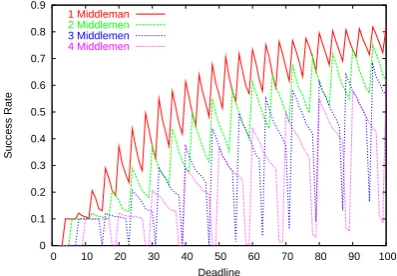
To further investigate the effect of the middlemen in the chained negotiation, we ran the same experi-ment through different numbers of middlemen. We focus on forwarded negotiation, because no matter how many middlemen are present, after an initial commitment has been made, an offer similar to this would always be satisfied by the first middleman in the chain. We ran the same experiment described above and varied the number of middlemen between one and five.
0 0.1 0.2 0.3 0.4 0.5 0.6 0.7 0.8 0.9
0 10 20 30 40 50 60 70 80 90 100
Success Rate
Deadline 1 Middleman
2 Middlemen
[image:6.595.304.503.522.660.2]3 Middlemen 4 Middlemen
Figure 4: Effect of varying deadline with multiple middlemen
dead-line tend to make negotiation less successful. This typically occurs when there is only a small overlap between the ranges of values each party considers acceptable. The reason for this drop is that while the supplier can determine when it is allowed to make its final concession and offer the reservation value, the consumer cannot because it does not know how far away the supplier is, so the final concession made by the consumer does not reach the supplier before the negotiation deadline. This worst case will hap-pen when the deadline is2n(m+ 1)−1, wherem
is the number of middlemen andnis an integer.
4.2.2 Varying Negotiation Terms
With a single negotiation term it is easy to match a new request to an existing commitment. With more negotiation terms, the negotiation has to get to the point where both terms are satisfiable by the com-mitment for it to be reused. We varied the number of terms the negotiation was run with, and used random deadlines between 30 and 60 messages.
0 0.1 0.2 0.3 0.4 0.5 0.6 0.7 0.8 0.9 1
0 2 4 6 8 10 12 14 16 18 20
Success Rate
Terms
Direct
Forwarded
[image:7.595.333.479.247.285.2]Chained Matched
Figure 5: Effect of varying number of terms
Figure 5 shows that as the number of negotiation terms increases the number of negotiations that can be matched to existing commitments drops sharply. It also shows that forwarded negotiation does not perform as well as direct negotiation, which we ex-plain with the same reason mentioned previously — forwarded negotiation performs worse than direct negotiation for a given deadline due to the extra time required to send messages.
We also ran the experiment through larger num-bers of environments. As this produces more op-portunities for commitments to be reused, the rate of matched commitments decreased at a slower rate. Overall, success rate in chained negotiation is badly affected by increasing the number of negotiation terms, but only to the level of forwarded negotiation as this is the worst case for chained negotiation.
4.2.3 Supplier capacity
One of the main objectives of chained negotiation is to reduce the amount of redundancy required in sending notifications, thereby increasing the number of consumers a single publisher can serve. To sim-ulate this, we have set up an experiment where we have a number of NSs chained together with a sin-gle publisher. Consumers are spread evenly between the NSs, and negotiations are run between them. We measured the difference in success rate and utilities compared to all of the consumers negotiating with the publisher’s NS directly.
Success Rate Utility Direct 0.680 0.270 Chained 0.986 0.857
Table 1: Success rate & consumer utility with chained negotiation
Table 1 shows the success rate and consumer util-ity is higher when using chained negotiation than negotiating directly. Out of 493 successful negoti-ations, only 24 of them involved making commit-ments with the supplier. The rest were satisfied us-ing existus-ing commitments held by middlemen. Over time most matched negotiations will be satisfied by the local middleman, as this will make a correspond-ing commitment when a match from a more distant middleman is accepted.
Our preliminary investigation indicates that while chained negotiation may make initial agreements harder to reach, especially with multiple middlemen, this is outweighed by the benefit that emerges when enough subsequent requests are satisfied using ex-isting commitments. In the context of a notification service, this allows a publisher at one NS to send notifications to more consumers at other NSs, while allowing consumers to specify aspects of QoS.
5
Conclusion and Future Work
[image:7.595.86.287.375.517.2]The next stage of this work is to integrate the chained negotiation engine with the myGrid notifi-cation service. The myGrid NS does not currently support negotiation over QoS attributes, so this will also be added at the same time. Adding QoS ne-gotiation abilities will enable consumers to request levels of QoS from the NS, with the NS retaining some control over what levels of QoS are realistic. Adding the chained negotiation will enable the NS to support many more consumers in the system as a whole without increasing the number of messages required significantly.
We have also identified a number of changes to the chained negotiation model which may provide bet-ter results, such as albet-tering the middleman so it can negotiate with both sides of a negotiation simultane-ously instead of sending a message in one direction and waiting for a reply.
Acknowledgements
This research is funded in part by EPSRC myGrid project (ref. GR/R67743/01).
References
[1] A. Andrieux, K. Czajkowski, A. Dan, K. Kea-hey, H. Ludwig, J. Pruyne, J. Rofrano, S. Tuecke, and M. Xu. Web services agreement specification (ws-agreement), Feburary 2004. [2] C. Bartolini, C. Preist, and N. R. Jennings.
Ar-chitecting for reuse: A software framework for automated negotiation. In 3rd International
Workshop on Agent-Oriented Software Engi-neering, pages 87–98, Bologna, Italy, 2002.
[3] P. Faratin, C. Sierra, and N. Jennings. Ne-gotiation decision functions for autonomous agents. International Journal of Robotics and
Autonomous Systems, 24(3–4):159–182, 1998.
[4] I. Foster, D. Gannon, and J. Nick. Open grid services architecure: A roadmap. Technical report, Open Grid Services Architecture WG, 2002. http://www.ggf.org/ogsa-wg/.
[5] G. Fox and S. Pallickara. The narada event bro-kering system: Overview and extensions. In H.R. Arabnia, editor, 2002 International
Con-ference on Parallel and Distributed Process-ing Techniques and Applications (PDPTA’02),
volume 1, pages 353–359, Las Vegas, Nevada, 2002. CSREA Press.
[6] S. Graham, P. Niblett, D. Chappell, A. Lewis, N. Nagaratnam, J. Parikh, S. Patil, S. Sam-darshi, S. Tuecke, W. Vambenepe, and B. Weihl. Web services notification (ws-notification), January 2004.
[7] Object Management Group. Event service specification. www.omg.org, mar 2001. [8] Object Management Group. Notification
ser-vice specification. www.omg.org, aug 2002. [9] S. Gullapalli, K. Czajkowski, and C.
Kessel-man. Grid notification framework. Techni-cal Report GWD-GIS-019-01, Global Grid Fo-rum, jul 2001.
[10] P. Houston. Building distributed applications with message queuing middleware – white pa-per. Technical report, Microsoft Corporation, 1998.
[11] N. Jennings, S. Parsons, C. Sierra, and P. Faratin. Automated negotiation. In 5th
Inter-national Conference on the Practical Applica-tion of Intelligent Agents and Multi-Agent Sys-tems, pages 23–30, Manchester, UK, 2000.
[12] Java Message Service API. http://java.sun.com/products/jms/, 1999. [13] A. Krishna, V. Tan, R. Lawley, S. Miles, and
L. Moreau. The mygrid notification service. In Proceedings of the UK OST e-Science
sec-ond All Hands Meeting 2003 (AHM’03), pages
475–482, Nottingham, UK, September 2003. [14] R. Lawley, M. Luck, K. Decker, T. Payne, and
L. Moreau. Automated negotiation between publishers and consumers of grid notifications.
Parallel Processing Letters, 13(4):537–548,
December 2003.
[15] T. Oinn. Change events and propaga-tion in mygrid. Technical report, Eu-ropean Bioinformatics Institute, 2002. http://www.ebi.ac.uk/ tmo/change notification.pdf. [16] C. Sierra, N. Jennings, P. Noriega, and S.
Par-sons. A framework for argumentation-based negotiation. In Intelligent Agents IV: 4th
Inter-national Workshop on Agent Theories Archi-tectures and Languages, volume 1365 of LNAI,
pages 177–192. Springer, 1997.