ARS MATHEMATICA CONTEMPORANEA 13 (2017) 275–291
Large circulant graphs of fixed diameter and
arbitrary degree
David Bevan
University of Strathclyde, Glasgow, U.K.
Grahame Erskine
,Robert Lewis
Open University, Milton Keynes, U.K.
Received 9 November 2015, accepted 24 February 2017, published online 9 March 2017
Abstract
We consider the degree-diameter problem for undirected and directed circulant graphs. To date, attempts to generate families of large circulant graphs of arbitrary degree for a given diameter have concentrated mainly on the diameter 2 case. We present a direct prod-uct constrprod-uction yielding improved bounds for small diameters and introduce a new general technique for “stitching” together circulant graphs which enables us to improve the current best known asymptotic orders for every diameter. As an application, we use our construc-tions in the directed case to obtain upper bounds on the minimum size of a subsetAof a cyclic group of ordernsuch that thek-fold sumsetkAis equal to the whole group. We also present a revised table of largest known circulant graphs of small degree and diameter.
Keywords: Degree-diameter problem, Cayley graphs, circulant graphs, sumsets.
Math. Subj. Class.: 05C25, 05C35
1
Introduction
The goal of thedegree-diameter problemis to identify the largest possible numbern(d, k)
of vertices in a graph having diameterkand maximum degreed. This paper considers the problem for the restricted category of circulant graphs, which we view as Cayley graphs of cyclic groups. We consider both undirected and directed versions of the problem in this paper. For a history and more complete summary of the degree-diameter problem, see the survey paper by Miller and ˇSir´aˇn [5].
E-mail address:[email protected] (David Bevan), [email protected] (Grahame Erskine), [email protected] (Robert Lewis)
All groups considered in this paper are Abelian (indeed cyclic) and hence we use ad-ditive notation for the group operation. With this convention we define aCayley graphas follows.
LetGbe an Abelian group andS⊆Ga subset such that0∈/ S. Then theCayley graph
Cay(G, S)has the elements ofGas its vertex set and each vertexghas an edge tog+s for eachs∈S. The following properties ofCay(G, S)are immediate from the definition:
• Cay(G, S)has order|G|and is a regular graph of degree|S|.
• Cay(G, S)has diameter at mostkif and only if every element ofGcan be expressed as a sum of no more thankelements ofS.
• Cay(G, S)is an undirected graph ifS=−S; otherwise it is a directed graph.
Acirculant graphis a Cayley graph of a cyclic group, and we use these terms inter-changeably.
Throughout the paper we use the following notation:
• CC(d, k) is the largest order of an undirected circulant graph with degree dand diameterk.
• DCC(d, k)is the largest order of a directed circulant graph with degreedand diam-eterk.
For a given diameterk, we are interested in determining the asymptotics ofCC(d, k)
andDCC(d, k)as the degreedtends to infinity. We make use of the following limits:
• L−C(k) = lim inf
d→∞ CC(d, k)/d
k; L+
C(k) = lim sup d→∞
CC(d, k)/dk.
• L−D(k) = lim inf
d→∞ DCC(d, k)/d
k; L+
D(k) = lim sup d→∞
DCC(d, k)/dk.
We begin with some trivial bounds onL− andL+. The following asymptotic upper
bound is easily obtained; see for example the survey paper [5]:
Observation 1.1(Trivial upper bound). L+C(k)≤L+D(k)≤ 1
k!.
For a lower bound, considerZrkwith generators{hr`:|h| ≤
r
2
,0≤` < k}:
Observation 1.2(Trivial lower bound). L−D(k)≥L−C(k)≥ 1
kk.
In this paper, we present constructions which yield, for eachk≥ 2, lower bounds on L−C(k)andLD−(k)that are greater than the trivial1/kkbound. No such bounds were known
previously. Our results include the following (see Corollary4.6):
• For any diameterk≥2and any degreedlarge enough,CC(d, k)> 1.14775dkk
.
• For any diameterkthat is a multiple of 5 or sufficiently large, and any degreedlarge enough,CC(d, k)> 1.20431dkk
.
• For any diameterk≥2and any degreedlarge enough,DCC(d, k)> 1.22474dkk
.
• For any diameterkthat is a multiple of 6 or sufficiently large, and any degreedlarge enough,DCC(d, k)> 1.27378dkk
We also deduce a result concerning sumsets coveringZn, and use our techniques to
con-struct a revised table of the largest known circulant graphs of small degree and diameter. For larger diameters, the trivial bounds become numerically small, and the ratio be-tween the upper and lower bound becomes arbitrarily large. Therefore, in order more easily to assess the success of our constructions, we make use of the following measure which records improvement over the trivial lower bound.
LetR−C(k) = k LC−(k)1/k, and defineR+
C(k),R
−
D(k)andR
+
D(k)analogously. Thus,
R−C(k)≥1, with equality if the trivial lower bound is approached asymptotically for large degrees. For eachk, theseRvalues thus provide a useful indication of the success of our constructions in exceeding the trivial lower bound. In Section4, we show how to construct a cyclic Cayley graph from two smaller ones in such a way that theRvalues are preserved. The R values are bounded above byRmax(k) = k(k!)−1/k. Using the asymptotic
version of Stirling’s approximation,logk!∼klogk−k, we see that as the diameter tends to infinity,
1 ≤ lim inf
k→∞ R
−
C(k) ≤ lim infk
→∞ R
+
C(k) ≤ e,
and similarly forR−D(k)andR+D(k).
In the next section, we extend a result of Vetr´ık [7] to deduce new lower bounds for L−C(2)andR−C(2). In Section3, we describe a direct product construction and use it to build large cyclic Cayley graphs of small diameter and arbitrarily large degree. We also prove that this construction is unable to yield values that exceed the trivial lower bound for large diameter. However, in Section4, we demonstrate a method of building a circu-lant graph by “stitching” together two smaller ones, and show how the application of this method to the constructions from Section3enables us to exceed the trivial lower bound for every diameter.
Section5contains an application of our constructions to obtain upper bounds on the minimum size of a setA ⊆Zn such that thek-fold sumsetkA is equal toZn. We
con-clude, in Section6, by presenting a revised table of the largest known circulant graphs of small degree and diameter, including a number of new largest orders resulting from our constructions.
2
Diameter 2 bounds for all large degrees
Much of the study of this problem to date has concentrated on the diameter 2 undirected case. In this instance, the trivial lower bound onL−C(2)is 1/4 and the trivial upper bound onL+C(2)is 1/2. Vetr´ık [7] (building on Macbeth, ˇSiagiov´a & ˇSir´aˇn [4]) presents a con-struction that proves thatL+C(2)≥ 13
36 ≈0.36111, and thusR +
C(2)>1.20185.
In this section, we begin by extending this result to yield bounds forL−C(2)andR−C(2). This argument can also be found in Lewis [3]. We reproduce it here for completeness, since we make use of the resulting bounds below.
Vetr´ık’s theorem applies only to values of the degreedof the form6p−2, wherepis a prime such thatp6= 13, p6≡1 (mod 13). We extend this result to give a slightly weaker bound valid for all sufficiently large values ofd. The strategy is as follows:
• Given a value ofd, we select the largest primepin the allowable congruence classes such that6p−2≤d.
• We add generators to the Vetr´ık construction (and hence edges to the Cayley graph) to obtain a new graph of degreedwhich still has diameter 2.
Note that the graphs in the Vetr´ık construction always have even order and hence we may obtain an odd degreedby adding the unique element of order 2 to the generator set.
Success of this method relies on being able to find a primepsufficiently close to the optimal value so that we need only add asymptotically few edges to our graph. We use recent results of Cullinan & Hajir [1] following Ramar´e & Rumely [6].
Lemma 2.1(Cullinan & Hajir [1], Ramar´e & Rumely [6]). Letδ = 0.004049. For any x0≥10100there exists a primep≡2 (mod 13)in the interval[x0, x0+δx0].
Proof. We use the method of Cullinan and Hajir [1, Theorem 1]. This method begins by using the tables of Ramar´e and Rumely [6] to find a valuecorresponding tok= 13, a= 2, x0 = 10100. Following the proof of Cullinan and Hajir [1, Theorem 1], if δ > 12− it
follows that there must exist a primep≡2 (mod 13)in the interval[x0, x0+δx0]. From
Table 1, Ramar´e and Rumely [6] we find = 0.002020 and henceδ = 0.004049will suffice.
Our improved bound for circulant graphs of diameter 2 follows:
Theorem 2.2(see [3, Theorem 6]). L−C(2)>0.35820, and henceR−C(2)>1.19700.
Proof. Letδ= 0.004049and letd > 10101. We seek the largest primep≡2 (mod 13)
such that6p−2 ≤d. By the result of Lemma2.1, there exists such apwithp≥ (d+ 2)/6(1 +δ). Letd0= 6p−2. Then by the result of Vetr´ık [7] we can construct a circulant graph of degree d0, diameter 2 and ordern = 1336(d0 + 2)(d0−4). We can addd−d0 generators to this construction to obtain a graph of degreedand diameter 2, with the same ordern.
Sincen=1336d2/(1 +δ)2+O(d)≈0.358204d2+O(d)the result follows.
3
Direct product constructions for small diameters
In this section, we construct large undirected circulant graphs of diametersk = 3,4,5
and arbitrary large degree. We also construct large directed circulant graphs of diameters k= 2, . . . ,9and arbitrary large degree. We then prove that the approach used is insufficient to yield values that exceed the trivial lower bound for large diameter.
3.1 Preliminaries
The diameter 2 constructions of Macbeth, ˇSiagiov´a & ˇSir´aˇn and of Vetr´ık both have the formF+
p ×Fp∗×Zwfor some fixedwand variablep, whereFp+andFp∗are the additive
and multiplicative groups of the Galois fieldGF(p). Thus the first two components of their constructions are very tightly coupled, and this coupling is a key to their success. However, a significant limitation of this method is that it is only applicable in the diameter 2 case.
In contrast, the constructions considered here have components that are as loosely cou-pled as possible. For diameterk, they have the formZr1×Zr2×. . .×Zrk×Zwfor some fixedwand variable pairwise coprimeri. This gives us greater flexibility, especially in
The constructions in this section make use of the following result concerning the rep-resentation of each element of the cyclic groupT=Zr×Zs(randscoprime) as the sum
of a small multiple of the element(1,1)and a small multiple of another element(u, v). It can be helpful to envisageTas a group of vectors on ther×sdiscrete torus.
Lemma 3.1. Letu,d,sandmbe positive integers withs > 1and coprime tomd. Let v=u+d. Supposes≥mv(u−1). Then, for every element(x, y)ofT=Zs+md×Zs,
there exist nonnegative integersh < s+mvand` < s−m(u−1)such that(x, y) =
h(1,1) +`(u, v).
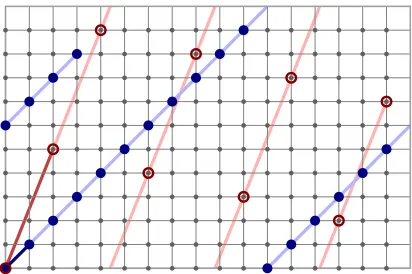
[image:5.468.140.346.207.344.2]Observe that the construction ensures that(s+mv)(1,1) = m(u, v). Figure1 illus-trates the case with parametersu= 2,v= 5,s= 11,m= 2.
Figure 1: Every element ofZ17×Z11is the sum of one of the 21 solid elements and one
of the 9 circled elements.
Proof. Let t = s−m(u−1). Sinces is coprime tomd,(1,1) generates T. Hence,
it suffices to show that, in the list(0,0), (1,1),(2,2), . . ., the gaps between members of {`(u, v) : 0≤` < t}are not “too large”.
Specifically, we need to show that, for each nonnegative` < t, there is some positive h0≤s+mvand nonnegative`0< tsuch that`(u, v) +h0(1,1) =`0(u, v).
There are two cases. If` < t−m, then we can takeh0=s+mvand`0 =`+m:
`(u, v) + (s+mv)(1,1) = (`u+s+mu+md, `v+s+mv)
= (`u +mu, `v +mv)
= (`+m)(u, v).
If`≥t−m, then we can takeh0=muvand`0=`+m−t=`+mu−s:
`(u, v) + muv(1,1) = (`u+mu2+mud, `v+muv) = (`u+mu2+mud−u(s+md), `v+muv−vs)
= (`+mu−s)(u, v).
In our direct product constructions, we make use of Lemma3.1via the following crucial lemma. Our strategy is to construct a cyclic group of the formT=Zr1×Zr2×. . .×Zrk such thatr1 > r2 > . . . > rk >1, and for each pairZri×Zrj fori < jwe will bring Lemma3.1to bear. In the notation of that lemma we will setu=i,d= j−i,s =rj,
s+md=ri. The conditions of Lemma3.2below are designed to ensure that for each pair
i, jwe can findm=mi,jto make this work.
Lemma 3.2. Letk >1and letr1 > r2> . . . > rk be pairwise coprime integers greater
than 1 such thatri is coprime to ifor all1 ≤ i ≤ k. Suppose that for eachi, j with 1≤i < j ≤kthere exists a positive integermi,jsuch that:
• ri−rj =mi,j(j−i)
• rj ≥mi,j(i−1)j.
LetT=Zr1×Zr2×. . .×Zrk. Leto= (1,1, . . . ,1),u= (1,2, . . . , k)and, for each i,ei= (0, . . . ,1, . . . ,0)be elements ofT, where only theith coordinate ofeiis 1, and let
the setAconsist of thesek+ 2elements.
Letco= maxi<j(rj+j mi,j),cu=r1, and for eachi,cei =ri.
Then, for every elementxofTand everyk-element subsetSofA, there exist
nonneg-ative integershs < csfor eachs∈S, such thatx=Pshss.
Proof. There are four cases. IfScontains neitheronoru, the result follows trivially. IfScontainsobut notu, omittingei, then we can choosehoto be theith coordinate
ofx. Note that, as required,co≥r2+ 2(r1−r2) =r1+ (r1−r2)> rifor alli.
IfScontainsubut noto, omittingei, then, sinceiandriare coprime, we can choose
husuch thatihu(modri)is theith coordinate ofx.
Finally, ifScontains bothoandu, omittingeiandej, then we can choosehoandhu
by applying Lemma3.1toZri×Zrj with(u, v) = (i, j).
We note that the conditions of Lemma3.2imply that at most one of therican be even,
and ifk≥4then allrimust be odd.
3.2 Undirected constructions
We can use Lemma3.2to construct undirected circulant graphs of any diameter by means of the following theorem:
Theorem 3.3. Letwandkbe positive integers and suppose that there exist setsBandT of positive integers with the following properties:
• B = {b1, . . . , bk+2}has cardinalityk+ 2and the property that every element of
Zwcan be expressed as the sum of exactlykdistinct elements ofB∪ −B, no two of
which are inverses.
• T = {r1, r2, . . . , rk}has cardinalitykand the properties that all its elements are
coprime tow, and satisfies the requirements of Lemma3.2, i.e. for eachi < j:
(a) ri> rj
(b) gcd(ri, rj) = 1
(d) There is a positive integermi,jsuch that equalitiesri−rj =mi,j(j−i)and
rj≥mi,j(i−1)jhold.
Letco= maxi<j(rj+jmi,j)andcu=r1as in Lemma3.2.
Then there exists an undirected circulant graph of order wQk
i=1ri, degree at most 2Pk
i=1ri+co+cu
and diameterk.
Proof. LetT=Zr1×Zr2×. . .×Zrk×Zw. ThenTis a cyclic group since all its factors have coprime orders.
LetXbe the generating set consisting of the following elements:
• (x,0,0, . . . ,0,±b1),x∈Zr1
• (0, x,0, . . . ,0,±b2),x∈Zr2
.. .
• (0,0, . . . ,0, x,±bk),x∈Zrk • ±(x, x, . . . , x, x, bk+1),0≤x < co
• ±(x,2x, . . . ,(k−1)x, kx, bk+2),0≤x < cu
Then by construction and by Lemma3.2, every element of T is the sum of at mostk
elements ofX. Since |T| = wQki=1ri and|X| = 2
Pk
i=1ri+co+cu
, the result follows.
For small diameters this technique results in the following asymptotic bounds:
Theorem 3.4. For diametersk= 3,4,5, we have the following lower bounds:
(a) L+C(3)≥ 57 1000 andL
−
C(3)≥
7 125, soR
+
C(3)>1.15455andR
−
C(3)>1.14775.
(b) L+C(4)≥L−C(4)≥ 25 3456, soR
+
C(4)≥R
−
C(4)>1.16654.
(c) L+C(5)≥L−C(5)≥ 109 134456, soR
+
C(5)≥R
−
C(5)>1.20431.
Proof. Given a diameterk, the strategy is to find an optimal value ofw which admits a setBsatisfying the conditions of Theorem3.3. We then seek an infinite family of positive integersqand a set∆ ={δ1, δ2, . . . , δk−1}such that for each of our values ofq, the set
T = {q, q−δ1, . . . , q−δk−1} satisfies the conditions of the theorem. We illustrate for
k= 3.
To prove(a)we takew= 57andB ={1,2,7,8,27}. It is easily checked that every element ofZ57 is the sum of three distinct elements ofB ∪ −B, no two of which are
inverses. Now we let∆ ={4,6}. For anyq≥17, q≡5 (mod 6), q 6≡0,4,6 (mod 19)
it is straightforward to verify that the setT ={q, q−4, q−6}satisfies the conditions of Theorem3.3. In the notation of Lemma3.2, we haveco=q+ 4.
Taking a generating setXas defined in Theorem3.3we may construct a circulant graph of diameter 3, degreed=|X|= 10q−12and order57q(q−4)(q−6) = 100057 (d+ 12) (d−28)(d−48).
We can do this for an infinite number of values ofq, and hence for an infinite number of values ofd= 10q−12we have
CC(d,3)≥ 57
This yieldsL+C(3)≥ 57
1000. Now we need to considerL
−
C(3). The strategy will be to try to
add “few” edges to our graphs to cover all possible degrees. Observe that we can use this construction for anyq ≡17 (mod 114)and hence for anyd≡158 (mod 1140). Given any arbitraryevendegreed, we can therefore find somed0 no smaller thand−1140for which the construction works. We can then addd−d0generators to our graph to obtain a graph of the same order, degreedand diameter 3.
However our graphs always have odd order, and so we are unable to obtain an odd degree graph by this method. To get round this problem we may use w = 56, B =
{1,2,7,14,15},∆ = {2,4}andco =q+ 2. Again it is easy to check that the relevant
conditions are satisfied for anyq ≥ 15such that q ≡ 3,5 (mod 6)andq ≡ 1,3,5,6 (mod 7). Then ford= 10q−8we can construct a graph of order257(d+8)(d−12)(d−32), degreedand diameter 3. We can do this for anyq ≡ 15 (mod 42)and hence for any d ≡142 (mod 420). So given any arbitrary degreed, we can therefore find somed0 no smaller thand−420for which the construction works, and then addd−d0generators to our graph to obtain a graph of the same order and diameter 3. (Since our graphs now have even order it is possible to add an odd number of generators.) Since the number of added generators is bounded above (by 419), the order of the graph is 1257 d3+O(d2). Result(a) forL−C(3)follows.
For(b)and(c)we adopt a similar method, except that in both cases the graphs used have even order and so our bounds onL+andL−are equal. For brevity we show only the relevant sets in the construction, summarised as follows:
(b) (k = 4) – Takew = 150,B = {1,7,16,26,41,61}and∆ = {6,8,12} soco =
q+ 6. Then forq≥49,q≡19 (mod 30)andd= 12q−40, we have
CC(d,4)≥ 25
3456(d+ 40)(d−32)(d−56)(d−104).
(c) (k = 5) – Takew= 436,B ={1,15,43,48,77,109,152}and∆ = {0,4,10,12,
16} soco = q+ 8. Then forq ≥ 77,q ≡ 5 (mod 6),q 6≡ 0,1 (mod 5), q 6≡
0,4,10,12,16 (mod 109)andd= 14q−68, we have
CC(d,5)≥ 109
134456(d+ 68)(d+ 12)(d−72)(d−100)(d−156).
3.3 Directed constructions
An analogous method yields directed circulant graphs via the following theorem:
Theorem 3.5. Letwandkbe positive integers and suppose that there exist setsBandT of non-negative integers with the following properties:
• B ={0, b2, . . . , bk+2}has cardinalityk+ 2and the property that every element of
Zwcan be expressed as the sum of exactlykdistinct elements ofB.
• T = {r1, r2, . . . , rk}has cardinalitykand the properties that all its elements are
coprime tow, and it satisfies the requirements of Lemma3.2, i.e. for eachi < j:
(b) gcd(ri, rj) = 1
(c) gcd(ri, i) = 1
(d) There is a positive integermi,jsuch that equalitiesri−rj =mi,j(j−i)and
rj≥mi,j(i−1)jhold.
Letco= maxi<j(rj+jmi,j)andcu=r1as in Lemma3.2.
Then we may construct a directed circulant graph of orderwQk
i=1ri, degree at most
Pk
i=1ri+co+cu−1and diameterk.
Proof. LetT=Zr1×Zr2×. . .×Zrk×Zw. ThenTis a cyclic group since all its factors have coprime orders.
LetXbe the generating set consisting of the following elements:
• (x,0,0, . . . ,0,0),x∈Zr1\ {0}
• (0, x,0, . . . ,0, b2),x∈Zr2
.. .
• (0,0, . . . ,0, x, bk),x∈Zrk
• (x, x, . . . , x, x, bk+1),0≤x < co
• (x,2x, . . . ,(k−1)x, kx, bk+2),0≤x < cu
Then by construction and by Lemma3.2, every element of T is the sum of at mostk
elements ofX. Since |T| = wQik=1ri and|X| = P k
i=1ri+co+cu −1, the result
follows.
For small diameters this technique results in the following asymptotic bounds:
Theorem 3.6. For diametersk= 2, . . . ,9, we have the following lower bounds onL−D(k)
andR−D(k):
(a) L−D(2)≥3 8, soR
−
D(2)>1.22474.
(b) L−D(3)≥ 9 125, soR
−
D(3)>1.24805.
(c) L−D(4)≥ 13 1296, soR
−
D(4)>1.26588.
(d) L−D(5)≥ 17 16807, soR
−
D(5)>1.25881.
(e) L−D(6)≥ 3 32768, soR
−
D(6)>1.27378.
(f) L−D(7)≥ 10
1594323, soR
−
D(7)>1.26436.
(g) L−D(8)≥ 9
25000000, soR
−
D(8)>1.25206.
(h) L−D(9)≥ 42
2357947691, soR
−
D(9)>1.23939.
(a) (k= 2) – Takew= 6,B={0,1,2,4}and∆ ={2}soco=q+ 2. Then forq≥7,
q≡1 (mod 6)andd= 4q−1, we have
DCC(d,2)≥3
8(d+ 1)(d−7).
(b) (k= 3) – Takew= 9,B ={0,1,2,3,6}and∆ = {4,6}soco =q+ 4. Then for
q≥17,q≡5 (mod 6)andd= 5q−7, we have
DCC(d,3)≥ 9
125(d+ 7)(d−13)(d−23).
(c) (k= 4) – Takew= 13,B ={0,1,3,5,7,8}and∆ ={2,4,6}soco=q+ 2. Then
forq≥23,q≡5 (mod 6),q6≡0,2,4,6 (mod 13)andd= 6q−11, we have
DCC(d,4)≥ 13
1296(d+ 11)(d−1)(d−13)(d−25).
(d) (k = 5) – Takew = 17,B ={0,1,2,3,4,8,13}and∆ = {4,10,12,16} soco =
q+ 8. Then for q ≥ 77, q ≡ 5 (mod 6), q 6≡ 0,1 (mod 5),q 6≡ 0,4,10,12,16 (mod 17)andd= 7q−35, we have
DCC(d,5)≥ 17
16807(d+ 35)(d+ 7)(d−35)(d−49)(d−77).
(e) (k= 6) – Takew= 24,B ={0,1,2,4,8,13,18,22}and∆ ={6,12,18,24,30}so co=q+ 6. Then forq≥181,q≡1,5 (mod 6),q6≡0,4 (mod 5)andd= 8q−85,
we have
DCC(d,6)≥ 3
32768(d+ 85)(d+ 37)(d−11)(d−59)(d−107)(d−155).
(f) (k = 7) – Takew = 30,B = {0,1,2,6,9,12,16,17,18}and∆ = {0,2,6,18,20,
30,42}soco=q+42. Then forq≥529,q≡1 (mod 6),q≡4 (mod 5),q6≡0,2,6
(mod 7),q6≡9 (mod 11)andd= 9q−77, we have
DCC(d,7)≥ 10
1594323(d+ 77)(d+ 59)(d+ 23)(d−85)(d−103)(d−193)(d−301).
(g) (k = 8) – Takew = 36, B = {0,1,2,3,6,12,19,20,27,33} and∆ = {0,6,12,
18,24,30,36,42} so co = q+ 6. Then forq ≥ 353, q ≡ 1,5 (mod 6), q ≡ 3
(mod 5),q6≡0,1 (mod 7)andd= 10q−163, we have
DCC(d,8)≥ 9
25000000(d+ 163)(d+ 103)(d+ 43)(d−17) (d−77)(d−137)(d−197)(d−257).
(h) (k = 9) – Takew = 42,B = {0,1,2,3,4,9,16,20,26,30,37} and∆ = {0,2,6,
12,20,30,42,56,72}soco =q+ 72. Then forq≥1093,q≡1 (mod 6),q≡3,4
(mod 5),q ≡ 1,3,4 (mod 7),q 6≡1,6,9 (mod 11),q 6≡ 4,7 (mod 13)andd= 11q−169, we have
DCC(d,9)≥ 42
3.4 Limitations
In [3], Lewis showed that an analogous class of constructions using finite fields to create graphs of diameter 2 is limited by the boundL−C(2)≤ 3
8. The constructions in this section
have a similar limitation:
Observation 3.7. Letkbe a positive integer. The direct product constructions of Theo-rems3.3and3.5can never yield a lower bound onL−C(k)orLD−(k)that exceeds2(kk+2)+1k−1.
Proof. First we consider the undirected case. Suppose the requirements of Theorem3.3
hold and for eachi = 1, . . . , k, we haveri = q−ai, wherea1 < a2 < . . . < ak. Let T=Zq−a1×. . .×Zq−ak×ZwandXbe its generating set as in the proof of Theorem3.3. Since every element ofZwis a sum ofkdistinct elements ofB, no pair of which are
inverses, we must havew≤ k+2
k
2k = (k+ 1)(k+ 2)2k−1.
By the requirements of Lemma3.2, for any i < j, we have mi,j ≤ ri −rj and
co = maxi<j(rj+j mi,j). Hence, sinceri =q−ai, we havemi,j ≤ak −a1, and so
co≤q+kak.
ThusX is the generating set for a Cayley graph onTwith diameterk, degreedno
greater than2(k+ 2)q−2Pk
i=1ai+ 2kak−2a1, and ordern=w(q−a1)(q−a2). . .(q−
ak).
Hence,n= (2(kw+2))kd
k+O(dk−1)≤ (k+1)(k+2)2k−1
(2(k+2))k d
k+O(dk−1) = k+1 2(k+2)k−1d
k+
O(dk−1),as required.
The directed case is analogous. We follow Theorem3.5and its proof. In this case, every element ofZwis the sum ofkdistinct elements ofB, sow≤ k+2k
= (k+ 1)(k+ 2)/2, andX is the generating set for a Cayley graph onTwith diameterk, degreed ≤ (k+ 2)q−Pk
i=1ai+kak−a1−1, and ordern=w(q−a1)(q−a2). . .(q−ak).
Hence, n = (k+2)w kd
k +O(dk−1) ≤ (k+1)(k+2) 2(k+2)k d
k +O(dk−1) = k+1 2(k+2)k−1d
k +
O(dk−1).
Observe that, in the limit,
lim k→∞k
k+ 1
2(k+ 2)k−1
1/k
= 1.
As a consequence, these direct product constructions themselves can never yield an im-provement on the trivial lower bound for the limiting value ofR−C(k)orR−D(k). However, it is possible to combine graphs of small diameter to produce larger graphs in such a way that we can improve on the trivial lower bound in the limit as the diameter increases. The next section introduces this idea.
4
A general graph product construction
The following theorem gives a simple way to combine two cyclic Cayley graphs to obtain a third cyclic Cayley graph. It is valid in both the directed and undirected cases.
Theorem 4.1. LetG1andG2be two cyclic Cayley graphs of diametersk1andk2, orders
n1andn2, and degreesd1andd2respectively. In the case of undirected graphs whered1
andd2 are both odd letδ = 1, otherwiseδ = 0. In the directed case letδ = 0always.
Then there exists a cyclic Cayley graph with diameterk1+k2, degree at mostd1+d2+δ,
Proof. LetS1 be the connection set ofG1 so that|S1| = d1 and similarly for G2. For
convenience we consider eachSito consist of elements within the interval(−ni/2, ni/2].
LetGbe the cyclic groupZn1n2 and consider the connection setS
0 =n
2S1∪S2. Then
|S0| ≤n
1+n2.
We now construct a connection set S for the group G such that the Cayley graph
Cay(G, S)has diameterk1+k2. In the directed case we may simply takeS = S0. In
the undirected case we need to ensure thatS = −S. If at least one ofd1, d2 is even we
may assume without loss of generality thatd2is even and then we may again letS =S0
andS =−Sby construction.
It remains to consider the undirected case whend1andd2are both odd (the caseδ= 1).
In that case we known2/2∈S2⊂S0and we letS =S0∪ {−n/2}so thatS =−S.
It is then clear that the Cayley graphCay(G, S)has degree at mostd1+d2+δ, diameter
k1+k2and ordern1n2.
We can use this “stitching” construction to obtain lower bounds on ourLandRvalues for large diameters, given values for smaller diameters.
Corollary 4.2. IfL(k)is one of L−C(k), L+C(k), L−D(k)or LD+(k) and R(k) is one of R−C(k),R+C(k),R−D(k)orR+D(k), then
(a) L(k1+k2) ≥
L(k1)L(k2)k1k1k
k2
2
(k1+k2)k1+k2
,
(b) R(k1+k2) ≥ R(k1)k1R(k2)k2
k1 +1k2.
Proof. (a)Letd >1. Fori= 1,2we may construct graphsΓiof diameterki, degreekid
and orderL(ki)(kid)ki+o(dki). Theorem4.1yields a product graph of diameterk1+k2,
degree at most(k1+k2)d+ 1and orderL(k1)L(k2)kk11k
k2
2 d
k1+k2+o(dk1+k2).
Part(b)follows by straightforward algebraic manipulation.
In particular, we note that the stitching construction of Theorem4.1preserves lower bounds on theRvalues:R(mk)≥R(k)for every positive integerm.
We may use this idea to obtain better bounds for some particular diameters; for example we may improve on the undirected diameter 4 construction in Theorem3.4:
Corollary 4.3.
(a) L+C(4)≥ 169
20736 ≈0.0081501, and henceR +
C(4)>1.20185.
(b) L−C(4)>0.0080194, and henceR−C(4)>1.19700.
Proof. For statement(a)we note R+C(2) ≥ 13
36 from Vetr´ık [7] and apply Corollary4.2
withk1=k2= 2. For(b)we use the same method starting with Theorem2.2.
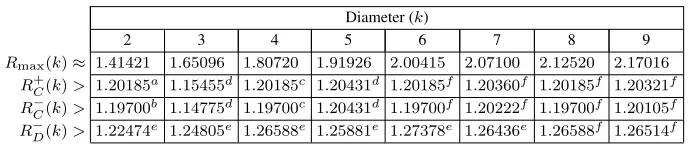
The stitching process of Theorem 4.1 can be iterated to produce a construction for any desired diameter, and Corollary4.2then gives us a lower bound for theRvalues for that diameter. We illustrate the results for small diameter k in Table 1. As an indica-tor of progress we show also the largest possible value ofRfor a particulark, given by Rmax(k) =k(k!)−1/k.
Table 1: The bestRvalues for diameterk≤9.
Diameter (k)
2 3 4 5 6 7 8 9
Rmax(k)≈ 1.41421 1.65096 1.80720 1.91926 2.00415 2.07100 2.12520 2.17016 R+C(k)> 1.20185a 1.15455d 1.20185c 1.20431d 1.20185f 1.20360f 1.20185f 1.20321f
R−C(k)> 1.19700b 1.14775d 1.19700c 1.20431d 1.19700f 1.20222f 1.19700f 1.20105f
R−D(k)> 1.22474e 1.24805e 1.26588e 1.25881e 1.27378e 1.26436e 1.26588f 1.26514f
a. Vetr´ık [7];b. Theorem2.2;c. Corollary4.3;d. Theorem3.4;e. Theorem3.6;f. Corollary4.2
For example, the limitations noted in Observation3.7show that the maximum possible value ofR−D(10)we could achieve using Theorem3.5is approximately 1.26699. However, combining the results for diameters 4 and 6 in Table1yieldsR−D(10)>1.27061.
Next we use our previous results to show thatRis well-behaved in the limit.
Theorem 4.4. Let L(k) be one of LC−(k), L+C(k), L−D(k) or L+D(k), and letR(k) =
k L(k)1/k. The limitR= lim
k→∞R(k)exists and is equal tosupR(k).
Proof. R(k)is bounded above (bye), sos= supR(k)is finite. Hence, givenε >0, we can choosek so thats−R(k) < ε/2. By Corollary4.2(b),R(mk) ≥ R(k)for every positive integerm. Moreover, for any fixedj < k, sinceR(j)≥1, we haveR(mk+j)≥ R(k)mk/(mk+j) ≥ R(k)m/(m+1), which, by choosingmlarge enough, can be made to
differ fromR(k)by no more thanε/2.
Corollary 4.5.
(a) lim
k→∞R
−
C(k)≥
5×1091/5
7×23/5 >1.20431
(b) lim
k→∞R
−
D(k)≥ 37/6
23/2 >1.27378
Proof. We choose the largest entry in the relevant row in Table1. For(a)we know from Theorem3.4that L−C(5) ≥ 109
23×75. For(b) we know from Theorem 3.6that L
−
D(6) ≥
3 215.
We conclude this section by using the foregoing to derive new lower bounds for the maximum possible orders of circulant graphs of given diameter and sufficiently large de-gree.
Corollary 4.6.
(a) For any diameterk≥2and any degreedlarge enough,CC(d, k)> 1.14775dkk.
(b) For any diameterkthat is a multiple of 5 or sufficiently large, and any degreedlarge enough,CC(d, k)> 1.20431dkk
.
(c) For any diameterk≥2and any degreedlarge enough,DCC(d, k)> 1.22474dkk.
(d) For any diameterkthat is a multiple of 6 or sufficiently large, and any degreedlarge enough,DCC(d, k)> 1.27378dkk
Proof.
(a) From Theorem4.4and Corollary4.2, we know thatRC−(k)always exceeds the smallest value in theR−Crow of Table1, which is1.14775.
(b) Fork a multiple of 5, we know from Theorem3.4and Corollary4.2that R−C(k) >
1.20431. The result for sufficiently largekfollows from Corollary4.5.
(c) and (d) follow by using similar logic in the directed case.
These represent significant improvements over the trivial bound of dkk
.
5
Sumsets covering
Z
nOur constructions of directed circulant graphs can be used to obtain an upper bound on the minimum size,SS(n, k), of a setA⊂Znfor which the sumset
k A = A+A+. . .+A
| {z }
k
= Zn.
The trivial bound isSS(n, k)≤kn1/k which follows in the same way as the trivial lower bound for the directed circulant graph (see Observation1.2). Improvements to this trivial bound do not appear to have been investigated in the literature.
The idea is that, givenS ⊆Zn such thatCay(Zn, S)has diameterk, if we letA =
S∪ {0}thenkA =Zn. Our constructions thus enable us to boundSS(n, k)for fixedk
and infinitely many values ofn. For example, if we letL−S(k) = lim inf
n→∞ SS(n, k)/n
1/k,
then the following new result fork= 2follows from Theorem3.6(a):
Corollary 5.1. L−S(2)≤q8
3 ≈1.63299.
More generally, Corollary4.5shows that for large enoughkand infinitely many values ofn,SS(n, k)is at least 21 percent smaller than the trivial bound:
Corollary 5.2. lim k→∞k
−1L−
S(k)≤
23/2
37/6 ≈0.78506.
6
Largest graphs of small degree and diameter
We can use the construction of Theorem 4.1to obtain large undirected circulant graphs for small degrees and diameters. Recently in [2], Feria-Puron, P´erez-Ros´es and Ryan pub-lished a table of largest known circulant graphs with degree up to 16 and diameter up to 10. Their method uses a construction based on graph Cartesian products which is somewhat similar to ours. In contrast, however, Theorem4.1does not in general result in a graph iso-morphic to the Cartesian product of the constituents. Furthermore, our construction does not require the constituent graph orders to be coprime, which allows more graphs to be constructed.
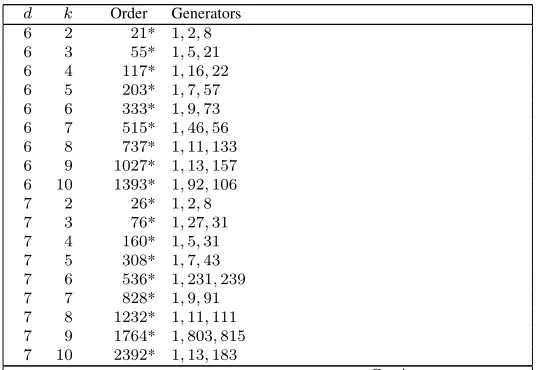
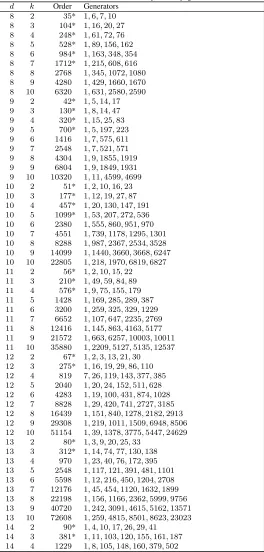
larger graphs (at least in the ranged ≤ 16, k ≤ 10) than the Theorem4.1method. We therefore present a much improved table of largest known circulant graphs based on the outputs of this search.
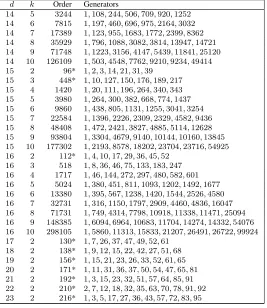
[image:15.468.72.418.174.353.2]In Table2, we show the largest known circulant graphs of degreed≤16and diameter k≤10. In Table3we give a reduced generating set for each new record largest graph found by the search. The computer search has been completed as an exhaustive search in the diameter 2 case up to degree 23, and these results are included in Table3for completeness.
Table 2: Largest known circulant graphs of degreed≤16and diameterk≤10.
d\k 1 2 3 4 5 6 7 8 9 10
2 3 5 7 9 11 13 15 17 19 21
3 4 8 12 16 20 24 28 32 36 40
4 5 13 25 41 61 85 113 145 181 221
5 6 16 36 64 100 144 196 256 324 400
6 7 21 55 117 203 333 515 737 1027 1393
7 8 26 76 160 308 536 828 1232 1764 2392
8 9 35 104 248 528 984 1712 2768 4280 6320
9 10 42 130 320 700 1416 2548 4304 6804 10320 10 11 51 177 457 1099 2380† 4551† 8288† 14099† 22805† 11 12 56 210 576 1428† 3200† 6652† 12416† 21572† 35880† 12 13 67 275 819† 2040† 4283† 8828† 16439† 29308† 51154† 13 14 80 312 970† 2548† 5598† 12176† 22198† 40720† 72608† 14 15 90 381 1229† 3244† 7815† 17389† 35929† 71748† 126109† 15 16 96 448 1420† 3980† 9860† 22584† 48408† 93804† 177302† 16 17 112 518† 1717† 5024† 13380† 32731† 71731† 148385† 298105†
†new record largest value
Table 3: Largest circulant graphs of small degreed and diameterk found by computer search.
d k Order Generators
6 2 21* 1,2,8
6 3 55* 1,5,21
6 4 117* 1,16,22 6 5 203* 1,7,57 6 6 333* 1,9,73 6 7 515* 1,46,56 6 8 737* 1,11,133 6 9 1027* 1,13,157 6 10 1393* 1,92,106
7 2 26* 1,2,8
7 3 76* 1,27,31 7 4 160* 1,5,31 7 5 308* 1,7,43 7 6 536* 1,231,239 7 7 828* 1,9,91 7 8 1232* 1,11,111 7 9 1764* 1,803,815 7 10 2392* 1,13,183
[image:15.468.109.377.431.616.2]Table 3 – continued from previous page d k Order Generators
8 2 35* 1,6,7,10 8 3 104* 1,16,20,27 8 4 248* 1,61,72,76 8 5 528* 1,89,156,162 8 6 984* 1,163,348,354 8 7 1712* 1,215,608,616 8 8 2768 1,345,1072,1080 8 9 4280 1,429,1660,1670 8 10 6320 1,631,2580,2590 9 2 42* 1,5,14,17 9 3 130* 1,8,14,47 9 4 320* 1,15,25,83 9 5 700* 1,5,197,223 9 6 1416 1,7,575,611 9 7 2548 1,7,521,571 9 8 4304 1,9,1855,1919 9 9 6804 1,9,1849,1931 9 10 10320 1,11,4599,4699 10 2 51* 1,2,10,16,23 10 3 177* 1,12,19,27,87 10 4 457* 1,20,130,147,191 10 5 1099* 1,53,207,272,536 10 6 2380 1,555,860,951,970 10 7 4551 1,739,1178,1295,1301 10 8 8288 1,987,2367,2534,3528 10 9 14099 1,1440,3660,3668,6247 10 10 22805 1,218,1970,6819,6827 11 2 56* 1,2,10,15,22
11 3 210* 1,49,59,84,89 11 4 576* 1,9,75,155,179 11 5 1428 1,169,285,289,387 11 6 3200 1,259,325,329,1229 11 7 6652 1,107,647,2235,2769 11 8 12416 1,145,863,4163,5177 11 9 21572 1,663,6257,10003,10011 11 10 35880 1,2209,5127,5135,12537 12 2 67* 1,2,3,13,21,30
12 3 275* 1,16,19,29,86,110 12 4 819 7,26,119,143,377,385 12 5 2040 1,20,24,152,511,628 12 6 4283 1,19,100,431,874,1028 12 7 8828 1,29,420,741,2727,3185 12 8 16439 1,151,840,1278,2182,2913 12 9 29308 1,219,1011,1509,6948,8506 12 10 51154 1,39,1378,3775,5447,24629 13 2 80* 1,3,9,20,25,33
13 3 312* 1,14,74,77,130,138 13 4 970 1,23,40,76,172,395 13 5 2548 1,117,121,391,481,1101 13 6 5598 1,12,216,450,1204,2708 13 7 12176 1,45,454,1120,1632,1899 13 8 22198 1,156,1166,2362,5999,9756 13 9 40720 1,242,3091,4615,5162,13571 13 10 72608 1,259,4815,8501,8623,23023 14 2 90* 1,4,10,17,26,29,41
14 3 381* 1,11,103,120,155,161,187 14 4 1229 1,8,105,148,160,379,502
Table 3 – continued from previous page d k Order Generators
14 5 3244 1,108,244,506,709,920,1252 14 6 7815 1,197,460,696,975,2164,3032 14 7 17389 1,123,955,1683,1772,2399,8362 14 8 35929 1,796,1088,3082,3814,13947,14721 14 9 71748 1,1223,3156,4147,5439,11841,25120 14 10 126109 1,503,4548,7762,9210,9234,49414 15 2 96* 1,2,3,14,21,31,39
15 3 448* 1,10,127,150,176,189,217 15 4 1420 1,20,111,196,264,340,343 15 5 3980 1,264,300,382,668,774,1437 15 6 9860 1,438,805,1131,1255,3041,3254 15 7 22584 1,1396,2226,2309,2329,4582,9436 15 8 48408 1,472,2421,3827,4885,5114,12628 15 9 93804 1,3304,4679,9140,10144,10160,13845 15 10 177302 1,2193,8578,18202,23704,23716,54925 16 2 112* 1,4,10,17,29,36,45,52
16 3 518 1,8,36,46,75,133,183,247 16 4 1717 1,46,144,272,297,480,582,601 16 5 5024 1,380,451,811,1093,1202,1492,1677 16 6 13380 1,395,567,1238,1420,1544,2526,4580 16 7 32731 1,316,1150,1797,2909,4460,4836,16047 16 8 71731 1,749,4314,7798,10918,11338,11471,25094 16 9 148385 1,6094,6964,10683,11704,14274,14332,54076 16 10 298105 1,5860,11313,15833,21207,26491,26722,99924 17 2 130* 1,7,26,37,47,49,52,61
18 2 138* 1,9,12,15,22,42,27,51,68 19 2 156* 1,15,21,23,26,33,52,61,65 20 2 171* 1,11,31,36,37,50,54,47,65,81 21 2 192* 1,3,15,23,32,51,57,64,85,91 22 2 210* 2,7,12,18,32,35,63,70,78,91,92 23 2 216* 1,3,5,17,27,36,43,57,72,83,95
* proven extremal
References
[1] J. Cullinan and F. Hajir, Primes of prescribed congruence class in short intervals,Integers12
(2012), #A56,http://www.integers-ejcnt.org/vol12.html.
[2] R. Feria-Puron, H. Perez-Roses and J. Ryan, Searching for large circulant graphs, 2015,
arXiv:1503.07357 [math.CO].
[3] R. R. Lewis, Improved upper bounds for the order of some classes of Abelian Cayley and
circu-lant graphs of diameter two, 2015,arXiv:1506.02844 [math.CO].
[4] H. Macbeth, J. ˇSiagiov´a and J. ˇSir´aˇn, Cayley graphs of given degree and diameter for cyclic, Abelian, and metacyclic groups,Discrete Math.312(2012), 94–99, doi:10.1016/j.disc.2011.03. 038.
[5] M. Miller and J. ˇSir´aˇn, Moore graphs and beyond: a survey of the degree/diameter problem, Electron. J. Comb.(2013), #DS14v2,http://www.combinatorics.org/ojs/index. php/eljc/article/view/DS14.
[6] O. Ramar´e and R. Rumely, Primes in arithmetic progressions,Math. Comp.65(1996), 397–425, doi:10.1090/S0025-5718-96-00669-2.