Procedia Engineering 183 ( 2017 ) 251 – 256
1877-7058 © 2017 The Authors. Published by Elsevier Ltd. This is an open access article under the CC BY-NC-ND license (http://creativecommons.org/licenses/by-nc-nd/4.0/).
Peer-review under responsibility of the organizing committee of SHEMET17 doi: 10.1016/j.proeng.2017.04.031
ScienceDirect
17th International Conference on Sheet Metal, SHEMET17
Metrology and Microscopy Analysis of Multisheet Packs
Manufactured Via Superplastic Forming to Study Possible Diffusion
Bonding
Mohammad Reza Allazadeh
a*, Nicola Zuelli
a aAdvanced Forming Research Centre, University of Strathclyde85 Inchinnan Drive ,Inchinnan ,Renfrew PA4 9LJ
Abstract
A number of titanium alloys multisheet packs with predefined complex features were manufactured via superplastic forming (SPF) and investigated via metrology and microscopy analysis to determine the possible occurrence of diffusion bonding. Four sheets of titanium alloys were welded using resistance seam welding based on a defined pattern to manufacture a composite sheet of four layers. Each composite sheet structure was composed of four sheets: two core sheets of the same titanium alloy material - Ti64 or Ti54M, and two external sheets of similar titanium alloy material - Ti64 or Ti6242. The composite sheet structures were inflated via SPF process in pockets where the sheets were not welded to each other to form a complex component. A pressure cycle was determined via the analysis of the numerical data from finite element simulations and a laboratory optimization method to form each multisheet pack. The maximum elongation due to stretching of sheets by SPF could reach 134% of initial part pre-forming. The wall thickness of each inflated packs was measured via GOM scanning all features of the formed structures. The thickness reduction imposed by SPF to the component surfaces was found to be up to 59% at some regions of the packs. Several samples from selected regions of each inflated pack were investigated via scanning electron microscopy (SEM) to study whether diffusion bonding occurred between the sheets. The GOM scanning and image analysis demonstrated that during SPF, the multisheet packs underwent a degree of diffusion bonding where the adjacent sheets exhibited thickness reduction under compression forces. © 2017 The Authors. Published by Elsevier Ltd.
Peer-review under responsibility of the organizing committee of SHEMET17.
Keywords: Superplastic forming; Multisheet packs; diffusion bonding; Titanium.
* Corresponding author. Tel.: +44 (0)141 534 5529.
E-mail address: [email protected]
© 2017 The Authors. Published by Elsevier Ltd. This is an open access article under the CC BY-NC-ND license (http://creativecommons.org/licenses/by-nc-nd/4.0/).
1.Introduction
Sheet metal forming processes are among the basic and essential manufacturing processes for automobile and aircraft industries. It was reported that about 15–20 % GDP of industrialized nations comes from the metal forming industry [1]. Although traditional sheet metal forming could be suitable for large volume production, it may not always utilize the competition on flexibility and innovation in production. Therefore, different advanced forming technologies, such as superplastic forming (SPF), are adapted to manufacture more complex components with special attributes or to produce prototypes and pre-series components at an economical cost and in a reasonable time. SPF have been exploited for the last 50 years to form complex shapes and curved components from superplastic sheet metals in the aerospace, defense, biomedical, architecture, sports and automotive sectors [2, 3]. Superplasticity is a scientific recognized process, indicating the high ductile tensile characteristics of certain materials under proper conditions [4]. Superplasticity mainly occurs at very low strain rate, at medium temperature (about Tmelt/2) and a quite low pressure of forming process [5-8]. One advanced application of SPF process is generating diffusion bonding (DB) between the surfaces of two metal sheets in contact. DB is a solid state joining process associated with coalescing between the contacting surfaces of the reactive metals under sufficient pressure and temperature by sharing their grains at the joint [9]. Some examples of applications of SPF/DB sheet forming are engine fan blades, outer guide vanes, exhaust structures, canard wings, fuselage panels, wing leading edges [10]. This paper covers briefly the manufacture and superplastic forming inflation of a series of four-sheet structures, using three different titanium alloys (Ti6Al4V, Ti6242, and Ti54M). The objective of the project was to design and manufacture complex DB/SPF structures via SPF process. The formed packs were inspected via GOM and SEM analyses to search for DB signs within the desired scopes and activities defined by the sponsors of the project.
Nomenclature
SPF superplastic forming DB diffusion bonding Tmelt melting point temperature FE finite element
AFRC Advanced Forming Research Centre
[image:2.544.52.498.315.609.2](a)
(b)
2.Packs formation
Six packs were composed of four sheets with 457 mm x 457 mm dimensions, using three different titanium alloys (Ti6Al4V, Ti6242, and Ti54M) and having following combinations,
• Three packs, labelled as 1, 2, and 3, were composed of two outer sheet from Ti64 with thickness of 1 mm and two core sheets of Ti64 with thickness of 0.8 mm.
•One pack, labelled as pack number 4, composed of two outer sheet from Ti6242 with thickness of 1 mm and two core sheets of Ti64 with thickness of 0.8 mm.
• Two packs composed of two outer sheet from Ti64 with thickness of 1 mm and two core sheets of Ti54M with thickness of 0.625 mm; the latest packs were labelled as pack number 5 and 6.
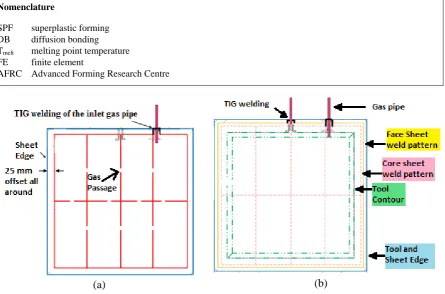
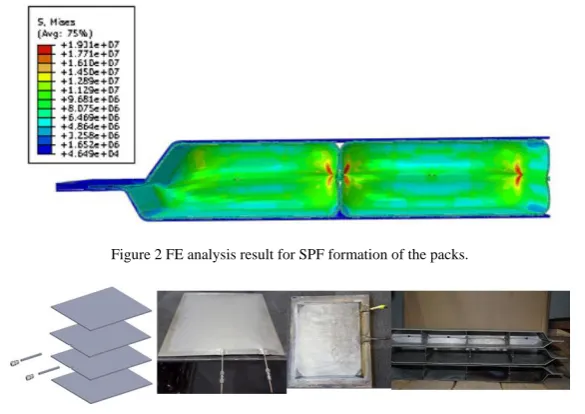
The main elements in the commercial chemical composition of Ti54M are Al, V, Mo, Fe, O, for Ti6242 are Al, Zr, Mo, Sn, and for Ti64 are Al and V [11]. The packs were manufactured by welding core sheets to each other, and then, the outer sheets over the core sheets using resistance seam welding, as per the schematics in Figure 1. As it can be seen in Figure 1(a), the core sheet contains eight identical pockets with ten gas passages of 5 mm. The forming process involves two pressure cycles acting simultaneously to expand first the inner sheets into the cell structure, and then, the outer sheets into the shape of the die cavity. The investigation for DB between two surfaces needed special care to assure buffing the surfaces from undesirable substances (e.g. oil, stain, workshop soot, etc.) [11], thereof, the surfaces of the sheets were etched in hydrofluoric acid prior to be welded to each other. The core sheets` inner surfaces were coated with boron nitride except on the welding lines to hinder the diffusion bonding between the aforementioned surfaces. Mutoh et al. [12] reported that the optimum condition for Ti6Al4V was 1173 K (i.e. 900 oC), 10 MPa for one hour, in which the bonding process was performed in vacuum with mechanical pressure loading. Nevertheless, the pressure-time cycle for each pack was initially developed following finite element time-hardening model simulations in ABAQUS for the target strain rate of 2E-4 s-1 at the temperature of 900 oC (See Figure 2) using Bailey-Norton law (the power law creep) for the superplastic creep behaviour of materials, i.e.:
ߝሶൌ ܣߪݐ (1)
[image:3.544.130.423.420.627.2]Where σ is the uniaxial equivalent deviatoric stress and t is the total time. Coefficients A, n, and m are temperature dependent material constants with necessary conditions that A and n must be positive, and m has a value between 0 and -1. The coefficients used in the FE models were derived from empirical curve-fitting to the tensile testing results, where testing was conducted for conditions representative of a single-sheet SPF process at the AFRC.
Figure 2 FE analysis result for SPF formation of the packs.
[image:3.544.137.417.564.620.2]However, adjustments to the inflation cycle were necessary to achieve full final forming. Therefore, the SPF pressure cycles were adjusted and optimized during the trials following GOM scanning and cutting the packs for visual inspection. For this purpose, each pack was scanned after cool down to room temperature by GOM ATOS Triple Scan III and then cut along longitudinal and transverse directions to investigate the formation of the core sheets. Consequently, each pressure cycle was revised based on the geometrical analysis of the packs previously formed. The multisheet packs were then formed in an ACB Loire 200T SPF press at AFRC. The sponsor companies provided initial design drawings for both the top and bottom dies, and these were modified by the AFRC to guarantee mounting of the dies in the 200T SPF press. Figure 3 shows the multisheet packs status through the project.
3.Results and discussions
[image:4.544.166.374.267.498.2]Two sets of GOM scanning were carried out on the formed packs prior and after cutting the packs transversely to compare the GOM images with the FE model simulations outcomes. Figure 4 shows the deviation between the first set of GOM scanning analyses for one of the formed packs before cutting it with the related FE simulation results. Figures 5 is the deviation analysis of the second set of GOM scans, after cutting the pack transversally, with FE simulation section view results for the same pack. The ductility characteristic of the material can also be measured via analyses of the GOM scans. The section measurement of the cut packs revealed that the elongation before failure was as high as 134% and 122% for the top and bottom halves of the Ti54M core sheets, respectively.
[image:4.544.129.411.532.622.2]Figure 4 GOM scanning of the formed packs
Figure 6 GOM scanning to identify the thinnest spot at inter-cell wall of pack #5
[image:5.544.71.456.303.358.2]There exists a potential link between local strain and the occurrence of diffusion bonding. High strains can create fresh surfaces, which then facilitate bonding. The reduction of the wall thickness for the layers welded into each other is the results of micro grain super plasticity due the tensile and compressive forces. GOM scanning measurement of the features of pack #5 in Figure 6 demonstrates that the reduction of the wall thickness in the packs was found to be up to 59%.
Figure 7 Positions of samples cut from the formed packs.
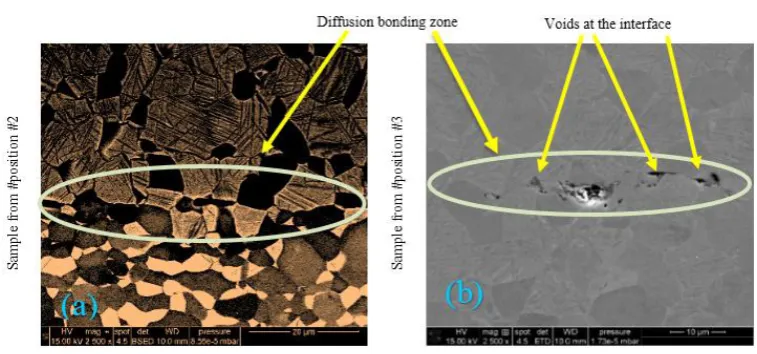
Figure 8 BSED and ETD SEM images of possible DB between (a) TI54M-Ti6242 and (b) TI54M-TI54M microstructures.
[image:5.544.80.459.385.562.2]marked as positions #1, #2. #3, and #4 for each pack in Figure 7. The images in Figure 8 show SEM Everhart-Thornley detector (ETD) images and backscatter electron diffraction (BSED) images of samples from positions #2 and #3. In the BSED image the contrast reflects chemical differences between the alpha and beta titanium phases. Figure 8 also shows the bond lines with certain level of residual porosity. ETD image in Figure 8(b) shows commonality of structure across the bond, though generally the bond-lines appeared to be with quite a high level of residual porosity. SEM analysis at the interfaces of the sheets pressed by against each other during forming suggest different levels of possible diffusion bonding potentially occurring in each pack. However, the image analysis alone is not sufficient to confirm the quality of diffusion bonding, and hence, it would be necessary to carry out supplementary examinations such as micro-hardness testing and shear testing.
4.Conclusions
The SPF process was deployed to inflate six packs of titanium alloys composed of four sheets from three different titanium alloys (Ti6Al4V, Ti6242, and Ti54M) in three different combinations. The inflated packs with predefined complex features of eight pockets were investigated via metrology and SEM analyses to determine the possible occurrence of diffusion bonding. It was observed that the SEM results indicated possible evidence of diffusion bonding within the interfaces of the sheets pressed to each other during superplastic forming. The thickness reduction to the component surfaces imposed by SPF was found to be up to 59% in some regions of the packs and the elongation was estimated to be up to 134%. It is known that certain factors play an important role in the occurrence of diffusion bonding during pressing of two layers at elevated temperature and high pressure. The main factors for diffusion bonding to occur are surface treatment, defined bonding temperature, and specific loading regimes considering the composition of the materials under high pressure. In this work, these factors were not studied and optimised and as a result the quality of the bonding was not homogenous. Further research work would be required to understand more in depth the interaction and effects of the key factors affecting the quality of diffusion bonding.
5.Acknowledgment
This research was supported by AFRC sponsor companies: Boeing, TIMET, Rolls-Royce, Barnes, Bifrangi and Aubert & Duval. We thank our colleagues at AFRC especially Jamie Frame, Craig Knowles and Kadir Paslioglu who provided insight and expertise that greatly assisted the research. We are grateful to Liza Hall and William Kerr from the AFRC metrology team for their collaboration in this research work. Also, we appreciate the support provided by MSM Aerospace Corporation engineers and technicians whose expertise and professional cooperation enabled the manufacturing of the flat packs.
References
[1]. R.G. Narayanan and U.S. Dixit (eds.), Advances in Material Forming and Joining, Topics in Mining, Metallurgy and Materials Engineering, DOI 10.1007/978-81-322-2355-9_2, pp29-46.
[2]. A. Barnes, Superplastic forming 40 years and still growing, J. Mater. Eng. Perform. 16 (2007) 440–454.
[3]. T.G. Langdon, Seventy-five years of superplasticity: historic developments and new opportunities, J. Mater. Sci. 44 (2009) 5998–6010. [4]. A.K. Ghosh, Superplastic sheet forming, ASM Handbook: Metalworking Sheet Forming, V14B, pp 345-365
[5]. ASM Handbook, Volume 22A: Fundamentals of Modeling for Metals Processing , D.U. Furrer and S.L. Semiatin, editors, p 472-477, www.asminternational.org.
[6]. G. GREBENIŞAN, Analysis Approach of Superplastic Deformation and Gasostatic Forming, The Journal of Strain Analysis for Engineering Design, ISSN 0309-3247, Edited by Professional Engineering Publishing Limited, London;
[7]. S. KOBAYASHI- Metal Forming and the Finite Element Method, Oxford University Press, New York, 1989. [8]. J. PILLING Superplasticity in crystalline solids, The Institute of Metals, London, 1989.
[9]. Daniel G. Sanders and Mamidala Ramulu,Examination of Superplastic Forming Combined with Diffusion Bonding for Titanium: Perspective from Experience, JMEPEG (2004) 13:744-752.
[10].Group Rhodes Company, www.grouprhodes.co.uk, SPF& DB Presses, Aerospace and Special Purpose, Technology& Products. [11].Titanium alloy guide, RMI TITANIUM COMPANY booklet.