City, University of London Institutional Repository
Citation:
Tahir, S. F., Ruj, S., Rahulamathavan, Y., Rajarajan, M. & Glackin, C. (2017). A
New Secure and Lightweight Searchable Encryption Scheme over Encrypted Cloud Data.
IEEE Transactions on Emerging Topics in Computing, doi: 10.1109/TETC.2017.2737789
This is the accepted version of the paper.
This version of the publication may differ from the final published
version.
Permanent repository link:
http://openaccess.city.ac.uk/18275/
Link to published version:
http://dx.doi.org/10.1109/TETC.2017.2737789
Copyright and reuse: City Research Online aims to make research
outputs of City, University of London available to a wider audience.
Copyright and Moral Rights remain with the author(s) and/or copyright
holders. URLs from City Research Online may be freely distributed and
linked to.
Abstract— Searchable Encryption is an emerging cryptographic technique that enables searching capabilities over the encrypted data on the cloud. In this paper, a novel searchable encryption scheme for the client-server architecture has been presented. The scheme exploits the properties of modular inverse to generate a probabilistic trapdoor which facilitates the searching over the secure inverted index table. We propose indistinguishability that is achieved by using the property of a probabilistic trapdoor. We design and implement a proof of concept prototype and test our scheme onto a real dataset of files. We analyze the performance of our scheme against our claim of the scheme being light weight. The security analysis yields that our scheme assures higher level of security as compared to other schemes.
Index Terms— Searchable Encryption, Modular Inverse, Extended Euclidean Algorithm, Indistinguishability, Privacy Preservation, Inverted Index, Database as a Service (DaaS).
I. INTRODUCTION
LOUD is an environment that provides the utility of on demand resource sharing and data access to the clients and their devices remotely. Apart from the core categories of cloud services i.e. SaaS, PaaS, IaaS, nowadays, Database as a Service (DaaS) enables people to store their files on the cloud. This DaaS helps in achieving availability of the documents but there are some interrelated concerns associated to DaaS that are security, trust, expectations, regulations and performance issues [1]. The concerns above are interdependent and should be addressed simultaneously. Encryption is probably the best solution that comes to one’s mind while talking about security. However, in the context of DaaS, searching over the encrypted text or Searchable Encryption (SE) is a difficult and resource consuming task.
This requires a SE scheme to be developed that would facilitate performing textual searches over encrypted data. Such a scheme would help maintain privacy of the outsourced documents while enabling the search over the encrypted documents. There are three main challenges associated with SE as discussed in [2] i.e. (1) efficiency, (2) security and (3) query
S. Tahir is with the Information Security Group, School of Mathematics, Computer Science and Engineering, City, University of London, UK, EC1V 0HB, on leave from the National University of Sciences and Technology (NUST), Islamabad, Pakistan (e-mail: [email protected]; [email protected]).
S. Ruj is with Indian Statistical Institute, 203 B.T. Road, Kolkata 700108, India. (e-mail: [email protected]).
expressiveness. These three terms can be assumed to be the vertices of a triangle and an idealistic SE scheme should be developed in such a way that it transforms the triangle into an equilateral triangle. In other words, a balance needs to be maintained between the faced challenges while designing a SE scheme.
National Security Agency (NSA) has highlighted the concerns related to security in the cloud and has proposed the use of homomorphic encryption [3]. Homomorphic encryption enables to perform operations on encrypted data. Though homomorphic encryption has revolutionized the field of cryptography, there are still major concerns related to performance. In [4] the authors have conducted a survey and comparison of different homomorphic and non-homomorphic SE schemes. Their result yields that non-homomorphic SE schemes out-perform homomorphic SE schemes in terms of efficiency.
Till now the use of SE has been explored in connection with E-mail servers [5] to conduct searches on confidential emails. In the healthcare domain [6][7] the SE has been researched as an effective method of providing keyword search on patients health records. SE could have a profound impact on areas related to telecom, e-commerce, warfare, big data analysis, cloud storage.
In this paper we present a novel lightweight ranked SE scheme. We develop and implement a proof of concept prototype and test it on a database containing 2000 documents. By developing the prototype, we explore the deployment of our scheme in the telecom industry. We use the Switchboard-1 speech database [8] that is a corpus of spontaneous conversations which addresses the growing need for large multi-speaker databases of telephone bandwidth speech. The corpus contains 2430 conversations averaging 6 minutes in length; in other words, over 240 hours of recorded speech, and about 3 million words of text, spoken by over 500 speakers of both genders from every major dialect of American English. This database consists of 120,000 distinct keywords. Based on the results we generate graphs and show that the scheme is
Y. Rahulamathavan is with the Loughborough University Epinal Way, Loughborough, Leicestershire LE11 3TU, UK. (email: y.rahulamathavan@ lboro.ac.uk)
M. Rajarajan is with the Information Security Group, School of Mathematics, Computer Science and Engineering, City, University of London, UK, EC1V 0HB, (email: [email protected])
C. Glackin is with the Intelligent Voice Limited, St Clare House, 30-33 Minories, London, EC3N 1BP, (email: [email protected])
A New Secure and Lightweight Searchable
Encryption Scheme over Encrypted Cloud Data
Shahzaib Tahir, Sushmita Ruj, Senior Member, IEEE, Yogachandran Rahulamathavan, Member,
IEEE, Muttukrishnan Rajarajan, Senior Member, IEEE, Cornelius Glackin
lightweight and shows a linear growth while scaling the input. Hence, we prove that our scheme can perform efficient keyword search on telephone speech. Furthermore, our scheme can be equally helpful for performing SE in the aforementioned domains.
Most of the schemes[5][9][10][11] proposed till date are proven secure in the random oracle model (ROM)[12]. ROM is based on the basic assumption that the cryptographic primitives are replaced with idealized versions. In [13] authors have presented a twenty year retrospective on the ROM. The authors discuss the controversies associated with the use of ROM. This evidence us to prove the security of our scheme in the standard model that only limits the adversary by the resources available i.e. time and computational resources.
A. Our Contributions
Following contributions to the field of SE have been made in this work:
Our foremost contribution is that we enumerate the properties of a “secure” ranked SE scheme by formally defining keyword-trapdoor indistinguishability and trapdoor-index table indistinguishability.
A primary contribution in this research is that we define “complete indistinguishability” in searchable encryption.
We design and present a novel Ranked based Searchable Encryption scheme that is completely based on a probabilistic encryption algorithm to address the distinguishability attacks.
We design and implement a proof of concept prototype and test our scheme onto a real dataset of files containing 120,000 keywords and 2000 documents to analyze the performance of our scheme.
B. Organization
Section II presents the literature review in which existing SE schemes are discussed. Section III discusses Ranked Searchable Encryption Scheme (RSE) model by formally defining our construction. In Section IV, we revisit the security definitions related to searchable encryption and propose new definitions for our proposed ranked searchable encryption scheme. Finally, in Section V, we present our ranked searchable encryption scheme followed by a security analysis. In Section VI, we perform a comparative analysis of the existing scheme against our scheme in terms of complexity. We also develop a proof of concept prototype and test our scheme onto a live dataset of documents by analyzing the computational time. The computational time is also analyzed in Section VI. The conclusions along with the future work are drawn towards the end of the paper, in Section VII.
II. LITERATURE REVIEW
A state of the art searchable encryption scheme must maintain a balance between security and efficiency. Previous researches fail to maintain this balance thus resulting in a system that lacks adaptability. In this section we discuss some significant schemes.
Wang et al. in [14][15] for the first time introduce the concept of ranked keyword searching over encrypted data. The authors have proposed two schemes for single keyword search over encrypted text. Their scheme was an extension of [16] and they added secure ranking to it. Both the schemes facilitate the server to perform ranked keyword searching on user’s behalf. In both the schemes, the user will generate the same trapdoor while searching for a particular file. Therefore, the schemes lack in providing indistinguishability. There is an advantage of their later scheme as it helps in providing dynamic inverted index i.e. whenever a new file is added to the server the re-ranking is not to be done but this comes with a huge computation cost which will be discussed in the section VI. Furthermore, the later scheme helps to keep the ranking score encrypted that will help to avoid leakage of occurrence of a particular keyword to the server. However, in [17] the authors have launched a successful differential attack on the aforementioned scheme. The authors have demonstrated that the scheme still leaks the relevance scores to the adversary from which the encrypted keywords can be inferred by using estimated distributions. Therefore, their scheme lacks in providing resistance against distinguishability attacks and leaks information.
Kamara et al. in [10] have proposed a dynamic searchable symmetric encryption scheme. Their work can be termed as an extension of their previous scheme that they had proposed in [16]. Their scheme facilitates the adding, deletion or modification of a document. The change is brought to the server at run time and comes with minimal modification and recompilation of the inverted index. For the deletion of the file they use an additional data structure that contains the pointers to the file being deleted. For the modification they use homomorphic encryption to encrypt the pointer so that based on the homomorphic encryption properties the server can get modify the file. Though this can be termed as a breakthrough in the field of searchable encryption, there is a drawback of their scheme i.e. the generated trapdoor is deterministic and the same trapdoor is generated for the same word every time hence it cannot resist distinguishability attacks. Furthermore, they have also analyzed that their scheme leaks even more information as compared to the previous scheme hence this scheme cannot be termed as an ultimate solution.
provide the desired level of security and privacy and reveals too much information.
Tang in [19] has proposed a symmetric searchable multiparty encryption scheme (MPSE) that is an extension of [20]. In their scheme they introduce a Follow algorithm that allocates a token to the writer to be distributed among the readers (user) of the index table. This token authorizes the reader to perform the search on the index table. This scheme facilitates the dynamic users but does not allow dynamic databases. The authors assume that there is a secure channel between the user and cloud server to transmit the trapdoors. Although, the secure channel hides the leakage of the trapdoor during transmission, the trapdoor is based on one-way hash function due to which the server itself can learn the access pattern and the keyword being searched for since the same trapdoor is generated for the same keyword. In other words the trapdoor is distinguishable. Their scheme uses forward index i.e. an index for each file due to which the ranking cannot be done.
In [21] Li et al. for the first time proposed efficient fuzzy keyword searching on encrypted cloud data. The authors have proposed two schemes i.e. the basic scheme and the wildcard based scheme. Their proposed work tolerates the searching over a dataset consisting of slight typo mistakes or errors. They use the edit distance to measure the distance between the similar erroneous words. The authors claim that the wildcard based scheme is efficient and effective though they have not performed any performance or complexity analysis of their scheme. We perform the analysis in Section VI and show the complexity of their scheme. Furthermore, since they are using deterministic encryption for the generation of the trapdoor hence the scheme is unable to provide prevention against deterministic attacks and hence reveals the outcome of the search and access pattern.
III. RANKED SEARCHABLE ENCRYPTION MODEL
We consider a single writer/single reader (S/S) architecture and use the client-server infrastructure by visualizing a scenario in which there are two parties, Alice (Client) and a Cloud Server (CS). Alice intends to upload all her documents D=
{𝐷1, 𝐷2, … , 𝐷𝑁} to the CS to enable remote access. CS performs
the searching of relevant documents on behalf of Alice. In the scheme it is assumed that the CS is a trusted but curious server. Being trusted means that CS acts in a known and designated manner but CS is also willing and curious to get hold of full or partial information about the documents uploaded and held with it.
Alice identifies a set of keywords W= {𝑊1, 𝑊2, … , 𝑊𝑖}
from the set of documents D and generates a relevance score based on the frequency of occurrence of the words with the set of documents D. These relevance scores help in performing ranked searching. Ranked searching facilitates the search by giving user the liberty to select the most relevant documents from a collection by identifying the frequency of occurrence of a keyword within a set of documents. Ranked searching is mainly used for single keyword search because the server may find several documents satisfying the query whereas, in complex queries, the server might be able to identify just a few number of documents in response to the search query.
Therefore, ranked searching is not effective in multi-keyword or expressive queries.
In [22], a formula (equation 1) has been presented that is commonly used for the relevance frequency generation and is widely used by researchers for designing the rank based searchable encryption schemes. For example in [15][14] authors have used the equation 1 for the ranking in searchable encryption
𝑅𝐹(𝑊, 𝐷) = ∑ |𝐷|1 ∙ (1 + ln 𝑓𝐷,𝑊) ∙ ln (1 +𝑓𝑁
𝑊)
𝑡∈𝑊 (1)
where 𝑊 denotes the keyword to be searched; 𝐷 denotes the document; |𝐷| denotes length of the document obtained by counting the words appeared in the document 𝐷; 𝑓𝐷,𝑊 denotes number of times a word 𝑊 appears within a particular document 𝐷; 𝑓𝑊 denotes the number of documents in the dataset that contain the word 𝑊 and 𝑁 denotes the total number of documents in the dataset.
Now Alice generates an index table 𝐼 (see Section V for more details). Now Alice outsources the index table 𝐼 along with the encrypted documents D to the CS.
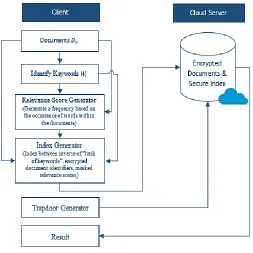
[image:4.612.314.567.387.640.2]If Alice wants to search for a document containing a specific keyword, she simply generates a trapdoor T and sends it to CS. CS uses the trapdoor T to search the index table 𝐼 and returns a set of relevant documents in a ranked order. Figure 1 shows the flow of events of the RSE scheme where a client is interacting with a CS. It can be seen that mainly all the tasks are performed on the client’s side, whereas, the searching is done at the CS side.
Fig. 1. The flow of events of proposed RSE scheme.
Definition (Ranked Searchable Encryption Scheme (RSE)) A RSE comprises of five polynomial time algorithms Π = (KeyGen, Build_Index, Build_Trap, Search_Outcome, Dec) such that:
(𝐾, 𝑘𝑠) ← KeyGen(1𝜆): is a probabilistic key generation
algorithm run by the client. The algorithm takes a security parameter λ as the input and returns a master key K and a session key 𝑘𝑠.
(𝐼) ← Build_Index(𝐾, 𝐷): is a deterministic algorithm run by the client to generate an index table 𝐼. The algorithm takes a master key K and a collection of documents D to be outsourced to the CS as input. The algorithm returns a secure index 𝐼.
𝑇𝑤← Build_Trap(𝐾,𝑘𝑠, 𝑤,num): is a probabilistic algorithm
run by the client. The algorithm requires the master key 𝐾, a session key 𝑘𝑠 , keyword w and the number (num) of
documents D required as the input. The algorithm returns a trapdoor 𝑇𝑤.
𝑋 ← Search_Outcome(𝑘𝑠, 𝐼, 𝑇𝑤): is a deterministic algorithm run by the CS. The algorithm takes the session key 𝑘𝑠 ,
index table 𝐼 and the trapdoor (𝑇𝑤) as the input and
returns X, a set of desired document identifiers encrypted 𝐸𝑛𝑐𝐾(𝑖𝑑(𝐷𝑖)) containing the keyword w in ranked order.
𝐷𝑖← Dec(𝐾, 𝑋): is a deterministic algorithm run by the client.
The algorithm takes client’s master key and encrypted set of document identifiers 𝐸𝑛𝑐𝐾(𝑖𝑑(𝐷𝑖)) to decrypt and
recover the document id’s.
Correctness: A RSE scheme is correct if for the security parameter λ, the master key 𝐾 and the session key 𝑘𝑠 generated by KeyGen(1𝜆), for (𝐼) output by Build_Index(𝐾, 𝐷), the search using the trapdoor 𝑇𝑤 always returns the correct set of encrypted document identifiers 𝐸𝐾(𝑖𝑑(𝐷𝑖)) in ranked order.
A RSE scheme is correct if the following are true:
If 𝑤 ∈ 𝐷𝑖 then the following should hold with an overwhelming probability
𝑆𝑒𝑎𝑟𝑐ℎ_𝑂𝑢𝑡𝑐𝑜𝑚𝑒(𝑘𝑠, 𝐼, 𝑇𝑤) = 𝐷 ∩ 𝐷𝑒𝑐(𝐾, 𝑋)
= 𝐷𝑖, where 1 ≤ 𝑖 ≤ 𝑛
If 𝑤 ∉ 𝐷𝑖 then the following should hold with an
overwhelming probability
𝑆𝑒𝑎𝑟𝑐ℎ_𝑂𝑢𝑡𝑐𝑜𝑚𝑒(𝑘𝑠, 𝐼, 𝑇𝑤) = 𝐷 ∩ 𝐷𝑒𝑐(𝐾, 𝑋) = 0
Soundness: A RSE scheme is sound if for the security parameter λ, the master key 𝐾 and the session key 𝑘𝑠 generated
by KeyGen(1𝜆), for (𝐼) output by Build_Index(𝐾, 𝐷), the search using the trapdoor 𝑇𝑤 always returns sound results i.e. the
result should not contain any false positives. A RSE scheme is sound if the following are true:
If 𝑤 ∈ 𝐷𝑖 then the following should hold with an
overwhelming probability
Search_Outcome(𝑘𝑠, 𝐼, 𝑇𝑤)=1
If 𝑤 ∉ 𝐷𝑖 then the following should hold with an
overwhelming probability
Search_Outcome(𝑘𝑠, 𝐼, 𝑇𝑤)=0
IV. SECURITY DEFINITIONS FOR RANKED SEARCHABLE ENCRYPTION (RSE)
In the context of searchable encryption, security is studied about privacy preservation of the data outsourced to the
CS[23][24].
A. Existing Security Definitions
The problem of searching over encrypted data has received attention for more than a decade now. Back in 2000, Song et al. in [25] were the first to come up with a practical way of searching symmetrically over encrypted data. Till then there was no formal definition regarding security for SE. Since 2000 several definitions and constructions of SE have been presented. In 2003, Goh [26] for the first time came up with the security definitions of searchable encryption called Semantic Security Against Adaptive Chosen Keyword Attack (IND-CKA). In the same paper, he proposed a searchable encryption scheme that met his proposed definition. There were some assumptions related to the definitions i.e. the number of keywords (size of the documents) with in the document should be same in order to achieve indistinguishability and if the index is indistinguishable the trapdoors need not to be kept secure. Since their definitions were focused towards secure indices and not probabilistic trapdoors, their definitions could not be generalized.
In [24] authors came up with an extension of IND-CKA that aimed to counter the assumption of same size documents. They supported their definition by presenting a secure index construction called z-index which was based on bloom filters. As highlighted in [16] that the definition was not secure and would be fulfilled by any insecure searchable encryption scheme. Later Goh introduced extended definitions IND1/2-CKA and now the documents did not need to be of the same size, and the trapdoor was again not kept secure. Curtmola et al. in [16][23] claimed that all the previous definitions did not provide adequate security and proposed two new definitions Adaptive/Non-Adaptive Indistinguishability Security for SSE. Both of the newly proposed definitions have their weaknesses and don’t provide adequate level of indistinguishability. We discuss the limitation of their slightly stronger definition i.e. Adaptive Indistinguishability below.
B. Limitations of previous definitions
As mentioned earlier, Curtmola’s definitions are widely accepted and used. They introduce four terms in [23] incurred as a result of a search query i.e. History, Access Pattern, Search Pattern and Trace. The history defines a tuple containing the document collection and the keywords. Access patterns represents the outcome, i.e. the documents contain a particular keyword. The Search pattern tells if the same keyword is being searched every time. Their security definition is defined as nothing is leaked beyond the access pattern and the search pattern while the Trapdoor is deterministic. Their definition of Indistinguishability refers to the indistinguishable index table generated based on pseudo-random functions.
construction (SSE-2) generates the same trapdoor (deterministic) every time the same keyword is queried. As a result the search pattern discloses which trapdoors correspond to the same underlying keywords resulting in privacy concerns (cf Section 4.2 of [23]). The deterministic trapdoor reveals the corresponding history tuple “prior” to the search. Furthermore, if an adversary is accidently given access to the trapdoor oracle then all the future searches are revealed. Hence, we term their definitions a primary “Baseline” for any SE scheme but improved definitions are required for enhancing the security and highlighting the advantage of a probabilistic trapdoor under those improved definitions.
Therefore, based on the improved security definitions a secure construction is required that primarily provides indistinguishable index table and ensures trapdoor indistinguishability that results in the increase in the security and privacy of the entire system.
Now, we can formally state the privacy concerns associated to RSE that are based on the following points
The index table contains information crucial for searching over the encrypted text and helps to relate keywords to the documents. The index table should not reveal any (partial) information about the documents (encrypted or unencrypted) or the keywords (encrypted or unencrypted) that form the table.
The trapdoor should not reveal any information about the keyword (unencrypted) that is being queried and should maintain privacy of search.
The trapdoor should be probabilistic and should not disclose the corresponding underlying encrypted keywords or document identifiers “prior” to the search.
The outcome of the trapdoor should not uncover any information about the encrypted document that is returned as a result of the query to the user.
C. Security Definitions for Proposed RSE
We now revisit the existing definitions of SE that will be utilized to prove the security of our proposed scheme. We propose new definitions for indistinguishability and define complete indistinguishability in the terms of ranked searchable encryption. An ideal searchable encryption scheme should fulfill all these definitions to ensure privacy. In Section V(G), we prove that our scheme complies with the following definitions.
1) Definition 1 (𝐷1): Non-Adaptive Indistinguishability for
Searchable Encryption
Non-Adaptive means that the adversary 𝒜 cannot make queries based on the outcome of the previous query [16][23]. Therefore, searchable scheme preserves security in the sense of non-adaptive indistinguishability if for any two non-non-adaptively constructed histories (documents & keywords) with equal length and trace (documents length, search pattern and outcome) no adversary can distinguish between the view (encrypted documents, trapdoors & Index) of one history from the view of the other in polynomial time with non-negligible probability over 1 2⁄ .
2) Definition 2 (𝐷2): Adaptive Indistinguishability for
Searchable Encryption
Adaptive means that the adversary 𝐴 can make queries based on the outcome of the previous query [16][23]. Therefore, searchable scheme preserves security in the sense of adaptive indistinguishability if for any two adaptively constructed histories (documents & keywords) with equal length and trace (documents length, search pattern and outcome) no adversary can distinguish between the view (encrypted documents, trapdoors & Index) of one history from the view of the other in polynomial time with non-negligible probability over 1 2⁄ .
3) Keyword-Trapdoor Indistinguishability for Ranked Searchable Encryption Scheme
Keyword-Trapdoor Indistinguishability refers to the act of performing a search over encrypted text in such a way that the redundancy in the statistics of the (plain text) keywords should be dissipated into the associated trapdoor. Therefore, for the same keyword appearing twice the trapdoor should not be able to distinguishable even if the history (keyword, trapdoor) is generated adaptively. To guess the word or the document’s content the attacker has to intercept a tremendous amount of data to uncover the underlying plain text in polynomial time.
The challenger begins by generating an index table against a data collection D. The adversary selects a keyword 𝑤 and sends it to the challenger. The challenger generates a trapdoor and sends it back to the adversary. This continues until the adversary has submitted polynomial-many keywords. Now the challenger tosses a fair coin 𝑏, the adversary has to submit two keywords (𝑤0, 𝑤1) to the challenger and receives a trapdoor
corresponding to the keyword 𝑤𝑏. The adversary has to guess and output the bit 𝑏.
Definition 3(D3)(Keyword-Trapdoor Indistinguishability). Let
RSE=(KeyGen, Build_Index, Build_Trap, Search_Outcome, Dec) be a Ranked Searchable Encryption scheme over a dictionary W, λ be the security parameter, D be the set of documents and 𝒜 = (𝒜0, 𝒜1, … , 𝒜𝑁+1) be such that 𝑁 ∈ℕ
and consider the following probabilistic experiment 𝐊𝐞𝐲_𝐓𝐫𝐚𝐩RSE,𝒜(𝜆):
𝐊𝐞𝐲_𝐓𝐫𝐚𝐩RSE,𝓐(𝜆)
(𝐾, 𝑘𝑠) ← KeyGen(1𝜆)
(𝐼) ← Build_Index(𝐾, 𝐷) 𝑓𝑜𝑟 2 ≤ 𝑖 ≤ 𝑁
(𝑠𝑡𝒜, 𝑤𝑖) ← 𝒜𝑖(𝑠𝑡𝒜, 𝑇𝑤2, … , 𝑇𝑤𝑖−1)
𝑇𝑤𝑖 ← Build_Trap𝐾(𝑤𝑖)
𝑇𝑤𝑁← Build_Trap(𝐾, 𝑘𝑠, 𝑤𝑁, 𝑛𝑢𝑚 )
𝑏← {0,1} $
(𝑠𝑡𝒜, 𝑤0, 𝑤1) ← 𝒜0(1𝜆)
𝑇𝑤𝑏← Build_Trap(𝐾, 𝑘𝑠, 𝑤𝑏, num)
𝑏′← 𝒜
𝑁+1(𝑠𝑡𝒜, 𝑇𝑤𝑏)
𝑖𝑓 𝑏′= 𝑏, 𝑜𝑢𝑡𝑝𝑢𝑡 1
𝑜𝑡ℎ𝑒𝑟𝑤𝑖𝑠𝑒 𝑜𝑢𝑡𝑝𝑢𝑡 0
where 𝑠𝑡𝒜 is a string that represents and captures 𝒜′𝑠 state. We
say that the keyword-trapdoor indistinguishability holds if for all polynomial-size adversaries (𝒜0, 𝒜1, … , 𝒜𝑁+1) such that
Pr [𝐊𝐞𝐲_𝐓𝐫𝐚𝐩RSE,𝒜(𝜆) = 1] ≤12+ negl(λ),
Where probability is over the choice of 𝑏.
We explain this by designing a game in the standard model.
Game 1: Let RSE be a Searchable Encryption scheme (𝑆𝐸). Suppose that there are at most 𝑁 keywords W =
(𝑊1, 𝑊2, … , 𝑊𝑁) and 𝑀 documents D = (𝐷1, 𝐷2, … , 𝐷𝑀),
where 𝑁, 𝑀 ∈ℕ (set of natural numbers) associated to an index table. The game is played between an adversary 𝒜 and a challenger 𝒞. The game is divided into three phases as follows:
Phase 1: The adversary 𝒜sends a keyword to the challenger
𝒞. The challenger 𝒞 returns a trapdoor to 𝒜. This continues between the adversary 𝒜 and the challenger 𝒞 for a while.
Challenge Phase: The adversary 𝒜 selects two keywords
𝑊1′, 𝑊2′∈ 𝑊 and send them to the challenger 𝒞. The selection
of the keywords can be done as follows:
a) 𝒜 intends to search for unique keywords such that
𝑊1′≠ 𝑊2′;
The challenger 𝒞 in response tosses a fair coin 𝑏 ← {0,1} and generates two trapdoors corresponding to the values of b i.e.
𝑇𝑊
𝑏′
′ such that 𝑇
𝑊′1′≠ 𝑇𝑊′2′.
After the challenge has been completed, Phase 1 is run again. We allow the adversary to search for the same keywords again if interested.
Outcome Phase: 𝒜 is given the generated Trapdoors
𝑇𝑊
1′
′ , 𝑇
𝑊′2′. 𝒜 will now have to guess and output 𝑏′∈ {0,1} and
if 𝑏 = 𝑏′ then the adversary wins. In other words the adversary
𝒜 has to output trapdoor T corresponding to 𝑊1′, 𝑊2′to the
challenger 𝒞 in polynomial time. If the adversary 𝒜 correctly guessed the trapdoor corresponding to the word then it has won otherwise RSE provides keyword-trapdoor indistinguishability and the challenger 𝒞 wins.
Therefore the probability that the adversary 𝒜 wins is 1
2
which is according to the definition stated above.
4) Trapdoor-Index Indistinguishability for Ranked Searchable Encryption
Trapdoor-Index indistinguishability relates to the complexity offered by a Searchable Encryption (𝑆𝐸) scheme. The keyword, trapdoor and index table should be complex and involved in such a way that trapdoor should not reveal the corresponding index table entries prior to the search and should not be distinguishable. Therefore, for the same keyword appearing twice the trapdoor should not be able to distinguishable even if the history (keyword, trapdoor, index) is generated adaptively. Furthermore, change of one bit/character of the keyword should completely change the Trapdoor and Index Table or vice versa.
The challenger begins by generating index table against a data collection D. The challenger sends the set of keywords 𝑊, the trapdoors generated for all the keywords 𝑊 along with the associated index table entries 𝐼[0][𝑊] to the adversary while maintaining the order in which they occur. Now the challenger tosses a fair coin 𝑏, the adversary has to submit two keywords
(𝑤0, 𝑤1) to the challenger and receives a trapdoor
corresponding to the keyword 𝑤𝑏. The adversary is now to
decide the corresponding index value and is challenged to output the bit 𝑏.
Definition 4 (D4)(Trapdoor-Index Indistinguishability). Let
RSE=(KeyGen, Build_Index, Build_Trap, Search_Outcome, Dec) be a Ranked Searchable Encryption scheme over a dictionary W, λ be the security parameter, D be the set of documents and 𝒜 = (𝒜0, 𝒜1) be such that 𝑁 ∈ ℕ and
consider the following probabilistic experiment 𝐓𝐫𝐚𝐩_𝐈𝐧𝐝𝐞𝐱RSE,𝒜(𝜆):
𝐓𝐫𝐚𝐩_𝐈𝐧𝐝𝐞𝐱RSE,𝓐(𝜆)
(𝐾, 𝑘𝑠) ← KeyGen(1𝜆)
(𝐼) ← Build_Index(𝐾, 𝐷) 𝑓𝑜𝑟 1 ≤ 𝑖 ≤ 𝑁
𝑙𝑒𝑡 𝐼′= 𝐼[0][𝑖]
𝑙𝑒𝑡 𝑤 = (𝑤1, … , 𝑤𝑖)
𝑇𝑤𝑖← Build_Trap(𝐾, 𝑘𝑠, 𝑤𝑖, num)
𝑏← {0,1} $
(𝑠𝑡𝒜, 𝑤0, 𝑤1) ← 𝒜0(𝑠𝑡𝒜, 1𝜆, 𝑤𝑁, 𝐼′, 𝑇𝑤𝑁)
𝑇𝑤𝑏← Build_Trap(𝐾, 𝑘𝑠, 𝑤𝑏, num)
𝑏′← 𝒜
1(𝑠𝑡𝒜, 𝐼𝑤𝑏)
𝑖𝑓 𝑏′= 𝑏, 𝑜𝑢𝑡𝑝𝑢𝑡 1
𝑜𝑡ℎ𝑒𝑟𝑤𝑖𝑠𝑒 𝑜𝑢𝑡𝑝𝑢𝑡 0
where 𝑠𝑡𝒜 is a string that represents and captures 𝒜′𝑠 state. We
say that the trapdoor-index indistinguishability holds if for all polynomial-size adversaries (𝒜0, 𝒜1, … , 𝒜𝑁+1) such that 𝑁 =
poly(𝜆),
Pr [𝐓𝐫𝐚𝐩_𝐈𝐧𝐝𝐞𝐱RSE,𝒜(𝜆) = 1] ≤12+ negl(λ),
Where probability is over the choice of 𝑏. We explain this by designing a game in the standard model.
Game 2: Let RSE be a Searchable Encryption (𝑆𝐸) scheme. Suppose that there are at most 𝑁 keywords W =
(𝑊1, 𝑊2, … , 𝑊𝑁) and 𝑀 documents D = (𝐷1, 𝐷2, … , 𝐷𝑀),
where 𝑁, 𝑀 ∈ℕ (set of natural numbers) associated to an index table. The game is played between an adversary 𝒜 and a Challenger 𝒞. The game is divided into three phases as follows:
Phase 1: The challenger 𝒞 generates an index table 𝐼 corresponding to the set of documents. The challenger 𝒞 generates and sends the trapdoors for all keywords W , the index table entries corresponding to the trapdoor and the keywords to the adversary 𝒜.
Challenge Phase: The adversary 𝒜 is allowed to select two keywords 𝑊1′, 𝑊2′∈ 𝑊 and send them to the challenger 𝒞. The selection of the keywords can be done as follows:
a) 𝒜 intends to search for unique keywords such that
𝑊1′≠ 𝑊2′;
The challenger 𝒞 in response tosses a fair coin 𝑏 ← {0,1} and generates two trapdoors corresponding to the values of b i.e.
𝑇𝑊
𝑏′
′ such that 𝑇
𝑊′1′≠ 𝑇𝑊′2′.
After the challenge has been completed, the adversary 𝒜 is given access to the previously generated history that was sent in Phase 1.
Outcome Phase: 𝒜 is given the generated Trapdoors
𝑇𝑊′1′, 𝑇𝑊 2′
′
. Adversary 𝒜 will now have to guess and return the
index entry corresponding to the Trapdoors 𝑇𝑊 1′
′ , 𝑇
𝑊′2′ and
is correct otherwise RSE provides trapdoor-index table indistinguishability, and the challenger 𝒞 wins.
Therefore the probability that the adversary 𝒜 wins is 1
2
which is according to the definition stated above.
Theorem 1: Keyword-Trapdoor Indistinguishability and
Trapdoor-Index table results in the Complete
Indistinguishability for a Ranked Searchable Encryption Scheme
𝑃𝑟𝑜𝑜𝑓 Let RSE=(KeyGen, Build_Index, Build_Trap, Search_Outcome, Dec) be a Ranked Searchable Encryption scheme. We make the following claim that leads to the proof of this theorem.
𝐶𝑙𝑎𝑖𝑚: If RSE is Keyword-Trapdoor Indistinguishable, then it is Trapdoor-Index Indistinguishable
Firstly, we assume that there exists a polynomial-size adversary
𝒜 that succeeds in an experiment 𝐊𝐞𝐲_𝐓𝐫𝐚𝐩RSE,𝒜(𝜆) with
non-negligible probability over 1 2⁄ , then there exists a polynomial size adversary ℬ and a polynomial size distinguisher 𝒟 that distinguishes between the output of the experiment 𝐓𝐫𝐚𝐩_𝐈𝐧𝐝𝐞𝐱RSE,𝒜(𝜆) with non-negligible probability over 1 2⁄ .
Let adversary ℬ sample 𝑏← {0,1}$ ; computes (𝑠𝑡𝒜, 𝑤0, 𝑤1) ←
𝒜0(1𝜆). The adversary ℬ. The distinguisher 𝒟 is given access
to a history consisting of trapdoors and corresponding keywords. The adversary proceeds as follows:
1. It parses (𝑠𝑡𝒜, 𝑤𝑖) ← 𝒜𝑖(𝑠𝑡𝒜, 𝑇𝑤2, … , 𝑇𝑤𝑖−1) where
2 ≤ 𝑖 ≤ 𝑁; 𝑁 ∈ ℕ
2. It computes 𝑏′← 𝒜𝑖+1(𝑠𝑡𝒜, 𝑇𝑤𝑏)
3. It outputs 1 if 𝑏′= 𝑏 , and 0 otherwise.
Clearly, ℬ and 𝒟 are polynomial size adversary since 𝒜𝑖+1 are. Now, we have to guess the probability of 𝒟’s success. 𝒟 will output 1 if and only if 𝒜𝑖+1(𝑠𝑡𝒜, 𝑇𝑤𝑏) succeeds in
correctly guessing 𝑏. It is to be noted that the Build_Trap phase is dependent upon trusted atomic primitives and uses a probabilistic encryption algorithm therefore the outcome is independent of 𝑏. Therefore, 𝒜𝑖+1 will guess 𝑏 with the probability atmost 1 2⁄ which is according to the definitions
D3. Therefore, our initial assumption of such an adversary who
can succeed in the experiment 𝐊𝐞𝐲_𝐓𝐫𝐚𝐩RSE,𝒜(𝜆) with a non-negligible probability over 1 2⁄ is wrong. Hence the distinguisher 𝒟 that distinguishes between the output of the experiment 𝐓𝐫𝐚𝐩_𝐈𝐧𝐝𝐞𝐱RSE,𝒜(𝜆) with non-negligible probability over 1 2⁄ does not exist and it is according to our definition D4. Hence our claim (stated above) is correct. Now, we prove that an RSE is “Completely Indistinguishable”. As discussed earlier, the entire scheme is dependent upon a probabilistic trapdoor and provides Keyword-Trapdoor and Trapdoor-Index indistinguishability. According to definition
D4, since a probabilistic trapdoor maps to an index location
while maintaining privacy, the privacy of the corresponding document identifiers is also preserved. Due to the probabilistic trapdoor, the indistinguishability and privacy between the entities involved in the RSE is maintained on the whole that results in complete indistinguishability.
V. PROPOSED RANKED SEARCHABLE ENCRYPTION (RSE) FRAMEWORK
As discussed in Section III, our RSE scheme comprises of five main phases. We now, present and discuss each of these phases below. (Table I shows the notations and abbreviation used in our scheme).
TABLEI
NOTATIONS AND ABBREVIATIONS
𝐶𝑆 – Represents a Cloud Server
𝐷 − Denotes a set of all possible documents to be outsourced to the cloud. That is 𝐷 = {𝐷1, 𝐷2, … , 𝐷𝑁}.
𝑊 − Denotes a set of unique Keywords extracted from 𝐷𝑁 such that
𝑊 = {𝑊1, 𝑊2, … , 𝑊𝑖}
|𝑊| − Denotes total number of identified distinct keywords.
|𝐷| − Denotes the size of a particular document, obtained by counting the words appeared in the document 𝐷.
𝑅𝐹 − Denotes the relevance frequencies of the keywords 𝑊 among the documents 𝐷.
𝑀𝑎𝑠𝑘(𝑅𝐹) – Denotes the masked 𝑅𝐹
𝑃 − Denotes a prime number of the size 𝜆 (security parameter) +1.
𝑖𝑑(𝐷𝑖) − Denotes the set of unique identifiers for each 𝐷𝑖.
𝐼 − Denotes the secure inverted Index table stored on CS and provides ranked keyword searching.
𝑇𝑊𝑖 − Represents the unique trapdoors generated to identify
documents 𝐷 containing word 𝑊𝑖.
𝐼𝑛𝑡𝑜_𝐼𝑛𝑡𝑒𝑔𝑒𝑟 – Represents the conversion of a value from
Hexadecimal to positive Integer.
𝐸𝑛𝑐 − Denotes a probabilistic encryption algorithm such as AES.
𝐷𝑒𝑐 − Denotes the decryption algorithm corresponding to 𝐸𝑛𝑐.
𝑥 ← 𝐴 − Represents that 𝑥 contains the content of the variable 𝐴.
𝐻(. ) – Represents a keyed one-way hash function.
𝐾 – Represents the master key
𝑘𝑠 – Represents the session key
A. KeyGen Phase
The KeyGen algorithm helps the client to generate the keys. The algorithm takes input a security parameter λ The client generates a master key 𝐾; where, 𝐾𝜖{0,1}𝜆 and a session key
𝑘𝑠; where, 𝑘𝑠𝜖{0,1}𝜆. The master key 𝐾 is kept secret with the
client whereas the session key 𝑘𝑠 is shared with the server prior to the Build_Index phase.
Phase 1: KeyGen
a) Input: A security parameter λ.
b) Output: Master key 𝐾 and session key
𝑘
𝑠B. Build_Index Phase
The client generates an index table 𝐼 represented by a dynamic array 𝐴. The client uses a cryptographic Hash function
𝐻: {0,1}𝜆× 𝑊 → {0,1}𝐿
where 𝐿 is the length of the output. The keyed Hash function
convert them to positive integer. The array 𝐴 holds three attributes. The first row of the array consists of a value that is generated by calculating the inverse of the hash of a keyword after converting it into positive integer. The first column consists of the encrypted document identifiers 𝐸𝑛𝑐𝐾(𝑖𝑑(𝐷𝑁))
of all the outsourced documents. Whereas, the remaining entries of the array are the relevance frequencies of the keywords 𝑊 among the documents 𝐷. The relevance frequencies are calculated according to equation (1). Each column represents the relevance frequencies associated to a particular keyword 𝑊. We multiply each column (excluding the first row and first column of the array 𝐴) with a random number, represented by 𝑀𝑎𝑠𝑘(𝑅𝐹). This way the relevance frequencies are masked while maintaining proportion between the relevance scores of the keyword 𝑊 occurring in different documents. This helps to prevent frequency analysis attack and disclosure of document size while maintaining correct ranking of documents.
Phase 2: Build_Index
a) Input: A set of documents 𝐷 and a master key 𝐾, a Hash functions 𝐻(. ).
b) Initialization:
Initialize dynamic 2D Array 𝐴.
Scan 𝐷 and build 𝑊, a set of unique and distinct keywords occurring in 𝐷.
Initialize Prime number 𝑃 of the size 𝜆 + 1bits. c) Build Index 𝐼:
for 1 ≤ 𝑡 ≤ |𝑊𝑖|:
− let 𝑎 ← 𝐼𝑛𝑡𝑜_𝐼𝑛𝑡𝑒𝑔𝑒𝑟(𝐻𝐾(𝑊𝑖)) mod P
− Compute 𝑎−1 and store it in 𝐴[1][𝑡]; − Compute 𝐸𝐾(𝑖𝑑(𝐷𝑁)),store it in 𝐴[𝑡][1]; − Calculate the 𝑅𝐹 for each 𝑊𝑖 occurring in
𝐷𝑁 using equation (1) and store the value
at the respective locations within 𝐴;
𝑀𝑎𝑠𝑘(𝑅𝐹):
for 1 ≤ 𝑚 ≤ 𝑛𝑢𝑚𝑏𝑒𝑟 𝑜𝑓 𝑐𝑜𝑙𝑢𝑚𝑛𝑠 𝑖𝑛 𝐴 − for 1 ≤ 𝑛 ≤ 𝑛𝑢𝑚𝑏𝑒𝑟 𝑜𝑓 𝑟𝑜𝑤𝑠 𝑖𝑛 𝐴
o 𝐴[𝑛 + 1][𝑚 + 1] = 𝐴[𝑛 + 1][𝑚 + 1] ∗ 𝑟𝑎𝑛𝑑𝑜𝑚 𝑣𝑎𝑙𝑢𝑒𝑠
d) Output: Index table 𝐼
C. Build_Trap Phase
The client generates a trapdoor to search for documents containing a particular keyword. The client using the master key 𝐾 generates the hash H(.) of the keyword and converts it into positive integer under mod 𝑃, represented by 𝑎. Again with a probabilistic symmetric encryption algorithm, encrypts the keyword and converts the result into positive integer under mod
P, represented by 𝑏. Now c is computed by multiplying 𝑎 with
𝑏 under mod P. The client uses a cryptographic keyed Hash function
𝐻: {0,1}𝜆× 𝑊 → {0,1}𝐿
where 𝐿 is the length of the output. The keyed Hash function
𝐻 uses the master key 𝐾 to generate 𝑎, the hash of the keyword and uses session key 𝑘𝑠 to generate 𝑑, the 𝐻𝑘𝑠(𝑏). The trapdoor
consists of 𝑑, 𝑐 and the desired number of documents represented by 𝑛𝑢𝑚.
The trapdoor is transmitted to the CS.
Phase 3: Build_Trap
a) Input: The master key (𝐾), the session key (𝑘𝑠), a keyword (𝑤𝑖), a Hash functions 𝐻(. ), desired
number of documents (𝑛𝑢𝑚). b) Trapdoor Generation:
let 𝑎 ← 𝐼𝑛𝑡𝑜_𝐼𝑛𝑡𝑒𝑔𝑒𝑟(𝐻𝐾(𝑊𝑖)) 𝑚𝑜𝑑 𝑃
let 𝑏 ← 𝐼𝑛𝑡𝑜_𝐼𝑛𝑡𝑒𝑔𝑒𝑟(𝐸𝑛𝑐𝐾(𝑊𝑖)) mod P.
let 𝑐 ← 𝑎 ∗ 𝑏 𝑚𝑜𝑑 𝑃
let 𝑑 ← 𝐻𝑘𝑠(𝑏).
Set Trapdoor 𝑇𝑊𝑖← (𝑑, 𝑐, 𝑛𝑢𝑚).
c) Output: Transmit 𝑇𝑊𝑖 to CS.
D. Search_Outcome Phase
CS now undertakes the search based on the received trapdoor. The server has 𝑑, 𝑐 and 𝑛𝑢𝑚. The CS tries to find an entry for which the following condition holds true 𝑑 ==
𝐻𝑘𝑠(𝑐 ∗ 𝑎−1𝑚𝑜𝑑 𝑃). On a positive hit, the CS returns client the encrypted document identifiers in ranked order based on the documents having the highest relevant frequencies. The total number of documents returned will be equal to 𝑛𝑢𝑚.
Phase 4: Search_Outcome
a) Input: A trapdoor 𝑇𝑊𝑖 transmitted by the client, a session key 𝑘𝑠, a Hash functions 𝐻(. ) (same as
Build_trap phase) and the index table 𝐼. b) Initialization:
Dynamic Array 𝑋. c) Searching:
for 1 ≤ 𝑙 ≤ 𝑠𝑖𝑧𝑒 𝑜𝑓 𝐼:
− if (𝑑 == 𝐻𝑘𝑠(𝑐 ∗ 𝑎−1𝑚𝑜𝑑 𝑃)): o for 1 ≤ 𝑚 ≤ 𝑛𝑢𝑚:
find highest RF, return
𝐸𝑛𝑐𝐾(𝑖𝑑(𝐷𝑖));
− 𝑋[ ] ←𝐸𝑛𝑐𝐾(𝑖𝑑(𝐷𝑖));
d) Output: X; //set of encrypted document identifiers stored in ranked order.
E. Dec Phase
The client after receiving the ranked encrypted document identifiers, decrypts them to uncover the document identifiers containing the searched keyword.
Phase 5: Dec
a) Input: The master key (𝐾), A set 𝑋 of encrypted document identifiers stored in ranked order b) Decryption:
for 1 ≤ 𝑜 ≤ 𝑠𝑖𝑧𝑒 𝑜𝑓 𝑋: − 𝐷𝑒𝑐𝐾(𝑋[𝑜]);
Remark 1: The index table 𝐼 needs to be regenerated whenever the database is modified but this can be avoided if we remove ranking because the re-ranking is to be done whenever a modification is made to the outsourced database.
Remark 2: By multiplying the relevance score with random numbers, we mask the actual frequency of the keywords and avoid the frequency analysis attack while performing effective and efficient ranked searching. This also helps to prevent the disclosure of the size of the documents and maintaining privacy.
F. Analysis of the proposed RSE scheme
We now prove that our proposed RSE scheme provides correctness and soundness (defined in Section III).
Let (𝐾, 𝑘𝑠) represent the output of the KeyGen phase,
where, the master key 𝐾𝜖{0,1}𝜆 and the session key
𝑘𝑠𝜖{0,1}𝜆. Given 𝑤, 𝑤′∈ 𝑊, it is straight forward to verify
that the following are true:
Given 𝑇𝑤= Build_Trap(𝐾, 𝑘𝑠, 𝑤, 𝑛𝑢𝑚), the following
equality holds with a probability 1
𝑇𝑤=
{
𝐻𝑘𝑠( 𝐼𝑛𝑡𝑜_𝐼𝑛𝑡𝑒𝑔𝑒𝑟(𝐸𝑛𝑐𝐾
(𝑤)) ∗ 𝐼𝑛𝑡𝑜_𝐼𝑛𝑡𝑒𝑔𝑒𝑟(𝐻𝐾(𝑤)) 𝑚𝑜𝑑 𝑃
) ,
( 𝐼𝑛𝑡𝑜_𝐼𝑛𝑡𝑒𝑔𝑒𝑟(𝐸𝑛𝑐𝐾(𝑤)) ∗ 𝐼𝑛𝑡𝑜_𝐼𝑛𝑡𝑒𝑔𝑒𝑟(𝐻𝐾(𝑤)) 𝑚𝑜𝑑 𝑃
) ,
𝑛𝑢𝑚 }
Given 𝑇𝑤= Build_Trap(𝐾, 𝑘𝑠, 𝑤, 𝑛𝑢𝑚), and 𝑤′≠ 𝑤, the following inequality holds with an overwhelming probability:
𝑇𝑤≠
{ 𝐻𝑘𝑠(
𝐼𝑛𝑡𝑜_𝐼𝑛𝑡𝑒𝑔𝑒𝑟(𝐸𝑛𝑐𝐾(𝑤′)) ∗
𝐼𝑛𝑡𝑜_𝐼𝑛𝑡𝑒𝑔𝑒𝑟(𝐻𝐾(𝑤′)) 𝑚𝑜𝑑 𝑃) ,
( 𝐼𝑛𝑡𝑜_𝐼𝑛𝑡𝑒𝑔𝑒𝑟(𝐸𝑛𝑐𝐾(𝑤′)) ∗ 𝐼𝑛𝑡𝑜_𝐼𝑛𝑡𝑒𝑔𝑒𝑟(𝐻𝐾(𝑤′)) 𝑚𝑜𝑑 𝑃
) ,
𝑛𝑢𝑚 }
In fact, this inequality can hold only if 𝐻𝐾(𝑤) = 𝐻𝐾(𝑤′)
which is having a negligible probability.
This leads to the conclusion that a unique trapdoor is mapped to a distinct keyword. Since the index table contains encrypted file identifiers 𝐸𝑛𝑐𝐾(𝑖𝑑(𝐷)) for every document that maps to
the keywords, therefore, as a result, the value of Search_Outcome phase corresponds to the value outlined in the correctness and soundness definitions mentioned in Section III. Therefore, the proposed RSE scheme is correct and sound.
G. Security Analysis
All of the previously known searchable encryption constructions leak some information because they were based on deterministic trapdoor [10][9]. In [27] authors have studied the access pattern disclosure of the previously known searchable encryption schemes that were based on deterministic trapdoors. Our proposed scheme is based on a probabilistic trapdoor. So before mapping our scheme against the security definitions stated in Section IV, we would like to formally highlight any information that our scheme leaks. We analyze
any possible leakage of information significant or insignificant, encrypted or unencrypted based on a set of assumptions. We analyze all the artifact that are obtained from the five polynomial time algorithms explained previously i.e. index table 𝐼, trapdoor 𝑇𝑤 and the outcome of a search. While defining the leakage we assume that the attack is launched by an adversary 𝒜 in a standard model so we do not restrict the adversary by replacing our scheme with any weak construction. The leakage focuses on the information that is revealed within polynomial time. Our security analysis yields the following results:
1) Leakage 𝐿1
Description: The leakage 𝐿1 is associated to the index
table 𝐼
Assumption: We assume that 𝐼 is revealed to all the stakeholders i.e. the client, Cloud Server and the adversary 𝒜.
Definition: The Leakage 𝐿1 is defined as:
𝐿1(𝐼) =
{
(𝐼𝑛𝑡𝑜_𝐼𝑛𝑡𝑒𝑔𝑒𝑟(𝐻𝐾(𝑊𝑖))) −1
, 𝐸𝑛𝑐𝐾(𝑖𝑑(𝐷𝑖)),
𝑀𝑎𝑠𝑘(𝑅𝐹),
𝐼𝑛𝑡𝑜_𝐼𝑛𝑡𝑒𝑔𝑒𝑟(𝐻𝐾(𝑊𝑖)) }
2) Leakage 𝐿2
Description: The leakage 𝐿2 is associated to the
Trapdoor 𝑇𝑤 generated for a particular keyword 𝑤 to be searched.
Assumption: We assume that 𝑇𝑤 is generated by the client and revealed to all the stakeholders i.e. Cloud Server and the adversary 𝒜.
Definition: The Leakage 𝐿2 is defined as:
𝐿2(𝑇𝑤) = {
𝑎 ← 𝐻𝐾(𝑊𝑖) ∗ 𝐸𝑛𝑐𝐾(𝑊𝑖) 𝑚𝑜𝑑 𝑃,
𝑏 ← 𝐻𝑘𝑠(𝐸𝑛𝑐𝐾(𝑊𝑖))𝑚𝑜𝑑 𝑃,
𝑛𝑢𝑚
}
3) Leakage 𝐿3
Description: The leakage 𝐿3 is associated to search
outcome (SO) of the Trapdoor generated for a particular word (𝑇𝑤)
Assumption: The search outcome is revealed to all the stakeholders i.e. i.e. the client, Cloud Server and the adversary 𝒜.
Definition: The Leakage 𝐿3 is defined as:
𝐿3(SO) = {OC(𝑤), 𝐸𝑛𝑐𝐾(𝑖𝑑(𝐷𝑖))∀𝑇𝑤∈𝐷
𝑖} where OC is the outcome
Lemma 1. The Ranked Searchable Encryption Scheme (RSE) presented above is “secure” as it is (𝐿1, 𝐿2, 𝐿3)-secure and
according to Definition 𝐷1, 𝐷2, 𝐷3, 𝐷4, where 𝐿1 is associated with the index table 𝐼 and leaks the encrypted file identifiers, masked relevance frequencies, inverse of hash of keyword. Whereas, 𝐿2 leaks a,b and the number of required documents
and 𝐿3 leaks the outcome of a trapdoor and the encrypted file
identifiers.
Proof Sketch. The security of our proposed scheme is dependent upon trusted atomic primitives therefore we claim that our scheme adds to the security of these primitives and does not weaken the security provided by the atomic primitives. We refer to the algorithm explained in Figure 3. The 𝐾𝑒𝑦𝐺𝑒𝑛 phase generates two keys (𝐾, 𝑘𝑠) ← 𝐾𝑒𝑦𝐺𝑒𝑛(𝜆). The 𝑆𝑒𝑡𝑢𝑝 phase
generates an index table (𝐼) ← 𝑆𝑒𝑡𝑢𝑝(𝐾, 𝐷𝑁) corresponding to the set of documents. The Build_Trap(K,𝑘𝑠,w,num) generates a
trapdoor 𝑇𝑤 corresponding to the word 𝑤 to be searched and Search_Outcome(𝑘𝑠, 𝐼, 𝑇𝑤) represents the outcome of the
trapdoor. In order to prove that our scheme satisfies this lemma we first prove that our scheme satisfies the security definitions
𝐷1, 𝐷2, 𝐷3, 𝐷4. Since our scheme uses indeterminisitic /
probabilistic encryption for the trapdoor generation therefore the generated trapdoor 𝑇 is also indeterministic and unique for the same keyword searched twice. It is hard for an adversary to map the trapdoor to the keyword or form a relationship between the keyword, trapdoor and index table prior to the search. This also holds true for an adversary maintaining a history of the search and outcome. Hence it satisfies the security definitions of 𝐷1, 𝐷2, 𝐷3, 𝐷4.
Now we need to prove the security of our scheme against the leakage 𝐿1, 𝐿2, 𝐿3. We argue that the leakage 𝐿1, 𝐿2, 𝐿3 are
meaningless and do not affect our scheme. It can be seen that the three leakages are either encrypted, masked or Hashed values. Based on the assumption of the master key (𝐾) being secret, the Hash cannot be regenerated by an adversary. Furthermore, we use a probabilistic encryption algorithm for the encryption due to which the no meaningful information can be obtained in polynomial time.
Therefore our scheme is (𝐿1, 𝐿2, 𝐿3)-secure against
adaptive/non-adaptive indistinguishability attacks and provides Keyword-Trapdoor Indistinguishability & Trapdoor-Index table indistinguishability.
Lemma 2. The Ranked Searchable Encryption Scheme (RSE) presented above is “Completely Indistinguishable” as it is (𝐿1, 𝐿2, 𝐿3)-secure and according to Definition 𝐷1, 𝐷2, 𝐷3, 𝐷4,
where 𝐿1 is associated with the index table 𝐼 and leaks the encrypted file identifiers, masked relevance frequencies, inverse of hash of keyword. Whereas, 𝐿2 leaks a,b and the number of required documents and 𝐿3 leaks the outcome of a
trapdoor and the encrypted file identifiers.
Proof Sketch. We extend the proof of Lemma 1 to establish proof of this lemma. We have already proved that our scheme is (𝐿1, 𝐿2, 𝐿3)-secure since the trapdoor of the proposed scheme is generated based on probabilistic encryption therefore our scheme satisfies the definitions 𝐷3, 𝐷4. Since the trapdoor T is
indistinguishable over the keyword W and the index table 𝐼, therefore there is an equal probability that the generated trapdoor T may be generated for any keyword 𝑊𝑖 and may be
mapped to any index table 𝐼 entry. Therefore, the outcome (prior to the search) will be completely indistinguishable. Hence the proposed RSE scheme is completely indistinguishable.
VI. PERFORMANCE EVALUATION
A. Algorithmic Analysis
The algorithmic analysis is based on the complexity analysis of the target schemes. We analyze the algorithm of each scheme and perform this complexity analysis. This analysis is based on upper bound analysis of the set of keywords (𝑊) and set of document (𝐷). In the asymptotic analysis the complexities of set of keywords (𝑊) is denoted by 𝑚, whereas the complexity of the set of document (𝐷) is denoted by 𝑛. As discussed previously, each scheme mainly comprises of 4 phases i.e. KeyGen, Build_Index, Build_Trap Search_Outcome and Dec phase. KeyGen and Dec phase are fairly identical to that other schemes. This is why we skip the comparative analysis of these phases and move onto the Build_Index phase. We extend the analysis of the remaining phases of all the schemes. We perform the analysis of our scheme while considering ranking and no-ranking. This way the readers can easily relate and evaluate the efficiency of our scheme to other schemes under discussion.
The algorithmic analysis is based on two cases: 1) 𝑛 < 𝑚
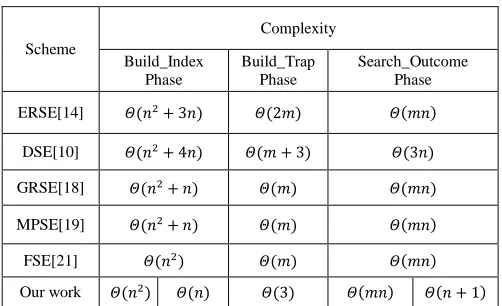
In this case we assume that the number of keywords will be greater than the number of documents. From the complexity analysis of our scheme, it is evident that the Build_Index phase requires 𝛩(𝑛2) where 𝑛 is the total number of documents in the dataset. The Build_Trap phase is bound by 𝛩(𝑚), where 𝑚 are the total number of words in the dataset. The Search_Outcome phase is bound by 𝛩(𝑚𝑛). We would like to highlight that if we remove the ranking functionality from our scheme then the efficiency of the Build_Index Phase increases to 𝛩(𝑛). Whereas, the efficiency of Search_Outcome phase can be increased to 𝛩(𝑛 + 1).
Table 2 shows the algorithmic comparative analysis of the schemes when 𝑛 > 𝑚. From the table it is evident that our scheme is efficient as compared to the other schemes.
Scheme
Complexity
Build_Index Phase
Build_Trap Phase
Search_Outcome Phase
ERSE[14] 𝛩(𝑛2+ 3𝑛) 𝛩(2𝑚) 𝛩(𝑚𝑛)
DSE[10] 𝛩(𝑛2+ 4𝑛) 𝛩(𝑚 + 3) 𝛩(3𝑛)
GRSE[18] 𝛩(𝑛2+ 𝑛) 𝛩(𝑚) 𝛩(𝑚𝑛)
MPSE[19] 𝛩(𝑛2+ 𝑛) 𝛩(𝑚) 𝛩(𝑚𝑛)
FSE[21] 𝛩(𝑛2) 𝛩(𝑚) 𝛩(𝑚𝑛)
Our work 𝛩(𝑛2) 𝛩(𝑛) 𝛩(3) 𝛩(𝑚𝑛) 𝛩(𝑛 + 1) TABLEII
[image:11.612.316.567.365.518.2]2) 𝑛 = 𝑚
In this case, we assume that the number of keywords are equal to the number of documents. Since 𝛩(𝑛2) is the upper bound of 𝛩(𝑚𝑛), therefore, 𝛩(𝑚𝑛) can be represented as
𝛩(𝑛2). We graphically represent the complexities of the
schemes by analyzing their phases separately. Our work is represented by (I) and (II), where (I) is for ranked searching and (II) is for unranked searching. We do the complexity analysis of our scheme by comparing it with the ranked and unranked schemes separately.
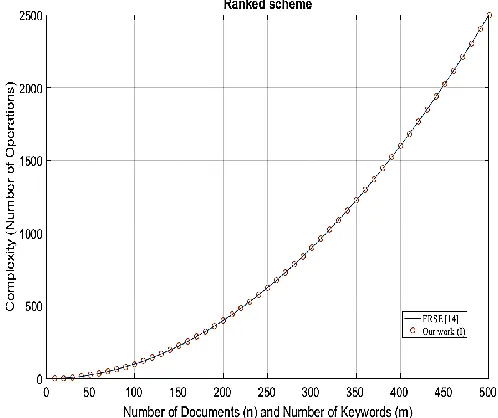
Figure 3 shows the Build_Index phase of the ranked schemes. It can be seen that the complexity of our proposed RSE scheme and existing ranked scheme increases with the increase in the number of documents. Even though our protocol also shows an exponential growth, it is more efficient and outperforms the other existing scheme.
Fig. 3. Complexity analysis of Build_Index phase in ranked schemes.
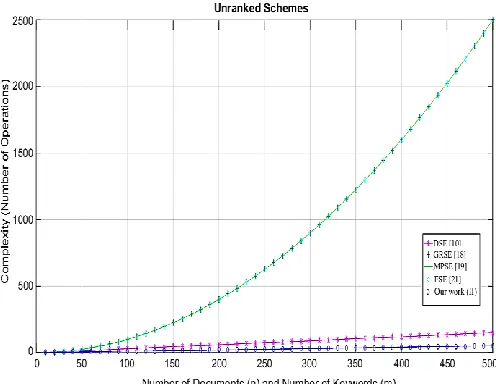
[image:12.612.315.565.154.346.2]On considering our scheme without ranking, it exhibits a mentionable linear growth as compared to existing schemes that show an exponential growth. Figure 4, graphically represents the complexity of the unranked schemes. From the graph it is evident that with the increase in the number of documents, there is a very slight increase in the complexity.
Fig. 4. Complexity analysis of Build_Index phase in unranked schemes.
The complexity of the Build_Trap phase isn’t effected by ranking or un-ranking. Therefore, Figure 5 represents a collective graph of the Build_Trap phase of ranked and unranked schemes. It can be seen that all the schemes show a linear growth but our proposed scheme outperforms other schemes in terms of complexity by maintaining the same efficiency even with the increase in the number of keywords being searched.
[image:12.612.48.298.243.442.2]Fig. 5. Complexity analysis of Build_Trap phase.
Figure 6 illustrates a graph generated for the Search_Outcome phase of the RSE schemes. It can be seen that our proposed scheme and the existing ranked scheme are showing an exponential growth by depicting the same complexity.
[image:12.612.311.560.507.716.2]Whereas, when we compare our unranked scheme with the similar existing unranked schemes then our scheme performs much better and is faster. Our unranked scheme shows a linear growth in terms of the complexity. Figure 7 shows a complexity analysis of the Search_Outcome phase of the unranked schemes.
[image:12.612.47.298.545.726.2]Fig. 7. Complexity analysis of Search_Outcome phase in unranked schemes.
The overall complexity analysis of our scheme against existing schemes yields that our scheme dominates the existing schemes in terms of efficiency and can be termed a lightweight scheme.
B. Computational Analysis
a) Dataset Description
The Switchboard-1 Telephone Speech Corpus (LDC97S62)[28] was originally collected by Texas Instruments in 1990-1, under DARPA sponsorship. The first release of the corpus was published by NIST and distributed by the LDC in 1992-3. The Switchboard-1 speech database [8] is a corpus of spontaneous conversations which addresses the growing need for large multi-speaker databases of telephone bandwidth speech. The corpus contains 2430 conversations averaging 6 minutes in length; in other words, over 240 hours of recorded speech, and about 3 million words of text, spoken by over 500 speakers of both genders from every major dialect of American English. The dataset comprises of 120,000 distinct keywords. A time-aligned word for word transcription accompanies each recording. As such it constitutes a realistic dataset of telephone speech, and for this reason the Switchboard-1 transcriptions were used to illustrate the functionality of the searchable encryption presented in this paper.
b) Implementation Details
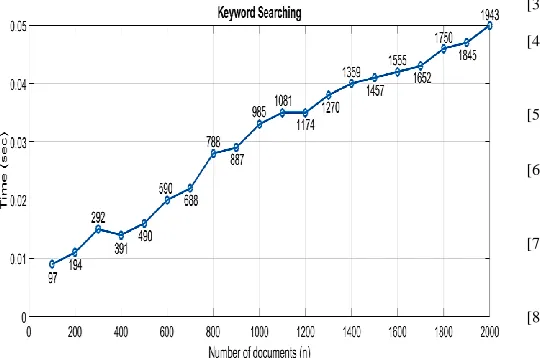
To demonstrate the feasibility of our RSE scheme, we have implemented our algorithms in Java and present the results in the form of graphs using MATLAB2016. The implementation helps us analyze the time that each phase of the algorithm takes while gradually scaling the input (documents or keywords). In order to highlight the cost of cryptography we have implemented the testbed such that the client and server side implementation is done on the same machine. Hence, the analysis does not take the cost incurred while transferring the documents, index tables or trapdoor over the network, to the CS, in to account.
The implementation uses all the algorithms presented in Section V. We achieve encryption by implementing 128-bit AES-CBC and the keyed cryptographic hash function used is
SHA-128. The dataset used is of the size 59MB and it contains 2100 files in total. The workstation used for the demonstration runs with an Intel Core i5 CPU running at 3.00GHz and 8GB of RAM.
c) Performance Metrics
To determine the performance of our RSE scheme, we analyze the performance of each individual phases that have been discussed throughout the paper. Since KeyGen and Dec phase are fairly identical to that of other schemes we therefore skip the performance analysis of these phases and shift our focus on to the remaining phases starting from the Build_Index phase.
1) Build_Index Phase
The Build_Index Phase comprises of index generation. After the index table is generated it is transmitted to the CS. We analyze the computation time index table generation. The computational cost analysis is done by running the code on a total of 120,000 distinct keywords, identified and extracted from a dataset of 2100 files.
[image:13.612.315.567.406.586.2]The index table is generated by the client and transmitted to the server. Our sheme facilitates both ranked and un-ranked searches depending upon the required functionality and area of application. As we have mentioned in Section V, our scheme uses equation 1 for the relevance score generation to achieve ranking. This ranking comes with an increase in the number of computations resulting in an increase in computational time. Therefore, we execute ranked index generation and un-ranked index generation seperately.
Fig. 9. Computational time for Index Generation (Ranked).
Figure 9 shows a graphical representation for the running time of the Index generation (ranked) in seconds (sec). We execute this phase for a total of 2000 documents, starting from 100 documents and gradually scaling the number of documents to 2000. For 2000 documents the Index generation takes a total of 14.7 seconds and shows a linear growth.