City, University of London Institutional Repository
Citation
:
Edirisinghe, C, Cheok, A. D. and Khougali, N (2018). Perceptions and
Responsiveness to Intimacy with Robots; A User Evaluation. Lecture Notes in Computer
Science, 10715, pp. 138-157. doi: 10.1007/978-3-319-76369-9_11
This is the accepted version of the paper.
This version of the publication may differ from the final published
version.
Permanent repository link:
http://openaccess.city.ac.uk/19432/
Link to published version
:
http://dx.doi.org/10.1007/978-3-319-76369-9_11
Copyright and reuse:
City Research Online aims to make research
outputs of City, University of London available to a wider audience.
Copyright and Moral Rights remain with the author(s) and/or copyright
holders. URLs from City Research Online may be freely distributed and
linked to.
City Research Online:
http://openaccess.city.ac.uk/
[email protected]
Robots; A User Evaluation
Chamari Edirisinghe, Adrian David Cheok, Nosiba Khougali
Imagineering Institute and City, University of London
Anchor 5, Iskandar Puteri, Johor, 79250 Malaysia and 10, Northampton Square, London EC1V0HB, UK
chamari,adrian,[email protected]
Abstract. In human-robot interactions research it is significant to question what measures humans will take to contest the challenges and what will become of them. Levy hypothesizes that robots will stimulate human senses with their many capabilities and humans will accept them as intimate companions because the human perception of intimacy will transform to accommodate various nuances. However, the question remains, how much humans understand and accept inti-macies with robots. We argue that perceptions of human-robot interactions (HRI) and intimate interactions with robots have a certain impact on how individuals comprehend intimacies with robots. Long term contact with robots, in terms of robotic technology and conversations, will change our views and practices re-garding intimacy with robots. Our study revealed that lack of awareness of the potentials of future AI robots has created a fear; fear of losing both tangible, intangible, and the sense of dominance. Yet, our participants’ intimate interactions with robots produced varying degree of responses that, we believe are revealing another scope of human-robot interactions.
Key words: Robots, Intimacies, Human-Robot Interactions, Perceptions, Touch
1
Introduction
regarding the problematic of cohabitation.
Future robots are going to be more than tools; instead they are walking, talking, and think-ing parts of our livthink-ing, and our experiences. Invariably, human acceptance of artificial, intelligent, and human-like entities will be a challenging process. However, the human will be strongly motivated to connect with robots intimately, because a large number of robots of various capabilities are going to move into our vicinity, compelling us for closer communications. Like mobile phone technologies, robotics will be constantly upgrading with an industry that is reaching towards new potentials, and demanding customers who are invariably intimately attached to their robot companion.
The prevailing arguments will continue to evolve; from morality of a robot companion to the rights over/of a robot. Our questions will largely be focused on the future of humankind as individuals and intelligent collectives. Although some of the scenarios involving AI and robotics might appear similar to science fiction, they are feasible, requiring improvement in a number of spheres. It will only be a matter of time until our communications with robots become similar to human-human interactions. Thus, it is imperative to concentrate on studying different aspects of human-robot relationships. It will prepare every structure of the society to address numerous challenges these new interactions bring forth. Besides, it is necessary to create a platform for robust conver-sations on human-robot relationships before the robotics industry overwhelms us with products and services.
This study is aiming at facilitating that platform for conversation. Our objective is to evaluate the perceptions and physical responses to intimacy with robots. Our study con-centrates on 1) understanding the perception of being associated with robots, and 2) the physiological responses (EDA measures) to interacting with robots. Through perception we are determining the subjective interpretations of human-robot connections, and EDA measurements are giving us evidence to how people physically react to intimacy with robots. Our results showed that, even though our study sample revealed a high awareness of robots, they reveal considerably less preference towards the idea of been intimate with robots. Physiological reactions have shown that our study participants experienced higher stimulation from the visual stimuli of the robot moving to music, rather more than haptic stimuli, such as touching the head or backside of the robot.
We understand that the perception and physiological responsiveness as key aspects in encouraging and developing communications and implications of human perception and responsiveness on human-robot interactions. Hence, the key novelty we presented in this research is the concept of intimacy with robots, in a variety of different roles and scenarios; as domestic help, companions, caregivers, comrades, lovers, true other halves, sexual partners, etc. within the framework of perception and responsiveness. Onwards, in this paper, we will discuss different studies on human-robot relationship platform. We will present our objectives, methodology, and follow it with our study results. We will discuss our study results lengthily and conclude the paper.
2
Background
convenient and efficient. Robots are naturally part of human day to day living, from birth to death, yet they have been designated a position in the periphery, not in the midst of human living. Robots in the future, despite their peripheral positioning, will be common, not merely performing routine jobs, but also be responsible for major tasks, executing them effectively and efficiently. No matter where humans position them, they will create their own space, and the challenge will be the human acceptance of their spatiality. Naturally, our relationship with robots will evolve with time, due to the amount of com-munication and familiarity. Whether human relationships with robots can provide for the good life is one of the focal points of discussion, with the central argument vying that the good life will be obliterated by the moral dilemma presented by these relationships. The constant criticism against deeper human-robot connection is part of the technological determinism and singularity. The fear of social and cultural changes, with the assumption that society and culture is not fluid, drives some people to understand that technological advancement determines the social and cultural values [2]. Simultaneously, people fear that, with time, technological advancement, specifically artificial intelligence, would be out of control of humans, and that will bring unimaginable changes to human nature itself [3].
While these forecasts paint a picture of gradual doom, a study found that individuals relate social rules and expectations to machines and exhibit certain socially acceptable behavior towards machines [4]. Why should we be concerned with human association with machines or computation, when we are as Sherry Turkle [5] said, ‘increasingly non-chalance about machines in our everyday lives? We have accepted the human-machine, human-robot, and human-computer interactions, albeit lots of remonstrations, without much thought to the simple fact that a few decades ago we were hardly at this threshold of development. Our acceptance of new developments did not arrive from the understanding that technology has a certain sequential inevitability, but from experiencing them, and adapting them to everyday living. What we deemed as good life has changed historically. It faced technology in different centuries, in different civilizations, in different continents. Change crushed the humans on one side while revving them to rise again with a different perspective on good life.
When Asimov [6] famously made laws of robotics, he was clearly ascertaining the supremacy of humans over robots, which is a moral and sentimental association with humanity. It created a moral legitimacy for robotics, because those laws fundamentally created a hierarchy of existence, where our basic fear of robots rest. Asimov not only introduced the laws to protect humans, thus limiting the production of artificial cognitive capacities in machines, but also assumed that robots with high AI will have the capability to comprehend the superiority of humans. Our lack of faith in technology is essentially evolving from our faith (lack thereof) in ourselves, rather than the inevitability of tech-nology.
was describing as a traditional relationship are multi-faceted with many nuances in each interaction. Whether a robot can become similarly complex and intricate is a dubious status. Since a robot acquires its information through various means and it will miss the fluid relationships between subjects, thus it is incapable of developing a knowledge of common-sense claims Nowachek [8], emphasizing on the idea that learning occurs as a function of being in the world. In that regard, a robot can be a substitute to a traditional relationship, however the fluidness and the complexities of a relationship will not be part of that substitution; instead it will be a leaner, non-compromising exchange. Subsequently comes the questions related to the association between a machine and a substitute. Thus, are machines really a substitute? In most instances it is a yes, because we rely on machines to an extent that is alarming, yet fathomable. Will people, who em-phatically declare robots as machines, view robots as substitutes for traditional methods of interacting?
Graaf [9] says that our interactions will have different meanings when there are with social robots. For one thing, the relationship between human and robot would, to a greater extent, be unidirectional, which produces chasm of expectations and unhealthy aspects of reliance. Social and cultural aspects are an integral part of this relationship, and highly contested, as those are built on values that are part and parcel of human lives. Kaplan [10] tried to measure the acceptance of robots by eastern and western cultural spheres, and concluded that they adopted different approaches towards robots; while West fervently embraced and involved with technology, and human-robot interactions, their attitude is generally distress for robotics. Contrastingly, the author has claimed that Japan, representing the East, embrace technology and human and robot interactions with a certain distant attitude and robots do not bother them extensively. Although the premise of this study raised issues, the moral and cultural perspective strongly decide on the human-robot relationship.
When the academic community measured in on the role of a robot companion [11], the human experience of psychological intimacy with robots through the physical inti-macy [12], human physiological response to intimately touching a robot [13], a system-atic survey of the acceptance of sex robots [14] and aspects that influence the purchase of sex robots [15] are (to name a very few) contributing to a greater discussion that would contain what could be described as an emerging phenomena. It is important to emphasize that greater contribution in terms of assessment of social impact and risk management are required for a robust coexistence in future.
3
Methodology
3.1 Objectives
the differences on an abstract level. Both of these measures will reveal the dynamics and trajectories of human-robot intimate interactions.
3.2 Participants
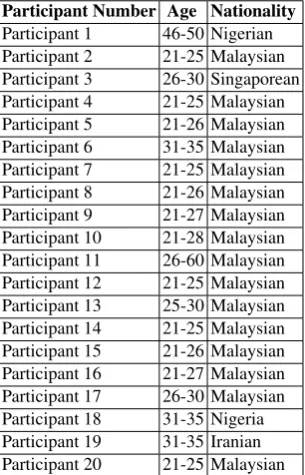
[image:6.595.232.385.241.479.2]A total of 20 participants of the age of 20 and above participated in this study. All participants are from different nationalities and ethnic backgrounds (Refer to Table 1).
Table 1: Participants Data
Participant Number Age Nationality
Participant 1 46-50 Nigerian Participant 2 21-25 Malaysian Participant 3 26-30 Singaporean Participant 4 21-25 Malaysian Participant 5 21-26 Malaysian Participant 6 31-35 Malaysian Participant 7 21-25 Malaysian Participant 8 21-26 Malaysian Participant 9 21-27 Malaysian Participant 10 21-28 Malaysian Participant 11 26-60 Malaysian Participant 12 21-25 Malaysian Participant 13 25-30 Malaysian Participant 14 21-25 Malaysian Participant 15 21-26 Malaysian Participant 16 21-27 Malaysian Participant 17 26-30 Malaysian Participant 18 31-35 Nigeria Participant 19 31-35 Iranian Participant 20 21-25 Malaysian
3.3 Study Protocol
Study 2 - Following Study 1, the second stage of this study measured the physiological reaction to close interactions with a robot. We used a commercially available biomedical equipment to measure electrodermal activity1.
3.4 Study Structure
Study 1 - The questionnaire consisted of five dimensions, each dimension pertaining to a particular aspect of robot or a particular responsiveness towards the existence of robots. The objective here is for participants to construct their own scenarios with their awareness of robots, whether those robots are industrial arms, humanoid robots, domestic robots, or future high-tec robots. They are encouraged through a number of questions that associate robots with humans, stimulating their minds to take a position on variety of human-robot interactions. The answers to each dimension will be examined to understand individual positions. Awareness is the first dimension, which is aiming to understand the level of awareness of robots in the day to day living and the degree of acceptability of that awareness. The second dimension is Association, which is aiming to comprehend the personal relations and associations individuals prefer to build or imagine preferring to build. Enjoyment, as the third criterion, is aiming to understand the individual pleasure and entertainment with/from robots. Attraction, as the fourth dimension, is measuring the perception of individual attraction to robots. The last dimension is Intimacy, where the individuals are requested to imagine intimacy (in terms of romance, love, and sex) with robots.
Study 2 - This experiment measured electrodermal activity (EDA) using a commercially available toolkit while the participants were engaged in designated interactions with the robot Alpha 22. The test started with relaxation of the participant with relaxing audio and visual stimuli, after which the participant interacted with the robot on predetermined stimuli, which were both visual and tactile. The predetermined protocols were designed to roughly collaborate with the dimensions discussed in study 1. While the test began with relaxation, it concluded with a high excitement point; a bursting of a balloon. The objective was to position all EDA results between the relaxed as the lowest reading of EDA to bursting balloon as the highest reading. Each interaction was for 30 seconds, with a 60 second relaxation period in between (refer to Table 2).
4
Results
4.1 Study 1
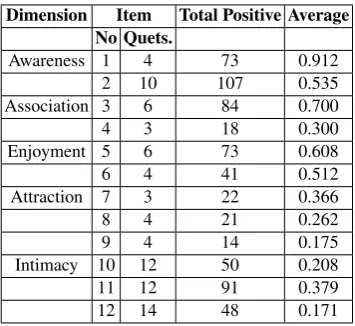
-This study, as we experienced in our pilot study [17], garnered high positive results for particular questions. The first item out of two items in awareness resulted in 91.25% of positive answers. However, item 2 showed only 53.5% average of positive answers.
1http://bitalino.com /en/board-kit-bt
2Alpha 2
Table 2: List of Test Protocols
No Protocol Time Dimension
1 Relaxation audio/video relaxation clip 30sec Lowest point 2 Looking at the robot robot sitting down 30sec
Awareness & Association 3 Looking at the robot robot standing up 30sec
4 Watching robot moving robot walking 30sec 5 Watching robot dancing 1 robot dancing to music 30sec
Enjoyment 6 Watching robot dancing 2- robot dancing to music 30sec
7 Watching robot dancing 3- robot dancing to music 30sec
Attraction 8 Watching robot dancing 4- robot dancing to music 30sec
9 Touching robots head robot stands still 30sec
Intimacy 10 Touching robots arm robot stands still 30sec
11 Touching robots waist robot stands still 30sec 12 Touching robots buttocks robot stands still 30sec 13 Touching robots inner thigh robot stands still 30sec
14 Bursting a balloon 30sec Highest point
Only four participants responded completely positively to questions of awareness. To six questions in the item one of dimension two, association, 70% of participants gave positive answers, while for the next item, 70% were negative in their responses.Fifty seven percent of answers were favourable to enjoyment criteria, however, only 35% thought of robots as entertainment and enjoyment (refer to Table 3).
Table 3: Results of each Dimension
Dimension Item Total Positive Average No Quets.
Awareness 1 4 73 0.912 2 10 107 0.535 Association 3 6 84 0.700
4 3 18 0.300
Enjoyment 5 6 73 0.608
6 4 41 0.512
Attraction 7 3 22 0.366
8 4 21 0.262
9 4 14 0.175
Intimacy 10 12 50 0.208 11 12 91 0.379 12 14 48 0.171
[image:8.595.219.397.443.606.2]only 17.5% positive responses. For the dimension attraction, 79.09% answers were negative. Intimacy was the last dimension, where for three items, participants answered 38 questions, and only 24.86% answered positively.
Study 2
-This study measured electrodermal activities (EDA) of participants when interacting with a robot. The protocols for interactions were associated with the same five dimensions as discussed above. Each participant was asked to interact with the robot in a quiet room with no disturbances, with only two researchers present. Their protocols were arranged thus (Refer to Table 2). The first and last stimuli were designed to measure the highest and lowest point in the EDA measures, so that benchmarks could be established to understand other measures. Our results revealed that each test elicited different level of responses from each participant. The benchmark we created, with the understanding that we need to position our test protocols somewhere within two spectrum, relaxation and high point of excitement, revealed that certain interactions with robots exceed those benchmarks.
In Li, J., Ju, W. and Reeves, B. [13], there was a similar study, where they measure the physiological responses to arrive at a conclusion that participants have shown a considerable higher response when touching morelow accessibility areasof a robot. They statistically measured the response time, deciding that the response time correlated with arousal, and the results showed that response time is higher for low accessibility areas of robots body. In our study (experiment 2), the test protocols were designed according to our first study criteria, and each protocol has a response time of 30 seconds, of which the average was considered as the highest response. The awareness and association criteria
0 0.1 0.2 0.3 0.4 0.5 0.6 0.7 0.8
1 2 3 4 5 6 7 8 9 10 11 12 13 14 15 16 17 18 19 20
E
D
A
PARTICIPANTS
TEST 2 - 4 - AWARENESS & ASSOCIATION
[image:9.595.134.485.440.610.2]Relaxa!on looking at robot si"ng down Looking at robot standing up Robot walking Burs!ng Balloon
Fig. 1: Awareness and Association EDA Results of Twenty Participants
significantly (Figure 1). If we examined the participant 16, there are visible changes in response averages, however, examining the changes, the difference in the response to looking at a seated robot and a standing robot is 0.076. Three participants scored below both benchmarks, while the same number of participants scored above both benchmarks. Watching the robot dance for the first time, all participants registered an average response level of 0.499 and 6 of them gave responses below the relaxation point, which was marked as the low benchmark. The second robot dance protocol elicited an average response of 0.469 (Refer to Figure 2). Different dancing acts were selected for attraction
0 0.1 0.2 0.3 0.4 0.5 0.6 0.7 0.8 0.9 1
1 2 3 4 5 6 7 8 9 10 11 12 13 14 15 16 17 18 19 20
E
D
A
Par cipants
TEST 5-8 - ENJOYMENT & ATTRACTION
Relaxa on
[image:10.595.135.481.238.474.2]Waching the robot dancing 1 Watching the robots dancing 2 Watching the robot dancing 3 Watching the robot dancing 4
Fig. 2: Enjoyment and Attraction EDA Results of Twenty Participants
criteria (Figure 2), where the robot made intricate dance movements. The first dance move attracted an average of 0.487 response. Seven participants out of 20, exceeded the highest benchmark we imposed. The second dance by the robot received a 0.449 average response. Only three participants exceeded the highest benchmark in their responses. To cover our different categories, we have thus far introduced visual stimuli, however, for the category of intimacy we introduced touch; touching different parts of the robot (refer to Table 2 and Figure 3). It started with 3 stimuli that were impersonal touches: head, arm, and waist. It progressed to touching the robot‘s backside and inner thigh. For clarity, we separated first three impersonal touches. Touching the head of the robot had an average of 0.498 EDA response and touching the robot‘s arm and waist garnered 0.451 and 0.471 averages, respectively.
0 0.1 0.2 0.3 0.4 0.5 0.6 0.7 0.8 0.9
1 2 3 4 5 6 7 8 9 10 11 12 13 14 15 16 17 18 19 20
e
d
a
PARTICIPANTS
TEST 9-13 - INTIMACY
Relaxa!on Touching robot's head Touchign robot's arm Touching robot's waist
[image:11.595.134.480.97.305.2]Touching robot's bu"ocks Touching robot's inner thigh Burs!ng Balloon
Fig. 3: Intimacy EDA Results of Twenty Participants
out of 20 participants exceeded the high benchmark we put forward. In contrast, touching the robot‘s inner thigh produced 0.460 average of response, with 7 participants exceeding the high benchmark of response, bursting a balloon. 9 participants touching the robot‘s buttocks and 6 participants touching robot‘s inner thigh produced responses that were below the low benchmark.
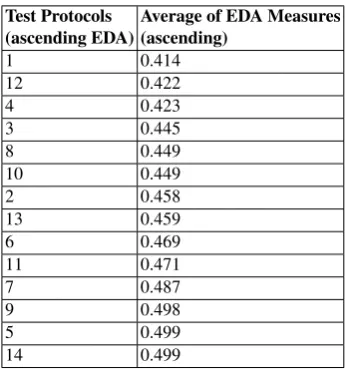
Although participants individually displayed EDA responses for each protocol that exceeded the high and low benchmarks responses, the averages of all participants demonstrate that high/low benchmarks are intact nonetheless. Table 4 will provide details on average responses of all 20 participants to each stimulus in ascending order.
5
Discussion
Our perceptions are constructed through social interactions, and interactions are the basis where humans understand their surrounding, be it tangible or intangible. The deeper their interactions, the more their understanding grows. Our perceptions are built through these interactions and social agreements. Connections are built through longer interactions. How we interact with robots and how we perceive them are interlinked because our perceptions influence how we interact and vice versa. Our questions on perception and informal exchange of thoughts lead us to understand certain aspects of participants perception before, during, and after interacting with the robot.
Table 4: EDA Average Ascending
Test Protocols (ascending EDA)
Average of EDA Measures (ascending)
1 0.414
12 0.422
4 0.423
3 0.445
8 0.449
10 0.449
2 0.458
13 0.459
6 0.469
11 0.471
7 0.487
9 0.498
5 0.499
14 0.499
and danger. Participants who answered 100% positively to this dimension saw robot as help, who perform routine and dangerous tasks in industry and help household chores in the home front. In other words, robots are mere tools, albeit more advanced ones than their dish washer. Some participants voiced future potentials, in education and healthcare, yet as tools.
Mixed answers, where participants refused to think of robot as human companions or friends, yet visualized a future of close associations with robots, were mostly founded on danger and fear. In 2005, a study conducted by Dautenhahn et al. [11] revealed that large number of the study participants were in favour of robot companions, as assistants or domestic help, but only few wanted those robot companions as friends. Considering that there are no real examples, perceiving robots as a danger is largely influenced by representation of robots in fiction. However, the fear is comprehensible when you imagine scenarios where there is a conflict of objectives between humans and robots. Consequently, it is argued that when robots learn a considerable amount of human values, they will not pose a threat [18].
concerns in that regard; instead they concentrated on the threats that might arise from robots controlled by others. This reveals that our perception of robots has a correlation to our perception of each other as humans.
It is revealed that perceived enjoyment has an impact on the interactions with robots [21]. For the dimension of enjoyment, overall, 57% of participants of our study answered positively. 9 out of 20 participants answered all questions positively. To questions like “do you enjoy robots” 75% agreed, yet to the statement “robots are joyous”, which is attempting to establish that robots have by themselves the capacity to be joyous, was met with only 40% of positive answers. All participants are somewhat assured that they will enjoy robots, but robots having the capability to be independently enjoyable is a phe-nomenon they find difficult to grasp. However, the capabilities of robots as entertainers is accepted by the majority, yet doubts are prevailing on the subject of robots as joyous entities, that could, given the capability, be able to create, provide, and experience joy. One of the prevailing issues with regards to the idea of a robot as an intimate part of everyday living is the appearance of the robot; the appearance will dissuade humans from bonding with robots. Anthropomorphic robots are inclined to be more accepted as attractive and intimate than robotic machines. As Donald Norman [22] says, beautiful things work better and make people feel good. Only 25.9% of our participants consider the possibility of being attracted to robots of any form or manner. The perception of robots as mere machines, thus tools for use, is the predominant sentiment that discourage thinking of robot differently. To argue the point that robots are indeed different, like every human being as individuals, might appear to point out the obvious rational argument, yet all of the study participants‘ first reaction is ‘what is there to be attracted to a robot when it looks like a machine. Writing about uncanny valley, Mori [23] reflected that humans will not feel an affinity with robots unless they look less similar to machines and more like humans. However, he further argues that if a robots appears to be very similar to humans in looks, it might develop a revulsion. 60% of our study participants found robots attractive, however only 25% thought they can be attracted to a robot. 25% imagined being attracted to a robot emotionally. Shibata et al. [19] maintain that designing robots that interact with humans required the understanding of how people think of robots subjectively. On the same wavelength Hanson et al. [24] express that for the robots to be attractive to humans, integrated social ‘responsivity’ and aesthetic enhancements are essential. Interactions between humans and robots largely depend on the human expectations of those interactions.
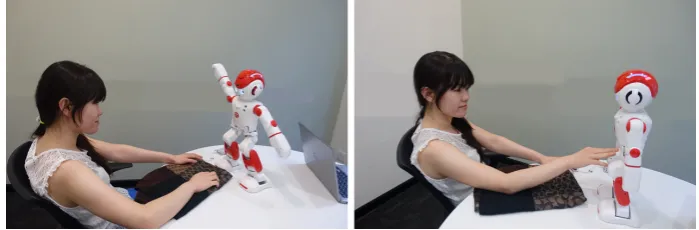
Fig. 4: Participant Interacting with the Robot
participants‘ imaginations have to be stretched to its fullest to comprehend and then relate to intimate scenarios with robots. Considering that their exposure to robots are limited, and the robots with high AI capabilities are still in future scenarios, imagining robots and humans in meaningful physical and emotional bonding is challenging. However, our participants found emotional bonding less disturbing than physical bonding through intimacy and sex.
Li, J., Ju, W. and Reeves [13], in their statistical analysis of EDA measurements when touching a robot, revealed that touching the intimate regions of the robot‘s body elicited a higher response than pointing at the those body regions. Jinnai et al. [26] claimed that more humanlike device, the human communication is more intimate. Our interactions with robots are a product of our perspectives, and there are numerous factors that influ-ence our perceptions; both internal and external. Some external factors may influinflu-ence the perception, thus impacting the physical interactions. It is argued that, irrespective of positive or negative, low motivational intensity (ie. amusement) expands the cogni-tive scope, than high motivational tendencies (ie desire) [27]. According to Gable and Harmon-Jones [28], high levels of arousal will not impact the motivational intensity, even though arousal and motivational intensity are connected. This encourages us to think that physiological responses may not always align with perceptions. Higher physiological responses will not necessarily indicate a change in cognition towards intimacy with robots, however, it will encourage the individual to be familiar with robots.
Our study of electrodermal activity (EDA) when interacting with a robot, revealed that on an average, watching the robot dancing protocol attracted the highest response (see Table 4 and 5). This is the first time in this study the participants encounter the robot moving to music in dancing motion. Touching the robot‘s body for the first time (the head) elicited the second highest response. Lowest responses were produced by the protocol that invite participants to touch the robot‘s buttocks.
response to touching a robot.
Fig. 5: Participant Interacting with Visual and Haptic Stimuli 1
Our results revealed that there was no clear difference between responsiveness towards visual stimuli, intended for influencing the perception of robots and haptic stimuli where regions of the robot‘s body that is deemed as private and intimate were being touched (refer to Table 4). The highest score, when participants are watching the robot dancing was understandably significant, not only because that was the first experience of a dancing robot to the participants, but also because the act of dancing could enliven the disposition. When the dancing entity is a robot, with its mechanical body, moving as smoothly and coordinated as possible, a perceptive change is created. In the same manner participants react to the sound of the bursting balloon, a dancing robot create an excitement that is physiologically measurable.
Fig. 6: Participant Interacting with Visual and Haptic Stimuli 2
[image:15.595.132.482.479.594.2]category. Touching the robot‘s waist, second highest score in haptics revealed that private yet less intimate regions of the robot‘s body elicited a higher response. However, the difference between touching the head and waist is 0.270. In comparison, the difference between the highest and lowest scored stimuli was 0.774. Touching robot‘s inner thigh scored higher than touching the buttocks, the difference being 0.037. The difference in responses is unexplainable, because it is difficult to make the assumption that the inner thigh is considered less intimate than the buttocks. However, when asked informally after the tests, they did not voice specific emotions like embarrassment or awkwardness when touching the intimate regions of the robot‘s body, instead they expressed the strangeness of the act itself. Perceptions are basically socially constructed; thus, it is problematic to conclude that each visual and haptic stimuli directly revealed a position. However, we would like to proposition that, even though for comprehensive analysis we considered all participants as an aggregate, considering individual responses with their study 1 results will produce an in-depth understanding of the subjective responses to human-robot interactions.
We have presented two different tests: one to understand perception of human-robot interactions, how they position themselves within the human and robot sphere, and another to measure their physiological responses. The first test revealed that perception of robots in any capacity is considerably built on media consumption. This was later clarified during informal discussions we conducted with participants. Whether it is human-robot romantic involvement, or powerful and aggressive robots (or hybrid creatures) invading the planet, these visual imageries are playing a leading role in conceiving the human-robot relationship. All the human-robots in contemporary everyday life, be it a mechanical arm, domestic service robots, entertainment robots, or sex robots, are such an extension to everyday living that we failed to notice the roles they play; the role of helping us. Yet our imagery has this evil entity that threaten the human values. A robot in an intimate setting is unimaginable to the majority because their fear of the unknown (known only through media depictions) is represented in the concept of human-robot interactions.
Lack of awareness of future possibilities in robotics, and human-robot relationships has created a void in most participants. Creating future scenarios, in terms of potentials developments in human-robot intimacies, were also decidedly influenced by the concept of creationism, the moral unacceptability of altering the belief in human creation. The perception of human-robot interactions and physiological responses to interacting with a robot (visual/haptic) have not been examined in this study to build a correlation, which will require a different methodological approach; instead we examined them in terms of the positioning of human-robot interactions. It is revealed that participants demonstrated mixed responses to touching perceived intimate regions of a robot‘s body. They have not revealed a significant high response when touching the most intimate part, instead displayed a lowest average for one of the most intimate parts of the robots body, the buttocks. The highest response recorded for touching the robot‘s buttocks was the participant whose positive responses to perception questions were only 40.24%. The participant whose responses recorded as the lowest for touching the robot‘s inner thigh, produced 93% of positive answers for perception of human-robot interactions.
Our conclusions at large;
Table 5: Visual and Haptic Stimuli
Protocol
category Stimuli
Stimuli (ascending)
Average of EDA (ascending)
Visuals
Relaxation audio/video relaxation 1 0.414 Watching robot moving robot walking 4 0.423 Looking at the robot robot standing up 3 0.445 Watching robot dancing 4- robot dancing to music 5 0.449 Looking at the robot robot sitting down 7 0.458 Watching robot dancing 2- robot dancing to music 9 0.469 Watching robot dancing 3- robot dancing to music 11 0.487 Watching robot dancing 1 robot dancing to music 13 0.499
Haptics
Touching robots buttocks robot stands still 2 0.422 Touching robots arm robot stands still 6 0.449 Touching robots inner thigh robot stands still 8 0.459 Touching robots waist robot stands still 10 0.471 Touching robots head robot stands still 12 0.498
Bursting a balloon 14 0.499
media exposure of various developments in the field of robotics and artificial intelligence. Awareness will create a mindfulness of robotic technology as more than machinery and algorithms, and advancement in robotics will prepare humans to think in terms of inclusivity.
2) Scenarios of future robotics technology and human-robot relationship are build and developed with information gleaned from robotic and AI-related research, and fictional depiction of human-robot relations. Robotic, AI, and human-robot interaction research expand the conversation of the repertoire of future human-robot developments. 3) Human-robot relations are based on fear (mingled with hope) and benefits. Fear of machines overpowering humans has been in the conversation from way back when automated manufacturing was introduced and recently in the form of mobile phones, internet, and media consumption. Robots, somehow, were revealed as entities that work, taking over repetitive, dangerous, and mundane tasks. Even though our participants were concerned about the loss of jobs to robots, thus increasing the unemployment, they have little conception of the incredible amount of jobs robots are already involved in and will be handling in coming decades.
4) Intimacy with robots is inconceivable to most because of the resolute belief that humans ought to be intimate with only humans, although sex robots are a thriving commercial industry. The morality of intimacy, especially the intimate act of sex, with a robot will always be subject of intense discussions.
6
Limitations
As limitations, we understand that our sample size of 20 participants is inadequate to argue a broader element. We will eliminate this weakness in our next study where we will add a third stage to the study, a qualitative analysis. We understand that, for a very complex subject, we let participants give binary answers in study one. That might not have given us a comprehensive perspective from the participants, however, we addressed that by having an informal exchange with each participant for this study. For the extended study, which we will be conducting as the next stage of this study, we are intending to incorporate open ended interviews with each participant.
7
Conclusion
In this study we discussed the perception of being intimately associated with robots and physiological reaction through EDA measurements to a number of stimuli that created intimacy with a robot. The majority of the participants of the study revealed they are aware of robots (largely due to media depiction of robots), however, they have reservation about being intimate with robots. They collectively saw robots as machines, even with the possibility of AI changing that status. The symbolic representation of robots as machines affected the way they associate robots with emotions and intimacy. Their physiological responses showed that their reactions are higher for visual stimuli of a robot moving to music, than for haptic stimuli.
It can be understood that the participants were primarily driven by the knowledge that robots are mere machines, which is permissible considering current developments in robotics and AI are progressing slowly. But in another decade, advancements in artificial intelligence, and experiments in humanoid robots will create an entity that is beyond a machine. Future robots will demonstrate capabilities somewhat equal to humans, which will create a strong friction that is triggered by the fear of being overpowered. Every participant of this study voiced their fear of future robots, either as a threat for employment or as a major threat to the humankind.
As future developments in this study, we will incorporate an open-ended interview, taking all participants as an aggregate, as well as individuals.
References
1. Levy, D.: Love and sex with robots: The evolution of human-robot relationships. Harper Collins (2009)
2. Servaes, J.: Introduction to the 3 as: Technology is great. Technological determinism and social change: Communication in a tech-mad world (pp. xiii–xxiii). New York, NY: Lexington Books (2014)
3. Kurzweil, R.: The singularity is near1. Ethics and Emerging Technologies (2016) 393 4. Nass, C., Moon, Y.: Machines and mindlessness: Social responses to computers. Journal of
social issues56(1) (2000) 81–103
7. Pic¸arra, N., Giger, J.C., Pochwatko, G., Gonc¸alves, G.: Making sense of social robots: A structural analysis of the layperson’s social representation of robots. Revue Europ´eenne de Psychologie Appliqu´ee/European Review of Applied Psychology66(6) (2016) 277–289 8. Nowachek, M.T.: Why robots can’t become racist, and why humans can. PhaenEx9(1) (2014)
57–88
9. de Graaf, M.M.: An ethical evaluation of human–robot relationships. International journal of social robotics8(4) (2016) 589–598
10. Kaplan, F.: Who is afraid of the humanoid? investigating cultural differences in the acceptance of robots. International journal of humanoid robotics1(03) (2004) 465–480
11. Dautenhahn, K., Woods, S., Kaouri, C., Walters, M.L., Koay, K.L., Werry, I.: What is a robot companion-friend, assistant or butler? In: Intelligent Robots and Systems, 2005.(IROS 2005). 2005 IEEE/RSJ International Conference on, IEEE (2005) 1192–1197
12. Kahn Jr, P.H., Ruckert, J.H., Kanda, T., Ishiguro, H., Reichert, A., Gary, H., Shen, S.: Psy-chological intimacy with robots?: using interaction patterns to uncover depth of relation. In: Proceedings of the 5th ACM/IEEE international conference on Human-robot interaction, IEEE Press (2010) 123–124
13. Li, J., Ju, W., Reeves, B.: Touching a mechanical body: tactile contact with intimate parts of a humanoid robot is physiologically arousing. In: 66th Annual Conference of the International Communication Association. Fukuoka, Japan. (2016)
14. Scheutz, M., Arnold, T.: Are we ready for sex robots? In: The Eleventh ACM/IEEE International Conference on Human Robot Interaction, IEEE Press (2016) 351–358 15. Szczuka, J.M., Kr¨amer, N.C.: Influences on the intention to buy a sex robot. In: International
Conference on Love and Sex with Robots, Springer (2016) 72–83
16. Abdi, H.: Guttman scaling. Encyclopedia of Research Design. SAGE Publications (2010) 17. Edirisinghe, C., Cheok, A.D.: Robots and intimacies: A preliminary study of perceptions, and
intimacies with robots. In: International Conference on Love and Sex with Robots, Springer (2016) 137–147
18. Russell, S.: Should we fear supersmart robots. Scientific American314(6) (2016) 58–59 19. Shibata, T., Tashima, T., Tanie, K.: Emergence of emotional behavior through physical
interaction between human and robot. In: Robotics and Automation, 1999. Proceedings. 1999 IEEE International Conference on. Volume 4., IEEE (1999) 2868–2873
20. Denning, T., Matuszek, C., Koscher, K., Smith, J.R., Kohno, T.: A spotlight on security and privacy risks with future household robots: attacks and lessons. In: Proceedings of the 11th international conference on Ubiquitous computing, ACM (2009) 105–114
21. Heerink, M., Kr¨ose, B., Wielinga, B., Evers, V.: Enjoyment intention to use and actual use of a conversational robot by elderly people. In: Proceedings of the 3rd ACM/IEEE international conference on Human robot interaction, ACM (2008) 113–120
22. Norman, D.A.: Emotional design: Why we love (or hate) everyday things. Basic Civitas Books (2004)
23. Mori, M., MacDorman, K.F., Kageki, N.: The uncanny valley [from the field]. IEEE Robotics & Automation Magazine19(2) (2012) 98–100
24. Hanson, D., Olney, A., Prilliman, S., Mathews, E., Zielke, M., Hammons, D., Fernandez, R., Stephanou, H.: Upending the uncanny valley. In: Proceedings of the national conference on artificial intelligence. Volume 20., Menlo Park, CA; Cambridge, MA; London; AAAI Press; MIT Press; 1999 (2005) 1728
25. Scheutz, M., Arnold, T.: Intimacy, bonding, and sex robots: Examining empirical results and exploring ethical ramifications. In Danaher, J., McArthur, N., eds.: Robot Sex: Social and Ethical Implications (working title). MIT Press (2017)
27. Harmon-Jones, E., Gable, P.A., Price, T.F.: Does negative affect always narrow and positive affect always broaden the mind? considering the influence of motivational intensity on cognitive scope. Current Directions in Psychological Science22(4) (2013) 301–307 28. Gable, P.A., Harmon-Jones, E.: Does arousal per se account for the influence of appetitive