Switchable gate-opening e
ff
ect in metal
–
organic
polyhedra assemblies through solution processing
†
Gavin A. Craig, aPatrick Larpent,aShinpei Kusaka, ‡aRyotaro Matsuda, ‡a Susumu Kitagawaaand Shuhei Furukawa *ab
Gate-opening gas sorption is known for metal–organic frameworks, and is associated with structural flexibility and advantageous properties for sensing and gas uptake. Here, we show that gate-opening is also possible for metal–organic polyhedra (MOPs), and depends on the molecular organisation in the lattice. Thanks to the solubility of MOPs, several interchangeable solvatomorphs of a lantern-type MOP were synthesisedviatreatment with different solvents. One phase obtained through use of methanol induced a gate-opening effect in the lattice in response to carbon dioxide uptake. The sorption process was thoroughly investigated with in situ powder X-ray diffraction and simultaneous adsorption experiments. Meanwhile, solution processing of this flexible phase using THF led to a permanently porous phase without a gate-opening effect. Furthermore, we find that we can change the metallic composition of the MOP, and yet retainflexibility. By showing that gate-opening can be switched on and offdepending on the solvent of crystallisation, thesefindings have implications for the solution-based processing of MOPs.
Introduction
Cooperative phenomena are found in many areas of chemistry. For example, cooperative models with a sharp increase in the rate of self-assembly have been proposed for supramolecular
polymerisation,1 while cooperativity in spin crossover
complexes leads to abrupt switches in the spin state of certain transition metals.2Metal–organic frameworks (MOFs), a type of polymeric material consisting of metal nodes bridged by organic ligands, may also show cooperativity.3 Usually, this results in a structural transition triggered by the entry of a gas molecule to the lattice, with a sudden increase in sorption capacity of the framework–so-called gate-opening behaviour.4 The extended character of MOFs is important here, as it oen means that they retain crystallinity aer activation, and such long-range order rapidly propagates the structural trans-formation throughout the lattice.5
Metal–organic polyhedra (MOPs) are the porous molecular counterparts of MOFs. This type of porous molecular solid is an attractive class of materials because their discrete nature means that they can be highly soluble, which is advantageous for solution-based processing.6The reticular chemistry used for MOFs can be applied to the design of MOPs, allowing precise control over the shape of the molecule and the size of the pore.7The intrinsic pores of MOPs should ensure that the activated solids display porosity. However, the weak nature of the intermolecular interactions, which leads to high solu-bility, can oen cause the lattice to collapse, resulting in an absence of porosity or slow gas diffusion.8 Additionally, the crystal packing of porous molecules is not straightforward to predict, as shown by recent combined theoretical and exper-imental work on organic cages, which revealed the huge range of potential lattice arrangements for a given porous mole-cule.9 Here we show the effect of chemical modication through covalent and coordination bonds at the molecular periphery on the arrangement of MOPs in the solid state and the discovery of gate-opening behaviour for MOPs. We have observed both type I gas sorption and stepped gate-opening for the same MOP molecule.In situpowder X-ray diffraction (PXRD) has been used to follow the gate-opening process, and demonstrates that these phenomena are intimately related to the crystal packing of the activated phase. It is possible to interconvert between these soand rigid activated phases by treating the samples with the appropriate solvents. We further show that we can change the metallic composition of the MOP but retain the same exible activated phase that aInstitute for Integrated Cell-Material Science (WPI-iCeMS), Kyoto University, Yoshida,
Sakyo-ku, Kyoto 606-8501, Japan. E-mail: [email protected]
bDepartment of Synthetic Chemistry and Biological Chemistry, Graduate School of
Engineering, Kyoto University, Katsura, Nishikyo-ku, Kyoto 615-8510, Japan
†Electronic supplementary information (ESI) available: Experimental procedures, crystallographic tables, thermogravimetric data, volumetric gas sorption data for N2and CO2, additional powder X-ray diffraction data, andin situpowder X-ray
diffraction-gas sorption experiments (PDF). X-ray crystallographic data in CIF format for1-DMF,1-THF, and2-DMA. CCDC 1840858–1840860. For ESI and crystallographic data in CIF or other electronic format see DOI: 10.1039/c8sc02263a
‡Present address: Department of Materials Chemistry, Graduate School of Engineering, Nagoya University.
Cite this:Chem. Sci., 2018,9, 6463 All publication charges for this article have been paid for by the Royal Society of Chemistry
Received 23rd May 2018 Accepted 9th July 2018
DOI: 10.1039/c8sc02263a
rsc.li/chemical-science
Science
EDGE ARTICLE
Open Access Article. Published on 10 July 2018. Downloaded on 9/12/2019 11:20:29 AM.
This article is licensed under a
Creative Commons Attribution 3.0 Unported Licence.
View Article Online
leads to gate-opening gas sorption, at the same time modu-lating the pressure at which gate-opening occurs.
Results and discussion
Design and synthesis of the ligand and MOPs
The organisation of a MOP in the solid state will depend on its shape, the inuence of solvent molecules on the packing, and the combination of intermolecular interactions arising from the functional groups present. The core shape of the MOP is determined by the geometry of the linker, while the packing can be altered by functionalisation of the external backbone of the ligand.10 Among potential MOPs for porous solids, we chose a lantern-type MOP with four organic linkers bridging two paddlewheel nodes: this shape guarantees relatively strong molecular interactions through effective pi–pi stacking, in contrast to other conventional Archimedean MOPs such as the cuboctahedron.11 MOPs with labile coordination sites at the axial sites of paddlewheel nodes, can be conveniently recrys-tallised from different solvents, allowing the investigation of the solvent effect on molecular packing arrangement (Chart 1).12
We studied two lantern MOP molecules based on the assembly of two paddlewheel nodes (Cu2for1, Rh2for2) with
the deprotonated form of the ligand 3,30 -((5-ethoxy-1,3-phenylene)bis(ethyne-2,1-diyl))dibenzoic acid (EtOLH2 in
Chart 1; see the ESI†for full synthetic details). We prepared this ligand as a functionalised version of the ligand 3,30 -((1,3-phenylene)bis(ethyne-2,1-diyl))dibenzoic acid (LH2), which has
been used previously to synthesise both Cu- and Rh-lantern MOPs.13 Compound 1 can be obtained as single crystals via reaction of Cu(OAc)2$H2O with EtOLH2 in DMF at room
temperature, yielding the neutral complex [Cu4(EtOL)4(H2O)2
(DMF)2] (1-DMF), or as a bulk powder by performing the
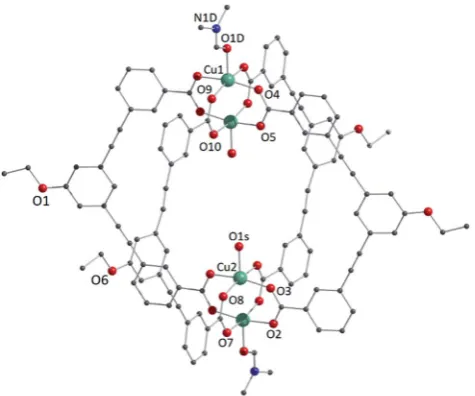
reac-tion in DMA and forcing precipitareac-tion through addireac-tion of MeOH. The molecular structure of1-DMFis shown in Fig. 1. The compound crystallises in the triclinic space groupP1, with half of the MOP molecule in the asymmetric unit and one entire
molecule in the unit cell. The molecule consists of two Cu2
pad-dlewheel nodes arranged on either side of the crystallographic inversion centre and bridged through four EtOL2ligands. A DMF molecule is bound to the exterior Cu1 of the paddlewheel in the axial position through the oxygen atom. Meanwhile, the coordi-nation sphere of the Cu2 on the interior site is completed by a water molecule. The pore size of this MOP can be dened by the distance across the pore of the molecule between Cu2 ions of 9.308(1) ˚A and the average distance between the opposing ethoxyphenyl rings of 14.838(6)˚A. The crystal packing is domi-nated byp/pstacking interactions arising from the faces of the aromatic ligand (Fig. S2†). The shortest interaction between aromatic rings on neighbouring MOP molecules measures 3.450(1)A. These interactions lead to an arrangement displaying˚ ordered channels along the [010] direction of the crystal lattice (vide infra). The shortest distance between the centre of two pores in the lattice is 15.965(1)˚A. In the crystal lattice of the compound [Cu4(L)4(DMF)4] the shortest distance between the centre of two
pores was 11.245(2) ˚A,13aillustrative of a more tightly packed
lattice, which may be due to the ethoxy-group in1-DMF.
Gate-opening sorption behaviour in theexible lattice of a MOP
To prepare compound1for activation, the crystals of1-DMFor of the bulk polycrystalline powder from DMA were soaked in MeOH for seven days, to exchange out the less volatile DMF or DMA molecules. The blue powder yielded by this solvent exchange process is crystalline; however, PXRD measurements showed that the crystal packing was altered with respect to that found in 1-DMF, and this new phase is referred to as 1-MeOH(Fig. 2). To activate1for gas sorption measurements, 1-MeOHwas heated overnight at 120C under vacuum (Fig. S3 and S4†). The PXRD data collectedin situof the resulting activated phase show that
Chart 1 (Left) A blueprint for lantern-MOPs. (Right) The features we vary in the work to modify the gas sorption properties of the MOPs described here, and the ligand used.
Fig. 1 View of the molecular structure of the MOP unit in compound
1-DMF. Hydrogen atoms have been omitted for clarity, and only crystallographically independent metal ions and heteroatoms have been labelled.
Open Access Article. Published on 10 July 2018. Downloaded on 9/12/2019 11:20:29 AM.
This article is licensed under a
[image:2.595.310.548.49.247.2]under these conditions,1packs in a third, distinct phase (1-a). These successive transformations demonstrate the importance of the solvent molecules for the overall molecular organisation.
The uptake of N2 by1-a at 77 K was found to be very low,
indicating that this phase is essentially non-porous towards N2
(Fig. S5†shows the volumetric N2and CO2sorption isotherms
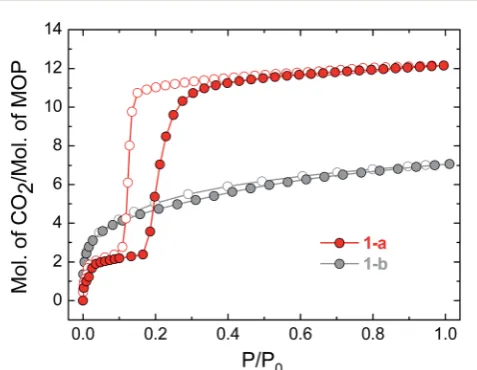
for1-a). The gas sorption of CO2 by1-a at 195 K is radically
different (Fig. 3). There is a micro-porous region in the low pressure regime, whereP/P0< 0.035, before the isotherm enters
a plateau for two adsorbed molecules of CO2for each molecule
of MOP. This plateau persists until a sharp increase in the uptake of CO2is triggered atP/P0 z 0.18. This gate-opening
effect is steepest in the pressure range 0.18 < P/P0 < 0.40,
before levelling out at higher pressures, attaining a maximum
capacity of 12 adsorbed molecules of CO2for each molecule of
MOP at P/P0 ¼ 1. The desorption measurements show
gate-closing to occur atP/P0 z 0.15, with the isotherm returning
to the plateau of two adsorbed molecules of CO2atP/P0¼0.08.
This behaviour is in stark contrast to the CO2sorption isotherm
described for the related MOP [Cu4(L)4], which was found to
present a type I isotherm.13aThis behaviour is also different
from the kinetic effect of slow gas diffusion observed for a handful of MOPs in the form of unstructured hysteresis loops in their gas sorption isotherms.14
Gate-opening gas sorption is a well-known phenomenon for MOFs, and requires a highly ordered network together with structural transformability. These features lead to the cooperative character in the lattice that allows a collective structural transi-tion to occur. In the case of MOPs, however, the lattice oen collapses to an amorphous phase upon activation.8d,15To char-acterise the changes in crystallinity driven by the entry of CO2into
the lattice of1-a, we performedin situCO2sorption and PXRD
measurements. Fig. 4 shows the evolution of the Bragg peaks in the range 2q¼5–8.75asP/P0is increased from 0 to 1 (selected
individual diffractograms are given in Fig. S6†). The initial gas uptake in the microporous regime (0.00 <P/P0< 0.035) induces
a displacement of the peak at 2q¼7.62to 7.54, accompanied by an increase in intensity. This new phase is retained over the range (0.035 <P/P0< 0.18), and corresponds to the plateau observed in
the gas sorption isotherm for two adsorbed molecules of CO2. In
fact, the majority of the observed peaks in the PXRD diff racto-gram are displaced to lower values of 2qforP/P0< 0.18, which
suggests an expansion of the unit cell in this regime. Therefore, it could be suggested that therst event in the lattice is entry of CO2
and formation of an interaction with the external Cu(II) ions of the
MOP paddlewheel, causing the expansion of the lattice and the existence of the plateau in the volume of CO2adsorbed, which
corresponds to two molecules of gas. AtP/P0 z 0.20, a phase
transition occurs: the peak at 2q¼7.54disappears at the same time as the emergence of new peaks at 2q¼8.45, 8.15, 6.95, and 5.35. The transformation from a closed phase of1to an open phase causes the sharp increase in gas uptake observed in the sorption isotherm. The open phase is retained through continued adsorption and through the desorption measurements until lowering the pressure to P/P0 z 0.15 where the gate-closing
occurs.
Switching gas sorption behaviour through solvent treatment
The structure of the activated phase of a MOF is generally independent of the solvent removed from the pores, due to the innite nature of the framework. A recent, notable exception was described for an indium-containing MOF SHF-61,16where activation from the CHCl3 solvate led to an open activated
phase, while activation from the DMF solvate yielded a closed activated phase.17Given the role of solvent molecules in deter-mining the crystal packing of the MOP molecules in compound 1, we targeted a new crystalline phase by re-crystallising the activated phase1-afrom THF. The molecular structure of the solvatomorph,1-THF, is shown in Fig. S7.†In contrast to the triclinic phase 1-DMF, 1-THF packs in the higher symmetry
Fig. 2 PXRD data collected for the as-synthesised crystals1-DMF
(black), and subsequent to solvent exchange with MeOH (1-MeOH, blue). The data collected after the activation processes for1-MeOH
(leading to1-a, red) and1-THF(leading to1-b, grey) are shown. The diffractogram for1-THFis shown in navy blue.
Fig. 3 CO2sorption isotherms for compounds1-aand1-b, measured at 195 K. Filled circles represent adsorption and empty symbols desorption in the colours indicated.
Open Access Article. Published on 10 July 2018. Downloaded on 9/12/2019 11:20:29 AM.
This article is licensed under a
[image:3.595.51.286.48.233.2] [image:3.595.49.288.503.688.2]monoclinic space group P21/n, and the conformation of the
MOP molecule is distinct (Fig. S8†). Here, the axial sites of the exterior Cu(II) ions are occupied by THF molecules, while water molecules coordinate to the Cu(II) ions of the interior site. The
effect of the THF molecules is to induce a completely distinct packing arrangement in1-THFwith respect to1-DMF, in that there are no ordered channels present (Fig. 5). The shortest distance between the centre of the pores in1-THFis 16.222(3)˚A (cf.15.965(1) ˚A in1-DMF). The phase1-THFwas activated by drying with supercritical CO2prior to gas sorption experiments.
Removal of THF from the lattice of1-THFdid not lead to the same solvent free phase1-athat was obtained from the acti-vation of 1-MeOH. Instead, a new phase 1-b was obtained, which had a lower degree of crystallinity than1-a(Fig. 2). The consequences of this alternative packing arrangement for the gas adsorption properties of 1 are shown in Fig. 3, where a type I isotherm is observed for the uptake of CO2at 195 K,
with a lower overall capacity. As with1-a, there is negligible uptake of N2at 77 K (Fig. S9†). For both1-aand1-b, it is likely
that initial CO2 uptake occurs with adsorption to the open
metal sites (OMS) of some external Cu(II) sites, causing an expansion of the lattice that is sufficient in the case of1-bto allow continued lling of the pores. For 1-a, the stepped nature of the isotherm suggests a more ordered process, in which all of the external OMSs are coordinated by CO2before
incorporation of CO2into other sites of the lattice. Whichever
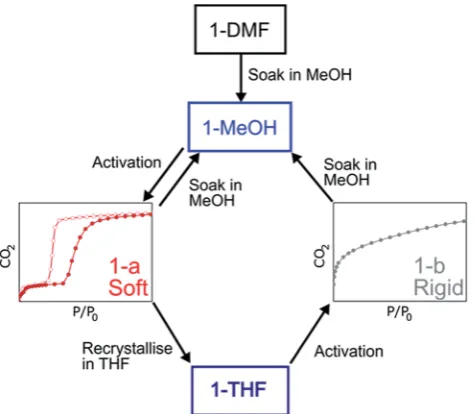
sorption process is active depends on the initial packing of the activated phase, which in turn is determined by the sol-vatomorph used to generate the activated phase. It is possible to reversibly cycle between these solvated phases: by soaking 1-bin MeOH, the phase1-MeOHis recovered, from which 1-aand1-bcan be obtained (Fig. 6).
Inuence of the metal nodes of the MOP on the gate-opening effect
Having demonstrated that the gas sorption of a specic MOP geometry could be modied by the solvent molecules in the
Fig. 5 (top) View along theb-axis for1-DMFand (bottom) view along theb-axis for1-THF, emphasising the different crystal packing dis-played by both solvatomorphs.
Fig. 4 (top) The adsorption branch of the CO2uptake measurements performed at 195 K on1-a. (bottom) A contour plot of the evolution of the Bragg peaks over the range 2q¼5.0–8.75as a function ofP/P0. The intensity of the peaks is relative to the strong peak observed at 7.54over the pressure rangeP/P0¼0.035–0.18.
Open Access Article. Published on 10 July 2018. Downloaded on 9/12/2019 11:20:29 AM.
This article is licensed under a
[image:4.595.311.548.287.691.2] [image:4.595.49.292.292.671.2]parent solvatomorph, we were interested in the effect of changing the identity of the metal paddlewheel. Thus, a lantern-type MOP was synthesised using [Rh2(OAc)4] as
a starting material, yielding [Rh4(EtOL)4(MeOH)4] [Rh4
(EtOL)4(H2O)2(DMA)2] (2-DMA). The as-synthesised complex
crystallises in the triclinic space groupP1, with two distinct MOP molecules in the lattice: one with the axial positions of the paddlewheel occupied only by MeOH molecules, and another with the interior sites occupied by water molecules and the exterior sites by DMA. The molecular structure of one of the MOPs in the lattice is shown in Fig. S10.†Through the solvent exchange process outlined for compound 1, it was possible to obtain the phase2-MeOH, which showed the same crystal packing as the Cu(II) containing analogue 1-MeOH
(Fig. 7). Activation of the parent phase2-MeOHsimilarly led to the formation of the phase2-a, conrming the role played by the relationship between the MOP geometry and the crystal packing of the parent phase in determining the molecular arrangement of the resulting activated phase. Fig. 7 shows the CO2 sorption isotherm measured at 195 K for2-a. The so
porous character of this lattice is seen to be retained despite the substitution of the metal paddlewheel, and again gate-opening is triggered by the uptake of CO2. The gate-opening
sorption displayed by 2-adiffers from that of1-a, in that it presents a stepped hysteresis loop with a less well dened plateau at lower pressures, and a step is observed in the gate-closing with a higher adsorbed volume of CO2. Additionally, 2-ashows a greater overall uptake of gas (Fig. S11†). Thein situ PXRD experiments showed that while the packing in2-ais the same as in1-a, the crystallinity was lower, which may lead to a less ordered process with a more gradual transition both structurally and in the uptake of CO2(Fig. S12†). It may also
be that the change in the nature of the OMS, caused by the presence of a different metal centre, leads to a different sorption process overall.18
Conclusions
In summary, we have described gate-opening gas adsorption for metal–organic polyhedra, which we were able to observe due to a dependence of the lattice packing on the solvent from which the molecules were crystallised. Clearly, there are implications for solution-based processing and applications, where different gas uptake would arise from the same molecule depending on how it was crystallised. The fact that cooperative gas uptake depends on how the sample is prepared could also mean that this phenomenon is widespread among metal–organic poly-hedra, and may be revealed across a range of compounds with study of solvent exchange conditions. Further, perhaps by functionalising the ligand backbone or introducing hydrogen bonding motifs it would be possible to increase crystallinity or cooperativity in the activated phases, allowing the nature of the gate-opening to be tuned, analogous to the strategies used to
Fig. 7 (top) Comparison of the PXRD diffractograms for theflexible phase1-MeOHand the phase obtained for the Rh-containing MOP 2-MeOH. (bottom) CO2sorption isotherms for2-a, measured at 195 K. Filled circles represent adsorption and empty symbols desorption.
Fig. 6 Summary of the transformations described for the MOPs based on1.
Open Access Article. Published on 10 July 2018. Downloaded on 9/12/2019 11:20:29 AM.
This article is licensed under a
[image:5.595.311.543.46.447.2] [image:5.595.50.288.49.256.2]increase cooperativity in spin crossover complexes.19 The subtlety of the relationship between the different packing motifs also suggests the applicability of recently described energy–structure–function maps to target specic properties in these molecules.20
Experimental
SynthesisThe full synthetic route for preparation of the ligand EtOLH2is
given in the ESI.†
3,30-((5-Ethoxy-1,3-phenylene)bis(ethyne-2,1-diyl))dibenzoic acid (EtOLH2).Diethyl 3,30
-((5-ethoxy-1,3-phenylene)bis(ethyne-2,1-diyl))dibenzoate (0.850 g, 1.82 mmol) was dissolved in THF/ MeOH (2 : 1, 60 mL), and 10 mL of a 2 M aqueous solution of KOH was added. The mixture was stirred at 55C forve hours. The organic solvents were removedin vacuo, and the remaining basic solution was acidied to pH¼1 with HCl (6 M), yielding a white suspension. This was ltered, and the white powder washed with water (3100 mL), and then dried under vacuum at 50 C. Yield 0.650 g, 87%. Elemental analysis (%) found (calc.): C 75.94 (76.09), H 4.59 (4.42).1H-NMR (DMSO-d
6, 500
MHz, 25C)d(ppm): 13.26 (br, 2H), 8.10 (s, 2H), 7.99 (d, 2H,3J¼ 7.7 Hz), 7.81 (d, 2H,3J¼7.6 Hz), 7.59 (t, 2H,3J¼7.7 Hz), 7.40 (s, 1H), 7.21 (s, 2H), 4.13 (q, 2H,3J¼6.7 Hz), 1.35 (t, 3H,3J¼6.8 Hz).13C-NMR (DMSO-d6, 125 MHz, 25C)d(ppm): 166.5, 158.6,
135.4, 132.1, 131.4, 129.6, 129.2, 126.7, 123.6, 122.3, 118.0, 89.0, 88.8, 63.7, 14.5.
[Cu4(EtOL)4(H2O)2(DMF)2] (1-DMF). A solution of EtOLH2
(40 mg, 0.1 mmol) in DMF (2 mL) was added to a solution of Cu(OAc)2$H2O (18.2 mg, 0.1 mmol) in DMF (2 mL). The
resulting blue solution was leto stand at room temperature. Blue block crystals suitable for single crystal X-ray diffraction formed aer several hours. Yield 49.0 mg, 62%. A bulk sample was also synthesised from DMA as follows: a solution of EtOLH2
(200 mg, 0.50 mmol) in DMA (4 mL) was added to a solution of Cu(OAc)2$H2O (97 mg, 0.5 mmol) in DMA (4 mL). The resulting
blue solution was stirred at room temperature for 1 hour before MeOH (8 mL) was added. Over the course of several hours, a blue crystalline powder formed that was isolated byltration, washed with DMA/MeOH (1 : 1, 2 5 mL), and dried in air, yielding 331 mg of a blue powder.
1-MeOH. 1-DMFor the bulk sample from DMA was trans-formed into the corresponding methanolic phase by soaking the samples in MeOH for seven days, replacing the MeOH each day with fresh solvent. Yield (starting from 49.0 mg of fresh 1-DMF) 27.6 mg, 92%. Elemental analysis for 1$(MeOH)2(H2O)2
(%) found (calc.): C 64.31 (64.04), H 3.66 (3.85).
[Cu4(EtOL)4(H2O)2(THF)2]$10THF (1-THF). The activated
sample1-awas recrystallised from hot THF (approximately 4 mg mL1THF). Yield (starting from 6 mg of1-a) 3.9 mg, 34%. Upon
cooling, blue block crystals suitable for single crystal X-ray diffraction formed.
[Rh4(EtOL)4(H2O)2(DMA)2][Rh4(EtOL)4(MeOH)4] (2-DMA).
EtOLH2 (198 mg, 0.48 mmol), [Rh2(OAc)4(MeOH)2] (100 mg,
0.20 mmol), and Na2CO3(53 mg, 0.50 mmol) were suspended in
DMA (7 mL), sealed in a vial, and heated at 100C for 72 hours.
Aer cooling to RT, the Na2CO3was separated from the
result-ing green suspension by decantation, and the green suspension was centrifuged. Single crystals of2-DMA were obtained aer one week by layering a 1 mL aliquot of the supernatant with MeOH (1 : 1, v/v). MeOH (30 mL) was added to the remaining supernatant, and the solid isolated by centrifugation. This green solid was washed with DMA, and then leto stand in MeOH for one week, replacing the MeOH each day, yielding the phase2-MeOH(55 mg, 26%, based on Rh). Elemental analysis for2$(MeOH)2(H2O)4(%) found (calc.): C 58.24 (58.36), H 3.47
(3.70).
Physical characterisation
1H and 13C NMR spectra were measured with a Bruker
Ultra-shield 500 plus (500 MHz) spectrometer at 25 C. Infra-red spectra were collected on neat samples using a Jasco FT/IR-6100 spectrometer. Thermogravimetric analyses (TGA) were performed with a Rigaku model Thermo plus EVO under an atmosphere of N2, and using a heating rate of 5 C min1.
Powder X-ray diffraction data were collected at room tempera-ture using a Rigaku SmartLab diffractometer equipped with Cu Ka radiation (l ¼ 1.54056 ˚A). Gas sorption isotherms were measured at 77 K (N2) and 195 K (CO2) using a BELSORP-max
volumetric adsorption instrument from BEL Japan, Inc. The samples of1-MeOHand2-MeOHwere activated by heating for 16 hours under vacuum at a temperature of 120C, while1-THF was activated through treatment with super-critical CO2, carried
out on an SCLEAD-2BD autoclave (KISCO) at 14 MPa and 40C for 2 hours, before heating to 120C under vacuum for 3 hours to complete activation.
In situ gas adsorption-PXRD. In situ gas adsorption-PXRD
measurements for 1-a and 2-a were performed on a Rigaku
SmartLab diffractometer with Cu Ka radiation connected to a BELSORP-18PLUS volumetric adsorption instrument (BEL Japan, Inc.). The instruments were automated and synchron-ised with each other, and an X-ray diffraction pattern was ob-tained at each equilibrium point in the adsorption isotherm.
Single crystal X-ray diffraction.All crystallographic intensity data were collected using a Rigaku model XtaLAB P200 diffractometer equipped with a Dectris model PILATUS 200K detector and confocal monochromated Mo Karadiation (l ¼ 0.71075˚A). All structures were solved within Olex2 (ref. 21) with the ShelXT structure solution program using intrinsic phasing, and rened with ShelXL using least squares minimisation (Table S1†).22For all three structures, the SQUEEZE23algorithm in PLATON24was used to account for areas of diffuse solvent. More detail is provided in the ESI.†
Con
fl
icts of interest
There are no conicts to declare.
Acknowledgements
G. A. C. and P. L. are grateful to the Japan Society for the Promotion of Science (JSPS) for Post-Doctoral Fellowships. S. F.
Open Access Article. Published on 10 July 2018. Downloaded on 9/12/2019 11:20:29 AM.
This article is licensed under a
acknowledges the support of JSPS KAKENHI Grant Number 17H05367 (Coordination Asymmetry). The authors thank the iCeMS Analysis Center for access to analytical facilities.
References
1 (a) M. M. J. Smulders, M. M. L. Nieuwenhuizen, T. F. A. de Greef, P. van der Schoot, A. P. H. J. Schenning and E. W. Meijer, Chem.–Eur. J., 2010, 16, 362; (b) R. Baumgartner, H. Fu, Z. Song, Y. Lin and J. Cheng,Nat. Chem., 2017,9, 614.
2 (a) V. Niel, J. M. Martinez-Agudo, M. C. Mu˜noz, A. B. Gaspar and J. A. Real,Inorg. Chem., 2001,40, 3838; (b) J.-F. L´etard,
P. Guionneau, E. Codjovi, O. Lavastre, G. Bravic,
D. Chasseau and O. Kahn, J. Am. Chem. Soc., 1997, 119,
10861; (c) M. J. Murphy, K. A. Zenere, F. Ragon,
P. D. Southon, C. J. Kepert and S. M. Neville,J. Am. Chem. Soc., 2017,139, 1330.
3 (a) S. Horike, S. Shimomura and S. Kitagawa,Nat. Chem., 2009, 1, 695; (b) G. Ferey and C. Serre, Chem. Soc. Rev., 2009,38, 1380.
4 (a) C. Serre, F. Millange, C. Thouvenot, M. Nogu`es, G. Marsolier, D. Lou¨er and G. F´erey,J. Am. Chem. Soc., 2002, 124, 13519; (b) P. L. Llewellyn, S. Bourrelly, C. Serre, Y. Filinchuk and G. F´erey,Angew. Chem., Int. Ed., 2006, 45, 7751; (c) N. Nijem, H. Wu, P. Canepa, A. Marti, K. J. Balkus, T. Thonhauser, J. Li and Y. J. Chabal,J. Am. Chem. Soc., 2012, 134, 15201; (d) J. A. Mason, J. Oktawiec, M. K. Taylor, M. R. Hudson, J. Rodriguez, J. E. Bachman, M. I. Gonzalez, A. Cervellino, A. Guagliardi, C. M. Brown, P. L. Llewellyn, N. Masciocchi and J. R. Long, Nature, 2015, 527, 357; (e) M. L. Foo, R. Matsuda, Y. Hijikata, R. Krishna, H. Sato, S. Horike, A. Hori, J. Duan, Y. Sato, Y. Kubota, M. Takata and S. Kitagawa,J. Am. Chem. Soc., 2016,138, 3022; (f) D. A. Reed, B. K. Keitz, J. Oktawiec, J. A. Mason, T. Runˇcevski, D. J. Xiao, L. E. Darago, V. Crocell`a, S. Bordiga and J. R. Long,Nature, 2017,550, 96; (g) P. Lama and L. J. Barbour, J. Am. Chem. Soc., 2018, 140, 2145; (h) A. Schneemann, P. Vervoorts, I. Hante, M. Tu, S. Wannapaiboon, C. Sternemann, M. Paulus, D. C. F. Wieland, S. Henke and R. A. Fischer, Chem. Mater., 2018,30, 1667.
5 (a) I. Dovgaliuk, F. Nouar, C. Serre, Y. Filinchuk and D. Chernyshov, Chem.–Eur. J., 2017, 23, 17714; (b) A. Schneemann, V. Bon, I. Schwedler, I. Senkovska, S. Kaskel and R. A. Fischer,Chem. Soc. Rev., 2014,43, 6062. 6 (a) J.-R. Li and H.-C. Zhou, Nat. Chem., 2010, 2, 893; (b)
A. G. Slater and A. I. Cooper,Science, 2015,348, aaa8075.
7 (a) D. J. Tranchemontagne, Z. Ni, M. O'Keeffe and
O. M. Yaghi, Angew. Chem., Int. Ed., 2008, 47, 5136; (b) J.-R. Li, A. A. Yakovenko, W. Lu, D. J. Timmons, W. Zhuang, D. Yuan and H.-C. Zhou, J. Am. Chem. Soc., 2010, 132, 17599; (c) J.-R. Li, J. Yu, W. Lu, L.-B. Sun, J. Sculley, P. B. Balbuena and H.-C. Zhou, Nat. Commun., 2013,4, 1538.
8 (a) T.-H. Chen, L. Wang, J. V. Trueblood, V. H. Grassian and S. M. Cohen,J. Am. Chem. Soc., 2016,138, 9646; (b) K. Xiong, F. Jiang, Y. Gai, D. Yuan, L. Chen, M. Wu, K. Su and M. Hong,
Chem. Sci., 2012,3, 2321; (c) W. Lu, D. Yuan, A. Yakovenko and H.-C. Zhou, Chem. Commun., 2011, 47, 4968; (d) J. M. Teo, C. J. Coghlan, J. D. Evans, E. Tsivion, M. Head-Gordon, C. J. Sumby and C. J. Doonan, Chem. Commun., 2016,52, 276.
9 A. Pulido, L. Chen, T. Kaczorowski, D. Holden, M. A. Little, S. Y. Chong, B. J. Slater, D. P. McMahon, B. Bonillo, C. J. Stackhouse, A. Stephenson, C. M. Kane, R. Clowes, T. Hasell, A. I. Cooper and G. M. Day,Nature, 2017,543, 657. 10 O. Barreda, G. Bannwart, G. P. A. Yap and E. D. Bloch,ACS
Appl. Mater. Interfaces, 2018,10, 11420.
11 (a) M. Eddaoudi, J. Kim, J. B. Wachter, H. K. Chae, M. O'Keeffe and O. M. Yaghi,J. Am. Chem. Soc., 2001,123, 4368; (b) Z. Ni, A. Yassar, T. Antoun and O. M. Yaghi, J. Am. Chem. Soc., 2005,127, 12752.
12 V. Brega, M. Zeller, Y. He, H. Peter Lu and J. K. Klosterman, Chem. Commun., 2015,51, 5077.
13 (a) M. Jaya Prakash, M. Oh, X. Liu, K. N. Han, G. H. Seong and M. S. Lah, Chem. Commun., 2010, 46, 2049; (b) L. Chen, T. Yang, H. Cui, T. Cai, L. Zhang and C.-Y. Su,J. Mater. Chem. A, 2015,3, 20201.
14 (a) A. Lopez-Olvera, E. Sanchez-Gonzalez, A. Campos-Reales-Pineda, A. Aguilar-Granda, I. A. Ibarra and B. Rodriguez-Molina,Inorg. Chem. Front., 2017,4, 56; (b) G. R. Lorzing, B. A. Trump, C. M. Brown and E. D. Bloch, Chem. Mater., 2017,29, 8583; (c) J. Park, Z. Perry, Y.-P. Chen, J. Bae and H.-C. Zhou,ACS Appl. Mater. Interfaces, 2017, 9, 28064; (d) D. Zhao, D. Yuan, R. Krishna, J. M. van Baten and H.-C. Zhou, Chem. Commun., 2010, 46, 7352; (e) Z. Lu, C. B. Knobler, H. Furukawa, B. Wang, G. Liu and O. M. Yaghi,J. Am. Chem. Soc., 2009,131, 12532.
15 S. Lee, J. H. Lee, J. C. Kim, S. Lee, S. K. Kwak and W. Choe, ACS Appl. Mater. Interfaces, 2018,10, 8685.
16 E. J. Carrington, C. A. McAnally, A. J. Fletcher,
S. P. Thompson, M. Warren and L. Brammer, Nat. Chem., 2017,9, 882.
17 Y. Sakata, S. Furukawa, M. Kondo, K. Hirai, N. Horike, Y. Takashima, H. Uehara, N. Louvain, M. Meilikhov, T. Tsuruoka, S. Isoda, W. Kosaka, O. Sakata and S. Kitagawa,Science, 2013,339, 193.
18 S. Furukawa, N. Horike, M. Kondo, Y. Hijikata, A. Carn´ e-S´anchez, P. Larpent, N. Louvain, S. Diring, H. Sato, R. Matsuda, R. Kawano and S. Kitagawa, Inorg. Chem., 2016,55, 10843.
19 P. G¨utlich and H. A. Goodwin, inTop. Curr. Chem., ed. P. G¨utlich and H. A. Goodwin, Springer-Verlag, Berlin, 2004, vol. 233, p. 1.
20 G. M. Day and A. I. Cooper,Adv. Mater., 2017, DOI: 10.1002/ adma.201704944, 1704944.
21 O. V. Dolomanov, L. J. Bourhis, R. J. Gildea, J. A. K. Howard and H. Puschmann,J. Appl. Crystallogr., 2009,42, 339. 22 (a) G. Sheldrick,Acta Crystallogr., Sect. C: Struct. Chem., 2015,
71, 3; (b) G. Sheldrick, Acta Crystallogr., Sect. A: Found. Crystallogr., 2008,64, 112.
23 A. Spek,Acta Crystallogr., Sect. C: Struct. Chem., 2015,71, 9. 24 A. Spek,Acta Crystallogr., Sect. D: Biol. Crystallogr., 2009,65,
148.
Open Access Article. Published on 10 July 2018. Downloaded on 9/12/2019 11:20:29 AM.
This article is licensed under a