1
Autonomous Robots for Harsh Environments: A Holistic Overview of
Current Solutions and Ongoing Challenges
Cuebong Wong
1, Erfu Yang
1, Xiu-Tian Yan
1and Dongbing Gu
21
Space Mechatronic Systems Technology Laboratory
Department of Design, Manufacture and Engineering Management University of Strathclyde, 75 Montrose St., Glasgow G1 1XJ, UK Emails: {cuebong.wong, erfu.yang, x.yan}@strath.ac.uk
2
School of Computer Science and Electronic Engineering University of Essex
Wivenhoe Park, Colchester CO4 3SQ, UK
2
Autonomous Robots for Harsh Environments: A Holistic Overview of
Current Solutions and Ongoing Challenges
This paper presents a holistic overview of robotics and autonomous systems
developed for applications in harsh environments where interactions with robots
are difficult to model due to reasons such as dynamics, uncertainty, complexity
and unpredictability. Robots of different characteristics and designs are required
to perform different tasks within these environments. A number of classes of
robots emerge as particularly favoured by the research community for solving
challenging problems in difficult environments. Key examples of these
deployments are studied with an analysis on how high-level autonomy is a key
issue that must be addressed. The surveyed work suggests that the lack of
observable autonomy in many systems is a consequence of both the complexity
of the problem and the lack of proven reliability of autonomous solutions for
applications that demand high success rates. This paper provides a broad and
general overview of autonomous robots deployed in harsh environments and the
commonalities of the challenges and existing solutions across application areas,
including oil and gas inspection, space exploration, deep-sea operations and
search and rescue.
Keywords: robotics, adaptive systems, intelligent systems, autonomous systems,
harsh environments
1. Introduction
In the past two decades, the use of robotics and autonomous systems (RAS) has become increasingly common across many human activities, even essential. While they were traditionally most popular for automating factory processes, the rapid decrease in the cost of RAS, their increased capabilities and flexibility, and the development of machine intelligence have enabled robots to be successfully deployed in all aspects of human life.
3
robots, serial-link manipulators, snake robots and legged robots. Nevertheless, the control of these robots is challenging due to the variation and unpredictability of the environments. Currently, much of this is achieved through manual or semi-autonomous operation. While this approach provides reliability in handling unforeseen circumstances through combining human cognitive decision-making processes with robot capabilities, efficiency is low and requires significant human effort to comprehend sensory data remotely and drive the robot accordingly. There is thus a growing need for greater levels of intelligence and autonomy to allow these physical systems to perform optimally within harsh environments.
Motivated by the ongoing need for greater adaptiveness, intelligence and decision-making capabilities in autonomous systems for harsh environments, this paper provides a preliminary study of existing solutions and ongoing problems for robotic and autonomous systems across a number of challenging applications, with the hopes of identifying common challenges and observable trends to guide future developments. Towards this end, this paper provides an overview of RAS for oil and gas inspection, space exploration, deep-sea operations and search and rescue.
The rest of the paper is organised as follows. Section 2 provides a general definition of harsh environments as adopted for its use in this paper, while literature survey is given in section 3. Section 4 gives a discussion on observable trends and some key issues regarding autonomy and intelligence for RAS in harsh environments, along with potential future development directions from the perspective of the authors. Section 5 concludes this paper.
2. Harsh Environments – Definition and Research Challenges
4
levels of radiation, high explosive risk, extreme temperatures or pressures, and lack of oxygen (Fahrner, Werner, & Job, 2001). On the other hand, harsh environments can also be defined as an environment that is challenging for agents to operate in. By this definition, these include environments that are remote, unknown, cluttered, dynamic, unstructured and limited in visibility. In this paper, the latter definition is adopted such that any environment in which its interactions with a robot are unpredictable or difficult to model is considered harsh.
For example, consider the challenge of space exploration. Outer space environments are largely unknown and unexplored places far away from Earth. Communications between operators and deployed systems face significant delays due to the long distances that separate them, while GPS infrastructure do not exist to provide necessary positioning information. Extra-terrestrial body surfaces are difficult to navigate due to the unstructured, sandy and rocky terrain, while micro-gravity results in further locomotion challenges. Sustained damages to robots in these environments are too costly to fix and rescue efforts are unavailable for robots trapped in the environment due to their remoteness. Nevertheless, the risk of damage to a robot when operated in autonomous mode is high due to the likelihood of the robot encountering unpredictable circumstances.
5
Search and rescue applications of RAS share some common challenges with space exploration, as these environments are commonly unstructured, unknown and are varying in topological landscapes. Robots are often needed to search for survivors in areas inaccessible to human rescue teams, assess safety conditions prior to human entry, and map unfamiliar environments. The complexity of these tasks varies from incident to incident and is additionally dependent upon whether the robot is deployed indoors or outdoors. As such, RAS technologies developed for this purpose must be sufficiently flexible and robust to perform a variety of tasks in differing environments.
Currently a common challenge across many tested and deployed RAS technologies for harsh environments like those described above is associated with intelligence and autonomy. In many cases, the operator must remotely operate robots from afar using limited visual feedback due to the hazardous nature of the environment for human entry. While autonomous capability would in theory improve efficiency of operation, environmental variation, uncertainty and unpredictability currently limits the performance of autonomous decision making and control processes for robots.
3. Key Technology Development Review
A. Oil and Gas
6
leads out of the pipelines, which also carries data transmission and control signals to and from an operator system. This can impose certain restrictions to the robot due to additional friction forces and twisting of the cable. Hence tether-less robots have also recently been proposed (Y. Wu, Noel, Kim, Youcef-Toumi, & Ben-Mansour, 2015).
Other technologies have been deployed for the monitoring of pipeline integrity. In particular, wireless sensor networks (WSNs) (Khan, Aalsalem, Gharibi, & Arshad, 2016) are a cost-effective and reliable way of detecting build-up of sand, pipe damage and fluid leakage, while also serving as an anti-theft system. These solutions deploy a large number of sensing units across a pipeline network and operate on a sleep-wake cycle, whereby sensors are active for a few seconds before switching to an idle state for up to several minutes. Expanding on the idea of WSNs are robotic sensor networks: wireless sensor nodes are carried by in-pipe robots and communicate with evenly spaced relay nodes across the pipeline infrastructure, which relay information back to a single base station. This method enables more accurate and adaptable inspection strategies (D. Wu, Chatzigeorgiou, Youcef-Toumi, & Ben-Mansour, 2016).
Mazzini & Dubowsky (2014) presenteda tactile exploration method to mapping pipelines and similar structures, which used a manipulator solely with joint encoders mounted on a remotely operated underwater vehicle (ROV). With the ROV anchored onto pipelines, contact could be maintained between the tip of the manipulator and the surface of interest, thus allowing the joint encoders to provide sufficient information to map its form in harsh situations where other sensors would be unsuitable. For example, during severe leakages, escaping fluids obscure the vision of cameras, while high turbulence and mixture of fluids impair the reliability of laser and sonar sensors.
7
(DuBose, 2017; Gómez & Green, 2017). In the case of outdoor deployment, drones can be used to inspect tanks, pipelines and refineries as a whole, as demonstrated by English (2015) and Shukla, Xiaoqian, & Karki (2016). These robots are either manually controlled or flown in semi-autonomous mode, with an operator providing high-level commands from a ground control station. As such, these systems rely heavily upon robust flight control techniques consisting of dead reckoning, inertial navigation, data fusion and tracking control. Furthermore, UAVs are effective for the exploration of oil and gas fields located in more remote and harsh environments not suitable for human exploration. Conversely, single UAV systems have been developed for the purpose of reliable internal (sub)-surface inspections of pressure vessels, tanks and other interior features. One notable commercial development is the Elios UAV, developed by Flyability (Knukkel, 2017). This system is surrounded by a spherical cage that protects the system from collision and enables the UAV to roll along surfaces when moving in cluttered environments. By carrying an on-board thermal camera, lighting and optical camera operators can remotely control the system from a safe environment, allowing the inspection of internal environments to be performed in minimal time. From the perspective of health and safety, this drastically saves cost and downtime as it eliminates the need to prepare the inspection space for human entry.
B. Deep Sea Robotics
8
beacons fixed onto ice along the intended path of the vehicle. An interesting discussion in this paper was the comparison between ship-based and through-ice methods of deploying ROVs into the waters. While deployment from a ship is dependent upon weather and ice conditions, through-ice deployment requires additional effort in the form of drilling/melting ice. Other example applications of ROV deployment include dam inspection (Yang et al., 2016) and long-term deep-sea observation through the use of underwater docking stations for wireless charging (H. Yoshida, Ishibashi, Yutaka, Sugesawa, & Tanaka, 2016).
9 C. Space Exploration
Outer space is undoubtedly the vastest, unreachable and harsh environment for humans to explore. The use of RAS technologies is therefore essential to space exploration and scientific discovery. Achievements in this field can be broadly divided into three classes: orbital robotics, asteroid robotics and planetary robotics (K. Yoshida, 2009). Orbital robotics typically consist of free-flying robots for purposes such as assembly of space structures, space debris rescue, unmanned orbital operations and routine satellite maintenance and servicing tasks. To achieve these goals, the robot must possess retrieval and docking functionalities typically provided by at least one manipulator arm. For the development of asteroid robotics, a major challenge is introduced by the micro-gravity environment. Locomotion becomes a more complicated task as there is insufficient wheel traction to permit the use of basic wheel-based locomotion designs. Existing solutions to this problem include: the use of an internal flywheel to create a hopping and tumbling motion across the surface; wheels attached to swingable struts to provide the required traction; and articulated robots that grasp and walk across the surface (inspired by the concept of rock climbing).
10
Recent attempts have been made to develop more effective solutions for planetary exploration. Aswath et al. (2015) proposed a rover that adopts the same rocker-bogie suspension mechanism from the Curiosity rover and carries an additional mechanical arm and humanoid robot onboard. These features provide the system with human-like investigation skills and extend the functionalities of the rover greatly. Robotic swarms have also been proposed for large-scale exploration (Staudinger, Zhang, Dammann, & Zhu, 2014). These solutions adopt the concept of a team of robots that work cooperatively to explore an environment, but acts as a single entity aiming to accomplish a common goal. This quickly introduces another kind of challenge: the coordination of multiple robots within an uncertain and unsafe environment. Yliniemi, Agogino, & Tumer (2014) discussed the benefits and challenges of multi-robot coordination from the perspective of planetary exploration. In their work, the appropriateness of reinforcement learning to overcome these challenges was also presented.
11 D. Search and Rescue
Robotic systems deployed for search and rescue are typically required to perform a wide variety of tasks given the numerous aspects that make up a disaster stricken environment. Furthermore, these environments vary drastically in each instance of deployment. Ground vehicle robots (GVR) are a common class of robots used to fulfill these requirements. One particular robotic system developed for the DARPA robotics competition was presented by Schwarz et al. (2017). Here a mobile manipulation robot,
named Momaro, was designed to perform a number of tasks, including opening a door, turning a valve, cutting a hole into a piece of drywall, overcoming rough terrain and scattered debris and climbing stairs. The locomotion system consisted of a four 4 degrees-of-freedom (DOF) leg design with steerable wheels at each foot, providing omnidirectional movements and the capability to step over obstacles. The robot also possessed two 7-DOF arms used for manipulation purposes, and was tele-operated using a 3-dimensional visualization system developed on the Oculus Rift. Furthermore, semi-autonomous control was used to autonomously perform stepping actions and weight shift handling.
12
described the use of fully autonomous UAVs to search for snow-covered survivors in the occurrence of avalanches in mountainous areas. By managing the information from sensors, the UAV automatically adjusts its flying mission, thus reducing the tasks of the operator to monitoring activities only.
Search and rescue is one area of RAS applications where HRI is necessary. In many real-world scenarios, deployed robots must work cooperatively and collaboratively with human rescue teams in fast-changing and dynamic environments. De Cillis, Oliva, Pascucci, Setola, & Tesei (2013) demonstrated one approach to this problem, where a gesture-based framework was tested in a simulated firefighting scenario to coordinate and command a team of robots. In their method, a Microsoft Kinect camera was used to recognize 12 gestures that provide specific control commands to the robots. This enabled quick and simple interactions between a human rescuer and the robots, providing effective integration between human cognitive decision-making abilities and robotic capabilities. Testing in a simulated environment proved effective when considering darkness, smoke, crowds and users wearing firefighting uniforms.
4. Research Trends and Directions
13
retrieval of samples, opening doors, or moving obstacles in cluttered environments (Hornung et al., 2014). Latest research have also begun to explore the use of various locomotion mechanisms as base for the humanoid robot to improve locomotion performance in challenging terrain (Badger et al., 2016; Khatib et al., 2016; Yaguchi et al., 2015). For tasks that involve coverage of large spaces, multi-agent systems and swarm robotics have emerged as a rapid solution that enhances the capabilities of individual robots. Complex and time-consuming tasks can be broken down to simple instructions and allocated to individual agents. Swarm robotics in particular consists of a large population of simple and low-cost robots, meaning that any damage suffered by a single agent has minimal impact to the performance of the overall system. Indeed, swarm robotics offers numerous other benefits, particularly when compared with a single robot system. Interested readers are directed to work presented by Tan & Zheng (2013), where a thorough survey of research advances in swarm robotics is provided.
14
intelligent robot behavior. A second cause for the limited use of full autonomy is the complexity associated with autonomous control of robots operating in harsh environments. This is particularly true for humanoid robots, where much research effort is still invested in developing effective low-level locomotive and manipulative control.
High-level autonomy cannot be achieved without first enabling a humanoid robot to perform simpler tasks such as moving across unknown and uneven terrain on its own. A report on the performance of teams in the DARPA Robotics Challenge (Atkeson et al., 2015) stated that one of the major causes of failure was robots’ inability to handle small variations in their tasks, a problem that arose when tests were no longer performed in a laboratory setting.
Given these current challenges, researchers seeking to push the boundaries of autonomous and intelligent robotics with challenging environments in mind must consider the behavior of control schemes, decision-making policies and planning algorithms when applied to tasks that are met with uncertainty and variation. One common property of harsh environments is their nature of being unpredictable or unknown. Simulations with simplified assumptions and laboratory tests alone are insufficient to prove the reliability of autonomy for systems that must operate with a high success rate. A number of concepts have begun to emerge as potentially viable solutions, including human-robot collaboration (whereby human decisions are conveyed in the field) and machine learning for more generalized autonomy, but significant research effort is required to bring these technologies to an appropriate technology readiness level such that their reliability is proven through real-world implementation and testing.
15
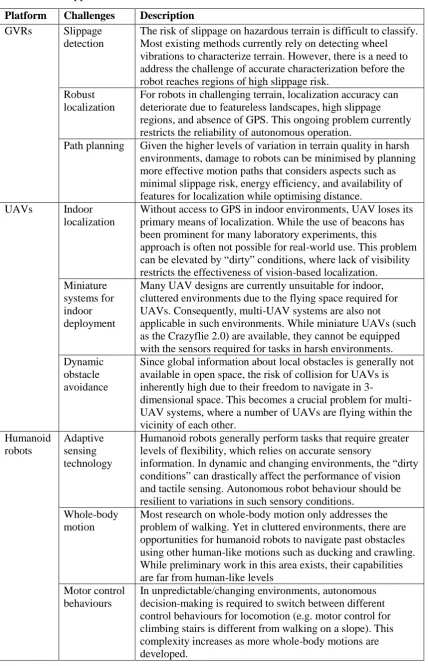
challenges faced by these robots make up a very broad topic on its own and is beyond the scope of this paper. Rather than summarizing all the research challenges, the intention of Table 1 is to give a flavor of the breadth and depth of open problems in the field of RAS for harsh environments.
5. Conclusion
In this paper, a holistic overview of robotic and autonomous systems developed for harsh environments is presented. Many of these environments share common challenges that drive the development of a variety of robot classes. Each class of robots has demonstrated effectiveness in tackling certain kinds of problems, but each application requires specific adaptation of the system to be fit for purpose. Examples of these have been given in this paper for a number of key application areas. From observation, there is a substantial lack of autonomy in many instances. We note that this is a consequence of the complexity of the problem for some robots, and in other cases autonomy has not yet reached a maturity level where reliability and robustness can be proven to meet the high success rates demanded by the task. The authors believe that making advances towards solving these challenges will require considerable effort in field-testing autonomous and intelligent solutions beyond a laboratory and simulation environment before significantly higher levels of autonomy can be realized in real-world applications.
Acknowledgements
This research is funded by the Engineering and Physical Sciences Research Council (EPSRC) under its Doctoral Training Partnership Programme (DTP 2016-2017 University of Strathclyde, Glasgow, UK).
16
Table 1. Research challenges for common classes of robots deployed for harsh environment applications.
Platform Challenges Description
GVRs Slippage
detection
The risk of slippage on hazardous terrain is difficult to classify. Most existing methods currently rely on detecting wheel vibrations to characterize terrain. However, there is a need to address the challenge of accurate characterization before the robot reaches regions of high slippage risk.
Robust localization
For robots in challenging terrain, localization accuracy can deteriorate due to featureless landscapes, high slippage regions, and absence of GPS. This ongoing problem currently restricts the reliability of autonomous operation.
Path planning Given the higher levels of variation in terrain quality in harsh environments, damage to robots can be minimised by planning more effective motion paths that considers aspects such as minimal slippage risk, energy efficiency, and availability of features for localization while optimising distance.
UAVs Indoor
localization
Without access to GPS in indoor environments, UAV loses its primary means of localization. While the use of beacons has been prominent for many laboratory experiments, this
approach is often not possible for real-world use. This problem can be elevated by “dirty” conditions, where lack of visibility restricts the effectiveness of vision-based localization. Miniature
systems for indoor deployment
Many UAV designs are currently unsuitable for indoor, cluttered environments due to the flying space required for UAVs. Consequently, multi-UAV systems are also not
applicable in such environments. While miniature UAVs (such as the Crazyflie 2.0) are available, they cannot be equipped with the sensors required for tasks in harsh environments. Dynamic
obstacle avoidance
Since global information about local obstacles is generally not available in open space, the risk of collision for UAVs is inherently high due to their freedom to navigate in
3-dimensional space. This becomes a crucial problem for multi-UAV systems, where a number of multi-UAVs are flying within the vicinity of each other.
Humanoid robots
Adaptive sensing technology
Humanoid robots generally perform tasks that require greater levels of flexibility, which relies on accurate sensory
information. In dynamic and changing environments, the “dirty conditions” can drastically affect the performance of vision and tactile sensing. Autonomous robot behaviour should be resilient to variations in such sensory conditions.
Whole-body motion
Most research on whole-body motion only addresses the problem of walking. Yet in cluttered environments, there are opportunities for humanoid robots to navigate past obstacles using other human-like motions such as ducking and crawling. While preliminary work in this area exists, their capabilities are far from human-like levels
Motor control behaviours
17
References
Aswath, S., Ajithkumar, N., Tilak, C. K., Saboo, N., Suresh, A., Kamalapuram, R., … Udupa, G. (2015). An intelligent rover design integrated with humanoid robot for alien planet exploration. Advances in Intelligent Systems and Computing (Vol. 345).
Atkeson, C. G., Babu, B. P. W., Banerjee, N., Berenson, D., Bove, C. P., Cui, X., … Xinjilefu, X. (2015). What Happened at the DARPA Robotics Challenge, and Why? Retrieved from https://www.cs.cmu.edu/~cga/drc/jfr-what.pdf
Badger, J., Gooding, D., Ensley, K., Hambuchen, K., & Thackston, A. (2016). ROS in space: A case study on robonaut 2. Studies in Computational Intelligence (Vol. 625).
Barker, L. D. L., & Whitcomb, L. L. (2016). Preliminary survey of underwater robotic vehicle design and navigation for under-ice operations. In IEEE International Conference on Intelligent Robots and Systems (Vol. 2016–Novem).
De Cillis, F., Oliva, G., Pascucci, F., Setola, R., & Tesei, M. (2013). On field gesture-based human-robot interface for emergency responders. In 2013 IEEE
International Symposium on Safety, Security, and Rescue Robotics, SSRR 2013.
DuBose, B. (2017). Drone interest soars: New partnerships aim to expand drone use for maritime asset maintenance and coating inspections. Materials Performance, 56(5), p28-31.
Duran, B., & Thill, S. (2012). Rob’s Robot: Current and Future Challenges for Humanoid Robots. In The Future of Humanoid Robots - Research and Applications. InTech.
English, D. (2015). Improving assetmanagement at process plants through UAV (unmanned aerial vehicle) inspections. In Abu Dhabi International Petroleum Exhibition and Conference. Society of Petroleum Engineers.
18
Gómez, C., & Green, D. R. (2017). Small unmanned airborne systems to support oil and gas pipeline monitoring and mapping. Arabian Journal of Geosciences, 10(9), 202. Grotzinger, J. P., Crisp, J., Vasavada, A. R., Anderson, R. C., Baker, C. J., Barry, R., …
Wiens, R. C. (2012). Mars science laboratory mission and science investigation. Space Science Reviews, 170(1–4), 5–56.
Hornung, A., Bottcher, S., Schlagenhauf, J., Dornhege, C., Hertle, A., & Bennewitz, M. (2014). Mobile manipulation in cluttered environments with humanoids: Integrated perception, task planning, and action execution. In 2014 IEEE-RAS International Conference on Humanoid Robots (pp. 773–778). IEEE.
Khan, W. Z., Aalsalem, M. Y., Gharibi, W., & Arshad, Q. (2016). Oil and Gas
monitoring using Wireless Sensor Networks: Requirements, issues and challenges. In 2016 International Conference on Radar, Antenna, Microwave, Electronics, and Telecommunications (ICRAMET) (pp. 31–35). IEEE.
Khatib, O., Yeh, X., Brantner, G., Soe, B., Kim, B., Ganguly, S., … Creuze, V. (2016). Ocean one: A robotic avatar for oceanic discovery. IEEE Robotics and Automation Magazine, 23(4).
Knukkel, D. (2017). Deploying Drones for Maintenance Strategies: Elios Drone Performs Remote Inspection. Sea Technology, 58(4), p41-42.
Mazzini, F., & Dubowsky, S. (2014). An experimental validation of robotic tactile mapping in harsh environments such as deep sea oil well sites (pp. 557–570). Springer Berlin Heidelberg. https://doi.org/10.1007/978-3-642-28572-1_38 Schwarz, M., Rodehutskors, T., Droeschel, D., Beul, M., Schreiber, M., Araslanov, N.,
… Behnke, S. (2017). NimbRo rescue: Solving disaster-response tasks with the mobile manipulation robot Momaro. Journal of Field Robotics, 34(2).
Shukla, A., & Karki, H. (2016). Application of robotics in onshore oil and gas industry—A review Part I. Robotics and Autonomous Systems, 75, 490–507. Shukla, A., Xiaoqian, H., & Karki, H. (2016). Autonomous tracking of oil and gas
19
Symposium on Circuits and Systems (MWSCAS) (pp. 1–4). IEEE.
Silvagni, M., Tonoli, A., Zenerino, E., & Chiaberge, M. (2016). Multipurpose UAV for search and rescue operations in mountain avalanche events. Geomatics, Natural Hazards and Risk, 1–16.
Staudinger, E., Zhang, S., Dammann, A., & Zhu, C. (2014). Towards a radio-based swarm navigation system on mars Key technologies and performance assessment. In 2014 IEEE International Conference on Wireless for Space and Extreme Environments (WiSEE) (pp. 1–7). IEEE.
Tan, Y., & Zheng, Z. (2013). Research Advance in Swarm Robotics. Defence Technology, 9(1), 18–39.
Tanaka, T., Matsuo, T., Fuji, H., & Takimoto, T. (2016). Development of quad-rotor type underwater robot for fixed-point observation. In Autonomous Underwater Vehicles 2016, AUV 2016.
Waharte, S., & Trigoni, N. (2010). Supporting search and rescue operations with UAVs. In 2010 International Conference on Emerging Security Technologies (pp. 142– 147). IEEE.
Wu, D., Chatzigeorgiou, D., Youcef-Toumi, K., & Ben-Mansour, R. (2016). Node localization in robotic sensor networks for pipeline inspection. IEEE Transactions on Industrial Informatics, 12(2), 809–819.
Wu, Y., Noel, A., Kim, D. D., Youcef-Toumi, K., & Ben-Mansour, R. (2015). Design of a maneuverable swimming robot for in-pipe missions. In 2015 IEEE/RSJ International Conference on Intelligent Robots and Systems (IROS) (pp. 4864– 4871). IEEE.
Yaguchi, H., Sasabuchi, K., Chan, W. P., Nagahama, K., Saiki, T., Shiigi, Y., & Inaba, M. (2015). A design of 4-legged semi humanoid robot aero for disaster response task. In 2015 IEEE-RAS 15th International Conference on Humanoid Robots (Humanoids) (pp. 61–66). IEEE.
20
Development of a stable localized visual inspection system for underwater structures. Advanced Robotics, 30(21).
Yliniemi, L., Agogino, A. K., & Tumer, K. (2014). Multirobot coordination for space exploration. AI Magazine, 35(4).
Yoshida, H., Ishibashi, S., Yutaka, O., Sugesawa, M., & Tanaka, K. (2016). A concept design of underwater docking robot and development of its fundamental
technologies. In Autonomous Underwater Vehicles 2016, AUV 2016.
Yoshida, K. (2009). Achievements in space robotics. IEEE Robotics & Automation Magazine, 16(4), 20–28.
Author Bio
Mr Cuebong Wong is a PhD researcher in Robotics and Autonomous Systems at the University of Strathclyde. He is researching novel strategies for robotic control through the study of dynamic interactions between robots and their environments, funded by EPSRC DTP scheme. Currently this involves development work relating to intelligent and adaptive path planning and control of wheeled mobile robots. Here machine learning techniques are integrated with on-board sensory information such as vision systems and proprioceptive sensors to realize robust and autonomous behaviour in robot systems operating in challenging environments that are dynamic, unknown, uncertain, unstructured and/or hazardous.
21
investigation of process information required to create an autonomous forging system, and the development of a smart and flexible automation system for high value cake manufacturing.
Prof Xiu-Tian Yan is a senior lecturer and the Director of the Space Mechatronic Systems Technology Laboratory (SMeSTech), DMEM, University of Strathclyde. Previously, he wsa a Research Associate at Engineering Design centre, Lancaster University. He received his PhD from Loughborough University of Technology in 1992. His research interests include computer support mechatronic product design using AI techniques, knowledge-intensive product modelling and simulation, design synthesis for lifecycle phases and mechatronic systems design. He has published over 150 papers in international journals and conferences in these fields and managed over 20 research projects. He is Vice Chairman of the Mechatronics Forum – an international mechatronics organization sponsored by the Institution of Mechanical Engineers. He is a Fellow of the Institution of Mechanical Engineers and a Chartered Engineer.