R E S E A R C H
Open Access
Trials directly comparing alternative
spontaneous breathing trial techniques: a
systematic review and meta-analysis
Karen E. A. Burns
1,2,3, Ibrahim Soliman
1,2, Neill K. J. Adhikari
2,4, Amer Zwein
,1,2, Jessica T. Y. Wong
5,
Carolina Gomez-Builes
1,2, Jose Augusto Pellegrini
6,7, Lu Chen
1,2, Nuttapol Rittayamai
1,2, Michael Sklar
1,2,
Laurent J. Brochard
1,2and Jan O. Friedrich
1,2*Abstract
Background:The effect of alternative spontaneous breathing trial (SBT) techniques on extubation success and other clinically important outcomes is uncertain.
Methods:We searched MEDLINE, EMBASE, CENTRAL, CINAHL, Evidence-Based Medicine Reviews, Ovid Health Star,
proceedings of five conferences (1990–2016), and reference lists for randomized trials comparing SBT techniques in intubated adults or children. Primary outcomes were initial SBT success, extubation success, or reintubation. Two reviewers independently screened citations, assessed trial quality, and abstracted data.
Results:We identified 31 trials (n= 3541 patients). Moderate-quality evidence showed that patients undergoing pressure support (PS) compared with T-piece SBTs (nine trials,n= 1901) were as likely to pass an initial SBT (risk ratio (RR) 1.00, 95% confidence interval (CI) 0.89–1.11;I2= 77%) but more likely to be ultimately extubated successfully (RR 1.06, 95% CI 1.02–1.10; 11 trials,n= 1904;I2= 0%). Exclusion of one trial with inconsistent results for SBT and extubation outcomes suggested that PS (vs T-piece) SBTs also improved initial SBT success (RR 1.06, 95% CI 1.01–1.12; I2= 0%). Limited data suggest that automatic tube compensation plus continuous positive airway pressure (CPAP) vs CPAP alone or PS increase SBT but not extubation success.
Conclusions:Patients undergoing PS (vs T-piece) SBTs appear to be 6% (95% CI 2–10%) more likely to be extubated successfully and, if the results of an outlier trial are excluded, 6% (95% CI 1–12%) more likely to pass an SBT. Future trials should investigate patients for whom SBT and extubation outcomes are uncertain and compare techniques that maximize differences in support.
Keywords:Weaning, Spontaneous breathing trial, Extubation, Systematic review, Meta-analysis, Extubation
outcome
Background
Weaning accounts for approximately 40% of the time spent on mechanical ventilation [1, 2]. Compared with nonprotocolized care, randomized controlled trials (RCTs) and a systematic review indicate that weaning protocols reduce the duration of mechanical ventilation, weaning time, and intensive care unit (ICU) length of stay (LOS)
[3, 4]. After identification, patients may undergo a spon-taneous breathing trial (SBT) to assess their ability to breathe spontaneously with minimal or no support.
Clinicians conduct SBTs to facilitate decision-making regarding timely extubation and to minimize patients’ exposure to invasive ventilation. In making decisions, clinicians ‘trade off’ the risks associated with delayed extubation and those associated with a premature failed attempt at extubation. Several techniques are commonly used to conduct SBTs, including pressure support (PS) with or without positive end-expiratory pressure (PEEP), continuous positive airway pressure (CPAP), automatic * Correspondence:[email protected]
1
St Michael’s Hospital and the Keenan Research Centre/Li Ka Shing Knowledge Institute, 30 Bond Street, Toronto, ON M5B 1W8, Canada 2Interdepartmental Division of Critical Care, University of Toronto, Toronto, ON, Canada
Full list of author information is available at the end of the article
tube compensation (ATC), and the T-piece. Whereas some SBT techniques deliver pressure during inspiration to overcome endotracheal tube resistance (e.g., PS, ATC), other techniques aim to improve respiratory mechanics or cardiac function (e.g., CPAP) and may overestimate pa-tients’ ability to breathe autonomously after extubation [5]. Conversely, the T-piece provides no support, is per-ceived to increase work of breathing (WOB), and may underestimate patients’ ability to breathe spontaneously after extubation [5]. The most recent American College of Chest Physicians/American Thoracic Society Clinical Practice Guidelines [6] support that an SBT is the major diagnostic test to determine whether patients can be extu-bated but give only a conditional (weak) recommendation that PS SBTs should be used as the initial SBT, based on limited data (three or four included RCTs).
A Cochrane review of nine trials compared PS and
T-piece ‘weaning’ in adults and found nonsignificant
differences between techniques on weaning success, pneumonia, reintubation, ICU mortality, and LOS. In a subgroup analysis (four trials, n= 940) the authors noted that patients were significantly more likely to pass a PS SBT vs a T-piece SBT (risk ratio (RR) 1.09, 95% confidence interval (CI) 1.02–1.17) [7]. This review did not directly compare alternative SBT techniques and was limited to full publications of adults. At present, no SBT technique has been shown to be superior to another.
We sought to summarize the RCT evidence directly comparing all alternative SBT techniques involving critically ill adults and children on initial SBT success, extubation success, reintubation rate (primary outcomes), and other important outcomes.
Methods Data sources
We searched MEDLINE (1966–February 2017), EMBASE (1980–February 2017), the Cochrane Central Register of Controlled Trials (CENTRAL, February 2017), CINAHL (1982–February 2017), evidence-based medicine reviews, and Ovid Health Star (1999–February 2017) to identify potentially eligible trials using database-specific search strategies without language restrictions. We used the opti-mally sensitive search strategies of The Cochrane Collab-oration for MEDLINE and EMBASE [8–10]. Two authors (KEAB, JOF) independently screened citation titles and abstracts and evaluated full-text versions of potentially relevant trials. Five authors hand-searched conference proceedings of five scientific meetings from 1990–2016: European Society of Intensive Care Medicine, American College of Chest Physicians (except 1999–2002, unavail-able), American Thoracic Society, International Sympo-sium of Intensive Care and Emergency Medicine, and Society of Critical Care Medicine (including 2017 for the latter). Ethics approval was not required.
Study selection
We included randomized or quasi-randomized trials comparing two or more SBT techniques in critically ill adults or children reporting at least one of initial SBT or extubation outcome (success or failure), reintubation, time to extubation or successful extubation, time to first successful SBT, mortality, ventilator-associated pneumo-nia (VAP), total duration of ventilation, ICU or hospital LOS, postextubation use of noninvasive ventilation (NIV), or adverse events using authors’ definitions. We excluded trials that evaluated: neonatal or tracheostomized patients; SBTs as part of a weaning strategy; automated SBTs (e.g., SmartCare™, Intellivent®); NIV vs continued in-vasive ventilation; and SBT conduct vs no SBT. Two au-thors (KEAB, JOF) independently selected trials meeting inclusion criteria, and another author (LJB) adjudicated differences.
Data extraction and quality assessment
Two unblinded authors (KEAB, JOF) abstracted data regarding the study risk of bias (RoB) (randomization, allocation concealment, blinded outcomes assessment, completeness of follow-up, selective outcomes report-ing, stopping early for benefit) and recorded outcomes, using authors’ definitions for reported outcomes, on a standardized form [11]. We evaluated RoB (yes, unclear, no) for each domain. Disagreements were resolved by con-sensus and arbitration with a third author (LJB).
Data synthesis
We pooled data across studies using random effects models. We derived summary estimates of RR and mean difference (MD) with 95% CI for binary and continuous outcomes, respectively, using Review Manager 5.3 (Cochrane Collaboration, Oxford, UK) [12]. We pooled ‘initial SBT success’ in trials that conducted more than one SBT. We evaluated statistical heterogeneity for each outcome using the I2measure with thresholds of 0–40% (might not be important), 30–60% (moderate), 50–90% (substantial), and >75% (considerable) [13, 14]. We sum-marized trials based on the techniques compared (e.g., T-piece vs other) (Additional file 1).
We planned subgroup analyses to compare the effects of different techniques on primary outcomes in periopera-tive vs nonperioperaperiopera-tive trials and based on: duration of ventilation at randomization (nonperioperative trials); the support provided during SBTs; the type of lung disease; and methodologic quality (low/moderate vs high RoB). We assessed for subgroup differences using the chi-square test [15].
We assessed for publication bias when at least 10 trials were identified [17]. A written protocol was used to guide the review process.
Results
Trial identification
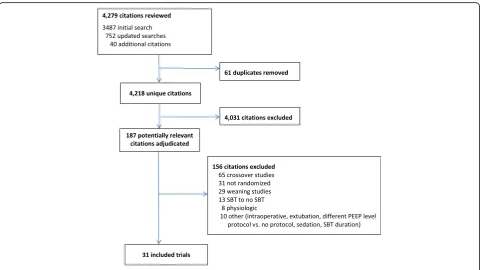
[image:3.595.58.541.448.718.2]We identified 4218 unique citations. We assessed 187 articles for eligibility and excluded 156 studies (Fig. 1). Thirty-one trials [18–48] reporting on 3541 patients met our inclusion criteria including five trials comparing three SBT techniques [23, 24, 29, 30, 48]. Two trials [38, 46] appeared to be published, at least in part, in duplicate [49, 50]. The most common comparisons were T-piece vs PS (13 trials), T-piece vs CPAP (nine trials), PS vs ATC (three trials), and CPAP vs ATC (three trials). Four trials [21, 34, 38, 40] were not published in English. Six trials [25, 27, 33, 36, 45, 47] were published as abstracts, of which two [36, 47] provided partial or full-text manu-scripts. Nine trials [19–21, 23–25, 44, 45, 47] evaluated perioperative populations (six cardiac surgical [19–21, 24, 25, 44] and three other surgical [23, 45, 47]). Three trials [28, 43, 46] evaluated pediatric patients.
Quality assessment
We judged randomization and allocation concealment to be at low RoB in 16 (52%) trials and 17 (55%) trials, re-spectively. One quasi-randomized trial allocated patients based on even or odd days [34]. No trial evaluated out-comes in a blinded manner. We judged 15 (48%) trials
to have complete outcomes reporting. Eighteen (58%) trials conducted an intention-to-treat analysis and 26 (84%) trials did not stop early for benefit. Overall trial quality was moderate (Additional file 2: Figure S1).
Primary outcomes
Initial SBT success
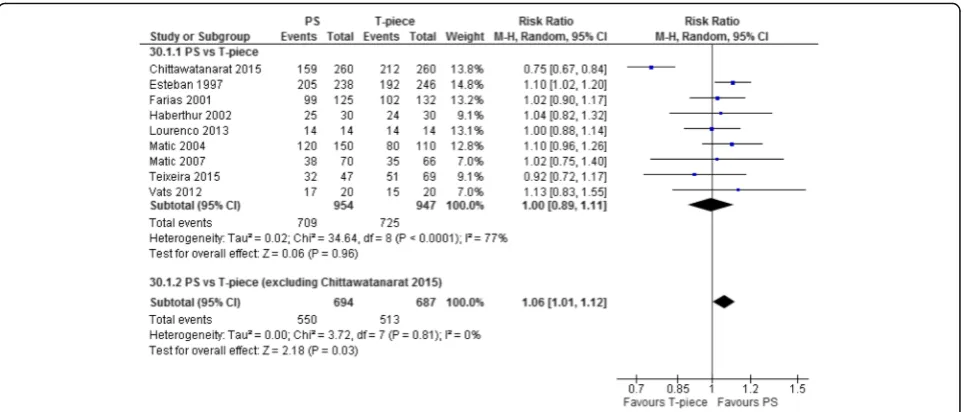
Seventeen T-piece, 12 CPAP, eight ATC, and 13 PS trials directly compared one SBT technique with another and reported initial SBT success (Table 1). Compared with T-piece SBTs, moderate-quality evidence supports that patients undergoing PS SBTs were not more likely to pass an SBT (RR 1.00, 95% CI 0.89–1.11; p= 1.0; nine trials,n= 1901) with considerable heterogeneity (I2= 77%) (Table 2, Fig. 2, Additional file 3: Figure S2).
Low-quality evidence from three trials (n= 247) sug-gests that patients were significantly more likely to pass an SBT with ATC + CPAP compared with CPAP alone (RR 1.12, 95% CI 1.04–1.22;p= 0.005,I2= 0%). Similarly, low-quality evidence from three trials (n= 276) showed that patients were significantly more likely to pass an SBT with ATC + CPAP compared with PS (RR 1.10, 95% CI 1.01–1.20;p= 0.02,I2= 0%) (Table 3).
Extubation success
Seventeen T-piece, eight CPAP, eight ATC, and 14 PS trials compared one SBT technique with another and re-ported extubation success (Table 1). Moderate-quality evidence supports that patients undergoing PS compared
Table 1Characteristics of included trials
Author and year Interventions Country Publication
Type
Population Duration of ventilation at inclusion
Feeley 1975 [18] (n= 25)
T-piece/PEEP 5 cmH2O vs T-piece USA Full Adult Not reported
Hastings 1980 [19] (n= 18)
IMV/CPAP 5 cmH2O vs T-piece/CPAP 5 cmH2O USA Full Adult Perioperative
Prakash 1982 [20] (n= 28)
IMV vs SVT (on ventilator) The Netherlands Full Adult Perioperative
Koller 1983 [21] (n= 45)
CPAP 10 cmH2O vs T-piece/ZEEP Austria Full Adult Perioperative
Jones 1991 [22] (n= 106)
CPAP 5 cmH2O vs T-piece/ZEEP USA Full Adult Not reported
Abalos 1992 [23] (n= 62)
SIMV vs CPAP 4 cmH2O vs T-piece USA Full Adult Perioperative
Bailey 1995 [24] (n= 82)
T-pieceavs CPAP 5 cmH2O vs CPAP 10 cmH2O England Full Adult Perioperative
Schinco 1995 [25] (n= 30)
PS 5 cmH2O/CPAP 5 cmH2O vs CPAP 5 cmH2O USA Abstract Adult Perioperative
Esteban 1997 [26] (n= 484)
T-piece vs PS 7 cmH2O Spain and South
America
Full Adult >48 hours
Holanda 2000 [27] (n= 35)
T-piece vs PS Brazil Abstract Adult >48 hours
Farias 2001 [28] (n= 257)
T-piece vs PS 10 cmH2O ± PEEP 5 cmH2O Argentina Full Pediatric >48 hours
Haberthur 2002 [29] (n= 90)
PS 5 cmH2O/PEEP 5 cmH2O vs ATC/PEEP 5 cmH2O vs T-piece
Switzerland Full Adult >24 hours
Koksal 2004 [30] (n= 60)
PS < 10 cmH2O/PEEP < 5 cmH2O vs CPAP < 5 cmH2O vs T-piece
Turkey Full Adult >48 hours
Matic 2004 [31] (n= 260)
T-piece vs PS 8 cmH2O Croatia Full Adult >48 hours
Cohen 2006 [32] (n= 99)
ATCb/CPAP 5 cmH2O vs CPAP 5 cmH2O Israel Full Adult >24 hours
Liang 2006 [33] (n= 97)
ATC vs T-piece Taiwan Abstract Adult >4 days
Colombo 2007 [34] (n= 120)
T-piece vs PS 7 cmH2O/PEEP 5 cmH2O Brazil Full Adult >48 hours
Matic 2007 [35] (n= 136)
T-piece vs PS (not specified) Croatia Full Adult >24 hours
Fayed 2008 [36] (n= 30)
ATCb/CPAP 5 cmH2O vs CPAP 5 cmH2O Egypt Abstract Adult >24 hours
Cohen 2009 [37] (n= 180)
ATCb/CPAP 5 cmH2O vs PS 7 cmH2O/CPAP 5 cmH2O
Israel Full Adult >24 hours
Zhang 2009 [38] (n= 208)
T-piece vs PS 5 cmH2O/PEEP 5 cmH2O China Full Adult Not reported
Figueroa-Casas 2010 [39] (n= 122)
ATCb/PEEP 5 cmH2O vs CPAP 5 cmH2O USA Full Adult >24 hours
Molina-Saldarriaga 2010 [40] (n=50)
CPAPcvs T-piece Colombia Full Adult >48 hours
Cekman 2011 [41] (n= 40)
CPAP < 5 cmH2O vs T-piece Turkey Full Adult >48 hours
Vats 2012 [42] (n= 40)
T-piece vs PS 7 cmH2O India Full Adult Not reported
El-beleidy 2013 [43] (n= 36)
ATCb/CPAP 5 cmH2O vs PS 6–10 cmH2O/CPAP 5 cmH2O
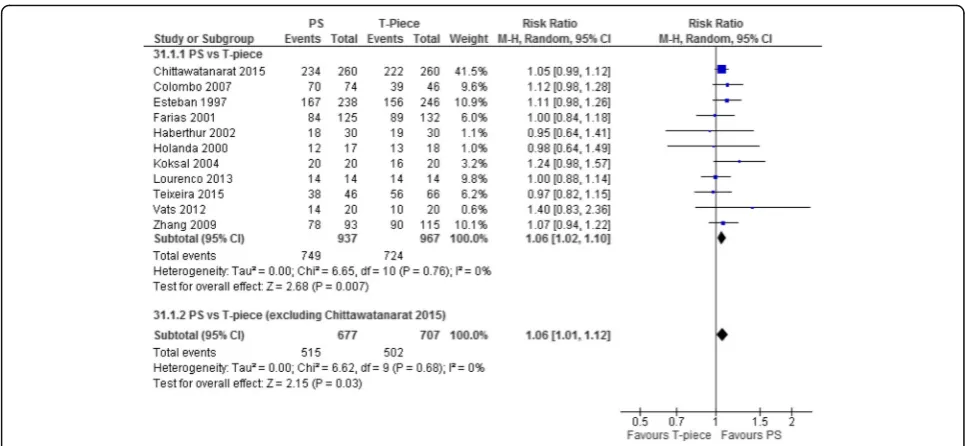
with T-piece SBTs were significantly more likely to be extu-bated successfully (RR 1.06, 95% CI 1.02–1.10;p= 0.007; 11 trials, n= 1904; I2= 0%) (Table 2, Fig. 3, Additional file 4: Figure S3).
Reintubation rate
Fourteen T-piece, nine CPAP, seven ATC, and 13 PS trials comparing one SBT technique with another reported the reintubation rate and found no statistically significant differences between techniques (Table 1, Additional file 5: Figure S4).
Secondary outcomes
There was no effect of one SBT technique vs another on ICU mortality (seven T-piece, three CPAP, and five PS trials), hospital mortality (four T-piece and four PS trials), or the most protracted mortality measure (10 T-piece, four CPAP, and seven PS trials).
No trial reported time to extubation or time to suc-cessful extubation. Meta-analysis of three trials compar-ing ATC + CPAP with CPAP alone found no difference in NIV use after extubation (RR 0.53, 95% CI 0.27–1.06; p= 0.07,I2= 0%).
Sensitivity, subgroup, and post-hoc analyses
Exclusion of a single quasi-randomized trial comparing PS vs T-piece SBTs [34] did not change the significant increase in extubation success favoring PS SBTs (RR 1.05, 95% CI 1.01–1.10;p= 0.02,I2= 0%).
[image:5.595.56.537.101.216.2]Meta-analyses of PS vs T-piece SBTs showed benefit in seven nonperioperative trials (n= 1273; RR 1.07, 95% CI 1.01–1.13; p= 0.02, I2= 94%) (high-quality evidence) compared with two perioperative trials (n= 548; RR 0.86, 95% CI 0.61–1.22; p= 0.41, I2= 0%) (low-quality evi-dence); however, an interaction test showed no difference between these summary estimates (p= 0.23) (Additional file 6: Table S1, Additional file 7: Figure S5). Subgroup analyses based on duration of ventilation among nonper-ioperative trials was not feasible given similar reported du-rations of ventilation. Subgroup analyses comparing more vs less inspiratory support and type of lung disease were not significant for commonly reported comparisons of alternative techniques. A sensitivity analysis was not pos-sible due to the absence of blinded outcomes assessment across trials. Inspection of a funnel plot for 11 trials com-paring PS with T-piece SBTs on extubation success did not suggest publication bias.
Table 2Summary of findings: PS vs T-piece SBTs on SBT and extubation success Outcome Illustrative comparative risksa(95% CI) Risk ratio
(95% CI)
Number of participants (trials)
Quality of evidence (GRADE)
Assumed risk, T-piece Corresponding risk, pressure support
PS vs T-piece SBTs on SBT success
Study population 1.00 (0.89–1.11) 1901 (9 trials) ⊕ ⊕ ⊕⊝moderateb
766 per 1000 766 per 1000 (681–850)
PS vs T-piece SBTs on extubation success
Study population 1.06 (1.02–1.1) 1904 (11 trials) ⊕ ⊕ ⊕⊝moderatec
749 per 1000 794dper 1000 (764–824)
PSpressure support,CIconfidence interval,SBTspontaneous breathing trial,GRADEGrading of Recommendations Assessment, Development and Evaluation, NNTnumber needed to treat
a
The assumed risk is based on the median control group risk across studies. The corresponding risk (and its 95% CI) is based on the assumed risk in the comparison group and the relative effect of the intervention (and its 95% CI). NNT is 1000/(794–749) = 22 (95% CI 13–67)
b
The Chittawatanarat [47] trial skews data, increases heterogeneity, and changes summary estimate of effect. It also changes our interpretation of the findings c
Methodologic concerns with the Colombo trial (quasi-randomized) [34]; this trial carries 10% weight in the pooled extubation outcome meta-analysis d
Corresponds to NNT of 794–749 = 45 or 1000/45 = 22 (95% CI 13–67)
Table 1Characteristics of included trials(Continued)
Lourenco 2013 [44] (n= 30)
T-piece vs PS (not specified) Brazil Full Adult Perioperative
Sherif 2013 [45] (n= 100)
PS (not specified) vs PS/ATC Egypt Abstract Adult Not reported
Bilan 2015 [46] (n= 51)
CPAP vs T-piece Iran Full Pediatric Not reported
Chittawatanarat 2015 [47] (n= 520)
T-piece vs PS 7 cmH2O/PEEP < 5 cmH2O Thailand Abstract Adult >12 hours
Teixeira 2015 [48] (n= 160)
PS 7 cmH2O/PEEP 5–8 cmH2O vs PAV+/PEEP 5–8 cmH2O vs T-piece
Brazil Full Adult >24 hours
PEEPpositive end-expiratory pressure,IMVintermittent mandatory ventilation,CPAPcontinuous positive airway pressure,SVTspontaneous ventilation trial, ZEEPzero end-expiratory pressure,SIMVsynchronized intermittent mandatory ventilation,PSpressure support,ATCautomatic tube compensation;PAV+ proportional assist ventilation with load adjustable gain factors
a
T-piece with CPAP 0 cmH2O b
ATC with 100% compensation c
[image:5.595.57.539.585.671.2]We conducted a post-hoc analysis that excluded a sin-gle, surgical trial [47] which enrolled surgical patients, was published in abstract form only, and had internally inconsistent results (i.e., lower initial SBT success rate but higher extubation success rate for PS vs T-piece SBTs). When this trial was excluded, meta-analyses showed that more patients passed an initial PS (vs T-piece) SBT (RR 1.06, 95% CI 1.01–1.12;p= 0.03) without heterogeneity (I2= 0%) and were similarly extubated suc-cessfully (RR 1.06, 95% CI 1.01–1.12; p= 0.03, I2= 0%). Excluding each of the other RCTs in a full leave-one-study-out analysis did not result in significant changes to the pooled effect estimate for SBT success (pooled RR range, 0.98–1.01) or heterogeneity (I2 range, 77–80%)
suggesting that only a single trial [47] was an outlier for this outcome. In a similar analysis for extubation suc-cess, the pooled RR ranged from 1.05 to 1.07 and remained statistically significant with no heterogeneity (I2= 0%) regardless of which RCT was removed, suggest-ing that no trial was an outlier or disproportionately influenced the extubation success summary estimate.
Discussion
We identified 31 trials of overall moderate quality reporting on 3541 patients. Moderate-quality evidence supported that SBT success rates were similar with PS and T-piece, with substantial heterogeneity. However, post-hoc exclusion of an unpublished trial [47] with in-consistent results eliminated the heterogeneity and showed that SBT success was 6% more likely with PS SBTs. Meta-analysis also showed a 6% higher probability of successful extubation following PS (vs T-piece) SBTs, with no heterogeneity, irrespective of this trial’s inclusion [47]. Although a 6% relative improvement in probability of successful extubation may appear small, it corre-sponds to a clinically important number needed to treat of 22 (95% CI 13–67) when the baseline risk of extuba-tion success is 75% (Table 2). Low-quality evidence from three trials indicated that patients were 12% more likely to pass an SBT with ATC + CPAP/PEEP compared with CPAP and were 10% more likely to pass an SBT with ATC + CPAP/PEEP compared with PS, although extuba-tion success rates were similar. We found no differences between alternative SBT techniques on reintubation rate or mortality, although CIs were wide. Subgroup analysis suggested beneficial effects of PS vs T-piece SBTs on SBT success in seven nonperioperative trials (high-qual-ity evidence) compared with two perioperative trials (low-quality evidence), but the RRs were not statistically dissimilar.
[image:6.595.58.541.87.293.2]Most trials directly compared T-piece with PS SBTs (13 trials) and T-piece with CPAP SBTs (nine trials). Very few trials assessed alternative SBT techniques in children. Most trials (n= 22) were conducted in patients who were nonperioperative and for whom extubation Fig. 2Forest plot comparing effect of SBT technique (PS vs T-piece) on SBT success. The pooled risk ratio with 95% confidence interval (CI) was calculated using a random effects model. Weight refers to the contribution of each study to the overall estimate of treatment effect.PSpressure support
Table 3Summary estimates of effect for comparisons of ATC vs other techniques on SBT success
Comparison Trials Risk ratio (95% CI) pvalue I2(%)
ATC/CPAP vs CPAP 3 (n= 247) 1.12 (1.04–1.22) 0.005 0
ATC/CPAP vs PS 3 (n= 276) 1.10 (1.01–1.20) 0.02 0
ATC vs T-piece 2 (n= 157) 1.03 (0.76–1.42) 0.83 81
ATC/PS vs PS 1 (n= 100) 1.04 (0.94–1.15) 0.40 NA
ATCautomatic tube compensation,CPAPcontinuous positive airway pressure, PSpressure support,CIconfidence interval,I2
[image:6.595.58.291.636.707.2]decisions are considered more challenging. In pooling outcomes, we noted that five of six cardiac surgery trials reported a 100% SBT success rate in both arms and three surgical trials reported a 100% extubation success rate in both arms. These findings suggest that the most important question in postoperative patients with a high pretest probability of SBT and extubation success may be whether an SBT is necessary and that questions regarding the best SBT technique to use may be most relevant to patients at indeterminate or low pretest probability of success.
Our systematic review differs from two previous reviews by directly comparing SBT techniques and excluding trials evaluating SBT techniques as one component of a wean-ing strategy [7, 51]. Moreover, we hand-searched confer-ence proceedings spanning 26 years, where feasible, and included pediatric trials. Compared with the Cochrane re-view of nine trials [7], we included nine additional trials (one pediatric trial [28], four adult trials [34, 38, 42, 44], two abstracts [27, 47], and two three-arm trials [30, 48]) comparing T-piece and PS SBTs and excluded four wean-ing trials [52–55]. Contrary to their findwean-ings, we found that patients were only more likely to pass a PS (vs T-piece) SBT after exclusion of a single outlier trial [47] but were significantly more likely to be extubated suc-cessfully. This finding remained significant after exclu-sion of a single pediatric trial [28]. Compared with a recent meta-analysis of 12 trials [51], we included five additional trials (one pediatric trial [28], three adult trials [34, 42, 48] including a three-arm trial [48], and an abstract [27]) and excluded four trials involving
weaning or tracheostomized patients [52, 53, 55, 56]. Similar to their review, we found that the SBT technique did not influence rates of weaning success, mortality, or reintubation.
[image:7.595.56.539.86.309.2]difficult airway) when clinicians are uncertain regard-ing their ability to breathe on their own and when they prioritize a low false positive rate for passing an SBT and being extubated successfully due to the risks asso-ciated with extubation failure [59]. Conversely, when T-piece (vs PS) SBTs are used in patients with a high likelihood of extubation success, they may induce a high false negative rate. Compared with T-piece SBTs, our review may suggest that PS SBTs facilitate extuba-tion decision-making. Even if PS SBTs underestimate postextubation WOB, their successful completion may offset clinician reluctance to extubate, resulting in more timely and successful extubation without in-creased reintubation [60, 61]. This may be the primary reason why PS SBTs result in both higher SBT and extubation success rates; otherwise one might expect a test that underestimates postextubation WOB to yield a higher SBT success rate followed by a higher reintu-bation rate. However, reintureintu-bation may be related not only to SBT technique and outcome but also to extu-bation readiness and new and concomitant illnesses. Furthermore, compared with T-piece SBTs, PS SBTs do not require that clinicians assemble a T-piece cir-cuit or disconnect the patient from the ventilator or its alarms, and permit application of PEEP that reduces the potential for loss of lung aeration immediately prior to extubation. Although passing an initial SBT is an import-ant outcome, patients may undergo serial SBTs before extubation, and stakeholders prioritize being extubated successfully [62].
Several additional findings warrant commentary. First, few trials reported use of daily screening or the criteria used to identify SBT candidates and assess extubation readiness. Second, we noted wide variation in initial SBT success rates across trials comparing PS (range, 54.3–
100.0%) with T-piece (range, 53.0–100.0%) SBTs and
comparing ATC + CPAP (range, 64.7–96.7%) with PS (range, 52.6–86.0%) SBTs, and, similarly, broad variation in extubation success rates comparing PS (range, 60.0– 100.0%) with T-piece (range, 50.0–100.0%) SBTs. Con-versely, we noted higher SBT success rates in three trials
comparing ATC and CPAP (range, 93.3–96.6%) with
CPAP alone (range, 80.0–86.7%). While SBT and extuba-tion summary estimates differed quantitatively across comparisons, qualitatively the direction of effect favored SBTs conducted with inspiratory support. Third, only eight trials [25, 28–30, 34, 37, 38, 43] specified addition of CPAP (or PEEP) to PS during SBTs. Fourth, trials were predominantly of moderate quality. Finally, al-though we included pediatric trials, we only identified three such trials. Because each pediatric trial compared different techniques (T-piece vs PS + PEEP [28], ATC/ CPAP vs PS/CPAP [43], and CPAP vs T-piece [46]) our ability to compare outcomes in children vs adults was
limited. Results for the pediatric trials were not different from the pooled results of the adult trials for any of the outcomes (interaction pvalues all nonsignificant; results not shown).
Our review is the first to directly compare alternative SBT techniques and was strengthened by an extensive search, duplicate citation screening and data abstraction, use of random effects models to pool data, and conduct of prespecified subgroup analyses. Our review also has limitations. Included trials were predominantly of mod-erate quality with no trial conducting blinded outcomes assessment and summary estimates were limited by vari-able outcomes reporting and unclear prospective follow-up. Statistical noise could be minimized if SBT techniques were applied serially until extubation and if extubation was restricted to patients who passed an SBT. Only five trials, all comparing PS with T-piece SBTs, reported con-ducting SBTs daily [31, 35], daily up to 3 days [29, 48], or for an undisclosed time [38]. Despite subgroup analyses, we cannot fully elucidate the impact of pretest probability of SBT or extubation success on the effect of SBT as pa-tients at intermediate or high likelihood of SBT and
extu-bation success dominated the analysis. The
implications of our findings for patients with low pre-test probability remain uncertain. Finally, our ability to as-sess the impact of other factors (e.g., pre-randomization duration of ventilation, type of ICU, presence of dedi-cated respiratory care personnel) in subgroup analyses was constrained by small numbers of trials and variable and limited reporting. Furthermore, SBT durations were variable. Two RCTs randomizing patients to 30 vs 120 minutes duration of T-piece [63] or PS [64] SBTs found nonsignificant differences in SBT and extubation success rates. In addition, a very recent multicenter RCT published only in abstract form [65] suggests that reventilating patients for 1 hour after a successful SBT may increase successful extubation rates.
Conclusion
Patients undergoing PS vs T-piece SBTs appear to be 6% (95% CI 2–10%,) more likely to be extubated successfully, and, if the results of an outlier trial are excluded, are 6% (95% CI 1–12%) more likely to pass an SBT. PS SBTs were not associated with an increased risk of reintubation or mortality, but CIs were wide.
Additional files
Additional file 1:Additional methods, results, and discussion. (DOCX 15 kb)
Additional file 2: Figure S1.Risk of bias for the included trials. (DOCX 30 kb)
Additional file 4: Figure S3.Forest plot comparing PS vs other techniques on extubation success. (DOCX 42 kb)
Additional file 5: Figure S4.Forest plot comparing SBT technique (PS vs other technique) on reintubation. The pooled risk ratio with 95% CI was calculated using a random effects model. Weight refers to the contribution of each study to the overall estimate of treatment effect. (DOCX 40 kb)
Additional file 6: Table S1.Summary of findings for PS vs T-piece SBTs on SBT success based on pretest probability. (DOCX 16 kb)
Additional file 7: Figure S5.Subgroup analysis: forest plot comparing PS vs T-piece on SBT success based on pretest probability. (DOCX 30 kb)
Abbreviations
ATC:Automatic tube compensation; CI: Confidence interval; CPAP: Continuous positive airway pressure; GRADE: Grading of
Recommendations Assessment, Development and Evaluation; ICU: Intensive care unit; LOS: Length of stay; MD: Mean difference; NIV: Noninvasive ventilation; PEEP: Positive end-expiratory pressure; PS: Pressure support; RCT: Randomized controlled trial; RoB: Risk of bias; RR: Risk ratio; SBT: Spontaneous breathing trial; VAP: Ventilator-associated pneumonia; WOB: Work of breathing
Acknowledgements
This manuscript was presented in abstract form at the annual assembly of the American Thoracic Society (2016). The authors wish to thank Mr David Lightfoot (librarian, St. Michael’s Hospital) for his assistance in conducting the original and updated literature searches.
Funding
No specific funding was received for this study. At the time of conducting this systematic review, KEAB and JOF held Clinician Scientist—Phase 2 Awards from the Canadian Institutes of Health Research, and KEAB also held an Ontario Ministry of Research and Innovation Early Researcher Award. LJB holds the Keenan Chair in Critical Care and Acute Respiratory Failure (St. Michael’s Hospital, Toronto, Canada).
Availability of data and material
KEAB and JOF had full access to all of the data in the study, take responsibility for the integrity of the data and the accuracy of the data analysis, and will make available the RevMan files used to conduct the analyses.
Authors’contributions
KEAB and JOF conducted the literature searches, selected studies meeting inclusion criteria, extracted data and assessed study quality, and conducted risk of bias assessments. KEAB, JOF, IS, JAP, LC, NR, and MS screened abstracts. JAP reviewed selected studies published in foreign languages, extracted data and assessed study quality, and assisted with adjudicating whether studies met inclusion criteria. JOF also reviewed selected foreign language publications. IS, AZ, NKJA, JTYW, and CG-B searched conference proceedings. IS and KEAB adjudicated abstracts for inclusion. LJB adjudicated disagreements between reviewers (study selection and quality). KEAB, JOF, NKJA, JAP, and LJB prepared the initial and subsequent drafts of the manuscript, and integrated comments into revised versions of the manuscript. JOF double-checked data entry. All authors revised and approved the final version of the manuscript.
Competing interests
All authors declare: (1)no support from any organization for the submitted work; (2) no financial relationships with any organizations that might have an interest in the submitted work in the previous 3 years; and (3) no other relationship or activities that could appear to have influence the submitted work.
LJB’s laboratory received equipment and/or research grants from Maquet (research on NAVA), Covidien (PAV), Philips (sleep), Fisher Paykel (high flow), Air Liquide (CPR), and General Electric (lung volume); and LJB received lecture fees from Covidien and Maquet.
Consent for publication
Not applicable.
Ethics approval and consent to participate
Not applicable.
Sources of direct financial support
None.
Publisher’s Note
Springer Nature remains neutral with regard to jurisdictional claims in published maps and institutional affiliations.
Author details
1St Michael’s Hospital and the Keenan Research Centre/Li Ka Shing Knowledge Institute, 30 Bond Street, Toronto, ON M5B 1W8, Canada. 2
Interdepartmental Division of Critical Care, University of Toronto, Toronto, ON, Canada.3Department of Clinical Epidemiology and Biostatistics, McMaster University, Hamilton, ON, Canada.4Department of Critical Care Medicine and Sunnybrook Research Institute, Sunnybrook Health Sciences Centre, Toronto, ON, Canada.5Department of Public Health, University of Toronto, Toronto, ON, Canada.6Division of Critical Care of Moinhos de Vento Hospital, Porto Alegre, Brazil.7Division of Critical Care of Hospital de Clínicas de Porto Alegre, Porto Alegre, Brazil.
Received: 3 February 2017 Accepted: 2 May 2017
References
1. Esteban A, Alia I, Ibanez J, et al. Modes of mechanical ventilation and weaning. A national survey of Spanish hospitals. The Spanish Lung Failure Collaborative Group. Chest. 1994;106:1188–93.
2. Esteban A, Anzueto A, Frutos F, et al. Characteristics and outcomes in adult patients receiving mechanical ventilation: a 28-day international study. JAMA. 2002;287(3):345–55.
3. Ely EW, Baker AM, Dunagan DP, et al. Effect on the duration of mechanical ventilation of identifying patients capable of breathing spontaneously. N Engl J Med. 1996;335:1864–9.
4. Blackwood B, Burns K, Cardwell C, et al. Use of weaning protocols for reducing duration of mechanical ventilation in critically ill adult patients: an updated Cochrane systematic review and meta-analysis. Cochrane Database Syst Rev. 2014;11:CD006904.
5. Kuhlen R, Max M, Dembinski R, et al. Breathing pattern and workload during automatic tube compensation, pressure support and T-piece trials in weaning patients. Eur J Anaesthesiol. 2003;20(1):10–6.
6. Oulette DR, et al. Liberation from mechanical ventilation in critically ill adults: an Official American College of Chest Physicians/American Thoracic Society Clinical Practice Guideline. Inspiratory pressure augmentation during spontaneous breathing trials, protocols minimizing sedation, and noninvasive ventilation immediately after extubation. Chest. 2017;151(1):166–80. 7. Ladeira MT, Vital FM, Andriolo RB, et al. Pressure support versus T-tube for
weaning from mechanical ventilation in adults. Cochrane Database Syst Rev. 2014;5:CD006056.
8. Dickersin K, Scherer R, Lefebvre C. Identifying relevant studies for systematic reviews. BMJ. 1994;309(6964):1286–91.
9. Lefebvre C, Manheimer E, Glanville J. Chapter 6: Searching for studies. In: Cochrane Handbook for Systematic Reviews of Interventions Version 5.0.1 (updated September 2008). The Cochrane Collaboration. 2011. www. cochrane-handbook.org. Accessed 16 May 2017.
10. Robinson KA, Dickersin K. Development of a highly sensitive search strategy for the retrieval of reports of controlled trials using PubMed. Int J Epidemiol. 2002;31(1):150–3.
11. Higgins JPT, Green S, editors. Cochrane Handbook for Systematic Reviews of Interventions Version 5.0.0. The Cochrane Collaboration. 2008. http:// handbook.cochrane.org. Accessed 16 May 2017.
12. Review manger (RevMan) Version 5.3.0. The Cochrane Collaboration. Copenhagen: The Nordic Cochrane Centre; 2011.
13. Higgins JP, Thompson SG. Quantifying heterogeneity in a meta-analysis. Stat Med. 2002;21:1539–58.
16. Guyatt G, Oxman AD, Kunz R, for the GRADE Working Group, et al. What is “Quality of Evidence”and why is it important to clinicians? BMJ. 2008;336:995–8. 17. Egger M, Davey Smith G, Schneider M, et al. Bias in meta-analysis
detected by a simple, graphical test. BMJ (Clinical Research Ed). 1997; 315(7109):629–34.
18. Feeley TW, Saumarez R, Klick JM, et al. Positive end-expiratory pressure in weaning patients from controlled ventilation. Lancet. 1975;2(7938):725–8. 19. Hastings PR, Bushnell L, Skillman JJ, et al. Cardiorespiratory dynamics during
weaning with IMV versus spontaneous ventilation in good-risk cardiac-survey patients. Anesthesiology. 1980;53:429–31.
20. Prakash O, Meij S, Van Der Borden B. Spontaneous ventilation test vs intermittent mandatory ventilation. Chest. 1982;81:403–6. 21. Koller W, Spiss C, Fina U, Duma S. Entwohnung nach postoperativer
Beatmung Kardiochirurgischer Patienten, CPAP versus ZEEP [German]. Der Anesthesist. 1983;32:483–7.
22. Jones DP, Byrne P, Morgan C, et al. Positive end-expiratory pressure vs. T-piece. Extubation after mechanical ventilation. Chest. 1991;100:1655–59.
23. Abalos A, Leibowitz AB, Distafanco D, et al. Myocardial ischemia during the weaning period. Crit Care. 1992;3:32–6.
24. Bailey CR, Jones RM, Kelleher AA. The role of continuous positive airway pressure during weaning from mechanical ventilation in cardiac surgical patients. Anaesthesia. 1995;50:677–81.
25. Schinco MA, Whitman GJR, Weiman DS, et al. Pressure support ventilation in combination with continuous positive airway pressure is a better weaning trial in the post coronary bypass patient. Crit Care Med. 1995;23:A236. 26. Esteban A, Alia I, Gordo F, et al. Extubation outcome after spontaneous
breathing trials with T-tube or pressure support ventilation. Am J Respir Crit Care Med. 1997;56:459–65.
27. Holanda MA, Rocha EM, Bandeira RM, et al. Pressure support ventilation (PSV) versus T-tube as pre-extubation spontaneous breathing trials (SBT). Am J Respir Crit Care Med. 2000;161:A559.
28. Farias JA, Retta A, Olazarri F, et al. A comparison of two methods to perform a breathing trial before extubation in pediatric intensive care patients. Intensive Care Med. 2001;27:1649–54.
29. Haberthur C, Mols G, Elsasser S, et al. Extubation after breathing trials with automatic tube compensation, T-tube, or pressure support ventilation. Acta Anaesthesiol Scand. 2002;46:973–9.
30. Koksal GM, Sayilgan C, Sen O, et al. The effects of different weaning modes on the endocrine stress response. Crit Care. 2004;8:R31–4.
31. Matic I, Majeric-Kogler V. Comparison of pressure support and T-tube weaning from mechanical ventilation: randomized prospective study. Croat Med J. 2004;45:162–6.
32. Cohen JD, Shapiro M, Grozovski E, et al. Extubation outcome following a spontaneous breathing trial with automatic tube compensation versus continuous positive airway pressure. Crit Care Med. 2006;34:682–6. 33. Liang CY, Chen CW, Lin WJ, et al. A prospective, randomized comparison of
automated tube compensation (ATC) and T-piece in the weaning of mechanically ventilated patients. Am J Respir Crit Care Med. 2006;173:A41. 34. Colombo T, Boldrini AF, Juliano SRR, et al. Implementation, assessment and
comparison of the T-tube and pressure-support weaning protocols applied to the intensive care unit patients who had received mechanical ventilation for more than 48 hours [Portugese]. Rev Bras Ter Intensiva. 2007;19:31–7. 35. Matic I, Danic D, Majeric-Kogler V, et al. Chronic obstructive pulmonary
disease and weaning of difficult-to-wean patients from mechanical ventilation: randomized prospective study. Croat Med J. 2007;48:51–8. 36. Fayed AM, El Feky IL. Adding automatic tube compensation to continuous
positive airway pressure in weaning patients with chronic obstructive pulmonary disease, is it worth trying? Crit Care Med. 2008;36:A137. 37. Cohen J, Shapiro M, Grozovki E, et al. Prediction of extubation outcome: a
randomized, controlled trial with automatic tube compensation vs. pressure support ventilation. Crit Care. 2009;13:R21.
38. Zhang B, Qin YZ. A clinical study of rapid-shallow breathing index in spontaneous breathing trial with pressure support ventilation and T-piece [Chinese]. Chinese Crit Care Med. 2009;21:397–401.
39. Figueroa-Casas J, Montoya R, Arzabala A, et al. Comparison between automatic tube compensation and continuous positive airway pressure during spontaneous breathing trials. Respir Care. 2010;55:549–54. 40. Molina-Saldarriaga FJ, Fonseca-Ruiz NJ, Castro C, et al. Study of spontaneous
breathing in patients with chronic obstructive pulmonary disease: continuous positive airway pressure (CPAP) versus T-Tube [Portuguese]. Med Intensiva. 2010;34:453–8.
41. Cekman N, Erdemli O. The comparison of the effects of T-piece and CPAP on hemodynamic parameters, arterial blood gases and success of weaning. Bratisl Lek Listy. 2011;112:512–16.
42. Vats N, Singh J, Kaira S. Extubation outcome after spontaneous breathing trials with T-tube or pressure support ventilation. Indian J Physiother Occup Ther. 2012;6:86–9.
43. El-beleidy ASE, Khattab AAE, El-Sherbini SA, et al. Automatic tube compensation versus pressure support ventilation and extubation outcome in children; a randomized controlled study. ISRN Pediatr. 2013;871376:1–6.
44. Lourenco IS, Franco AM, Bassetto S, et al. Pressure support ventilation versus spontaneous breathing with T-tube for interrupting the ventilation after cardiac operations. Rev Bras Cir Cardiovasc. 2013;28:455–61.
45. Sherif AA, Atalaah HA. Prediction of weaning outcome, feasibility of automatic tube compensation (ATC) for weaning of chronic obstructive pulmonary disease (COPD) patients from mechanical ventilation. Anesth Analg. 2013;116:S-108. 46. Bilan N, Ganji S. Comparison of CPAP with humidifier, blender, and T-piece
on the outcome of weaning in patients with neurologic disorders. Iran J Child Neurol. 2015;9:42–5.
47. Chittawatanarat K, Orrapin S, Orrapin S. An open label randomized control trial between low pressure support and T-piece method for discontinuation from mechanical ventilation and extubation in general surgical intensive care units. Crit Care. 2015;19:P268.
48. Teixeira SN, Osaku EF, Costa CRLM, et al. Comparison of proportional assist ventilation plus, T-tube ventilation and pressure support ventilation as spontaneous breathing trials for extubation: a randomized study. Respir Care. 2015;60:1527–35.
49. Zhang B, Qin YZ. Comparison of pressure support ventilation and T-piece in determining rapid shallow breathing index in spontaneous breathing trials. Am J Med Sci. 2014;348:300–5.
50. Bilan N, Gangi S. Weaning from ventilator and effect of blender-humidifier on outcome. Int J Pediatr. 2014;2 Suppl 6:39–45.
51. Pellegrini JAS, Moraes RB, Maccari JG, et al. Spontaneous breathing trials with T-piece or pressure-support ventilation: a systematic review and meta-analysis of RCTs. Respir Care. 2016;61(12):1693–703.
52. Brochard L, Rauss A, Benito S, et al. Comparison of three methods of gradual withdrawal from ventilatory support during weaning from mechanical ventilation. Am J Respir Crit Care Med. 1994;150:896–903. 53. Esteban A, Frutos F, Tobin MJ, et al. A comparison of four methods of weaning
patients from mechanical ventilation. N Engl J Med. 1995;332:345–50. 54. Koh Y, Hong SB, Lim CM, et al. Effect of an additional 1-hour T-piece trial on
weaning outcome at minimal pressure support. J Crit Care. 2000;15:41–5. 55. Vitacca M, Vianello A, Colombo D, et al. Comparison of two methods for weaning patients with chronic obstructive pulmonary disease requiring mechanical ventilation for more than 15 days. Am J Respir Crit Care Med. 2001;164:225–30.
56. Jubran A, Grant BJ, Duffner LA, et al. Effect of pressure support vs unassisted breathing through a tracheostomy collar on weaning duration in patients requiring prolonged mechanical ventilation: a randomized trial. JAMA. 2013;309(7):671–7.
57. Sklar MC, Burns K, Rittayamai N, et al. Effort to breathe with various spontaneous breathing trial techniques: a systematic review and physiological meta-analysis. Am J Respir Crit Care Med. 2016.[Epub ahead of print].
58. Tobin MJ, Jubran A. Variable performance of weaning-predictor tests: role of Bayes’theorem and spectrum and test-referral bias. Intensive Care Med. 2006;32:2002–12.
59. Thille AW, Richard JC, Brochard L. The decision to extubate in the intensive care unit. Am J Respir Crit Care Med. 2013;187:1294–302.
60. Afessa B, Hogans L, Murphy R. Predicting 3-day and 7-day outcomes of weaning from mechanical ventilation. Chest. 1999;116:456–61.
61. Stroetz RW, Hubmayr RD. Tidal volume maintenance during weaning with pressure support. Am J Respir Crit Care Med. 1995;152:1034–40. 62. Burns KEA, Karottaiyamvelil Jacob S, Aguirre V, et al. Stakeholder engagement
in trial design: a survey of citizen’s preference for outcomes and treatment options during weaning. Ann Am Thorac Soc. 2016;13(11):1962–8. 63. Esteban A, Alia I, Tobin MJ, Gil A, Gordo F, Vallverdu I, Blanch L, Bonet A,
64. Perren A, Domenighetti G, Mauri S, Genini F, Vizzardi N. Protocol-directed weaning from mechanical ventilation: clinical outcome in patients randomized for a 30-min or 120-min trial with pressure support ventilation. Intens Care Med. 2002;28:1058–63.
65. Fernandez MM, Fernandez R, Magret M, González-Castro A, Bouza MT, Ibañez M, García C, Balerdi B, Mas A, Arauzo V, Añón JM, Ruis F, Ferreres J, Tomás R, Alabert M, Tizón AI, Altaba S, Llamas N. Reconnection to mechanical ventilation for one hour after a successful spontaneous breathing trial reduces extubation failure and reintubation in critically ill patients: a multicenter randomized controlled trial. Intens Care Med Exp. 2016;4 Suppl 1:A470.
• We accept pre-submission inquiries
• Our selector tool helps you to find the most relevant journal • We provide round the clock customer support
• Convenient online submission • Thorough peer review
• Inclusion in PubMed and all major indexing services • Maximum visibility for your research
Submit your manuscript at www.biomedcentral.com/submit