Rochester Institute of Technology
RIT Scholar Works
Theses
Thesis/Dissertation Collections
2006
An Investigation into Implementing E-commerce
Workflow in the Digital Print Market
Svetlana Dolinskiy
Follow this and additional works at:
http://scholarworks.rit.edu/theses
This Thesis is brought to you for free and open access by the Thesis/Dissertation Collections at RIT Scholar Works. It has been accepted for inclusion
in Theses by an authorized administrator of RIT Scholar Works. For more information, please contact
.
Recommended Citation
An
Investigation
into
Implementing
E-commerce Workflow in
the
Digital Print
Market
By
Svetlana
Dolinskiy
A
thesis
submitted
in
partial
fulfillment
of
the
requirements
for
the
degree
of
Master
of
Science in
the
School
of
Print Media in
the
College
of
Imaging
Arts
and
Sciences
of
the
Rochester Institute
of
Technology
May,
2006
Primary
Thesis Advisor:
Professor
Mary
Anne Evans
School of Print Media
Rochester Institute of Technology
Rochester, New York
Certificate of Approval
Master
'
s Thesis
This is to certify that the Master's Thesis of
Svetlana Dolinskiy
Has been approved by the Thesis Committee as satisfactory
for the thesis requirement for the Master of Science degree
at the convocation of
May 2006
Thesis Committee
:
Mary Anne Evans
Primary Thesis Advisor
Franziska Frey
Secondary Thesis Advisor
Graduate Program Coordinator
Permission to Reproduce an R.I.T. Thesis
I, Svetlana Dolinskiy, herby grant permission to the Wallace Memorial Library of R.I.T.
to reproduce my thesis in whole or in part. Any reproduction will not be for commercial
use or profit.
Svetlana Dolinskiy
Acknowledgement
I
would
like
to
acknowledge
all of
the
people
who
helped
me
achieve
the
completion
of
my
thesis.
Thank
you
to
everyone
that
supported me
during
the tough times
and
has
shared
in
the
celebration
of
completing
this
part of
my life.
Special
gratitude goes
to
my primary
thesis
advisor,
Dr.
Mary
Anne
Evans,
for her
continuous support
throughout this process,
never
letting
me give
up
and
always
having
words of
encouragement
to
go on.
Special
thanks to
Dr. Franziska
Frey
and
Dr. Twyla Cummings for
their
knowledge
and
support
in
this
process.
A
warm
thank
you goes
to
my
friend,
strong
supporter and
my
peer
advisor,
Roxanne
Stevens,
who spent
limitless hours
with
me while
working
on
completing
our studies.
To my
mom,
dad
and
my
sister,
without your support
and
belief in
me, this
would
not
be
Table
of
Contents
List
of
Figures
vii
List
of
Tables
viii
Abstract
ix
Chapter 1: Introduction
1
Statement
of
the
Problem
1
Background
and
Significance
3
Reasons for Interest
4
Chapter 2: Review
of
the
Literature
6
1.
Defining
E-commerce
6
a.
Significance
of
the
Internet
6
b.
Influence
on
Printing
Industry
7
c.
E-commerce
Terminology
8
d.
Change in Communication Process
9
e.
Geographic Boundaries
11
f
.Early
Failure
of
Dot-coms
12
2.
Categories
of
E-commerce Websites
13
3.
Digital
Print Technologies
15
a.
New
Developments
and
Digital Equipment
16
b.
Digital
Print Capabilities
17
c.
Workflows
18
4.
Workflow
and
Technological
Innovations
20
a.
Structure
of
the
Websites
20
b.
File Transfer Features
22
d.
Software
Providers
24
5.
Cost
of
E-commerce
Services/Price Models
25
a.
Diverse Payment Features
25
b.
Cost
of
and
Price Competition
28
6.
Implementation
of
E-commerce
30
a.
Benefits
of
Implementing
E-commerce
30
b.
Barriers
of
Implementing
E-commerce
31
7.
Education
and
Training
33
8.
Customer Expectations
and
Trends
34
a.
Customer Needs for E-commerce
34
b.
Trend:
One-stop Shopping
35
c.
Customization
35
9.
E-commerce
as a
Value-Added Service
36
Chapter 3: Research
Statement
38
Chapter 4:
Methodology
40
1.
Overview
40
2.
Definition
of
the
Case
Study
Methods
40
3.
Case
Study
Structure
41
a.
Interview
Questions
41
b.
Selection
of
Participants
41
c.
Contact
of
Participants
43
d.
Interview
Structure
43
e.
Post-Interview
Process
44
4.
Data Analysis
45
5.
Summary
46
6.
Post-Interview Analysis
47
a.
Case
Study
Structure
47
b.
Five Categories
of
Analysis
47
Chapter
5:
Case
Study
Results
53
Company
1: Cohber
Press
53
Company
2: Delias Graphics
58
Company
3:
Canfield
and
Tack
62
Company
4: The
ODEE
Company
66
Company
5: Merlin International
70
Company
6: Direct
Connect
Group
(DCG)
74
Company
7: Kansas
City
Digital Press
(KCDP)
78
Summaries
and
Comparison
of
the
Results
81
1
.Comparison
of
Respondent Companies
83
2. Value Added Services Analysis
84
3.
Early
and
Late Adopters
85
4. Education
and
Training
Programs
87
5. Customization
of
Workflow
87
6. E-commerce
and
Digital
Printing
88
7. Resources Required
89
8
.Barriers
90
Chapter 6: Conclusions
and
Recommendations
93
1. Introduction
93
2.
Key
Findings
93
3. Research Questions
97
4. Final Conclusions
101
5.
Recommendation
for Further Research
102
Bibliography
104
Appendices
109
Appendix
A: Interview Questions
110
Appendix B: Participants Responses
113
Appendix C:
Glossary
121
List
of
Figures
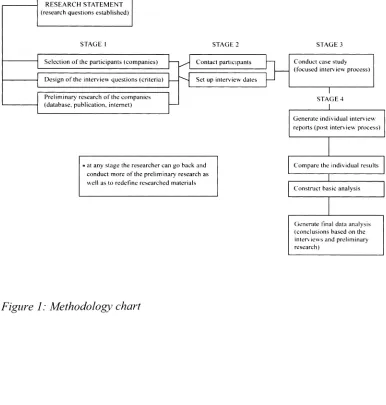
Figure 1:
Methodology
Chart
46
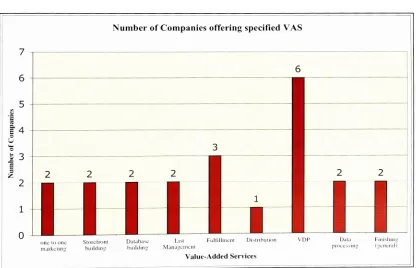
Figure 2: Number
of
Companies
using VAS
84
List
of
Tables
Table 1:
Categories
of
Companies
Interviewed
42
Abstract
The Print
Industry
is gradually changing into IT
technology
based
service
provider
as
new
services and
technologies
are
continuously
being
introduced. It
is
vital
for
service providers
to
keep
abreast
of
these
changes and provide custom solutions
for
their
customers.
E-commerce
solutions are
some of
the
value-added services
that
service
providers
offer.
Digital printing is
one of
the
fastest growing
sectors
in
the
Industry,
with revenues
increasing by
129
percent
from 2000
to
2005
(Smyth,
2005
p.
23).
Combined,
e-commerce capabilities and
digital printing
can
provide a
service
that
fulfills
the
customers'
requirements
for fast
turnaround times
and
on-demand
printing.
The
following
study
explored
the
current conditions
of
e-commerce enabled
applications
in
the
digital
print market.
Seven interviews
were
conducted
with
digital
service
providers
that
are
involved in
e-commerce software solutions.
This study
investigated
the
current enablers and
barriers
in
implementing
e-commerce solutions
in
the
digital
market,
in
addition
to
providing future
predictions
for
implementing
these
services.
The study
showed
that
the
future
of
the
Industry
consists of
companies
that
are able
to
embrace new
technology.
service
providers are
merging
with
IT
and
marketing
companies
to
provide
their
customers
with
shorter
turnaround
times,
wide
variety
of
services
and
up
to
date
technology
at
low
cost.
These
companies
have
the
Chapter 1
Theoretical Basis
of
the
Study
Statement
of
the
Problems
In
the
early 1990s
the
world
experienced
a
new
burst
of
technology
with
the
introduction
of
the
Internet
and
the
concept of
the
World Wide Web. The
rapid
growth of
this
revolutionary
new
way
of communication
among
individuals,
as
well as
business
to
business,
was unexpected.
The
world
of
commerce
slowly
started
to
adopt
a new concept
of
doing
business
over
the
Internet
and
increasing
revenues
through
e-commerce
capabilities.
The
development
of
more
affordable communication
techniques,
through
innovative
software and
hardware,
enabled
the
Internet
to
be
available
for
everyone
for
diverse
activities,
from shopping
to
educational experiences
(O'Flaherty,
1999).
It
took
38
years
for
the
radio
to take
off and progress
in
the
world
as a widespread
media
communication
device
and
the
television
13
years
to
become widely
accepted
within
the
general population.
In
1990,
the
Internet quickly
entered
lifestyles,
and
it
took
only five
years
for
users
to
familiarize
themselves
with
this
new
medium
of
communication
and
to
make
it
a major part of
their
everyday
lives.
It
has been
estimated
that
in 1993 only
one percent of people used
the
Internet
in
the
United
States
however,
As
the
Internet rapidly
progressed, the
Industry
started
to
take
interest in
the
development
of
e-commerce capabilities
in
order
to
establish
new niche markets
through
interaction
over
the
Web.
Many
in
the
industry
realized
that to
progress
and
survive
the
downfall
of
the
economy in
the
late
1990s,
printers needed
to
start
developing
hybrid
solutions and
invest in
new
technologies.
According
to
Schreier
of
Heidelberg
"...
one
way
to
do
this
is
to
combine
the
use
of
traditional
processes
with
Internet
services...
"(p.
14)
in
order
to
develop
innovative
e-commerce
solutions
(Vinocur,
2000
).
In
2004,
60-70
percent of
people are
connected
to the
web,
and
there
will
be
more
than
80
percent
in
the
next
two
years
(Muir,
2004). The full
benefit
of e-commerce
to
digital
providers
has
yet
to
be determined. The
growth of
e-commerce
service
has
been
seen over
the
past several
years
(2004-2005),
as
well
as
the
failure
of
many
companies
that
were unable
to
recognize
the
value
of
these
potential services.
There
are
several questions
that
still
need
to
be
answered
in
order
to
determine
the
success
or
failure
of e-commerce capabilities.
Some
of
these
questions
include:
Will
there
be
growth
in
e-commerce and
digital printing in
the
future?
What
are
the
current conditions of
the
printing
industry
with
the
implementation
of online services?
What
are
the
barriers
in establishing
e-commerce solutions with print
service
providers?
Answers to
these
questions will
help
determine
the
current conditions
of
the
printing
industry
in
relation
to
online presence.
It
will
also
identify
the
key
barriers
for
establishing
e-commerce
services
in
the
digital
providers'
Background
and
Significance
The
forecast
for
the
printing
industry
in
the
upcoming
years
(2005
and
2006)
is
optimistic.
With
the
economy changing
and
moving in
a positive
direction,
businesses
are
starting
to
develop
new partnerships and
invest
more
in
new
technologies.
Overall
economic growth should continue at a
3
percent
to
3.5
percent rate
for 2005
and
2006
(Davis,
2005). Even
with
this
positive
projection, the
industry
is
still
seeing
a
decline in
the
number
of
print service providers
that
exist
today.
An
option printers
have
is
to
join
with other
companies
to
develop
partnerships,
which will
make
them
stronger.
Other
options
include entering
new
markets and
diversifying
the
services
offered.
This
includes
adding
e-commerce capabilities
to their
operations
(Davis,
2005). "The
industry
is
in
a
state
of
constant evolution
from
changes
in advertising
and print
demand,
technology,
customer
demographics
and other
factors"(Davis
2005,
p.
5). All
of
these
factors
contribute
to the
changes
in
the
way
print providers establish
themselves
in
the
market and
the
way
they
gain a
competitive
advantage.
One
of
the
largest growing
sectors
in
the
industry
is digital
printing,
which
is
up
by
5
percent
in
revenues
in 2004
compared
to
2003 figures. This
trend
will
continue
and
there
will
be
more
sales
in digital
and on
demand printing in
the
next
few
years
(Davis,
2005).
on
demand
and
direct marketing printing
are
adding
sale profits
to
the
print providers
that
offer
such services.
With
the
recent
laws
on
telemarketing
restrictions
and
"do
not
call"
lists,
the
industry
is experiencing
a
high demand
for
direct
marketing
printed materials
that
often use variable
data printing
enabled
by
digital
The
world
is
experiencing
a great change
in
the
communication process
and
the
Industry
is
joining
the
evolution.
The Internet is playing
a
major role
in
our
personal
lives
and
in
business
communications.
Now
is
the time to
examine
the
way
service
providers
(PSP)
communicate
with
their clients,
and
the
way
their
business
operates.
Developing
e-commerce capabilities might
be
the
answer
to
satisfy
customer
demands
for
new ways
of
communicating
and
new
ways of
conducting business. Customers
and
printers
both
realize
that
they
need
to
do
more
with
fewer
people.
Faster
turnaround
times,
higher quality
and
ease
of
communications are some
of
the
major
benefits
that
e-commerce and
digital
capabilities
can provide
to
customers.
"Customers
need
solutions,
not print
procurement
or
e-commerce.
They
need
buying
to
be
easier,
faster,
less
expensive and
add
value
to their
own
business"(Gehman
2005,
p.
51).
Reasons for Interest
The preliminary literature
research shows
that
in
the
late 1990s
and
the
beginning
of
2000
several research
studies
were
conducted
on
the
issue
of e-commerce and printer
communications.
Numerous
issues have been discussed concerning
the
downfall
of
the
economy,
as
well as
the
crash of several
dot-com
companies.
As
it became
evident
that
a
stronger online presence would extend
the
services
provided
by
the
Printing
Industry,
more printers
became interested in acquiring
e-commerce capabilities.
The
speed of
Internet
connection
has been
one
of
the
early
issues
in
the
industry
that
has
been
resolved
such as emails and online
data
transfers,
and
there
has been
more
trust
in Internet
business
transactions
developed
by
the
user
(Davis,
2005).
Today,
the
Industry
is
still
expanding its involvement
with e-commerce
capabilities and
the
customer
demands for
these
services are
rapidly
growing
as new
solutions appear
on
the
market.
Many
printers are
becoming
more
interested in acquiring
these
services
but
they
are still
lacking
the
resources and
knowledge
available
in
this
area
to
succeed.
In
the
past
couple
of years
few
studies
have been
published
that
would
address
the cost, time
and expertise
involved in
developing
an
e-commerce
strategy.
It
is
important
to
look into
the
success and
barriers
of
establishing
e-commerce capabilities
in
traditional
and
digital printing
companies.
Therefore,
this thesis
will give
the
outlook on
print service providers with
digital
capabilities
that
are engaged
in
the
e-commerce
trade
between
themselves
and
their
customers;
it
will
explore
the
reasons
behind establishing
e-business
strategies;
and examine
the
barriers
of
establishing
e-commerce capabilities and
Chapter 2
Review
of
Literature
1.
Defining
E-commerce
a.
Significance
of
the
Internet
In
the
late
1960s,
military
intelligence
in
the
United States developed
a
new
technology
that
enabled
military
sites
to
stay
connected.
By
the
early
1990s,
the
world
had been
introduced
to
a new
communication
technology
called
the
World Wide
Web,
now
known
as
the
Internet.
Today,
the
Internet
plays a major role
in
consumers'
lives,
as
well as
in
everyday business
transactions
(O'Flaherty,
1999).
Starting
in
the
mid-1990s
the
Internet
became
an
affordable communication
tool
for
consumers.
With
computer
hardware
and
software prices
dropping
and an
increase in
Internet
connection
quality,
people
began
to
use
this
new
method
of communication
for
their
business
and
personal
transactions:
such as
shopping,
banking
or even
scheduling
their
traveling
plans
(O'Flaherty,
1999). The
ease and
user
friendly
interface for
the
Internet browser
allowed
the
consumer
to
get
more
involved in
online commerce
"...customers
were
thrilled
with
the
availability
of products
at
the
click of a mouse.
By
the
end of
the
decade,
it
was clear
that
e-commerce was
the
next
frontier for
the
Internet
user"
Based
on
the
Raine
Consulting
Inc.
report
on
Transition
of
the
Printing
Industry
to the
Internet,
it
was estimated
that
92
million
users
worldwide were connected
to the
Internet
at
the
end of
1998,
and
by
the
end
of
the
2002
the
estimate was
320
million users
(Kelly,
1999 1st
wave).
Today (2005)
it is
estimated
that there
are
812
million users
that
are connected
to
the
Internet
worldwide
(www.intemetworldstats.com).
b. Influence
on
Printing
Industry
As
the
Internet rapidly
took
over major
business
operations,
it greatly influenced
the
Industry.
Currently,
the
success
of
business
operations
is
largely
depends
on
turnaround
times
and
the
quality
of
the
product produced.
What previously
took
several weeks
to
produce,
now
only
takes
hours. Companies
are not
only competing
on
the
quality
of
products
but
also
the
speed of
producing
these
products.
Many
customers
do
not
have
the
time to
wait several weeks or plan ahead
to
get
the
desired
results.
It
is
now a
standard
in
the
industry
to
produce
the
desired
outcome
as
quickly
as
possible.
The PIA E-commerce
Council
estimated
that
in
2000,
8%
of print was
delivered
within
a
day;
by
2020 it
will
be
over
30%
of
delivered
within
a
day
(Kelly,
2000 2nd
wave).
The business-to-business
communication process
between rapidly
changed with
the
introduction
of
the
Internet,
leading
to
new methods
for
submission
of
files
and
the
transfer
of
information.
Today,
paperwork
for submitting
a
job
and
receiving
a
quote
takes
several
minutes
to
process over
the
Internet
by
using
the
appropriate e-commerce
programs
provided
by
the
print service
provider.
The Internet
enables users
to
cut
the
job
industry
matures,
so
do
the
capabilities of
new
e-commerce
software.
Presently,
software
available on
the
market allows
the
customer
to
design
their
product
online
and
then
submit
jobs
directly
to the
printer.
The Internet
allows
freedom
of communication
between
the
client and
the
printer,
and
decreases
the time
required
to
produce
the
product.
service providers are
trying
to
establish
themselves
in
the
e-commerce
market,
regardless
of
the
value-added services
they
offer.
It
has been
estimated
by
Raine
Consulting
Ine,
that
"...
by
2003 approximately
one-fourth
to
one-third
of
printing
firms'sales volume
will
be facilitated
by
the
Internet
or other
online services.
By 2006,
approximately
two-thirds to three-fourth
of
printing
firms'sales volumes
will
be
facilitated in
this
manner"
(Kelly,
1999 1st
wave,
p.
5).
c.
E-commerce
Terminology
E-commerce
has been
one
of
the
most
widely
misused
terms
in
the
Print Industry. To
determine
what e-commerce
represents
for
each
company,
it
must
be clearly defined.
Within
the
last
decade,
the
definition
of e-commerce
has
changed
multiple
times,
varying
from
and online
file
transfer
capabilities
to
full
online
business
transactions.
The
question
that
still remains
to
be
answered and
clearly defined is "what do
e-commerce
capabilities
entail?"
Based
on
Robert Plant's
analysis of e-commerce
strategies,
e-commerce
transactions
are
defined
by
any business
transactions
that
are
done
over
the
Internet,
which
can
involve
file
transfers,
communication
between
two
parties as
well
as
The
definition
of commerce
itself
represents
the
exchange
of
goods
or services
between
two
or more parties.
When
the
"electronic"terminology
is
added
to the
commerce
process,
it
should
be
defined
as
"... any
exchange
of
commodities,
goods
and
services..."
(p.
9)
via
electronic
process; the
Internet
being
the
medium
by
which
this
process
takes
place.
In
the
Industry,
e-commerce capabilities
are more
broadly
defined
as
a
value-added service rather
than
simply purchasing
of
the
product
(Romano
&
Goldberg,
2001).
Today,
e-commerce services
in
the
Printing
Industry
entail
anything from file
transfer
capabilities
to
full business
transactions
over
the
Internet. This study
concentrated
on
the
companies
that
have full business
transaction
capabilities over
the
Internet,
from
account
sales, marketing,
communication processes and workflows
to
payment services.
d.
Change
in
Communication Process
The
communication process
between
clients
and
printing
companies
has
dramatically
changed
since
the
introduction
of
the
Internet.
The Print
Industry
is
not
the
only
industry
that
has been
affected
by
the
Internet;
many
companies
have
changed
their
business
strategy
to
fit
new
and
evolving
communication
processes.
This
is particularly
true
in
the
area of
customer
service
division.
Many
customer
service representatives
(CSRs)
responsibilities
are
rapidly changing
to
fit
new communication processes.
CSRs
are
conducting
more of
the
technical
support
for
customers'
projects
than
merely managing
customers
are able
to
by-pass contacting
a
CSR
on
the
status of
their
job;
they
are
able
to
quickly
view
their
job
status online.
At
the
same
time
it has
allowed
CSRs
to
work
on
other important aspects of
a
clients'job
rather
than
spending
time
on redundant
information
(Danielli,
2004).
According
to
John
Fox,
the
president
of
the
Northern
Printing
Network,
there
is
a
constant
debate regarding
the
impersonal
nature
of
the
relationship between
the
printer
and
the
client within
the
e-commerce process.
The
industry
is
afraid
that
e-commerce
will
take
away
the
personal communication aspect
that
always existed
between
the
customer
and
the
printer.
However,
Fox
believes
that
personal
relationship
will still
exist
between
the
customer
and
the
printer
even
with
the
presence of e-commerce
"You
will still need
the
phone and you
definitely
have
to
have
that
personal contact and service...
the
Web is
just
a
tool"(Graham,
2003
p.
26). E-commerce is
a
service
that
is
provided
by
the
printing
companies;
it simply increases
the
ease
of
ordering
and communication
for
the
client and
does
not remove
the
need
for
personalized
customer
service.
Contrary
to
Fox's
positioning,
Hal
Hinderliter,
the
owner of
Hinderliter
Consulting
in Boulder
Creek,
CA
states
"In
reality,
a
large
portion of sales
have already drifted
to
impersonal
mechanisms,
especially fax
machines,
voicemails
and e-mail messages
"(Graham,
2003
p.
28). The
use
of
web-based applications
to
conduct
business
has simply
enabled
the
customers
to
use a
more cost-effective
solution;
if
this
service
helps
to
lower
the
cost
of
the
jobs,
customers
will accept
the
web-based communication.
According
to
Frank
Romano,
not all print
jobs
could
be completely
arranged
low-complexity
items
or
regularly recurring
orders.
As
the
complexity
increases,
a
greater
amount
of
interaction
between
the
buyer
and printer
is usually
necessary"(Romano,
2003
p.
4). In
the
future,
society is
likely
to
be
more
accepting
of
web-based
communication;
emails are
already
an accepted
way
of
communication.
The Internet
will
allow clients
to
gain
better insight into
their
job
status and allow
more
control
over
the
job
tracking
process
(Romano,
2003).
e.
Geographic Boundaries
One
of
the
great advantages
that
e-commerce
introduced
to the
Industry
is
the
elimination
of geographic
boundaries. Because
of
the
establishment of
the
Internet
and
ability
to transfer
files from any location
to
any
printer with
e-commerce
capabilities,
local
printers are now able
to
acquire
customers
from different
parts of
the
world,
without
being
concerned
about
the
clients'
location.
Today
some
of
the
online
printing
companies
with
digital
capabilities are
able
to
complete and
ship
customer
orders
within
24
to
48
hours;
a
job
that
a
few
years ago
could
have
taken
days
to
complete,
now
takes
a
few hours
(Sherburne,
2004).
Printers
are
slowly
learning
that
it does
not matter where
they
are
located,
as
long
as
they
get
the
job
to
the
customer on
time
and within
budget. "The
e-commerce software
allows
to
blend
a
job's input
with
printing
technologies
and
to
deal
with
a customer
anywhere
in
the
country
as
easily
as
the
printers
deal
with
customers
locally"
(Do it in
/ Early
Failure
of
Dot-coms
Along
with
the
success
stories, there
are
the
failure
stories
of print service providers
unable
to
conduct
their
business
via
the
Internet.
Many
print service providers who
are
considering
investing
in
e-commerce
solutions
wonder what went
wrong
during
the
dot
com
boom. Since
1999,
several articles
have been
published
in
an attempt
to
analyze
the
explanations
to
what
contributed
to the
failure
of so
many
dot-coms,
several
theories
have
been
indicated:
it
was either
miscommunication,
lack
of
knowledge
of
the
new
trend
or
concept
rejection
by
the
customers
(Romano,
2003).
In
2001,
there
were
still
many
service
providers
who were unaware of
e-commerce
solutions,
and others
who were unable
to
implement
the
strategy because
of
the
available resources
(Doyle,
2001). In August
2001,
whattheythink.com reported
that
46
e-commerce companies
closed;
several research
companies
kept
track
of
the
companies
that
are still open
to
see
how many
will survive
the
transformation
of
the
industry
(Kelly,
2001 3rd
wave).
In
2001 only 2
percent
of all print
transactions
were
conducted
via e-commerce solutions.
Where
as
in
2004,
that
number
rose
to
23.4
percent
(Kelly,
2001 3rd
wave).
Frank
Romano,
in
"Printing
to the
Power
of
E",
believes
that
some e-commerce
companies grew
too
quickly for
the
wrong reasons,
"Some
companies misapplied
the
Internet,
focusing
only
on
price,
while others rushed
into
poor
partnership
and some
had
no
business
model
or value at
all"(Romano &
Goldberg
2001,
p.
42). Whatever
the
reason, the
value of
the
service
and
the partnership
are
two
key
elements of e-commerce
The
following
list is
a
small sample of
the
companies
that
closed
due
to the
afore
mentioned
reasons or merged with
larger
corporations.
Media
Flex:
closed
(first
quarter of
2001)
connect: merged
with
httpPrint
(2000)
PrintBid:
closed
(first
quarter
of
200 1
)
Collabria
closed
(2001)
PrintCafe
merged with
EFI
Impresse.com
merged
with
EFI
Print-On-Demand,
Printware,
Printovation
and
Easy
all
closed
(first
quarter
of
2001)
(Romano &
Goldberg,
2001)
There
are
many
more
service providers
that
have
either
closed
or merged with
others
to
survive
the
economic
downfall
and
the
failure
of
early dot-coms.
2. Categories
of
E-commerce Websites
There
are
three
major
business
models
for
e-commerce
websites
in
the
printing
business.
Some
are
more
popular
than
others
depending
on
the
companies'demands
and
their
customer needs.
These
are auction
sites,
"storefront"
sites
and
"hubs".
Auction
Sites
are sites
that
primarily
concentrate
on
online
business
transactions.
The
customer submits a
request
for
a print
job
online and several
printers
bid
on
the
job
at
what
they
estimate
to
be
a competitive
price
for
a specified
job
(Vinocur,
2000).
Many
will argue
that
these
types
of sites are
quickly
driving
to
become
a commodity.
The
printers
compete
among
each other
based
on
price,
rather
than the
quality
or
level
of
printer
to
fill
the
gap in
their
schedules,
when
they
have
an
excess
capacity
available
to
run a specified
job. The
auction process provides
a
printer
with
the
opportunities
to
find
new customers
through
the
bidding
process.
Even
though the
initial
process
was
based
on
price
competition,
a
long-term
customer-printer
relationship
might
evolve
from
this
initial
interaction
generating
potential profitable
work
in
the
future
(Dyson,
1999).
Storefront Sites
are sites
that
are
branded for
an
individual
printer,
based
on
customers'
requirements.
These
sites are
usually
formulated
by
third
party
software
developers
or
designed
in-house
by
the
provider.
These
sites allow
the
customer
to
submit
a
job
online,
browse
the
available product
catalogs,
check
the
status of
their
jobs,
pay
their
bill
online,
as well as contact customer service representatives
for any
additional
questions
they
might
have
(Vinocur,
2000). In
the past, these
sites were
not created
to
accept customized products
but
with
technology
changing
rapidly,
more
complex
jobs
can
be
submitted
electronically.
The
goal of storefront sites
is
to
fully
support
the
e-commerce
capabilities
of
the
print service
provider,
allowing
the
customer
to
be
in
charge
of
creating
their
own
job
tickets,
and
tracking
the
process of
the
job
submission
(Romano
&
Goldberg,
2001).
Hubs
are
sites
that
allow corporate customers
to
interact,
send materials and check
their
job
status with
their
various
printers.
These
sites are
specifically
branded for
the
customers
to
help
them
interact
with
the
print service provider.
These
sites are
usually
supported
by
third-party
vendors
that
require
a
printer
to
pay
a
fee
to
be
a part of
the
3.
Digital Print Technologies
Digital printing
has been
growing
in
the
last five
years,
in
terms
of
both increased
revenues and
the
number
of
companies
that
are
offering digital
services.
The
benefits
that
digital printing
can provide compared
to
lithography
are
crucial
for any
business
that
requires short
run
solutions,
shorter
turnaround
times
and minimal
makeready.
Based
on
the
NAPL 2004
report,
participants
were
asked
to
state
their
investment
priorities
in
the
next
five
years;
57.6
percent
responded
that their
top
priority
on
their
list
was
to
install/purchase
a
digital printing
press.
Five
years
prior,
a similar
survey
showed
digital
print systems
were
not a
priority;
only 21.6
percent of
respondents
stated
that
they
were
interested in acquiring digital
print capabilities
and
37.1
percent of
respondents were
considering
investing
in
e-commerce capabilities.
Based
on
these
numbers,
it
can
be
projected
that
digital
print services
will continue
to
grow
in
the
next
five
years,
and companies
acquiring
e-commerce solutions
will
also
increase (NAPL
Report,
2004).
While
overall commercial
printing
revenues
declined in 2003
by
$150
billion
in
the
United
States,
digital printing
gained
in
process market shares.
Digital
color
printing
volumes
reached
2.5
million
impressions
per
month
(Romano,
2004 GATF World). In
2004,
1 1
percent
of
revenues
in
market share
came
from
digital
printing;
in 2005 it is
estimated
to
be 14
percent.
The
predictions
for
2010-2015
are optimistic with a projected
revenue market share
reaching
25
percent
of all print production.
Lithography, however,
is
losing
its
market share
from 47
percent
in 2003
to
46
percent
in
2004,
and with
Other
print processes cannot compete
with
the
beneficial
aspects of
digital
printing.
Digital
print offers
economically
viable short
run
capabilities,
such as
producing
one
copy
of a
document.
The
turnaround times
are much shorter
than
with
lithography;
short
turnaround times
are achieved
because digital
equipment
does
not require
significant
make-ready,
or
drying
time
and are cost effective
with
low
waste production.
One
of
the
major advantages
of
digital printing is
the
process
of
"distribute
then
print."
Unlike
the traditional
process
of
printing
a
job
and
then
distributing
or
delivering,
jobs
are
first distributed in
electronic
form
to
digital
print providers close
to the
customer.
When
processed
in
this
manner,
jobs
printed
locally
are
distributed in less
time than
central
production would
enable
(Romano,
2001 Digital Basics). In
2002,
18
percent of
was
delivered
within a
day. It is
estimated
that
by
2020,
30
percent
of
will
be
delivered
within
a
day
(Romano,
2002). Based
on such
predictions,
it
can
be
concluded
that
"distribute
then
print"enabled
by
digital printing
will
benefit
printers
in
the
future
and
lead
to
a
further decrease in
turnaround time.
With
the
added
advantages
of
e-commerce
capabilities, this
process
will enable
the transfer
of
information electronically
to the
desired location easily
and
with
fewer
errors.
a.
New
Developments
and
Digital Equipment
The
main
digital
press
manufacturers
include:
Xeikon
Xerox
(DocuTech,
Nuvera, DocuColor,
IGen3
brands)
HP
Indigo
Kodak Nexpress
Canon
These
six
companies
are
the
major manufacturers
of
electrophotographic
technologies.
In
2003,
13,610 digital
presses shipped worldwide and
in
the
following
year, that
number
rose
to
17,
300. This
indicates
a
healthy
increase in
the
demand for digital
presses
worldwide
(Romano,
2004 GATF World).
Most digital
color presses use some
type
of electrophotographic method
of
producing
an
image.
There
are some variations
in
the
processesdepending
on
the
manufacturer of
the
digital
equipmentbut in
general
most of
the
presses
use common
principles.
b. Digital Print Capabilities
Variable data printing
(VDP)
is
one of
the
major
advantages
that
digital printing is
able
to
provide
customers;
allowing
customers
to
personalize
their
printed
material.
Variable
data printing
software
does
not
require
additional equipment
for digital
presses
to
be
installed
to
produce
the
variable
content,
however,
with conventional
presses,
additional
equipment
is
needed.
Based
on market
research,
variable content
in
mailings and
customer
targeted
materials are
the
key
to
increasing
response rates.
Variable data
printing
can
be divided into
three
main market applications.
The
first is
transactional
printing,
which
includes
all
financial
and
billing
statement materials.
The
second area
is
promotional
marketing
material,
such
as mailings and
advertisements
that
are addressed
to
individual
customers.
The
third
area
involves
the
use of
images
and content
tailored
to
the
recipient's
demographics,
where
the
response rate
is
vital
to the
company
(Brunner,
A few
years
ago,
digital printing
was
mostly
used
for black
and white
jobs,
because
of
the
low
cost
of
production.
Color jobs
were
not
very
common
because
of
the
high
cost
involved
in
producing
the
job
and
the
low
print quality.
Today
the
cost
of
digital
color
is
decreasing
because
of
the
higher demand for
color
jobs,
the
decrease in
cost
of
the
toner/ink,
the
cost
per
impression
declining
and
the
productivity
of
digital
presses
greatly
increasing.
Color is very important for high
end
printing jobs because it
draws
attention
to
the
produced product.
It
has been
predicted
that
digital
color
production will grow
from 48
percent
of all pages printed
today
to
75
percent
by
2020
(Romano 2002). "Digital
color
is making inroads
and
newer systems
are
printing
at
lower
costs
than
ever
before,
changing
the
economic models
for
short run
printing"
(Romano,
2004
GATF
World,
p.
49).
c.
Workflows
The digital
print workflow
is
now capable of
being
a
fully
automated
process
transferring
files
straight
to
the
press.
Automatic PDF
generators,
which
come
with
digital
press
workflow
systems,
help
to
preflight
and check
incoming
files for
any
errors such
as
missing
fonts, images,
or color space.
In
some
cases, the
system can
generate
an
automatic soft proof.
With
the
help
of e-commerce
software, this
process
can
automatically
send
the
proof
to the customer,
obtain approval and
transfer
it back
to the
press
to
start
the
job. In
this
streamlined
process,
less human interference is
required
(Shaffer,
2004). Some
jobs
can
be done
via workflow
integration
that
goes as
far
as
files
are
chosen,
and
the
job
automatically
enters
a particular
'workflow'
pipeline
where
they
are processed and
automatically
output
on
a
digital
press"(Shaffer,
2004
p.41).
Whole jobs
can
be
produced
inline; Nexpress,
Xerox DocuTech
or
HP Indigo
systems
have
the
ability
to
produce a
book inline
without
the
need
to
manually
move
the
product
from
one machine
to
another.
In
one seamless production
process,
complete products
can
be
fully
printed
and
bound
with
color
inserts
(Shaffer,
2004).
i. PDF Workflow
The development
of
the
Portable Document Format
(PDF)
standard
has
changed
the
way
graphic
arts,
and
the
Industry,
works
with
their
production
workflow
(Creating
Reliable
JDF,
2004). PDF
added
the
freedom
to
create
files
and print wherever
and
whenever needed.
Documents
that
used
to
be only
accessible
to
specific
equipment
are
now accessible
to
anyone
on
any
computer platform
(Mason,
2004). The
idea
of
the
workflow
supports
the
major
trends
in
the
Industry
today;
get
it
printed
fast,
accurately
and
delivered in less
time.
"Get
it
fast,
get
it
right,
get
it
through
now
are
in
essence
what automated
workflow
is
all
about"
(Adobe PDF Transit
2002,
p.
3).
With
today's technologies
a
workflow
is
an
important
concept
to
adopt
in
any printing
process.
It
is
an
easy
process
to
leam
and
additionally it
eliminates common
mistakes
produced
by
the
graphic
designers
during
file
creation and
submission.
The
smaller
file
size allows a
smoother
transition
with
online submission
and
less
process
ii. JDF
Workflow
Job
Definition
Format
(JDF)
is
a
device-independent
standard,
using
a
vendor-neutral
format,
which
is fast
becoming
an
international
standard
for
defining
job
submission
information.
It is
a comprehensive
XML-based file
format,
which
is
created
for job
ticket specifications
combined
with
the
message
description
standard,
which
allows
the
addition of
information
at
each
step
of
the
printing
workflow
from
prepress, to
production and post press
phase
(Creating
Reliable
JDF,
2004).
The JDF
standard allows
for
complete
automation
of
the
process
workflow;
process operations
are
controlled
under
one
workflow system
and
the
different
parts of
the
process are
linked from
start
to
finish. Michele
Strachie,
the
workflow production
manager
from Screen
(USA),
described
the
JDF
process as
when
"presses
communicate
with
estimating
systems,
production
schedulers communicate
with
presses,
imposers
communicate
with
folders
and
so
forth. It
results
in
simplified production automation
from
the
moment a
customer places
the
order
through the production,
delivery
and,
ultimately,
invoicing
of
the
finished
product"(Creating
Reliable JDF
2004,
p.
9). JDF
is
the
next
big
step for
the
industry
and with
this trend
developing,
the
industry
will
be
seeing
more changes
in
the
workflow
process and equipment produced.
4.
Workflow
and
Technological
Innovations
a.
Structure of
the
Websites
Depending
on
the
primary
purpose
of
the
company
and
the
customers
that
they
serve,
Plant's
theory
for
e-commerce
strategy
(2000),
there
are
four
positional
factors
and
three
bonding
factors
involved in
the
e-commerce website structure
(Plant,
2000).
Position
factors:
Bonding Factors:
1.
Technology
1.
Leadership
2.
Service
2. Infrastructure
3.
Market
3. Organizational
Learning
4.
Brand
In
each
of
these categories,
both
the
technology
and
infrastructure
play
a major
role.
To
be
able
to
create a
fully
functional
e-commerce
interface,
the
infrastructure has
to
be
clearly defined
and must correspond
to the
available
technologies
prior
to the
beginning
of
the
project.
The PSP (print
service
provider)
must
be
able
to
provide
the
corresponding
server
that
will contain
the
website content and submitted
customer
information. The
servers are
required
to
have
a
high-speed Internet
connection
that
allows customers
easy
and quick access
to the
website
content and
individual
accounts.
If
the
PSP
is
unable
to
provide
the
technology
that
will support network
requirements,
third-party
software providers
will
supply
the
equipment
to the
PSP
for
a
monthly
subscription
fee
(DeWitt,
2003).
The importance
of
the
IT
(information
technology)
personnel must
be
taken
into
consideration
when
developing
the
infrastructure
of
the
website.
If
a
third-party
company
is providing
software and
the
creation of
the
printer's
website, the
PSP
has
a choice
to
either
rely
on
the
IT
personnel provided
by
the
third-party
company
or
have
an
in-house
IT
professional.
This
position provides
full
support
in maintaining
the
e-commerce
(concerning
access and
file transfer),
and
any
technical
difficulties
that
may
occur
in
the
workflow
(DeWitt,
2003). It
is strongly
recommended
that
smaller companies
use
third-party
e-commerce software packages and available
IT
support
to
avoid
high development
costs and
lack
of
expertise
in
the
IT field (Romano &
Goldberg,
2001). Romano
states
that
besides
determining
the
right
system requirements
for
e-commerce
website
"...
other
things that
need
to
be
taken
into
consideration
include money
and
customer
data,
firewalls,
authentication,
user
access, encryption,
digital
signatures and
security
features"
(Romano &
Goldberg,
2001
p.
1 1).
b. File Transfer Features
One
of
the
most
important features
of e-commerce enabled
websites
in
the
Printing
Industry
is
the
process of
file
transfer.
It is
crucial
for
the
printer
to
receive
the
correct
files
without
any damage
or
alteration
resulting from
the transfer
process.
There
are
two
ways
that the
file
can
be
transferred
to the
PSP's
server:
FTP (file
transfer
protocol)
is
a
transfer
method created
to
move
files
that
are
2 MB
or greater.
Using
FTP
requires software such as
CUTE
for Windows
or
Fetch for Macintosh
(Starr,
2002).
HTTP
(hypertext
transfer protocol)
a
Web browser based file
transfer tool that
does
not require
additional
software
(Starr,
2002).
In
the
early
1990s,
when
the
Internet
and email communication was
considered
the
newest
technological
innovation,
customers and printers were
attempting
to transfer
files
The
greatest
inconvenience
with
file
transfer
is
that the
files
are
too
large
for
an
email server
to
accept.
Additionally,
there
is
the
possibility
of
corruption
during
the
file
transfer
process.
Today,
the
most common
way
of
transferring
job files
to the
PSP
is
via