R E S E A R C H
Open Access
WFDC1 expression identifies memory CD4
T-lymphocytes rendered vulnerable to cell-cell
HIV-1 transfer by promoting intercellular adhesive
junctions
Raymond A Alvarez, Georgina Thorborn, James L Reading, Shalini Kamu Reddy and Annapurna Vyakarnam
*Abstract
Background:Elucidating mechanisms that promote HIV-1 transfer between CD4+T-lymphocytes and their subsequent loss is of importance to HIV-1 pathogenesis. We recently reported that whey acidic protein, ps20, promotes cell-free HIV-1 spread through ICAM-1 modulation. Since ICAM-1 is pivotal in cell conjugation and intercellular HIV-1 transfer, this study examines ps20 effects on HIV-1 spread between T lymphocytes.
Results:We demonstrate intrinsic ps20 variability in primary CD4+T-lymphocyte clonal populations and a significant positive correlation between endogenous ps20 levels and virus transfer involving fusion resulting in a spreading infection that could be reversed by the addition of reverse transcriptase inhibitors. Blocking anti-ps20 antibody or siRNA mediated ps20 knockdown, significantly reduced virus transfer. Conversely, virus transfer was promoted by ectopic ps20 expression or by exogenous addition of recombinant ps20. A higher frequency of virological synapse formation was evident in cocultures of HIV-1 infected donor T-cells with ps20highv ps20low/intermediatetargets. Blocking ps20 inhibited T-lymphocyte conjugate formation and ICAM-1 expression, and was as potent as ICAM-1 in inhibiting HIV-1 transfer.
Conclusions:Therefore ps20 is a novel marker of CD4+T-cells rendered vulnerable to HIV-1 infection by regulating the fundamental biologic process of intercellular conjugate formation and consequently of potential importance in HIV-1 pathogenesis.
Background
Understanding the mechanisms by which retroviruses spread from one cell to another is of central importance to disease pathogenesis as this process enables viruses to effectively escape immune responses. Three modes of cell contact have been described which are capable of transmitting retroviruses. One mode is through the for-mation of filopodial bridges, which are protrusions that originate from uninfected target cells that become teth-ered to infected donor cells through the surface expres-sion of viral ENV proteins [1]. After tethering, both MLV and HIV-1 were shown to travel along the outside of these bridge structures onto the surface of target cells [1]. A similar mode of retroviral transfer involves thin
elongated structures called nanotubes, which form when two T cells come into contact and begin to move apart, independent of virus protein expression and described in HIV-1 transmission [2]. Lastly, a highly prevalent mode of virus transfer, occurs through the close apposi-tion of infected and uninfected cells which form cellular conjugates [3,4] leading to the formation of virological synapses (VS). A VS forms when CD4 and HIV-1 Env and Gag polarize to conjugate interfaces in a microtu-bule- and actin- dependent manner, allowing for the rapid and direct transfer of virus from infected to unin-fected cells [3-10]. A recent study demonstrated conju-gate formation preceding and leading to Gag redistribution/polarization with VS formation detected in 80% of conjugates formed [11]. Similarly, the forma-tion of multiple conjugates precedes the formaforma-tion of
multiple VS termed “polysynapses” [12] and is
* Correspondence: [email protected]
Department of Infectious Diseases, King’s College London, U.K
postulated as an efficient mode of virus disseminationin
vivo, enabling a single infected cell to infect multiple target cells, as observed in the cervix and lymph nodes of SIV+ Macaques [12].
Several host factors beyond the HIV-1 receptor/core-ceptor complex can regulate the process of cell-cell HIV-1 transfer depending on whether the conjugates
formed are between CD4+ T cells or between CD4+ T
cells and dendritic cells. These include adhesion mole-cules, lipid raft components, signalling molecules and the tetraspanins [6,13-22]. More recently, our laboratory identified a novel HIV-1 enhancing pathway, namely the
whey acidic protein, ps20, in memory CD4+T
lympho-cytes that promotes cell-free HIV-1 replication through the modulation of ICAM-1 surface expression [23]. Blocking endogenous ps20 suppressed HIV-1 replica-tion, while the exogenous addition of recombinant ps20 promoted infection. Furthermore, blocking anti-ps20 Ab suppressed ICAM-1 surface expression [23]. Cell adhe-sion antigens like ICAM-1 and integrins (e.g. like LFA-1 anda4b7 [17,18,24-27]), can be exploited by viruses like HIV-1 to promote spreading infection. Specifically, bud-ding cell-free HIV-1 particles that incorporate ICAM-1 bind target cells better through cognate LFA-1 binding [24-27]. Additionally, ICAM-1 can promote cell-to-cell HIV spread by stabilising virus fusion to target cells and VS formation [17,26,27] and ICAM-1 blocking anti-body can reduce VS formation by ~30% [17]. Together, these observations prompted us to test the hypothesis that ps20 can promote cell-cell HIV transfer by modu-lating ICAM-1 expression.
WFDC1/ps20 is a member of the extended whey acidic protein (WAP) family, identified by a highly con-served 4-disulphide core domain, which includes a num-ber of small, secreted proteins found within mucosal secretions [28,29]. Of the 18 human members, only three, namely secretory lymphocyte protease inhibitor (SLPI), Elafin and more recently ps20, have ascribed functions. All three proteins appear multifunctional; SLPI and Elafin possess anti-microbial activity, including HIV-1 activity, as well protease and anti-inflammatory activity [28-30]. Consequently, these pro-teins are implicated in innate immunity by providing broad anti-microbial cover and by negating the dama-ging effects of host and pathogen proteases and limiting immune activation [28-30]. To date, ps20 has not been ascribed with anti-microbial activity or anti-protease activity, and in contrast to SLPI and Elafin [30], ps20 promotes HIV-1 infection [23]. A previous study high-lighted the ability of ps20 to promote wound healing, cell migration and angiogenesis [31]. All these processes require the modulation of adhesion molecules [32,33], and therefore ps20 function is postulated to involve cell-extracellular matrix or cell-cell interactions [31,34]. In
this paper, we provide data in support of this contention by demonstrating that HIV-1 exploits ps20-mediated regulation of the quality and quantity of T lymphocyte-T lymphocyte (lymphocyte-T-lymphocyte-T) conjugate formation and ICAM-1 expression in the process of cell-cell virus transfer and ps20 to be a novel marker of CD4+ T cells that are highly vulnerable to HIV-1 infection.
Results
Jurkat CD4+T cells stably transduced to express ps20, are rendered more susceptible to T-T HIV-1 transfer
Screening steady state ps20 mRNA in ten primary clones from multiple donors confirmed profound het-erogeneity in ps20 levels spanning 5 logs (Additional file 1 figure S1A) and confirmed ps20 expression, in the transduced J-ps20highcells, falls within the range seen in primary clones. As ps20 expression in this panel segregated naturally into three distinct clusters,
we arbitrarily assigned populations to be ps20hig h
(RCN above 0.1), ps20Intermediate (ps20inter)(RCN
0.001-0.1) and ps20l ow (RCN below 0.001). Ps20 mRNA
expression in J-ps20highcells was 3-logs higher than J-ps20inter cells; accordingly, J-ps20high cultures were clearly ps20 protein positive (Additional file 1 figure S1B). A 23-fold higher level of infection in J-ps20high vs. J-ps20intercells was noted in a spreading infection assay (Additional file 1 figure S1C). Blocking anti-ps20 Ab reduced single-cycle infection by 2.8-fold in the
J-ps20high population (Additional file 1 figure S1D).
These data extend previous observation that human ps20 promotes cell-free HIV-1 infection [23].
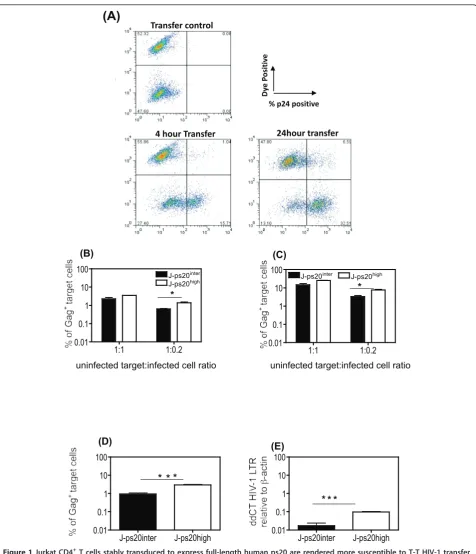
We next probed the role of ps20 in cell-to-cell HIV transfer using a flow cytometry assay [10,12,15] (see
Fig-ure 1A). HIV-infected WT Jurkat cells (Jwt-ps20inter)
served as infected donor cells. J-ps20highand empty vec-tor transduced J-ps20intertarget cells were co-cultured with donor cells that were 40% Gag+ following infection with NL4-3 virus at 1:1 or 1:0.2 target:donor (T:D) cell
ratios and the percentage of Gag+target cells
enumer-ated at 4 (Figure 1B) and 24 hours (Figure 1C) post co-culture. At both time points and ratios tested, a higher
proportion of Gag+ cells were detected in J-ps20high
cells. However, a significant 2-fold difference between
the J-ps20high vs. J-ps20inter population was only
observed at the lower T:D ratio of 1:0.2, similar to our previous study that highlighted ps20-dependency of HIV-1 to be most marked at low virus challenge doses [23].
(A)
1:1 1:0.2
0.01 0.1 1 10 100
J-ps20inter
J-ps20high
(B)
*
uninfected target:infected cell ratio
1:1 1:0.2
0.01 0.1 1 10 100
J-ps20inter J-ps20high
(C)
*
uninfected target:infected cell ratio
J-ps20inter J-ps20high 0.01
0.1 1 10 100
(D)
* * *
J-ps20inter J-ps20high 0.01
0.1 1 10 100
(E)
[image:3.595.60.537.85.640.2]* * *
Figure 1Jurkat CD4+T cells stably transduced to express full-length human ps20 are rendered more susceptible to T-T HIV-1 transfer. (A) Representative dot plots of dye labelled target cells co-cultured with uninfected (transfer control) or infected donor cells at 4 and 24 hours post co-culture. (B) Mean percentage of Gag+J-ps20intervs. J-ps20hightarget cells at 4 hours post co-culture with 36% NL4-3 Jwt-ps20interdonor cells at T:D ratio of 1:1 and 1:0.2. Data represent mean of three replicate assays. (C) Mean percentage of Gag+J-ps20intervs. J-ps20hightarget cells at 24 hours post co-culture with 36% NL4-3 infected Jwt-ps20interdonor cells at T:D ratio of 1:1 and 1:0.2. Data represent mean of three replicate
assays. (D) Mean percentage of Gag+J-ps20intervs. J-ps20hightarget cells at 4 hours post co-culture with YU2 infected Jwt-ps20interdonor cells at
T:D ratio of 1:0.2. Data represent mean of three replicate assays. (E) Target cells co-cultured with 40% YU2 infected donor cells were sorted for dye-positive single cells based on both FSC height vs. width followed by SSC height vs. width, on a BD FACS Aria II cell sorter. DNA extracted from these sorted singlet cells was subject to qDNA PCR for HIV-1 LTR. The level of HIV-1 LTR in J-ps20intervs. J-ps20hightarget cells is shown
parallel, the co-cultured populations were FACS sorted for dye-positive single target cells and HIV-1 DNA mea-sured in the sorted population. This sorting procedure ensured that infection levels were determined in single target cells, excluding possible target-target or donor-target conjugates [35], thereby providing an accurate estimation of infection in the infected target cells. qPCR on these samples showed a 6-fold higher level of HIV-1 LTR in the J-ps20highvs. J-ps20intertarget cells (Figure 1D).
HIV-1 transfer into J-ps20highcells is fusion dependent and leads to productive infection
Evidence exists for fusion -dependent and -independent T-T transfer of HIV-1 [6,36,37]. To probe this in the context of ps20, target cells were cultured with Jwt-ps20interdonor cells productively infected with NL4-3 at a T:D ratio of 1:0:2 for 4 hours in the presence or absence of the T-20 fusion inhibitor. T-20 addition reduced virus transfer significantly by 3-fold and
2.4-fold in the J-ps20inter vs. J-ps20high cells, respectively (Figure 2A). To determine productive infection [38], tar-get cells were cultured with reverse transcription RT
inhibitors prior to co-culturing with Jwt-ps20inter
infected donor cells at a T:D ratio of 1:0.2 and Gag+
cells enumerated at 4, 24, and 72 hours post co-culture. J-ps20high target cells had higher infection with evidence
of progressive increase in Gag+ cells from the 4 to 72
hour time point, whereas there was no significant virus
spread in the J-ps20inter population (Figure 2B). The
addition of RT inhibitors did not inhibit virus transfer in either population at 4 hours (Figure 2B). However, a
significant reduction was observed in the J-ps20high
[image:4.595.60.540.345.641.2]population with a 1.6-fold and 3-fold reduction between the J-ps20highRT-inhibitor treated and untreated popu-lations at 24 and 72 hours respectively (Figure 2B). RT-inhibitors have been noted not to influence HIV-1 transfer, but can inhibit Gag accumulation in prolonged co-cultures [37]. Our findings corroborate these obser-vations. We next tested if increasing the virus challenge
Figure 2HIV-1 transfer into J-ps20highcells is dependent on virus fusion and leads to higher levels of productive infection. (A) J-Ps20highand J-ps20intertarget cells stained with DDAO SE vital dye were seeded at 1 × 10⁵cells per well of a 24 well plate in the presence or the absence of 5μg/ml of T-20 for 1 hour prior to co-cultured with 18% Jwt ps20interNL4-3-infected donor cells at a T:D ratio 1:0.2. Mean percentage of Gag+J-ps20intervs. J-ps20hightarget cells 4 hours post co-culture is shown. Data represent mean of three replicate assays. (B) The dye-labelled J-Ps20highand J-ps20intertarget cells were seeded at 1 × 10⁵cells in the presence or the absence of 5μM of RT-inhibitors (AZT +Lamimidine) for 1 hour prior to co-culture with 25% NL4-3-infected donor cells at a T:D ratio of (B) 1:0.2 or (C) 1:1. The percentage of Gag+ J-ps20intervs. J-ps20hightarget cells +/- RT inhibitors were assessed at 4, 24 and 72 hours post co-culture. Data represent the mean of three
dose to 1:1 T:D ratio promoted virus spread in the J-ps20intercells. Figure 2C shows increase of Gag+ cells at the 1:1 ratio from the 24-72 hour time point to be 1.83% (± 0.36) to 3.43% (± 0.78) respectively in J-ps20
in-ter
cells, versus 3.84% (± 0.45) to 9.34% (± 0.79) respec-tively in J-ps20hightargets. At the lower T:D ratio, Gag+ staining increased from 1.82% (± 0.13) to 4.3% (± 0.28) in J-ps20high cells between 24-72 hours versus 0.66% (± 0.11) to 0.77% (± 0.05) in J-ps20inter cells (Figure 2B).
These data confirm J-ps20inter cells require a higher
virus challenge dose than J-ps20high for efficient virus spread to be achieved in these cells.
HIV-1 transfer correlates directly with ps20 expression in primary CD4+T cell clones
A panel of six CD4+ T cell clones from multiple donors
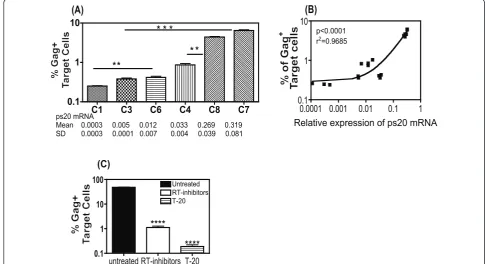
(Additional file 1 figure S1D) were examined. Clones 1 (ps20low) and 6 (ps20inter) were gut-derived isogenic clones. Clones 3 (ps20inter), 7 (ps20high), 4 (ps20inter) and 8 (ps20high) were all blood-derived, with clones 3 and 7 being isogenic (Figure 3A). Cells were co-cultured for 4
hours with Jwt-ps20inter donor cells that were 60%
productively infected with the X4-HIV-1 strain, 2044 and in each case, ps20highclones had a higher frequency of Gag+cells as compared to the ps20interor ps20low counter-parts. Differences between these clone pairs were as fol-lows: 1.6-fold between clone 2 and clone 6, 16-fold between clone 3 and clone 7 and 5-fold between clone 4 and clone 8 (Figure 3A). Furthermore, comparison of all the ps20 low and intermediate clones (C1, C3, C4, C6) versus the ps20 high clones (C7, C8) highlighted statisti-cally higher virus infection of the ps20 high clones (Mann-Whitney p = 0.0009) (Figure 3A). Indeed, a significant positive correlation was noted between HIV-1 transfer and ps20 mRNA expression in these clones (Two-tailed non-parametric Spearman’s correlation, p < 0.0001, Figure 3B).
Virus transfer into primary clones was next confirmed to be fusion-dependent resulting in spreading infection. Representative Clone 7 (ps20high) was treated with either 5μM RT-inhibitors or 5 μg/ml T-20 for 1 hour prior to co-culturing with 2044 infected Jwt-ps20interdonor cells at a T:D ratio of 1:0.2 for 48 hours. The presence of RT inhibitors reduced Gag accumulation by 43-fold (Figure 3C). In the presence of the T-20 fusion inhibitor,
C1 C3 C6 C4 C8 C7
0.1 1 10
ps20 mRNA
Mean 0.0003 0.005 0.012 0.033 0.269 0.319 SD 0.0003 0.0001 0.007 0.004 0.039 0.081
(A)
**
* * * * *
0.0001 0.001 0.01 0.1 1
0.1 1 10
p<0.0001 r2=0.9685
(B)
Relative expression of ps20 mRNA
untreated RT-inhibitors T-20 0.1
1 10 100
(C)
Untreated RT-inhibitors T-20 *
****
[image:5.595.53.540.368.632.2]****
inhibition was even more pronounced with a >100-fold reduction of Gag expression (Figure 3C). These data
confirm that virus transfer into primary ps20inter and
ps20high clones is fusion dependent and can lead to pro-ductive infection, with more marked suppression noted in ps20high cells due to higher levels of virus transfer and spread in these cells.
Blocking endogenous ps20 inhibits HIV-1 transfer in primary CD4+T cell clones
Extensive characterisation of the Dharmacon Accell siRNA showed a consistent 50-60% specific knockdown
of ps20 mRNA with maximal effects seen in ps20inter
populations. Accordingly, we conducted functional
knockdown studies in the Jwt-ps20inter and clone 3
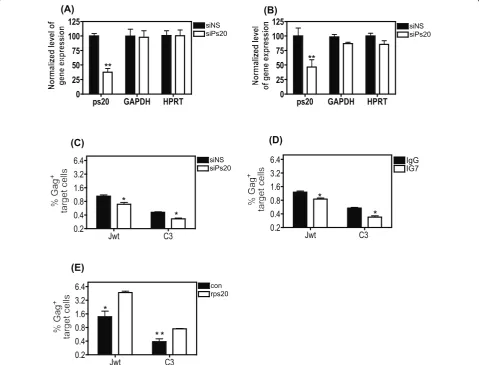
(ps20inter). Both populations were treated with either non-specific (NS) siRNA or siRNA against ps20, which inhibited ps20 mRNA significantly by 62% in the Jurkat population and by 54% in clone 3 (Figure 4A, B respec-tively). To control for off target effects, GAPDH and
HPRT expression was also measured relative to b-actin
and no significant modulation of either noted in the presence of the siRNA against ps20 (Figure 4A, B). A reduction in ps20 expression was associated with a
ps20 GAPDH HPRT 0
25 50 75 100
125 siNS
siPs20
(A)
**
ps20 GAPDH HPRT 0
25 50 75 100
125 siNS
siPs20
(B)
**
Jwt C3
0.2 0.4 0.8 1.6 3.2
6.4 siNS
siPs20
(C)
* *
Jwt C3
0.2 0.4 0.8 1.6 3.2
6.4 IgG
IG7
(D)
* *
Jwt C3
0.2 0.4 0.8 1.6 3.2
6.4 con
rps20
(E)
* * *
[image:6.595.58.538.247.612.2]*
Figure 4Blocking endogenous ps20 inhibits HIV-1 transfer. Jwt ps20interor clone 3 (ps20inter) was treated with either a non-silencing (siNS)
significant 34% and 28% reduction in virus transfer into the WT Jurkat cells and clone 3, respectively (Figure 4C). These observations were supported by antibody-mediated blocking experiments. A significant 29% and 36% reduction in virus transfer into Jurkat and clone C3 respectively was noted when cultured with anti-ps20 Ab relative to control IgG (Figure 4D). Conversely, recom-binant ps20 (rps20) promoted virus transfer. Cells were pre-cultured with 1 ug/ml rps20 over-night, generated as previously described [23], washed to remove excess protein, then co-co-cultured with infected targets, resulting in a significant 3.4-fold and 1.9-fold enhance-ment of virus transfer into Jurkat and clone C3 respec-tively (Figure 4E). Similar observations of Ab-mediated blockade and rps20-induced transfer were also noted in additional clones (data not shown). These data confirm
that blocking endogenous ps20 in primary CD4+T cells
limits HIV-1 transfer.
ps20highCD4+T cells form a higher frequency of conjugates, multiple conjugates and virological synapse with HIV-1 infected donor cells
The quality and quantity of cell-cell conjugates formed in the presence of ps20 were next assessed. To avoid inherent differences in primary clonal populations, these studies were performed using the Jurkat model system. First the number of conjugates formed was assessed. Conjugates were defined as a target cell closely apposed to an infected donor cell, and multiple conjugates (MCs) as a target cell closely apposed to two or more infected donor cells (Figures 5A, B, C). We observed a significant 2.3-fold and 5.4-fold higher frequency of con-jugate and MC formation and a 2.75-fold higher fre-quency of Gag and CD4 polarization to conjugate interfaces (VS formation - see Figure 5D) in J-ps20high vs. J-ps20interpopulations respectively (Figure 5F). How-ever, the proportion of conjugates containing VS was similar, 14.6% vs. 17.3% in J-ps20intervs. J-ps20high con-jugates, in keeping with the notion that the number of VS formed is determined by the number of conjugates. Previously, it has been shown postulated that the forma-tion of multiple virological synapses (termed polysy-napses-PS) in conjugates of uninfected targets and HIV-infected donors is an efficient mode of virus dissemina-tion [12]. We, therefore, enumerated conjugates (target or donor) containing two or more synapses simulta-neously (Figure 5D). A marked 28-fold higher frequency of PS in co-cultures of J-ps20highvs. J-ps20intercells was noted (Figure 5F). However, the frequency of remote contacts (filopodial bridges and nanotubes) formed between uninfected target and infected donor cells did not differ between J-ps20highvs. J-ps20intercells (Figure
5F). Interestingly, ps20high cells were observed to be
more closely apposed to infected donor cells compared
to ps20inter cells (Figure 5A vs. 5B). To quantify this observation, the medial diameter of conjugate interfaces was measured and found to be significantly larger in conjugates with ps20hightargets. J-ps20high vs. J-ps20inter conjugates had a mean diameter of 7.46 uM (± 0.41) vs. 4.25 uM (± 0.23) respectively (Figure 5G). Together, these data highlight ps20 to impact the fundamental biologic process of cell-cell conjugation.
ps20 promotes conjugate and multiple conjugate formation more effectively than ICAM-1
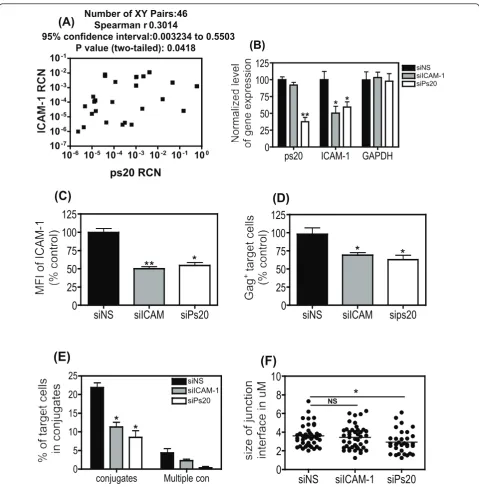
We assessed the potency of ps20- vs. ICAM-1- mediated virus transfer and determined the relative importance of each in T-T conjugate formation, using an si-RNA tar-geted knock-down strategy in the Jurkat system.
Treat-ment of Jwt-ps20inter cells with siRNA against ICAM-1
led to a significant 50% reduction in the levels of ICAM-1 mRNA, with no significant reduction of either ps20 or GAPDH expression (Figure 6A). However, siRNA against ps20 led to a significant 60% reduction in ps20 mRNA, and a concomitant 40% reduction in ICAM-1 mRNA, with no reduction in GAPDH. This confirms our previous observations that blocking ps20 can inhibit ICAM-1 expression [23]. Surface ICAM-1 protein expression was reduced by 50% and 45% with siRNA against ICAM-1 or ps20, respectively (Figure 6B). Ps20 vs. ICAM-1 knockdown resulted in a 36% vs. 30% reduction in the levels of virus transfer respectively (Fig-ure 6C). In addition, ICAM-1 versus ps20 siRNA inhib-ited single conjugates by 50% vs. 61% respectively (Figure 6D). ICAM-1 siRNA inhibited multiple conju-gates by 50% versus a marked 92% by ps20 siRNA (Fig-ure 6D). Lastly, the size of the conjugate interface was not affected by ICAM-1 knockdown, whereas ps20 knockdown had a small but consistent effect; a signifi-cant 1.2-fold reduction in mean conjugate diameter
from 3.601 (± 0.1871) μm in NS siRNA treated control
to 2.933 (± 0.2179)μm in ps20 siRNA treated cells was
noted (Figure 6E).
Discussion
Cell-to-cell HIV transfer is a significant mode of virus
spread amongst CD4+ T cells in-vitro[3-10] and also
likely to be predominantin vivo, since memory CD4+T
cells are more likely to become infected while trafficking through secondary lymphoid tissue, where lymphocyte velocities decrease allowing for cell-virus and cell-cell interactions to take place [10,39,40]. Therefore, identify-ing host factors that regulate this process is of impor-tance to understanding HIV-1 disseminationin-vivo.
Single conjugate ps20 inter
Single conjugate ps20 high
A)
B)
C)
5uM
2uM 2uM
2uM 2uM
2uM 2uM
D) E)
[image:8.595.60.537.89.553.2]
Multiple conjugates Virological Synapse Remote contacts
Figure 5ps20highCD4+ T cells form a higher frequency of conjugates, multiple conjugates and VS with HIV-1 infected donor cells. 1 ×
105DDAO vital dye labelled ps20inter(Figure 5A) and ps20high(Figure 5B) target cells were co-cultured with 60% 1 × 1052044-infected donor
cells for 1 hour on Poly-L-lysine coated glass cover slips. Cells were then fixed and stained with a PE anti-Gag (red) and a FITC anti-CD4 (green) Abs. The frequency of target cells that were involved in a single conjugate was defined as the percentage of dye-labelled target cells apposed to an HIV-1-infected donor cell. Representative high power fields captured at 63× magnification are shown, which depict single conjugates for between (A) J-ps20interor (B) J-ps20highcells and HIV-infected donor cells. Left panels depict conjugates with no HIV-Gag CD4 polarization to conjugate interface. Right panels depict conjugates with HIV-Gag and CD4 polarization (yellow) to conjugate interfaces. (C) Picture shows a representative high power field of dye labelled targets (white arrows) involved in multiple conjugates, defined as a target cell apposed to two or more HIV-1-infected donor cells. (D) Picture shows a representative high power field of a polysynapse, defined as a cell with two or more virological synapses (yellow) at conjugate interfaces. (E) Picture shows a representative high power field of remote contacts (RC) (filopodial bridges or nanotubes) that connect uninfected target cells to HIV-infected targets. (F) Mean frequency of J-ps20intervs. J-ps20highcells involved in single conjugate, multiple conjugates, or which contain virological synapses, polysynapses or are in contact through remote contacts are shown. A total of 600 random target cells were assessed across quadruplicate experiments. (G) Qualitative analysis of the junction diameter of a conjugates was measured using LEICA TCS SP2 software, where the diameter was measured across the medial section of a conjugate. Graph depicts the mean conjugate interface diameter (μM) between J-ps20intervs. J-ps20highcells and HIV-1-infected donor cells. A total of at least 30
Number of XY Pairs:46 Spearman r 0.3014
95% confidence interval:0.003234 to 0.5503 P value (two-tailed): 0.0418
10-6 10-5 10-4 10-3 10-2 10-1 100 10-7
10-6 10-5 10-4 10-3 10-2 10-1
(A)
ps20 RCN
ps20 ICAM-1 GAPDH
0 25 50 75 100 125
(B)
siNS
siPs20 siICAM-1
*
* * *
siNS
siICAM
siPs20
0
25
50
75
100
125
(C)
*
**
siNS
siICAM
sips20
0
25
50
75
100
125
(D)
*
*
conjugates Multiple con
0 5 10 15 20
25 siNS
siPs20 siICAM-1
*
*
(E)
siNS
siICAM-1 siPs20
0
2
4
6
8
10
(F)
*
[image:9.595.58.538.86.574.2]NS
Figure 6mediated knockdown of ps20 inhibits conjugate and multiple conjugate formation more effectively than siRNA-mediated knockdown of ICAM-1. (A) ps20 and ICAM-1 mRNA levels were measured in a selection of ps20highandps20inter/lowcells at 4 different time points. Data show a two-tailed non-parametric Spearman’s r correlation of all data points. CD4 T-cell Jwt ps20interwere treated with either; a non-silencing (NS), ICAM-1 or WFDC1/ps20-silencing siRNA pool for 6 days. (B) After siRNA treatment the expression of ICAM-1, ps20 and GAPDH mRNA was analyzed by qRT-PCR and relative expression tob-actin was measured. Normalized relative expression was calculated in reference to siNS control. Data represent the mean of three replicate assays. (C) Surface expression of ICAM-1 in siRNA treated cells is shown as assessed by standard immunofluorescence. Normalized MFI was calculated in reference to siNS control. Data represent the mean of three replicate assays (D) 8 × 10⁴NS, ICAM-1, or ps20 siRNA-treated WT Jurkat cells were dye-labelled and co-cultured with donor 40%
2044-infected donor cells at a T:D ratio of 1:0.2. Mean percentage of Gag+target cells after 4-hour co-culture is shown. Normalized % of Gag+target
cells was calculated in reference to siNS control. Data represent the mean of three replicate assays. (E) 5 × 10⁵siRNA treated cells were
dye-labelled and co-cultured with 5 × 10560% 2044-infected donor cells. Co-cultures were incubated for 1 hour on Poly-L-lysine coated glass cover
as in a panel of primary CD4+ T cell clones. We report a significant positive correlation between endogenous ps20 expression levels and T-T virus transfer. Blocking ps20 activity with siRNA or specific antibody signifi-cantly inhibited T-T transfer. Conversely, gain of
func-tion studies using ps20-transduced Jurkat CD4+ T cells
or the exogenous addition of rps20 confirmed ps20 to promote HIV-1 transfer. We further show inhibition of virus transfer and spread into ps20high cells by the T-20 fusion inhibitor and RT inhibitors respectively, with dif-ferences in virus spread between ps20highvs. ps20low/inter populations reaching upto 5.7-fold in Jurkat cells (Figure 2) and 8.7-fold in primary clones (Figure 3), highlighting ps20 to be a potentially potent pathway in promoting T-T virus dissemination.
Divergent data exist with regard to cell-cell transfer mediated by fusion vs. endocytosis contributing to pro-ductive HIV infection [6-8,36,37,41]. In studies using
unstimulated CD4+ T-cells as target populations, virus
transfer through endocytosis [8,36,37] was noted. How-ever, other studies show T-T virus transfer to be both co-receptor- and virus fusion- dependent [6,41]. Whilst the infected donor cell in these divergent studies was Jurkat or Molt 4, a key difference appears to be the state of target cell activation with evidence of fusion
dependent entry into activated memory CD4+ T-cells
targets [41]. Our observations with activated clonal CD4 T-cells or Jurkat cells are therefore compatible with this data. Taken together, these findings suggest that the activation state of the target cell may account for observed differences in the mode of virus uptake during cell-cell virus transfer. Indeed, these differences may account for other data showing ICAM-1 and LFA-1 as
not being critical for HIV transfer to unstimulatedex
vivo CD4 T cells [38], which have been shown to take
up virus via endocytosis [8,36,37]. Thus it is reasonable to hypothesize that, differences in the molecular deter-minants and the mechanisms that govern virus transfer are at least partly dependent on the state of activation of the target CD4+T-cell.
An important step in HIV transfer is the conjugation between an infected and an uninfected cell, leading to VS formation, through which virus can be directly trans-ferred [3-10]. A time-lapse microscopy study highlighted that up to 80% of T-T conjugates, at some point after conjugation/contact, form a VS [11]. Consequently, we examined the role of ps20 in the quality and quantity of T-T conjugate formation. Evidence is provided in sup-port of ps20 promoting intercellular conjugation and VS formation. As the overall proportion of conjugates
con-taining VS was similar between ps20high and ps20low
populations, the capacity of ps20 to promote VS forma-tion may be attributable to the protein enhancing T-cell conjugation. In addition, we observed a higher frequency
of multiple conjugates and polysynapses in the presence of ps20. Therefore, the ability of ps20 to promote multi-ple conjugates and polysynapses may be of critical importance to virus dissemination in lymphoid and mucosal tissue by allowing for fewer transient interac-tions between cells [see [12]]. This notion is further sup-ported by the observation that the conjugate interface
between infected donor cells and ps20high targets was
significantly larger compared to ps20low targets. These characteristics were attributable to ps20, since knocking down ps20 expression significantly reduced the number of single conjugates, multiple conjugates, the size of the conjugate interface and resulting virus transfer.
Molecular determinants of cell-cell conjugate and VS formation include the actin and microtubule cytoskeletal networks, cell signalling, tetraspanin and lipid raft recruitment [6,13-22,42]. In addition to the HIV-1 receptor complex, several adhesion molecules can polar-ize to, and stabilpolar-ize these supramolecular synapses [13,15,17,20,21]. In particular, Jolly et al. showed that anti-ICAM-1 inhibited VS by 30%, while anti-LFA-1 inhibited VS and conjugate formation from 15-90% depending on the blocking Ab used [17]. Previously, we demonstrated that ps20 enhanced HIV-1 infection through ICAM-1 modulation [23]. Here we confirm and extend these observations. Knocking down ps20 by 60% specifically suppressed ICAM-1 mRNA by 40% and ICAM-1 surface staining by 45% and both ICAM-1 and ps20 individually contributed to conjugate formation and virus transfer. Strikingly, knocking down ps20 inhib-ited multiple conjugate formation by 90% compared to 50% inhibition by siRNA against ICAM-1. Furthermore, ICAM-1 did not impact the size of the conjugate inter-face, whilst ps20 did so, albeit marginally (Figure 6E). These data suggest that ps20-induced ICAM-1 modula-tion though important, may not fully account for the ps20 effect. As ps20 is implicated in regulating extracel-lular matrix (ECM) components [31,34] and given recent data that another retrovirus, HTLV-1, can be captured, and then transmitted through ECM glycopro-teins’[43], the identification of other adhesion and ECM targets regulated by ps20 and their role in cell-cell HIV-1 transfer could enhance understanding of mechanisms that drive HIV-1 disseminationin-vivo.
The molecular mechanisms by which ps20 regulates ICAM-1 expression and clustering through putative binding partners and signalling functions are part of on-going work in our laboratory. Other work highlights a fundamental role for ps20 in cell migration and angio-genesis [31]. Both these processes are recognised to modulate adhesion molecules [32,33]. As cell-cell adhe-sion plays a significant role in successful virus infections in general [44], it could be argued that the potency of
fundamental role in regulating cell adhesion. The novel
observation that CD4+ T cells can be segregated into
stable subsets on the basis of ps20 expression coupled
with the observation that ps20high CD4+ T cells are
more susceptible to infection than ps20lowcells, strongly suggests that ps20+ CD4+ T cells may be preferentially targeted and lostin-vivo. Our contention is that local concentrations of ps20, in tissue such as the gut, may
drive HIV-1 infection and CD4+ T cell loss by
increas-ing adhesion antigen expression on CD4+ T cells
through autocrine and paracrine effects, thereby high-lighting a novel role for the ancient whey acidic protein, WFDC1/ps20, in HIV-1 pathogenesis.
Conclusions
This study highlights three novel aspects of T-T HIV transfer. First, using three approaches to probe T-T HIV transfer, namely, flow cytometry, PCR and confocal microscopy, this study highlights ps20 to be a novel host factor that promotes cell-cell conjugation and viro-logical synapse formation in gain and loss of function assay systems. Second, one mechanism by which ps20 promotes intercellular HIV transfer is by regulating sur-face ICAM-1 expression levels. Importantly, ps20 pro-moted multiple cell conjugation more efficiently than ICAM-1 and was identified to promote poly-synapse formation. Host factors that promote poly-synapse for-mation may be particularly potent in promoting virus
dissemination in vivo [12] and thereby impact HIV-1
pathogenesis. Thirdly, the observation that primary CD4 T-lymphocyte clones segregate naturally into distinct subsets based on endogenous ps20 expression and that ps20 levels correlate with intercellular HIV transfer, identifies ps20 to a novel marker of CD4 T cells that are vulnerable to HIV infection. Together, these observa-tions highlight that ps20 is a novel host factor that could promote virus dissemination by promoting T-T cell conjugation.
Methods
CD4+T cells
Jurkat CCR5+ T cells (from National Centre for Biologi-cal Standards & Controls, NIBSC, UK) were maintained in RPMI 1640 (GIBCO Invitrogen, UK) + 10% Fetal Calf Serum (FCS) (Helena Biosciences UK), 20 ug/ml Genta-mycin (Sigma-Aldrich, UK). A panel of random blood CD4+ T-cell clones generated by standard limiting dilu-tion cloning [23,45] was screened for ps20 mRNA, and cells were identified to be ps20high
, ps20inter, ps20low(see
Additional file figure S1A). Additionally, two CD4+ T
cell clones isolated from Endoscopy sections taken from non-lesional or lesional portion of the colon of a patient with Crohns disease (kind gift Dr. Deena Gibbons and
Prof. Adrian Hayday King’s College London) were
identified to be ps20low and ps20high respectively. Clones were maintained in RPMI 1640, 10% FCS + 10% Human
AB+ Serum (First Link, UK), 20 ug/ml Gentamycin. A
typical feeding cycle of CD4+ T cell clones included
activation with irradiated allogeneic PBMC (1:1 ratio) +
2 μg/ml PHA (Biostat Diagnostic Systems, Germany) +
20 IU/ml IL2 (Proleukin, Chiron, UK) every 10-14 days. Cells were split and fed every 3-4 days with fresh 30 IU/ ml IL2.
Stable ps20highJurkat CD4+T cells
The WFDC1 gene was digested out from the pHA/
WFDC1expression plasmid (kind gift D. Rowley, Baylor
University, USA) withEcoRI and cloned into an MMLV
based bi-cistronic retroviral vector, pCxCR encoding red fluorescent protein (RFP) under the control of a cytome-galovirus (CMV) promoter (kind gift Greg Towers, Uni-versity College London). Retroviral particles encoding WFDC1/RFP (pCps20CR), or RFP alone (pCxCR, empty vector control) were made by transient transfection of 293T cells with pCxCR, or pCG9CR, along with the packaging construct pCpg (MMLV Gag/Pol) and an envelope construct encoding VSV-G (pMD.G) (kind gift D. Trono, Geneva, Switzerland). Retroviral particles were harvested 48 hrs after transfection, clarified and
titrated onto 2 × 10⁵ CCR5+ CD4+ Jurkat cells, three
times over 3 days. Cells were sorted for RFP, expanded and ps20 expression confirmed by qRT-PCR. The ps20 transduced population is referred to as J-ps20high; the empty vector control as J- ps20inter.
Virus Production
The primary HIV-1 X4 strain 2044 was propagated in PHA activated PBMC [35]. The HIV-1 full-length mole-cular clones NL4-3 and YU2 (kind gift, M Malim, King’s College London) were produced by the transient trans-fection of 293T cells, using Fugene 6 reagent (Roche, Switzerland). Viral stocks were standardised based on Gag p24 concentrations determined by p24 ELISA (NIH Reagents).
Antibodies
Anti-CD54 RPE (clone 15.2; Serotec, U.K.); anti-ps20 (IG7; kind gift D. Rowley); anti-ICAM-1 Ab (LB-2) (BD Pharmingen, CA); FITC- or PE- conjugated Gag-p24 antibody (clone KC57; Beckman Coulter, UK) were used. In addition: anti-CD4 (L120), anti-HIV ENV and rabbit anti-HIV Gag p24 and p17 were obtained from NIBSC, UK. Isotype-matched mAbs were from BD Phar-mingen, CA.
Ps20 ELISA
amino acid sequence was generated through Eurogentec Ltd, Belgium. Nunc 96-well plates were coated over-night at 4°C with 1 ug/mL 202-254 diluted in PBS. Plates were blocked with PBS, 1% BSA for 2H at room temperature (RT), washed x3 with PBS-0.2% Tween-20 and test samples added for 2 hours at RT. Plates were washed 6 times to remove unbound material. Detection was with 2 ug/ml IG7 anti-ps20 conjugated to horserad-ish peroxidase in PBS-1% BSA-0.2% Tween-20 for 2
hours, RT followed by further 6 washes. 150μL of
sub-strate OPD (Sigma) was added for 30 min. at room
tem-perature and stopped with 50μL of 4 M sulphuric acid.
Optical densities were determined at 492 nm in a Bio-Rad ELISA plate reader. Ps20 concentrations were deter-mined in relation to a standard curve using recombinant ps20 of known concentration generated in drosophila2.
Spreading HIV-1 infection
Cells were challenged with virus stocks standardised on Gag p24 concentration, and unbound virus was removed by washing after 24 hours. Productive infection was monitored by intracellular staining for HIV-1 Gag p24 using a Fix and Perm kit (AD Serotec, U.K.). Cells were fixed for 10 minutes at RT in fixation buffer, washed once with cold PBS, then resuspended in permeabiliza-tion buffer and a 1/10 final dilupermeabiliza-tion of KC57 RD1 or FITC added for 25 minutes at RT. Samples were washed twice with PBS and resuspended in PBS 2%FCS, 2% par-aformaldehyde and analysed on a FACSCalibur instru-ment and data analysed using Flow Jo software.
Cell to cell HIV-1 transfer assay
A modified version of an assay described by Sourisseau
et al [10,15] was used. Briefly, WT Jurkat CD4+ T cells (Donor) were infected with HIV-1 strains till cultures were 10-60% Gag p24+. Targets cells comprising ps20high, ps20interor ps20low CD4+ T cell population were first labelled with the Cell Trace FarRed DDAO-SE vital dye (Invitrogen UK). 1 × 10⁶/ml target cells were
incubated in PBS with 10 μM of the DDAO-SE dye for
7 minutes at 37°C, washed twice in PBS 5% FCS and co-cultured with infected donor cells at varying ratios in a final volume of 500μl in a 24-well plate. Infection
inhi-bitors included were 5 μg/ml T-20 (Roche,
Hertford-shire, UK), or 5 μM each of AZT/Lamirudine (AIDS
Repository Reagent Program, MD, USA). Gag transfer was measured 4 hours post co-culture by enumerating dye-labelled targets cells that stained positive for HIV-1 Gag p24 by flow cytometry.
siRNA knockdown
Accell siRNA smart pools targeting ps20 (E-013097-00), ICAM-1 (E-003502-00-0010) or a non-specific tar-geting control (D-001910-10) were purchased from
Dharmacon, CO, USA. Cell populations were washed 3 times in PBS prior to resuspension at a density of 3 ×
105/ml in Accell siRNA passive uptake media
contain-ing, 3% FCS and 1 μM of specified Accell siRNA
pools. For primary clones, the medium was supple-mented with 30 IU/ml IL-2. 3 days later cells were
washed and re-incubated at 3 × 10⁴ cells/well in a
96-well plate in a fresh aliquot of complete passive uptake
media containing 1 μM of specified Accell siRNA pool.
3 days later, cells were washed, and target gene knock-down efficiency was assessed by qRT-PCR before use in functional assays.
mRNA measurement
Total RNA was extracted using an RNaeasy kit (Qiagen, UK), then converted to cDNA (Ambion, Inc., TX, USA). ps20 was measured using a custom designed Taqman™ assay as described previously [23]. ICAM-1 was
mea-sured using a TaqMan® primer and probe set
(Hs99999152_m1). ps20/ICAM-1 expression was
mea-sured relative to HPRT 1(Hs01003268_g1) or b-actin
(Hs99999903_m1) or GAPDH (Hs99999905_m1)
(Taq-Man®; Applied Biosystems, UK), according to
manufac-turer’s instructions, on an ABI Prism 7900 HT (Applied Biosystems, CA, USA). Data was analyzed using SDS 2.3 software (Applied biosystems, CA, USA). Relative copy number (RCN) was calculated by determining the delta ct values, which was used in the following equation (RCN) = 2^(-ΔCt).
HIV-1 LTR measurement
DNA was extracted using a DNeasy kit (Qiagen, UK).
Primer sequences for HIV-1 LTR were; L2:
CTGTGGATCTACCACACACAAGGCTAC (forward)
and L3:GCTGCTTATATGTAGCATCTGAGGGC
(reverse) [46] and measured using TaqMan® probe
assay relative tob-actin (Applied Biosystems, CA, USA). Delta Ct was first calculated, then normalized by sub-tracting the delta ct values generated from 8E5 cells, which contain one integrated copy of HIV-1. Relative copy number = 2^(-ΔΔCt).
Confocal microscopy
Far Red DDAO-SE dye-labelled target cells were cul-tured with HIV-1 infected donor cells along with 5 ug/ ml anti-CD4 and anti-HIV ENV Abs on poly-L-lysine coated glass cover slips (Sigma, UK). Cells were washed twice with PBS, fixed for 10 minutes in 4% paraformal-dehyde, 1% BSA in PBS at RT, washed twice with PBS 1% BSA and permeabilized using 0.2% triton X-100 for 10 minutes at RT. The cells were then blocked and
quenched in 50 mM NH4CL, 2% mouse serum, 2% BSA,
anti-CD4, L120-FITC (BD, San Jose, CA) at 1/20 total volume dilutions in block/quench buffer for 60 minutes at RT. After incubation, cells were washed 3× with PBS and mounted on Superfrost Plus glass slides (VWR International, UK), using ultramount aqueous perma-nent mounting medium (Dako, Denmark). Slides were allowed to dry overnight at 4°C in the dark. The next day the cells were visualized by scanning laser confocal microscopy on a Leica DM IR2 (LEICA Microsystems, Germany) and analyzed using LEICA TCS SP2 confocal software (LEICA, Microsystems, Germany). Images were acquired using a 63× oil-immersion objective and pro-cessed using Adobe Photoshop CS (Adobe Systems, San Jose, CA).
Statistical Analysis
Statistical analysis of data was performed using Graph Pad PRISM Software, San Diego, CA. All p-values reported are two-tailed. P values of less than or equal to 0.05 were deemed significant.
Additional material
Additional file 1: Figure S1. Jurkat CD4 T cells stably transduced to express full-length human ps20 are more susceptible to cell-free HIV-1 infection. A) The mean relative copy number (RCN) of ps20 mRNA (relative to the HPRT house keeping gene) measured in three biological replicate samples by qRT-PCR; in the empty vector (EV) transduced ps20interJurkat cells, WFDC1/ps20 transduced ps20highJurkat cells,
wild-type Jurkat cells as well as a panel of 10 primary CD4+T-cell clones
(C1-C10) is shown. The two horizontal lines are arbitrarily set to define CD4 T-lymphocyte populations as ps20 low (RCN <0.001), ps20 intermediate (RCN 0.001-0.1) and ps20 high (>0.1RCN). (B) Mean secreted ps20 protein levels measured in three replicate samples by a ps20 specific ELISA assay are shown. Positive control was supernatant from the human embryonic kidney cell line, 293T cells transfected with a WFDC1/ps20 encoding construct (pBKps20) and supernatant from ps20 mRNA high HeLa cells; negative control was supernatant from 293T cells transfected with empty vector alone (pBK). Test samples included 48-hour culture supernatant from the WFDC1/ps20 transduced population and the empty vector transduced EV population. (C) 2 × 10⁵J-ps20interor J-ps20highcells were
challenged with 2.5 ng/1 × 106cells of the X4-tropic HIV-1 strain, NL4-3.
Productive infection was measured by intracellular staining for HIV-1 p24 capsid antigen and the percentage of p24 positive cells determined on days 3, 5 and 7 post-challenge. (D) J-ps20interor J-ps20highcells were first
pre-cultured overnight (16 hrs) in 5μg/ml of either control mouse IgG1
or the anti-ps20 Ab, IG7, then challenged with NL4-3 for 24 hours (10 ug Gag p24 antigen concentration of virus stock/105cells). 24 hours later equivalent numbers of cells were trypsinized to remove surface bound virus, washed and cell pellets lysed in PBS with 10% triton-X 100. The amount of Gag p24 antigen was then measured by ELISA and used to assess the fold increase in infection over background. The mean and standard error of triplicate replicate experiments are shown.
Acknowledgements
This work was funded by a PhD studentship funded by the Medical Research Council, UK & by grants to AV from the Guy’s & St Thomas’Charity and the International Consortium for Novel Anti-Virals. The authors thank Professor M Malim for discussions and critical review of the manuscript; Dr Nathan Shearer for expert advice on confocal microscopy and critical review
of manuscript; Dr T Tree for CD4 T cell clones from blood and Dr Deena Gibbons and Professor AH Hayday for CD4+T cell clones isolated from gut
tissue. The authors thank Professor Q Sattentau and Dr C Jolly for helpful discussions, and review of the manuscript.
Authors’contributions
AV was involved in experimental design, hypothesis generation and manuscript editing. RAA conducted 80% of the work outlined and wrote the manuscript. JLR helped with qRT-PCR. GT helped with qDNA-PCR and HIV transfer assays. SKR helped develop the ps20 ELISA. All authors read and approved the final manuscript.
Conflict of interests
The authors declare that they have no competing interests.
Received: 18 October 2010 Accepted: 5 May 2011 Published: 5 May 2011
References
1. Sherer NM, Lehmann MJ, Jimenez-Soto LF, Horensavitz C, Pypaert M, Mothes W:Retroviruses can establish filopodial bridges for efficient cell-to-cell transmission.Nat Cell Biol2007,9:310-315.
2. Sowinski S, Jolly C, Berninghausen O, Purbhoo MA, Chauveau A, Köhler K, Oddos S, Eissmann P, Brodsky FM, Hopkins C, Onfelt B, Sattentau Q, Davis DM:Membrane nanotubes physically connect T cells over long distances presenting a novel route for HIV-1 transmission.Nat Cell Biol
2008,10:211-219.
3. Jolly C, Sattentau QJ:Retroviral spread by induction of virological synapses.Traffic2004,5:643-650.
4. Sattentau Q:Avoiding the void: cell-to-cell spread of human viruses.Nat Rev Microbiol2008,6:815-826.
5. Dimitrov DS, Willey RL, Sato H, Chang LJ, Blumenthal R, Martin MA:
Quantitation of human immunodeficiency virus type 1infection kinetics.
J Virol1993,67:2182-2190.
6. Jolly C, Kashefi K, Hollinshead M, Sattentau QJ:HIV-1 cell-to-cell transfer across an Env-induced, actin-dependent synapse.J Exp Med2004,
199:283-293.
7. Carr JM, Hocking H, Li P, Burrell CJ:Rapid and efficient cell-to-cell transmission of human immunodeficiency virus infection from monocyte-derived macrophages to peripheral blood lymphocytes.
Virology1999,265:319-329.
8. Chen P, Hubner W, Spinelli MA, Chen BK:Predominant mode of human immunodeficiency virus transfer between T cells is mediated by sustained Env-dependent neutralization-resistant virological synapses.J Virol2007,81:12582-12595.
9. Sato H, Orenstein J, Dimitrov D, Martin M:Cell-to-cell spread of HIV-1 occurs within minutes and may not involve the participation of virus particles.Virology1992,186:712-724.
10. Sourisseau M, Sol-Foulon N, Porrot F, Blanchet F, Schwartz O:Inefficient human immunodeficiency virus replication in mobile lymphocytes.J Virol2007,81:1000-1012.
11. Hübner W, McNerney GP, Chen P, Dale BM, Gordon RE, Chuang FY, Li XD, Asmuth DM, Huser T, Chen BK:Quantitative 3D video microscopy of HIV transfer across T cell virological synapses.Science2009,323:1743-1747. 12. Rudnicka D, Feldmann J, Porrot F, Wietgrefe S, Guadagnini S, Prévost MC,
Estaquier J, Haase AT, Sol-Foulon N, Schwartz O:Simultaneous HIV Cell-to-Cell Transmission To Multiple Targets Through Polysynapses.J Virol2009,
83:6234-46.
13. Nobile C, Petit C, Moris A, Skrabal K, Abastado JP, Mammano F, Schwartz O:
Covert human immunodeficiency virus replication in dendritic cells and in DC-SIGN-expressing cells promotes long-term transmission to lymphocytes.J Virol2005,79:5386-5399.
14. Vasiliver-Shamis G, Cho MW, Hioe CE, Dustin ML:Human
immunodeficiency virus type 1 envelope gp120-induced partial T-cell receptor signalling creates an F-actin-depleted zone in the virological synapse.J Virol2009,83:11341-11355.
15. Sol-Foulon N, Sourisseau M, Porrot F, Thoulouze MI, Trouillet C, Nobile C, Blanchet F, di Bartolo V, Noraz N, Taylor N, Alcover A, Hivroz C, Schwartz O:
16. Jolly C, Sattentau QJ:Human immunodeficiency virus type 1 assembly, budding, and cell-cell spread in T cells take place in tetraspanin-enriched plasma membrane domains.J Virol2007,81:7873-7884. 17. Jolly C, Mitar I, Sattentau QJ:Adhesion molecule interactions facilitate
human immunodeficiency virus type 1-induced virological synapse formation between T cells.J Virol2007,81:13916-13921.
18. Arthos J, Cicala C, Martinelli E, Macleod K, Van Ryk D, Wei D, Xiao Z, Veenstra TD, Conrad TP, Lempicki RA, McLaughlin S, Pascuccio M, Gopaul R, McNally J, Cruz CC, Censoplano N, Chung E, Reitano KN, Kottilil S, Goode DJ, Fauci A:SHIV-1 envelope protein binds to and signals through integrin alpha4beta7, the gut mucosal homing receptor for peripheral T cells.Nat Immunol2008,9:301-309.
19. Krementsov DN, Weng J, Lambele M, Roy NH, Thali M:Tetraspanins regulate cell-to-cell transmission of HIV-1.Retrovirology2009,6:64. 20. Tsunetsugu-Yokota Y, Yasuda S, Sugimoto A, Yagi T, Azuma M, Yagita H,
Akagawa K, Takemori T:Efficient virus transmission from dendritic cells to CD4+ T cells in response to antigen depends on close contact through adhesion molecules.Virology1997,239:259-268.
21. McDonald D, Wu L, Bohks SM, KewalRamani VN, Unutmaz D, Hope TJ:
Recruitment of HIV and its receptors to dendritic cell-T cell junctions.
Science2003,300:1295-1297.
22. Jolly C, Sattentau QJ:Human immunodeficiency virus type 1 virological synapse formation in T cells requires lipid raft integrity.J Virol2005,
79:12088-12094.
23. Alvarez R, Reading J, King DF, Hayes M, Easterbrook P, Farzaneh F, Ressler S, Yang F, Rowley D, Vyakarnam A:WFDC1/ps20 is a novel innate immunomodulatory signature protein of human immunodeficiency virus (HIV)-permissive CD4+ CD45RO+ memory T cells that promotes infection by upregulating CD54 integrin expression and is elevated in HIV type 1 infection.J Virol2008,82:471-486.
24. Tardif MR, Tremblay MJ:LFA-1 is a key determinant for preferential infection of memory CD4+ T cells by human immunodeficiency virus type 1.J Virol2005,79:13714-13724.
25. Liao Z, Roos JW, Hildreth JE:Increased infectivity of HIV type 1 particles bound to cell surface and solid-phase ICAM-1 and VCAM-1 through acquired adhesion molecules LFA-1 and VLA-4.AIDS Res Hum Retroviruses
2000,16:355-366.
26. Fortin JF, Cantin R, Lamontagne G, Tremblay M:Host-derived ICAM-1 glycoproteins incorporated on human immunodeficiency virus type 1 are biologically active and enhance viral infectivity.J Virol1997,
71:3588-3596.
27. Tardif MR, Tremblay MJ:Presence of host ICAM-1 in human
immunodeficiency virus type 1 virions increases productive infection of CD4+ T lymphocytes by favoring cytosolic delivery of viral material.J Virol2003,77:12299-12309.
28. Bingle CD, Vyakarnam A:Novel innate immune functions of the whey acidic protein family.Trends Immunol2008,29:444-453.
29. Ranganathan S, Simpson KJ, Shaw DC, Nicholas KR:The whey acidic protein family: a new signature motif and three-dimensional structure by comparative modeling.J Mol Graph Model1999,17:106.
30. Moreau T, Baranger K, Dadé S, Dallet-Choisy S, Guyot N, Zani ML:
Multifaceted roles of human elafin and secretory leukocyte proteinase inhibitor (SLPI), two serine protease inhibitors of the chelonianin family.
Biochimie2008,90:284-295.
31. McAlhany SJ, Ressler SJ, Larsen M, Tuxhorn JA, Yang F, Dang TD, Rowley DR:Promotion of angiogenesis by ps20 in the differential reactive stroma prostate cancer xenograft model.Cancer Res2003,
63:5859-5865.
32. Berrier AL, Yamada KM:Cell-matrix adhesion.J Cell Physiol2007,
213:565-573.
33. Hynes RO, Lively JC, McCarty JH, Taverna D, Francis SE, Hodivala-Dilke K, Xiao Q:The diverse roles of integrins and their ligands in angiogenesis.
Cold Spring Harb Symp Quant Biol2002,67:143-153.
34. Larsen M, Ressler SJ, Lu B, Gerdes MJ, McBride L, Dang TD, Rowley DR:
Molecular cloning and expression of ps20 growth inhibitor. A novel WAP-type“four-disulfide core”domain protein expressed in smooth muscle.J Biol Chem1998,273:4574-4584.
35. Ruggiero E, Bona R, Muratori C, Federico M:Virological consequences of early events following cell-cell contact between human
immunodeficiency virus type 1-infected and uninfected CD4+ cells.J Virol2008,82:7773-7789.
36. Blanco J, Bosch B, Fernández-Figueras MT, Barretina J, Clotet B, Esté JA:
High level of coreceptor-independent HIV transfer induced by contacts between primary CD4 T cells.J Biol Chem2004,279:51305-51314. 37. Bosch B, Grigorov B, Senserrich J, Clotet B, Darlix JL, Muriaux D, Este JA:A
clathrin-dynamin-dependent endocytic pathway for the uptake of HIV-1 by direct T cell-T cell transmission.Antiviral Res2008,80:185-193. 38. Puigdomenech I, Massanella M, Cabrera C, Clotet B, Blanco J:On the steps
of cell-to-cell HIV transmission between CD4 T cells.Retrovirology2009,
6:89.
39. Bousso P, Robey EA:Dynamic behavior of T cells and thymocytes in lymphoid organs as revealed by two-photon microscopy.Immunity2004,
21:349-355.
40. Celli S, Garcia Z, Bousso P:CD4 T cells integrate signals delivered during successive DC encounters in vivo.J Exp Med2005,202:1271-1278. 41. Martin N, Welsch S, Jolly C, Briggs JA, Vaux D, Sattentau QJ:Virological
synapse-mediated spread of human immunodeficiency virus type 1 between T cells is sensitive to entry inhibition.J Virol2010,84:3516-3527. 42. Vasiliver-Shamis G, Cho MW, Hioe CE, Dustin ML:Human
immunodeficiency virus type 1 envelope gp120-induced partial T-cell receptor signaling creates an F-actin-depleted zone in the virological synapse.J Virol2009,83:11341-11355.
43. Pais-Correia AM, Sachse M, Guadagnini S, Robbiati V, Lasserre R, Gessain A, Gout O, Alcover A, Thoulouze MI:Biofilm-like extracellular viral assemblies mediate HTLV-1 cell-to-cell transmission at virological synapses.Nat Med
2010,16:83-89.
44. Stewart PL, Nemerow GR:Cell integrins: commonly used receptors for diverse viral pathogens.Trends Microbiol2007,15:500-507.
45. Vyakarnam A, Eyeson J, Teo I, Zuckerman M, Babaahmady K, Schuitemaker H, Shaunak S, Rostron T, Rowland-Jones S, Simmons G, Clapham P:Evidence for a post-entry barrier to R5 HIV-1 infection of CD4 memory T cells.AIDS2001,15:1613-1626.
46. Wu Y, Marsh JW:Selective transcription and modulation of resting T cell activity by preintegrated HIV DNA.Science2001,293:1503-1506.
doi:10.1186/1742-4690-8-29
Cite this article as:Alvarezet al.:WFDC1 expression identifies memory CD4 T- lymphocytes rendered vulnerable to cell-cell HIV-1 transfer by promoting intercellular adhesive junctions.Retrovirology20118:29.
Submit your next manuscript to BioMed Central and take full advantage of:
• Convenient online submission
• Thorough peer review
• No space constraints or color figure charges
• Immediate publication on acceptance
• Inclusion in PubMed, CAS, Scopus and Google Scholar
• Research which is freely available for redistribution