Rochester Institute of Technology
RIT Scholar Works
Theses
Thesis/Dissertation Collections
7-1-2000
Perceived image contrast and observer preference
Anthony Calabria
Follow this and additional works at:
http://scholarworks.rit.edu/theses
This Thesis is brought to you for free and open access by the Thesis/Dissertation Collections at RIT Scholar Works. It has been accepted for inclusion
in Theses by an authorized administrator of RIT Scholar Works. For more information, please contact
.
Recommended Citation
Perceived
Image Contrast
and
Observer
Preference
Anthony
J. Calabria
B.S.
Imaging
Science
Perceived Image Contrast and
Observer Preference
Anthony
J.
Calabria
B.S. Imaging Science
Rochester Institute of Technology (2000)
A thesis submitted in partial fulfillment of the requirements
for the degree of Master of Science in Color Science
in
the
Center of Imaging Science, Rochester Institute of Technology
July 2000
Signature of Author
Accepted by
CENTER FOR IMAGING SCIENCE
ROCHESTER INSTITUTE OF TECHNOLOGY
ROCHESTER, NEW YORK
CERTIFICATE OF APPROVAL
M.S. DEGREE THESIS
The M.S. Degree Thesis of Anthony J. Calabria
has been examined and approved
by two members of the color science faculty
as satisfactory for the thesis requirement for the
Master of Science degree
Dr. Mark Fairchild, Thesis Advisor
THESIS RELEASE PERMISSION FORM
Rochester Institute of Technology
Center for Imaging Science
Title of Thesis
Perceived Image Contrast and
Observer Preference
I, Anthony
J.
Calabria, hereby grant permission to the Wallace Memorial Library of
R.I.T. to reproduce my thesis in while or part. Any reproduction will not be for
commercial use or profit.
Signature of Author
Perceived
Image Contrast
and
Observer Preference
Anthony
J. Calabria
A
thesis
submitted
in
partial
fulfillment
of
the
requirements
for
the
degree
of
Master
of
Science in Color Science
in
the
Center
of
Imaging
Science,
Rochester Institute
of
Technology
Abstract
A
large-scale investigation
into
the
perception of contrast
in
color
images
was performed.
Experiments
were performed
to
determine
the
influence
of
image
lightness,
chroma,
and
sharpness
transforms
on perceived
image
contrast and
observer preference.
The
influence
of
lightness,
chroma,
and sharpness manipulations was
investigated separately
by
independent
soft-copy,
paired-comparison
tests
of
contrast
perception and
image
preference.
The
perception of
contrast
between images
of
different
transforms
and
different
subject
matter
was also
investigated
as
was
the
perception of
image
contrast
relative
to the
most preferred
image
manipulation.
In
all,
five
experiments
of contrast
perception
and
four
experiments of
image
preference
were
performed
by
at
least
thirty-two
observers each.
Results
of
the
lightness,
chroma,
and sharpness-contrast
experiments
indicate
perceived
image
contrast
is
a
function
of multiple
image
characteristics as opposed
to
simply
being
a
function
of
the
dynamic
range
of
image
intensity. In
the
Lightness-Contrast
Experiments,
images
of
identical
white
and
black
points were scaled
to
have
significant
differences in
contrast
based
on
their
manipulations
from
the
original
image. In
the
Chroma-Contrast
Experiments,
images
of
identical
lightness
channels were scaled
to
have
significant
differences in
perceived contrast
due
to
relative chroma amount.
In
the
Sharpness-Contrast
Experiments,
images
of
identical
white and
black
points
were
scaled
to
have significantly different levels
of perceived contrast
due
to
sharpness.
In
the
Scale-Linking
Experiment,
it
was
found
that
images
of
the
above
manipulations could
be
scaled
similarly for
perceived contrast.
All
scales
of
perceived
contrast
and
image
preference
were
found
to
be image independent among
pictorial
images.
Empirical modeling
of perceived contrast
indicates differences in
perceived contrast can
be
quantified as a
function
of
image
colorimetry,
independent
of original scene
Acknowledgements
Special
thanks
go
to the
following
for
their
influence
on
this
research
and
efforts
leading
up
to this
point.
Dr. Mark Fairchild
whose
wisdom
and guidance
have been invaluable both
professionally
and personally.
Dr. Ethan
Montag
for
his
guidance,
inspiration
and
support.
Dr.
Roy
Berns
who
taught
me
knowledge
worth
having
is knowledge
worth
teaching.
Garrett Johnson my
friend,
colleague,
and roommate.
The
faculty,
staff,
and
students of
the
Munsell Color Science Laboratory.
Jack Ladson
for giving
me
the
opportunity
that
started
me
down
this
path.
My
family
and
friends for
being
there
when
I
needed
them.
And
to
Monica,
whose
love,
support,
and
motivation
over
the
last
two
years was
exceeded
only
by
her
patience
and understanding.
Table
of
Contents
Table
of
Contents
vii
List
of
Tables
xi
List
of
Figures
xiv
List
of
Equations
xxi
1
.Introduction
1
2.
Background
9
2.1
Past Research
on
Contrast
10
2.2
Past Research
on
Image
Contrast
13
2.3
Past Research
on
the
Helmholtz-Kohlrausch Effect
16
3.
Experimental
18
3.1
Experimental
Setup
18
3.1.1
Device Specifications
18
3.1.2
Device Characterization
18
3.1.2.1
Stability
ofPrimaries
20
3.1.2.2
Luminance,
Contrast
and
Additivity
21
3.1.2.3
Primary
Transform
Matrix
and
Inverse
22
3.1.3
Viewing
Conditions
26
3.2
Experimental
Overview
27
3.2.1
Test Images
28
3.2.2
Experimental
Images
Image Manipulations
29
3
.2.2.1
Lightness-Contrast
Experiment Images
29
3.2.2.2
Chroma-Contrast Experiment Images
30
3.2.2.3
Sharpness-Contrast
Experiment Images
31
3.2.2.4
Scale-Linking
Experiment Images
32
3.2.2.5
Inter-Image Contrast
Scaling
Experiment
Images
33
3.2.3
Observers
34
4.
Lightness-Contrast Experiments
38
4.1
Observers
38
4.2
Lightness-Contrast
Experiment Images
38
4.3
Scale Generation
40
4.3.1
Perceived
Lightness-Contrast Scales
40
4.3.2
Image Preference Scales
41
4.3.3
Observer Expertise Comparison
42
4.4
Analysis
44
4.4.1
Image Contrast Perception Analysis
45
4.4.2
Image Preference Analysis
49
4.4.3
Image Preference
vs.
Perceived
Contrast Analysis
52
4.5
Lightness-Contrast Experiments
Summary
56
5.
Chroma-Contrast
Experiments
58
58
59
59
60
60
61
62
62
66
69
70
5.1
Observers
5.2
Chroma-Contrast Experiment Images
5.3
Scale Generation
5.3.1
Perceived Chroma-Contrast Scales
5.3.2
Image Preference Scales
5.3.3
Observer Expertise Comparison
5.4
Analysis
5.4.1
Image
Contrast Perception Analysis
5.4.2
Image Preference
Analysis
5.4.3
Image Preference
vs.
Perceived
Contrast Analysis
6.
Sharpness-Contrast Experiments
72
72
73
73
74
74
75
76
77
79
83
86
7.
Scale-Linking
Experiments
88
88
89
89
90
91
91
93
93
95
97
99
108
8.
Inter-Image Contrast
Scaling
Experiment
109
8.1
Observers
109
8.2
Inter-Image
Contrast
Scaling
Experiment Images
109
8.3
Inter-image Contrast Scales
110
8.3.1
Observer Expertise
Comparison
111
8.4
Analysis
112
8.4.1
Inter-Image Contrast
Scaling
Analysis
112
8.5
Inter-Image Contrast Experiment
Summary
117
6.1
Observers
6.2
Sharpness-Contrast
Experiments
Images
6.3
Scale Generation
6.3.1
Perceived Sharpness-Contrast
Scale:
6.3.2
Image Preference
Scales
6.3.3
Observer Expertise
Comparison
6.4
Analysis
6.4.1
Image Contrast
Perception Analysis
6.4.2
Image Preference
Analysis
6.4.3
Perceived Contrast
vs.
Image
Preference
Analysis
6.5
Sharpness-Contrast
Experiments
Summary
Scale-Linking
Experiments
7.1
Observers
7.2
Scale-Linking
Experiments Images
7.3
Scale-linking
Scales
7.3.1
Perceived-Contrast
Scales
7.3.2
Image Preference Scales
7.3.3
Observer Expertise Comparison
7.4
Analysis
7.4.1
Image Contrast Perception Analysis
7.4.2
Image Preference Analysis
7.4.3
Perceived Image Contrast
vs.
Image Preference Analysis
7.5
Linking
ofPerceived Image Contrast
and
Image Preference Scales
9.
Empirical
Modeling
of
Perceived Image
Contrast
and
Observer Preference
1
1
9
9.1
Perceived Image Contrast
Modeling
122
9.1.1
Reproduction
versus
Preferred
(RVP)
Contrast
Modeling
122
R VP Lightness-Contrast
Modeling
1 22
RVP
Chroma-Contrast
Modeling
126
R VP
Sharpness-Contrast
Modeling
127
R VP
Contrast
Modeling
1 3 0
R VP
Contrast
Summary
133
9.1.2
Single Image Perceived
(SIP)
Contrast
134
SIP Lightness-Contrast
Modeling
1 3 7
SIP Chroma-Contrast
Modeling
137
SIP
Sharpness-
Contrast
Modeling
138
SIP Contrast
Modeling
140
Single Image Perceived
(SIP)
Contrast
Summary
146
9.1.2
Perceived Image Contrast Model
Fitting Summary
147
9.2
Image Preference
Modeling
148
9.2.1
Modeling
Image Preference
vs.
RVP
Contrast
149
9.2.2
Modeling
Image Preference
vs.
SIP Contrast
150
9.2.3
Image Preference
Modeling
Conclusions
152
9.1 1.1
9.1 1.2
9.1 1.3
9.1 1.4
9.1 1.5
9.1 2.1
9.1 2.2
9.1 2.3
9.1 2.4
9.1 2.5
10.
Image Difference Metric Application
10.1
Image Difference Metric Application Images
10.2
Image Difference Metric Application Analysis
10.3
Image Difference Metric Application
Summary
153
153
153
157
1 1
.Conclusions
159
References
Appendices
List
of
Tables
Table 3-1
.Measured luminances
of monitor
primaries,
white
and
black
points,
sum of
RGB
luminances,
and
percent
luminance additivity
error.
Measurements
taken
with
the
Photoresearch 650.
22
Table 3-2.
Measured
tristimulus
values of monitor
primaries,
white
and
black
points,
sum of
RGB
channels,
and
percent colorimetric
additivity
error.
Measurements
taken
with
LMT
C1210
colorimeter.
22
Table 3-3.
Observer
statistics
from
the
five
experiments.
For
ethnicity,
C=Caucasian, A=Asian,
ME=Middle
Eastern,
H=Hispanic.
34
Table
4-1
.Interval
scales of perceived contrast
for lightness-manipulated
images. Scales
were
generated
for
the
six
test
images
and
averaged.
Scale
values
ofthe
five
pictorial
images
were averaged
separately.
41
Table 4-2.
Interval
scales
of
image
preference
for lightness-manipulated
images. Scales
were
generated
for
the
six
test
images
and
averaged.
Scale
values
of
the
five
pictorial
images
were averaged
separately.
42
Table 4-3.
Order
of
perceived contrast and
image
preference
for
the
pictorial
images
and
the
medical
image (1
=
highest
scale
value,
20
=
lowest
scale value).
56
Table 5-1
.Interval
scales
of
perceived contrast
for
chroma-manipulated
images. Scales
were generated
for
the
six
test
images
and
averaged.
Scale
values
of
the
five
pictorial
images
were averaged
separately.
60
Table 5-2.
Interval
scales of
image
preference
for
chroma-manipulated
images. Scales
were generated
for
the
six
test
images
and
averaged.
Scale
values of
the
five
pictorial
images
were
Table
6-1
.Interval
scales of perceived contrast
for
L*
sharpened
images.
Scales
were generated
for
the
six
test
images
and averaged.
Scale
values of
the
five
pictorial
images
were averaged
separately.
74
Table 6-2.
Interval
scales of perceived contrast
for
L*
sharpened
images.
Scales
were generated
for
the
six
test
images
and averaged.
Scale
values of
the
five
pictorial
images
were averaged
separately.
74
Table 7-1.
Interval
scales of perceived contrast
for images
compared
for
the
linking
experiments.
90
Table 7-2.
Interval
scales of
image
preference
for images
compared
for
the
linking
experiments.
9 1
Table 7-3.
Linear
transform
parameters
used
for
linking
the
lightness,
chroma,
and
sharpness-contrast scales.
100
Table 7-4.
Linked
scales
of
perceived contrast.
101
Table 7-5.
Linked
scales
of
image
preference.
101
Table
8-
1
.
Cumulative
frequency
matrix of
34
observers.
1 1 0
Table 8-2.
Interval
scales
of
perceived contrast
for 25sc
manipulation
of
the
five
pictorial
test
images
compared
for inter-image
contrast perception
test.
1 1 1
Table
8-3.
Frequency
matrices
and
row
sums of expert
observer
MDF
and nai've
observer
JAD. Both MDF
and
JAD
had
observer
standard
deviations
of
2
.43.116
Table 8-4.
Selection
frequency
of
expert
observers
RKH
and
TO,
and
naive
observer
BLK
and
DLM. All
observers
with
observer
standard
deviation 2.18.
116
Table 9-1
.Image
number and
name
for upcoming
plots.
Image
numbers
1-6
represent chroma-manipulated
images. Image
numbers
7-26
represent
lightness-manipulated images.
Image
number
27-34
Table 9-2.
Table 9-3.
Table 9-4.
Table
9-5.
Image RVPk
models with model
parameters and weights.
130
Parameters
and error metrics of
RVPk
and
RVPKSJmpie.
RMS
error
metrics
between
the
RVPk
models
and
the
actual
perceived contrast
data
are shown
for
the three
groups
of
image
manipulations.
Also
shown are
the
weights
for
the
kC,
kL,
and
kS
parameters.
132
Image SIPk
with model parameters.
142
List
of
Figures
Figure 1-1
.Example
of
a
"sigmoidal"
tone
reproduction curve
(TRC).
4
Figure
3-
1
.
Chromaticity
coordinates of
increasing
monitor
luminances.
20
Figure 3-2.
Chromaticity
coordinates
of
increasing
monitor
luminances
corrected
for
LCD black
point
leakage
2 1
Figure 3-3.
Red
channel
lookup
tables
and
their
correspondence
with
measured
ramp data.
24
Figure 3-4.
Green
channel
lookup
tables
and
their
correspondence with
measured
ramp data.
25
Figure 3-5.
Blue
channel
lookup
tables
and
their
correspondence
with
measured
ramp data.
25
Figure 3-6.
braincan
image,
size
(640
x
424)
28
Figure 3-7.
pyramid
image,
size
(384
x
480)
28
Figure 3-8.
wakeboarder
image,
size
(640
x
410)
28
Figure 3-9.
couple
image,
size
(320
x
480)
28
Figure 3-10.
fruits
&
veggies
image,
size
(614
x
480)
28
Figure 3-11.
dinner
image,
size
(384
x
480)
28
Figure 3-12.
Example
of
linear lightness-transfer function.
30
Figure 3-13.
Example
of
sigmoidal
lightness-transfer function.
30
Figure 3-14.
Example
of
power
lightness-transfer function.
30
Figure
4-
1
.
Example
of
linear lightness-transfer
function.
3 9
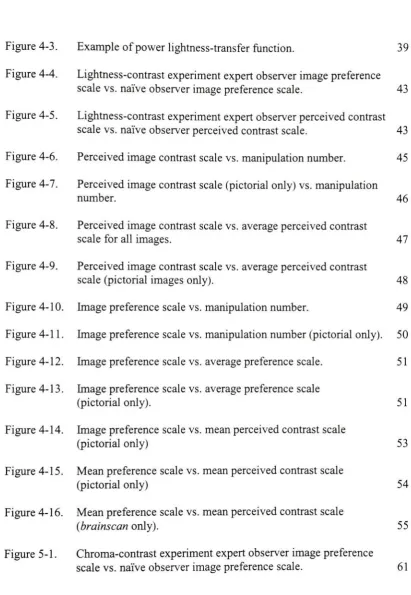
Figure 4-3.
Example
of power
lightness-transfer
function.
39
Figure 4-4.
Lightness-contrast
experiment expert
observer
image
preference
scale vs. naive observer
image
preference
scale.
43
Figure 4-5.
Lightness-contrast
experiment expert observer
perceived contrast
scale
vs.
naive observer perceived contrast scale.
43
Figure 4-6.
Perceived image
contrast scale vs. manipulation number.
45
Figure 4-7.
Perceived
image
contrast scale
(pictorial
only)
vs.
manipulation
number.
46
Figure 4-8.
Perceived
image
contrast scale
vs.
average perceived contrast
scale
for
all
images.
47
Figure 4-9.
Perceived image
contrast
scale
vs. average
perceived
contrast
scale
(pictorial images
only).
48
Figure 4-10.
Image
preference
scale vs. manipulation number.
49
Figure 4-1 1
.Image
preference scale vs.
manipulation
number
(pictorial
only).
50
Figure 4-12.
Image
preference
scale
vs.
average
preference scale.
51
Figure 4-13.
Image
preference
scale vs. average preference scale
(pictorial
only).
51
Figure 4-14.
Image
preference scale
vs.
mean perceived contrast
scale
(pictorial
only)
53
Figure 4-15.
Mean
preference scale vs. mean perceived
contrast scale
(pictorial only)
54
Figure 4-16.
Mean
preference scale
vs.
mean perceived
contrast
scale
(brainscan
only).
55
Figure 5-1
.Chroma-contrast
experiment expert observer
image
preference
Figure 5-2.
Chroma-contrast
experiment expert
observer perceived contrast
scale vs. naive observer perceived
contrast scale.
62
Figure 5-3.
Perceived
contrast scale
vs.
chroma
scalar
for
all
six
test
images.
63
Figure 5-4.
Perceived
contrast scale vs. chroma
scalar
(pictorial
only).
64
Figure 5-5.
Image
preference scale
vs.
chroma
scalar.
67
Figure 5-6.
Image
preference scale
vs.
chroma
scalar
(pictorial
only).
68
Figure 5-7.
Image
preference scale
vs.
perceived
contrast scale
(pictorial
only).
69
Figure 5-8.
Mean
preference
scale vs.
perceived
contrast
scale
(pictorial
only).
70
Figure
6-1.
Sharpness-contrast
naive
observer
image
preference
scale
vs.
expert
observer
image
preference
scale.
75
Figure 6-2.
Sharpness-contrast
naive observer perceived contrast scale vs.
expert observer perceived contrast scale.
76
Figure 6-3.
Perceived
contrast
scale
vs. sharpness
level for
the
six
test
images.
77
Figure
6-4.
Perceived
contrast
scale
vs. sharpness
level for
pictorial
images
only.
78
Figure 6-5.
Image
preference scale vs. sharpness
level for
six
test
images.
79
Figure
6-6.
Image
preference scale vs. sharpness
level (pictorial
only).
80
Figure 6-7.
Pyramid
FFT
relative
to
unsharpened
image FFT. X-axis
represents visual
frequency
in
cycles per
degree.
8 1
Figure 6-8.
CoupleJOOsc FFT
relative
to
unsharpened
image FFT. X-axis
represents visual
frequency
in
cycles per
degree.
82
Figure
6-9.
Image
preference scale
vs.
sharpness-contrast
scale.
83
Figure 6-11.
Mean
preference scale vs. sharpness-contrast scale
for
the
five
pictorial
images.
85
Figure 6-12.
Mean
preference scale vs. sharpness-contrast
scale
for
brainscan image.
86
Figure 7-1
.Scale-linking
experiment expert
observer
image
preference
scale
vs.
naive observer
image
preference
scale.
92
Figure 7-2.
Scale-linking
experiment expert observer
perceived contrast
scale
vs. naive observer perceived contrast
scale.
93
Figure 7-3.
Linking
image
perceived
image
contrast scale.
94
Figure 7-4.
Linking
image
perceived
image
contrast
scale vs. mean
contrast scale.
95
Figure 7-5.
Linking
experiment
image
preference scale.
96
Figure 7-6.
Linking
experiment
image
preference scale vs.
average
preference
scale.
97
Figure
7-7.
Linking
experiment
image
preference scale vs. perceived
image
contrast
scale.
98
Figure 7-8.
Linking
experiment mean perceived contrast scale vs.
mean preference scale.
98
Figure
7-9.
Linked
perceived-contrast
scale
in
order
from highest
perceived contrast
to
lowest
perceived contrast with
95%
confidence
limits.
103
Figure
7-
1 0.
Symbolic illustration
of
linked
perceived-contrast scale
to
note
the
location
of perceived contrast scales.
104
Figure
7-11.
Linked image
preference scale
in
order
from
most preferred
manipulation
to
least
preferred with
95%
confidence
limits.
106
Figure
7-
1 2.
Linked
mean preference scale vs.
linked
mean
perceived
Figure 8-1
.Inter-image
contrast perception expert
observer
image
preference scale vs. naive observer
image
preference scale.
112
Figure 8-2.
Perceived
contrast scale
vs.
test
image.
95%
error
limits
=
+/-
0.106.
"
113
Figure 8-3.
Histogram
of
inter-image
contrast
scaling
experiment
observer
standard
deviation
(naive
and expert).
X-axis
represents
frequency
matrix standard
deviation.
Observer
standard
deviation
gives an
indication
as
to the
observer
repeatability.
A
standard
deviation
of
2
.5
relates
to
1 00%
repeatability.
1 1 4
Figure 8-4.
Cumulative histogram
of
inter-image
contrast
scaling
experiment
observer standard
deviation
(naive,
expert,
and
their
combination).
Observer
standard
deviation
gives
an
indication
as
to
the
observer
repeatability.
A
standard
deviation
of
2.5
relates
to
100%
repeatability.
115
Figure
8-5.
Selection
frequency
of expert observers
RKH
and
TO,
and
naive observer
BLK
and
DLM. All
observers
with observer
standard
deviation 2.18. Image
numbers represent
1
-couple,
2-dinner, 3-pyramid, 4-veggies,
5-wakeboarder.
117
Figure
9-1
.Image
L*
channel shown as a
function
of
the
most preferred
image
(25sc)
L*
channel.
The
mean output
L*
is
shown
in
red.
Minimum
and
maximum
output
L*
shown
in black.
124
Figure 9-2.
Perceived image
contrast scale with modeled
image RVPkL.
Images
are numbered
in
order
of
decreasing
contrast
for
chroma-contrast
(Image
numbers
1-6),
lightness-contrast (Image
numbers
7-26),
and
sharpness-contrast
(Image
numbers
27-34).
125
Figure
9-3.
Perceived image
contrast scale with modeled
image RVPkC
Images
are
numbered
in
order of
decreasing
contrast
for
chroma-contrast
(Image
numbers
1-6),
lightness-contrast (Image
numbers
7-26),
and
sharpness-contrast
(Image
numbers
27-34).
127
Figure 9-5.
Perceived image
contrast scale with
modeled
image RVPks.
Images
are numbered
in
order of
decreasing
contrast
for
chroma-contrast
(Image
numbers
1-6),
lightness-contrast
(Image
numbers
7-26),
and
sharpness-contrast
(Image
numbers
27-34).
129
Figure 9-6.
Perceived image
contrast scale
with modeled
image RVPk.
131
Figure 9-8.
Perceived
image
contrast model
RVPKSimpie
(without
offset)
vs. actual perceived contrast
scale.
133
Figure 9-9.
Perceived image
contrast
scale
with modeled
image
SIPkl
for
all
pictorial
images
.136
Figure
9-10.
Mean
perceived
image
contrast
scale
with modeled
image SIPkl.
136
Figure 9-11.
Perceived image
contrast
scale
with modeled
image
SIPKc
for
all
pictorial
images
.137
Figure
9-12.
Mean
perceived
image
contrast
scale with modeled
image SIPKc.
138
Figure
9-13.
Perceived
image
contrast scale with modeled
image
SIPKs
for
all pictorial
images.
139
Figure
9-14.
Mean
perceived
image
contrast scale with modeled
image SIPks.
140
Figure 9-15.
Perceived image
contrast
scale with modeled
image SIPk
for
all pictorial
images
.141
Figure
9-16.
Mean
perceived
image
contrast scale with modeled
image
SIPk for
all
pictorial
images.
141
Figure 9-17.
Mean SIPk
contrast
vs. actual mean perceived contrast scale.
142
Figure 9-18.
SIPk difference
vs.
image
number.
144
Figure 9-19.
Mean SIPk
contrast
difference
vs. actual
mean perceived
contrast scale
difference.
144
Figure 9-2 1
.Mean
SIPkd
contrast
difference
vs. actual mean perceived
contrast scale
difference.
147
Figure 9-22.
Modeled
image
preference vs.
RVPk.
Actual
scale
is
the
actual
image
contrast scale
vs.
the
actual perceived
contrast scale.
149
Figure 9-23.
Modeled
image
preference
vs.
RVPk.
151
Figure
9-24.
Modeled image
preference vs.
RVPk difference from
preferred
image.
1
52
Figure 10-1.
Mean image differences
vs.
Actual Contrast Scale Difference
from
most preferred
(25sc).
1 54
Figure
10-2.
Mean
image differences
vs.
SIPk Contrast Difference from
most preferred
(25sc).
155
Figure
10-3.
Median
image differences
vs. contrast scale
difference from
most
preferred
(25sc).
156
Figure 10-4.
Median
image differences
vs.
SIPk Contrast
Difference
from
List
of
Equations
Equation
2.1.
Equation
of
Michelson
Contrast
10
Equation
2.2.
PCR
12
Equation 2.3.
PLCR
12
Equation 2.4.
PCCR
12
Equation 3.1.
RGB
to
XYZ
transform
23
Equation 3.2.
XYZ
to
RGB
transform
26
Equation 4. 1
.95%
confidence
range
44
Equation 7. 1
Scale
transformation
99
Equation 7.2
Pseudoinverse
of perceptual scales
99
Equation 7.3.
Lightness-contrast
scale
transformation
100
Equation 7.4.
Chroma-contrast
scale
transformation
100
Equation 7.4.
Sharpness-contrast
scale
transformation
100
Equation
8.1.
95%
confidence range
1 1 2
Equation
9.1.
RVPkl
125
Equation
9.2.
Kc
126
Equation
9.3.
RVPkc
126
Equation
9.4.
Ks
128
Equation 9.6.
RVPk
130
Equation 9.7.
RVPKSimpie
131
Equation 9.8.
KL
135
Equation 9.9.
SIPkl
135
Equation 9
.1 0.
Kc
137
Equation
9.1
l.SIPKc
137
Equation 9.1 2. KS
138
Equation
9.13.
SIPks
139
Equation
9.14. SIPk
140
Equation
9.1 5. ASIPk
143
Equation 9.16.
SIPkd
143
Equation
9.1 7. fl
148
Equation
9.18.
f2
148
1.
Introduction
Basic
colorimetry has
long
been
used
to
identify
the
degree
to
which
pairs
of colored
patches match under specified
viewing
conditions.
Mathematical
equations
such
as
CIE
AEab
,
A4
and
CIEDE2000
are
increasingly
more complex and robust
tools
used
to
quantify
the
perceived
difference
between
two
colors.
When attempting
to
quantify
the
perceptual
difference between
a
pair of
color
images (an
original and
reproduction,
for
example)
the
problem
become
more
complex.
A
natural
first
attempt
to
quantify
the
difference between
the
image
pair
could
be
to
utilize
the
color-difference
equations
of
basic colorimetry in
an
image
element-wise
(pixel-wise)
manner.
Pixel-wise
statistics
such as an average or standard
deviation
color
difference
(a9'4,
a1(Af1^))
are
quite
common
in image
analyses.
Shortcomings
of an average pixel-wise color
difference
as
a
degree
of
difference
between
an
image
pair
have been discussed
(Johnson,
2001). The
development
of an
image difference
(fidelity)
metric
incorporating
more
parameters
than
simply
a mean
pixel-wise color
difference
metric
is
thus
necessary.
Such image
fidelity
models
and
algorithms
have been
proposed
(Zhang
et
al.,
1997; Daly, 1993; Johnson,
2001)
and continue
to
be developed
(Fairchild,
2002).
Assuming
differences
are present
in
an
image
pair,
it
is
natural
to
investigate
which
of
the
images
is
of
higher
quality.
The ability
to
utilize
an
image
quality
metric
in
the
importance
of various colorimetric and perceptual
errors
on
the
quality
of
their
reproductions.
An
image
quality
model would also enable
the
imaging
system
manufacturer
to
determine
the
amount of error
allowable
in
the
system.
The ability
to
determine
system error and
its
affect on
the
quality
of
the
reproductions
would
be
a
tremendous tool
for
the
imaging
industry.
A
robust
image
quality
or
image
difference
algorithm
should
employ
colorimetric
and perceptual characteristics
of
the
image
pair.
Image
contrast
is
one
such characteristic
that
is described
as
both
a
physical
and perceptual
attribute of
images. In
vision
science,
contrast
defines
the
perception
of spatial
variation.
There
has been
a good
deal
of
research on contrast
in
the
visual
science community.
The
contrast
of
uniform patches on
a uniform
background,
contrast
of grayscale
sinusoids,
and
contrast
of
colored
text
on a
uniform
colored
background
have been
researched
extensively.
This
type
of
research
is
typically
the
base
of
contrast-sensitivity
function
(CSF)
parameters utilized
in image
difference/quality
models
(Johnson,
2002).
Contrast
metrics
dealing
with
these
simple
situations
are
typically
a
weighted ratio of measurable
foreground
and
background
characteristics
(luminance,
CIELAB
L*,
etc.).
Although
contrast
defined
as some
ratio of
luminances (such
as
Michelson contrast)
may be
appropriate when
dealing
with
sinusoids
or
uniform
patches,
a
luminance
ratio
does
not
necessarily
correspond
with
perceived
contrast
in
color
images. When
dealing
with complex
images
(especially
of various
sizes)
the
use
of
the
maximum and minimum
luminance
pixels
do
not coincide
with
artifacts such as
a
speckle
highlight
could cause a
luminance-based
contrast
metric
to
fall
apart.
A
preferred version of an
image
may
have
the
same
luminance-based
contrast
as
an undesirable
overexposed
or underexposed
reproduction
of
that
image
with
these
simple metrics.
The
term
contrast
in
color
imaging
is commonly
used
as an overall
image
attribute.
For
the
purposes
of
this research,
image
contrast
is defined below.
Image
contrast:
the
rate
of
change
of
the
relative
luminance of
image
elements
of
a
reproduction as afunction
of
the
relative
luminance
of
the
same
image
elements
of
the
original
image.
(Fairchild, 1995)
In
the
imaging
community,
research on
perceived
image
contrast
has been
largely
based
on environmental
aspects of an
image
or
viewing
system.
Environmental
aspects such as
luminance
level (Stevens
Effect,
Hunt
Effect)
or surround
(Bartleson-Breneman
Equations)
have
been
proven significant
in image
contrast perception
(see
Fairchild,
1998). To
differentiate image
contrast
from
perceived
image
contrast, the
following
definition
is
used:
Perceived
image
contrast:
the
perception
of
the
rate
of
change
of
the
relative
luminance
of
image
elements
of
a
reproduction
as a
function of
the
relative
luminance
of
the
same
Image
contrast
is commonly defined
in
terms
of
an
image
tone
reproduction curve
(TRC).
In
image
capture,
the
TRC
represents
the
transformation
from
the
actual
scene
luminance
to the
luminance
of
the
captured
image.
The
transform
from
scene
luminance
to
image
luminance
yields
the
contrast of
the
imaging
system.
In
image
reproduction,
the
TRC
often represents
the
luminance
transform
from
an
original
image
to
its
reproduction.
Contrast
in
the
image-reproduction
sense
is commonly
thought
of as
the
straight-
line
portion
of
the
TRC
between
an
image
and
its
reproduction.
The
transform
from
original
to
reproduction results
in
image
contrast
(as defined
above).
The
transformation
in
Figure 1-1
represents such a
TRC. The
term
gamma
(y)
is
often
used
to
describe
this
portion of a
TRC (Stroebel
et
al.,
1986).
<D
O
A
03
/
c
s?
/*/^
/
/
^v /
-$/
/
_dy_dx
-*-V
/
3
&
3
o
Input Luminance
Figure 1-1. Example
of a
"sigmoidal"tone
reproduction
curve
(TRC).
This
straight-line portion
of a
TRC
represents
the
midtone
region ofthe
image,
where
there
is
a consistent separation
of
tone.
A
preliminary
difficulty
in using
a
TRC's
gamma
reproduction curves are
rarely
of
the
ideal
sigmoidal nature where
derivatives
can
be
used
to
find
the
point of
inflection
where contrast should
be
calculated.
Aside
from
difficulty
in managing
the
physical
nature
of
the
TRC,
a
shortcoming
in
defining
image
contrast
in
terms
of a
TRC
requires an original and
a
reproduction.
Contrast
defined
by
a
TRC
also makes
it
possible
for
two
images
to
have
similar
"gammas"
despite
having
very
different
white and
black
points,
in
which
case
the
images
may
have
very
different
perceptual contrasts.
The TRC
also
does
not contain
any
color
information,
therefore
a
TRC-based
contrast
definition
assumes
images
have
the
same
contrast as
long
as
their
achromatic
information is
the
same.
For
these
and other
reasons,
using
characteristics
of a
TRC
to
define
the
perception of contrast
in images is inadequate
when
the
degree
of
perceived contrast
of a single
image is desired.
The
perception of contrast
in
a
single
color
image is
sometimes
considered
to
be
a
function
of
the
image dynamic
range.
Images
with
a narrow
distribution in dynamic
range
are
thought
to
be
of
low
contrast;
images
with
a
wide
dynamic
range can
be
considered of
high
contrast.
Images
with
histograms low in
the
midtone regions and
high
in
the
light
and
dark
regions can
be
considered
"too
contrasty."
In
digital
imaging,
histogram
explosion and
histogram
equalization
are
methods
commonly
used
to
utilize
the
full dynamic
range possible and
increase
contrast
(Mlsna
et
al.,
1996;
Tumblin
et
al.,
1999). Despite
these
methods of
"contrast
enhancement,"
there
is only
a single
image
being
manipulated although changes
in
contrast
are
perceived.
In
these
single
image
the
image before
manipulation.
If
this
is
the case,
then
contrast might
be judged between
an
image
and
a
manipulated version of
that
image.
Since
these
histogram
manipulation
methods are capable of
manipulating
perceived
contrast,
it may be
possible
to
describe
contrast
based
on physical parameters of
the
image.
The
following
examples motivate
this
definition:
supposing
a
user with
knowledge
of
the
above
histogram
manipulations
is
given
the
task
of
generating his
preferred contrast
level
of
a
digital image. How does he determine if
the
image
contrast
should
be increased
or
decreased?
Single images
are
commonly described
to
be
of
low
or
high
contrast.
However,
one
cannot
describe
the
contrast of a single
image in
terms
of
TRC
characteristics.
If
the
user
decides his image is "too
contrasty"
it may be
possible
that
he is
judging
the
image
relative
to
what
he feels
the
image
should
look like. If
this
is
the case,
it is
possible
that the
perception of contrast
in
an
image is
some
relationship
between
the
presented
image
and
the
user's
preferred
or
ideal
version of
that
image.
Another shortcoming
of
defining
contrast
in
terms
of a
TRC
is
the
terminology
original and reproduction.
Suppose
an
experiment
is designed
where an observer
is
given
two
reproductions of
an
image
and
asked
to
select
the
image he
perceives
to
be
of
higher
contrast.
In
most
likelihood
the
observer will make
his decision based
on
the
two
images
in
front
of
him. In
this
experiment, the
observer
selects
the
image he
perceives
to
be
of
higher
contrast.
It may be
that the
observer
judges
the
contrast of
the
image
reproductions relative
to
each
other.
In
this case, the
observer
may
select
the
higher
Another possibility
may
be
the
observer
judges
the
contrast
of
each
image
reproduction
relative
to
what
he
perceives
to
be
his
preferred version
of
the
image. In
this case,
the
observer
may
be
judging
a
hypothetical
transformation
between
each
test
image
and
his
mental version of
the
preferred
image. Although it may
not
be
possible
to
determine
what
observers'
ideal
or preferred
internal
representation of
an
image
looks
like,
it
seems
quite reasonable
that the
judgments
of
perceived
contrast
for
various
image
manipulations
may
contribute
information
relative
to the
observers'
perception
of
contrast.
When
dealing
with
image quality
or
image
difference,
one
must
take
into
account
the
physical
(measurable)
characteristics
of
the
image,
perceptual
image
characteristics,
and
viewing
environment parameters.
Physical
characteristics
may be
white
point,
black
point
and
gray balance. Perceptual
parameters
may include
colorfulness,
perceived
contrast and naturalness.
Environmental
parameters
such
as
illumination,
surround,
and
degree
of
adaptation
have been
shown
to
have
significant affect on
image
perception
(Fairchild, 1995, 1999; Daniels,
1997).
Oftentimes,
limitations
of
the
imaging
system
hardware
provide
boundaries affecting both
the
perceptual and physical
characteristics
of
the
image. Resolution limitations
affect
sharpness,
reflectance spectra of printer
inks
determine
gamut and
influence
characteristics such as
black
point and colorfulness.
The
characteristic of
image
contrast
is
a
function
of
the perceptual,
environmental and
physical aspects
of
the
image. There
are
several
important
questions one should address
metric
be
relative or absolute?
Should
the
metric
be
image independent? Should
achromatic and chromatic versions of
the
same
image have
the
same contrast?
What
physical attributes of
the
image
should
be
incorporated
in
the
contrast metric?
Will
the
metric work
for
both
natural and unnatural
images,
where naturalness
is defined
as
the
conformity
of
the
image
to the
ideas
and expectations
the
observers
have
about
the
original scene
at
the time the
picture was
being
taken
(de
Ridder,
1996).
The
goal
of
this
research
is
to
contribute
information relating
to the
perception of
contrast
in digital
color
images. This
task
is
approached
through the
generation of a
large-scale
psychophysical
data
set of
perceived
contrast
in
color
images. The
effect of
common
achromatic manipulations
on
the
perception
of
image
contrast
is investigated
experimentally.
Also
investigated
are
the
role
of chroma and sharpness
in image
contrast
perception.
The
task
of
proving
or
refuting
common myths
and assumptions
relating
image
chroma
and sharpness
to
perceived contrast
in
color
images
is investigated
experimentally.
The
ultimate
goal
of
this
research
is
the
development
of a metric of
perceived
image
contrast
for incorporation into both
color
image difference
and color
2.
Background
One shortcoming
of
the traditional
definition image
of
contrast
based
on
the
slope a
portion of a
TRC,
for
example,
lies
in
the
need
for
an
original and a reproduction.
As
long
as
image
contrast
is defined
in
terms
of a
reproduction,
by
definition,
a
pair of
images
must
be
present
in
order
for
contrast
to
exist.
By
defining
contrast
in
terms
of
a
reproduction,
contrast
in
a single
image
cannot
be defined. This
being
said,
it
is
possible
for
two
identical
images
generated
by
manipulation
oftwo
different
"originals"
to
have
different
contrast.
It
is important here
to
note
the
distinction between
physical
image
contrast
(also
referred
to
as
image contrast)
and perceived
image
contrast
(also
referred
to
as
perceived
contrast
or contrastness).
Image
contrast
as
defined previously is
appropriate
for
a
physical
measure of contrast
between
an original and
a
reproduction.
The
definition
of
image
contrast
in
terms
of relative
luminances
is
consistent with
the
imaging industry
and
research
in
vision science.
For
reasons
discussed previously
and
throughout
this
research,
it is believed
the
definition
of physical
image
contrast
does
not
correlate with
the
perception
of
image
contrast.
A
tremendous
advantage of
digital
imaging
research
is
the
ability
to
separate and
manipulate
individual
aspects of
the
image (CIELAB
L*,
a*,
b*
values and
individual
example, if
a conventional photographer were
wishing
to
increase
contrast,
a
full
lightness
manipulation
in
subtractive
film
would
require manipulation
of
the cyan,
magenta,
and yellow channels of
the
image.
Using
digital
imaging,
if
one were
to
manipulate
lightness-contrast
defined
in
terms
of
TRC,
one
can
manipulate
the
image
lightness
channel while
understanding
the
a*and
b*
channels remain unchanged.
2.1
Past Research
on
Contrast
Contrast
of sinusoids or
uniform
patches
on a
uniform
background is
typically
defined in
terms
of
luminance,
independent
of
chroma.
Michelson
contrast,
shown
in Equation
2.1,
conventionally
used
in quantifying
contrast of sinusoidal
gratings,
is
defined
as
the
ratio
between differences
of maximum
and
minimum
luminance
to the
sum of
the
maximum
and minimum
luminances.
/"
_
Anax
~Aran
(J
]\
M~
L
+L
'
max
mm
Michelson
contrast
is
also
commonly
used
as a
factor in
metrics
describing
the
contrast of
uniform patches
on a
uniform
background. In
applications
where patches are either
achromatic
or
chromatic, the
presence of chroma
is
typically
ignored. A
contrast
metric
as
simple
as
Michelson
contrast
is
not adequate
for
complex
images
since
only
the
maximum
and
minimum
luminance image
elements
are
considered.
These
types
of
formulae may be
appropriate
for
contrast
of
patches, sinusoids,
or
text,
but
are
not
adequate when
dealing
with
images. For
example,
a
smooth grayscale
which can
have
the
same
Michelson
contrast as
a natural
image
whether color
or
grayscale.
Although
Michelson
contrast
is regularly
used
to
quantify
contrast
in
sinusoidal
gratings, there
is
no correlate
for
the
effect
of chrominance on contrast
in
gratings.
Switkes
and
Crongle
(1999)
performed
a
comparison
on
observers'
ability
to
match
sinusoidal gratings
differing
in
chrominance
and
luminance. In
this
research,
it
was
learned
that
contrast matches could
be
made
between
gratings
which
differ along
the
chrominance and
luminance dimensions. Chromatic
and achromatic contrast
in
these
experiments
was
determined
by
observers
obtaining
a perceptual match
between
the
contrast of
two
gratings whose chromaticities or
luminances
varied
along
differing
chromatic
directions (axes):
achromatic
luminance,
S-cone
activation,
L-and M-cone
activation,
L-cone
activation,
and
M-cone
activation.
These
experiments resulted
in
a
scaling factor
to
be
multiplied
by
cone-contrast
to
achieve
the
equivalent
luminance
contrast of
a
sinusoidal grating.
Shevell
(1993)
discusses how
the
appearance
of a colored patch
is
a
function
of
the
light
falling
at
the
edges of
the
patch
(contrast)
and
the
scene
beyond
the
patch edges
(context). It
can
be
inferred from
this
statement
that
contrast
of a complex scene must
incorporate
more
than
simple patch contrast methods.
Yu
et
al.
(2001)
performed experiments
judging
contrast
of sinusoidal gratings
on
sinusoidal
backgrounds
of
various
orientations
and
brightnesses.
Surround
contrast
Research
on
the
contrast of colored
text
on a colored
background
has
acknowledged
the
influence
of chroma on contrast although
this
influence
is
small
relative
to
luminance
contrast.
The
influence
of
chroma on contrast perception
in
text
has
been
examined
by
Spenkelink
and
Besuijen
(1994). Equations 2.2
-2.4
were
investigated for
significance
in
text
applications.
PCR
=
yj
PCCR2
+
PLCR2(2.2)
PLCR^L^IL^
(2.3)
(2.4)
0.027
These
equations
have
similarities
common
to
contrast
luminance
ratios,
as
well as
sum-squared
differences
common
to
color
difference
formulae. In
most
cases
of
simultaneous
contrast, the
luminance
contrast
term
PLCR
will
be
much
greater
than
the
PCCR
term
and
PCR
will
be
approximately
equal
to
PLCR.
An
example would
be black
text
on a
white
background does
not
have significantly
more contrast
than
white
text
on a
black
background. At lower luminance levels
(PLCR)
the
influence
of chroma
on contrast
is
significant.
Colored
text
on
a colored
background
of equal
luminance
can exhibit
different
levels
of
contrast
depending
on
their
chromaticities.
CIELUV chromaticity
was
2.2
Past Research
on
Image Contrast
The
role of surround on
the
perceived contrast
of
images
has
been investigated (Bartleson
and
Breneman, 1967; Fairchild,
1995). It
has
been determined
that
a white
background
increases
perceived
image
contrast,
making
dark
areas
appear
darker,
thus
giving
the
perception of
a
larger dynamic
range.
A
dark
surround
reduces
perceived
image
contrast
by
making
the
dark
regions appear
lighter
relative
to
the
light
regions.
A
reduced
dynamic
range
is
therefore
perceived.
The
perception
of
the
reduced
dynamic
range can
be
thought
of
in
terms
of
Michelson
contrast
as
the
ratio
of perceived
luminances.
Fairchild
(1995)
defines
several
terms
relevant
to this
research.
Brightness,
lightness, luminance,
and
contrast are
defined. Contrast is defined
as
the
rate of change
of
the
relative
luminance
of
image
elements of a reproduction as a
function
of
the
relative
luminance
of
the
same
image
elements
of
the
original
image. This
definition
relates
specifically
to
"image
contrast"as opposed
to
colored
patches.
It
is discussed how image
contrast
and perceived
chroma change with surround
luminance. The impact
of
surround
on
contrast
must
therefore
be
considered
in
the
proposed experiments.
It
is
mentioned,
however,
that the
surround effects on contrast
may be l