Bose-Einstein condensation
and the atom laser
A
thesis submitted
for
the
degree of
Doctor of philosophy
at
the Australian National
University
Nicholas P. Robins
Declaration
This thesis contains no material which has been accepted for the award of any other degree or diploma in any university. To the best of the authors knowledge, it contains no material previously published or written by another person, except where due reference is made in the text. The research has been conducted under the supervision of Dr. John Close, Dr. Craig Savage and Prof. Yuri Kivshar.
Acknowledgements
My deepest gratitude and thanks go to my three supervisors, John Close, Craig Savage, and Yuri Kivshar, for all the opportunities you gave me to become a better physicist. At different stages in the three years of my PhD, each one of you has fulfilled the role of primary supervisor, and not once in that time have my questions been unanswered or your answers been incomprehensible.
Theoretical modeling of an atom laser is fun, but, for me, making one was better. Thank you to John Close for trusting my conviction that I could do the job, and for giving me the opportunity to join the 'dark side'.
My best wishes go to my fellow students, in particular Cameron (are you antag-onising me?) Fletcher, Jessica (Frisbee) Lye, Simon (my atom laser is better than yours) Haine and Adele (Hmmm) Morrison. My thanks go also to Joseph Hope and Hans Bachor for taking part in my scientific development.
Abstract
>
Publications
The research carried out for this PhD thesis spanned both theoretical and ex-perimental physics. This led to the publication of 5 papers related to the theoretical dynamics of multiple spin state Bose-Einstein condensates (BEC) j including atom lasers> and 4 eArperimental papers on atom lasers and related techniques. The di-verse nature of the topics covered, reflect a change from theoretical to experimental physics half way through my PhD. In order to produce a cohesive document; a ju-dicious selection of material was essential. Starred publications; in the list below, have been emphasised in this thesis.
• A model of a pumped continuous atom laser; N. Robins; C. Savage; E. Ostro-vskaya, in >> Directions in Quantum Optics : A Collection of Papers Dedicated to the Memory of Dan ·vvalls;', eds. H. Carmichael; R. Glauber, M. Scully
(Springer; 2000).
• * Atom laser dynamics; N. P. Robins, C. Savage; and E. A. Ostrovskaya; Phys. Rev. Ai 64 043605 (2001).
• Modulational instability of spinor condensates; N. P. Robins; \N. Zhang; E. A. Ostrovskaya; and Y. S. Kivshar; Phys. Rev. A, 64 021601 (2001).
• Stability of continuously pumped atom lasers; S. A. Haine; J. J. Hope; N. P. Robins, C. M. Savage; Phys. Rev. Lett.; 88 170403 (2002).
• A self-locked magneto-optic trap; C. S. Fletcher, J. E. Lye; N. P. Robins , and J. D. Close, Opt. Commun. 212 85 (2002).
• *Interferometric, modulation-free laser stabilization, N. P. Robins, B. J. J. Slagmolen, D. A. Shaddock; J. D. Close; M. B. Gray Optics Letters, 27 1905 (2002).
• Bose-Einstein condensate collapse: a comparison between theory and eArperi-ment; C. IVI. Savage; K. P. Robins> and J. J. Hope; Phys. Rev. Ai 67 014304 (2003).
Vl
(ICOLS 2003)" P. Hannaford, A. Sidorov, H. Bachor, and K. Bald-win eds., (World Scientific Publishing, Singapore, 2004).
Contents
Acknowledgements
Abstract
Publications
1 Introduction
1.1 Motivation: the pumped atom laser . . . 1.2 Bose-Einstein statistics . . . . . . . . . . 1.3 BEC and the macroscopic wavefunction . 1.4 BEC and ultra-cold atoms . . .
1. 5 Experimental History of BEC . 1.6 The definition of an atom laser
1. 6 .1 The optical laser . . . .
1.6.2 Properties of a generic laser beam 1.6.3 An ultra-cold laser . . . . . . 1.6.4 The theory of atom lasers . . . . 1.6.5 The continuously pumped atom laser 1. 7 This thesis . . . . . . . . . . . .
2 Experimental and theoretical background
2.1 Atomic properties and hyperfine structure of 87Rb 2.2 Pushing atoms around . . . . . . . . . . 2.3 Optical molasses & the magneto-optical trap
2.3.1 Doppler and sub-Doppler cooling 2.3.2 Polarisation gradients . . . . 2.3.3 The magneto-optic trap 2.3.4 The limits of optical cooling 2 .4 Magnetic trapping . . . . . . . . .
2.4.1 The Ioffe-Pritchard configuration trap . 2.5 Forced evaporative cooling . . . . . .
2.5.1 Losses and magnetic trap lifetimes 2.6 Calculating numbers and temperatures
2.6.1 Calculating the atom number . . .
Vlll Contents
2.6.2 Temperature calculations . 43
2.7 The Gross-Pitaevskii equation . 45
2.8 Atom laser output coupling . . 46
2.8.1 Raman output coupling 47
3 The atom laser source 49
3.1 Magnetic trap MkII . 49
3.1.1 Trap construction 51
3.1.2 Coil geometry . . 53
3.2 Trap characterisation . . 53
3.2.1 Power dissipation 53
3.2.2 Magnetic field strength 56
3.2.3 Measurement of trap frequencies . 56
3.2.4 Magnetic trap lifetime 57
3.3 Magnetic trap switching scheme . . .. . 59
3.4 Optical pre-cooling . . . .. 60 3.4.1 Fluorescence measurement of atom number . 62
3.4.2 The laser system 64
3.4.3 Upper MOT . . . 64
3.4.4 Push loading . . . 65
3.4.5 Optimising a single push 66
3.5 Lower MOT . . . 68
3.5.1 The repumper . . . . . . 69
3.6 Three steps to stability . . . 69
3.6.1 Retro- reflection lower MOT 69
3.6.2 Polarizing beam splitters 70
3.6.3 Gaussian beam profiles 70
3.7 Optical pumping . . . 71
3.8 New imaging system .. . . 71
3.9 Summary of optical pre-cooling and transfer 72
3 .10 Evaporative cooling . . . . . 73
3.11 Fitting to column density 74
3.12 Bose-Einstein condensation. 76
3.12.1 Sudden increase in optical depth. 77
3.12.2 Bimodal distribution . 77
3.12.3 Anisotropic expansion 77
4 The atom laser 81
Contents
4.5.1 4.5.2 4.5.3
Experimental results Theoretical results Conclusion . . .
5 Pumping an atom laser 5.1 The model . . .
5 .1.1 Numerical results 5. 2 Conclusion . . . . . . . .
6 Next generation atom laser machine 6 .1 Design philosophy . . . . . . . . . 6.2 An optimized QUIC trap for EEC . .
6.2.1 Three loop QUIC trap . . . .
6.3
6.2.2 The ideal QUIC trap and figures of merit . 6.2.3 Geometrical considerations .
6.2.4 Concrete examples . . . . 6.2.5 Construction techniques . 6.2.6 Experimental verification . 6.2.7 Conclusions . . . Overview of the new system
7 Conclusions and outlook.
Appendices
A Atomic tilt locking A.1 Background .. . A.2 Tilt locking . . . A.3 Atomic phase shift
A.4 Experimental setup and results A.5 Conclusion . . . .
B Numerical Methods B .1 Overview of the chapter B.2 The split-step Fourier method
B.2.1 The approximation ..
B.2.2 Implementation for a generic NLS equation . B.2.3 Split-step scheme for the atom laser model .
(/J
..µ
~
<l)
~
0
CHAPTER 1
Introduction
1.1
I\/Iotivation:
the pumped atom laser
In 1995, a new state of matter, a Bose-Einstein condensate (BEC), was created [1]. BEC is a collection of ultra-cold dilute neutral atoms that occupy the same quantum state, which is usually the ground state of the potential of a confining magnetic trap. In this state, the de-Broglie wavelength of the individual atoms become comparable to the dimension of the entire atomic cloud. The atoms are no longer distinguishable and acquire collective properties, similar to those of photons in a coherent light wave produced by an optical laser. A consequence of BEC is that this giant ( rv 106 atoms) coherent matter ·wave can be released from the trap without disturbing the coherence. Then a directional beam of coherent, bright, spectrally narrow atoms forms an 'atom laser'. The output of an atom laser is a coherent matter wave where the wavelength is the de-Broglie wavelength of the atoms. "\Ve call it a laser by analogy with the device we are more familiar with, an optical laser (first demonstrated by Maiman in 1960 [2]), where a large number of photons are built up and stored in the laser cavity and are eJ\.rtracted continuously in order to form a beam. Ideally, an atom laser would consist of a trapped component ( the Bose-Einstein condensate) surrounded by a thermal cloud, an outcoupling mecha-nism continuously transferring atoms from the BEC to the output component (laser beam), and a pump mechanism enhancing the thermal cloud and thus ensuring that the condensate can be continuously replenished.
16 Introduction
new science - Quantum Optics. The atom laser will become one of the enabling technologies for the development of Quantum Atom Optics.
Despite the infancy of the field, a number of uses for the atom laser are al-ready clear. From the perspective of pure research into ultra-cold atoms, an un-pumped ( quasi) continuous atom laser can be used as a sensitive probe of condensate properties such as coherence [10] and collective modes [11]. The atom laser is an obvious ( although as yet unused) choice for experiments on the interaction of Bose-condensed atoms with surfaces, such as those undertaken recently on condensate fragmentation near a microchip surface [12, 13]. Applications of the atom laser as a technology are more speculative, primarily because of the low flux associated with the current generation of quasi-continuous atom lasers. The development of a neutral atom beam scanner [14] and the demonstration of atom laser reflection and focusing [15] light the way for future experiments. Using an atom laser as the primary component of a de Broglie wave microscope [16] or in a separated path interferometer [17] appear experimentally feasible.
The atom laser schemes currently conceived are possible only through the cre-ation of a Bose-Einstein condensate (BEC). There follows a short, general review of the theoretical and experimental achievements in the field of ultra-cold atomic physics, that have led to the belief that it may be possible to create the atomic equivalent of an optical laser.
1. 2
B
ose-
Ein
ste
in
stat
i
st
i
cs
The theory of BEC, the effect on which atom lasers are based, is attributed to A. Einstein [18]. It was inspired by the work of S. N. Bose on photon statistics and the Planck radiation distribution law. Einstein's studies (1925) were centred around the statistical mechanics of an ideal monoatomic gas. He justified the use of Bose's photon statistics in describing the distribution function of an atomic gas by citing de Broglie's thesis (1924) on the existence of matter waves. Einstein maintained that if bosonic particles behave like waves, then they should obey the same statistics as photons. This work led him to formulate the Bose-Einstein distribution function for a system of N non-interacting, indistinguishable particles, where the mean number of particles in the ith energy state is given by
1
ni
=
e(Ei-µ)/kBT - 1(1.1)
1.3 BEC and the macroscopic wavefunction
Figure 1.1: Demonstration of Bose-Einstein condensation in a dilute alkali gas of 87 Rb atoms, generated in the updated BEC machine described in this thesis. Shown are the raw data from consecutive runs of the experiment displaying the column density distribution from expanded cloud absorption imaging. The left image shows a thermal cloud of atoms just prior to condensation. The central image displays a characteristic 'spike' in the density distribution indicating the onset of BEC. The right image is an anisotropic distribution ( reflecting the magnetic trap anisotropy) indicating an almost pure BEC. Each image is f"'..I 0.4mm x 0.4mm. From left to right the total number of atoms are 7 x 10⁵, 3.2 x 10⁵, 1.3 x 10⁵.
temperature at which this effect begins to occur is given by
2n1i2 [ n
l
2 13Tc= kBm
((3/2)
17
(1.2)
where m is the mass of a particle, ( is the Riemann zeta function and the density, n, is given by the total number of particles, N, divided by the total volume of the system, V. The number of particles in the lowest energy state is given by
No
=
N[l - (T /Tc)312]. (1.3)
1.3
BEC
and the macroscopic wavefunction
The development of many-body quantum mechanics [21] meant that the Hamil-tonian of a ''Neakly interacting dilute Bose gas confined by an external potential,
"Ve
xt,
could be written down in terms of creation and annihilation field operators for bosons [22] in second quantisation formalism. In general, the field operators can be written as a sum of single-particle wavefunctions and their respective annihilation operators, for example, [image:15.525.85.449.89.218.2]18 Introduction
where the summation is carried out over all single-particle states, a and cf::t lowers the atom number in mode
w
a by 1. Because BEC occurs when the number of particles in a single ground state becomes very large compared to the occupation of other states, the condensate contribution to the field operator can effectively be separated out as follows:'IF(r, t)
=
<I>(r
,
t)
+
c(
r
,
t),
(1.5)where <I>(r,
t)
=
('IF(r,t))
and c(r,t)
is the annihilation operator for uncondensed particles. The function <I>(r,t)
is a complex scalar field constituting an order param-eter for the condensate, but is more typically called the macroscopic wavefunction of the condensate. In Landau's original work, the order parameter was a variable used to characterise the symmetry breaking that occurs in second order phase transitions [23].The atoms in a BEC are essentially all in the same quantum mechanical state and can be thought of as forming a new state of matter, a quantum gas that behaves as a macroscopic system of a few million atoms, all evolving in a coherent way. The condensate forms a single quantum mechanical entity; to describe it mathematically, it is not necessary to keep track of the individual wavefunctions of the atoms forming the condensate. Rather, it is sufficient in many situations to describe the whole condensate in terms of one wavefunction, <I>(r,
t).
If the depletion of the condensate is slow then the fluctuation term 'IF~(r,t)
in Eq.(1.5) can be neglected. Then one can derive the Gross-Pitaevskii equation for the spatio-temporal evolution of the condensate wavefunction.1.4 BEC
and
ultra-cold
aton1s
Apart from their direct contribution to the understanding of ideal gas behaviour, Bose-Einstein statistics, and BEC, have been used as a theoretical tool for the de-scription of superfluid systems and the theory also has close links to the Bardeen, Cooper, and Schrieffer (BCS) theory of superconductivity [24]. By increasing the attractive two particle interaction between Cooper-paired electrons it is possible to go continuously from weak-coupling BCS superconductivity to the limit of tightly bound electron pairs which undergo Bose-Einstein condensation (BEC) [25, 26]. One of the most interesting results of these applications, at least from the perspec-tive of the late 90s, stemmed from the study of the bosonic liquid, 4H e. Below a certain critical temperature 4
1.5 Experimental History of BEC 19
1.5 Experimental
History
of
BEC
The classic system of cold atoms is liquid 4
He, and the theory of BEC has had a mottled history with respect to this system [27]. The application of the theory to 4 He was marginalised for a time, but remained in the minds of some physicists. That a real system of trapped cold atoms in gas form could Bose condense was suggested as early as 1959 by Hecht [29], but it was not until the late 70s that experimental groups [30] began taking up the challenge. These early experiments were done in a dilution refrigerator using a stabilised gas of spin polarised hydrogen. Fundamental problems relating to recombination of the atomic hydrogen were encountered. It was realised that magnetic atom traps would overcome this difficulty by thermally separating the atoms from physical contact with the cooling apparatus [31]. From this configuration emerged ~he idea of evaporative cooling of atoms toward the BEC transition [32]. A theory of laser cooling of atoms [33, 34] had also been developing, together with subsequent experiments on trapped MgII ions [35]. By 1985, Steve Chu had experimentally studied the 'optical molasses' of laser cooled gaseous atoms made famous by the 1997 Nobel Prize in physics [36]. A retrospective look at the development of laser cooling is presented by the three co-winners of the prize in consecutive articles of the Reviews of Modern Physics (1998) [37]. By combining the ideas of laser cooling and magnetic trapping, the magneto-optical trap (MOT) was created (see Fig.1.2) [38].
This was a major step towards the creation of a BEC of gaseous atoms. BEC was actually achieved in 1995 using a combination of the MOT and a magnetic trap where atoms could be evaporatively cooled [1]. In 2001, the Nobel Prize was awarded to Eric Cornell, Carl Weimann and Wolfgang Ketterle for this early work [39]. There are now about 40 groups around the world working with BEC's in atoms as diverse as metastable He and ytterbium. Much of the experimental equipment used is now so refined that components such as the MOT are routinely built by talented undergraduate groups [40]. The theory of BEC has shown itself to be extraordinarily rich.
1.6
The
definition of an atom
laser
20 Introduction
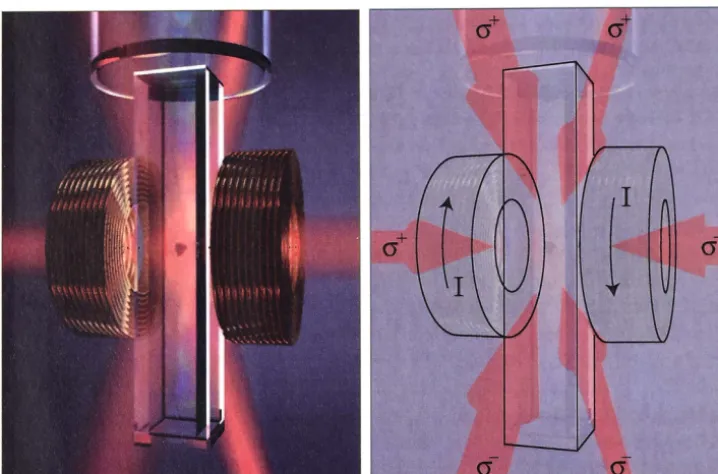
Figure 1.2: Left panel shows a rendering of a magneto-optical trap. The
trapped atoms can be seen levitating at the center of six intersecting laser
beams which cool the atoms below 1 mK. The atoms are contained within
an ultra-high vacuum glass cell (3 cm by 3cm square in this image) to isolate
them from thermal contact with any hot objects. Electromagnetic coils on either side of the cell create a trap for the atoms. Image created by the author
using Pov-Ray. Right panel shows a labeled schematic of the MOT, including
laser polarisation and orientation of current in the electromagnets.
1. 6
.1
The optical laser
[image:18.534.64.423.87.324.2]1.6 The definition of an atom laser 21
of light resonant with the inverted transition, via stimulated emission. The cavity mirrors reflect the amplified light back into the gain medium producing a feedback system which leads to laser oscillation. Providing that the cavity has low losses, these coherent optical oscillations can build up to extremely large amplitudes. A partially silvered mirror allows some of this light to 'leak' from the cavity producing a beam with the previously mentioned qualities. The properties of monochromaticity, directionality and brightness can be seen intuitively to arise from this 'mechanical' description, however the coherence of the optical laser stems from subtleties of the quantum processes within the system that are not immediately apparent.
The above properties can be condensed into a one line definition for the ( con-tinuous) laser as follows:
• A laser system produces a beam with a very large number of bosons in a single mode, which is very well approximated by a classical wave of fixed intensity and phase [42, 44].
Optical lasers conform so closely to this definition that much of their study is related to the noise in both amplitude and phase around the wave. The remainder of this section outlines why this is so.
1. 6. 2 Properties of a generic
laser
beam
Arguably, the most important of the processes within an optical laser is the gain saturation [9] that leads to steady-state operation. Many of the useful properties of a laser output, in particular its low-intensity fluctuations and slowly varying phase (which are both related to coherence), rely upon this mechanism [41]. It is a standard result [20] that the gain coefficient of a typical laser medium is a function of the population difference between the excited and ground states of a laser medium, N
=
N2 - N1. This, in turn, is a function of the photon flux density, through the transition rate between the two levels. Thus the gain coefficient for the photon field is actually dependent upon the photon density to be amplified. This is a nonlinear process and one finds that the gain coefficient is a decreasing function of photon fluxPumping process
t t t t
t t t t t t t t
Atoms (Gain Medium}
Mirror (R=l00%)
111111111111
Mirror (R=80%)Pumping process
22 Introduction
density. This effect is termed gain saturation. vVhen the saturated gain coefficient becomes equal to the loss coefficient (ie the sum of cavity and mirror losses) for the system, the laser reaches a steady-state regime. The intensity fluctuations of the laser field are damped by this dynamical negative feedback and the laser becomes approximately second order coherent. In terms of Glauber's second order normalized coherence functions [45] this can be expressed as
Jg2(T)
- lJ
«
1. (1.6)where g
2(T) = (:
I(t+T)I(t) :)/(1)2,
(::)
denotes normal ordering, and I is the laser intensity ( or atom laser density). For second order coherent light the quantum ( or shot) noise is the only contribution to the intensity noise spectrum.Given that gain saturation leads to laser oscillation of essentially constant in-tensity, fluctuations in the laser field's complex amplitude are dominated by phase noise [9, 42]. Phase noise in the laser is typically attributed to spontaneous emission [44]. Recently, Wiseman pointed out that this is not the case [46]. In fact, the phase diffusion has equal contributions from both the gain and loss. Just as stimulated emission in a linear amplifier causes intensity noise, stimulated emission gain in the laser causes phase noise. Taking a two time correlation of the field itself will char-acterise these phase fluctuations and this is generally expressed as the normalised first order correlation function g1(T)
=
(at(t+T)a(t))/(ata) 2
where a is the complex amplitude of the field. For T=
0 this is simply a measurement of the mean intensity( density for atoms). Ideally the phase, and hence g1 (
T),
will remain constant for along period. This coherence time of the laser can be characterised by
T
=
l
xo
jg1(T)jdT. (1. 7)To make a precise measurement of the phase of the field, and hence g1
( T), requires
an interference experiment with a large number bosons in the field ( the uncertainty in the measurement scales roughly with the inverse of the occupation number). This condition coupled with the requirement that the measurement time be shorter than the coherence time of the laser leads to the conclusion that spectral width of the laser beam should be much smaller than the output flux ( defined in this comparison as number of bosons per unit time) [47]. Written in terms of phase fluctuations of the field this condition is:
1
«
J
jG1(T)jdT, (1.8)where G
1 (T) = (at (
t
+
T)a(
t
))
is the unnormalised first order coherence function.In summary, there are a number of properties of a generic laser beam which do not require a unique form of the actual laser system. These are [42]
• the beam should be highly directional
1.6 The definition of an atom laser 23
• the beam intensity fluctuations are small (Jg2
(T)
-
11«
1)• the beam phase fluctuations are small (1
«
J
JG1(T)jdT)
The final condition can be made stronger by requiring that the laser linewidth be
less than the bare cavity linewidth, an effect which is known as linewidth narrowing.
The theoretical discovery of this effect is usually attributed to Schawlow and Townes [48], but a related result was actually derived three years earlier by Gordon et. al.
[49]. As discussed by Siegman [9], the results of Schawlow and Townes predict a narrowing of the spectral linewidth ( equivalent to a slowing of the rate of phase
diffusion) of the laser mode as the coherent power_ of the laser is increased. The
reader should note that in practice the limiting linewidth due to these quantum noise
fluctuations is broadened significantly by effects such as mechanical jitter, thermal
drift and other 'technical nC?ise' [9]. Thus we do not use this stronger condition in
defining a laser.
Figure 1.4: The atom laser described in Chapter 4 showing an atomic beam
derived from a Bose-Einstein condensate of about 104 atoms over a 12ms
period of continuous out-coupling. The magnetic trap has its weakly confining axis perpendicular to the output beam and gravity. The spatial extent of the beam is 0.7mm, and gravity is to the right.
1.6.3 An ultra-cold laser
24 Introduction
feedback due to the cavity initiates laser oscillation and the number of photons in
the mode dramatically increases.
The formation of a Bose-Einstein condensate is a non-equilibirum process deter-mined by complicated many-body dynamics [50]. In particular, there is a significant body of evidence indicating that 'quasi-condensates' form prior to a true phase co
-herent BEC [51, 52]. Experimental and theoretical findings indicate that after the
initial condensate nucleation, bosonic gain plays a significant part in the forma-tion of a large phase coherent condensate [53]. In keeping with the description of the optical laser, the environment in which BEC occurs can be similarly described. Magnetically confined neutral atoms are cooled through a process of runaway evap-orative cooling, where the most energetic atoms are expelled from the magnetic trap and the remaining atoms continuously rethermalise at a lower temperature, a
pro-cess that never strays far from thermal equilibrium. As the atoms are cooled, their
dimensionless phase space density
n(
O
)
A
3 approaches 1, and the average distancebetween the particles becomes comparable to their thermal de Broglie wavelength,
A
=
A~::
2r- Here,n(
O
)
is the peak density. At a critical temperature determined primarily by the number of atoms in the system, a phase transition occurs and the atoms condense into the ground state of the trap. The final number of atomsin the trap is determined by the ratio of the actual temperature to the transition temperature.
Figure 1.5: The atom laser consists of the same elements as the optical laser; a laser mode (the condensate) within a cavity (magnetic trap), a pumping
mechanism ( thermal cloud), which is not shown in the diagram, and an output
beam.
Let us now consider figure 1.5 v.rhich shows a schematic comparison between the
t\YO systems. One can equate the macroscopic occupation of the cavity mode by
photons ,..-ith the macroscopic occupation of the ground state of a magnetic trap
1.6 The defi.nition of an atom laser 25
means and this is equivalent to the traditional partially silvered mirror of an optical laser - a directional beam of bosons is produced in both cases. This comparison is the simplistic basis of the atom laser analogy, however there are far deeper similarities between the two systems: The Glauber coherence functions of first, g1
(0),
and second order,g2(0),
of a condensate have been measured. Both correlation functions are required to have values of approximately 1 for the BEC to be considered laser like. The condensate has been demonstrated to have a first order coherence of close to one through interference experiments [53] and this has also been demonstrated for atom laser beams [10]. Preliminary work from the Boulder and MIT groups indicate the suppression of local density fluctuations through measurements of the mean field ( or interaction energy) of the condensates [54, 55]. The most recent results are also consistent with g2( 0)
=
1 [56]. However, to the best of our knowlege secondorder coherence has not been measured in an atom laser beam. These measurements indicate strongly that the unpumped atom laser actually goes a long way to fulfilling the requirements set out in the previous section for laser-like behavior. The atom laser does not require continuous pumping or gain saturation effects to aquire its multiple order laser-like coherences. These properties arise from the formation of the condensate and spontaneous symmetry breaking that leads to the condensate phase.
Despite these striking similarities, in order to achieve the utility of an optical laser the atom laser must be continuously pumped. In particular, this should boost the output flux and significantly reduce the operational linewidth ( which is deter-mined by the atomic reserviour drain time).
Although the atom laser was first demonstrated by the MIT group, at the present time the experimental investigation of atom lasers has been dominated by the contri-butions of T. Hansch, I. Bloch, T. Esslinger and M. Kohl at the Max-Planck-Institut for Quantenoptik, in Germany. Experimental literature in the field is extremely lim-ited and highlights in the literature, which actually comprise about 70% of the total experimental research published, are:
• Output Coupler for Bose-Einstein Condensed Atoms, M.-0. Mewes, M. R. Andrews, D. M. Kum, D. S. Durfee, C. G. Townsend, and W. Ketterle, Phys.
Rev. Lett., 78 582-585 (1997).
• Atom Laser with a cw Output Coupler, I. Bloch, T. W. Hansch, and T. Esslinger, Phys. Rev. Lett., 82 3008-3011 (1999).
• A Well-Collimated Quasi-Continuous Atom Laser, E.W. Hagley, L. Deng, M. Kozuma, J. Wen, K. Helmerson, S. L. Rolston, and W. D. Phillips, Science, 283 1706-1709 (1999).
• Measurement of the spatial coherence of a trapped Bose gas at the phase transition, I. Bloch, T.W. Hansch, and T. Esslinger, Nature, 403 166-170 (2000).
26 Introduction
• Optics with an Atom Laser Beam, I. Bloch, M. Kohl, M. Greiner, T. W. Hansch, and T. Esslinger, Phys. Rev. Lett., 87 030401 (2001).
• Atom Laser Divergence, Y. Le Coq, J. H. Thyvvissen, S. A. Rangwala, F. Gerbier, S. Richard, G. Delannoy, P. Bouyer, and A. Aspect, Phys. Rev. Lett., 87 170403 (2001).
• Continuous detection of an atom laser beam, M. Kohl, T. W. Hansch, and T. Esslinger, Phys. Rev. A, 65 021606 (2002).
• Giovanni Cennini, Gunnar Ritt, Carsten Geckeler, and Martin Weitz All-Optical Realization of an Atom Laser, Phys. Rev. Lett., 91 240408 (2003).
1.6.4 The theory
of
atom
l
asers
In this section, we briefly discuss the ways in which atom lasers have been
treated theoretically. In analogy with optical laser theory, the theoretical
descrip-tion of atom lasers can be broadly divided into three approaches: rate equation models, semiclassical (mean-field) models, and quantum models. Optical laser the
-ory tends to increase in complexity when one moves from the level of rate equations to quantum formalism. This also applies to atom lasers, and there are many factors
such as the interactions between atoms, the fact that atoms cannot be created or
destroyed, and the quadratic dispersion relation of atoms, that make the dynam-ics of atom laser systems far less easy to tackle in more complex formalisms. At present, simpler models are able to take into account more physical contributions to the dynamics.
Using rate equation methods, theorists describe how the populations of atoms (in an atomic cavity, or atom trap, the output field and perhaps a pumping reservoir) evolve over time [57, 58, 59]. Rate equation models can also predict whether the
atom laser system has a threshold or a steady state. They are well suited to describe
the coarse properties of the system.
Ideally: the full quantum theory of an atom laser system, beginning with a complete Hamiltonian for the field operators of the system, would allow one to describe the quantum statistics of the atom laser completely [60, 61]. ::viany obstacles
stand in the way of this 'complete' theory, mainly due to the mathematical and numerical complexity of the problem.
The mean field approach uses the Gross-Pitaevskii (GP) formalism discussed
earlier to describe the time and space evolution of the macroscopic wavefunction of
the condensate and output fields. In the framework of this approach, it is straight -fon-.-ard to include effects. such as interactions: that are hard to tackle with quantum
statistics. Hmwver. because the GP formalism can only describe macroscopic dv -namics of the atoms. we cannot extract their statistical behaviour.
A promising new approach is to use a stochastic GP equation approach based on a quasi-probability distribution. This method would incorporate stochastic terms
1. 7 This thesis 27
equations. In the semi-classical limit, this stochastic approach is formally equivalent to the full quantum theory [44].
1.6.5 The continuously pumped atom laser
At the time of writing, the longest an atom laser has been run continuously is about 300 ms [7], albeit at very low flux. More typical operating times are in the lO's of milliseconds. In all cases, current atom lasers are limited by typical conden-sate sizes of around 106 atoms. The atom laser beam quickly drains the condensate.
Despite this, atom laser brightness [44] outperforms traditional atomic sources such as Zeeman-slowers and laser cooled atoms by at least six orders of magnitude. With Fourier limited outcoupling a further four orders of magnitude could be gained to produce an atomic source of brightness 1028 atoms s2m-5. The closest advanced
high flux source is a Cs atomic fountain created from 3D degenerate Raman side-band cooling in an optical lattice that produced a flux of 4 x 10²² atoms s2m-5
[63]. In order to utilise the atom laser as a practical research tool, a method must be found to replenish the condensate atoms without disturbing the production of an atom laser beam. Significant experimental progress has been made toward this goal. The recent work of Chikkatur et. al. demonstrated a comprehensive technique for continuously making, transporting and storing condensates [64]. The group at Laboratoire Kastler Brossel in paris have made significant progress towards imple-menting evaporative cooling of a continuous atomic beam in a magnetic waveguide [65, 66, 67]. A continuously pumped atom laser may be able to operate at far higher fluxes than are currently experimentally feasible and will certainly open up the possibility of long time scale measurements such as continuous interferometric detection.
1. 7 This thesis
28 Introduction
coupling is presented. This chapter investigates in detail the multi-component flux limiting dynamics of a pulsed atom laser and presents the first detailed comparison betv,reen an atom laser experiment and a full three-dimensional GP simulation of the system (performed by Dr. Craig Savage). Chapter 5 relates to the pumping of an atom laser. We demonstrate ,;vith an original theoretical model that three body recombination acts to stabilise the pumped atom laser in much the same way as gain saturation stabilises the output of an optical laser. Chapter 6 discusses the design and partial construction of our next generation atom laser machine, and includes a detailed procedure for optimising the efficiency (power generated versus geometric trapping frequency) of a QUIC magnetic trap for atom laser studies. Two appen
CHAPTER 2
Experimental and theoretical background
This chapter briefly reviews important theoretical and experimental results in the field of ultra-cold neutral atomic gases that form the underpinnings of the work described in later chapters. BEC with dilute alkali gases has so far been achieved only via evaporative cooling. Unless a completely new path to condensation is found, a machine designed to make BEC has only one core function: to create a long lasting, high atomic phase-space density. This core function is achieved by a two step process: laser cooling followed by evaporation in a storage potential. Below we describe the physics of the main components of a BEC machine. Unless otherwise specified, all quantities refer to the 87Rb laser cooling transition.
2.1 Atomic properties and hyperfine structure of
87Rb
" ... If one works hard enough, the probability that any given species can be evaporatively cooled to the point of BEC is actually quite high."
- E.A. Cornell, J.R. Ensher, and C.E. Wieman [28].
Despite this optimistic comment, and strong evidence to support it ( condensation of H [68], He[69, 70], Li[71], Na[72], K[73], Rb[74, 75], Cs[76] and Yb[77]), 87Rb is the most popular choice of atom for producing Bose-Einstein condensation [112]. We attribute this to three important points. It was the first atomic species condensed and hence expertise was built up rapidly and is now widely available. Secondly, the laser cooling resonance at 780 nm ( the rubidium D2-line) corresponds to exactly the wavelength used for compact disc music systems. As a consequence relatively cheap, high power diode lasers are available to cool this atom, which is an important consideration for new groups entering the field [28]. Finally, and most importantly, 87Rb has just the right combination of low temperature scattering properties that it
can be 'straightforwardly' evaporatively cooled to degeneracy (given a large number of cold atoms and a low background gas collision rate).
The atomic spectroscopy of 87Rb is presented on the left hand side of fig-ure 2.1, showing the D2 optical transition (saturation intensity 1.65 mW/cm2 for 5S1;2, F = 2 --+ 5P3;2, F' = 3 or 4.lmW /cm2 for random polarization), and the
30 Experimental and theoretical background
n
-···
SP 3121
-_--]·rr- ~::
:::
I 72 MHz780.24 nm
cooling imaging
optical
pumping
55 t (---i;epurnping
1/2 ... ···
-F'=3 ' '
F'=2 F'=l, ' ' F'=O F=2 F=l 700
G{ock-:
~
600 500 400? ~300 ...__,
>.. 0
200 ~
::i O"
100 ~
',~ ~
10
u..100
200
Figure 2.1: Some details of the 87Rb spectroscopy relevant to the current
experiment. On the right is a theoretical plot of the saturated absorption
spectrum [79) calculated from the model of Appendix A. In our experiment
the laser is locked to the F = 2, F' = 1, 3 crossover and shifted onto resonance by a double passed 120 MHz acousto-optic modulator (AOM).
The right side of Figure 2.1 shows a typical saturated absorption spectrum of the 5S1;2 ; F
=
2-+ 5P3; 2 , F' transitions. The cycling transition for laser cooling of 87Rb is the 5S1;2 , F=
2 -+ 5P3; 2 , F'=
3 which has a natural linewidth of r-.r=
21r x 5.9NIHz. A laser able to resolve this transition must have an instantaneous ( rv lms)
line·width less than 5.9 MHz and be frequency stabilised in an absolute sense to greater than 1 part in 109. Despite such stringent requirements, there is a small
probability (;::::: 10-3) of the cooling laser exciting the 5S
1;2 , F
=
2 -+ 5P3;2 , F'=
2transition. From this hyperfine state there is significant chance ( 50%) of the atom decaying into the 'dark' lower hyperfine ground state. For saturation intensities, light resonant with the 5S1;2 ; F = 2 -+ 5P3;2 , F' = 3 transition will optically pump
an entire atomic sample into a non-resonant state and laser cooling will cease in a few milliseconds. To avoid this; an additional low power laser is applied resonant with the 5S1;2 ; F
=
1 -+ 5P3;2 ; F'=
2 transition, pushing the atoms back into theoptical cooling cycle. The fraction of laser cooled atoms in the dark state can then be controlled, ranging from O to 100%. A number of schemes rely on manipulating this effect either spatially [80] or temporally [81] to increase magneto-optic trap densities: a factor critical to BEC. The optical pumping light resonant with the
5S1;2. F
=
2 -+ 5P3;2 : F'=
2 transition is used to prepare an atomic sample formagnetic trapping and is discussed in detail in Chapter 3.
2.2
Pushing
aton1s around
The production of a Bose-Einstein condensate and an atom laser requires that the external (kinetic temperature) and internal (electronic) degrees of freedom of an atom must be manipulated v\ith high precision. In order to manipulate atoms.
,..-e must apply a force to them. Three general tools are used to do this: the
2.3 Optical molasses & the magneto-optical trap 31
interaction of its atomic spin with an inhomogeneous magnetic field. The radiation pressure force arises when a stationary atom absorbs photons from an optical trav-eling wave. Because the atom spontaneously emits photons absorbed from the laser
in a random direction, it feels a net force ( the acceleration can be huge - up to 105
g)
in the direction of the wavevector of the laser. This scattering force is dissipative
and saturable. The atom also experiences a force proportional to the gradient of the spatially modulated light shift 6
=
(nJJ25/(52+
,
-y2/4),
where Dis the Rabi frequency, , is the transition linewidth and J is the laser detuning from the atomic resonance. This force is called the dipole force. It is conservative and does notsaturate. The scattering and dipole forces can be used in combination or separately to produce a variety of optical cooling and/ or trapping schemes. Although we will
not discuss the dipole force any further in this thesis, it plays an integral part of the new atom optics of Feshbach resonances in optical dipole traps [82]. The magnetic
force is well known through the experiment of Stern and Gerlach on the separation of atomic spin [83, 84]. It takes the form F
= -
'V(µ
·
B) where µ is the atomic magnetic moment and B is the magnetic field. Each force has its own uniqueben-efits and, as will be discussed in the following sections, when judiciously combined to make use of their strengths, they can increase the phase space density of a small number of atoms (106) by at least 12 orders of magnitude.
2.3 Optical molasses
&
the magneto-optical trap
The magneto-optical trap (MOT) [38] cools atoms from a diffuse room tempera-ture vapor to a small cloud of atoms at a few hundred micro-kelvin in milli-seconds. As mentioned in the introduction, this dramatically efficient cooling system forms
a key step in the production of a Bose-Einstein condensate. When the MOT is
followed by an optical molasses cooling stage [37], the temperature of an atomic sample can be lowered another order of magnitude to approximately 50µK.
Opti-cal molasses cooling relies on a velocity dependent form of the scattering force as described below.
2.3.1 Doppler and sub-Doppler cooling
For a two level atom moving in a single optical travelling wave ( one beam), the optical Bloch equations [85] can be used to find that the radiation pressure
32 Experimental and theoretical background
velocity is lowered towards zero. This effect is known as Doppler cooling and can be intuitively understood by studying a two-level atom moving in a red detuned traveling wave as in Fig. 2.2. An atom that is moving towards one of the cooling beams will be Doppler shifted towards the atomic resonance, while an atom traveling in the opposite direction will be shifted away from resonance. Because an atom is more likely to absorb photons on resonance, it preferentially scatters photons opposing its motion. In this way, the motion of an atom in a one dimensional optical standing wave is quickly damped. This cooling effect is limited by the random momentum kick the atom receives from spontaneous emission following the absorption of a directional cooling photon. By equating the diffusive heating of spontaneous emission with this velocity selective cooling mechanism, one arrives at the Doppler cooling limit to the temperature: T
=
n
, /
(2kB) where , is the linewidth of the atomic transition and kB is Boltzmann's constant. For rubidium, this temperature corresponds to about 140µK. By using three pairs of orthogonal laser beams to produce optical standing waves in three orthogonal directions, this system can be extended to create a full three dimensional cooling scheme. The atoms are cooled so quickly in the laser fields that they move according to simple Brownian motion due to spontaneous emission. Because of this, the atoms diffuse out of the trap on the time scale of 10 to 102 milli-seconds; the atoms are effectivelyconfined over these short times, and this has become known as optical molasses [37] (figure 2.3).
Temperatures significantly lower than those predicted by Doppler cooling are possible in this type of laser configuration due to interaction between the polarisa -tion of the molasses and the complex internal structure of the atom (rather than the two level atom used to model Doppler cooling). Temperatures of a few times the recoil limit T
=
(nk)2
/(MkB): where k is the wavevector of the laser beams and :\I is the mass of an atom ( about 400 nK for Rb), are theoretically possible [37] but in practice radiative effects limit the temperature of optical molasses to a factor of about 102 higher than the recoil limit.Laser frequency
\
Atomic resonance+-- --+
2.3 Optical molasses & the magneto-optical trap
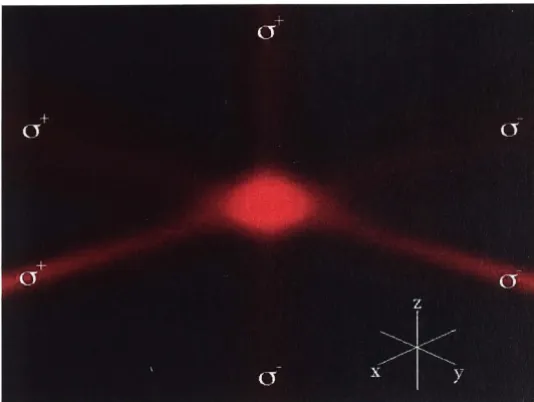
Figure 2.3: Three spatially orthogonal, counter-propagating pairs of oppo-sitely circular polarized light form an optical molasses as used in many Bose-Einstein condensation experiments.
2.3.2
Polarisation gradients
33
Consider the light field generated by two red-detuned counter-propagating op-positely circular polarized lasers of the same wavelength, A. If the amplitude of the lasers is the same then along the axis of the beams the local polarisation is always linear and varies helically with a pitch of A. For a two level atom, charac-terised by a transition linewidth of 1 , moving in this configuration of lasers simply results in the Doppler cooling described in the previous section. A real atom has multiple Zeeman states of the ground and excited levels. A velocity dependent sub-Doppler cooling mechanism arises in this configuration due to a combination of polarisation-dependent optical pumping and constant (but different) light shifts
(
.6
=
(nJJ25/(52
+
,
2 /4) where Dis the Rabi frequency, 1 is the transition linewidth and 5 is the laser detuning from the atomic resonance) on each of the atomic Zee-man states due to the presence of the optical field. This effect can be described by considering an atom with a J=
l ---+ 2 transition ( the simplest case for which this cooling scheme can work), consisting of three initially degenerate Zeeman ground states, m} = -1, 0, 1 and five excited statesmp
= - 2, -1, 0, 1, 2. Because of the selection rules for 1r atomic transitions ( absorption of linearly polarised light), astationary atom quantised in the direction of the local polarisation will quickly be optically pumped into steady state population distribution of 0.235:0.53:0.235 for them} = -1, 0, 1 states respectively, according to the appropriate Clebsch-Gordon coefficients. In addition, a 1r transition from m}
=
0 is 1.33 times as strong as a 1r [image:31.527.131.398.87.288.2]34 Experimental and theoretical background
in the polarisation direction, which leads to a non-adiabatic coupling between the
Zeeman ground states experiencing different light shifts. A lengthy calculation [86] reveals that in the moving frame of the atom a population difference between the
m} = 1 and m} = -1 arises proportional to the atomic velocity divided by the
m}
=
O light shift. For red detuned lasers, the light shift is negative. As shownschematically in figure 2.4, if an atom is moving toward the CJ+ laser, it vvill have a
greater population in the m}
=
+
1 states. For an atom in this state, the scatteringprobability for CJ+ light is a factor of six higher than that for CJ- light. A similar
argument applies for atoms moving towards the CJ- light. The radiation pressures
exerted by the lasers will be unbalanced and atoms will scatter more light from the
counter-propagating laser, giving rise to velocity dependent cooling. The time scale
for optical pumping is equal to the inverse of the linewidth of the ground state, 'Ye
( which is due to the mean scattering rate of photons). In the limit of low laser power
(Rabi frequency D
«
ry), the optical pumping time is very long compared to the lifetime of the excited state and hence 'Ye«
T Because of this clear separation of internal timescales, there are two regimes in which this 'induced orientation' coolingforce acts depending on the velocity of the atom, v;
• when kv
«
'Ye there will be significant cooling due to the mechanism described above.• when kv ;?:, ry the coherences between Zeeman states will be negligible and the force on the atom roughly equals the Doppler force.
In figure 2.5, the force on the atoms over a large range of velocities is presented [86].
It is clear that this cooling mechanism is extremely versatile. It has a large capture range (similar to Doppler cooling) but can also reduce the kinetic temperature of
atoms well bellow the Doppler limit. The scheme is very sensitive to an external magnetic field because it relies on the spin orientation of the Zeeman states. A field
of the order of 10 mG will dramatically disrupt the low velocity cooling [37]. Finally all of the above analysis relies on the fact that an atom travels directly along the
axis of the cooling beams, which is clearly not the case in reality. The polarisation
experienced by an atom moving off axis is far more complex than described here
and other types of cooling mechanisms (such as Sysiphus cooling [86]) occur as well. Although Doppler cooling and induced orientation cooling can dramatically reduce the temperature of an atomic system (to lO's of µK) they are still only viscously
mF=l mF=-1
~
+---·
\
-
~i
~
2.3 Optical molasses & the magneto-optical trap
0. 15
-1
-0. 15
FORCE (Uni l
nk
r/2)0
01\ .. 0. 04
[image:33.527.112.414.91.311.2]VELOCITY unit- r1k
Figure 2.5: The complete cooling scheme of o-+ - o-- polarisation showing the force on an atom as a function of its velocity. Schematic from J. Dalibard and C. Cohen-Tannoudji [86]. The inset to the figure shows the increased slope of the cooling force coinciding with sub-doppler cooling region in comparison to the standard doppler cooling slope.
35
confining ( a feature described by the optical Earnshaw theorem [87]). In order to produce a true trap we need to introduce a spatially dependent mechanism to localise the atoms.
2.3.3 The magneto-optic trap
36 Experimental and theoretical background
mechanism described in the previous section still operates to cool atoms in both the high and low velocity limits. As vvith the molasses, to form a three-dimensional trap, three orthogonal sets of counter-propagating red-detuned beams with a-+ and a- -polarization are used. A magnetic field that varies linearly in space is applied, and the orientation of the polarisations of the laser beams are selected appropriately to create a confining force. Atoms moving sufficiently slowly are collected by Doppler cooling and then captured by the confining potential. Once confined, the atoms continue to be cooled, both by Doppler cooling and also by polarization-gradient cooling (PGC). The combination of these viscous forces and the confining magneto-optic forces creates a cold cloud of atoms trapped in the vicinity of the minimum in the magnetic field. A further discussion of the magneto optic trap is given in chapter 3 including loading, trap lifetime, characterisation, and construction.
2.3.4 The
li
mits of opt
i
ca
l
coo
li
ng
A MOT collects a large number of atoms at intermediate temperatures typically just below the Doppler limit. Upon removing the magnetic field used to create the trapping in a MOT, a much larger portion of the atomic cloud experiences the conditions necessary for orientational cooling. We mentioned previously that the theoretical limit to PGC is extremely low, around a couple of µK. In fact, optical techniques, such as Raman sideband cooling [63], are available that can lower the temperature of an atom cloud significantly below the recoil limit of 400 nK. However, achieving Bose degeneracy requires a phase space density of the order of 1, and although very low temperatures are achievable with optical cooling, the atomic density is severely limited. At such high densities and low temperatures the large number of trapped atoms becomes optically thick; it is likely that a cooling photon will be scattered multiple times. This leads to a repulsive radiative force between the atoms, which limits the density of the sample to less than 1011atoms/cm3 [81]. The presence of the laser light also introduces density-dependent light-assisted collisional losses in the MOT [135]. The combination of these effects limits the phase space density of a MOT to around 10-7 and a PG cooled sample to an order of magnitude
less. In order to increase the density, it is clear that the resonant cooling light
~
~
~11~--
l
-
~
---1-
~
~~)---~
~ ~?11J
F~l~____.._-~
~ ~ ~
~ ~ ~ -
-~~
F
-
0
IBI - -- - -- --- I- - - -- IBI
position
2.4 Magnetic trapping 37
must be removed from the system completely. Magnetic trapping takes over the confinement with forced evaporation providing the cooling.
2.4 Magnetic trapping
The alkali atoms typically used in BEC experiments are well suited to magnetic trapping due to the magnetic moment of the unpaired valence electron. For the magnetic field magnitudes described in this thesis, the degeneracy of the Zeeman states of 87Rb are lifted in the presence of a magnetic field (for fields
<
80 G by about1 MHz/G) according to an approximate Breit-Rabi equation [88] for the Zeeman energy:
P
(1
1
2 (gsµBB)2 )
EP,mp(B) = (-1)
2
rlw+
gpmpµBB+
16 (4 - mp) n,w+
canst. (2.1) where gp = (-l)Pl/(21+
2)gs, I = 3/2 is the nuclear spin of 87Rb, w = 21r x 6.835GHz and gs = 2.0 is the electron g-factor. The first term is the hyperfine splitting between ground states. The second term is the linear Zeeman effect. The third term contributes significantly for magnetic fields above about 100 G. The magnetic traps used for the work presented in this thesis operate near zero magnetic field and hence the energy of anIF,
mp) state can be well approximated by the linear Zeeman effect E = gpmpµBIBI. As an atom moves through space, its moment will precess around the spatially varying magnitude and direction of the magnetic field, with a Larmor frequency of WL = gpµBIBl/n (for a field of 1 G WL ~ 21r x 0.7 MHz). If the field varies slowly, the precession will adiabatically follow the field, and the atom's Zeeman energy will depend only on the amplitude of the field. Thus, the atom will remain in a particular Zeeman state and will move in a potential defined by the Zeeman energy:V(x)
=
gpmpµBIB(x)j. (2.2)38 Experimental and theoretical background
Figure 2. 7: BEC spectroscopy of the Zeeman sublevels of the F=2 ground state of 87Rb performed on the BEC machine described in this thesis. Shown are 5 ms expansion absorption images of a cloud of atoms through which a magnetic field zero crossing has been swept. ( a) Cloud just prior to BEC and
(b) well below the transition temperature. From left to right of image (b) is the mp = 2, mp = 1, mp = 0 and a faintly visible mp = -1
crossing
[
91
].
The adiabaticity criterion can be established by requiring that the rate of change of the magnetic field direction is significantly smaller than the Larmorfrequency,
lvT
·
vBI
«
WL wherelvTI
= ~ i s the thermal velocity of the atomof mass M and temperature T and
13
=
B
/I
B
I
is the magnetic field unit vector. Th. 1s con d't' 1 10n can e approx1ma e b . t d . m one d1mens10n ' . b y vrdp dBp<<
9FµBB~ --n-. F or atemperature of 1 mK and a magnetic field gradient of 200 G / cm, this condition is easily satisfied for field magnitudes greater than about 200 mG. For atoms at BEC temperatures less than 1 µK, this adiabaticity condition is relaxed dramatically.
The simplest way to create a trapping magnetic field geometry is to use a pair of coils with opposite but equal current. The magnitude of the magnetic field produced increases linearly from zero in all directions and hence is able to trap neutral atoms. Although this geometry was used for the first demonstration of magnetic trapping of neutral atoms [92], an extreme version of Majorana transition
occurs in this configuration. The Larmor frequency goes to zero at the trap centre
producing a Majorana flop, and this mechanism introduces a catastrophic loss of
atoms at low temperatures [93]. To avoid this effect, different trapping geometries have been developed, all based on keeping the magnetic field minimum ( or bias) in
the adiabatic regime. One solution is the so called time-orbiting potential (TOP)
trap which employs a time varying magnetic field to create a finite magnetic field
bias. This trap was used for the first observation of Bose-Einstein condensation in rubidium atoms [74]. The MIT group solved the problem of creating a bias by adding a blue detuned focused laser to the magnetic trapping potential [72]. The dipole effect forced atoms into regions where they could adiabatically follow the magnetic field. Later, many groups moved to a DC trap known as the
Ioffe-Pri tchard (IP) conguration [94], in which the atoms experience a harmonic potential
2.4 Magnetic trapping
!1::::~1
0 0.1 0.2 0.3 0.4 0.5 Position (au)Figure 2.8: Left panel: Schematic of the QUIC magnetic trap, showing the relative position of each coil and the direction of current flow in the coils. The two large coils are the quadrupoles. Right panel: Absorption images of 108 87 Rb atoms in the QUIC trap described in Chapter 3. In ( a) the magnetic coils are adjusted to produce a harmonic IP trap, while in (b) the Ioffe coil has been moved axially outward by approximately 20µm producing two quadrupole traps. The barrier height is low enough that the 50µK atoms spill between the wells.
2.4.1
The Ioffe-Pritchard configuration trap
39
The IP configuration provides the strongest DC trapping potential with an
inher-ently non-zero bias field. For an IP-type trap, the field is approximately harmonic
about a non-zero field minimum ( B0 ), the radial (tight) trapping direction scaling
with the inverse of B0 . If the temperature of the trapped atoms satisfies the relation kT
«
l
µIBo
,
the trapping potential around the trap minimum is well described by a harmonic function [95]:V
(z,
p)
=
l
µI
(Bo+
!B;p2
+
!B;
z
2)2 2 (2.3)
.. where z is the axial coordinate, p is the radial coordinate and Bi
=
B~ 2 / B0 - B: /2.The ' denotes magnetic field derivatives ·vlith respect to the spatial coordinates. The radial and axial trapping frequencies are then given by:
Wz = '\/ µBgpmpB~ M
µBgpmpB" (2.4)
Wp = '\/ p
40 Experimental and theoretical background
The adiabaticity criterion can be recast in terms of the trapping coefficients using the Landau-Zener formalism [91 J as:
gpµBB5
«
l (2.5)nmpB~lvTI
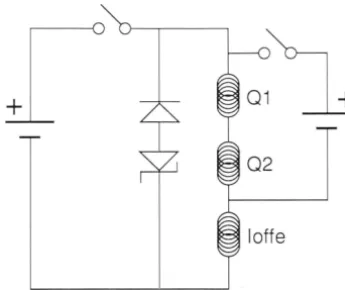
In the work described in this thesis, we use a three coil IP trap conceived by Soding
et. al [96] and developed into the tightly confining quadrupole Ioffe configuration
(QUIC) design at Munich [97]. The configuration of the QUIC trap is shown in the
left panel of Figure 2.8. In this setup an Ioffe-Pritchard trap is generated by two quadrupole coils ( oriented along the y-axis) with opposite current which produce a field BQ that increases linearly in all directions from a zero at the origin. The Ioffe coil ( oriented along the z-axis) produces a non-linear magnetic field, Br, that, when summed with the linear quadrupole field, gives an approximately harmonic field along the z-axis. In the radial directions, the Ioffe field equalises the gradient produced by the quadrupole coils to produce a radially symmetric trap. "\i\Then arranged appropriately, the three coils produce a magnetic field,
I
B
I,
consisting of either two quadrupole traps or a harmonic trap with a magnetic bias, B0, as shownin the right panel of Figure 2.8.
2.5 Forced evaporative cooling
To date, forced evaporation is the only method that can produce a Bose-Einstein condensate. Typically, evaporative cooling is implemented in a magnetic trap, how-ever the condensation of Rb by evaporation in an optical dipole trap [98] opened up the possibility of cooling atoms with magnetically unfavourable scattering prop-erties at low temperature [76]. In the present experiment, once the atoms have been loaded into the magnetic trap, they are cooled by preferentially removing high energy atoms from the trap while leaving the remaining atoms to re-thermalize to a lower temperature via elastic collisions. Radio-frequency transitions between dif-ferent magnetic sublevels provide a spatially selective means of removing the most
energetic atoms from the trap. The resonance between the magnetic field and
ap-plied RF radiation is defined by
nwev
IBcutl
=
gpµ3 (2.6)where Wev is the RF frequency and Bcut is the value of the magnetic field at which
atoms interact with the RF mechanism. Atoms with an energy of approximately
the truncation energy Ecut
=
gpmpµs(Bcut - Bo) have a high probability of beingremoved from the system via transitions from trapped to untrapped states. The precise probability can be calculated numerically via a set of coupled Schrodinger
equations for the relevant interaction Hamiltonian[99, 100]. By continuously
lower-ing the truncation energy the evaporation can be forced to proceed at a constant
rate, which is parameterised by the truncation coefficient
Ecut gpmpµs(Bcut - Bo) nmp(Wev -


![Figure 2.9: lowing [4], Schematic representation of the Raman coupling mechanism fol-and described in the text](https://thumb-us.123doks.com/thumbv2/123dok_us/8047640.222638/45.526.196.354.100.280/figure-lowing-schematic-representation-raman-coupling-mechanism-described.webp)