by
Robert Joseph Adler, B.Sc.(Hons) Sydney
A thesis submitted for the degree of Master of Science at
The Australian National University, Canberra.
The author wishes to acknowledge the assistance given to him by his supervisor, Dr. C.C. Heyde, who was always avail able for comment and discussion, even when we were separated by some thousands of miles. He also thanks Miss Norma Chin, whose excellent typing has turned a somewhat messy manuscript
into a readable and presentable form. Finally, thanks are due to the author's wife, Joan, and his daughter, Arielle, both of whom have, in their own way, made this thesis
CENTRAL LIMIT RESULTS WITHOUT INDEPENDENCE
CONTENTS
INTRODUCTION 1
CHAPTER I - MARTINGALE CENTRAL LIMIT RESULTS 3
1.1 Preliminaries 3
1.2 Brown’s Theorem 7
1.3 Scott's Theorem 8
1.4 Drogin's Theorem 12
1.5 AnConoralioation of Drogin's Theorem 14
CHAPTER II - RELAXING THE LINDEBERG CONDITION FOR MARTINGALES 19
2.1 Zolotarev's Theorem 20
2.2 Two Central Limit Theorems 24
2.3 On an Invariance Principle 34
CHAPTER III - QUESTIONS OF NECESSITY 38
3.1 Necessary and Sufficient Conditions when the
Summands are Independent 39
3.2 Some Necessary Conditions for Martingales 40 3.3 A Necessary and Sufficient Form of Drogin's Theorem 45
This thesis is primarily concerned with central limit results for martingales, and the role Lindeberg-type conditions play in them. Two types of results are dealt with, simple one-dimensional central limit theorems and more complex invariance principles for the central limit theorem. Some of our results are more general or slightly different versions of known results, while others, within the context of
martingale theory, are completely new.
We begin in Chapter I by introducing the notation and the problems we shall consider. Also, as much of the earlier work relevant to our study has not yet been published, we spend some time describing and discussing it. The last part of the chapter derives two new invariance principles, the first of which is a subsequence version of a theorem of Scott [16] , while the second takes an invariance principle relating to a random subsequence of a martingale process (Drogin [8]) and derives a new version relating to a similar non-random subsequence.
In Chapter II we take the Lindeberg condition, which appears in some form in all the theorems of Chapter I, and, while still retaining a central limit theorem, weaken it in a manner analogous to Zolotarev's weakening of the Lindeberg condition in the classical Lindeberg-Feller
theorem for sums of independent random variables [19]. The aim here is to remove from the martingale differences the standard condition that they be uniformly asymptotically negligible (u.a.n.). In this chapter we also show that once the u.a.n. condition is lifted, simple
Chapter III considers the problem of necessity in more detail. Invariance principles of the type we consider contain a considerable amount of information, much of which can be conveniently retrieved using mappings of the random functions involved, together with
Theorem 5.1 of Billingsley [3]. Using this technique we are able to obtain the necessity and sufficiency of both the u.a.n. and Lindeberg conditions in a functional analogue of the classical Lindeberg-Feller theorem, as well as deriving some general, necessary conditions for invariance principles involving martingales and other stochastic
processes. The main result of this chapter is an invariance principle for martingales in which the convergence in the mean of order one of a Lindeberg sum to zero is sufficient for weak convergence, while
Chapter I
Martingale Central Limit Results
1.1 Preliminaries
There has existed for some time a large body of literature con cerned with central limit theorems for sums of independent random variables. Recently a considerable amount of work has been done extending these results to cases when the summands are no longer independent. In this chapter, which serves as an introduction to the terminology, notation, and concepts of the later chapters, we shall review some of this work, as well as establishing two new results.
Various forms of dependence among summands have been used in generalising independence results, among the more important being con ditions of stationarity, m-dependence, mixing, and martingale
dependence. Serfling [17] has obtained, under a certain set of moment conditions, combined with a Lindeberg-type condition, central limit theorems for sequences of random variables satisfying each of these types of dependence, and his paper serves as a good introduction to the various classes of dependence currently in the literature. In what follows however, we shall be concerned exclusively with martingale dependence. There are two main reasons for this, which we shall state after having defined exactly what we mean by a martingale.
Let {ft,F,P} be a measure space: Ü is a set, F is a a-field of subsets of $7, and P is a probability measure defined on F. Let
information contained in the past history of the process. Then if the following three conditions hold, the sequence of random variables (Sn , n > 1} is said to be a martingale relative to {F , n > 1}.
(i) S is measurable with respect to F ,
n r n *
(ii) EIS I < », ! n 1 *
(iii) If m < n, then E(S |F ) = S a.s.
“ n 1 m m
We shall refer to this sequence of random variables as the martingale {Sn ,Fn> n > 1} defined on the probability space {fi,F,P}.
The simplicity and ensuing generality of martingales is the first reason to study this form of dependence. The second and more
important reason is the rather useful fact that it is possible to obtain from any integrable stochastic process a closely related
martingale by appropriate subtraction of conditional expectations. If
n n
Z.} is any integrable process then { £ [Z. - E(Z.|z. , , ...)]}
I J j=l J J J-i
{
2 ja martingale relative to the sequence of o-fields generated by , j < n. Often the conditional expectations of a process, given the past, have a simple form, and thus central limit results are easy to establish if corresponding results are already known to hold for martingales. Furthermore Scott [16] has developed a representation, due originally to Gordin [20], which shows that the increments of a stationary process can, under mild conditions, be represented as the increments of a
stationary martingale plus extra terms which telescope under summation and disappear under the usual normings. Such results indicate the importance of martingales in the much wider field of dependent random variables.
sufficient condition for the asymptotic normality of the sum, under an appropriate uniformity condition on the summands.
The Lindeberg-Feller Theorem
Let {X., j > 1} be a sequence of independent random variables with n
EX. = 0, EX? < 00 Vj, and with partial sums S = 2 X.. Let
J J n j=i J
s2 = E(S2) and write F. for the distribution function of X.. Then if
n n j j
sup E(Xf)/s- 0 as n -> °°, the following (Lindeberg) condition is
j-n 3 n
v
v
necessary and sufficient for s 1 S ■> N(0,1) as n ■+ », where denotes convergence in distribution,
n j*
s” 2 2 X2 dF.(x/s ) 0 as n -* Ve > 0 .
n . it j (ii)**v n *
j=l J |x|>e
It seems natural to study a martingale analogue of the above theorem, and particularly the role that some analogue of the Lindeberg condition has to play for a martingale sequence. Central limit
theorems and invariance principles for martingales, using such con ditions, have already been found by Brown [4], [5], Brown and Eagleson
[6], Drogin [8], and Scott [16J , all of whom used quite different techniques, and, quite often, different sequences and norming factors. Underlying all of these results however is some form of Lindeberg con dition for martingales, which we now describe in its simplest form.
Consider the martingale defined above. Then we can define a sequence of martingale differences as follows:
(i) X = S = 0 a.s.
o o
(ii) X = S - S - , n > 1. n n n - 1
We shall suppose that EX2 < 00 for each n. If we now write s2 = E(S^), n > 1, we can say that the martingale satisfies the Lindeberg
j = l
E(x! I(lxj
> e s
n } ■ > 0 1 . 1. 1
a s n Ve > 0 , w h e r e 1(A) i s t h e i n d i c a t o r f u n c t i o n o f t h e s e t A, P
and d e n o t e s c o n v e r g e n c e i n p r o b a b i l i t y . 1 . 1 . 1 o f c o u r s e r e d u c e s t o
t h e c l a s s i c a l f o r m o f L i n d e b e r g c o n d i t i o n i n t h e c a s e o f i n d e p e n d e n c e .
Two m ai n t h eme s r u n t h r o u g h t h i s t h e s i s . F i r s t l y , i s i t p o s s i b l e
t o r e l a x t h e L i n d e b e r g c o n d i t i o n i n t h e r e s u l t s m e n t i o n e d a b o v e t o
o b t a i n a w e a k e r s e t o f c o n d i t i o n s f o r t h e m a r t i n g a l e t h a t i s s t i l l
s u f f i c i e n t f o r a c e n t r a l l i m i t r e s u l t ? The m o t i v a t i o n b e h i n d t h i s i s
d e s c r i b e d i n C h a p t e r I I . S e c o n d l y , w i t h t h e e x c e p t i o n o f Brown [ 5 ] ,
a l l o f t h e a b o v e p a p e r s h a v e c o n s i d e r e d o n l y t h e s u f f i c i e n c y o f t h e i r
c o n d i t i o n s f o r o b t a i n i n g f u n c t i o n a l c e n t r a l l i m i t t h e o r e m s ( i n v a r i a n c e
p r i n c i p l e s ) , and t h e on e e x c e p t i o n c o n t a i n s a r a t h e r r e s t r i c t e d r e s u l t .
I s i t p o s s i b l e t h e n , w i t h i n t h e f r a m e w o r k o f a n i n v a r i a n c e p r i n c i p l e ,
t o o b t a i n g e n e r a l n e c e s s a r y and s u f f i c i e n t c o n d i t i o n s f o r t h e
c o n v e r g e n c e o f a m a r t i n g a l e s e q u e n c e ?
I n C h a p t e r I I we s h a l l show t h a t t h e f i r s t o f t h e s e p r o b l e m s c a n
b e s o l v e d u s i n g a s i m i l a r a p p r o a c h t o t h a t t a k e n by Z o l o t a r e v [19J i n
s o l v i n g t h e same p r o b l e m i n t h e i n d e p e n d e n c e c a s e . C h a p t e r I I I
p r o v i d e s a p a r t i a l a n s w e r t o t h e s e c o n d p r o b l e m u s i n g a v a r i e t y o f
t e c h n i q u e s .
B e f o r e we a c t u a l l y t a c k l e t h e s e p r o b l e m s f u l l y i t i s w o r t h w h i l e t o
s p e n d some t i m e r e v i e w i n g , i n r e a s o n a b l e d e t a i l , r e c e n t wo rk i n
m a r t i n g a l e c e n t r a l l i m i t t h e o r e m s . B e c a u s e much o f t h e wo rk we s h a l l
r e f e r t o h a s n o t y e t b e e n p u b l i s h e d , i t w i l l b e n e c e s s a r y t o q u o t e some
t h e o r e m s i n f u l l , an d t o g i v e s k e t c h e s o f t h e i r p r o o f s .
The h i s t o r y o f m a r t i n g a l e c e n t r a l l i m i t t h e o r e m s a c t u a l l y d a t e s
invariance principle for stationary, ergodic martingales. The results
of immediate concern to us however, are those of Brown [3], Scott [16]
and Drogin [8], whose results are written out below as Theorems 1.1 to
1.3.
1.2 B r o w n ’s Theorem
Theorem 1.1, which we shall call Brown's Theorem for the remainder
of this thesis, was the first, chronologically, of the three results
following, and is perhaps also the simplest of them. Brown's result is
actually an invariance principle, in which he considers a random
function, £n , defined on the martingale, with realisations (sample
paths) in C = C[0,1], the space of continuous functions on [0,1], He
defines
= s ' 1 S,
n k
sk s t s 2 < s 2 n " Sk+1 + X.
(ts2 - s 2)
n k
k+1 (s2
k+1
3&
1. 2. 1
for 0 < t < 1, and s£ < ts^ < s£+ ^, k = 0,1,2, ..., n-1. Then is
a.e. continuous on [0,1] for all n, being composed of straight line
segments joining the points (sn 2s 2 ,sn LSk ) and (sn 2s£+ 1 >
snl
sk + i > >k = 0,1, ..., n-1. Furthermore, write W for a standard Wiener process
(Brownian Motion) in C, with the properties defined on page 61 of [3].
The existence of such a W is established in [3]. Then Brown's result
can be stated as follows.
Theorem 1.1
Retain the above notation. Then
V
£ -> W as n -* 00
n 1.2.2
n P
s“2 2 E(X?|F. .) + 1 as n -> « , 1.2.3
n - I J J-l J = 1 J J
n p
s 2 2 E(X2 I ( IX. > es ) IF. ,) + 0 as n + «>, Ve > 0 . 1.2.4 n . . j 3 ! ” n 1 i-l
J = 1 J
Like most other invariance principles of this type, Theorem 1.1 is
proven in two steps. Firstly, Brown shows that the finite dimensional
distributions of approach those of W, and then that the set of
measures associated with these finite dimensional distributions is
relatively compact (tight). Theorem 8.1 of Billingsley [3] then
guarantees the weak convergence of the random functions. The first
part of the proof is based on manipulation of characteristic functions,
following a technique developed by Billingsley [1], [2]. The same
technique is used in Chapter II of this thesis. The tightness proof
relies on an .upcrossing inequality for martingales derived by Doob [7].
As noted above, Brown's Theorem is perhaps the simplest we shall
consider. It is a result that involves the full martingale sequence
(some later results relate essentially only to subsequences of the
martingale) and the norming factor, s2 , is the intuitively obvious one.
Brown also provides a set of equivalent conditions to 1.2.3 and
1.2.4, but as these also arise in Scott’s Theorem we shall not state
them now. Another result of Brown’s, which contains a necessary as
well as sufficient condition for convergence of a subsequence of the
normed martingale is described in Chapter III.
1.3 Scott’s Theorem
Many of the random functions that we shall deal with are different
from in that they have sample paths in D[0,1] rather than C[0,1J.
Here D = D [0,1] is the space of real functions on [0,1] which are
to working in D rather than C. Firstly, since D contains C, the results in D have more scope and, as we shall see in Chapter III, necessity results are easier to obtain in D than in C. (It is of course imprecise to speak of "results in C or D" as we do here, since
convergence in distribution is always relative to a metric space. The
metric spaces we shall use are (D,p) and (C,p), where p is the sup-norm (uniform) metric. As we shall always be using the metric p with these function spaces, we shall continue to use this convenient expression.
The space (D,p) is used rather than the apparently more natural (D,d) because the limit distribution in all cases under consideration is con
centrated in C. In these cases it is not hard to show that convergence
in (D,d) is equivalent to convergence in (D,p). The advantage of (D,p)
will become apparent whe n we move on to proving necessity results
using Billingsley’s continuous mapping theorem, to be described later.)
The function q^, defined below, has sample paths in D, and is the
function that Scott [16] works with.
n (t) = s" 1S, 1.3.1
n n k
for 0 < t < 1, s2 < ts2 < s 2 . , k = 0,1, ..., n.
k - n k+1 *
For this function the following result holds.
Theorem 1.2
Any one of the following five equivalent sets of conditions is
sufficient for
V
q ->■ W as n -* 00 .
n 1.3.2
n p
s 2 2 X 2 •* 1 as n 00
(A)
n . . ] J = 1 and
s 2 2 X 2 I ( X . > es ) + 0 as n ->
n . 1 J J n
3 = 1 J
1.3.3
CB)
5 2 2 E(X? F. .) 1
n - 1 J J - l
J = 1 J
as n > «
and
r
2 2E
(X2 I(I
X .I
> es ) |F. .) 5- 0 n - = l J 1 J 1 " n' 1 j - l '1.3.5
as Ve > 0 , 1.3.6
(C) and
s 2 2 X 2 ■+ 1 as n 00
n j-i J
s 2 sup X 2 -> 0 as n + “ ,
n . i *
J<n J
1.3.7
1.3.8
(D)
n P
s” 2 2 X 2 -> 1 as n “
n j-i J and
n P
s” z 2 X 2 U( |X. I / (es )) -* 0 as n Ve > 0 ,
n j=l 3 3 n
1.3.9
1.3.10
(E)
P
f 2 2 E (X ?
I
F . .) ->■ 1 as n ->■ n i = 1 3 1 J-1and
s“ 2 2 E(X2 U(|X |/(es )) |F ) l 0 as n+<=o, Ve > 0
l i = l J J J
1.3.11
1.3.12
where U is any continuous non-negative function of bounded variation on
[0,°°) for which U(0) = 0 and U(x) converges to a positive constant as
x °°.
One of the main points to note about this theorem is the set of
equivalent conditions it provides. This will be of significant value
later, when we attempt to show the necessity of a Lindeberg condition.
It is intuitively clear that conditions such as (B) above would be very
difficult to establish as necessary, whereas condition (C), which
resembles the conditions of Raikov (see [11], page 143), would seem
easier to derive from the convergence of to W. That this is in fact
the case will be shown in Chapter III.
Scott's proof of Theorem 1.2 is markedly different from that of
representation theorem given by Strassen, as Theorem 4.3 of [18]. Essentially what Scott does is to embed the martingale into a Brownian motion, and then show that appropriate sums of the stopping times that define the embedding approach any given value of the time parameter of a Wiener process. The a.s. (uniform) continuity of the Wiener process then ensures the convergence in probability of the finite dimensional distributions of nn to those of W as n °°. An appeal to Theorem 3 of Loynes [14], which proves that if the finite dimensional distributions
V
of nn approach those of W then nn W as n -* °°, completes the proof.
1.4 Drogin's Theorem
Although the results of Brown and Scott relate to different random functions they still have a great deal in common. Both relate to the full martingale sequence S , and to the "natural" norming factor s^. Drogin [8] has recently obtained some sufficient, and partly necessary, conditions for invariance principles involving random subsequences of the martingale, with a rather different method of norming.
n n
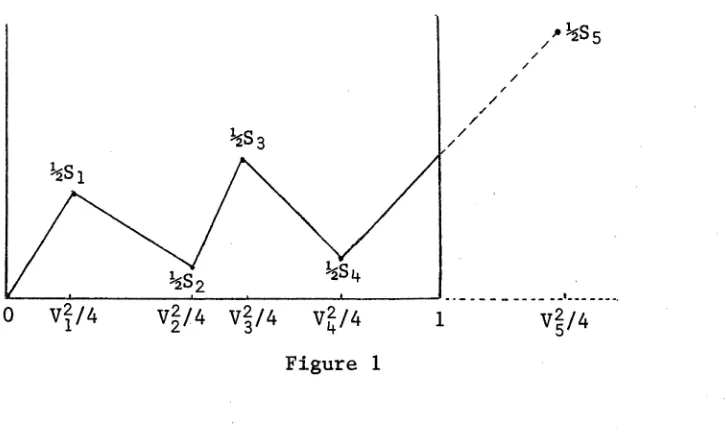
Let W2 = 2 X? and V 2 = 2 E(X?|F. ,). Define T =inf{m:V2 >n}. n j = l J n j = i J J"1 n m " Then Drogin forms the continuous random function 3 on [0,°°) by the
requirements that 8(0) = 0 , 8(V^) = Sm> and 8 is linear on [V^jV^^] . In the same way he forms y, using W^ instead of V^. Then he defines 8n and y^, both continuous functions on [0 ,1], defined at t by
8 (t) = 8(nt)/n2 and yR (t) = y(nt)/n. Thus 8R and yn have sample paths in C, being composed of straight line segments joining the points
(v£/n, Sk /n's) to (v£+1/n, S^j/n*5) and (W^/n,
Sjn'*)
toFigure 1
For these functions, Drogin has proven the following result.
Theorem 1.3
Suppose EX2 < 00 Vj > 0, and V 2 -* 00 a.s. Then (A), (B) , and (C) are equivalent, and if they are true, so is (D).
(A)
_. n L
n 1 2 x 2 I(X? > ne) -* 0 as n Ve > 0 j = l 3 3
1.4.1
(B) and
sup
|v?
- W 2 |/n ->■ 0 as n -> 00 l<jcT 3 Jn~ 1 V 2 -> 1 as n -> 00 . in
1.4.2
1.4.3
(C)
\
and3 W as n ■> n
n 1 V 2 -> 1 as n -* in
1.4.4
1.4.5
and
sup 13 (t) - y (t) I 0 as n ->• 00 0<t<l n n
y -> W as n -> 00 .
1 T t
1.4.6
where -> indicates convergence in the mean of order 1.
[image:15.552.136.499.78.294.2]There are many aspects of this result that are of importance to us. Firstly, it does, to a degree, show the necessity of a Lindeberg-type
V
condition. However in order to derive 1.4.1 from 3 W it also n
requires 1.4.5 to hold, and this is a rather strong restriction. Although we have been unsuccessful in dealing with 3R , in Chapter III we shall show that if we redefine y^ slightly so that its sample paths
lie in D, the convergence of this new function to W is sufficient for 1.4.1, with convergence in mean replaced by convergence in probability.
The second point to note about Drogin's Theorem is the new method of norming the martingale it introduces, which is quite different from that used in the last two theorems. Finally, it is important to note that Theorem 1.3 relates only to a (random) subsequence of the
martingale, rather than the full sequence. As will become evident later, it is in many ways easier to show the necessity of a Lindeberg-type condition in this case.
Drogin's proof of Theorem 1.3 is quite different again from those of the previous theorems. It is based on the fact that, for large n, 3n and y^ both behave approximately like a fair coin random walk with small steps. As this type of proof will not be used in this thesis, it will not be described in detail.
As we have already noted, one of the major drawbacks of Drogin's Theorem is that it involves a random subsequence of the martingale. The following section removes this drawback by modifying the method of norming the martingale so that rather than using the conditional
1.5 Ao G one ralioatiott of Drogin's Theorem
Before progressing to the gonera-lioation of Drogin's Theorem, we
shall state without proof a lemma that generalises Scott's Theorem to
subsequences of the martingale. Its result is actually of some
interest in itself, as it can be easily shown that similar results hold
in the independence case, but we shall not examine its full import here.
Essentially what the lemma says is that if any martingale subsequence
satisfies subsequence versions of the conditions of Theorem 1.2, then
this subsequence, suitably normed, approaches normality. A correspond
ing invariance principle also holds. The proof of the lemma follows
Scott's original proof of Theorem 1.2 in detail, the only changes being
in the upper limits of summations, and thus we shall not reproduce the
proof here.
ing the notation of Theorem 1.2, if any one of the following three
equivalent sets of conditions holds Lemma 1.1
Let { n . b e some subsequence of the positive integers.
Retain-l Retain-l — Retain-l
s~ 2 2 X? -> 1 as i -* 00 n. . 1 J
l j = l J
1.5.1
(A*) sand
n
P
> es ) -* 0 as i -* °°, Ve > 0
n. 1.5.2
i P
2 E(XJ|F ,) + 1 = 1 J J
as i -> oo 1.5.3
(B*) Sand
(C*) -sand
i p
s 12 2 X 2 -> 1 as i + n . . , j
l j = l J
s 2 sup X 2 -* 0 as i , n - . J
1 3<*± J
1.5.5
1.5.6
V
then n ->W. as i -> oo. n .
l
u<irG cc->»a
We are now in a position to state and prove our generalioation of
Theorem 1.3. Firstly, redefine T by T = inf{m:s2 > n}. Thus T is
n J n m - n
no longer a random variable. We form the random function L as n u
Cn (t) = S k/ n 2 for s 2 < tn < s 2+ 1 , k = 0,1, . . ., T -1, and t € [0,1] .
Then has sample paths in D, and the following result holds.
Theorem 1.4
and
1 11 L
- Z X 2 I (X2 > ne) + 0 , as n + » v e > o ,
n j=1 J J "
J = 1 J J
as n -> 00 ,
1.5.7
1.5.8
V
then C W as n -> °°. n
Before we prove T h e orem 1.4 we need to introduce a result of
B i l l i n g s l e y ’s (Theorem 5.1, [3]) which we shall refer to as his con
tinuous mapping theorem. This result, stated below as Theorem 1.5,
guarantees the preservation of weak convergence under almost surely
continuous mappings. The corollary describes the same result in terms
of convergence in distribution.
Let {Xn } be a sequence of random elements on some metric space
(S,S), and let {Pn ) be their distributions. Denote the weak conver
gence of these distributions to the distribution P of X by ^ P. Let
h be a measurable mapping of S into another metric space ( S ’,S’) and
measure P on (S,S) induces on (S',S') a unique probability measure Ph- *, defined by Ph"1(A) = P(h_1A) for A e 5'. Billingsley [3] has
established the following result.
Theorem 1.5
If P => P and P ( D J = 0, then P h"1 =► Ph"1.
n h * n
Corollary
For a random element X of S, h(X) is a random element of S'. Thus
V
V
if Xn -* X and P(X 6 Dh ) = 0, then h(X ) ■> h(X).
Proof of Theorem 1.4
We are now in a position to commence proving Theorem 1.4. To
V
prove it we introduce Scott's p , (1.3.1), show that p^ -> W and then
p n
that sup |pT (t) - £ (t) I -► 0 as n ■> °°. Theorem 4.1 of Billingsley
te [0,1] n p
[3] then guarantees Cn W as n -* 00.
Firstly we note that
1 < s| /n < n
1 + sup E(X?)/n j <T n J
< 1 + e + sup E(X? I(X? > ne))/n j <T J 2
n Tn
< 1 + e + 1/n E 2 X? I(X? > ne) j = l J J
-> 1 + e as n 00 ,
and since e > 0 is arbitrary we have
s^ /n 1 as n -► 00 . n
Applying 1.5.9 to the conditions of the theorem, and noting that
1.5.9
11 L
s 2 2 X? I(X2 > £S2 ) -* 0 as n -*■ °° ,
in j=i 3 J in which implies
Tn i p
s“2 2 E (X2 I ( IX
J
> c^s ) I F .) -* 0, as n1n j=i 3 J in 3 1
and
xn p
s”2 2 E(X?|F. ,) ■> 1 as n ■* 00 . in j = i J 3
But the last two conditions appear in Lemma 1.1. Thus we have that
V
nT -> W as n -* 00 . 1.5.10 in
Now note that
sup U-.Ct) -
nT
(t)I
< sup|s./sT
|.|l - ST / v/nI
.te[0,l] n j<Tn J n n
Consider the distribution of S,/s . Let Y = sup|w(t)|. From
F
n
t
Billingslay [^] (page 3 3 0 .) we have the distribution of Y.
P(Y<b) „ iL s iziil e- 2 ( 2 k + D 2/8b2 . TT i i ^rC i i.
k=l Given e > 0, choose b such that
e
P(Y > b ) < e .
Now, using Billingsley’s continuous mapping theorem, 1.5.10 implies that we can find an ni(e) large enough such that
P(sup
|s./sT I
> b ) <e
Vn > ni .jiTn J
Choose next an n2(e) so that
11 — s //n| < e/b Vn > n2 •
in b
Thus
P ( s u p I S / s | . | l - s / v/n I
j < T n J n
su p IS ( t ) - n ( t ) I 0
t € [ 0 , l ] n
and t h e p r o o f o f t h e t h e o r e m i s c o m p l e t e .
> £ ) < £ .
Chapter II
Relaxing the Lindeberg Condition for Martingales
Zolotarev [19] has proven what he calls a "Generalised Lindeberg-Feller Theorem" in which he shows that the uniform asymptotic
negligibility (u.a.n.) condition in the standard Lindeberg-Feller central limit theorem for sums of independent random variables can, under certain conditions, be dispensed with. The aim of this chapter is, by generalising Zolotarev’s result to martingale sequences, to weaken the u.a.n. condition either explicit or implicit in the theorems
of Chapter I. We shall do this by weakening the Lindeberg condition (1.1.1) since this condition holds in some form in all of the results of the preceding chapter. As the following simple argument shows, it is the Lindeberg condition that leads to the u.a.n. condition of 1.3.8.
sup j<n J
< sup X?
j<n J * esn>
+ s-2 X] I(|X.| > es ) n
Choosing e suitably small, and using the form of the Lindeberg condi tion given by 1.3.4, we have that the u.a.n. condition holds.
The first section of this chapter states and describes Zolotarev’s result, and in order to place what follows into a clear perspective, investigates the manner in which it is related to the standard
2.1 Z o l o t a r e v ' s T h e o r e m
C o n s i d e r a s e q u e n c e (X., j < 1 } of i n d e p e n d e n t r a n d o m v a r i a b l e s
^ n
w i t h EX. = 0, EX? < 00 V i , and w i t h p a r t i a l sums S = 2 X.. Let
J J J v n J
s 2 = E ( S 2) and a 2 . = E ( X ? ) / s 2 . W r i t e F. and F . r e s p e c t i v e l y for the
n n nj j n j nj v 3
d i s t r i b u t i o n f u n c t i o n s of X. and X ./s . We s hall say that the u n i f o r m
J J n
a s y m p t o t i c n e g l i g i b i l i t y c o n d i t i o n is s a t i s f i e d by this s e q u e n c e if
sup a . 0 as n -* 00
. nJ
J < n
2.1. 1
and that the L i n d e b e r g c o n d i t i o n is f u l f i l l e d if
x 2 dF . (x) 0 as n Ve > 0 . 2.1.2 gn (e)
n 2
j = l J x >e
F u r t h e r m o r e , d e n o t e the L e v y d i s t a n c e b e t w e e n two d i s t r i b u t i o n f u n c t i o n s P and Q b y L (P,Q); the d i s t r i b u t i o n f u n c t i o n of a s t andard n o r m a l v a r i a t e by $, and let be d e f i n e d by (x) = ^ ( x / a ^ ) . T h e n
the w e l l k n o w n L i n d e b e r g - F e l l e r c e n t r a l limit t h e o r e m (see, for example, G n e d e n k o and K o l m o g o r o v [11], T h e o r e m 4, p.103) is g e n e r a l i s e d by the
f o l l o w i n g result, w h i c h is a c o m b i n a t i o n of two t h e o r e m s of Z o l o t a r e v [19].
T h e o r e m 2.1
E i t h e r of the e q u i v a l e n t c o n d i t i o n s A or B p r o v i d e s a set of
V
n e c e s s a r y a nd s u f f i c i e n t c o n d i t i o n s for s ^ S ->• N(0,1) as n 00.
A. a sup L ( F . .) -> 0 as n
n . / nj n y
J <n
2.1.3
G (6) = 2
n jell
x 2 dF . (x) •+ 0 as n ->• », V6 > 0 , |>6 nJ
2.1.4
B. a = sup L ( F . .) -> 0 as n n . n i * ni
J<n
2.1.5
D (6) = 2 n j - i J
x 2 d [F . (x) - $ . (x) ] -* 0 as n
| > « nJ n;l
where U is the set of values of the index i for which a 2 . < \/a , i.e.
n J nj n *
U = {j:a2 . < \fa„. i < n} .
n nj J
It is condition A of this theorem that has the more intuitively
clear meaning. Essentially, what it states is the following: for
those terms satisfying a u.a.n. condition — those with index in U — n let the ordinary Lindeberg condition (2.1.4) hold. The remaining
"large" terms — those with index in the complement of U^, Ü — must all
be arbitrarily close to a normal variate (2.1.3). Note that 2.1.3 is
immediately fulfilled by terms with index in U . This fact is obvious
from the following lemma of Zolotarev [19] , which we state here for
later use.
Lemma 2.1
Let P and Q be distribution functions of independent random
variables with means ap and a^ and variances o 2 and a 2 respectively,
Further, let
£ = L(P,Q) , r = p(P,Q) , s = sup Q'(x)
x
where p(P,Q) = sup|p(x) -Q(x)| is the uniform metric. Then the x
following inequalities hold:
£ < r 2.1.7
r < (£ + s) £ 2.1.8
£ < [2 max(Op,Gp) ] if ap = a^ . 2.1.9
It is worthwhile investigating the manner in which 2.1.3 and 2.1.4
are related to the standard conditions, 2.1.1 and 2.1.2. It is clear
from the fact that both sets of conditions appear as necessary and
related, and it is useful to examine this relation from first
principles. The following theorem does this. It points out two facts — firstly, it shows why, when the u.a.n. condition holds for all the
summands, 2.1.3 is unnecessary, and secondly it highlights the power of the Levy metric. This is a tool that we will not be able to use when we generalise Theorem 2.1 to martingales.
Theorem 2.2
Let the notation be as in Theorem 2.1 and above. Then the following relationships hold.
(i) If sup a . ->•
• nJ
J<n J
0 and g (e) ->0 as n->°°, Ve > °n
then a -> 0
n and G (e) -* 0 as n->°°, Ve > 0 .n *
(ii) If a -* 0, G (e) -* 0 as n -*■ °°, Ve > 0, and sup a . 0
n j<n nj
then g (e) -* 0 as n -> °°, Ve > 0 . 2.1.11
° n
Proof
(a) We shall first prove (i), i.e. that the standard Lindeberg condition implies Zolotarev's condition if all the summands are u.a.n. Now
Furthermore,
a = sup L (F . , $ .)
n . K nj * n i J<n J J < sup
j<n
[4E(X|)/S2]1/3 by 2.1.9
0 by 2.1.10 .
Gn (e)
jeu 1 J n X >E
x 2 dF .(x) nj
n
< 2
J - l J
x >ex 2 dF .(x) nj
gn ( 0
Hence (i) is established.
(b) We shall now prove (ii), i.e. that in the presence of the u.a.n. condition Zolotarev's conditions imply the standard Lindeberg condition.
Firstly we note
D ( e ) = g (e) - 2
n n . ,
j = l J X >£
x2 d$ .(x) nJ
> gn (e)
-xI>e/sup a . j<n J
x2 d$(x) . 2.1.12
But the u.a.n. condition implies that the rightmost term in 2.1.12 goes to zero as n Furthermore, as we shall see, G^Ce) -* 0, the u.a.n. condition, and a 0 entails D (e) -* 0, and it follows from 2.1.12
n n
that g^Ce) + 0 as required. We have
D (e) n
n 2
j = l J x >e
X2 d[F^(x) - (x)]
< 2
j€U
x 2 dF . (x) + 2
xI >e nJ jeU x >e
x2 d$ . (x)
nJ
jeU J
J n x >e
x2 d [F . (x) - $ . (x) ]
nj nj
< G (e) + n
|x|>e/sup o j<n 1
j£Un J
X >£x2 d$(x)
x 2 d[F . (x) - $ . (x) ]
nj nj 2.1.13
But G (e) 0, and the u.a.n. condition gives us that the second term of 2.1.13 also goes to zero.
Furthermore, since
x 2 dF . (x)
nj x 2 d$ .(x)nj v
2
jeu X >£
X2 d[F .(x) -$> . (x)]
nj nj
jGU
J n X <£
x 2 d[F . (x) - $ . (x) ]
nj nj
- h
< a sup n . r
J<n x <e
x 2 d[F . (x) - $ . (x) ]
nj nj
, -J*
as there are at the most a terms in U (since ieU entails that
n n J n
n
°ni > ^an anc* ^ ° 2i = integrating by parts we have that the
J j=i nJ
above term is not greater than
an 2 SUP ( [ x2(Fn (x) - $n (x))]f
j£n
J
J
- 2 x [F (x) - $ n j (x)]dx}
x I<e
< a 2 { ia + 4 e 2a }
a 2 { £?■+ 4 e 2 }
-> 0 as n ^
This completes the proof.
2.2 Two Central Limit Theorems
Having set the background, we are now in a position to prove the
central results of this chapter. We shall in fact prove two central
limit theorems, Theorems 2.3 and 2.4, which generalise to martingales
the sufficiency half of Theorem 2.1. We shall show later that when the
summands are independent the martingale results simplify to give parts
A and B respectively of Zolotarev's theorem. In this case the con
ditioning on sigma fields generated by the past that appears in most of
the conditions of the next two theorems disappears.
The result that holds the most interest is Theorem 2.3. This
theorem generalises part A of Zolotarev's theorem and thus has a
similarly clear intuitive meaning. Theorem 2.4 is included mainly for
completeness. We shall have more to say about these results later.
the probability space {fi,F,P} with Sq = Xq = 0 a.s.,
-and s2 = E(S2). For this martingale the following result
n n
n 2 X. j-i 3 holds.
n > 1,
Theorem 2.3
, V
In order that s ~ 1S + N ( 0 , 1 ) it is sufficient that the following n n
conditions hold:
1°
2°
3° 2 jeU
EI a2. - a2 .I + 0
1 nj nj 1 n
Z E(X2 I(|x I
j£U 3 3
J n
= sup sup E I P ( X ./
j<n x
as n -> 00
2 esn ) * 0 33
sn S X lFj-l) ■ $(x/anj) l n ->
- > 0
V £ > 0
as n -> 00
2.2.1
2.2 . 2
2.2.3
where o 2 . = E(X2)/s2 , S 2 . = E(X2 | F /s2 , Un = { j : o ^ s V a n , j < n},
and -*■ denotes convergence in the mean of order one.
Proof
In order to prove this theorem we require the following lemma.
Lemma 2.2
Let $(x) be the distribution function of a standard normal n
variable. Then, if . 0 1 > a > 0 , X > 0 , X = a 4 implies
$(-X) = 1 - $(X) < a . 2.2.4
Proof
From Feller [9] (p.175) we have
1 - $(X) < 1 1 -!sX2 x x/2tF e
< (X e ^ V 1
Noting that y > 10 implies e'7 > y 3 , and that here X 2 > 10, we have
Thus
as required.
Corollary
1 - $(X) < (X.X3)“ 1
Under the same conditions as Lemma 2.2,
$(-X/o) 1 - $(X/a) < a 2.2.5
if a 2 < 1.
Proof
If we follow the proof of the lemma, replacing X by X/a we obtain
1 - $(X/a) < (X/a.X3/o3)-1
a^a
< a as a 2 < 1 .
We are now in a position to commence proving the theorem.
Adjoin to the probability space new random variables Yi,Y2,...,
each normally distributed with zero mean, and having variances
2 2
E C X ^ , E(X2), ..., so that the Y_. are independent of each other and of 00
the Borel field generated by
U F..
For ease of notation denote X./sj-0 J J n
by X . and Y./s by Y .. Define a new set of variables, W , , 0 < k < n ,
nj j n J nj nk*
as follows
k n
2 X . + 2 Y .
j-o nj
j-w -i nj
2 . 2 . 6
If we can show that -* N(0,1) as n -* 00 we have proven the
theorem. It is in fact sufficient to show that for any choice of
0 < e < 1 and positive T there exists an n (e,T) such that for any n > n
|E(e it W
nn
) - e-t2/2 < e Vt e (-T,T) . 2.2.7
distributed, and as 2 E(Y2 .) = 1, we have
J-l
nj
it W
E (e n°) e -t2/2' Vn > 0 . Thus
it W
IE (e nn) - e-t2/2
n itW , it W . .
2 E(e nk) - E(e nk_1) k=l
n it W , it W , ,
< 2 IE(e nk) - E(e nk l) | k=l
2.2.8
Consider each term of 2.2.8 it W 1 it W . . |E(e nk) - E ( e ^
it k-1
Z
n
X . it Z Y it X . it Y .
= | E(e j = l nJ e j =k+l nJ) • (e nk - e nk, i) 1
it k-1
Z
n
X . it Z Y . it X . it Y . = | E{e j-l nJ e j=k+l n;l E(e nk - e nk I|F r
it X . it Y .
< EIE (e nk - e ^ I F )| .
Thus
it W x . o n it X . it Y ,
IE (e nn) - e ^ t 2 | < 2 E | E (e nk - e n k |F. .)| k=l
it X . it Y .
2 + 2 EIE (e nk - e n k |F )| . 2.2.9
keU keÜ k 1
n n
We shall now show that both terms of 2.2.9 go to zero as n increases. Consider first the summation over U . These are the small terms. For
n ease of notation define A . as follows
nj
A .(x) = P ( X . < x | F . 1) - $(x/ö .) .
nj nj 1 j-l/ nj
Thus we wish to place an upper bound on the sum
2 E
jeü
eltX dA .(x)I .
n J
2 E j £U
eitX dA (x) I < 2 E
J j eU
J n
itX ! •*. .
e - 1 - ltx + t2x2^ dA . (x) I nj 1
+ 2 E jeu
f t2X2
^ d A nj(x)| . 2.2.10
Now, under condition 1° of the theorem, there exists an ni(e,T) such that
2 E
j e U
2V 2
t^x
dA .(x)j < — 2 e|o3j “
2 nj 2 j e U ‘ n J n;l
J n
< e/3 for n > ni . 2.2.11
Furthermore, the first term on the right hand side of 2.2.10 is not greater than
' tx 2 E
j e U
t2x2
min 2, ldAn j W |
2 E jeU
+ x I <6 J
t2x 2 min x >6
2, |dAn j (x)I
- " T
2
E f , I
H
3
ld A n i ( x ) I
j e U J x <6 J
j n 11
+ T 2 2 E
j e U x >6
x 2 |dAn^(x)| . 2.2.12
Choose 6 = e(2T^) Then we have that the left hand term of 2.2.12 is not greater than
6T2
j e U
2 {e x 2 dP(X . < x|F._^) +
I x I < 6 nJ
5T3 “ 3
= e/6 .
x 2 d$(x/ö .)}
I <6 nJ
(as 2 o2 . < 1)
j e U n j
J n
2.2.13
T 2 2 E
j £ U
J n - T2 2
j e U J
J n
:|>6 " d- 1
x 2 dP(X . < x) + T 2 sup x I ><$ nj
j e U
not greater than
a 2 .
1
x2 d$ (x) nj J Ix|> 6/a .
11 nj
x2 d$(x) . 2.2.14
j e U
Noting that condition 2° of the theorem implies that the first term of
2.2.14 becomes arbitrarily small as n -* °°, and that sup o , •> 0 as jeUn nj
n -> it becomes clear that there exists an n2(e,T) such that the sum
of the terms in 2.2.14 is less than e/6, Vn > n £ . Combining this with
2.2.11 and 2.2.13 we have
it X , it Y ,
2 EIE(e n - e n | F, ,) | < 2e/3 Vn > max(n1,n2) . 2.2.15 k£U
n
We now wish to place a similar bound on the summation over of
the same terms. We note first a few facts.
It follows from the definition of A ., and from condition 3° of
nj
the theorem, that
sup EIA (x)I < an . x
2.2.16
Define now a sequence of numbers {A^} by . Then by the
corollary to Lemma 2.2 we have, for n large enough so that an < .01
2.2.17 $(-A / a . ) = l - $ ( A / a . ) < a
n nj n nj n
We thus have:
it X . it Y . r _
E IE (e nj - e nj | Fj_1> | = E| e1 X d A ^ (x) |
< E -A
n eltX c3An j (x) I + E n itx -A
e dAnj(x)I + E e^tX dA .(x)I
nj 1
II + I2 + 13
Now,
1 1 < E
< E -A
— 00
-A
I
dAnj(x)
I
dP(xnj ^
+ E
-A
d $ ( x / )
E{P(X . < -A IF. ,) + $(-A /a .)}
nj n 1 j-1 n nj'
by 2.2.16 < 2$(-A /a .) + a
n nj n
Similarly
x 3 i 3a . 2.2.19
Now consider I2 . On integrating by parts we have
A
I9 < E*{ I it A .(x) dx| + I [e^tX A .(x)] ? | 1
l
J _ A
nJ
1
njv
-A 'J
"An A
< T E n IA .(x) Idx + 2a
_ A ' n J '
n E ( I A .(x)I) dx + 2a -A
< 2T A a + 2a by 2.2.16
n n n J
2T a 3/4 + 2a as A = a ^
n n n n 2.2.20
Combining 2.2.18-2.2.20 we have
E IE (e
it X it Y_ .
nJ - * IF. .) I < 8a + 2T a J
1 j-1 1 n n
3/4
Now jeU^ entails that a^. > v/a^. But as 2 = 1, this implies
that there are at most a 2 indices in U . Thus we have that
n n
.3/4,
it X . it Y . ,
2 EIE (e nj - e nj | F . ) | < a ^(8a + 2 T a 3/<4)
jsu 1 j-1 1 - n n
8a*4 + 2T a*4 .
n n
But since a^ -> 0 as n -> °°, we can find a n3 (e,T) such that the last
expression is less than e/3 for n > n3 * Combining this with 2.2.15 we
have
. i t W ™ .A, 2.
< e Vn > n
it w 1 . 2
_ nn
E e - e
where n Q = max(ni,n2 ^ 3). Thus the proof of the theorem is complete.
Before we progress to the next result, it is worthwhile to stop
for a moment to consider the relationships between the above theorem
the special case when the are independent, Theorem 2.3 is almost
identical with the sufficiency half of the first part of Zolotarev's
theorem. It differs only in that Theorem 2.1 is set up in terms of a
triangular array whereas Theorem 2.3 is not. It is possible, with only
minor changes in notation, to put both the statement and proof of this
result into triangular array form. We have avoided doing this in order
to keep both the notation, and problem, described in Chapter I.
The necessity part of Zolotarev's theorem has not been carried
over to Theorem 2.3, for such results are hard to obtain for sequences
of dependent random variables, the basic tool of characteristic func
tion theory no longer being appropriate. It appears that a stronger
result, such as an invariance principle, would be needed to prove some
thing of this form. The next section of this chapter shows that no
invariance principle involving one of the standard random functions can
hold in the absence of an appropriate u.a.n. condition, and thus not
for Theorem 2.3.
That Theorem 2.3 bears the relationship to Theorem 2.1 stated
slrtclUA co,"o-e
above is not iHranodiatoly' obvious, as in the former the closeness of the
summands to normal variates is expressed in terms of the uniform metric,
O-wC^. O v-v,
whereas in the latter the Levy metric is involved^ However, if we note
the-, results of Lemma -2»-l■,■■■■ and the-fact that fr-(x )— is an ab solute ly
con-o&*\> _i
tinuous function with- <— (2tt) 2 for all x .,— this relation sh ip
-he-com es clear
Although Theorem 2.3 is a generalisation of Zolotarev's result,
the extra condition we have introduced (Condition 1° disappears when
the X_. are independent, for then o^. = a^_.) places a rather severe res
triction on the conditional variances of the summands. The need for 1°
may be partially due to the method of proof, but is most likely a
require that the conditional distribution of X^. be close to that of a
normal variate with variance equal to the unconditional variance of X^. .
Attempts were made in the course of this research to overcome this
problem by redefining, for example, as
a = sup sup e|p(X./s < x|F._,) - $(x/a .)|, but it was found that the
n j < n x 3 n 3 1 n3
proof of Theorem 2.3 could no longer be applied and no simple
alternative seemed available.
Finally we note that although Theorem 2.3 relaxes the Lindeberg
condition appearing in the invariance principles of Brown and Scott, it
does so at the expense of placing a somewhat different condition on the
conditional variances of the summands. Whereas the earlier theorems
n p
require conditions such as s"2 2 E(X?|F. .) ■+ 1 hold, we require a
n j=i J 3-i
slightly stronger condition (1°) on only some of the summands.
In the following theorem, which generalises to martingales part B
of Zolotarev’s result, condition 1° of Theorem 2.3 has been
strengthened by extending it to the full sequence of conditional
variances. This theorem completes our generalisation of the
sufficiency part of Theorem 2.1.
Theorem 2.4
V
In order that s 1 S N(0,1) it is sufficient that the following
n n
conditions hold.
1* n
2 Ela2 . . i 1 nj 3 = 1
- a 2 . I -* 0 as n -* 00 nj 1
2* n 2
j = l |X | >£
x 2 dA . (x) -> 0 as n Ve > 0 nj
3* a ->
n 0 as n -+ 00 .
Proof
clearly sufficient to show that 2° is satisfied. Note that
s 2 I E(X2 I( |X. I >s e) |F. ,)
n jeU J J n
2 x2 d$(x/a .) + 2 j €U ■M x I > e 1 gU J
J n 1 J n
x2 dA .(x) . 2.2.21 X >£
The first term on the right hand side of 2.2.21 is not greater than
2 a2 .
j€U J I>e/a . nJ
x 2 d$(x) < sup jGU
J n xI>e/a
x2 d$(x)
0 as n-^00, as ö . 0 for j gU
nj J n
Furthermore, the second term on the right hand side of 2.2.21 is equal to
n f
x2 dA .(x) - 2 n
2
j = l X >£ jGU
J n X >£
x2 dA .(x) n J
and 2* ensures that the first term tends in the mean of order one to zero.
From 1* we have
2 (d2 .
j£Ü n;l J n
- a ‘
>1
<j = l ^ 3
- o ‘
-* 0 as n 2.2. 2 2
We now follow part (b) of the proof of Theorem 2.2.
2
jeU x >e
x2 dA .(x) nj
s (Ö
2 - a 2 ) -S
jeU J 3 jeU J-=
J n J n
2 - 2
jeU 3 3 jeU J
J n J n
2 (a2 . - a2 .) + a 2 sup . - nj nj n . ,
igU j j igU
J n J n
x2 dA .(x) + 2 nJ
x2 dA .(x) X <£
X <£ nJ
x2 d A ^ (x)
j G U J X >£
j n 11
x 2 dA .(x) nJ
2.2.23
as the number of indices in U does not exceed a . Integrating by
n n
E(a '**
n sup x 2 dA .(x))
jeU J |x|<e nJ J n 1 1
e 2
J x <e
x A .(x) dx}) nj
n
n n n
= a 2 { £?■+ 4 e 2 } n
-* 0 as n + ® . 2.2.24
Thus from 2.2.22, 2.2.23, and 2.2.24 we have that 2° is satisfied, and
the proof of the theorem is complete.
2.3 On an Invariance Principle
Having established the theorems of the last section we have suc
cessfully generalised Zolotarev's theorem and weakened the Lindeberg
condition of the theorems of Chapter I. The results of Chapter I,
however, are actually stated as invariance principles, and the central
limit theorems they imply are only part of the total result. The
question immediately arises as to whether or not there is some
functional analogue of the preceding theorems.
For such theorems there are two obvious prospective choices for
the random function defined on the martingale; the function £n in
C[0,1], as defined by 1.2.1 and ri in D[0,1] as defined by 1.3.1.
Theorem 2.5 shows that for these functions there can be no functional
central limit theorem generalising either of Theorems 2.3 or 2.4.
Although this does not prove that no such generalisations can exist, it
does indicate that the search for a suitable function would be quite
involved. Any such function would probably not involve the whole his
tory of the process and as a consequence the result would probably be
of little value. The aim of an invariance principle is to enable a
this is not possible the invariance principle in itself has no real value.
The following two lemmas lay some foundation work for Theorem 2.5. Essentially what they do is to find some necessary conditions for £n or Dn to approach W in distribution. They are based on an idea obtained from Lemma 1 of Loynes [14].
Lemma 2.3
Retain the preceding notation. A necessary condition for
n + W as n n
E(Sn - P
E(S2) 1 as n 2.3.1
Proof
Suppose 2.3.1 is not fulfilled. Then along some subsequence {n^}^_^ we must have
E(SS±)
< 1 - e for some e > 0 .Thus, from the definition of q , we have> n ’
nn i ( l - e ) = nn i (1 - e / 2 ) . That is,
P i n n j ^ Ci - e ) = nn i Cl - e / 2) > = 1 along this subsequence.
But this contradicts the convergence of the finite-dimensional
V
distributions of rin to those of W, a fact implied by nn ■ + W. Hence our
Lemma 2.4
In the usual notation, a necessary condition for
£ -* W as n ■ + n
E <Sn-l>
E(S2) 1 as n -> 2.3.2
Proof
As in the proof of Lemma 2.3, assume 2.3.2 is false. Then, along
some subsequence {n^}?_^ we have
Sn.CD " Cn.U-e/2) = 5n (l-e/2) - 5n (1 - e) i. e.
P{?n .(l) = 2?n (l-e/2) - 5n±(l-e)} = 1 .
This leads to a contradiction as in Lemma 2.3, and so we have that
2.3.2 is necessary.
Theorem 2.5
Define and as usual. Then there exist martingales satisfy
ing the conditions of Theorems 2.3 and 2.4 for which an invariance
principle involving or cannot hold. Thus the conditions of these
theorems are not sufficient for an invariance principle involving
either of these random functions.
Proof
From Lemmas 2.3 and 2.4 it is clearly sufficient to find a
martingale satisfying the conditions of these theorems with
E ( S 2 ..)/E(s2) -> a as n - + °°, for some a < 1.
n-1 n *
Consider a martingale with martingale differences distributed
E ( S 2 )
m 2 E (X2 )
m 2 2k k=l
2m+l
1 .
For this martingale sequence a n = 0, Vn, and so = <J). Furthermore
E(X?) = E( X 2 IF. ,). Thus all the conditions of both theorems are
J 3 1 J-l
fulfilled by this sequence. (Most of the conditions which are
difficult to verify can be dispensed with as the X. are independent.)
H o w e v e r ,
E(Sn-l>
E(S2)
2n -l
2n +1-l
as n «j
Thus we have found an example of the required form, and the
theorem is established.
Note that this example also proves that there is no standard weak
Chapter III
Questions of Necessity
In Chapter I we examined a variety of invariance principles for martingales in which a Lindeberg-type condition played a prominent role, and in Chapter II we showed how this condition could be relaxed and a central limit theorem still obtained. It is well known that in the Lindeberg-Feller form of the central limit theorem for sums of
independent random variables the Lindeberg condition, under appropriate u.a.n. conditions, is both necessary and sufficient for the asymptotic normality of the sums, and it seems natural to enquire if some similar result also holds in the martingale theorems.
Very little work has so far been done on this problem. As we noted earlier, Drogin's result shows that a Lindeberg-type condition is necessary if the normed conditional variances are assumed to converge in probability to one, but this is not a truly satisfactory result. Brown [5] is the only worker we know of who has made a serious attempt to solve this problem, and we shall discuss his work later.
The first section of this chapter investigates the necessity of the Lindeberg condition in an invariance principle for independent