Design and Implementation
of
a Transaction Manager
for
a Relational Database
A thesis submitted for the degree of Nlaster
of Science
of The Australian National University
Jason C.C. Lan,
Statement
I here by state that this thesis contains only my own original work except where explicit reference has been made to the work of others.
11 Statement
£
sF
Acknowledgements
It
is my pleasure to acknowledge the help I have received in developing this thesis and in my studying in the Computer Science Department.I sincerely thank my supervisor, Prof. Mike Papazoglou for his valuable advice, constant encouragement, and providing incisive comments on enhancing the quality of the thesis. My thanks also go to Dr. Vicki Peterson for her helpful comments and suggestions.
I thank Dr. Brendan McKay for providing the data structure I needed and for answering all my questions, even the stupid ones. I thank Prof. Robin Stanton for creating and maintaining such an atmosphere in the department which makes studying enjoyable.
My special thanks go to my colleague Kerry Taylor for tirelessly reading the manuscript, and providing invaluable suggestions and comments which make the thesis more accurate and precise. I also thank James Popple for his kind help in answering my endless questions about Tu\.TEX.
I am grateful to our programmers and secretaries m the department: David Hawking, Drew Corrigan, Ivan Dean, Steven Ball, Bev Johnstone, Jeannie Haxell, Claire Hinton, Mary Gilmour, and Sally Begg, for their efficient assistance whenever it was requested.
I thank all my friends in the department: ·William Sun, Jian Yang, Dan Zhou, Rachel Onate, Graham ·Willians, Ross Parker, Markus Zellner, Dharmendra Sharma, Ely Albacea, Gavin Michael, Robert Cohen, and Mostafa Haghjoo, for their friend-ship which makes me feel like I was studying at home.
I sincerely thank my parents for their love, encouragement and endless support. Finally, I would like to _express my sincerest thanks to my wife Candy, Chi Ying
.,--- -
--·---- -- ·__:....,;
IV Acknowledgements
Fan for her unlimited support, encouragement and love during the developmen.t of this thesis, and to my son Simon, Wei-En Lan. This thesis is dedicated to them.
C
(
t s
(
Abstract
1vf ulti-user database management systems are in great demand because of the infor-mation requirements of our modern industrial society. A clear requirement is that
database resources be shared by many users at the same time. Transaction manage-ment aims to manage concurrent database access by multiple users while preserving the consistency of the database.
In this thesis a single-user relational database management system, REQUIEM, is used as a vehicle to investigate improved methods for achieving this. A module,
called the REQUIEM Transaction Manager (RTM), is built on top of the original
REQUIEM to achieve a multi-user database management system.
The design work of the present thesis is founded upon various techniques for
transaction management proposed in published literature which are critically
as-sessed and a mechanism which combines appealing features from existing
method-ologies.
The problems of transaction management considered in this thesis are:
1. concurrency control,
2. granularity control,
3. deadlock control, and
4. recovery control.
The RTM is also compared with the transaction management facilities of
con-ventional commercial systems such as DB2, INGRES and ORACLE.
VI Abstract
(
1
-2
-Contents
1 Introduction
1.1 Introduction to Transactions 1.1.1 The Transaction 1.1.2 Commit and Rollback 1.1.3 Serializability . . . 1.2 Thesis Aim and Approach
1.3 A Relational Database Management System - REQUIEM . 1.3. l The Database Management System
1.3.2 The Relational Database 1.3.3 REQUIEM .. . . . 1.3.4 Access to REQUIEM Database 1.3.5 Transactions in REQUIEM . .
1.4 General Problems of Transaction Management 1.4.1 General Concurrency Control Problems . lA.2 General Recovery Control Problems . 1.5 Problems Examined in the Thesis
1.6 Structure of the thesis . .
2 A Survey of Existing Work
2.1 Centralized vs Distributed DBMSs 2.2 Concurrency Control
2.2.1 Locking . . 2.2.2 Optimistic . 2.2.3 Timestamping .
.
...
I
Vlll Contents
2.2.4 Multiple Version . . . . . .
2.2.5 Various Combined Methodologies 2.2.6 Discussion . .
2.3 Granularity Control .
2.3.1 Multiple Granularity Locking 2.3.2 Lock Escalation ..
2.3.3 Fixed Granularity . 2.3.4 Discussion
2.4 Deadlock Control
2.4.1 Deadlock Detection 2.4.2 Deadlock Prevention 2.4.3 Discussion
2.5 Recovery Control
2.5.1 DBMS Data Manipulation 2.5.2 Recovery Mechanisms 2.5.3 Discussion
3 Design Principles
3.1 A Hybrid Concurrency Control Mechanism . 3.1.1 Combining Different Mechanisms
3.1.2 Discussion . . . . 3.2 Multiple Granularity Locking (MGL)
3.2.1 Discussion . . . .. . . .
3.3 A Query Analysis Methodology to Support DGL. 3.3.1
3.3.2
3.3.3 3.3.4
3.3.5 3.3.6 3.3.7
Create and Drop clauses .
Insert and Import clauses Queries without Predicates .
Predicates with Indexed Attributes
Predicates containing Equality or Non -cq uali ty Operators . Lock Escalation
Discussion . . .
27
28
28
29
29
32 32 32 33 33 34 34 35 36 36 39 41 42 43 45 4547 ·
Contents
3.4 Deadlock Prevention 3.4.1 Discussion 3.5 Recovery . . : ..
3.5.1 Discussion
4 System Overview
4.1 Architectural Overview .
. . .
4.2 Functional Components for Interprocess Communication 4.3 The RTM Interface . . . . . . . . . . . . .
4.3.1 The REQUIEM Query Interpreter. 4.3.2 The Query Analysis Module
4.3.3 The IO Manager . . . . . .
4.4 The REQUIEM Transaction Manager (RTM) 4.4.1 Concurrency Control Manager . 4.4.2 Cache Manager . . . . .
4.4.3 The Recovery Manager . 4.5 The Lock Manager . . . . . . . 4.6 Other Transaction-Specific Modules
4.6.1 Monitor Manager 4.6.2 Terminator . . .
5 Comparison of REQUIEM with other Relational DBMSs
5.1 Brief Overview of the RDBMSs
5.1.1 DB2
..
.
5.1.2 INGRES. 5.1.3 ORACLE 5.2 Concurrency Control5.2.1 DB2
.
..
5.2.2 INGRES. 5.2.3 ORACLE 5.2.'1 Discussion
X Contents
5.3 Granularity Control . 78 '
5.3.1 DB2
...
785.3.2 INGRES . 80
5.3.3 ORACLE 82
5.3.4 Discussion 84
5.4 Deadlock Control 85
5.4.1 DB2
...
85J.
5.4.2 INGRES . 85
5.4.3 ORACLE 86 J.
...
5.4.4 Discussion 86
]
-I' 5.5 Recovery Control 87
5.5.1 DB2
...
875.5.2 INGRES. 87
5.5.3 ORACLE 88
5.5.4 Discussion 90
5.6 Comparative Table 91
(
6 Implementation 93
I
6.1 Types of Processes in the multi-user REQUIEM 94
6.2 Interprocess Communication Interface . 95 E
6.3 Central DBMS Processes . . . 98
F
6.3.1 The REQUIEM Transaction Manager . 98
6.3.2 Lock Manager . . . 107 (
6.3.3 Monitor Manager . 109
6.4 Terminator Manager
..
. 1096.5 Overview of Changes To REQUIEM . 109
6.5.1 The Changes to IO Operations . 109
6.5.2 Local Memory Manager
..
. 1106.5.:3 The Query Analysis Module . 110 6.5.4 Conclusion . .. . . .. . llO
Contents
7 Conclusion
7.1 Future Work . . . . 7.1.1 Security of the RTM
7.1.2 Explicit Transaction Management 7 .1.3 Improvement of Lock Manager . 7.1.4 Distributed Database Systems .
Appendix
A Building a Kernel for RTJ\tl
B A Sample Session
B.l Environment Variables B.2 The REQUIEM Makefile B.3 Database Schema Definitions . B.4 Start A Multi-User REQUIEM B.5 Single-User REQUIEM Compilation.
C Terminating Processes of The Multi-User REQUIEM
D Interprocess Communication Commands on UNIX System V
E IPC code
F Data Structures of the RTM
G Proposed Data Structures for the Lock Manager
References
XI
111
. 112
. 112 . 113
. 114 . 114
116
117
119
. 119
. 120 . 122
. 123
. 125
127
129
131
137
139
Xll Contents
List of Figures
1.1 Accessing the REQUIEM Database . . . . . . . . . . . . . . . . . . . 10
2.1 Centralized and Distributed Database Systems. 22
2.2 The Three Phases of a Transaction. 25
2.3 The Three Level Hierarchy. . . . . 30
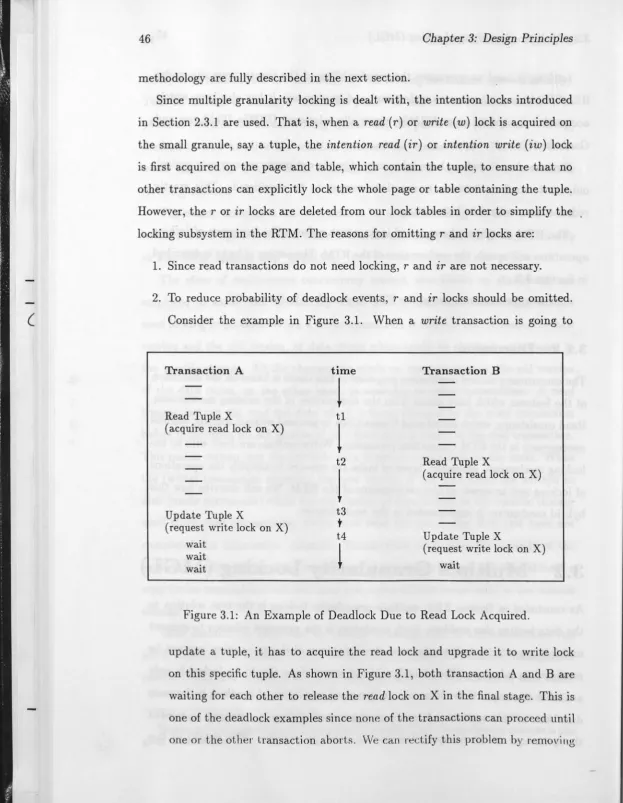
3.1 An Example of Deadlock·Due to Read Lock Acquired. 46 3.2 The Query Analysis Module. . . 48 3.3 The Wait for Graph in Deadlock Prevention. 54
3.4 The vVait for Graph in Deadlock Detection. 54 3.5 An Example of The vVrite Transaction Data Manipulation. 56 3.6 An Example of The Read Transaction Data Manipulation. 56
4.1 The Architecture of the multi-user REQUIEM . . . 60
4.2 The Interprocess Communication between Two Processes. 63
6.1 The IPC between Clients and Centralized DBMS processes. 97 6.2 The Data Structure of the RTM Process. 99 6.3 The Transactions Timing Sequence. . . 101
XIV List of Figures
f--List of Tables
1.1 The Supplier-and-Product Database . . . . 1.2 The Result Table of Example 1.3.1 Query 1.3 The Result Table of Example 1.3.2 Query 1.4 The Result Table of Example 1.3.3 Query 2.1 The Compatibility Matrix . . . .
7 8 9 11
24 2.2 The Compatibility Matrix for lvlultiple Granularity Locking. 31 5.1 The Comparison of Concurrency Control Between RDBMSs 77
5.2 The DB2 Locks Table. . . . 79
5.3 The INGRES Locks Table. . 80
5.4 The INGRES Locking Levels Table. . 81
5.5 The ORACLE Locks Table. . . . . . 83
5.6 The ORACLE Locking Levels Table. 83
5.7 The REQUIEM Lock Mode Table. 84
5.8 The Comparison of Granularity Control Between RDBMSs 85 5.9 The Comparison of Deadlock Control Between RDBMSs 86 5.10 The Comparison of Recovery Control Between RDBMSs 90 5.11 The Comparison of Transaction Management Between RDBMSs 92 6;1 The Employee Table . . . . . . . . . . . . . . . . . . . . . . . 100
xv
-List of Tables XVI
Chapter
1
Introduction
Use of database systems has increased dramatically in recent years due to their ease of use and the fast development of the industrial society. Single-user systems, which provide a resource for only one user, no longer meet the demands of database users. A modern database system needs to support sharing of resources by many users at the same time. Such a system is called a multi-user system.
Access to a database is mainly handled by a logical unit of work called a trans-action. Businesses such as banks and airlines have been moving their transaction
processing activities on-line since the early seventies. This allows the processing of
transactions to proceed while data is being entered. On-line processing is impor-tant to banks because the processing of transactions must be concluded as soon as possible, and it is similar to airline reservations.
The on-line databases which are shared by many users have to be maintained up-to-date and data should be stable at all times. This is achieved by a database management system (DBMS)1 which also employs multiprogramming principles for
sharing data between groups of users and attaining high performance. Multipro-gramming allows many application programs to interleave their pattern of execu
-tion.
When many programs attempt to simultaneously access a database, interference between them may occur. How to avoid interference between active programs is
1The concepts underlying DBMS will be discussed in Section 1.3.1.
C
r
2 Chapter 1: Introduction
known as the concurrency control problem. A database could also be damaged due
to internal malfunction, such as a hardware crash or software errors, or external damage caused by human mistakes. In such cases, the DBMS should be able to restore the database to the earlier but latest version of consistent state. This is known as the recovery problem. Thus, "transaction management is the task of supervising the execution of transactions in such a ·way that each transaction can be
considered as an all-or-nothing proposition, given the possibility of arbitrary failures
on the part of individual transactions or on the part of the system itself, and given
also the fact that multiple independent transactions may be executing concurrently
and accessing the same data" [Date 90].
The transaction management is taken care of by a component of the DBMS,
called the Transaction Manager. A single-user DBMS REQUIEM is used as a vehicle
to investigate the improved method for achieving this.
In this thesis, we critically assess various solutions to transaction management
that exist in contemporary commercial products or are proposed in literature, and propose an upgraded transaction management methodology for the existing single-user DBMS REQUIEM.
In the following sections 0£ this chapter we first examine the features of general
transactions. The aim and approach of the thesis are outlined. Also, the DBMS -REQUIEM, the key system of this thesis, is introduced. Then general problems of
transaction management will be discussed together with an indication of the
prob-lems considered in this thesis. The structure of the thesis then will be summarized.
1.1
Introduction to Transactions
1.1.1
The Transaction
We commence our introduction by considering some examples. A transaction pro -cessing system is a collection of software that processes transactions. Some examples of the systems are:
1.1. Introduction to Transactions 3
• airline reservations systems,
• public library database access systems, and
• vehicle registration systems.
In these systems, transactions can be illustrated in terms of the following examples:
• banking: deposit or withdraw funds to or from an account; transfer funds from one account to another;
• airlines: make or cancel a reservation;
• library access: insert a new book entry or remove a lost book entry to or from the library database;
• vehicle registration: add a new car entry or delete an obsolete car entry to or from the registration.
The common feature of the above examples is that they can modify the database in terms of the transaction. These kinds of transactions are called write transactions.
In addition, users may only want to view the information held in the database, such as:
• banking: check the current balance of an account, produce an account state-ment;
o airlines: find out the available flights for a given destination and time, or find out the number of available seats on a given flight;
1t library access: find out the call number of a book from its title;
e vehicle registration: find out the owner and registration expiry date for a given vehicle identified by its registration number.
C
r
4
Chapter 1: Introduction
The division of transactions into two kinds, rea4 and write transactions simplifies
the examination of the conflicts between transactions. Simple read and write
con-flicts become major problems to be solved in concurrency control. We will discuss
conflicts further in Section 2.2.1.
In all of the above examples, there is a primary database which is shared by several users. Since the database is shared, conflicts may occur due to the interfer
-ence between numerous read or write transactions. Therefore, the transaction has
to guarantee:
• consistency: each transaction accesses shared data without interfering with
other transactions, and
• atomicity: if a transaction terminates normally, all of its effects are made
permanent, otherwise it has no effect at all.
That is, transactions must be concurrency controlled ( consistency) and
recover-able ( atomicity).
1.1.2
Commit and Rollback
In this section, two important operations, commit and rollback, are introduced. These two operations are the key to provide the atomicity of a transaction.
• Commit - The commit operation signals the success of completing a trans
-action. This is to tell the system that the transaction has been successfully
completed and that the database is in a consistent state again. All of the
changes made by the unit of work can now be committed or made permanent.
• Rollback - A rollback operation is required when a transaction is not
success-fully completed, or has aborted before the time of commit. In this case, all the changes made by this transaction must be rolled back or undone.
Commit and rollback ensure that a transaction is atomic, since all effects made by the
1.2. Thesis Aim and Approach 5 .
1.1.3
Serializability
Serial execution is an execution of transactions where one transaction is performed
at a time. A serial execution preserves database consistency when each individual
transaction preserves database consistency. Nonserial execution can change the
database to an inconsistent state.
An execution of transactions is said to be serializable if it has the same effect as
a serial execution on the database. Since a serial execution preserves consistency, a
serializable execution also preserves consistency. One goal of the transaction
man-agement is to order the operations executed by different transactions so that the
resulting execution is serializable and recoverable.
1.2
Thesis
.
Aim and Approach
The aim of this thesis is to develop a multi-user version of a single-user relational
DBMS, namely REQUIEM. This is done by adding a separate module, named
RE-QUIEM Transaction Manager (RTM), to the original REQUIEM version. One
char-acteristic of this RTM design is that it is based on modularity principles, that is,
isolating design decisions and decomposing the system into modules which hide these
decisions, resulting in a much more flexible design.
'fwo main aspects of the RTM are concurrency control and recovery control.
• Concurrency control - this is to ensure that transactions run by different users
will not interfere with each other and lead to database inconsistency. For
example, one might try to update the data which another user is trying to
delete from the same database at the same time. This produces one of the
concurrency control problems, namely the lost update problern2• Concurrency
control makes data sharing transparent to each user.
• Recovery control - the database can become inconsistent due to a failure
oc-curring in the computer system. The failure may be caused by human error,
6 Chapter 1: Introduction
e.g. typing mistakes, or a crash in the computer system itself. In such cases, the DBMS should be able to restore the database to the latest version of a
consistent state according to the type of failure that occurs. We will detail the
types of failures later in Section 1.4.2.
Although RTM is implemented on the relational DBMS, REQUIEM, the concepts underlying RTM are applicable in general and could be used in either relational or
non-relational database systems.
The design principles of the RTM are motivated by the existing transaction
management methodologies proposed in literature. The RTM is a better transaction
manager than the others because the mechanisms used to solve each component problem of the transaction manager are comparatively better than others currently
available. A comparison between RTM and other transaction managers will be made
in Chapter 5.
1.3
A Relational Database Management
System - REQUIEM
1.3.1
The Database Management System
As indicated in [Date 90), "a database system is essentially nothing more than a
computerized record-keeping system". The database can be regarded as an elec-tronic cabinet which stores a collection of computeri:!led data files. The task of a database management system is to maintain information and to make that
informa-tion available on demand. Moreover, the DBMS should be able to provide reliable
data to the user, in the presence of concurrency and recovery problems.
1.3.2
The Relational Database
A relational database is one in which the data and the relationships among data
1.3. A Relational Database Management System - REQUIEM 7
with unique names. Moreover, a number of operations allow the user to extract a
table from old tables. We demonstrate the relational database by the well known
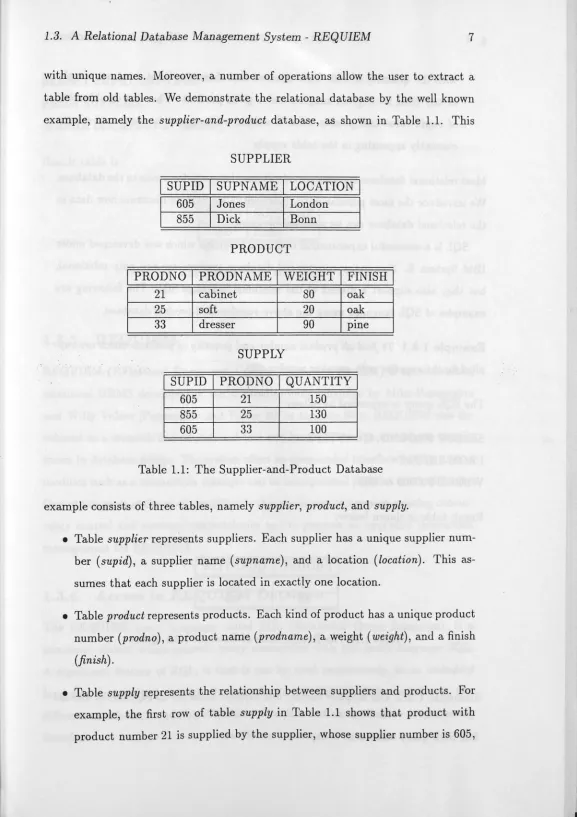
example, namely the supplier-and-product database, as shown in Table 1.1. This
SUPPLIER
I
SUPIDI
SUPNAMEI
LOCATIONI
I
~~~
I
~~~~s
I
~~:!on
I
PRODUCT
I
PRODNOI
PRODNAMEI
WEIGHTI
FINISHI
21 cabinet 80 oak
25 soft 20 oak
33 dresser 90 pme
SUPPLY
I
SUPIDI
PRODNOI
QUANTITYI
605 21 150
855 25 130
605 33 100
Table 1.1: The Supplier-and-Product Database
example consists of three tables, namely supplier, product, and supply.
• Table supplier represents suppliers. Each supplier has a unique supplier
num-ber ( supia), a supp lier name ( supname), and a location (location). This as-sumes that each supplier is located in exactly one location.
• Table product represents products. Each kind of product has a unique product
number (prodno), a product name (prodname), a weight ( weight), and a finish (finish).
• Table supply represents the relationship between suppliers and products. For
example, the first row of table supply in Table 1.1 shows that product with
[image:24.639.48.626.17.835.2]C
8 Chapter 1: Introduction
with the quantity of 150. This assumes that there can be at most one supply
at any time for a given supplier and a given product. Thus the combination
of supid value and prodno value is unique with respect to the set of supply currently appearing in the table supply.
Most relational database systems.provide a query language for access to the database.
We introduce the most popular query language called SQL to illustrate how data in
the relational database can be accessed by users.
SQL is a successful experimental relational language which was developed under
IBM System R. Now many commercial database systems are not only relational,
but they also support a dialect of the relational language SQL. The following are
examples of SQL language using the above supplier-and-product database.
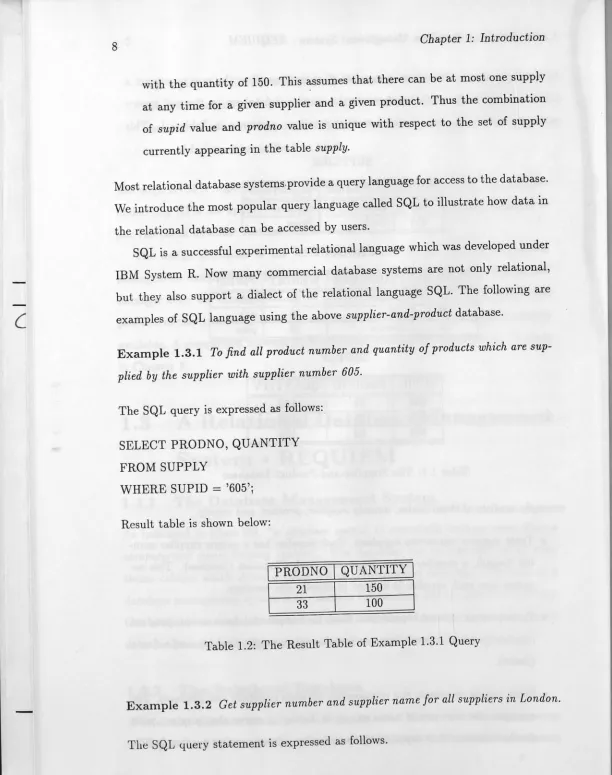
Example 1.3.1 To find all product number and quantity of products which are
sup-plied by the supplier with supplier number 605.
The SQL query is expressed as follows:
SELECT PRODNO, QUANTITY
FROM SUPPLY
WHERE SUPID
=
'605';Result table is shown below:
I
PRODNOI
QUANTITYI
21 150
33 100
Table 1.2: The Result Table of Example 1.3.1 Query
Example 1.3.2 Get supplier number and supplier name for all suppliers in London.
[image:25.666.16.628.16.791.2]1.3. A Relational Database Management System - REQUIEAJ
SELECT SUPID, SUPNAME FROM SUPPLIER
WHERE LOCATION
=
'London';Result table is :
I
SUPIDI
SUPNAMEI
i
605I
JonesI
Table 1.3: The Result Table of Example 1.3.2 Query
1.3.3
REQUIEM
9
REQUIEM (REiational Query and Update Interactive SystEM) is an extensible, .
>:
·.
relational DBMS developed in the C programming language by Mike Papazoglouand Willy Valder (Papazoglou and Valder 89] in the late 80's. REQUIEM was de-veloped as a research and educational tool and has been used to investigate various issues in database design. The system offers an open-ended interface facility so that modules such as a transaction manager can be incorporated without much difficulty.· One of the goals of the work described in this thesis was to research existing concur-rency control and recovery methodologies and to propose an upgraded transaction management for REQUIEM.
1.3.4
Access to REQUIEM Database
C
r
10
Chapter 1: IntroductionWhen the REQUIEM interactive interface is invoked, the RQL statements can
be entered and executed immediately. The results will be displayed right after the
execution of the RQL statements. Also, the query language can be embedded in
an application language program such as a C language program. In this case, the
query statements will be executed while the program is executed, and the result will
be bound into the program defined variables. Alternatively, in REQUIEM, RQL
statements can be put in an external file called a command file. In such case, many
statements can be executed at once. A command file which includes RQL statements
may be executed in either interactive or non-interactive way as shown in Figure 1.1.
We will discuss them in terms of some examples in the following sections.
General User (Interactive use, or Use for external files)
l
Relation Query Language (RQL)l
Query Language Interpreter
l
File ManagerApplication Programmer
l
Embedding RQL ina C Program
l
Requiem's PreprocessorDatabase
Figure 1.1: Accessing the REQUIEM Database
1.3. A Relational Database Management System - REQUIEM 11
JI
Interaction with REQUIEM Database
The main method of accessing to the REQUIEM database is interaction with the database via various query language statements supported by the DBMS. When the REQUIEM interactive interface is invoked, the prompt "REQUIEM:" is displayed at a terminal ( or a window on a workstation) and the system waits for the input of RQL statements. Once the statements are input, they are processed by the query language interpreter which sends requests to the file manager to perform the appropriate operations. Then the resulting table ( or return message) will show immediately. The following is an example of interactive RQL statements.
The supplier-and-product database in Table 1.1 is used again to illustrate RQL statements.
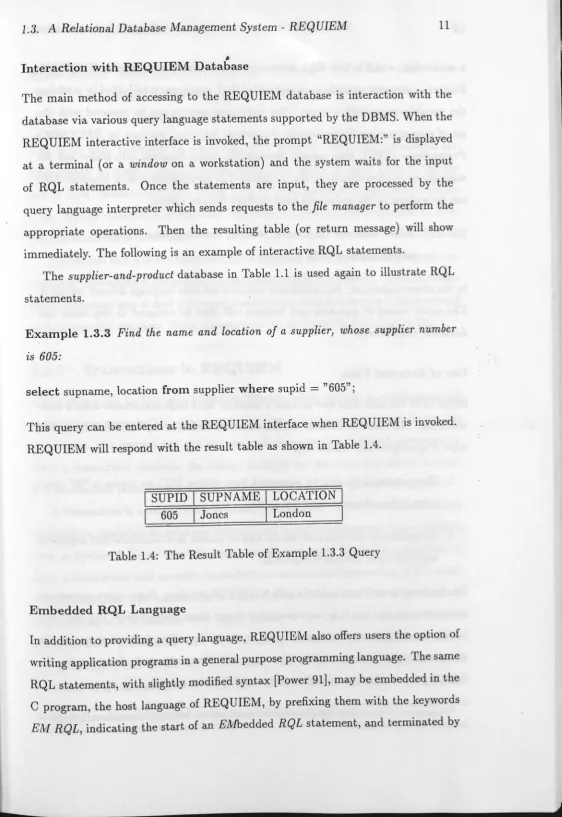
Example 1.3.3 Find the name and location of a supplier, whose supplier number
is 605:
select supname, location from supplier where supid
=
"605";This query can be entered at the REQUIEM interface when REQUIEM is invoked. REQUIEM will respond with the result table as shown in Table 1.4.
I
SUP IDI
SUPN AMEI
LOCATIONI
j 605
!
Jones!
LondonI
Table 1.4: The Result Table of Example 1.3.3 Query
Embedded RQL Langµage
In addition to providing a query language, REQUIEM also offers users the option of writing application programs in a general purpose programming language. The same RQL statements, with slightly modified syntax [Power 91], may be embedded in the C program, the host language of REQUIEM, by prefixing them with the keywords
[image:28.621.49.612.24.842.2]C
,
12 Chapter 1: Introduction
•
a semi-colon, which is how RQL statements are normally terminated in REQUIEM. Further, a program variable in an embedded RQL statement is identified by prefixing the variable name with a colon. The embedded queries can be replaced with the set of corresponding Programmable Procedural Interface3 routines by REQUIEM's Preprocessor (RPP), then passed through the query language interpreter and file manager to retrieve data from the database. The same example as in Example 1.3.3 can be written in the embedded form in the following syntax:
EM RQL select supname :Sup....name, location :Location from supplier
where supid
=
"605";In the above statement, Sup_name and Location are host language defined variable_s. The result values of supname and location will then be assigned to Sup_name and
Location, respectively.
Use of External Files
REQUIEM can also read and process a series of valid RQL statements from a com-mand file. The user can process the statements included in the command file in two ways [Papazoglou and Valder 89):
1. The command file can be processed from within RQL by typing a "@" char-acter before the command file name.
2. Alternatively, the name of the file can be passed as a command-line argument when the user invokes REQUIEM.
The first way is used interactively with REQUIEM interface. Some query statements are quite long, so that it is not convenient to use them interactively. The easy way to run the long query statements is to put them in a file. Instead of typing the whole statement, a short name of the command file can be used. For example, the following statements are stored in a file named create_supplier.
3 Programmable Procedural Interface provides an interface to REQUIEM that allows C programs
1.3. A Relational Database Management System - REQUIEM
create supplier (su-pid (num(5), UNIQUE),
supname ( char(20), SECONDARY),
location (char(20)));
13
This is an RQL statement to create the table supplier. Since the statements arc
long enough to make a typing mistake likely, it is better to store them in the file
and to type "@create_supplier" rather than to type the whole statements to create
a file. All the statements in the table then will be executed and responded to after
the command file is processed.
The second way is that a command file is executed as an application program, ex
-cept that the content of the command file is pu~ely RQL statements. These provide a
more convenient way to deal with some transactions, such as inserting a large amount
of data into the database. More information can be found in [Papazoglou 89].
1.3.5
Transactions in
REQUIEM
Transactions can be formally defined in different ways, as long as consistency and
atomicity are preserved. If a transaction processes without producing any errors, the
transaction will commit and put the changed data into the database permanently.
Once a transaction commits, the change made to the database can not be undone.·
If a transaction terminates before it commits, it is called an aborted transaction.
A-transaction is a unit of work to access the database. It can be expressed either
explicitly or implicitly to point out the start and end of a transaction. Some DBMSs,
such as System R [Gray et al 81], issue explicit statements like begin_transaction to
start a transaction and commiUransaction to commit the transaction in the appli-cation programs. The transaction is a user defined logical unit of work. However,
the concepts of a transaction may apply equally to the end user environment. For
example, DB24 provides the user with the ability to enter SQL statements interac
-tively through DB2I5 [Date 90]. In this case, each such interactive SQL statement
is treated as a transaction in its own right; DB2I will automatically issue a
COM-4DB2 is a commercial relational database product developed by IBM.
C
14 Chapter 1: Introduction
MIT on the user's behalf after the SQL statement has been executed. Th~s kind of
transaction is essential since generally a query statement does not contain a begin
or commit command.
A transaction in REQUIEM is defined in terms of an RQL language statement,
a file command, and an embedded query statement as described in Section 1.3.4.
All the following examples are valid transactions in REQUIEM.
• A single RQL query statement such as:
update location from supplier where supname
=
"Jones";• An embedded RQL query statement such as:
EM RQL select supname :SupJ1ame, location :Location from supplier
where supname
=
"Dick";• A command file such as create_supplier described in Section 1.3.4.
A transaction starts when the first RQL statement is encountered. REQUIEM
will
issue a commit automatically when the execution comes to the end, such asa ";" is executed at the end of the query statement or the end of a command
file. The transaction will then be committed, otherwise, the transaction is aborted.
The transaction ends when any result is returned.
It
is natural to define these astransactions since each of them is treated as a complete task in REQUIEM.
1.4
General Problems of Transaction
Management
General problems of transaction management are considered in this section. They
are concurrency and recovery problems.
1.4.1
General Concurrency Control Problems
Without any concurrency control, various problems may arise in a multi-user DBMS
....
_.1-1.4. General Problems of Transaction Management 15
time. In this section, we describe the concurrency problems that may affect database consistency.
Concurrency problems are usually caused by the interference of transactions. Although some of the aborted transactions can cause database inconsistency, even if all the transactions are correct themselves, the interleaving of them may also damage the database. The interleaving of operations from transactions is the main
cause of the problem. There are four problems that may result from the interference of transactions [Date 90]:
1. The lost update problem: Assume transaction A and transaction B read the
same record R, containing a data item X with value 100, at the same time. Then transaction A increase X from 100 to 150, and after that transaction B increase X from 100 to 120 before both transactions commit. Then the update of X by transaction A is lost since transaction B overwrites it without even
looking at it.
2. The uncommitted dependency problem: A transaction A updates a data item
X in record R , from 100 to 150, and then transaction B reads the value of X which is 150. If transaction A is aborted at this time, the value of X read by transaction B is an uncommitted value and should not be allowed to be read.
3. The inconsistent analysis problem: Assume both transaction A and B are
operating on bank account records. Transaction A is summing the account balances and transaction B is transferring from one account to another. At first, transaction A sums the balance account 1 X, say 40, and the balance of account 2 Y, say 50, to the sum of 90 to TOTAL. Then transaction B transfers the amount of 10 from account 3 to account 1. If the balance of account 3 Z was 30, the new balances of account 1 and 3 would be 50 and 20 respectively. After transaction B commits, transaction A reads Z, which is 20, and TOTAL is changed to 110. However, this is the wrong answer, since the sum is supposed to be 120. This is wrong due to the inconsistent analysis of
transactions.
16 Chapter 1: Introduction
4. The inconsistent table problem: another problem may arise because of a trans-action updating a table simultaneously with another deleting the table.
It is clear that if many users are trying to access the data at the same time, one way of guaranteeing database consistency is to make each person wait his turn,
that is, to make the execution of transactions serial a.s described in Section 1.1.3. Therefore, if the transaction manager can manage transactions as serializable, which has the same effect as serial execution, then the concurrency control problems can be solved.
1.4.2
General Recovery Control Problems
Recovery control aims to recover the transaction from different kinds of failures which may occur and which affect the database consistency during transaction processing. In order to solve such problems, one must know precisely which types of failures are to be considered and how often will they happen. Generally, the following types of failures should be considered [Gray et al 81):
• Transaction failure. As described in Section 1.1.2, the outcome of a transaction is either commit or abort ( rollback). Although all of the transactions processed are expected to commit, there is always a possibility that the transactions will be aborted. This might happen due to internal conditions such as bad input, data not found, overflow, or resource limit exceeded, etc.
• System failure. The system failures can be caused by a bug in the DBMS code, an operating system fault, or a hardware failure. In such cases, the transactions are terminated unexpectedly, and the contents of main (or volatile) memory are lost. As a consequence, the database may remain in an inconsistent state due to the aborted transactions.
• Media failure. A media failure is a failure in which some portion of the database has been physically destroyed. This could be caused by a disk head crash, a disk controller failure, magnetic decay, etc.
1-1.5. Problems Examined in the Thesis 17
A good transaction management should be able to recover from all the types of
failures that occur in a system.
1.5
Problems Examined in the Thesis
We first point out the various problems of transaction management which will be
examined in this thesis. Then we investigate the existing solutions for each problem
and build up a firm foundation solution for the RTM. The aim of investigating
exist-ing implementations is to examine how various problems of transaction management
can be resolved. Since each transaction management of those compared systems are
different but have something in common, a set of problems are examined which
allows them to be fairly compared. These problems are outlined below.
The first problem considered here is how a transaction manager can be merged
seamlessly with the original DBMS design. A good transaction manager design
should be able to hide the decisions from the main system and to avoid affecting
the performance of the main system. That is, the design should be general and
independent, so that one may easily employ the same design abstract on different
systems. This aspect of the RTM design is consistent with the design of REQUIEM
and no comparison with other systems in this aspect is made here.
The second problem considered here is that of the concurrency control
mecha-nism to be used. Locking is the most popular mechamecha-nism to solve the concurrency
control problem in most of the relational DBMSs. A transaction has to ask for
the privilege (lock) to read or write a data before it is going to do so. If another
transaction owns the conflict privilege ( conflict lock) to the data, it has to wait
until the privilege is granted by the DBMS. However, locking has a drawback of its
own. Generally, read tr~nsactions can be arbitrarily large so considering them in
concurrency control interactions may cause large overheads. Therefore read
trans-actions which do not modify the database, should be possible to run without any
interaction with concurrency control. Optimistic concurrency control is developed
18 Chapter 1: Introduction
any control. Serializability is guaranteed by a validation step performed at the end
of each transaction. If a conflict action has occurred the transaction is aborted and
restarted. However, abort and restart transactions caused by optimistic concurrency
control may be very expensive. Locking is useful for solving this problem in the sense
of pessimistic concurrency control. That is, read transactions should run without
any locking control (optimistic), and write transactions should be controlled by the
locking (pessimistic).
The third problem is the granularity problem. The granularity of data item,
which refers to the size of the data to be locked, is important as far as
perfor-mance is concerned. In the relational model of data, large items, like the whole
tables, or small items, like individual records, can be chosen as the granularities to
be locked. Large granularity locks reduce concurrency, since operations are most
likely to conflict. On the other hand, overhead is decreased because fewer locks
are managed. Small granularity locks involve higher locking overhead, since more
locks are required, but they improve concurrency by locking only those data items
the transaction accesses. Choosing the lock granularity presents a tradeoff between
locking overhead and the amount of concurrency. One approach "is to attempt to
design the database so that large transactions are rare" [Robinson 82] and simply
use the small granularity locks. This approach is usually in the design at higher
lev-els, and is not considered here. Another approach is hierarchical concurrency control
([Gray 75], [Gray et al 76] and [Gray 78]), also known as multiple granularity locking
[Bernstein 89] and is used in RTM. This is to use a kind of scaling granularity most
appropriate to each transaction's mode of operation. We propose a query analysis
module {QAM} to predict the behaviour of the transactions as much as possible and
make the granularity choosing decision appropriate to each transaction. This is not
achieved by any other existing DBMS systems.
Since locking is used, deadlock may arise. When the data is locked by a
transac-tion, another transaction has to wait until the lock is released if it wants to lock the
data and update the data. Deadlock is a situation in which two or more transactions
are in a simultaneous wait state, each one waiting for one of the others to release a
•-1.6. Structure of the thesis
19
lock before it can pro~eed.
The fourth problem examined in this thesis is that of recovery control. A DBMS
should be able to recover database consistency in the event of failures as described in Section 1.4.2. Recovery from three types of failure, transaction, system, and media
failures are all considered.
1.6
Structure of the thesis
The problems ·of transaction management considered here have been addressed
above. The next chapter examines the solutions of these problems published in literature and discusses the methodologies related to each problem.
Chapter 3 contains a design framework for the RTM based on the features
dis-cussed in Chapter 2.
Chapter 4 details design of the system architectural of the RTM and describes
the communication between components of the system.
Chapter 5 describes the transaction management mechanisms used in
conven-tional relaconven-tional database management systems, such as DB2, INGRES, and
ORA-CLE, and presents a comparison of the transaction management of RTM with these
RDBMSs.
Chapter 6 presents a detailed description of the RTM implementation.
Chapter 7 draws conclusions of the transaction manager developed in REQUIEM
20
Chapter 1: IntroductionChapter
2
A Survey of Existing Work
The RTM is founded upon a mechanism which combines appealing features of
ex-isting methodologies. In the previous chapter, we briefly described the problems of transaction management concerned in this thesis. This chapter investigates
pub-lished solutions to these problems . These four problems of transaction management
which were described in Section 1.5 are used in this chapter for investigation. They
are:
1. Concurrency control,
2. Granularity control,
3. Deadlock control, and
4. Recovery control.
Related work published in literature since the early seventies is discussed here.
The solutions to the four problems listed above are examined in turn in the following
sections. The discussion of the methodologies related to each problem are also
presented.
2.1
Centralized vs Distributed DBMSs
This section briefly describes centralized and distributed DBMSs. Roughly speaking,
a centralized system consists of a central processor, main memory, secondary storage
21
(_
22
Centrialized Database System
Chapter 2: A Survey of Existing Work
Network
Centrialized Database System
Distributed Database System
[image:39.678.0.624.18.823.2]Centrialized Database System
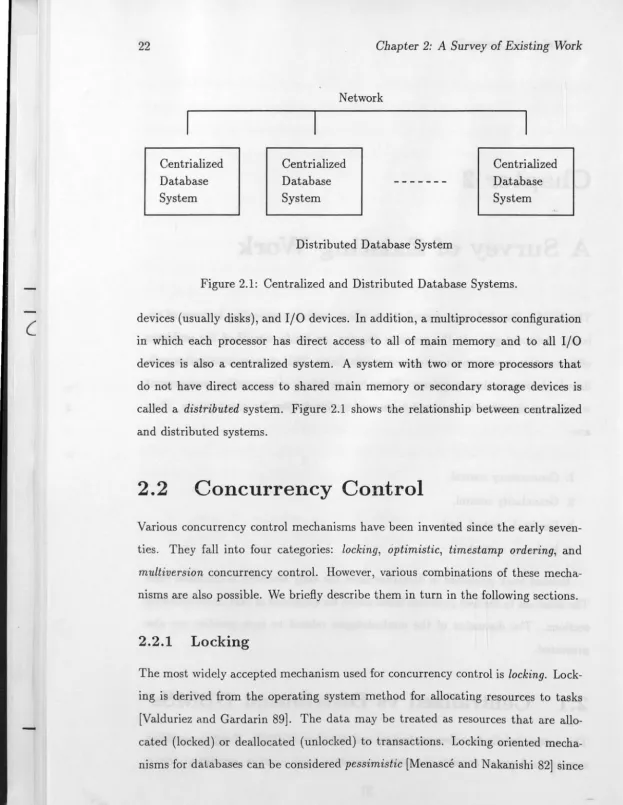
Figure 2.1: Centralized and Distributed Database Systems.
devices ( usually disks), and I/ 0 devices. In addition, a multiprocessor configuration
in which each processor has direct access to all of main memory and to all I/0
devices is also a centralized system. A system with two or more processors that
do not have direct access to shared main memory or secondary storage devices is
called a distributed system. Figure 2.1 shows the relationship between centralized
and distributed systems.
2.2
Concurrency Control
Various concurrency control mechanisms have been invented since the early
seven-ties. They fall into four categories: locking, optimistic, timestamp ordering, and
multiversion concurrency control. However, various combinations of these mecha
-nisms are also possible. We briefly describe them in turn in the following sections.
2.2.1
Locking
The most widely accepted mechanism used for concurrency control is locking. Lock -ing is derived from the operating system method for allocating resources to tasks
[Valduriez and Gardarin 89). The data may be treated as resources that are
allo-cated (locked) or deallocated (unlocked) to transactions. Locking oriented
2.2. Concurrency Control
23
database resources are locked even though transactions may not conflict with other
executing transactions. That is, they may prevent transactions from executing
con-currently, even though no interference may occur.
For locking, sharing is usually controlled by dividing the database into locking
units or granularities, and by specifying a locking policy to ensure integrity of the
database. An analysis of locking policies in DBMSs can be found in [Potier and
Leblanc 80]. Another comparative analysis between two-phase and non-two-phase
locking algorithms for DBMSs is given in [Joergensen and Singhal 87].
Two-phase locking (2PL), one of the locking policies proposed by K.P.Eswaran, J.N.Gray, R.A.Lorie and I.L.Traiger [Eswaran et al 76], guarantees serializability. This mechanism has been used to deal with the concurrency control problem in
most relational database management systems [Valduriez and Gardarin 89]. A brief
description of two-phase locking is given below.
Theorem 2.2.1 From ?.A.Bernstein, V.Hadzilacos and JV.Goodman [Bernstein 89}.
Two-phase locking is achieved if all transactions obey the following rules:
1. before operating on any object the transaction first acquires a lock on that object,- and
2. after releasing a lock the transaction never acquires any more locksj then all interleaved executions of those transactions are serializable.
A transaction that obeys conditions (1) and (2) of the theorem is said to be
two phase, i.e., to satisfy the two phase locking protocol. The proof of the theo-rem relies on the serialization ability of two-phase locking. The proof is given in
[Eswaran et al 76] and [Bernstein 89]. P.A.Bernstein and N.Goodman [Bernstein 89] have provided more details on two phase locking theory and some implementation
issues. Serializability has been discussed in Section 1.1.3 and the related theory can
be found in [Eswaran.et al 76], [Bernstein 79], and [Papadimitriou 79].
In general, two-phase locking consists of a growing phase, during which locks are
24 Chapter 2: A Survey of Existing Work
2PL theorem provides guidelines for the safe design of transactions. The transaction
manager ensures that all the transactions it receives follow the two-phase locking
protocol.
The database is partitioned into items, such as records, which are portions of the
database that may be locked. A transaction can prevent other transactions from
accessing an item by locking the item until the transaction holding the lock releases
the lock on the item.
Generally, two types of lock modes, read ( or share) and write ( or exclusive) locks
are used
in
locking. Read locks on the same data items can be shared. Writelocks.on the data items can only be acquired by one transaction at a time. The
compatibility matrix for the two lock types ·in .Table 2.1 shows how different locks
can be acquired in the event of conflicts. A "y" (yes) entry means that two locks of
rea
write
read write
y
n
[image:41.678.2.629.15.811.2]n
n
Table 2.1: The Compatibility Matrix.
the types specified by the row and column labels do not conflict. The only "y" in
the table specifies that read lock does not conflict with itself. This means that users
can acquire as many read locks as they like on the same data without any conflict.
On the other hand, an "n" (no) entry means that the lock types conflict. The other
"n" in the table shows that when a read or write lock has been acquired on one
data item, no one can acquire write lock on the same data. The design of two phase
locking is safe in the sense that only one user can change the data each time.
Two phase locking represents an overhead that is not present in the sequential
case. Even read-only transactions (queries), which can not affect the integrity of the
data, must in general use locking in order to guarantee that the data being read are
not modified by other transactions at the same time.
Non-two-phase locking, also known as tree locking, is used upon the assumption
...
2.2. Concurrency Control 25
access data items by following paths in the tree [Bernstein 89]. Since this is not the
case in REQUIEM, it is not discussed here.
2.2.2
Optimistic
Another mechanism which is called optimistic is proposed by Kung and Robinson
(Kung and Robinson 81]. The optimistic mechanism works on the assumption that
conflicts between transactions are rare. It does not consider access conflicts when they occur, as in the locking approach. Instead, detection of transaction conflicts is
delayed until the transaction commit time, and upon conflict the changes made by
the transaction are undone. The principles of this method are summarized in the
following (Kung and Robinson 81].
1. Since reading the data from the database can never cause a loss of integrity,
reads are completely unrestricted.
2. vVrites are severely restricted. It is required that any transaction consist of two or three phases: a read phase, a validation phase, and a possible write
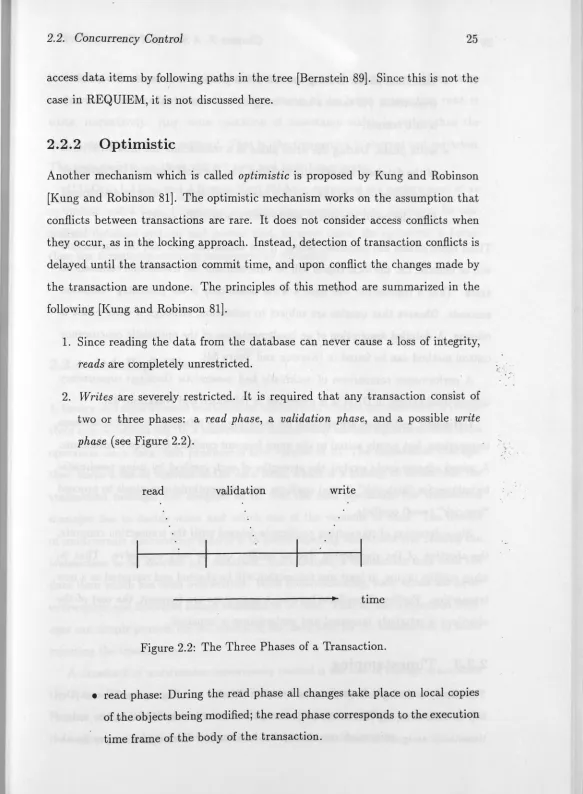
phase (see Figure 2.2).
read validation write
time
Figure 2.2: The Three Phases of a Transaction.
• read phase: During the read phase all changes take place on local copies
of the objects being modified; the read phase corresponds to the execution
time frame of the body of the transaction.
[image:42.636.38.621.18.812.2](
26
Chapter 2: A Survey of Existing Work• valida~ion phase: During the validation phase it is determined whether a
transaction will cause a loss of integrity and whether the result of a query
is still correct.
• write phase: During the write phase of a transaction the data structures
of the database are actually updated, i.e. the local copies of the database
are made global. In the case of a query (read-only), it must be determined that the result the query would return is actually correct.
These three phases are described below.
If
the validation does fail, the transactionwill be undone, i.e. the local copies will be removed, and the transaction commenced
again. Thus a transaction will have a ·.write phase only if the preceding validation
succeeds. Observe that queries are subject to validation, although a write phase is
missing. A detailed description of an implementation of the optimistic concurrency
control method can be found in [Kersten and Tebra 84].
A performance comparison of optimistic and pessimistic (locking) concurrency
control mechanisms in DBMSs is presented in [Menasce and Nakanishi 82].
Optimistic techniques are suitable for resolving the infrequent conflicts between
transactions, but poorly suited to the more frequent conflicts between transactions.
A mixed scheme could exploit the strengths of each method by using pessimistic
techniques for "high-risk" (write) conflicts, reserving optimistic methods to proceed
"low-risk" ( read') conflicts.
Since detection of transaction conflicts is delaye<l until the transaction commits,
the abortion of the transaction due to conflict can be very expensive. That is,
when conflict occurs, at least one transaction will be aborted and restarted as a new
transaction. Further, if conflicts between transactions are frequent, the cost of the
abortions is relatively increased and performance is impaired.
2.2.3
Timestamping
Timestamp ordering concepts can be found in [Ritchie and Thompson 74] and [Orji
88]. In timestamping [Bernstein 89], seria.lizaLion order is determined by the unique
2.2. Concurrency Control 27
timestamp of its transaction. For each data item accessed, there is a read timestamp
and a write timestamp to record the timestamp of the latest transaction read or write, respectively. Any write operation of timestamp which is earlier than the data's read timestamp is rejected. That is, the transaction is aborted and restarted. The restarted transactions will get new and later timestamps.
C.U.Orji, L.Lilien and J.Hyziak [Orji 88) have compared the performance of an optimistic and a basic timestamp ordering concurrency control algorithm for cen-tralized database systems and proved that, in most cases, the optimistic is better than the timestamp-ordering mechanism in efficiency.
2.2.4
Multiple Version
A theory and algorithms of multiversion concurrency control are described in (Bern-stein and Goodman 83). In a multiversion concurrency control algorithm, each write operation on a data item produces a new version of it. The transaction manager then keeps a list of versions of the data item, which is a history of values that the transaction manager has assigned to it. For the read operation, the transaction manager has to decide when and which one of the versions to read. The benefit of multiversion concurrency control is to avoid rejecting operations and causing the transaction to be aborted and restarted. For example, a transaction may read the data item which has been overwritten. \Vith multiversioning, such values are never overwritten and therefore always available to be read. That is, the transaction man-ager can simply provide the old version of the data item for the transaction to avoid rejecting the transaction.
28 Chapter 2: A Survey of Existing iVork
2.2.5
Various Combined Methodologies
The concurrency control mechanisms mentioned above may also be used by mixing
different methods together. M. Herlihy [Herlihy 86) proposed mixing pessimistic
(locking) and optimistic methods. In [Kim and Lochovsky 89) and [Lausen 82),
dif-ferent ways of mixing these two methods are presented. A general description of
various combinations of different concurrency control mechanisms can be found in
[Bernstein 89).
Nevertheless, the compatibility of different mechanisms is a non-trivial
prob-lem, for example, two-phase locking and multiversion timestamping cannot be used
together in a multi-user system [Herlihy 86).
2.2.6
Discussion
The following are the major features which have come to light from the survey of
the existing concurrency control mechanisms.
1. Locking provides a safe guideline for concurrency control design, but presents
an overhead that is not present in the sequential case. Read transactions,
which will not possibly affect the integrity of the data, should proceed without
locking to provide more concurrency in the transaction processing.
2. Optimistic concurrency control favours the read transactions to proceed
with-out any interruption. In the case of write conflicts, the cost of the abortion
and restart of transactions may be unacceptable.
3. Timestamp ordering is generally found not efficient ([Orji 88) and [Date 90))
in the DBMS especially in a centralized DBMS. Since a centralized multi-user
DBMS is developed here, timestamp ordering is not considered.
4. Multiversion concurrency control also provides a better solution for read
trans-actions. Nevertheless, the cost of storage and garbage collection may be too
...
·
-2.3. Granularity Control
29
2.3
Granularity Control
The granularity of a data item refers to the size of the item. In the relational model of data, we can choose large items, like relations (or tables), or small items like
individual tuples ( or records). Also, items could be of an intermediate size, say 50
tuples from a relation.
The granularity of data items is important for performance but irrelevant for
correctness. Suppose locking as described in the previous section is used. Large
or coarse granularity locks reduce concurrency, since operations are more likely to
conflict. On the other hand, overhead is decreased because fewer locks are
man-aged. Small granularity locks involve higher locking overhead, since more locks
are required, but they improve concurrency by locking only those data items the
transaction accesses.
Choosing the granularity of locks presents a tradeoff between locking overhead
and the amount of concurrency. It would be desirable to use different granularity according to what is most appropriate to each transaction's mode of operation.
That is, large transactions, which access many tuples can lock coarse granules, say
relations. Small transactions can lock fine granules, say tuples, in case only few
tuples are accessed. Therefore, long transactions do not waste time setting too
many locks, and short transactions do not bother others by locking those data items
they do not access.
2.3.1
Multiple Granularity Locking
One solution to the granularity control is multiple granularity locking {lv!GL) which
was originally proposed by J.N. Gray, R.A. Lorie and G.F. Putzolu [Gray 75]1, and
are also examined by Bernstein, Had7.ilacos, and Goodman [Bernstein 89]. Other
re-lated description of MGL are examined in [Gray et al 76], [Ries and Stonebraker 79],
and [Korth 83]. The granularity of the data item may either be logical or physical.
In a database, the term logical data refers to the data which are viewed by the
ex-1 In [Gray 75], multiple granularity locking is described as dynamic locking.
30
Cl1apter 2: A Survey of Existing Worktern.al users, and physical data refers to the d~ta which are actually stored in the
computer system. For logical data, the most appropriate granularity to be locked are relations and tuples, i.e. files and records. Page, a unit of space in memory, is an
appropriate granularity lock for physical locking. Figure 2.3 shows the relationship between these different granules. Each level of the diagram is given a node type
Indexed Files Data Files
I
Pages
[image:47.672.11.629.19.819.2]Records
Figure 2.3: The Three Level Hierarchy.
which is a generic name for all the node instances of that type. Each node, either
indexed files, data files, pages or records, of the diagram can be locked. The task
of choosing coarse or fine granularity to be locked is generally achieved by the lock
escalation which will be described in Section 2.3.2.
Multiple granularity locking (MGL) also requires the transaction manager to prevent two transactions from setting conflicting locks on two granules that overlap.
If one requests a write lock to file node, then when the request is granted, the
requester has write access to that node and implicitly to all its descendant records.
If one requests a read lock to file node, then when the request is granted, the
requester has read access to that node and implicitly to all the descendant records of that node. The two access modes lock all the records of the files.
A lock on a file node which explicitly locks the node also implicitly lock all
its descendant records. On the other hand, it is also necessary to have the effect
of record locking to the file that contains the records. That is, when a record is locked by a transaction, then the file node that contains the record can not be
explicitly locked by other transactions. To achieve this, ir ( intention read) locks and