The Art of Practice – Understanding the process of
musical maturation through reflection
Monica Esslin-Peard, Tony Shorrocks University of Liverpool, School of Music
Graham F. Welch, UCL Institute of Education, University of London
Abstract
Much has been written in the last 30 years about musical practice and performance, but there is little consensus over what practice really means, or how musicians progress by practising. Researchers tend to focus on specific elements in practice rather than a more holistic perspective. Whilst academics historically focused on (primarily Western) classical musicians, more recent research has encompassed popular, jazz and folk musicians. The current research project at the University of Liverpool1 focuses on the practice and performance of both popular and classical musicians as described in students’ reflective essays. We posit a model for musical maturation that incorporates key elements from psychology, epistemology and socio-cultural theory.
Keywords
Practice, Performance, Reflection, Maturation, Metacognition
Introduction
The “Art of Practice” research project at the University of Liverpool, School of Music seeks to explore how students of classical2 and popular3 music acquire the knowledge, skills and expertise of practising. The main field of enquiry is to discover how an individual learns to practise. This prompts not only an investigation into the process of practice, but also the educational and social context of the learning. This paper presents a review of relevant literature and then considers the initial findings from data gathered from the 2012-2014 cohort of popular and classical undergraduate musicians on the performance module at the University of Liverpool.
1 The Russell Group represents 24 leading UK universities which are committed to maintaining the
very best research, an outstanding teaching and learning experience and unrivalled links with business and the public sector.
2 “Classical” is used to describe musicians who have been educated in the tradition of Western
classical music, for example those who play orchestral instruments or piano or sing and largely perform works from the Western classical oeuvre. These musicians generally start their instruments at a young age and are used to the expectation of several hours of practice a day.
3 “Popular” is used to describe musicians who are largely self-taught and whose preferred style of
Background
Historically, music education research has centred on classical musicians. It is well documented that practice is a key part in the development of musical excellence (e.g. Hallam, 2001). Classically-trained musicians often report 10,000 hours or ten years of practice to reach professional standards (Ericsson et al., 1993). In an attempt to explain the phenomenon of practice, researchers draw on a wide variety of models. Miksza (2011) offers a tripartite division between the individual, comparison of student and teacher views, and changes in approaches to practice over long periods of time.
More recently in the last 20 years, following the ground-breaking work of Green (2001), research also focuses on popular music. There is a lively debate ranging about formal versus informal learning models, which we will discuss later in the context of our own research.
Two further areas are important to frame this study. Firstly, assessment—both formative and summative—is a key part of the individual, group and institutional process employed to track progress. Musical assessment varies from institution to institution and by musical genre, including peer and faculty assessment (Ginsborg & Wistreich, 2010; Lebler, 2007, 2008). Secondly, reflective practice has been
embraced by tertiary educational institutions in England, Scotland and Wales over the last two decades, following theories of reflective practice that were developed by Schön (1987) and refined for educational practice by Ghaye (2011) amongst others. It is reported that reflective journals or practice diaries offer one type of tool to develop metacognitive thinking skills, but the process needs to be managed carefully (see Cowan, 2013).
The research question
In our research at the University of Liverpool, the aim is to develop a model which explains the maturation of musicians through practice and performance, based on the following research question:
To explore the self-reported behaviours of undergraduate popular and classical musicians, and identify similarities and differences in changes which
individuals experience in the development of musical expertise.
This is essentially a study about intending professional musicians, based in their world of making music daily, rehearsing and performing and trying to capture the moment when students self-report that they consciously understand their practice.
The research context
The performance module requires classical musicians to perform in one end of year recital, and popular musicians to perform in two band performances in December and May. These performances are assessed by university faculty staff using a standard marking protocol and the mark awarded is worth 70% of the final grade. All
performance students at the University of Liverpool are expected to keep a practice diary, or online practice blog. The diary is used as a prompt for the 1,500 word end-of-year reflective essay about the individual experience of practice and performance and this is marked according to agreed published criteria and is worth 30% of the final grade. This assessment combination of practice diary, reflective essay and
performance is unique amongst comparable universities.
All students who take the performance module are entitled to individual instrumental or vocal lessons provided by the School of Music. In addition, the faculty encourages students to attend concerts regularly and to reflect on performances in guided
sessions. The two heads of performance (classical, popular) hold weekly two hour workshops for students, divided by year group, to provide practical and academic content. The style of these workshops differs by musical genre. Popular music students discuss aspects of performance and production, and play to their peers in their workshop, exchanging feedback. Classical music students are offered workshops with a specific focus; in the first year, the emphasis is on understanding the process of practice; in the second year, the focus is on intonation; and, in the third year, they explore the historical context of performance practice. As one of the tutors explained in interview:
The first years - pop and classical - get a lot of input in class into aspects of learning and practising. Some sessions are people explaining in front of the class what their one-to-one instrumental or vocal lesson content has been, followed by “how” they practised it, what problems arose, discussions as to how it could be practised and then all have to make notes as to what they could use.
It is important to note that the tutors take care not to “instruct” their students how to practise. Whilst the student handbooks have some basic guidelines, the emphasis is on a process of self-discovery, which is enhanced by discussion with peers and tutors. This concurs with Cowan’s approach (2013:4):
I want to empower each learner supportively and without exercising authority, within a ring-fenced area where their self-directed learning and development will be self-assessed. I try to help them to be the best that they can be – but always leave them to decide what to do and how to do it. I nudge the learners forward into Vygotsky’s Zone of Proximal Development where they can make more progress through prompting than they could manage on their own. I do no more than that. I certainly do not instruct, or tutor.
Methodology
comments are identified in reflective essays which need further explanation, the lead researcher invites students to participate in one-to-one or individual interviews, which are audio recorded and transcribed for subsequent analysis by an independent typist to avoid any bias.
We adopt a mixed approach to analysing the data, using both quantitative and qualitative techniques, a method which is commonly used in (music) education research, following Bryman (2006:100). Quantitative data plays a lesser role in this project, serving to show trends, such as, for example, in students taking music lessons.
Qualitative data drawn from the reflective essays and interview transcripts is
examined based on the principles of textual analysis. Following McKee (2003), we seek to gain an understanding of how students make sense of their practice
behaviours. Repeated close reading of all the available narratives was considered to be the most appropriate method to gain an understanding of how students’ behaviour and attitude towards practice was changing, which is similar to the approach of
Joansson (2013) and methods adopted by Green (2001) and Smith (2013) in exploring data from popular musicians who had been interviewed.
As music research in any educational setting, such as tertiary education, is—by
necessity—also affected by the physical and socio-cultural environment, including the social and musical backgrounds of the participants and their concepts of self-identity and the influence of peer groups, we are keen to take the “bigger picture” into account in our research, and concur with the philosophical standpoint cited by Yarbrough (2003: 10) of:
the behavioural psychologist who studies and interprets musical phenomena and behaviours in light of environmental and cultural influences, learning and achievement, and nurturing aspects.
A research project based on self-reported behaviours begs the question whether student behaviour is voluntary, or determined by their teachers, c.f. Cowan, (2013). As stated above, the tutors seek to leave the students as much freedom as possible to understand their own learning journeys, whilst also being available to offer advice and support. We would argue that it is precisely because there is no formal pedagogy of practice, but rather a culture of experimentation and trial and error, that statistical analytical approaches are not primarily appropriate for this study, as the outcomes of this research are intended for a wide audience of music educators and practising musicians.
Ethical considerations
Ethical approval was obtained from the university Ethics Committee in October 2012. Students were given information about the research project and asked to sign an approval form (Appendix 1) to ensure that they understood the nature of the study, and they were free to withdraw at any time for any or no reason. This form also offered an opt-in clause for taking part in interviews.
conducting focus groups and one-to-one semi-structured interviews in order to avoid influencing the content of reflective essays.
Discussion of Results for 2012-2014
The results which we discuss below are based on the data from reflective essays which were available for the first two years of study for the student cohort who started in October 2012. Throughout the discussion below, we highlight important
similarities and differences between the practice behaviours of classical and popular musicians.
Baseline data were collected for 32 popular musicians and 15 classical musicians about instrumental and vocal tuition for both years. The take up for the 15 classical musicians in the group was 100%. Popular musicians, on the other hand, did not all make use of the provision in the first and second years. Popular musicians are often self-taught, and the essays revealed a certain reluctance from some students to try out individual tuition. A drummer commented thus:
I have never had any instrumental lessons. It was never part of my agenda, growing up. Mostly because it was time-consuming, costly, and there weren’t many female drum teachers. The first ever drum lesson I had was […] in Liverpool. It was an interesting experience. For me, it was like going to the dentist for the first time.
Analysis – General considerations
The principle challenge in the analysis of a total of 94 reflective essays was to make sense of narratives which had been generated in many different styles, and with a wide range of foci for reflection. The lead researcher read through the essays to identify common themes, which, for the first year, were consistent across the two sub-groups of musicians in terms of focus on elements which might be deemed relevant to musical maturation through practice.
In addition, many of the first year popular musicians described the social aspects of band formation, and identified a host of barriers to their learning, such as band members not turning up to rehearsals, or arguing over the direction which rehearsals should take. This area of investigation has been excluded from the present paper, as it detracts from the principle focus on the development of practice.
Analysis – First Year Classical Musicians
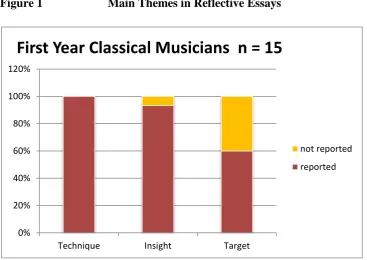
[image:6.595.90.458.159.419.2]All the first year classical musicians submitted reflective essays. Close reading and re-reading of their texts revealed Technique, Insight and Targets as the three most common themes, (see Figure 1 below).
Figure 1 Main Themes in Reflective Essays
Technique
The majority of classical musicians identified technique as a major area of focus in their practice. Students gave a variety of responses: some described what their teacher was working on with them, others wrote about their own attempts to tackle technically difficult pieces, or specific passages. Some students who were admitted with playing or singing skills below ABRSM Grade VIII4 may have felt under pressure compared
with their peers, and so were encouraged to focus on building technique by their teachers.
Lessons have consisted almost exclusively of singing exercises to build up technique from the basics, rather than building upon flawed foundations. (Singer)
Insight
The majority of the first year classical students described instances of practice that demonstrated varied levels of insight into their personal practice routines. There is certainly some evidence of a change towards an examination of the “how” to practise, rather than re-iteration without reflection. For example:
4 The Associated Board of the Royal Schools of Music offers a graded sequence of practical and
theoretical examinations in the UK and around the world. The examination syllabus caters for classical and jazz musicians. Grade VIII, the highest grade, is often required for school leavers wanting to study music at university.
0% 20% 40% 60% 80% 100% 120%
Technique Insight Target
First Year Classical Musicians n = 15
Throughout the year I have learnt that there is a difference between simply just playing through a piece and actually practising a piece. Now I focus on
specific parts of the piece that I know are a problem for me. I now question myself more as to why I cannot do certain things and try and find solutions. (Saxophonist)
A first year viola player who had previously been a junior student at the Royal Academy of Music in London, and who had completed one year of conservatoire study before coming to Liverpool, focused almost entirely in her essay on her own emerging musical identity. She also notes the transition from re-creating a
performance to being creative in performance:
When I started my year, in my private work, I was trying to achieve the feelings and match the sound identical to that of a performance and I was only satisfied if I had re-created that sound. This behaviour is now alien to me and pretty unimaginable. Who would only want to re-do?
Compared with her peers, this first year student has a much deeper understanding of what practice and performance is about.
Targets
Just over half of the first year classical musicians had set themselves longer term goals which encompassed particular performance opportunities, such as playing a concerto, or taking a specific music exam. Nine out of the 15 musicians cited targets, which included a more regular use of the practice diary in the following year, or changes in practice habits, such as breaking down pieces into smaller chunks to overcome technical difficulties and spending time more effectively and not ‘playing through’ pieces which points to the emergence of some metacognitive practice strategies.
Analysis – First Year Popular Musicians
The popular musicians are a diverse group. Their ages and backgrounds vary,
including those that are mainly self-taught, those that have had some instrumental or vocal lessons and those that already consider themselves to be experienced
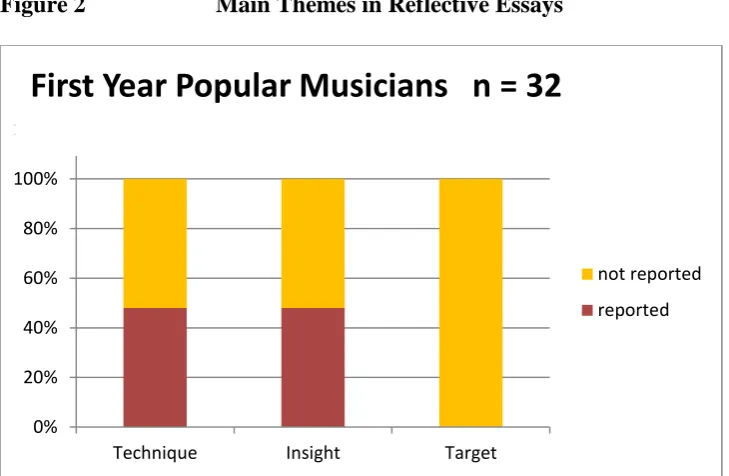
performers. Some have had classical training, including one cathedral chorister; others are already working as session musicians. Whilst the majority of these students tended towards a narrative description of their experiences in the first year in their reflective essays, 28 articulated some kind of insight into their own development as musicians. A minority of students, either with extensive experience of playing with bands, or who were already working as session musicians, exhibited much deeper levels of reflection, both in terms of their individual development, and about the process of band rehearsals. The same three themes were used to analyse these essays to highlight the differences and similarities between the classical and popular
Figure 2 Main Themes in Reflective Essays
Technique
Not surprisingly, the 19 popular students who were taking regular lessons (Figure 2) wrote about technique. Many of the vocalists, like their classical musician peers, accepted to a greater or lesser extent that practice was necessary to develop their skills. In particular, they were very positive about their one-to-one lessons, even though they reported a relentless focus on warm-ups and technique, which was new for many:
Before I had any lessons from Anne, I didn’t always warm up before
individual practice, but by having these lessons, I now know the importance of a decent warm up and so before practising in the future, I will always warm up.
Similarly, a guitarist reported:
I have to admit I was a bit hesitant to begin with. My tutor was covering material that was mainly orientated towards a jazz style of playing, which was unfamiliar territory for me.
He persevered with the technical work on chord voicings, alternative chord shapes and modal scales and reported that this enabled him to be more creative when working with others, whatever the genre:
One thing I have learnt is how I always need to be able to adapt to the type of band I am playing in as I have realised how differently many musicians work.
Unlike classical musicians, who had extensive experience of individual tuition and practice, one popular guitarist wrote:
0% 20% 40% 60% 80% 100% 120%
Technique Insight Target
First Year Popular Musicians n = 32
Although I appreciated [that] these chords and scales were useful, and perhaps vital in my progression to becoming a better player, I found the practice tedious, bland, insipid and dull.
Insight
The popular musicians’ weekly tutor-led workshops offered an opportunity for bands to perform to each other and gain peer and tutor feedback. In addition, the tutor spent three evenings a week coaching bands in rehearsal. It seems clear that he was keen to encourage first year bands to bring a creative twist to their cover versions. Here is a typical comment:
By jamming along to and transposing songs from a wide range of different genres from hip-hop to deep house, I have gained an insight into alternative scales, intervals, phrasing and percussive techniques that can be used to great effect in creating original sounds.
One guitarist’s commentary stands out from his peers as he gained experience not only from bands, but also by playing for a musical theatre production, recording how he dealt with a large amount of unfamiliar material. He listened to the musical numbers, practised difficult passages and ensured that he had the appropriate guitars and equipment. He noted that he spent a couple of hours a day in preparation, but does not say for how many days this practice took place. In this context, his comments suggest that he was displaying behaviours more typical of his classical peers, in the sense that he prepared before the rehearsals and focused on technical aspects to ensure that he could play fluently.
The rehearsals were incredibly different to the ones I have with the university band. Due to the small amount of time we had to go through the songs, we all had to be concentrating and 100% prepared for it.
Targets
We were somewhat surprised to find that 17 out of 32 students mentioned general targets, either for improvement within their first year, or for the second year. This seems to be in line with DeNora’s (2000) comment that popular music is situated in a social context and, as such, group identity may be more important than individual identity. This may go some way to explaining why there are no clearly defined individual goals to be found, as many of the student musicians see their musical development within the band.
Analysis – Second Year Classical Musicians
is partly due to the nature of the taught content of the first semester and, as we will show below, can be explained by a change in student behaviour.
Tuning and intonation
In the regular weekly lectures, the Head of Performance worked with the students on different tuning temperaments for a harpsichord. The objective of this exercise, which many students reported at the start as baffling, was to develop aural acuity and to recognise the interference beats of notes that are out of tune. It was, therefore, no surprise to find that eight out of the 15 students offered comments that reflected on intonation. One saxophone player’s comments demonstrated a real change in attitude to tuning:
Despite the initial resentment that I felt towards the lectures spent tuning a harpsichord, it did not take me long to realise and appreciate the vast development that it was making on my playing. I found myself constantly listening out for tuning issues.
One of the pianists says that, as a result of the lectures, “It is the pianist’s job to play the piano in tune.” This suggests that the student has not only learnt and internalised aurally what it means for her to be in tune, but can also vary her touch at the keyboard to improve intonation.
Metacognitive practice strategies
Metacognitive practice strategies have been reported by Hallam (2001). Her research, based on the experiences of 22 professional musicians, points clearly to key elements in mature practice such as acute self-awareness, planning practice tasks using a wide variety of strategies and effective time management. The student musicians in Liverpool are, in their second year, writing about specific changes in their practice strategies, and how they divided up a challenging passage into tasks.
Furthermore, mental rehearsal techniques have been cited in the literature about metacognitive practice and these were echoed in students’ written reflections. A viola player writes almost exclusively about what she hears in her head, and what she is thinking about:
I am imagining what can be done, and how I could be improving. The music is clearer and louder in my head, as is the image of the viola when I am not practising.
In summary, looking across the reflective writing about practice strategies by these second year classical musicians, there is more evidence which points to conscious thought about how to practise and an understanding of which strategies to use in a specific set of circumstances.
Change and ‘A-Ha’ moments
when a developing musician “gets” what practice is all about, and starts to use metacognitive practice strategies deliberately.
As there is no theoretical model for an “A-Ha” moment and, as students were not told deliberately to identify such moments in their reflective essays, the examples which we give below have been selected as they seem to suggest some kind of breakthrough in learning and understanding. For example, one of the singers missed half of the second semester through illness. He seemed to be totally stuck in his practice.
However, at the end of the second semester, he reportedly made a major breakthrough with his singing teacher by combining physical movement with vocal exercises. As a result, he was able to use metacognitive strategies such as planning his practice schedule to work on his technique and the interpretation of the songs for his final second year recital. Despite admitting that he was not using a practice diary, the student describes in interview how he internalised the change which had taken place:
Whereas last year I was trying a new approach with practising, I feel that lately it has become more of a natural attitude and habit than something I am affecting to do, which is very promising. I feel as though I have managed to overcome a large obstacle to my progress as a singer, resulting in a much faster rate of progress than I was previously experiencing.
We would suggest that this singer is demonstrating not only evidence of learning how to learn, but also of owning the strategies and internalising them.
Analysis – Second Year Popular Musicians
All 32 popular musicians continued with the performance module in the second year. Of these, 23 students explicitly mentioned going to lessons provided by the music department – an increase of four students from the first year – and this seems to underlie one of the areas on which they focus in their reflective essays, namely technique and performance craft.
In our discussion below, we focus on two areas, namely individual practice, and band practice/working on original material. In particular, song writing is so central to the development of bands, that we believe that it is impossible to divorce the creation of new material from the process of band development. In accounts of both individual and group practice sessions, we have been looking for indications of metacognitive practice strategies.
Individual Practice
Using “practice” as a term to describe individual work to improve technical or interpretative skills (as reported by the majority of classically-trained student
Not surprisingly, with a great deal of time spent in band rehearsals, there are fewer accounts of individual practice in the second year essays, and several students make it clear that what they practise on their own is linked to what they are rehearsing with their bands. A female vocalist reports
On top of lessons, I also practise on my own. My solo practices are enjoyable, […] although I feel like sometimes because I am on my own, I will slack off and maybe not be as picky with my playing as I would be in band practice or in my lessons: I do better when I am accountable to somebody.
Based on the available data, for many of the popular musicians at the University of Liverpool, a conscious awareness of the need to develop technique appears to emerge during the second year, strongly motivated by positive experiences in collective musical performance, such as bands. Unlike their classical musician peers, who have grown up with a culture of individual practice, our data show that popular musicians develop the motivation to practise individually as a result of playing in bands. This is echoed by one of the most experienced guitarists in the second year who is already playing professionally outside the university. He recognised the value of developing jazz guitar techniques in his lessons at the university:
I have improved my versatility as a guitarist because I’m now getting used to playing in different styles and being more creative in music that I would normally only listen to and not get to play with a band.
Band practice/working on original material
If the band is the centre of focus for learning for popular musicians, then it seems worth exploring how the students describe their band rehearsal sessions. Green (2001) describes a variety of different models for generating original material, ranging from a single composer bringing music to the band in an almost finished state to
collaborative jamming based on a single riff or musical idea as a starting point. The same processes can be seen in the student bands at the University of Liverpool, driven by the rapport between musicians. One singer describes the process of rehearsal thus:
I feel we understand each other as musicians to the point that, if one person has an idea that they’re struggling to articulate, someone else will know what they are trying to say, and help them explain it to the band.
This view was echoed by a second year violinist on the classical course who had joined an all-girl acoustic band of her pop peers. She reports:
We would just sit there and work out the chords, play around on the piano to work out a riff. I would write the notes down, but not even musical notation, then mess about on the violin.
One bass player explains in detail how a new band ‘Defunkt’ worked in the second year:
hands on approach to playing them as we discussed what direction to follow, and focusing on sections of songs that we felt needed work instead of wasting time by running through the whole song.
The reflective essays show that most of the bands were rehearsing regularly and making progress, and it would appear that the notion of being prepared before a band rehearsal was beginning to become more important. This was made very clear by a guitarist playing in the Funk Soul Continuum, a function band playing covers.
I had not been in a function band before, so I had to adapt to its fast-paced rehearsals. Rehearsals are not the place for individual practice, but rather they are for bringing all of the different parts together as a collective.
In conclusion, it seems fair to say that the majority of popular musicians had made some, or considerable, progress in their second year, as they show a developing sense of what effective individual or group practice entails. For those students who were involved in bands which were performing regularly, or were working as session musicians, there is a deeper understanding of the learning process which in many ways mirrors the developments which we have identified for the classical musicians in their second year. Most importantly, they are moving beyond “play through”
behaviour and developing some metacognitive practice strategies, such as overcoming technical challenges by practising a small section of the piece.
Into the melting pot – cross-genre experiences
The School of Music encourages performance students to go to concerts in a wide range of musical genres. This is believed to increase the likelihood that students will experiment with musical styles which are new to them. As one-to-one and focus group interviews revealed, the key characteristics which are required to succeed in this cross-genre “musicking” are flexibility, adaptability, and keeping an open mind. Mixed-genre groups typically use different rehearsal resources – sometimes with notation, sometimes working aurally. The actual practice routine may be quite formal, or very informal – and the learning style can move continuously on the continuum between formal and informal (as described by Folkestad, 2006). As bands become established, it is clear that friendship plays an important role, as does a common purpose focused on future concerts, gigs or recording sessions.
In the current cohort, two classical string players got involved in an acoustic band with a guitarist/singer/songwriter, and won a local open mic night in March 2014. This band broke up when the singer/songwriter graduated in June 2014. A classical violinist joined an all-girl acoustic folk-rock group and also played a wedding gig with a guitarist previously unknown to her in the USA. She describes the different challenges thus:
The Schubert quintet, the acoustic cover band and the wedding in San
Francisco – for all three of them you have to operate differently and get into a different mind-set and you work with the musicians differently.
admitting that improvisation and working without notation was very challenging at the start. This sentiment was reflected by a third year classical violinist, who was very sceptical in her early days of playing with an Indie Rock band:
We’ve got four classical and four popular musicians. At the beginning, we were just sat there asking ‘Why are we playing through the set again and again and again without making anything better?’ And them asking us ‘Why are you stopping every 30 seconds to change this?’ The processes are so different.
The data suggest that all musicians who took the plunge and explored “musicking” in new genres gained insights, not only into their own practice behaviours, but also in beginning to appreciate the benefits of exploring learning along the formal-informal continuum. This finding we hope to explore further as the research project
progresses.
Discussion – Factors in Musical Maturation
The key question which arises at the end of the students’ second year is to what extent they have made progress with their practice and performance. How would they
answer the question “What is practice”. As a starting point, we suggest that Harris and Crozier’s (2000) definition is helpful:
The central purpose of practice is to progress – to solve problems, to develop and broaden musicality, to think about the music.
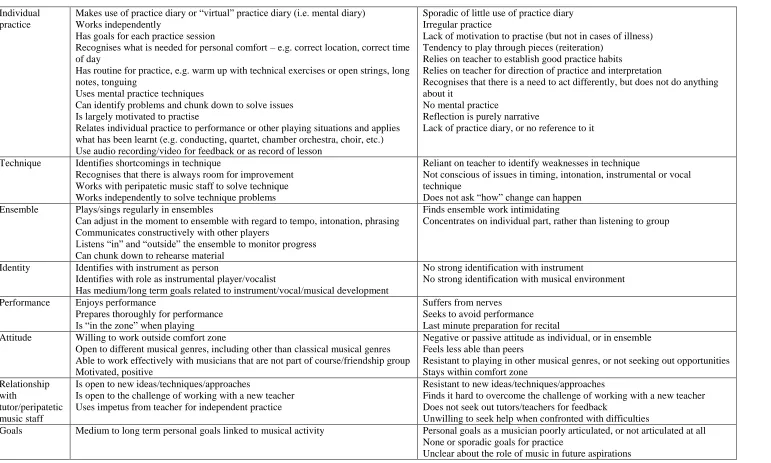
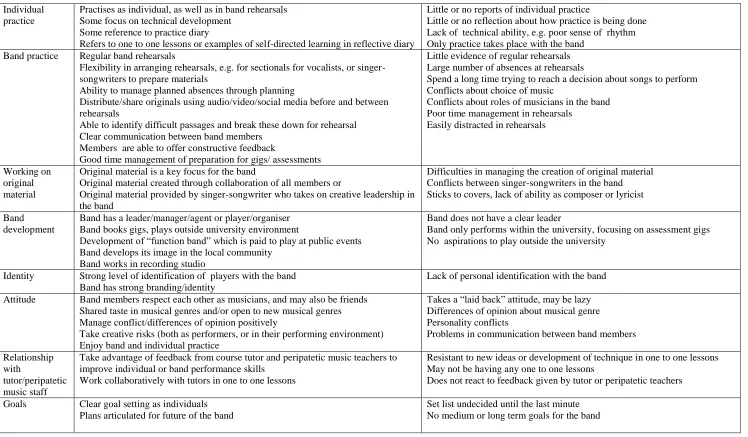
As a means summarising the first two years of research, we created tables of possible components which may point towards the maturation of the student musicians. The statements in the tables are extrapolated from the student narratives.
Table 1shows a summary of data drawn from the reflective essays written by the
classical musicians in the 2012-2014 cohort. There are clear differences between those students who seem to be maturing in their understanding of practice, and those who are not making as much progress as their peers in such understanding. An individual musician may exhibit evidence which points exclusively either towards a more or less expert approach, or a mix of behaviours from both columns of the table.
Table 1 Classical musicians 2012-2014
Evidence which suggests maturation Evidence suggesting less maturation
Individual practice
Makes use of practice diary or “virtual” practice diary (i.e. mental diary) Works independently
Has goals for each practice session
Recognises what is needed for personal comfort – e.g. correct location, correct time of day
Has routine for practice, e.g. warm up with technical exercises or open strings, long notes, tonguing
Uses mental practice techniques
Can identify problems and chunk down to solve issues Is largely motivated to practise
Relates individual practice to performance or other playing situations and applies what has been learnt (e.g. conducting, quartet, chamber orchestra, choir, etc.) Use audio recording/video for feedback or as record of lesson
Sporadic of little use of practice diary Irregular practice
Lack of motivation to practise (but not in cases of illness) Tendency to play through pieces (reiteration)
Relies on teacher to establish good practice habits
Relies on teacher for direction of practice and interpretation
Recognises that there is a need to act differently, but does not do anything about it
No mental practice
Reflection is purely narrative
Lack of practice diary, or no reference to it
Technique Identifies shortcomings in technique
Recognises that there is always room for improvement Works with peripatetic music staff to solve technique Works independently to solve technique problems
Reliant on teacher to identify weaknesses in technique
Not conscious of issues in timing, intonation, instrumental or vocal technique
Does not ask “how” change can happen Ensemble Plays/sings regularly in ensembles
Can adjust in the moment to ensemble with regard to tempo, intonation, phrasing Communicates constructively with other players
Listens “in” and “outside” the ensemble to monitor progress Can chunk down to rehearse material
Finds ensemble work intimidating
Concentrates on individual part, rather than listening to group
Identity Identifies with instrument as person
Identifies with role as instrumental player/vocalist
Has medium/long term goals related to instrument/vocal/musical development
No strong identification with instrument
No strong identification with musical environment
Performance Enjoys performance
Prepares thoroughly for performance Is “in the zone” when playing
Suffers from nerves Seeks to avoid performance Last minute preparation for recital Attitude Willing to work outside comfort zone
Open to different musical genres, including other than classical musical genres Able to work effectively with musicians that are not part of course/friendship group Motivated, positive
Negative or passive attitude as individual, or in ensemble Feels less able than peers
Resistant to playing in other musical genres, or not seeking out opportunities Stays within comfort zone
Relationship with
tutor/peripatetic music staff
Is open to new ideas/techniques/approaches
Is open to the challenge of working with a new teacher Uses impetus from teacher for independent practice
Resistant to new ideas/techniques/approaches
Finds it hard to overcome the challenge of working with a new teacher Does not seek out tutors/teachers for feedback
Unwilling to seek help when confronted with difficulties
Goals Medium to long term personal goals linked to musical activity Personal goals as a musician poorly articulated, or not articulated at all None or sporadic goals for practice
Table 2 Popular musicians 2012-2014
Evidence suggesting maturation Evidence suggesting less maturation
Individual practice
Practises as individual, as well as in band rehearsals Some focus on technical development
Some reference to practice diary
Refers to one to one lessons or examples of self-directed learning in reflective diary
Little or no reports of individual practice
Little or no reflection about how practice is being done Lack of technical ability, e.g. poor sense of rhythm Only practice takes place with the band
Band practice Regular band rehearsals
Flexibility in arranging rehearsals, e.g. for sectionals for vocalists, or singer-songwriters to prepare materials
Ability to manage planned absences through planning
Distribute/share originals using audio/video/social media before and between rehearsals
Able to identify difficult passages and break these down for rehearsal Clear communication between band members
Members are able to offer constructive feedback
Good time management of preparation for gigs/ assessments
Little evidence of regular rehearsals Large number of absences at rehearsals
Spend a long time trying to reach a decision about songs to perform Conflicts about choice of music
Conflicts about roles of musicians in the band Poor time management in rehearsals
Easily distracted in rehearsals
Working on original material
Original material is a key focus for the band
Original material created through collaboration of all members or
Original material provided by singer-songwriter who takes on creative leadership in the band
Difficulties in managing the creation of original material Conflicts between singer-songwriters in the band Sticks to covers, lack of ability as composer or lyricist
Band development
Band has a leader/manager/agent or player/organiser Band books gigs, plays outside university environment
Development of “function band” which is paid to play at public events Band develops its image in the local community
Band works in recording studio
Band does not have a clear leader
Band only performs within the university, focusing on assessment gigs No aspirations to play outside the university
Identity Strong level of identification of players with the band Band has strong branding/identity
Lack of personal identification with the band
Attitude Band members respect each other as musicians, and may also be friends Shared taste in musical genres and/or open to new musical genres Manage conflict/differences of opinion positively
Take creative risks (both as performers, or in their performing environment) Enjoy band and individual practice
Takes a “laid back” attitude, may be lazy Differences of opinion about musical genre Personality conflicts
Problems in communication between band members
Relationship with
tutor/peripatetic music staff
Take advantage of feedback from course tutor and peripatetic music teachers to improve individual or band performance skills
Work collaboratively with tutors in one to one lessons
Resistant to new ideas or development of technique in one to one lessons May not be having any one to one lessons
Does not react to feedback given by tutor or peripatetic teachers
Goals Clear goal setting as individuals Plans articulated for future of the band
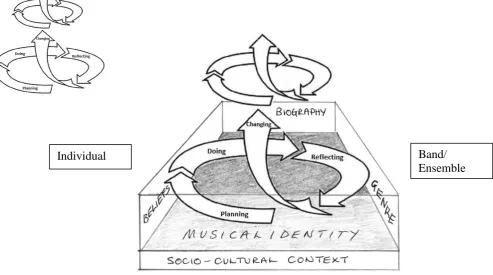
Figure 4 - The Spiral of Reflection Models
Basic model Contextual Model
Based on the preceding qualitative analysis of the data, we propose a model which describes a contextual learning process for these undergraduate musicians. The spiral of reflection, which is the basic model, implies iteration in practice, rather than re-iteration. Re-iteration is the mindless repetition of a phrase, a passage or a song or a piece without any reflection. However, iteration, or mindful repetition utilising metacognitive processes, results in change. Iteration, we would suggest, implies a conscious process of planning, doing, reflecting and changing. When this model synthesised from the available student reflective data, was presented to students in October 2014, many commented that this spiral was helpful in describing productive practice behaviours, but also pointed out that there were days in which they might not consciously acknowledge that progress had been made; either they were “stuck”, or might even have thought that they had fallen backwards. This is an important aspect of the model which will require further investigation in the future.
We have refined this model, drawing from Welch’s Russian Doll model of musical learning (2007). Students bring their personal experience of music before university, which is described here as “biography”. They also hold a set of beliefs about their musical potential, and a personal preference for one or more musical genres.
Furthermore, they are, or may be becoming cogniscent of their own musical identity.
All this happens in the socio-cultural context of the learning institution, both the university campus, venues for rehearsal and performance, and the city of Liverpool. The institution provides support from tutors and one-to-one peripatetic music teachers
Individual Band/
who, in their own way, will also influence the learning journeys of students. A student can access this learning environment zone either as an individual, or as a member of a band, or ensemble, or through both routes. The combination of these psychological factors and the socio-cultural and institutional context give rise to differing levels of maturation in the spiral of reflection. Maturation depends not only on the individual, the group and the context, but also the degree to which a student can progress through a series of spirals.
Conclusions and further areas of research
The research we have conducted so far, based on data drawn from reflective essays and interviews, suggests that there are similarities in the musical maturation of classical and popular musicians. Whilst it would seem on the current evidence that popular musicians come to understand the importance of individual practice – learning their craft – later than classical musicians, further research with both sub-groups in their final year will be designed to compare both individual and group behaviours.
In addition, we would like to test the robustness of the model by gathering feedback from students in the 2012-2015 cohort to ensure that the model mirrors their
experiences of musical maturation. It may be this feedback requires us to adapt our model, but, if the model and the maturation factors stand up to scrutiny, we believe that the “Spirals of Reflection” model can be used not only to accelerate effective learning practices, but may also have an impact on the design of tertiary education performance modules for undergraduate musicians. The next years of research will, we hope, enable us to make the model more robust, profiting from the next set of student reflective essays, further interviews with popular, classical and mixed-genre musicians and dialogue with other academics.
Contact: [email protected] Tel: +44 7976 761142
Bibliography
Bryman, A (2006) Integrating quantitative and qualitative research: how is it done?
Qualitative Research6; 97-113
Cowan, J (2013) Facilitating reflective journaling – personal reflections on three decades of practice Journal of Learning Development in Higher Education5 1-17
DeNora, T (2000) Music in Everyday Life Cambridge: Cambridge University Press
Ericsson, K. Anders, Krampe, R & Tesch-Römer, C (1993) The role of deliberate practice in the acquisition of expert performance Psychological Review100 (3) 363-406
Folkestad, G (2006) Formal and informal learning situations or practices vs. formal and informal ways of learning British Journal of Music Education23 (2) 135-145
Ghaye, T (2011) Teaching and Learning through reflective practice Abingdon: Routledge
Ginsborg, J & Wistreich, R (2010) Promoting Excellence in Small Group Music Performance: Teaching, learning and assessment. Royal Northern College of Music accessed 3.8.2014
http://labspace.open.ac.uk/mod/resource/view.php?id=456882&direct=1
Green, L (2001) How Popular Musicians Learn Aldershot: Ashgate
Hallam, S (2001) The development of meta-cognition in musicians: Implications for education British Journal of Music Education18 (1) 27-39
Harris, P & Crozier, R (2000) The Music Teacher’s Companion London: Associated Board of the Royal Schools of Music
Johansson, K (2013) Undergraduate students’ ownership of musical learning British Journal of Music Education 30 (2) 277-295
Lebler, D (2007) Student as master? Reflections on a learning innovation in popular music pedagogy International Journal of Music Education25 (3) 205-221
Lebler, D (2008) Popular music pedagogy: peer learning in practice Music Education Research10 (2) 193-213
McKee, A (2003) Textual Analysis: a beginner’s guide University of Queensland: Sage
Miksza, P (2011) A Review of Research on Practicing: Summary and Synthesis of the Extant Research with Implications for a new Theoretical Orientation Bulletin of the Council for Research in Music Education190 51-92
Smith, G D, (2013) I drum, therefore I am Farnham: Ashgate
Welch, G.F. (2007) Addressing the multifaceted nature of music education: An activity theory research perspective Research Studies in Music Education28 (1) 23-37
Appendix 1 Information for student participants in the research project
The Art of Practice Doctoral Research Project
Participant Information Sheet
October 2013
Dear Undergraduate Music Student,
You are being invited to participate in a research study. Before you decide whether to participate, it is important for you to understand why the research is being done and what it will involve. Please take time to read the following information carefully and feel free to ask us if you would like more information or if there is anything you do not understand. You are welcome to discuss this with your peers, friends and relatives if you so desire. We would like to stress that you do not have to accept this invitation and should only agree to take part if you want to.
The purpose of this study
My name is Monica Esslin-Peard and I am a part-time doctoral research student in Performance at the University of Liverpool, School of Music. My supervisor is Tony Shorrocks, Head of Performance. In my day job, I am Director of Music at a school in Sussex and I am passionate about all genres of music and about helping students to develop as performers. Below you can read about the scope of the proposed research project.
‘The Art of Practice’
How music undergraduates reflect on their instrumental and vocal practice to understand how to become better performers.
Why are you being asked to take part in this research?
As a music undergraduate opting for the performance module as part of your studies, you are being invited to take part in this project because I am seeking to discover how music undergraduates like you develop your practising skills (whether as an
individual, or in groups/bands) and how what you do in practising contributes to your progress as a performer. To this end, I would like to be able to explore the relationship between your experience of practising and your end-of-year recitals.
may collect as many as 300 different sets of data relating to individual musicians over three years, which will allow us to conduct statistical analyses of the data and see whether we can establish a connection between reflection on practice and
performance in end-of-year recitals. In other words, we want to understand how you learn to practice your instrument and how, by writing about your practice in a reflective essay at the end of the year, you recognise the times when you changed your practice habits, or noticed that you had made a breakthrough or overcame a particular challenge.
What will it involve for you?
Participation in this study will not change your experience of the Performance Module as part of your undergraduate study in any way. All I am seeking is your permission to do the following:
Read your end of year reflective essay based on your practice diary Gain access to your grades for your reflective essay and your end-of-year
recital
Possibly invite you to take part in a semi-structured, informal interview which will be audio-recorded, so that you can tell me more about what you have learned
I would like to stress that I am not here to judge how much you practise, or what you are practising. As an external researcher, I have no influence over your grades, and will not be able to access your reflective essays and performance grades until these have been awarded and moderated within the School of Music and communicated to you. My supervisor, Tony Shorrocks, Head of Performance, will continue to teach the performance module in the same way as it has been taught in previous years.
Wider benefits for you, and Music Education
By allowing me access to this information, you will be contributing to the first research project in the UK which compares the practice behaviours of classical and popular musicians at undergraduate level. Your experiences and views are not only valuable to this research project, but will also be of benefit to the School of Music and your tutors in enabling them to evaluate the performance courses and address themes which arise from the research which are important to you, the students. You will have access to the final thesis which will be written based on this research, and you will hear about the progress of the research through the performance module seminars when findings emerge which are relevant and helpful to your learning and
development as musicians.
Confidentiality
All the data which will be used in this research will be handled in the strictest confidence. None of you will be named in the research and you will be free to withdraw from the research at any time without giving a reason.
Results from the reflective essay on practice and the end of year performance are held in a locked office in the School of Music. Data from these results which are passed on to me each academic year will be held securely on the University M drive. The
analytical data arising from the project will be held securely in the School of Music for a period of three years after the conclusion of the project.
Expenses/Payments
There are no expenses or payments to be made to you for your participation.
Personal Risks
There are no personal risks involved in this research, as I am seeking your permission for access to academic records based on course work and performance assessments which are already part of the undergraduate Performance Module.
Complaints Procedure
If you are unhappy, or there is a problem with your participation in this research, please feel free to let us know by contacting Tony Shorrocks 0151 794 3097 and we will try to help. If you remain unhappy or have a complaint which you feel you cannot come to us with, then you should contact the Research Governance Officer on 0151 794 8290 ([email protected]) When contacting the Research Governance Officer, please provide details of the name of the research project, the researchers involved and the details of the complaint you wish to make.
I very much hope that you will agree to let me have access to your Performance Module reflective practice essay and recital grades after the end of this academic year. Many thanks for giving me, and the School of Music, your support.
If you have further questions, please do not hesitate to contact me: Email: [email protected] or text me on my mobile: 07976 761142
You can also talk to Tony Shorrocks about this research project in person – or contact him on 0151 794 3097; Email [email protected]
Next Steps
When you have had time to think about whether you would like to accept our
Committee on Research Ethics
PARTICIPANT CONSENT FORM
Participant Name Date Signature
Name of Person taking consent Date Signature
Researcher Date Signature
Principal Investigator: Student Researcher:
Tony Shorrocks Monica Esslin-Peard
University of Liverpool, School of Music Claremont School
80-82 Bedford Road South, Liverpool L69 7WW Baldslow, St Leonards on Sea, TN37 7PW
0151 794 3097 [email protected] 07976 761142 [email protected]
Title of Research Project:
“The Art of Practice” How music undergraduates reflect on their instrumental and vocal practice to understand how to become better performers
Please initial box Researcher(s): Tony Shorrocks, Monica Esslin-Peard
1. I confirm that I have read and have understood the information sheet dated 24.7.2013 for the above study. I have had the opportunity to consider the information, ask questions and have had these answered satisfactorily.
2. I understand that my participation is voluntary and that I am free to withdraw at any time without giving any reason, without my rights being affected. In addition, should I not wish to answer any particular question or questions, I am free to decline.
3. I understand and agree that I may be invited to take part in an interview to discuss my experiences of music practice which will be audio recorded and I am aware of and consent to your use of these recordings for the following purposes: for transcription and use of comments made by me in the final report
4. I understand that my responses will be kept strictly confidential. I give permission for members of the research team to have access to my anonymised responses. I understand that my name will not be linked with the research materials, and I will not be identified or identifiable in the report or reports that result from the research.
5. I understand that, under the Data Protection Act, I can at any time ask for access to the information I provide and I can also request the destruction of that information if I wish.