Which behavior change techniques are most effective at increasing older adults’ self-efficacy and physical activity behavior? A systematic review
David P French1*, Ellinor K Olander2, Anna Chisholm3, & Jenny McSharry1
1 Manchester Centre for Health Psychology School of Psychological Sciences, University of Manchester
2 School of Health Sciences, City University London
3 Manchester Centre for Health Psychology, Institute of Inflammation and Repair , University of Manchester
* Manchester Centre for Health Psychology School of Psychological Sciences
University of Manchester Coupland 1 Building Oxford Road
Manchester M13 9PL
Tel (0161) 275 2605 Fax (0161) 275 8487
Abstract
Background. Increasing self-efficacy is an effective mechanism for increasing physical activity, especially for older people.
Purpose.The aim of this review was to identify behavior change techniques (BCTs) that increase self-efficacy and physical activity behavior in non-clinical community-dwelling adults 60 years or over.
Methods. A systematic search identified 24 eligible studies reporting change in self-efficacy for physical activity following an intervention. Moderator analyses examined whether the inclusion of specific BCTs (as defined by CALO-RE taxonomy) was associated with changes in self-efficacy and physical activity behavior.
Results. Overall, interventions increased self-efficacy (d=0.37) and physical activity (d=0.14). Self-regulatory techniques such as setting behavioral goals, and prompting self-monitoring of behavior, planning for relapses, providing normative information, and
providing feedback on performance, were associated with lower levels of both self-efficacy and physical activity.
Conclusions. Many commonly used self-regulation intervention techniques that are effective for younger adults may not be effective for older adults.
Introduction
Numerous physical and mental health benefits can be gained for older adults through physical activity [1-5]. Based on this evidence, recommendations have been issued by several
national governments proposing that adults over 65 years should engage in at least 150
minutes of moderate intensity physical activity per week [1-3]. Despite this, there is evidence from several national surveys of a decline in the proportions of adults achieving national guidelines with advancing age. For example, a 2008 English national survey showed that only 20% of men and 17% of women aged 65-74 years engaged in 30 minutes of moderate or vigorous physical activity on at least five days a week [6]. This contrasts with 49% of men and 35% of women aged 25 to 34 years who met the recommended level of physical activity. Given the compelling evidence for the benefits of physical activity in older adults, and the generally low level of physical activity in this population, it is important to consider how these levels of physical activity can be increased in the longer term.
There is now strong evidence that interventions can promote increases in physical activity lasting beyond 12 months in adults aged 55 to 70 years [7]. However, it is unclear how the efficacy of such interventions can be enhanced. A promising target for physical activity interventions is self-efficacy, which has been defined as: “the belief in one’s capabilities to organize and execute the courses of action required to produce given attainments” [8]. Theoretically, those people who are high in self-efficacy regarding their capacity to be more active are more likely to initiate increases in physical activity and sustain attempts to
A recent major review of systematic reviews of correlates of physical activity identified self-efficacy as one of the most consistent predictors of physical activity in adults in general [9]. Despite this, the evidence that self-efficacy is a determinant [10] or mediator [11] or cause [12] of changes in adult physical activity is still not entirely compelling, at least partly because the studies needed to provide such evidence have not been conducted. Nevertheless, a review restricted to studies with a mean sample age of 50 years or above identified self-efficacy as one of the most intensively studied and consistent predictors of initiation and maintenance of physical activity in this age range [13]. There is also evidence from a longitudinal survey that there is a stronger association between self-efficacy and physical activity behavior in older adults than younger adults [14].
To date however, no systematic review has been conducted to identify which BCTs are associated with changes in self-efficacy and physical activity in non-clinical samples of older adults (60 years or above). The aim of the present study was therefore to conduct such a review using similar methods as were employed in the earlier reviews with different
populations. Non-clinical samples only were included, as samples based on specific clinical populations, e.g. arthritis or cancer, were thought likely to have barriers to physical activity that were condition-specific, making it less sensible to aggregate such samples than non-clinical samples who would be expected to be more homogeneous.
Specific objectives of this study were: (i) To identify which BCTs were associated with changes in self-efficacy for physical activity in non-clinical samples of older adults (60 years or above), (ii) To identify which BCTs were associated with changes in physical activity behavior in this population, and (iii) To assess the extent to which those BCTs that were associated with changes in self-efficacy were also associated with changes in physical activity
Methods
Inclusion criteria
with a pre-post design. Authors were contacted when further information was required to clearly determine study eligibility. Only English language articles were included.
Search method
Searches were conducted using the Scopus and PsycInfo electronic databases in April 2012. Appendix 1 displays the full search strategy used which included keywords relating to self-efficacy, physical activity, and study design terms. In addition to initial database searches, forward and backward citation searches were conducted, and the database searches were updated in November 2013. See Appendix 2 for a flowchart illustrating the review process.
Data extraction
Study and intervention characteristics, sample sizes, means and standard deviations of relevant outcomes (i.e. physical activity self-efficacy, and physical activity behavior
measures) were extracted by the second author. Intervention descriptions were taken from the primary studies, and from other papers describing the same studies where available.
Descriptions were double coded using the standardised CALO-RE taxonomy [17]. This standardised taxonomy was a refined version of an earlier taxonomy developed by Abraham and Michie [18]. The CALO-RE taxonomy was developed to identify theory-linked BCTs within physical activity or healthy eating interventions and contains established standardised definitions of 40 different BCTs, listed in Appendix 3. Inter-rater reliability assessed by chance-corrected kappa was k=0.65, indicating “substantial” agreement according to conventional criteria [19]. All disagreements were resolved via discussion between coders.
analyses were conducted separately for self-efficacy and physical activity using a random-effects model, with weighting by sample size, computed with Schwarzer’s Meta computer program [21]. Random effects models assume that effect size estimates can vary across studies because of real differences in treatment effect, as well as due to chance alone [75]: this is the most reasonable assumption when examining the effects of a varied group of interventions. Effects size estimates were calculated for all experimental groups within each study. Where studies reported post-intervention measures at multiple time points, the earliest post-intervention measure was used in line with the assumption that this would indicate the largest effect attributable to the intervention.
Testing for moderators, even when no significant heterogeneity is present, has been advocated as providing testing of theory and a better route to understanding of a literature, and the approach taken in the present study has been endorsed as the simplest approach [79]. Thus, moderator analyses with pairwise Z tests compared self-efficacy effect sizes for groups of studies characterised by the presence or absence of each BCT in turn. Further moderator analyses were then conducted for physical activity effect sizes. Moderator analyses were not conducted for those BCTs that were not coded as present in only one or no intervention group (listed at end of table 2).
Spearman’s Rho correlation coefficient was used to assess whether change in physical activity self-efficacy was associated with change in physical activity behavior across studies.
Results
with an obese sample [16] as well as an older adult sample). A total of 25 comparisons based on 24 unique studies provided usable data on changes in self-efficacy data [22-57,70-74] and were included. Of these 25 comparisons, 20 were from randomised controlled trials, one was a non-randomized controlled trial, and four were pre-post designs. Of these, 16 unique studies provided usable data on changes in physical activity [22-28, 38-41,44-49,53-57,70-71,73-74].
Study and participant characteristics
The mean number of participants in the comparisons included in the self-efficacy analysis was 247 (range 5 to 1011); the mean number included in the physical activity analysis was 349, as the smaller studies tended to report self-efficacy only. The overall mean age of participants was 69 years (study means ranged from 60 to 84 years), with 76% female and 61% white for those samples that reported this information. Details of each included study are given in Appendix 4.
Intervention characteristics
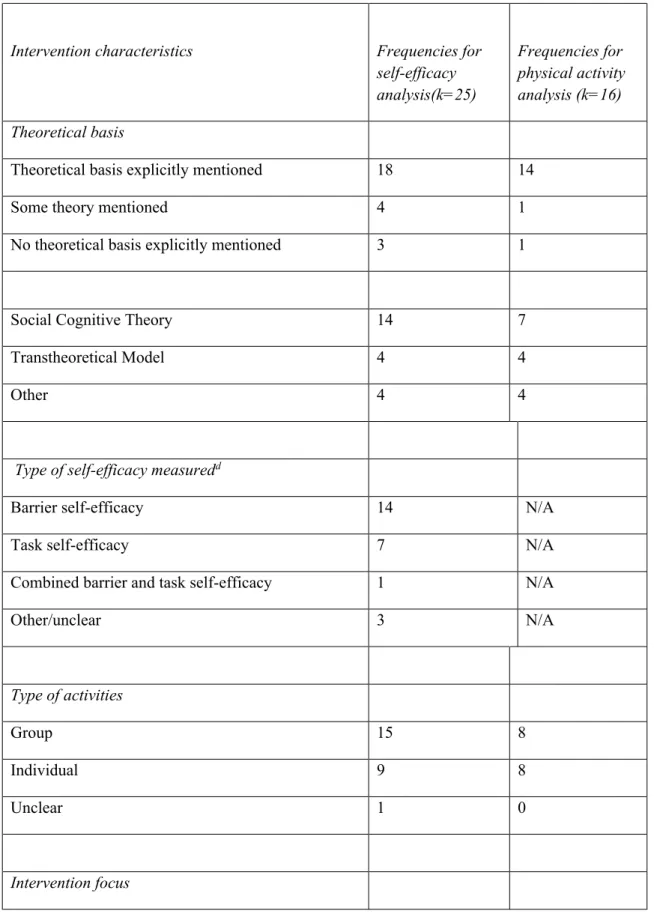
An explicit theoretical basis was mentioned for 18 of 25 comparisons included, with the most frequent being Social Cognitive Theory [8] (see table 1). Interventions were most commonly delivered face-to-face by a nurse or general practitioner or a health and fitness professional to groups in a community centre. Most commonly, the interventions aimed to increase lifestyle physical activity, such as walking.
perform the behavior”, with 11 of the 40 BCTs in the CALO-RE taxonomy not included in any study included (see table 2).
Changes in self-efficacy
For the analysis of change in self-efficacy, 25 comparisons were included, indicating a small to medium sized effect of the interventions on self-efficacy (d=0.37, 95% confidence
intervals (CI): 0.22 to 0.52, p<0.001). A greater variability in effect size estimates existed than could be explained by random sampling error alone (Q=153.3, p<0.001). The amount of variance attributable to sampling error was 35%. Effect sizes for self-efficacy ranged from d=-0.42 [70] tod= 1.78 [71].
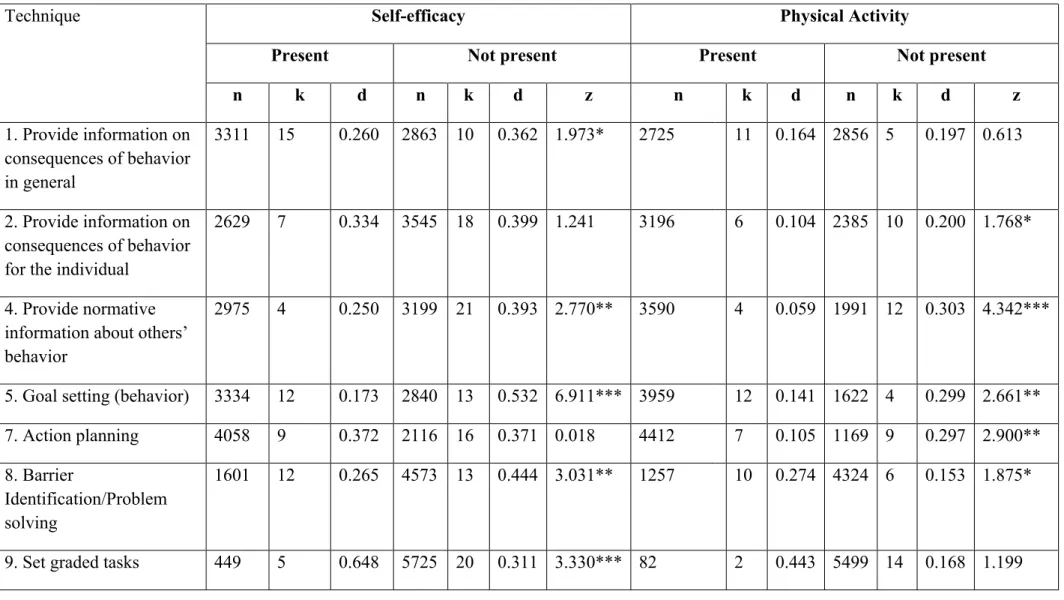
In total, 25 moderator analyses were conducted to investigate differences in self-efficacy according to presence or absence of BCTs (see table 2). Six BCTs were significantly associated with higher self-efficacy effect sizes when present. The greatest difference in effect size occurred when the following techniques were present: “set graded tasks”, “prompt self-monitoring of behavioral outcome”, “provide information on where and when to perform the behavior” and “motivational interviewing” (see table 2). Eleven BCTs were significantly associated with lower self-efficacy effect sizes when present. The greatest difference in effect size occurred when the following techniques were present: “goal setting (behavior)”, “prompt self-monitoring of behavior”, “plan social support/ social change”, and “relapse prevention/ coping planning”,
Changes in physical activity
The interventions had an effect on physical activity that was small in size (d=0.14, 95% CI: 0.09 to 0.20, p<0.001), based on 16 comparisons. A greater variability in effect size
although all variance could be explained by sampling error alone. Effect sizes ranged from d=-0.02 [28] tod=0.63 [22].
In total, 23 moderator analyses were conducted to investigate differences in physical activity according to presence or absence of BCTs (see table 2). Three BCTs were significantly associated with higher physical activity behavior effect sizes when present: “barrier identification/ problem solving”, “provide rewards contingent on successful behavior” and “model/ demonstrate the behavior” (see table 2). Ten BCTs were significantly associated with lower physical activity behavior effect sizes when present. The greatest difference in effect size occurred when the following BCTs were present: “provide normative information about others’ behavior”, “provide information on where and when to perform behavior”, and “plan social support/ social change”.
Comparison of techniques associated with self-efficacy and physical activity
A positive but non-significant relationship of medium size was found between the change in self-efficacy and change in physical activity across the 16 comparisons for which full data was available (Spearman’s Rho = 0.439, p = 0.089).
Of the 23 BCTs included in both moderator analyses, none were associated with significantly larger effect sizes for both self-efficacy and physical activity. However, of the ten BCTs that were associated with smaller effect sizes for physical activity, six were also associated with smaller effect sizes for self-efficacy: “provide normative information about others’
Discussion
The interventions included produced changes with the following overall effect sizes: d=0.37 for self-efficacy and d=0.14 for physical activity. Despite this, only six BCTs were
associated with higher self-efficacy effect sizes when included, and only three BCTs were associated with higher physical activity effect sizes. By contrast, eleven BCTs were
associated with lower self-efficacy effect sizes when included, and ten BCTs were associated with lower physical activity effect sizes when included. Of these, six BCTs were associated with both lower self-efficacy and lower physical activity effect sizes when included: “plan social support/ social change” (promoting a person to plan how to elicit social support to help him/ her achieve their target behavior), “provide normative information about others’
behavior” (providing information about what other people are doing), “goal setting (behavior)” (encouraging a person to make a behavioral resolution), “relapse prevention/ coping planning” (prompting a person to identify in advance situations where their new behavior may not be maintained and develop strategies to avoid or manage those situations), “provide feedback on performance” (providing a person with recorded data about their own behavior), and “prompt self-monitoring of behavior” (the person is asked to keep a record of a specified behavior as a method of change behavior, not for research purposes).
Strengths and weakness of study
This study has several strengths, mainly due to the use of robust systematic review
CALO-RE taxonomy [17] to reliably code intervention contents, making the results of the present review directly comparable with these previous reviews.
The review also has several limitations, which indicate caution when interpreting the results. Firstly, a review is limited by the primary studies that are eligible for inclusion. The limited number of studies identified made it less sensible to perform more complex analyses than those reported here, e.g. meta-regression, as such analyses would have low power. Second, BCTs clearly cannot be coded when the reports of intervention studies do not adequately report intervention contents, although we should note that this is a common problem in conducting reviews such as these [58,59], and that the reports were reliably coded by two independent raters.
to teach us anything. A more balanced position is to conduct such reviews, but to use caution in their interpretation. The value of this review lies primarily in describing regularities in the literature as it currently exists, and generating hypotheses based on these regularities
(described below). Ultimately, the validity of this approach will be borne out or not by direct empirical testing of the hypotheses generated, which suggest several novel directions for research on physical activity interventions in older people.
Relationship with other relevant literature
The contrast with the findings of other similar reviews is fairly stark. Most notably, a previous review [59] focussed on both healthy eating and physical activity found that interventions containing self-monitoring and one of four other BCTs consistent with control theory [60] or other self-regulation approaches were associated with larger changes in physical activity and healthy eating. These approaches propose that much behavior is goal oriented and people self-regulate their behavior to achieve these goals, through a feedback loop involving setting goals, identifying discrepancies between goals and current status based on feedback, and making plans to reduce these discrepancies [60]. Similar findings have been produced by previous reviews focussing on the association of BCTs and physical activity self-efficacy and behavior [15,16]. By contrast, in the present review, BCTs involved in self-regulation were associated with lower levels of both self-efficacy and physical activity. Specifically, BCTs associated with lower self-efficacy and physical activity involved setting behavioral goals, self-monitoring, receiving feedback on the behavior of self or others, and planning social support or making plans to cope with future relapses.
the inclusion of healthy eating in one previous review [59] and the presence of opposing spurious associations due to chance in other reviews [15,16]. However, explanations of most substantive interest focus on the present review including studies involving older adults, which may render interventions based on self-regulatory or planning principles less effective. These explanations concern older people finding self-regulatory BCTs either more
cognitively difficult, or less acceptable.
There is a good deal of evidence that as adults age, they show decreases in executive
functioning [61]. Executive functioning refers to higher-order cognitive processes involved in the control and instigation of thoughts and behaviors that require effort, including planning, sequencing of actions, attentional capacity, inhibition of habitual responses, or novel actions [62]. Of particular relevance here, there is evidence that the size of the “gap” between intentions and behavior [63] can be predicted by measures of executive control [64]. Further, the ability to form and implement intentions [65,66] is a key component of executive control, and those people low in in this ability spontaneously produce poorer implementation
intentions, than those higher in such ability [67, study one].
self-regulatory interventions, they would be expected to derive less benefit than younger adults.
It is also possible that interventions based on self-regulatory or planning principles are less effective with older adults than younger adults because they are less acceptable. Many of these BCTs are concerned with finding ways to fit in physical activity, in the face of
competing demands from work or family. That is, such techniques are effective at translating motivation into action [66]. Competing demands on time may, however, be less of an issue for many older people, as reflected in the stronger relationship between physical activity intentions and behavior in older people [68]. For older people, it may be simply that the motivation to increase physical activity is lacking. There is now a wealth of evidence that in later life, life goals and motivations become more focussed on maximising meaning and positive emotions, and less concerned with delayed future payoffs, such as improving health [77].
BCTs such as prompting self-monitoring and receiving feedback are essentially concerned with reaching a particular level of performance with regard to physical activity. It may be that such achievements are not particularly salient for many older people, who may be more concerned with enjoyable activities, and/ or those that involve social activities [78].
Relatedly, it may be that, as many older people are fairly inactive and hence in poor cardiovascular condition, interventions involving identifying current levels of physical activity or receiving normative feedback may be demoralising, as this may involve becoming more aware of current low levels of actual efficacy with regard to physical activity. It is also possible that, if BCTs involving planning are cognitively difficult for many older adults, they are unacceptable for this reason.
The main implication of the present research is that caution is needed in applying BCTs that are generally effective at increasing physical activity in younger and middle-aged adults, especially those involving planning or other forms of self-regulation. It is important to note, however, that the interventions as a whole were successful at increasing self-efficacy and physical activity generally, albeit with small effect sizes. In the present sample, the BCT involving self-monitoring of a behavioral outcome involved heart-rate monitoring, and was associated with higher levels of self-efficacy. This is in line with the contention of social cognitive theory that physiological feedback can increase self-efficacy: when participants see that they can increase their physical activity and raise heart-rate without adverse effects, they appear to be more confident about doing so. Similarly, seeing a similar other modelling the behavior was associated with increased physical activity. This may reflect the generally good efficacy of walking groups at increasing physical activity [69], including those in the present review [38].
currently not clear whether these constructs are related, and if they are, the extent to which one causes the other.
It is also important for experimental studies to systematically consider the effectiveness for older people of self-regulatory techniques that have demonstrated utility in younger samples. Further consideration of the role of executive functioning in the success of planning or other self-regulatory techniques in older adults also seems warranted. If future research indicates that executive functioning is an important determinant of capacity to use planning BCTs, a position for which there is some evidence [67], then there is a need for further development of common BCTs that reduce the demands on executive function, or those elements of cognition, such as prospective memory, that are most impaired due to aging.
Conclusion
The findings of the present research indicate that many BCTs that are effective at increasing the physical activity of younger adults may not be effective for older adults. Future
experimental research should consider whether this finding is spurious or real, and if real, to identify whether such BCTs are too cognitively complex or simply not acceptable. Generally, there is a need for research to systematically elicit what is acceptable and what is
unacceptable to older adults about interventions to increase physical activity, including identifying effective BCTs that this population would find acceptable.
References
2. UK Department of Health, Start active, stay active. A report on physical activity for health from our four home countries' Chief Medical Officer. UK Department of Health London; 2011.
3. Warburton D, Charlesworth S, Ivey A, Nettlefold L, Bredin S. A systematic review of the evidence for Canada’s Physical Activity Guidelines for Adults. Int J Behav Nutr Phys Act. 2010; 7:39.
4. Paterson D, Warburton D. Physical activity and functional limitations in older adults: A systematic review related to Canada's Physical Activity Guidelines. Int J Behav Nutr Phys Act. 2010; 7:38.
5. Kesäniemi A, Riddoch CJ, Reeder B, Blair S, Sørensen T. Advancing the future of physical activity guidelines in Canada: an independent expert panel interpretation of the evidence. Int J Behav Nutr Phys Act. 2010; 7:41.
6. NHS Information Centre for health and social care Health Survey for England – 2008: Physical activity and fitness. Leeds; 2009.
7. Hobbs N, Godfrey A, Lara J, et al. Are behavioural interventions effective in increasing physical activity at 12-36 months in adults aged 55 to 70 years? A systematic review and meta-analysis. BMC Med. 2013; 11:75.
8. Bandura A. Self-efficacy: The exercise of control. New York, NY: Freeman; 1997.
10.Koeneman MA, Verheijden MW, Chinapaw MJM, Hopman-Rock M. Determinants of physical activity and exercise in healthy older adults: A systematic review. Int J Behav Nutr Phys Act. 2011; 8:142.
11.Rhodes RE, Pfaeffli LA. Mediators of physical activity behaviour change among adult non-clinical populations: A review update. Int J Behav Nutr Phys Act. 2010; 7:37.
12.French DP. The role of self-efficacy in changing health-related behaviour: Cause, effect or spurious association? Brit J Health Psychol. 2013; 18:237-243.
13.van Stralen MM, Vries HD, Mudde AN, Bolman C, Lechner L. Determinants of initiation and maintenance of physical activity among older adults: A literature review. Health Psychol Rev. 2009; 3:147-207.
14.Schwarzer R, Renner B. Social-cognitive predictors of health behavior: Action self-efficacy and coping self-self-efficacy. Health Psychol. 2000; 19:487-495.
15.Williams SL, French DP. What are the most effective intervention techniques for changing physical activity self-efficacy and physical activity behaviour-and are they the same? Health Educ Res. 2011; 26:308-322.
16.Olander EK, Fletcher H, Williams S, Atkinson L, Turner A, French DP. What are the most effective techniques in changing obese individuals' physical activity
self-efficacy and behaviour: A systematic review and meta-analysis. Int J Behav Nutr Phys Act. 2013; 10:29.
activity and healthy eating behaviours: The CALO-RE taxonomy. Psychol Health. 2011; 26:1-20.
18.Abraham C, Michie S. A taxonomy of behaviour change techniques used in interventions. Health Psychol. 2008; 27:379-387.
19.Landis JR, Koch GG. Measurement of observer agreement for categorical data. Biometrics. 1977; 33:159-174.
20.Cohen J. A Power primer. Psychol Bull. 1992; 112:155-159.
21.Schwarzer R. Statistics Software for Meta-Analysis. Available at: http://userpage.fu-berlin.de/health/meta_e.htm. Accessibility verified May 2, 2013.
22.Aree-Ue S, Pothiban L, Belza B, Sucamvang K, Panuthai S. Osteoporosis preventive behavior in Thai older adults: feasibility and acceptability. J Gerontol Nurs. 2006; 32:23-30.
23.Buman MP, Giacobbi PR, Dzierzewski JM, et al. Peer volunteers improve long-term maintenance of physical activity with older adults: A randomized controlled trial. J Phys Act Health. 2001; 8:S257-266.
24.Clark DO, Stump TE, Damush TM. Outcomes of an exercise program for older women recruited through primary care. J Aging Health. 2003; 15:567-585.
25.Connell CM, Janevic MR. Effects of a Telephone-Based Exercise Intervention for Dementia Caregiving Wives: A Randomized Controlled Trial. J Appl Gerontol. 2009; 28:171-194.
26.Greaney ML, Riebe D, Ewing Garber C, et al. Long-term effects of a stage-based intervention for changing exercise intentions and behavior in older adults.
27.Clark PG, Rossi JS, Greaney ML, et al. Intervening on exercise and nutrition in older adults: The Rhode Island SENIOR Project. J Aging Health. 2005; 17:753-778. 28.Clark PG, Nigg CR, Greene G, Riebe D, Saunders SD. Study of Exercise and
Nutrition in Older Rhode Islanders (SENIOR): Translating theory into research. Health Educ Res. 2002; 17:552-561.
29.King AC, Pruitt LA, Phillips W, Oka R, Rodenburg A, Haskell WL. Comparative effects of two physical activity programs on measured and perceived physical functioning and other health-related quality of life outcomes in older adults. J Gerontol A Biol Sci Med Sci. 2000; 55:74-83.
30.Li F, McAuley E, Harmer P, Duncan TE, Chaumeton NR. Tai Chi enhances self-efficacy and exercise behavior in older adults. J Aging Phys Act. 2001; 9:161-171. 31.Li F, Harmer P, McAuley E, Fisher J, Duncan T, Duncan S. Tai chi, self-efficacy, and
physical function in the elderly. Prev Sci. 2001; 2:229-239.
32.McAuley E, Mailey EL, Mullen SP, et al. Growth trajectories of exercise self-efficacy in older adults: Influence of measures and initial status. Health Psychol. 2011; 30:75-83.
33.McAuley E, McAuley E, Mullen S, et al. Self-regulatory processes and exercise adherence in older adults. Am J Prev Med. 2011; 41:284-290.
34.McAuley E, Katula J, Mihalko SL, et al. Mode of physical activity and self-efficacy in older adults: a latent growth curve analysis. J Gerontol B Psychol Sci Soc Sci, 1999; 54:283-292.
36.McAuley E, Jerome G, Marquez D, Elavsky S, Blissmer B. Exercise self-efficacy in older adults: Social, affective and behavioral influences. Ann Behav Med. 2003; 25:1-7.
37.McAuley E, Elavsky S, Jerome G, Konopack J, Marquez D. Physical activity-related well-being in older adults: Social cognitive influences. Psychol Aging. 2005; 20:295-302.
38.Michael YL, Carlson NE. Analysis of Individual Social-ecological Mediators and Moderators and Their Ability to Explain Effect of a Randomized Neighborhood Walking Intervention. Int J Behav Nutr Phys Act. 2009; 6:49.
39.Fisher KJ, Li F. A community-based walking trial to improve neighborhood quality of life in older adults: A multilevel analysis. Ann Behav Med. 2004; 28:186-194.
40.Nahm ES, Barker B, Resnick B, Covington B, Magaziner J, Brennan PF. Effects of a social cognitive theory-based hip fracture prevention web site for older adults. Comput Inform Nurs. 2010; 28:371-379.
41.Nahm ES, Resnick B, Covington B. Development of theory-based, online health learning modules for older adults: Lessons learned. Comput Inform Nurs. 2006; 24:261-268.
42.Petrella RJ, Koval JJ, Cunningham DA, Paterson DH. Can primary care doctors prescribe exercise to improve fitness? The Step Test Exercise Prescription (STEP) project. Am J Prev Med. 2003; 24:316-322.
44.Pinto BM, Lynn H, Marcus BH, DePue J, Goldstein MG. Physician-based activity counseling: intervention effects on mediators of motivational readiness for physical activity. Ann Behav Med. 2001; 23:2-10.
45.Pinto BM, Lynn H, Marcus BH, DePue J, Goldstein MG. Physician-based activity counseling: intervention effects on mediators of motivational readiness for physical activity. Ann Behav Med. 2001; 23:2-10.
46.Pinto BM, Goldstein MG, DePue JD, Milan FB. Acceptability and feasibility of physician-based activity counseling. The PAL project. Am J Prev Med. 1998; 15:95-102.
47.Pinto BM, Goldstein MG, Marcus BH. Activity counseling by primary care physicians. Prev Med. 1998; 27:506-513.
48.Qi BB, Resnick B, Smeltzer SC, Bausell B. Self-efficacy program to prevent osteoporosis among Chinese immigrants: A randomized controlled trial. Nurs Res. 2011; 60:393-404.
49.Resnick B, Luisi D, Vogel A. Testing the Senior Exercise Self-efficacy Project
(SESEP) for use with urban dwelling minority older adults. Public Health Nurs. 2008; 25:221-234.
50.Rose MA. Evaluation of a peer-education program on heart disease prevention with older adults. Public Health Nurs. 1992; 9:242-247.
51.Shin KR, Kang Y, Park HJ, Heitkemper M. Effects of exercise program on physical fitness, depression, and self-efficacy of low-income elderly women in South Korea. Public Health Nurs. 2009; 26:523-531.
53.van Stralen MM, de Vries H, Mudde AN, Bolman C, Lechner L. The long-term efficacy of two computer-tailored physical activity interventions for older adults: Main effects and mediators. Health Psychol. 2011; 30:442-452.
54.van Stralen MM, de Vries H, Mudde AN, Bolman C, Lechner L. The working mechanisms of an environmentally tailored physical activity intervention for older adults: a randomized controlled trial. Int J Behav Nutr Phys Act. 2009; 6:83 55.van Stralen MM, de Vries H, Bolman C, Mudde AN, Lechner L. Exploring the
efficacy and moderators of two computer-tailored physical activity interventions for older adults: a randomized controlled trial. Ann Behav Med. 2010; 39:139-150. 56.van Stralen MM, de Vries H, Mudde AN, Bolman C, Lechner L. Efficacy of two
tailored interventions promoting physical activity in older adults. Am J Prev Med. 2009; 37:405-417.
57.van Stralen MM, Kok G, de Vries H, Mudde AN, Bolman C, Lechner L. The Active plus protocol: systematic development of two theory- and evidence-based tailored physical activity interventions for the over-fifties. BMC Public Health, 2008; 8:399. 58.Dombrowski SU, Sniehotta FF, Avenell A, Johnston M, MacLennan G,
Araujo-Soares V. Identifying active ingredients in complex behavioural interventions for obese adults with obesity-related morbidities or additional risk factors for co-morbidities: a systematic review. Health Psychol Rev. 2012; 6:7-32.
59.Michie S, Abraham C, Whittington C, McAteer J, Gupta S. Effective techniques in healthy eating and physical activity interventions: A meta-regression. Health Psychol. 2009; 28:690-701.
61.De Luca CR, Leventer RJ. Developmental trajectories of executive functions across the lifespan. In Anderson, Peter; Anderson, Vicki; Jacobs, Rani. Executive functions and the frontal lobes: A lifespan perspective. Washington, DC: Taylor & Francis. 2008:3–21
62.Norman DA, Shallice T. Attention to action: Willed and automatic control of
behaviour. In: Davidson RJ, Schwartz GE, Shapiro D, eds. Consciousness and Self-Regulation: Advances in Research and Theory. New York: Plenum; 1986:1-18. 63.Orbell S, Sheeran P. “Inclined abstainers”: A problem for predicting health-related
behaviour. Br J Soc Psychol. 1998; 37:151-165.
64.Allan JL, Sniehotta FF, Johnston M (in press). The best laid plans: Planning skills determines the effectiveness of action plans and implementation intentions. Ann Behav Med. DOI 10.1007/s12160-013-9483-9.
65.Gollwitzer PM. Implementation intentions: Strong effects of simple plans. Am Psychol. 1999; 54:493-503.
66.Gollwitzer PM, Sheeran P. Implementation intentions and goal achievement: A meta-analysis of effects and processes. Adv Exp Soc Psychol. 2006; 38:69-119.
67.Allan JL, Johnston M, Campbell NC. Missed by an inch or a mile? Predicting size of intention-behaviour gap from measures of executive control. Psychol Health. 2011; 26:635-650.
68.Hagger M, Chatzisarantis NLD, Biddle SJH. A meta-analytic review of the theories of reasoned action adn planned behavior in physical activity: Predictive validity and the contribution of additional variables. J Sport Exerc Psychol. 2002; 24:3-32. 69.Kassavou A, Turner A, French DP. Do interventions to promote walking in groups
70.Anderson KJ, Pullen CH. Physical activity with spiritual strategies intervention: A cluster randomized trial with older African American women. Res Gerontol Nurs. 2013; 6:11-21.
71.Dattilo J, Martire L, Gottschall J, Weybright E. A pilot study of an intervention designed to promote walking, balance, and self-efficacy in older adults with fear of falling. Educ Gerontol. 2014; 40:26-39.
72.Dye CJ, Williams, JE, Kemper KA, McGuire FA, Aybar-Damali, B. Impacting mediators of change for physical activity among food stamp recipients. Educ Gerontol. 2012; 38:788-798.
73.Irvine AB, Gelatt VA, Seeley JR, Macfarlane P, Gau JM. Web-based intervention to promote physical activity by sedentary older adults: Randomized Controlled Trial. J Med Internet Res. 2013; 15:e19.
74.Purath J, Keller CS, McPherson S, Ainsworth B. A randomized controlled trial of an office-based physical activity and physical fitness intervention for older adults. Geriatr Nurs. 2013; 34:204-211.
75.Hunter J, Schmidt FL. Methods of meta-analysis: correcting error and bias in research findings (second edition). Thousand Oaks, CA: Sage, 2004.
76.Peters GJY, de Bruin M, Crutzen R (in press). Everything should be as simple as possible, but no simpler: towards a protocol for accumulating evidence regarding the active content of health behaviour change interentions. Health Psychol Rev. DOI: 10.1080/17437199.2013.848409.
78.Kassavou A, Turner A, Hamborg T, & French DP (in press). Predicting maintenance of attendance at walking groups: Testing constructs from three leading maintenance theories. Health Psychol. DOI: 10.1037/hea0000015.
Table one – summary of intervention characteristics for studies included in self-efficacy analysis
Intervention characteristics Frequencies for
self-efficacy analysis(k=25)
Frequencies for physical activity analysis (k=16) Theoretical basis
Theoretical basis explicitly mentioned 18 14
Some theory mentioned 4 1
No theoretical basis explicitly mentioned 3 1
Social Cognitive Theory 14 7
Transtheoretical Model 4 4
Other 4 4
Type of self-efficacy measuredd
Barrier self-efficacy 14 N/A
Task self-efficacy 7 N/A
Combined barrier and task self-efficacy 1 N/A
Other/unclear 3 N/A
Type of activities
Group 15 8
Individual 9 8
Unclear 1 0
Lifestyle physical activity (e.g. gardening, walking
etc) 14 10
Exercise (e.g. aerobics class, gym, jogging) 10 5
Unclear 1 1
Delivered by
Nurse or GP 5 3
Health and fitness professional 5 1
Researcher 4 4
Peers 2 1
Not stated 3 2
Not applicable 3 3
Other 3 2
Setting
Community Centre 9 5
Participants home 5 5
GP Surgery/Hospital 3 2
Other 2 1
Unclear 6 3
Delivery mode
Face-to-face 18 10
Web-based 4 4
Telephone 2 2
Table two: Comparison between mean effect sizes for self-efficacy and physical activity behavior, according to whether specific BCTs are included in the intervention or whether they are not
Technique Self-efficacy Physical Activity
Present Not present Present Not present
n k d n k d z n k d n k d z
1. Provide information on consequences of behavior in general
3311 15 0.260 2863 10 0.362 1.973* 2725 11 0.164 2856 5 0.197 0.613
2. Provide information on consequences of behavior for the individual
2629 7 0.334 3545 18 0.399 1.241 3196 6 0.104 2385 10 0.200 1.768*
4. Provide normative information about others’ behavior
2975 4 0.250 3199 21 0.393 2.770** 3590 4 0.059 1991 12 0.303 4.342***
5. Goal setting (behavior) 3334 12 0.173 2840 13 0.532 6.911*** 3959 12 0.141 1622 4 0.299 2.661**
7. Action planning 4058 9 0.372 2116 16 0.371 0.018 4412 7 0.105 1169 9 0.297 2.900**
8. Barrier
Identification/Problem solving
10. Prompt review of
behavioral goals 981 6 0.271 5193 19 0.399 1.81* 991 6 0.241 4590 10 0.137 1.476
12. Provide rewards contingent on effort or progress towards behavior
463 3 0.143 5711 22 0.396 2.585** 415 2 0.081 5166 14 0.150 0.672
13.Provide rewards contingent on successful behavior
696 3 0.194 5478 22 0.398 2.502** 696 3 0.273 4885 13 0.127 1.789*
15.Prompt generalisation
of a target behavior 106 2 0.744 6068 23 0.355 1.885* 16. Prompt
self-monitoring of behavior 3493 12 0.237 2681 13 0.487 4.785*** 3703 9 0.131 1878 7 0.245 2.002* 17. Prompt
self-monitoring of behavioral outcome
820 6 0.612 5354 19 0.288 4.204***
18.Prompting focus on
past success 384 3 0.570 5790 22 0.356 1.970* 394 3 0.114 5187 13 0.161 .447
19. Provide feedback on
performance 3625 7 0.281 2549 18 0.410 2.457** 4095 6 0.154 1486 10 0.272 1.935*
20. Provide information
perform the behavior 21. Provide instruction on how to perform the behavior
4330 17 0.393 1844 8 0.314 1.398 3888 11 0.153 1693 5 0.180 0.461
22. Model/demonstrate the
behavior 1929 12 0.412 4245 13 0.326 1.539 1413 7 0.348 4168 9 0.085 4.24***
26. Prompt practice 5326 19 0.388 848 6 0.293 1.264 5387 13 0.136 194 3 0.382 1.656* 27. Use of follow up
prompts 439 2 0.278 5735 23 0.375 0.963 449 2 0.177 5132 14 0.142 0.353
29. Plan social
support/social change 3750 11 0.235 2424 14 0.451 4.080*** 4317 10 0.073 1264 6 0.401 5.082*** 34.Prompt use of imagery 91 2 0.589 6083 23 0.371 0.987 91 2 0.203 5490 14 0.181 0.102 35. Relapse
prevention/coping planning
2087 4 0.038 4087 21 0.430 7.220*** 2644 3 0.092 2937 13 0.192 1.859*
36. Stress
Management/emotional control training
537 3 0.420 5637 22 0.376 0.477 547 3 0.091 5034 13 0.151 0.663
BCTs were not included in moderator analyses if they were not coded as present at all (3: “provide information about others’ approval; 6: “goal setting (outcome)”; 11: “prompt review of behavioral goals”; 14: “shaping”; 23: “teach to use prompts/ cues”; 24: “environmental restructuring”; 31: “prompt anticipated regret”; 32: “fear arousal”; 33: “prompt self-talk”; 38: “time management”; 40: “stimulate anticipation of future