arXiv:1709.08991v1 [cs.FL] 26 Sep 2017
John Fearnley
1, Martin Gairing
1, Matthias Mnich
2, and Rahul
Savani
11 University of Liverpool, UK
{john.fearnley, gairing, rahul.savani}@liverpool.ac.uk
2 Universität Bonn, Germany and Maastricht University, The Netherlands [email protected]
Abstract
In this paper, we study the problem of deciding the winner of reachability switching games. These games provide deterministic analogues of Markovian systems. We study zero-, one-, and two-player variants of these games. We show that the zero-player case isNL-hard, the one-player case is NP-complete, and that the two-player case is PSPACE-hard and inEXPTIME. In the one-and two-player cases, the problem of determining the winner of a switching game turns out to be much harder than the problem of determining the winner of a Markovian game. We also study the structure of winning strategies in these games, and in particular we show that both players in a two-player reachability switching game require exponential memory.
Keywords and phrases Deterministic Random Walks, Model Checking, Reachability, Simple Stochastic Game, Switching Systems
1
Introduction
Probabilistic model checking is an important topic in the field of formal verification. Like any model checking problem, it asks us to check that a given system satisfies a logical specification. In the probabilistic setting, the system itself makes use of probability, either in the form of an explicit use of randomization, or because the system interacts with a randomized environment. Probabilistic model checking is now a mature topic, with tools like PRISM [15] providing an accessible interface to the research that has taken place.
In this paper, we approach this topic from a different view. Prior work has studied deterministicrandom systems, which attempt to replicate the properties of a random system in a deterministic way. Aswitching system (also known as a Propp machine) does this by replacing the nodes of a Markov chain withswitching nodes. Each switching node maintains an ordered queue over its outgoing edges. When the system arrives at the node, it is sent along the first edge in this queue, and that edge is then sent to the back of the queue. In this way, the switching node ensures that, after a large number of visits, the system uses each outgoing edge a roughly equal number of times. This mimics a Markovian node with a uniform distribution over its outgoing edges, since such a node also ensures a fairness property over its outgoing edges, in expectation.
There has been much work that studies how well switching systems achieve their goal of simulating a Markov chain, which we will discuss in more detail in the related work section. However, in this paper, we study the questionhow hard is it to model check switch-ing systems? We already have a good knowledge about the complexity of model checking Markovian systems, but how does this change when we instead use switching nodes?
Twister, used as the standard generator in Python, requires an extra 2.5 kilobytes of internal state. This complicates the program, and hence makes the model checking task much harder. By comparison, a switching system provides a much cheaper implementation, so long as the designer is willing to accept deterministic randomness. Another reason why a system de-signer may use switching nodes is that they naturally satisfy fairness properties. In fact, they do this better than random systems, which can only provide fairness in expectation.
Our contribution. In this paper, we initiate the study of model checking in switching systems. We focus onreachability problems, one of the simplest model checking tasks. This corresponds to determining the winner of a two-player reachability switching game. We study zero-, one-, and two-player variants of these games, which correspond to switching versions of Markov chains, Markov decision processes [18], and simple stochastic games [3], respectively.
The main message of the paper is that deciding reachability in one- and two-player switching games is much harder than deciding reachability in Markovian systems. Our results are summarised in the table below.
Markovian Switching
0-player PL-complete1
NL-hard; inPLS, inNP∩coNP
1-player P-complete NP-complete
2-player NP∩coNP2 PSPACE-hard; inEXPTIME
The PLS and NP∩coNPupper bounds for the 0-player case were shown before [8, 13], but all other upper and lower bounds for switching games we show for the first time in this paper.
We also investigate the properties of winning strategies in these games. For the one-player case, we show that the reachability one-player can win using amarginal strategy, which simply counts the number of times that each edge has been used. For the two-player case, we show that both players can win using exponential memory, and also that both players requireexponential memory in order to win.
Related work. Our work was directly inspired by the work of Dohrau, Gärtner, Kohler, Matousek, and Welzl [8]. They studied zero-player reachability switching games and showed that the associated decision problem is inNP∩coNP. More recently, it was shown that the zero-player problem is inPLS[13]. The contribution of our work is to study these questions in the one- and two-player settings.
Switching games are part of a research thread at the intersection of computer science and physics. This thread has studied zero-player switching systems, also known asdeterministic random walks,rotor-router walks, theEulerian walkers model [17] andPropp machines[4–7, 11, 12]. Propp machines have been studied in the context of derandomizing algorithms and pseudorandom simulation, and in particular have received a lot of attention in the context of load balancing [1, 9]. However, most work on Propp machines has focused on how well
1
PL, or probabilistic L, is the class of languages recognizable by a polynomial time logarithmic space
randomized machine with probability > 1/2.
2
multi-token switching systems simulated Markov chains. The idea of studying single-token reachability questions should be credited to the work of Dohrau at al. [8] mentioned above. Katz et al. [14] and Groote and Ploeger [10] consideredswitching graphs; these are graphs in which certain vertices (switches) have exactly one of their two outgoing edges activated. However, the activation of the alternate edge does not happen when a vertex is traversed by a run; this is the key difference to switching games in this paper. That model was also studied by others [10, 16, 19].
2
Preliminaries
A reachability switching game is defined by a tuple (V, E, VR, VS, VSwi,Ord, s, t), where (V, E) is a finite graph, andVR,VS,VSwipartition V into reachability vertices,safety vertices, and switching vertices, respectively. The reachability verticesVR are controlled by the reach-ability player, the safety verticesVS are controlled by the safety player, and the switching verticesVSwiare not controlled by either player, but instead follow a predefined “switching order”. The function Ord defines thisswitching order: for each switching vertexv ∈VSwi, we have that Ord(v) =hu1, u2, . . . , ukiwhere the sequence is required to be a permutation over the vertices that have an incoming edge from v. The vertices s, t∈ V specify source andtarget vertices for the game.
A state of the game is defined by a tuple (v,C), where v is a vertex in V, and C : VSwi → N is a function that assigns a number to each switching vertex, which rep-resents how far that vertex has progressed through its switching order. Hence, it is required that C(u)≤ |Ord(v)| −1, since the counts specify an index to the sequence Ord(v).
When the game is at a state (v,C) with v ∈ VR or v ∈ VS, then the respective player chooses an outgoing edge at v, and the count function does not change. For states (v,C) withv∈VSwi, the successor state is determined by the count function. More specifically, we define Upd(C, v) :VSwi→Nso that for eachu∈VSwi we have
Upd(C, v)(u) = (
(C(u) + 1) mod|Ord(u)| ifv=u,
C(u) otherwise .
This function updates the count atv by 1, and wraps around to 0 if the number is larger than the number of outgoing edges of v. Then, the successor state of (v,C), denoted as Succ(v,C) is (u,Upd(C, v)), whereuis the element at positionC(v) in Ord(v).
Aplayof the game is a (potentially infinite) sequence of states (v1, C1),(v2, C2), . . . with the following properties:
1. v1=sandC1(v) = 0 for allv∈VSwi;
2. Ifvi∈VRorvi∈VS then (vi, vi+1)∈E andCi =Ci+1; 3. Ifvi∈VSwithen (vi+1, Ci+1) = Succ(vi, Ci);
4. If the play is finite, then the final state (vn, Cn) must either satisfy vn =t, or vn must have no outgoing edges.
3
One-player reachability switching games
In this section we consider one-player reachability switching games, i.e., games withVS=∅.
3.1
Containment in
NP
We show that deciding whether the reachability player wins a one-player reachability switch-ing game is in NP. The proof uses controlled switching flows. These extend the idea of switching flows, which were used in [8] to show containment of the zero-player reachability problem inNP∩coNP.
Controlled switching flow. A flow is a function F : E → N that assigns a natural
number to each edge in the game. For each vertexv, we define Bal(F, v) = X
(v,u)∈E
F(v, u)− X
(w,v)∈E
F(w, v)
to be the difference between the outgoing and incoming flow atv.
A flowF is acontrolled switching flow if it satisfies the following constraints: The source vertexssatisfies Bal(F, s) = 1
The target vertextsatisfies Bal(F, t) =−1
Every vertexv other thansort satisfies Bal(F, v) = 0
Letv∈VSwibe a switching node and Ord(v) =hu1, u2, . . . , uki. There exists a constant
cand an indexi≤ksuch that
F(v, uj) =c+ 1 for allj < i.
F(v, uj) =cfor allj≥i.
The first three constraints ensure that F is actually a flow from s to t, while the final constraint ensures that the flow respects the switching order at each switching node. Note that there are no constraints on how the flow is split at the nodes inVR.
Marginal strategies. A marginal strategy for the reachability player is defined by a functionM :E →N, which assigns a target number to each outgoing edge of the vertices
in VR. The strategy ensures that each edge e is used no more thanM(e) times. That is, when the play arrives at a vertexv ∈VR, the strategy checks how many times each outgoing edge ofv has been used so far, and selects an outgoing edge ethat has been used strictly less thanM(e) times. If there is no such edge, then the strategy is undefined.
Observe that a controlled switching flow defines a marginal strategy for the reachability player. We prove that this strategy always reaches the target.
◮Lemma 1. If a one-player reachability switching game has a controlled switching flow F, then the corresponding marginal strategy is winning for the reachability player.
Proof. The proof will be by induction on the total amount of flow inF, which is defined as P
e∈EF(e).
The base case isP
e∈EF(e) = 1. The requirements of a controlled switching flow imply thatF(s, t) = 1, and all other edges have no flow at all. Ifs∈VR, then the corresponding marginal strategy is required to choose the edge (s, t), and thus it is a winning strategy. If
s∈VSwi, then the balance requirement of a controlled switching flow ensures thatt is the first vertex in Ord(s), so the switching node will move tot, and the reachability player will win the game.
There are two cases to consider for the inductive step. First, assume thatP
be any node that satisfiesF(s, v)>0). IfGdenotes the current game, then we can create a new switching gameG′, which is identical to
G, but wherevis the designated starting node. Moreover, we can create a controlled switching flowF′
forG′
by settingF′
(s, v) =F(s, v)−1 and leaving all other flow values unchanged. Observe that all properties of a controlled switching flow continue to hold forF′
. Since P e∈EF
′
(e) =i−1, the inductive hypothesis implies that the marginal strategy that corresponds to F′ (which is consistent with the marginal strategy forF) is winning for the reachability player.
The second case for the inductive step is when P
e∈EF(e) =i ands∈VSwi. Let (s, v) be the first edge in Ord(s), which is the edge that the switching node will use. Again we can define a new gameG′ where the starting node isv, and in which Ord(s) has been rotated so thatv appears at the end of the sequence. We can define a controlled switching flowF′ forG′
whereF′
(s, v) =F(s, v)−1 and all other flow values are unchanged. Observe thatF′ satisfies all conditions of a controlled switching flow, and in particular that rotating Ord(s) allows s to continue to satisfy the balance constraint on its outgoing edges. Again, since P
e∈EF ′(
e) = i−1, the marginal strategy corresponding to F′ (which is identical to the marginal strategy forF) is winning for the reachability player. ◭
In the other direction, if the reachability player has a winning strategy for the game, then we can show that there exists a controlled switching flow.
◮Lemma 2. If the reachability player has a winning strategy for a one-player reachability switching game, then that game has a controlled switching flow of bounded size.
Proof. Letv1, v2, . . . , vk be the play that is produced when the reachability player uses his winning strategy. We may assume that during the play no state (v,C) is repeated. This is without loss of generality, since if the safety player can force a loop in the state space than she could force to stay in this loop forever and thus the reachability player would not have a winning strategy. Thus, if the play visits a fixed vertex multiple times then for each visit the switch configuration C must be unique. It follows that each vertex is visited at mostnn
times. Define the flowF so thatF(e) is the number of timese is used by the play. Since each vertex is visited at mostnn times, we have F(e)≤nn for alle. We claim thatF is a controlled switching flow. In particular, since the play is a path through the graph starting at s and ending at t, we will have Bal(F, s) = 1 and Bal(F, t) = −1, and we will have Bal(F, v) = 0 for every vertex v other thans and t. Moreover, it is not difficult to verify that the balance constraint will be satisfied for every vertexv∈VSwi. ◭
Combing the two previous lemmas yields the following corollary.
◮Corollary 3. If the reachability player has a winning strategy for a one-player reachability switching game, then he also has a marginal winning strategy.
Finally, we can show that solving a one-player reachability switching game is inNP.
◮Theorem 4. Deciding the winner of a one-player reachability switching game is in NP.
Controller start
fail
x1 x2 x3 x4 target
C1 C2 C3
start start start start
[image:6.595.192.427.97.269.2]start fail start fail start fail
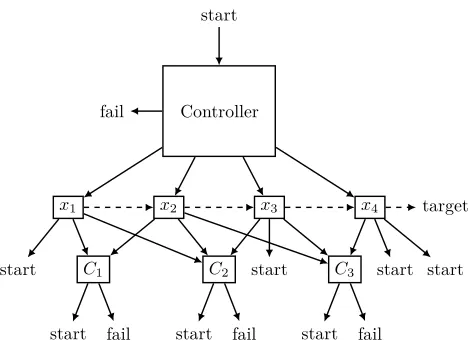
Figure 1 High-level overview of our construction for one player for the example formulaC1∧
C2∧C3= (x1∨ ¬x2)∧(¬x1∨ ¬x2∨x3)∧(x2∨x3∨x4). Note that the negations of variables in the formula are not relevant for this high-level view; they will feature in the clause gadgets as explained below. The edges for the variable phase are solid, and the edges for the subsequent verification phase are dashed.
3.2
NP
-hardness
In this section we show that deciding the winner of a one-player reachability switching game is NP-hard. We will do so by reducing from 3SAT. Throughout this section, we will refer to a 3SAT instance with variablesx1, x2, . . . ,xn, and clausesC1, C2, . . . ,Cm. It is well-known [20, Thm. 2.1] that 3SAT remainsNP-hard even if all clauses contain at most three variables, and all variables appear in at most three clauses. We make this assumption during our reduction.
Overview. At a high level, the idea behind the construction is that the reachability player will be asked to assign values to each variable. Each variablexi will have a corresponding vertex that will be visited three times during the game. Each time this vertex is visited, the reachability player will be asked to assign a value to xi in a particular clause Cj. If the player chooses an assignment that does not satisfy Cj, then the game records this by incrementing a counter. If the counter corresponding to any clauseCj is incremented to three (or two if the clause only has two variables), then the reachability player immediately loses, since the chosen assignment fails to satisfyCj.
The problem with the idea presented so far is that there is no mechanism to ensure that the reachability player chooses a consistent assignment to the same variable. Since each variablexi is visited three times, there is nothing to stop the reachability player from choosing contradictory assignments toxion each visit. To address this, the game also counts how many times each assignment is chosen forxi. At the end of the game, if the reachability player has not already lost by failing to satisfy the formula, the game is configured so that the target is only reachable if the reachability player chose a consistent assignment.
A high-level overview of the construction for an example formula is given in Fig. 1.
a3n+1b start
fail
x1 x2 x3 x4 x5 a
b
1 2
3 4
[image:7.595.105.485.100.242.2]5
Figure 2The control gadget.
xi
a3b
xi+1
Ci start start a b
1
2 3
a3b xi+1
Cj Ck start a
b
1
2 3
true false
Figure 3A variable gadget.
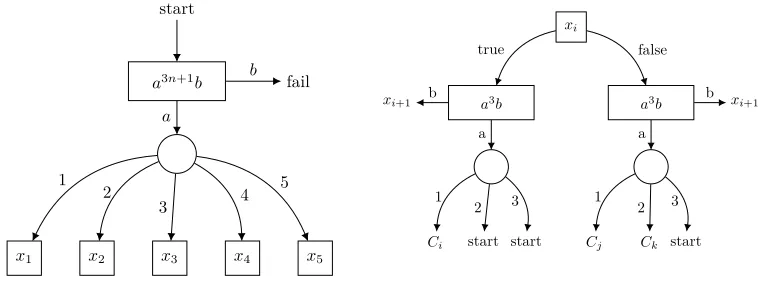
gadgets, which are represented as non-square rectangles that have labelled output edges. The counting gadget is labelled by a sequence over these outputs, with the idea being that if the play repeatedly reaches the gadget, then the corresponding output sequence will be produced. In this example the gadget is labelled bya3n+1b, which means the first 3n+ 1 times the gadget is used the token will be moved along thea edge, and the 3n+ 2nd time the gadget is used the token will be moved along the b edge. This gadget can be easily implemented by a switching node that has 3n+ 2 outgoing edges, the first 3n+ 1 of which go toa, while the 3n+ 2nd edge goes tob. We use gadgets in place of this because it simplifies our diagrams.
The control gadget has two phases. In thevariable phase, each variable gadget, repres-ented by the vertices x1 through xn is used exactly 3 times, and thus overall the gadget will be used 3n times. This is accomplished by a switching node that ensures that each variable is used 3 times. After each variable gadget has been visited 3 times, the control gadget then sends the token to thex1variable gadget for theverification phaseof the game. In this phase, the reachability player must prove that he gave consistent assignments to all variables. If the control state is visited 3n+ 2 times, then the token will be moved to the fail vertex. This vertex has no outgoing edges, and thus is losing for the reachability player.
The variable gadgets. Each variable xi is represented by a variable gadget, which is shown in Figure 3. This gadget will be visited 3 times in total during the variable phase, and each time the reachability player must choose either the true or false edges at the vertexxi. In either case, the token will then pass through a counting gadget, and then move to a switching vertex which either moves the token to a clause gadget, or back to the start vertex.
It can be seen that the gadget is divided into two almost identical branches. One cor-responds to a true assignment toxi, and the other to a false assignment toxi. The clause gadgets are divided between the two branches of the gadget. In particular, a clause appears on a branch if and only if the choice made by the reachability player fails to satisfy the clause. So, the clauses in which xi appears positively appear on the false branch of the gadget, while the clauses in whichxi appears negatively appear on the true branch.
The switching vertices each have exactly three outgoing edges. These edges use an arbitrary order over the clauses assigned to the branch. If there are fewer than 3 clauses on a particular branch, the remaining edges of the switching node go back to the start vertex. Note that this means that a variable can be involved with fewer than three clauses.
the variable player must prove that he has chosen consistent assignments to each of the variables. Once each variable gadget has been used 3 times, the token will be moved to x1 by the control gadget. If the reachability player has used the same branch three times, then he can choose that branch, and move tox2, which again has the same property. So, if the reachability player gives a consistent assignment to all variables, he can eventually move toxn, and then on toxn+1, which is the target vertex of the game. Since, as we will show, there is no other way of reachingxn+1, this ensures that the reachability player must give consistent assignments to the variables in order to win the game.
The clause gadgets. Each clause Cj is represented by a clause gadget, an example of
a2b
start a b fail
Figure 4A gadget for a clause with three variables
which is shown in Figure 4. The gadget counts how many variables have failed to satisfy the corresponding clause. If the number of times the gadget is visited is equal to the number of variables involved with the clause, then the game moves to the fail vertex, and the reachability player immediately loses. In all other cases, the token moves back to the start vertex.
Correctness. The following pair of lemmas show that the reachability player wins the one-player reachability switching game if and only if the 3SAT instance is satisfiable.
◮Lemma 5. If there is a satisfying assignment to the 3SAT formula, then the reachability player can win the one-player reachability switching game.
Proof. The strategy for the reachability player is as follows: at each variable vertex xi, choose the branch that corresponds to the value of xi in the satisfying assignment. We argue that this is a winning strategy. First note that the game cannot be lost in a clause gadget during the variable phase. Since the assignment is satisfying, the play cannot visit a clause gadget more than twice (or more than once if the clause only has two variables), and therefore the edges from the counting gadgets to the fail vertex cannot be used. Hence, the game will eventually reach the verification phase. At this point, since the strategy always chooses the same branch, the play will pass throughx1, x2, . . ., xn, and then arrive xn+1.
Since this is the target, the reachability player wins the game. ◭
◮Lemma 6. If the reachability player wins the one-player reachability switching game, then there is a satisfying assignment of the 3SAT formula.
Proof. We begin by arguing that, if the reachability player wins the game, then he must have chosen the same branch at every visit to every variable gadget. This holds becausexn+1 can only be reached by ensuring that each variable has a branch that is visited at least 3 times. The control gadget causes the reachability player to immediately lose the game if it is visited 3n+ 2 times. Thus, the reachability player must win the game after passing through the control gadget exactly 3n+ 1 times. The only way to do this is to ensure that each variable has a branch that is visited exactly 3 times during the variable phase.
not end in a clause gadget, and therefore under this assignment every clause has at least one literal that is true. Thus, the assignment satisfies the 3SAT instance. ◭
Hence, we have the following theorem.
◮Theorem 7. Deciding the winner of a one-player reachability switching game isNP-hard.
4
Two-player reachability switching games
4.1
Containment in
EXPTIME
We first observe that solving a reachability switching game lies in EXPTIME. This follows from the fact that the game can be simulated by an alternating Turing machine, which is a machine that has both non-deterministic and universal control states. It has been shown that APSPACE =EXPTIME[2], which means that if we can devise an algorithm that runs in polynomial space on an alternating Turing machine, then we can obtain an algorithm that runs in exponential time on a deterministic Turing machine.
It is straightforward to implement a reachability switching game on an alternating Turing machine. The machine simulates a run of the game. It starts by placing a token on the staring state. It then simulates each step of the game. When the token arrives at a vertex belonging to the reachability player, it uses existential non-determinism to choose a move for that player. When the token arrives at a vertex belonging to the safety player, it uses universal non-determinism to choose a move for that player. The moves at the switching nodes are simulated by remembering the current switch configuration, which can be done in polynomial space. The machine accepts if and only if the game arrives at the target state.
This machine uses polynomial space, because it needs to remember the switch configur-ation. Thus, we have the following theorem.
◮Theorem 8. Deciding the winner of a reachability switching game is in EXPTIME.
4.2
PSPACE
-hardness
We show that deciding the winner of a two-player reachability switching games is PSPACE -hard, by reducingtrue quantified boolean formula (TQBF), the canonicalPSPACE-complete problem, to our problem. Throughout this section we will refer to a TQBF instance
∃x1∀x2. . .∃xn−1∀xn·φ(x1, x2, . . . , xn), where φ denotes a boolean formula given in
neg-ation normal form, which requires that negneg-ations are only applied to variables, and not sub-formulas. The problem is to decide whether this formula is true.
Overview. We will implement the TQBF formula as a game between the reachability player and the safety player. This game will have two phases. In thequantifier phase, the two players assign values to their variables in the order specified by the quantifiers. In the formula phase, the two players determine whether φ is satisfied by these assignments by playing the standard model-checking game for propositional logic. The target state of the game is reached if and only if the model checking game determines that the formula is satisfied. This high-level view of our construction is depicted in Fig. 5.
Formulaφ
x1 · · · x2 xn
start
[image:10.595.196.425.114.237.2]target fail target fail target fail
Figure 5 High-level overview of our construction for two players. The dashed lines between variables are part of the first, quantifier phase ; the dotted line from variablexnto the Formula is
the transition between phases, and the solid edges are part of the second, formula phase.
di
xi ¬xi
fi
fromxi−1
target target
toxi+1 fail
1 1
2 2
1 2
Figure 6The initialization gadget for an ex-istentially quantified variablexi.
∧1 fromfn
∨1 ∧2
[image:10.595.113.291.300.453.2]x1 ¬x2 ¬x3 x4
Figure 7 The formula phase game for the formula (x1∨ ¬x2)∧ ¬x3∧x4.
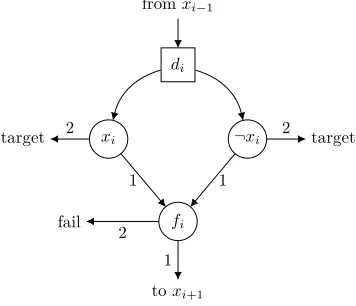
During the quantifier phase, the game will start atd1, and then pass through the gadgets for each of the variables in sequence. In each gadget, the controller ofdi must move to either
xi or ¬xi. In either case, the corresponding switching node moves the token to fi, which then subsequently moves the token on to the gadget forxi+1.
The important property to note here is that once the player has made a choice, any subsequent visit toxi or ¬xi will end the game. Suppose that the controller ofdi chooses to move to xi. If the token ever arrives at xi a second time, then the switching node will move to the target vertex and the reachability player will immediately win the game. If the token ever arrives at¬xi the token will move tofi and then on to the fail vertex, and the Safety player will immediately win the game. The same property holds symmetrically if the controller ofdi chooses¬xi instead. In this way, the controller ofdi selects an assignment toxi. Hence, the reachability player assigns values to the existentially quantified variables, and the safety player assigns values to the universally quantified variables.
[image:10.595.148.468.308.458.2]order logic. The players play a game on the parse tree of the formula, starting from the root. The reachability player controls the∨ nodes, while the safety player controls the ∧nodes (recall that the game is in negation normal form, so there are no internal ¬nodes.) Each leaf is either a variable or its negation, which in our game are represented by thexiand¬xi nodes in the initialization gadgets. An example of this game is shown in Figure 7. In our diagramming notation, nodes controlled by the safety player are represented by triangles.
Intuitively, ifφis satisfied by the assignment tox1throughxn, then no matter what the safety player does, the reachability player should be able to reach a leaf node corresponding to a true assignment, and as we discussed earlier, he will then immediately win the game. Conversely, if φ is not satisfied by the assignment, then no matter what the reachability player does, the safety player can reach a leaf corresponding to a false assignment, and then immediately win the game.
◮Lemma 9. The reachability player wins if and only if the QBF formula is true.
The proof can be found in Appendix A. Thus, we have shown the following theorem.
◮Theorem 10. Deciding the winner of a reachability switching game isPSPACE-hard.
Note that all runs of the game have polynomial length, a property that is not shared by all reachability switching games. This gives us the following corollary.
◮Corollary 11. Deciding the winner of a polynomial-length reachability switching game is PSPACE-complete.
The proof, which contains the argument for containment inPSPACE, is in Appendix A.
4.3
Memory requirements of winning strategies
In this section we will show that both players need exponentially many memory states to win a reachability switching game. We begin by giving a simple gadget that forces the
x
y
a
b
c target
target
fail y
start 1
1 2
2
[image:11.595.187.393.476.611.2]2 1
Figure 8A reachability switching game in which the reachability player needs to use memory.
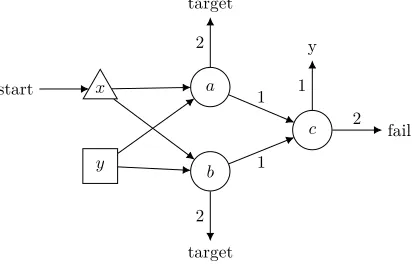
fail vertex, which is losing for the reachability player. Thus, every winning strategy of the reachability player must remember the choice made by the safety player.
Observe that we can create a similar gadget that forces the safety player to uses memory, by swapping the two players. In this modified gadget, the safety player would have to chose the vertex not chosen by the reachability player. Thus, in a reachability switching game, winning strategies for both players need to use memory.
A memory lower bound. We can now use this gadget to show a lower bound on the amount of memory that is need to win a reachability switching game.
◮ Lemma 12. In a reachability switching game, winning strategies for both players may need to use2n memory states, wherenis the number of switching nodes.
Corresponding upper bound. We can also show that exponential memory is sufficient in a two-player reachability switching game. We say that a strategy is aswitch configuration strategy if it simply remembers the current switch configuration. Any such strategy uses at most exponentially many memory states. For games with binary switch nodes, these strategies use exactly 2n memory states, wherenis the number of switching nodes. ◮Lemma 13. In a reachability switching game, both players have winning switch configur-ation strategies.
The proofs of Lemmas 12 and 13 can be found in Appendix A.
5
Zero-player reachability switching games
In this section we consider zero-player reachability switching games, i.e., games withVR=
VS = ∅. As an initial hardness result for this case, we show that deciding the winner of a zero-player game is NL-hard. To do this, we reduce from the problem of deciding s-t
connectivity in a directed graph.
The idea is to make every node in the graph a switching node. We then begin a walk froms. If, after |V| steps we have not arrived att, we go back tos and start again. The idea being that, if there is a path fromstot, then the switching nodes must eventually send the token along that path.
More formally, given a graph (V, E), we produce a zero-player reachability switching game played onV×V∪ {fin}, where the second component of each state is considered to be a counter that counts up to|V|. Every vertex is a switching node, the start vertex is (s,0), and the target vertex is fin. Each vertex (v, k) with v 6= t k <|V| has outgoing edges to (u, k+ 1) for each outgoing edge (v, u)∈E. Each vertex (v,|V|) withv6=thas a single edge to (s,0). Every vertex (t, k) has a single outgoing edge to fin. Given (V, E), this game can be constructed in logarithmic space by looping over each element inV ×V and producing the correct outgoing edges.
◮Theorem 14. Deciding the winner of a zero-player reachability switching game is NL-hard under logspace reductions.
The proof can be found in Appendix B.
6
Further work
that we showed here. We conjecture that the problem is in fact P-complete, but despite much effort, we were unable to improve upon the upper or lower bounds.
For the one-player case we have shown tight bounds. For the two-player case we have shown a lower bound of PSPACE and an upper bounds of EXPTIME. We conjecture that the lower bound can be strengthened, since we did not make strong use of the memory requirements that we identified in Sect. 4.3.
Finally, here we studied the problem of reachability, which is one of the simplest model checking tasks. What is the complexity of model checking more complex specifications?
References
1 Hoda Akbari and Petra Berenbrink. Parallel rotor walks on finite graphs and applications in discrete load balancing. InProc. SPAA 2013, pages 186–195, 2013.
2 Ashok K. Chandra, Dexter C. Kozen, and Larry J. Stockmeyer. Alternation. J. Assoc. Comput. Mach., 28(1):114–133, 1981.
3 Anne Condon. The complexity of stochastic games. Inf. Comput., 96(2):203–224, 1992. 4 Joshua Cooper, Benjamin Doerr, Tobias Friedrich, and Joel Spencer. Deterministic random
walks on regular trees. Random Structures Algorithms, 37(3):353–366, 2010.
5 Joshua Cooper, Benjamin Doerr, Joel Spencer, and Gábor Tardos. Deterministic random walks on the integers. European J. Combin., 28(8):2072–2090, 2007.
6 Joshua N. Cooper and Joel Spencer. Simulating a random walk with constant error.Combin. Probab. Comput., 15(6):815–822, 2006.
7 Benjamin Doerr and Tobias Friedrich. Deterministic random walks on the two-dimensional grid. Combin. Probab. Comput., 18(1-2):123–144, 2009.
8 Jérôme Dohrau, Bernd Gärtner, Manuel Kohler, Jirí Matousek, and Emo Welzl. ARRIVAL: A zero-player graph game in NP ∩ coNP. Technical report, 2016.
https://arxiv.org/abs/1605.03546.
9 Tobias Friedrich, Martin Gairing, and Thomas Sauerwald. Quasirandom load balancing. SIAM J. Comput., 41(4):747–771, 2012.
10 Jan Friso Groote and Bas Ploeger. Switching graphs. International Journal of Foundations of Computer Science, 20(05):869–886, 2009.
11 Alexander E Holroyd, Lionel Levine, Karola Mészáros, Yuyal Peres, James Propp, and David B Wilson. Chip-firing and rotor-routing on directed graphs. In In and Out of Equilibrium 2, pages 331–364. Springer, 2008.
12 Alexander E. Holroyd and James Propp. Rotor walks and Markov chains. InAlgorithmic probability and combinatorics, volume 520 ofContemp. Math., pages 105–126. Amer. Math. Soc., Providence, RI, 2010.
13 Karthik C. S. Did the train reach its destination: The complexity of finding a witness.Inf. Process. Lett., 121:17–21, 2017.
14 Bastian Katz, Ignaz Rutter, and Gerhard Woeginger. An algorithmic study of switch graphs. Acta Inform., 49(5):295–312, 2012.
15 Marta Kwiatkowska, Gethin Norman, and David Parker. PRISM 4.0: Verification of prob-abilistic real-time systems. InProc. CAV 2011, volume 6806 ofLecture Notes Comput. Sci., 2011.
16 Christoph Meinel. Switching graphs and their complexity. In Proc. MFCS 1989, volume 379 ofLecture Notes Comput. Sci., pages 350–359, 1989.
17 Vyatcheslav B. Priezzhev, Deepak Dhar, Abhishek Dhar, and Supriya Krishnamurthy. Eu-lerian walkers as a model of self-organized criticality. Phys. Rev. Lett., 77(25):5079, 1996. 18 Martin L. Puterman. Markov Decision Processes: Discrete Stochastic Dynamic
19 Klaus Reinhardt. The simple reachability problem in switch graphs. In Proc. SOFSEM 2009, volume 5404 ofLecture Notes Comput. Sci., pages 461–472, 2009.
A
Proofs for Section 4
Proof of Lemma 9.
Proof. If the QBF formula is true, then during the quantifier phase, no matter what assign-ments the safety player picks for the universally quantified variables, the reachability player can choose values for the existentially quantified variables in order to makeφ true. Then, in the formula phase the reachability player has a strategy to ensure that he wins the game, by moving to a nodexi or ¬xi that was used during the quantifier phase.
Conversely, and symmetrically, if the QBF formula is false then the safety player can ensure that the assignment does not satisfyφduring the quantifier phase, and then ensure that the game moves to a node xi or ¬xi that was not used during the quantifier phase.
This ensures that the safety player wins the game. ◭
Proof of Corollary 11.
Proof. Hardness follows from Theorem 10. For containment, observe that the simulation by an alternating Turing machine described in Section 4.1 runs in polynomial time whenever the game terminates after a polynomial number of steps. Hence, we can use the fact thatAP =PSPACE[2] to obtain a deterministic polynomial space algorithm for solving the problem. ◭
Proof of Lemma 12.
Proof. Consider a game withncopies of the memory gadget shown in Figure 8, but modified so that the following sequence of events occurs.
1. The safety player selectsaorb in all gadgets, one at a time.
2. The safety player then moves the game to one of they vertices in one of the gadgets. 3. The reachability player selectsaorb as normal, and then either wins or loses the game. The reachability player has an obvious winning strategy in this game, which is to remember the choices that the safety player made, and then choose the same vertex in the third step. Since the safety player makesnbinary decisions, this strategy uses 2n memory states.
On the other hand, if the reachability player uses a strategy σ with k < 2n memory states, then the safety player can win the game in the following way. There are 2n different switch configurations that the safety player can create at the end of the first step of the game. By the pigeon-hole principle there exists two distinct configurationsC1 andC2 that are mapped to the same memory state byσ. The safety player selects a gadgetithat differs betweenC1 and C2, and determines whetherσ selectsaor b for gadgeti. He then selects the configuration that that is consistent with the other option, so if σchoosesathe safety player chooses the configurationCi that selectsb. He then sets the gadgets according toCi in step 1, and moves the game to gadgetiin step 2. The reachability player will then select the vertex not chosen in step 1, he loses the game.
Finally, observe that we can obtain the same lower bound for the safety player by
swap-ping the roles of both players in this game. ◭
Proof. LetG= (V, E, VR, VS, VSwi, o, s, t) be a reachability switching game, and letCdenote the set of all switch configurations in this game. Consider the “blown-up” reachability game
G′
played on V × C, where there are no switching nodes, but instead the successor of a vertex (v, C) with v ∈ VSwi is determined by C. It is straightforward to show that the reachability player wins the gameG′
if and only if he wins the original game. Both players in a reachability game have positional winning strategies. Therefore, if a player can win in G′, then he can also win in
G using a switch configuration strategy that always plays
according to the positional winning strategy inG′. ◭
B
Proof for Section 5
Proof. We must argue that there is a path fromsto tif and only if the zero-player reach-ability game eventually arrives at fin. By definition, if the game arrives at fin, then there must be a path fromstot, since the game only uses edges from the original graph.
For the other direction, suppose that there is a path from s to t, but the game never arrives at fin. By construction, if the game does not reach fin, then (s,0) is visited infinitely often. Since (s,0) is a switching state, we can then argue that the vertex (v,1) is visited infinitely often for every successorv ofs. Carrying on this argument inductively allows us to conclude that if there is a path of lengthkfrom sto v, then the vertex (v, k) is visited