Thesis submitted in accordance with the requirements of the University of Liverpool for the degree of Doctor in Philosophy by
Mihai Burcea
Ship: I have taught you about the classical Pandora and her box. Panille: I know how this planet got its name.
Ship: Where would you hide when the serpents and shadows oozed out of the box? Panille: Under the lid, of course.
–Kerro Panille, Shiprecords
by Frank Herbert,The Jesus Incident
But the Great Sea is terrible, Tuor son of Huor; and it hates the Noldor, for it works the Doom of the Valar. Worse things it holds than to sink into the abyss and so perish: loathing, and loneliness, and madness; terror of wind and tumult, and silence, and shadows where all hope is lost and all living shapes pass away. And many shores evil and strange it washes, and many islands of danger and fear infest it. I will not darken your heart, son of Middle-earth, with the tale of my labour seven years in the Great Sea from the North even into the South, but never to the West. For that is shut against us.
Contents v
Illustrations vii
List of Acronyms ix
Preface xi
Abstract xiii
Acknowledgements xv
1 Introduction 1
1.1 Algorithms . . . 1
1.1.1 Offline Algorithms and the NP Complexity Class . . . 2
1.1.2 Approximation Algorithms . . . 2
1.1.3 Online Algorithms and Competitive Analysis . . . 3
1.2 Bin Packing Problems . . . 4
1.2.1 The Classical Bin Packing Problem. . . 4
1.2.2 Online Bin Packing . . . 5
1.2.3 Online Dynamic Bin Packing . . . 6
1.2.4 Additional Lower Bounds . . . 8
1.3 Organization of the Thesis . . . 9
1.4 Author’s Contribution . . . 9
1.5 Additional Contribution . . . 10
2 Bin Packing Problems 11 2.1 The Classical Bin Packing Problem . . . 11
2.2 Online Bin Packing . . . 13
2.3 Online Dynamic Bin Packing . . . 14
2.3.1 Online one-dimensional dynamic bin packing . . . 15
2.3.2 Online multi-dimensional dynamic bin packing . . . 19
2.4 Variations on Bin Packing . . . 22
3.2 Preliminaries . . . 26
3.3 Op-Inc and Op-Comp . . . 27
3.3.1 Operation Op-Inc . . . 28
3.3.2 Operation Op-Comp . . . 28
3.3.3 Using Op-Inc and Op-Comp. . . 29
3.3.4 A 2.5 lower bound using Op-Inc and Op-Comp . . . 31
3.4 The 8/3 Lower Bound - The Simple Cases . . . 33
3.5 The 8/3 Lower Bound - The Complex Cases . . . 38
3.6 The optimal offline packing . . . 46
3.7 Conclusion . . . 47
4 Online Two-dimensional Dynamic Bin Packing of Unit Fraction Items 51 4.1 Introduction. . . 51
4.2 Preliminaries . . . 53
4.3 Classification of 2-D unit fraction items . . . 56
4.3.1 Class 5: T(1,1),T(12,1) . . . 56
4.3.2 Class 3: T(1,1),T(1,12),T(12,1),T(12,12) . . . 57
4.3.3 Class 2: T(1,≤13),T(12,≤13) . . . 57
4.3.4 Class 1: T(≤13,≤1) . . . 58
4.3.5 Class 4: T(1,12),T(1,≤13),T(12,12),T(12,≤13) . . . 59
4.4 Packing of 2-D unit fraction items . . . 61
5 Online Multi-dimensional Dynamic Bin Packing of Unit and Power Fraction Items 63 5.1 Introduction. . . 63
5.2 2-D power fraction items . . . 64
5.2.1 Existing scheme . . . 64
5.2.2 Classification of 2-D power fraction items . . . 66
5.3 3-D unit and power fraction items . . . 67
5.4 Conclusion . . . 70
6 Lower Bounds for Online Multi-dimensional Dynamic Bin Packing 73 6.1 Introduction. . . 73
6.2 Preliminaries . . . 74
6.3 Lower bounds for general size items . . . 75
6.4 Lower bounds for unit and power fraction items . . . 76
6.4.1 First-Fit . . . 76
6.4.2 Best-Fit . . . 82
6.4.3 Worst-Fit . . . 84
6.5 Conclusion . . . 86
7 Conclusion 89
Bibliography 95
List of Figures
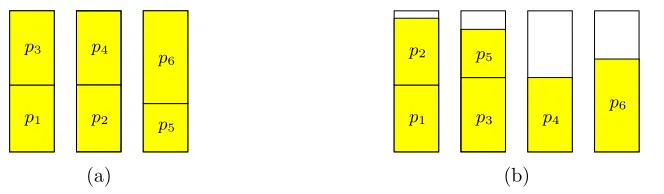
1.1 (a) The optimal solution with three bins and (b) the First-Fit online
algo-rithm solution with four bins for item listL. . . 5
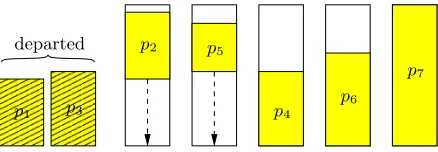
1.2 (a) The optimal solution with three bins and (b) the First-Fit online algo-rithm solution with five bins. . . 7
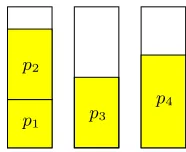
2.1 (a) The optimal solution and (b) the First-Fit solution for item list L. . . 12
2.2 The final configuration of FF achieved by the adversary for a simple 2.25 lower bound. . . 17
3.1 Op-Inc and Op-Comp . . . 29
3.2 Example for Op-Inc and Op-Comp . . . 30
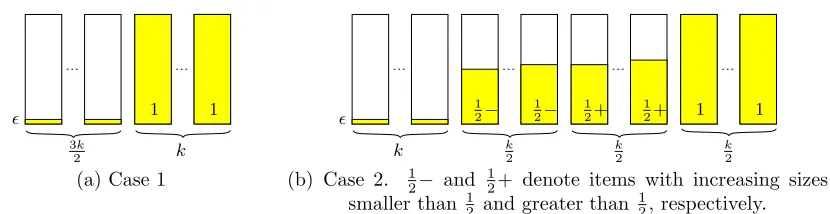
3.3 The final configuration ofAachieved by the adversary for a simpler 2.5 lower bound in Cases 1 and 2. . . 31
3.4 Different cases of the adversary. . . 33
3.5 The final configuration of Aachieved by the adversary in Case 1.1. . . 34
3.6 The final configuration of Aachieved by the adversary in Case 1.2. . . 36
3.7 The final configuration of Aachieved by the adversary in Case 2.1. . . 39
3.8 The final configuration of Aachieved by the adversary in Case 2.2.1. . . 41
3.9 The final configuration of Aachieved by the adversary in Case 2.2.2. . . 43
4.1 Infeasible repacking of existing items of types T(1,≤13) and T(12,≤13) and a new item of type T(1,∗). . . 55
4.2 Illustration of the proof of Lemma 4.8.. . . 58
6.1 Select bin configurations for First-Fit in Stage 0. . . 77
6.2 Select bin configurations for First-Fit in Stage 2. . . 78
6.3 The bin configuration of First-Fit at the end of Stage 4. . . 79
6.4 The final configuration achieved by First-Fit. . . 80
6.5 The final configuration achieved by Best-Fit fornbins. . . 83
6.6 The final configuration achieved by Worst-Fit fornbins. . . 85
List of Tables
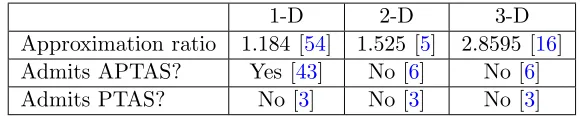
2.1 Asymptotic approximation ratios, and APTAS and PTAS admissibility for offline bin packing. . . 132.2 Asymptotic competitive ratios and lower bound results for online static bin packing and online dynamic bin packing of general size items. . . 14
2.3 Competitive ratios for general size, unit fraction, and power fraction items. . 22
3.3 The optimal schedule for Case 1.2. . . 38
3.4 The optimal schedule for Case 2.1. . . 47
3.5 The optimal schedule for Case 2.2.1. . . 48
3.6 The optimal schedule for Case 2.2.2. . . 49
4.1 Competitive ratios for general size, unit fraction, and power fraction items. . 52
4.2 Types of unit fraction items considered. . . 54
4.3 The 2-D results of [70] for unit-fraction items. . . 54
4.4 Values ofβhx, yi for 3≤x≤6 and 3≤y ≤6. . . 55
4.5 Classifications of 2-D unit fraction items and their competitive ratios. . . 56
4.6 Values ofγhx, yi for 2≤x≤6 and 2≤y≤6. . . 60
4.7 Competitive ratios for 2-D unit fraction items. . . 61
4.8 Competitive ratios for 2-D unit fraction items. . . 61
5.1 Competitive ratios for general size, unit fraction, and power fraction items. . 64
5.2 Types of power fraction items considered. . . 64
5.3 The 2-D results of [70] in the context of power-fraction items.. . . 65
5.4 Competitive ratios for 2-D power fraction items. . . 65
5.5 Values ofβphx, yi forx∈ {4,8} andy∈ {4,8}. . . 66
5.6 Competitive ratios for 3-D unit fraction items. . . 68
5.7 Competitive ratios for 3-D power fraction items. . . 68
6.1 Results for online dynamic bin packing algorithms.. . . 74
6.2 The optimal schedule used by the adversary for First-Fit. . . 81
7.1 Results for online dynamic bin packing algorithms.. . . 92
1-D One-Dimensional
2-D Two-Dimensional
3-D Three-Dimensional
AF Any-Fit
APTAS Asymptotic Polynomial Time Approximation Scheme
BF Best-Fit
d-D d-Dimensional (equivalently, Multi-Dimensional)
FF First-Fit
FFD First-Fit Decreasing
FFDH First-Fit Decreasing Height
FFM First-Fit Modified
MFFD Modified First-Fit Decreasing
NF Next-Fit
NFDH Next-Fit Decreasing Height
NP Non-deterministic Polynomial
P Polynomial
PF Power Fraction
PTAS Polynomial Time Approximation Scheme
RCP Rectangle Packing
UF Unit Fraction
WF Worst-Fit
A significant part of this thesis is based on two peer-reviewed papers that have been published in international conferences. The two papers have been adapted for the pur-pose of this thesis and expanded to contain work that was omitted from the conference versions of the papers. The extended versions of the papers are also either under sub-mission for journal publication or in preparation for subsub-mission. An additional chapter presents work that has not yet been published that is related to one of the above papers. Specifically, Chapter 3 of the thesis is based on the paper entitled “An 8/3 Lower Bound for Online Dynamic Bin Packing”, co-authored with Prudence W.H. Wong and Fencol C.C. Yung. The paper has been published in Proceedings of the 23rd Interna-tional Symposium on Algorithms and Computation.
We study the dynamic bin packing problem introduced by Coffman, Garey and Johnson. This problem is a generalization of the bin packing problem in which items may arrive and depart dynamically. The objective is to minimize the maximum number of bins used over all time. The main result is a lower bound of 8/3 ∼2.666 on the achievable competitive ratio, improving the best known 2.5 lower bound. The previous lower bounds were 2.388, 2.428, and 2.5. This moves a big step forward to close the gap between the lower bound and the upper bound, which currently stands at 2.788. The gap is reduced by about 60% from 0.288 to 0.122. The improvement stems from an adversarial sequence that forces an online algorithm A to open 2sbins with items having a total size of s only and this can be adapted appropriately regardless of the current load of other bins that have already been opened byA. Comparing with the previous 2.5 lower bound, this basic step gives a better way to derive the complete adversary and a better use of items of slightly different sizes leading to a tighter lower bound. Furthermore, we show that the 2.5-lower bound can be obtained using this basic step in a much simpler way without case analysis.
Chapters4and5of the thesis are based on the paper entitled “Online Multi-dimensional Dynamic Bin Packing of Unit-Fraction Items”, co-authored with Prudence W.H. Wong and Fencol C.C. Yung. The paper has been published in Proceedings of the 8th Inter-national Conference on Algorithms and Complexity.
Garey, and Johnson motivated by the dynamic storage problem. Bar-Noy et al. have studied packing of unit fraction items (i.e., items with length 1/k for some integer k ≥ 1), motivated by the window scheduling problem. In this paper, we extend the study of 2-D and 3-D dynamic bin packing problem to unit fractions items. The objective is to pack the items into unit-sized bins such that the maximum number of bins ever used over all time is minimized. We give a scheme that divides the items into classes and show that applying the First-Fit algorithm to each class is 6.7850- and 21.6108-competitive for 2-D and 3-D, respectively, unit fraction items. This is in contrast to the 7.4842 and 22.4842 competitive ratios for 2-D and 3-D, respectively, that would be obtained using only existing results for unit fraction items.
Finally Chapter6represents a continuation of the work in Chapters4and5that focuses on obtaining lower bounds for certain online algorithms for multi-dimensional dynamic bin packing. We consider several types of input and construct different adversaries suitable to each specific input.
In this thesis we study online algorithms for dynamic bin packing. An online algorithm is presented with input throughout time and must make irrevocable decisions without knowledge of future input. The classical bin packing problem is a combinatorial opti-mization problem in which a set of items must be packed into a minimum number of uniform-sized bins without exceeding their capacities. The problem has been studied since the early 1970s and many variants continue to attract researchers’ attention today. The dynamic version of the bin packing problem was introduced by Coffman, Garey and Johnson in 1983. The problem is a generalization of the bin packing problem in which items may arrive and depart dynamically. In this setting, an online algorithm for bin packing is presented with one item at a time, without knowledge of its departure time, nor arrival and departure times of future items, and must decide in which bin the item should be packed. Migration of items between bins is not allowed, however rearrange-ment of items within a bin is permitted. The objective of problem is to minimize the maximum number of bins used over all time. In multi-dimensional generalizations of the problem, multi-dimensional items must be packed without overlap in multi-dimensional bins of uniform size in each dimension. In this work, we study the setting where items are oriented and cannot be rotated.
We first consider online one-dimensional dynamic bin packing and present a lower bound of 8/3 ∼ 2.666 on the achievable competitive ratio of any deterministic online algorithm, improving the best known 2.5-lower bound. Since the introduction of the problem by Coffman, Garey and Johnson, the progress on the problem has focused on improving the original lower bound of 2.388 to 2.428, and to the best known 2.5-lower bound. Our improvement from 2.5 to 8/3∼ 2.666 makes a big step forward in closing the gap between the lower bound and the upper bound, which currently stands at 2.788. Secondly we study the online two- and three-dimensional dynamic bin packing prob-lem by designing and analyzing algorithms for special types of input. Bar-Noy et al. initiated the study of the one-dimensional unit fraction bin packing problem, a restricted version where all sizes of items are of the form 1/k, for some integer k > 0. Another related problem is for power fraction items, where sizes are of the form 1/2k, for some integer k ≥0. We initiate the study of online multi-dimensional dynamic bin packing of unit fraction items and power fraction items, where items have lengths unit frac-tion and power fracfrac-tion in each dimension, respectively. While algorithms for general
fraction items, we design and analyze online algorithms that achieve better worst-case performance guarantees compared to their classical counterparts. Our algorithms give careful consideration to unit and power fraction items, which allows us to reduce the competitive ratios for these types of inputs.
Lastly we focus on obtaining lower bounds on the performance of the family of Any-Fit algorithms (Any-Any-Fit, Best-Any-Fit, First-Any-Fit, Worst-Any-Fit) for online multi-dimensional dynamic bin packing. Any-Fit algorithms are classical online algorithms initially studied for the one-dimensional version of the bin packing problem. The common rule that the algorithms use is to never pack a new item to a new bin if the item can be packed in any of the existing bins. While the family of Any-Fit algorithms is alwaysO(1)-competitive for one-dimensional dynamic bin packing, we show that this is no longer the case for multi-dimensional dynamic bin packing when using Best-Fit and Worst-Fit, even if the input consists of power fraction items or unit fraction items. For these restricted inputs, we prove that Best-Fit and Worst-Fit have unbounded competitive ratios, while for First-Fit we provide lower bounds that are higher than the lower bounds for any online algorithm. Furthermore, for general input we show that all classical Any-Fit algorithms are not competitive for online multi-dimensional dynamic bin packing.
My biggest thanks go to my supervisor, Prudence W.H. Wong, with whom I have had the privilege and pleasure of working from my second year as an undergraduate student to the very end of my research degree. Her guidance and support were invaluable to me throughout my summer project as an undergraduate student, following to my final year project, and leading to the research found here. I am honoured to have been her student, but regret I may not be able to repay all the time and energy she has invested in me. She has shown me the elegance of research, and for me this elegance represents saying something correctly and clearly. I have been allowed to contribute alongside her and our co-authors to a piece of knowledge, and for this I am forever grateful.
Of course, the work in this thesis and elsewhere would not have been possible without the help and enthusiasm of my other co-authors, Wing-Kai Hon, Hsiang-Hsuan Liu, David K.Y. Yau, and Fencol C.C. Yung. I am very thankful for the time they have invested in our work. Their dedication allowed us to bring our ideas to published pages. A great aid in evaluating my progress throughout the years was provided by my advisors, Leszek A. Gasieniec, Mingyu Guo, and Piotr Krysta. I am very thankful for֒ their suggestions on improving and expanding the work in this thesis.
Lastly, I would like to thank my examiners, Stanley P.Y. Fung and Leszek A. Gasieniec. I am very grateful for their thoroughness and advice in revising this the-֒ sis to its final version.
Introduction
In this thesis we investigate the area of online algorithms in the context of the bin packing problem. An online algorithm must make irrevocable decisions without knowledge of future input. Our aim is the study of performance guarantees of online algorithms for optimization problems, specifically variants of the bin packing problem. The classical bin packing problem is a combinatorial optimization problem in which a set of items must be packed into a minimum number of uniform-sized bins without exceeding their capacities. In this setting, an online algorithm for bin packing is presented with one item at a time, without knowledge of future items, and must decide in which bin the item should be packed. Migration of items between bins is not allowed, however rearrangement of items within a bin is permitted. The objective of the problem is to minimize the total number of bins used. A classical approach to measure the performance of an online algorithm is competitive analysis, where the output of an online algorithm is compared to the output of an optimal offline algorithm that holds complete knowledge about the input. We first give an introduction to algorithms, including offline algorithms and the NP complexity class in Section1.1.1, approximation algorithms in Section 1.1.2, and online algorithms and competitive analysis in Section1.1.3. We further present the models for bin packing problems we consider in Section 1.2. The organization of the thesis and author’s contributions are noted in Sections1.3and 1.4, respectively. Finally in Section
1.5 we note an additional contribution of the author that was not included as part of this thesis.
1.1
Algorithms
In this thesis we focus on deterministic algorithms for optimization problems. A deter-ministic algorithm is an algorithm which, presented with a particular input, will always produce the same output by passing through the same sequence of steps. Depending on the nature of the input, algorithms can be classified as offline and online. In the offline setting, all input is known in advance to the algorithm and can usually be preprocessed in such a way that it allows for good performance guarantees. On the other hand, in the online setting, input is received throughout time and preprocessing is not usually
available. Our goal is to overcome these additional hurdles and design and analyze on-line deterministic algorithms with good performance guarantees. The class of problems for which we aim to prove performance guarantees are called optimization problems.
An optimization problem refers to a problem of either cost minimization or profit maximization. In our case, the bin packing problem is a cost minimization problem and we give definitions applicable to this type of optimization problem, while profit maximization problems can be defined similarly. An optimization problem P of cost minimization can be defined as follows [11]. P consists of a set I of inputs and a cost function C. Associated with every input I is a set of feasible outputs (or solutions) F(I), and associated with each feasible solution O in F(I) is a positive real, C(I, O), representing the cost of the output O with respect to the input I. The aim of such a problem thus becomes to minimize C(I, O) for any inputI ∈ I.
1.1.1 Offline Algorithms and the NP Complexity Class
Offline algorithms are algorithms that hold complete knowledge of the input for a prob-lem and are required to output an answer or solution for a given probprob-lem. For many important optimization problems, including the bin packing problem, an optimal so-lution of minimum cost (or maximum profit, respectively) may not be determined in polynomial time, even if the input is received offline. These problems fall within the non-deterministic polynomial (NP) complexity class [45] and some of the hardest prob-lems in NP are NP-complete and NP-hard probprob-lems. On the other hand, the polynomial (P) complexity class also falls within NP and its problems are polynomial-time solvable. For both NP-complete and NP-hard problems, an optimal solution cannot be found in polynomial time, unless P=NP [29]. Given a solution for an optimization problem, the difference between NP-complete and NP-hard problems lies in whether we may be able to verify in polynomial time if the solution given is an optimal solution. While NP-complete problems are verifiable in polynomial time, NP-hard problems may or may not be verifiable in polynomial time. The bin packing problem, for example, is an NP-hard problem which is not verifiable in polynomial time, assuming P6=NP. This is due to the fact that an optimal solution is required beforehand in order to determine if the given solution is optimal. Up to now no polynomial-time algorithm for any NP-complete or NP-hard problem is known and researchers have focused on approximation algorithms that run in polynomial time.
1.1.2 Approximation Algorithms
Let A(I) denote the cost of the solution for an approximation algorithm A on any input I, and OP T(I) denote the cost of the optimal solution onI. For a minimization problem, we say thatAhas an asymptotic approximation ratioc >1 (or alternatively is c-approximate) if for any inputI,A(I)≤c OP T(I) +b, for a positive constant b. If the constantbis not a positive value, then we say thatAhas anabsolute approximation ratio c(or alternatively is strictlyc-approximate). The definition for a maximization problem is similar, except that we now require that OP T(I) ≤ cA(I) +b. These performance guarantees are similar for online algorithms, which are the main focus of this work, as we will see in the next subsection.
1.1.3 Online Algorithms and Competitive Analysis
Optimization problems in which the input is received one at a time and output must be produced throughout time are called online problems. In order to solve such problems, online algorithms are used. An online algorithm receives input throughout time and must make irrevocable decisions without knowledge of future input. The disadvantage of online algorithms becomes apparent compared to offline algorithms that have access to the whole input in advance. In the case of online algorithms, irrevocable decisions taken throughout their execution affect the cost of the solution produced. Nonetheless, the challenge of designing ‘good’ online algorithms has contributed to the theory of combinatorial optimization for almost half a century in the context of, e.g., bin packing, scheduling, and data structures (surveys [23], [64], and [1], respectively). Although many of the problems mentioned above are initially studied offline, their online counterparts reflect realistic models and online algorithms constitute an interesting class of algorithms by themselves. It is also worth mentioning that some online algorithms give good offline approximation results, thus their significance is not only limited to online problems.
Competitive analysis [11] was introduced by Sleator and Tarjan [65] as a measure-ment of the worst-case performance of an online algorithm A compared to an optimal offline algorithm OP T. As mentioned before, OP T knows the whole input in advance and is able to compute an optimal solution for a given problem. Even though the com-putational complexity of finding such an optimal solution may be very high and we may not be able to explicitly give such an optimal algorithm, a comparison of performance betweenA andOP T can still be made, as the minimum cost of OP T’s solution is con-strained by the problem model and input. Competitive analysis has also been compared to a game of two players [67], in which an online algorithm plays against an adversary that generates the input and acts as an offline algorithm, while it tries to minimize its cost relative to the online algorithm.
b is a positive value, c is called an asymptotic competitive ratio. Having a positive constant breflects that for online problems we allow arbitrarily long input and thus the value of bbecomes insignificant. On the other hand, whenbis a constant with value at most zero, i.e.,A(I)≤c OP T(I), we say thatAis a strictlyc-competitive algorithm or equivalently that A attains an absolute competitive ratio c. Note that in the case of a cost minimization problem the competitive ratio is at least 1 and the smaller it is, the better an online algorithm performs against an optimal offline algorithm.
In this work we focus on the asymptotic performance of deterministic online algo-rithms for the bin packing problem. A different approach would be to use randomized online algorithms. Randomized algorithms for bin packing are algorithms that use coin flips to determine where to pack items. We recognize that randomization may be useful in improving upper bounds for optimization problems. However, for bin packing it is currently unclear whether randomized algorithms may help substantially. As noted in [23], Chandra [21] gave adversaries for any randomized online algorithm for some bin packing problems where the lower bounds were matching the lower bounds of determin-istic online algorithms. Note that some lower bounds for determindetermin-istic online algorithms were further improved since [21]. The study of randomized online algorithms for bin packing would merit a topic of its own, however it is beyond the scope of this thesis. We will thus mainly study the bin packing problem from a deterministic point of view.
1.2
Bin Packing Problems
There are many variants of the classical bin packing problem that continue to attract researchers’ attention (see the surveys [31, 27, 24, 23]). We introduce the classical bin packing problem in Section 1.2.1 before proceeding to online (static) bin packing in Section 1.2.2. In Section 1.2.3 we introduce the online dynamic bin packing problem, which is the model studied throughout this thesis. These sections give a brief overview of the problem models and some results for them, while Chapter 2 gives a detailed literature review. Most of the results obtained in this thesis are described in Section
1.2.3, with additional results in Section 1.2.4.
1.2.1 The Classical Bin Packing Problem
The bin packing problem is an NP-hard [45] classical combinatorial optimization problem that has been extensively studied throughout the years and different variants continue to attract researchers’ attention (surveys [31,27,24,23]).
Problem definition. In the offline setting [53], we are given a set of items, each with size a real number in (0,1] and an infinite supply of unit-size bins. The objective of the bin packing problem is to pack the set of items into a minimum number of bins such that the total size of the items in a bin does not exceed the bin capacity.
p1 p2
p3 p4
p5
p6
(a)
p1
p2
p3 p4
p5
p6
[image:21.595.162.494.76.173.2](b)
Figure 1.1: (a) The optimal solution with three bins and (b) the First-Fit online
algo-rithm solution with four bins for item listL. The example shows items being packed
along the height of a one-dimensional bin.
[13], and packing and cutting stock applications [2]. Multi-dimensional generalizations of the problem have applications in storing real objects. Furthermore, the dynamic setting is a more realistic model that takes into account departure of items at arbitrary times, and is suitable for dynamic storage allocation in computers and warehouse storage. It is worth mentioning that the online versions of the problems also reflect more realistic scenarios where the input is given one at a time, and decisions are irrevocable and will impact the overall cost of the solution.
1.2.2 Online Bin Packing
Problem definition. In the online setting [63, 69], items with sizes that are real numbers in (0,1] arrive at arbitrary times. The item size and arrival time are only known when the item arrives. Given an infinite supply of unit-size bins, the objective of the online bin packing problem is to pack items given throughout time into a minimum number of bins such that the total size of the items in a bin does not exceed the bin capacity. Migration of items between bins is not permitted1.
Recall from Section 1.1.3 that the performance of an online algorithm is measured using competitive analysis [11]. Consider any online algorithm A. Given an input I, let A(I) and OP T(I) be the number of bins used at the end of the input by Aand the optimal offline algorithm, respectively. AlgorithmA is said to bec-competitive if there exists a constant b such that A(I) ≤c OP T(I) +b for all I. In order to highlight the additional difficulty of the online model, let us consider the following example.
Example 1.1. Suppose we have an input list L consisting of six items. Let L = (p1, p2, p3, p4, p5, p6) and let si denote the size of pi. For a small ǫ > 0, suppose
s1 = s2 = 1/2−ǫ, s3 = s4 = 1/2+ǫ, s5 = 1/3, and s6 = 2/3. In the offline setting,
all items sizes are known in advance, while in the online setting item sizes are given one at a time in the order of their indices.
For Example 1.1, one optimal solution is to pack items as shown in Figure 1.1(a), i.e., p1 and p3 are packed in one bin, p2 and p4 are packed in a second bin, and p5 and p6
are packed in a third bin. An online algorithm will also aim to minimize the “wasted”
1
space within a bin, even without knowledge of the input, in this case consisting of complementary size items. Consider the First-Fit (FF) algorithm. When a new item arrives, if there are occupied bins in which the item can be repacked, FF assigns the new item to the bin which has been occupied for the longest time. In other words, assuming bins are indexed in increasing order from left to right, FF aims to pack a new item in the lowest index bin in which it will fit. If no existing bin can accommodate the item, FF opens a new bin and packs the item there. Note that FF will not open a new bin unless no existing bin can accommodate the new item. For the item list L with items given in the order of their indices, FF requires four bins as shown in Figure1.1(b).
Knowing the input in advance does provide better cost solutions. For instance, First-Fit Decreasing (FFD), an algorithm that sorts the items in non-increasing order of their sizes and then packs them according to the First-Fit rule, gives an optimal solution for Example1.1. In general, FFD has an asymptotic approximation ratio of 11/9 ∼1.223 [52,53], while the best lower bound for any algorithm for online bin packing currently stands at 1.54037 [4].
1.2.3 Online Dynamic Bin Packing
Most existing work focuses on “static” bin packing in the sense that items do not depart. In some potential applications like warehouse storage, a more realistic model takes into consideration dynamic arrival and departures of items. This natural generalization, known as dynamic bin packing, was introduced by Coffman, Garey and Johnson [26].
Problem definition. In online dynamic bin packing, items with sizes that are real numbers in (0,1] arrive over time, reside for some period of time, and may depart at arbitrary time. The size and arrival time of an item are only known when the item arrives and the departure time is only known when the item departs. We are also given an infinite supply of unit-size bins. Each item has to be assigned to a bin from the time it arrives until it departs such that the total size of the items in a bin does not exceed the bin capacity at any time. The objective is to minimize the maximum number of bins used over all time. Migration of items between bins is not allowed, while rearrangement of items within a bin is permitted2.
While the generalization to include dynamic departure of items is indeed useful, it may further increase the ratio of the online solution cost to the optimal offline solution cost. Recall the item listL in Example 1.1. Suppose first all items in L are packed by the First-Fit (FF) online algorithm (defined in Section1.2.2). After all items have been packed, we let p1 and p3 depart as shown in Figure 1.2(b). Finally, we release one new
itemp7 with s7 = 1. In the end, FF uses five bins as no existing bin can accommodate
the new item. On the other hand, the cost of the optimal solution remains unchanged, as shown in Figure1.2(a).
2
p1 p3 p2
p4
p5
p6
p7 departed
(a) The first bin is emptied entirely
as itemsp1 andp3depart. The new
itemp7is packed in the first bin and
the cost of the optimal solution re-mains unchanged.
p1
p2
p3 p4
p5
p6
p7 departed
(b) As itemsp1 andp3 depart the contents of
ex-isting bins may be shifted towards the bottom of the bin to accommodate new items. However, no
[image:23.595.302.521.79.155.2]existing bin can accommodate the new itemp7.
Figure 1.2: (a) The optimal solution with three bins and (b) the First-Fit online algo-rithm solution with five bins.
Existing results. The seminal paper [26] studied the First-Fit online algorithm. They showed that the competitive ratio of First-Fit lies between 2.75 and 2.897. However, the 2.75-lower bound assumes an optimal offline algorithm that allows migration of items between bins. They also showed that a modified First-Fit algorithm is 2.788-competitive. The modified First-Fit algorithm packs any item with size larger than 1/2 to a dedicated bin and all other items according to the First-Fit rule. They also gave a lower bound of 2.388 on the competitive ratio of any deterministic online algorithm. As usual, the 2.388-lower bound adversary assumes the optimal offline algorithm knows the input in advance, however it is not allowed to migrate items between bins, thus the result is “stronger” in this sense. This lower bound has later been improved to 2.428 [18] and then to the best known lower bound of 2.5 [19].
Our contribution. In Chapter 3 of this thesis, we improve the lower bound for any deterministic online algorithm to 8/3 ∼ 2.666, reducing the gap between the upper and lower bounds by about 60% from 0.288 to 0.122. We introduce a novel adversarial sequence that forces an online algorithm A to open 2s bins with items having a total size of s only and this can be adapted appropriately regardless of the current load of other bins that have already been opened byA. Comparing with the previous 2.5 lower bound, this basic step gives a better way to derive the complete adversary and a better use of items of slightly different sizes leading to a tighter lower bound. Furthermore, we show that the 2.5-lower bound can be obtained using this basic step in a much simpler way.
Online Multi-dimensional Dynamic Bin Packing. The bin packing problem has been initially studied in one dimension, i.e, 1-D, and has been extended to multiple dimensions, i.e.,d-D, whered≥1 (see survey [39]).
is only known when the item departs. We are also given an infinite supply of multi-dimensional bins of unit size in each dimension. Each item has to be assigned to a bin from the time it arrives until it departs such that items do not overlap and do not exceed the boundary of the bin. The items are oriented and cannot be rotated. The objective of the problem is to minimize the maximum number of bins used over all time. As in one-dimensional dynamic bin packing, migration of items to another bin is not allowed, yet rearrangement of items within a bin is allowed.
Unit fraction and power fraction items. In some real applications, item size is not represented by arbitrary real numbers in (0,1]. Bar-Noy et al. [8] initiated the study of the one-dimensional unit fraction bin packing problem, a restricted version where all sizes of items are of the form 1k, for some integer k > 0. The problem was motivated by the window scheduling problem [7,8]. Another related problem is forpower fraction items, where sizes are of the form 21k, for some integer k≥0.
It is clear that items with lengths that are real numbers in (0,1], which we callgeneral size items, form a superset of unit fraction and power fraction items, and algorithms for general size items obtain the same worst-case performance for unit fraction and power fraction items. A natural question arising is whether there are better algorithms for multi-dimensional dynamic bin packing of unit fraction and power fraction items. Currently, the best algorithm for online one-dimensional dynamic bin packing of unit and power fraction items is the First-Fit algorithm that attains a competitive ratio of 2.4842 [47], compared with 2.788 [26] for general size items.
Our contribution. We extend the answer to the above question in the affirmative and initiate the study of two- and three-dimensional dynamic bin packing of unit and power fraction items. In Chapter 4 we provide a new algorithm for online 2-D dynamic bin packing of unit fraction items and show that its worst-case performance is indeed better than its classical counterpart. Based on this result, we expand our analysis and provide new algorithms for 2-D power fraction items, and 3-D unit and power fraction items in Chapter 5.
1.2.4 Additional Lower Bounds
Our contribution. We first show that the First-Fit, Best-Fit, Worst-Fit, and Any-Fit algorithms without modification have unbounded competitive ratios for multi-dimensional dynamic bin packing of general size items. This is contrasted with the performance of First-Fit which isO(1)-competitive for one-dimensional dynamic bin packing of general size items [26]. Using an argument from [26], it can also be shown that Any-Fit (in-cluding Best-Fit and Worst-Fit) is also O(1)-competitive for one-dimensional dynamic bin packing of general size items. Additionally, we show that Best-Fit and Worst-Fit have unbounded competitive ratios for multi-dimensional dynamic bin packing even for power fraction items, while First-Fit is at least 5.45-competitive for 2-D unit fraction items and at least 6.45-competitive for 3-D unit fraction items. For First-Fit, the lower bound results for 2-D and 3-D power fraction items are slightly lower. These results are in contrast with the lower bounds of any algorithm of 3.70301 [37] and 4.85383 [37] for 2-D and 3-D unit fraction items, respectively.
1.3
Organization of the Thesis
The thesis is dedicated to the design and analysis of online algorithms for the dynamic bin packing problem. In particular, Chapter2 gives a more detailed background of the bin packing problem, current results, and the online dynamic bin packing models that are considered in this thesis. Chapter 3 gives a new approach to improving the lower bound of any deterministic online algorithm for one-dimensional dynamic bin packing. The results are published in [71]. In Chapter 4 we consider two-dimensional online dynamic bin packing of unit fraction items and design and analyze the performance of an online algorithm for the model. Based on this result, we expand our analysis in Chapter 5 to two-dimensional power fraction items, and three-dimensional unit and power fraction items. The results in Chapters 4 and 5 are published in [15], however most of the analysis of Chapter 5 was omitted in [15]. In Chapter6 we present several lower bounds for the family of Any-Fit algorithms for multi-dimensional dynamic bin packing of general size, unit fraction, and power fraction items. The work in Chapter 6
represents a continuation of the results in [15]. Finally in Chapter7we give concluding remarks, including some partial results on the lower bound for the algorithm in Chapter
4. We also propose future directions for the work.
1.4
Author’s Contribution
The work in this thesis is in part based on the following two publications, that have been expanded and adapted for the purpose of this thesis:
• Prudence W.H. Wong, Fencol C.C. Yung, and Mihai Burcea. An 8/3 Lower Bound for Online Dynamic Bin Packing. Proceedings of the 23rd International Symposium on Algorithms and Computation (ISAAC), 2012, pp. 44–53 ([71]).
The journal version is currently under submission to Algorithmica; and
• Mihai Burcea, Prudence W.H. Wong, and Fencol C.C. Yung. Online Multi-dimensional Dynamic Bin Packing of Unit-Fraction Items. Proceedings of the 8th International Conference on Algorithms and Complexity (CIAC), 2013, pp. 85–96 ([15]).
The journal version is currently in preparation.
1.5
Additional Contribution
The author has also contributed to an offline scheduling problem arising in demand response management [17, 60] in Smart Grid [42]. However, the work resulted in part from a collaboration with another Ph.D. student and it has been decided not to include the results in this thesis. For completeness, we give the definition of the problem and results obtained.
Problem definition. We consider an offline scheduling problem where the input con-sists of a set of unit-sized jobs J ={J1, J2, . . . , Jn}. The time is divided into integral
timeslots T = {1,2,3, . . . , τ} and each job Ji ∈ J is associated with a set of feasible
timeslots Ii ⊆ T, in which it can be scheduled. In this model, each job Ji must be
assigned to exactly one feasible timeslot fromIi. Theload ℓ(t) of a timeslottrepresents
the total number of jobs assigned to the timeslot. We consider a general convex cost function f that measures the cost used in each timeslot t based on the load at t. The total cost used is the sum of cost over time. Over all timeslots this isPt∈T f(ℓ(t)). The objective is to find an assignment of all jobs in J to feasible timeslots such that the total cost is minimized.
Our contribution. We propose a polynomial time offline algorithm that gives an optimal solution. We show that the time complexity of the algorithm is O(n2τ), where n is the number of jobs and τ is the number of timeslots. We further show that if the feasible timeslots for each job to be served form a contiguous interval, we can improve the time complexity to O(nlogτ + min(n, τ)nlogn).
The interested reader is referred to the following publication.
• Mihai Burcea, Wing-Kai Hon, Hsiang-Hsuan Liu, Prudence W.H. Wong, and David K.Y. Yau. Scheduling for Electricity Cost in Smart Grid. Proceedings of the 7th International Conference on Combinatorial Optimization and Applications (COCOA), 2013, pp. 306–317 ([14]).
Bin Packing Problems
In this chapter we give a more detailed history of the bin packing problem and some of its variants. We first survey results on the offline bin packing problem in Section 2.1
before proceeding to online bin packing in Section 2.2 and ultimately online dynamic bin packing in Section 2.3. We also present variations on the bin packing problem and other metrics to measure the performance of online algorithms in Section 2.4.
We also give a flavour of the results addressed in this thesis. Specifically, we give simple upper and lower bounds for the First-Fit algorithm in the context of online dynamic bin packing (Section 2.3). This serves to introduce the reader to the more complex analysis in later chapters, where several algorithms are analyzed.
2.1
The Classical Bin Packing Problem
In the classical bin packing problem [53] we are given an infinite supply of uniform-sized bins and a list of items, each of which has size no larger than the common bin capacity. The goal of the optimization problem is to pack the items into a minimum number of bins, such that the sum of all items in a bin does not overflow the bin capacity. There are many applications of bin packing such as allocating memory in computers [20], assigning commercials to station breaks in television programming [13], and packing and cutting stock applications [2].
Due to the fact that the bin packing problem is NP-hard [45], research has been devoted to developing approximation algorithms for the offline version of the problem and online algorithms for its online counterpart. In fact, the research on bin packing has played an important role in the formation of complexity theory and in both the com-binatorial and average-case analysis of approximation and online algorithms [27, 23]. Approximation algorithms (online algorithms, respectively) are sub-optimal offline algo-rithms (online algoalgo-rithms, respectively) that guarantee worst-case performance within a factor of the optimal offline solution. For the bin packing problem, approximation and online algorithms that run in polynomial time are generally sought.
In Sections 1.1.2 and 1.1.3 we have defined the approximation ratio and the com-petitive ratio for approximation and online algorithms, respectively. For bin packing,
p1 p2
p3
p4
(a) The optimal solution requires two bins,
by packing p1 and p4 in the first bin, and
p2and p3 in the second bin.
p1
p2
p3
p4
(b) The First-Fit algorithm requires three
bins. p1 andp2 are packed in the first bin,
p3 is packed in the second bin, and p4 is
[image:28.595.336.429.78.154.2]packed in the third bin.
Figure 2.1: (a) The optimal solution and (b) the First-Fit solution for item listL. The
example shows items being packed along the height of a one-dimensional bin.
where input sequences may be arbitrarily long, we use the asymptotic approximation ratio and asymptotic competitive ratio as a metric for measuring the performance of approximation and online algorithms, respectively. We usually refer to the asymptotic approximation (competitive, respectively) ratio simply as the approximation (compet-itive, respectively) ratio when discussing worst-case performance of algorithms, unless both absolute and asymptotic ratios are relevant to the discussion.
Throughout the thesis we assume without loss of generality that each bin has a capacity of 1 and items have sizes that are real numbers in (0,1]. To illustrate the classical bin packing problem, suppose we have an input listL consisting of four items. LetL= (p1, p2, p3, p4) and let si denote the size ofpi. Supposes1 = 1/3, s2 =s3= 1/2,
and s4 = 2/3. It is clear that an optimal solution requires at least ⌈(s1+s2+s3 +
s4)⌉ = 2 bins; Figure 2.1(a) shows such an optimal solution. Nonetheless, it is not
so straightforward how to produce an optimal solution. Consider the First-Fit (FF) algorithm. When a new item arrives, if there are occupied bins in which the item can be repacked, FF assigns the new item to the bin which has been occupied for the longest time. If no existing bin can accommodate the item, FF opens a new bin and packs the item there. For the item listL, FF requires three bins as shown in Figure 2.1(b). Note that FF greedily packs the items in order of their indices.
A better approximation algorithm would make use of the information of the input se-quence, i.e., the item sizes. In order to obtain an improvement over First-Fit, algorithms that pack larger items first would be desirable. This is because we want to minimize the “wasted” space in a bin. A natural modification of First-Fit is the First-Fit Decreasing (FFD) algorithm that first sorts the items sizes in non-increasing order and then packs them according to the First-Fit rule. For the example list Lgiven above FFD produces an optimal solution.
1-D 2-D 3-D Approximation ratio 1.184 [54] 1.525 [5] 2.8595 [16] Admits APTAS? Yes [43] No [6] No [6] Admits PTAS? No [3] No [3] No [3]
Table 2.1: Asymptotic approximation ratios, and APTAS and PTAS admissibility for offline bin packing.
the bound is shown to be tight. On the other hand, FFD originally analyzed by Johnson et al. [52,53] has a much better asymptotic approximation ratio of 11/9∼1.223, while its absolute approximation was shown by D´osa et al. [34] to be 4/3∼1.334. The current best approximation algorithm was proposed by Johnson and Garey [54]. The algorithm is called Modified First-Fit Decreasing (MFFD) and is a modification based on FFD. The main difference from FFD is that MFFD attempts to packs items with sizes in (1/6,1/3] in bins containing items with size larger than 1/2. The asymptotic approximation ratio is proven to be 71/60∼1.184.
There are of course many other offline algorithms for bin packing, including asymp-totic polynomial-time approximation schemes [45] denoted by APTAS. An APTAS pro-duces an approximation algorithm that uses (1 +ǫ)OP T +b bins, for a small ǫ > 0, OP T being the number of bins used by an optimal offline algorithm, and b a positive constant, that has a running time that is polynomial in 1/ǫ. The bin packing problem is shown to admit an asymptotic PTAS in [43]. If the additive constant is not positive, there is no PTAS for the bin packing problem [3]. A recent survey [23] covers a wide range of results for classical bin packing algorithms.
There are multi-dimensional generalizations of the classical bin packing problem, where items have lengths in (0,1] in each dimension and must be packed in multi-dimensional unit-size bins. The best approximation ratio for two-multi-dimensional bin pack-ing is 1.525 [5], while for three-dimensional bin packing it is 2.8595 [16]. Bansal et al. [6] showed that even the two-dimensional problem does not admit an APTAS un-less P=NP. Multi-dimensional generalizations of the classical bin packing problem are surveyed in [39]. Table 2.1 gives a summary of the best results for bin packing ap-proximation algorithms. In the next sections we will also survey existing results for the online multi-dimensional model before discussing the online multi-dimensional dynamic setting.
2.2
Online Bin Packing
1-D 2-D 3-D Upper
bound
Static 1.58889 [63] 2.5545 [46] 4.3198 [46] Dynamic 2.788 [26] 7.788 [70] 22.788 [70] Lower
bound
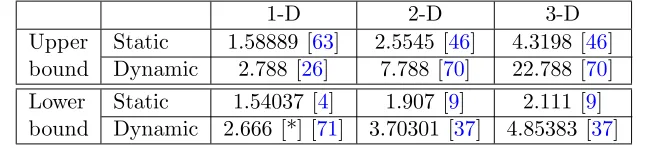
[image:30.595.118.443.80.154.2]Static 1.54037 [4] 1.907 [9] 2.111 [9] Dynamic 2.666 [*] [71] 3.70301 [37] 4.85383 [37]
Table 2.2: Asymptotic competitive ratios and lower bound results for online static bin packing and online dynamic bin packing of general size items. General size items have
lengths that are real numbers in (0,1]. [*] This result is also presented in Chapter3.
is received one at a time, without knowledge of future input, and an online algorithm must make an irrevocable decision on where to pack the current item.
FF can be applied to the online (static) bin packing problem and its approximation ratio directly translates into a tight 1.7-competitive ratio based on the result of [35]. There are many [23] online algorithms for bin packing. The current best algorithm, Harmonic++[63] has a competitive ratio of 1.58889. The algorithm works by defining types for the items based on their sizes and for each type the items are packed in dedicated bins which contain only items of one specific type. Harmonic++ defines 70 types of items, i.e., there are 70 disjoint subintervals of (0,1] which together fully cover (0,1]. The lower bound for this algorithm, which belongs to the class of Harmonic algorithms [68], was already established to be 19/12 ∼ 1.58333 [61]. The lower bound for any algorithm for online bin packing currently stands at 1.54037 [4].
In multi-dimensional online (static) bin packing, the bins have capacity 1 in each dimension and items have lengths in (0,1] in each dimension. In this thesis, we study the model where items are oriented and cannot be rotated. For two-dimensional online bin packing, the current best upper bound of 2.5545 is due to Han et al. [46], and they achieve this result by using a Harmonic-type algorithm. The best lower bound known is 1.907 [9]. Han et al. [46] also mentioned that their result can be applied to three-dimensional online bin packing and this gives an algorithm with competitive ratio 4.3198, improving the previous upper bound of 4.8354 [38]. The lower bound for any online algorithm for three-dimensional bin packing is 2.111 [9]. A more detailed survey by Epstein and van Stee [39] covers offline and online results for multi-dimensional bin packing. Table 2.2 gives a summary of the best results for online static bin packing and also provides a comparison with the results for online dynamic bin packing. It is interesting to note that Harmonic-type approaches currently give the best algorithms for online static bin packing. Unfortunately, some of these approaches may not be suitable for onlinedynamic bin packing, as we will discuss in the next section.
2.3
Online Dynamic Bin Packing
generalization was introduced by Coffman, Garey and Johnson [26]. In online dynamic bin packing, items arrive over time, reside for some period of time, and may depart at arbitrary time. Each item has to be assigned to a bin from the time it arrives until it departs. The objective is to minimize the maximum number of bins used over all time. Note that migration to another bin is not allowed, but rearrangement of items within a bin is permitted. In the online setting, the size and arrival time is only known when an item arrives and the departure time is only known when the item departs. For online dynamic bin packing, as usual, we measure the performance of an online algorithm using competitive analysis [11]. The subtle difference from online bin packing is that the maximum number of bins used by an online algorithm A and an optimal offline algorithm OP T are measured overall time. More formally, for any input I, we say thatA is c-competitive if there exists a constant b such that A(I)≤c OP T(I) +b for all I, where A(I) and OP T(I) are the maximum number of bins used by A and OP T, respectively, overall time.
In the remainder of this section, we will discuss the one-dimensional dynamic bin packing problem, showing how to obtain simple bounds for the First-Fit algorithm, before proceeding to online multi-dimensional dynamic bin packing where we describe previous algorithms by Epstein and Levy [37]. These discussions serve to introduce the reader to the more complex analysis in later chapters, where several algorithms are analyzed. State of the art results for online dynamic bin packing are summarized in Table 2.2, where they are compared against results for online static bin packing. It is interesting to note that the lower bounds for any algorithm for online dynamic bin packing exceed the upper bound results for online static bin packing, making online dynamic bin packing “harder” than its static counterpart.
2.3.1 Online one-dimensional dynamic bin packing
Coffman, Garey, and Johnson [26] initiated the study of the online one-dimensional dynamic bin packing problem. Among their results, they analyze the worst-case per-formance of the First-Fit (FF) algorithm (see Section 2.1 for a description) and pro-vide lower bounds for FF and any online algorithm. They showed that FF is 2.897-competitive and gave a lower bound for any online algorithm of 2.388. They also gave a modified version of First-Fit (FFM) that classifies items into two classes, items with size larger than 1/2 and smaller or equal to 1/2, and packs items of the first class in a dedicated bin and items of the second class according to the First-Fit rule. They show that FFM is 2.788-competitive.
To introduce the reader to the more complex analysis of bin packing algorithms in later chapters, we give a trivial method of proving a competitive ratio of 3 for FF, shown in [26]. We also show how a simple lower bound can be constructed for FF.
(i) FF uses the maximum number of bins when the last item is packed and not before.
(ii) No occupied bin ever becomes empty during the execution of FF on input sequences satisfying (i). Otherwise, if there is an occupied bin that becomes empty, we can consider the same sequence of items without all the items that are packed to that bin before the bin becomes empty. FF will work out the same final packing and the maximum number of bins used will remain unchanged.
Let FF(I) and OPT(I) denote the number of bins used by First-Fit and an optimal offline algorithmOP T, respectively, on any input I satisfying the above two conditions. Notice that by condition (ii) we can label the bins in increasing order and their labels do not change. The lowest index bin represents the longest occupied bin that FF uses and the highest index bin represents the latest occupied bin used by FF. We refer to binBi as thei-th bin opened by FF. Theload of a binBi, denoted byℓi, represents the
sum of sizes of items that have been packed inBi. Similarly, the total load Lof all bins
represents the total sum of loads of all bins. It is clear that an optimal solution requires at least⌈L⌉ bins.
Coffman et al. give the following two observations that are sufficient to prove the upper bound of 3. First, any item that is packed in binBj withj >2 OPT(I) must have
size greater than 1/2. Otherwise, if any item smaller than 1/2 is packed inBj, the load
of all bins beforeBj must exceed 1/2, i.e.,ℓi >1/2, for all i < j, and thus the total load
of all bins used by FF exceeds 2 OPT(I)×1/2. In this case, OP T would require more than OPT(I) bins to pack the load, which is a contradiction. The second observation is that there are at most OPT(I) items with size larger than 1/2, since more than that number requires more than OPT(I) bins. Then the upper bound of 3 follows.
Although the analysis presented above is simple, it contains important arguments when analyzing the performance of bin packing algorithms. We first want to ensure that when a new bin is opened, we can obtain a bound on the load of all other bins. Additionally, we want to deduce the sizes of items beyond a certain point in the packing configuration. Our approach in Chapters4and 5, albeit more complex, follows this line of arguments.
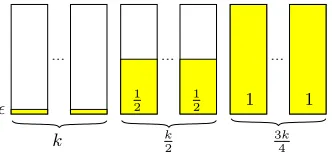
A lower bound of 2.25 for First-Fit. From an adversarial point of view, the lower bound construction aims to maximize the “wasted” space in a bin. For FF, we show how to obtain a simple 2.25 lower bound for online dynamic bin packing. Generally, lower bounds for dynamic bin packing consist of multiple stages and in each stage there may be item arrival and departure. Let k be an arbitrarily large integer andǫ = 1/k. We aim to show that FF uses 2.25k bins, while the optimal offline algorithmOP T uses k+ 1 bins. Then the competitive ratio of FF is at least 2.25. During the adversarial sequence, we keep the total load of items released and not departed to at mostk+ 1.
ǫ
k
1 2 1 2
k
2
1 1
3k
[image:33.595.235.401.79.159.2]4
Figure 2.2: The final configuration of FF achieved by the adversary for a simple 2.25
lower bound.
total load in the packing at this point becomesk×(1/2 +ǫ) =k/2 + 1. We now release kitems of size 1/2, accounting for a load ofk/2. No item can fit in any of the openedk bins, and FF packs them in k/2 new bins, two items in each bin. In Stage 2, we depart only one 1/2-sized item from each of the k/2 bins opened in Stage 1. Additionally, we depart a load of 1/2 ofǫ-sized items from each of the firstkbins. We are left withkbins each packed with oneǫ-sized item andk/2 bins each packed with a 1/2-sized item, with a total load of k/4 + 1. We can finally release 3k/4 items of size 1. FF packs each item in a dedicated bin, thus the total number of bins used by FF is 9k/4 = 2.25k. Figure
2.2shows the final configuration of the packing of FF.
What remains to show is that there exists an optimal offline algorithmOP T that can use at any time no more than k+ 1 bins. In Stage 0, all ǫ-sized items in the adversary that never depart are packed in one bin byOP T. The remainingǫ-sized items are packed as follows. The items that will depart in Stage 1 are packed in k/2−1 bins and the ǫ-sized items that depart in Stage 2 are packed ink/2 bins. OP T uses kbins in Stage 0. At the beginning of Stage 1,k/2−1 bins are emptied. OPT packs the new 1/2-sized items that never depart ink/4 of the emptied bins, and the remaining items ink/4 bins, opening only one additional new bin. In totalOP T usesk+ 1 bins. At the beginning of Stage 2,k/4 bins containing 1/2-sized items are emptied andk/2 bins containingǫ-sized items are emptied. The new 3k/4 items of size 1 are packed in the empty bins and at the endOP T uses k+ 1 bins. The lower bound of 2.25 then follows.
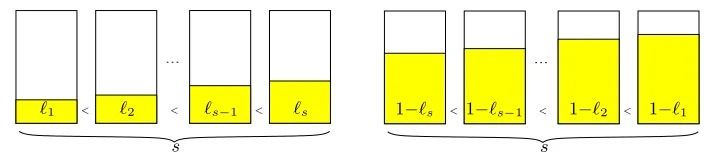
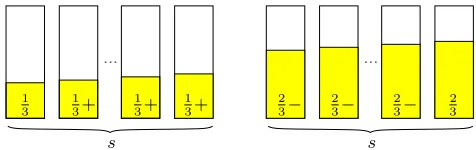
e.g., for some small ǫ > 0, three items of size 1/2 +ǫ (with total load 1.5 + 3ǫ) may not be packed in less than three bins, as any two items packed in the same bin would overflow the bin capacity. Our 8/3 ∼ 2.666 lower bound for any online algorithm in Chapter 3 is based on these observations and additionally a novel way of constructing the adversary, by using items of slightly different sizes and items with complementary sizes. Furthermore, Chapter 6 also gives adversaries for several online algorithms for multi-dimensional dynamic bin packing.
A note on Harmonic-type algorithms. Recall that Harmonic-type algorithms are used for online non-dynamic (static) bin packing. The algorithms define types for the items based on their sizes and for each type the items are packed in dedicated bins which contain only items of one specific type. We can see that for online dynamic bin packing such algorithms may not be suitable if the number of types defined is large. We can construct an adversary that releases items of one type at a time, then departs most of them from the packing, without emptying any bin, and proceeds to release items of a different type. Previously opened bins will not pack items of a different type, thus the wasted space in existing bins can be maximized. Nonetheless, for online multi-dimensional dynamic bin packing we use in Chapters 4 and 5 a classification of items based on their lengths (three and four classes for two- and three-dimensional dynamic bin packing, respectively) in order to get constant competitive algorithms. In fact, without any classification we show that, amongst other algorithms, First-Fit is not competitive for multi-dimensional dynamic bin packing in Chapter6. One of the aims in this thesis is also to strike a balance between the number of classes used and the performance of an algorithm. Indeed, the number of classes we define in Chapters4and5gives algorithms with good competitive ratios.
Before proceeding to online multi-dimensional dynamic bin packing, we briefly dis-cuss special types of input for the bin packing problem, in particular unit fraction and power fraction items, for which we initiate the study in the context of online multi-dimensional dynamic bin packing in Chapters4 and 5.
Unit fraction and power fraction items. Bar-Noy et al. [8] initiated the study of the unit fraction bin packing problem, a restricted version where all sizes of items are of the form k1, for some integerk >0. The problem was motivated by the windows scheduling problem [7,8]. Another related problem is for power fraction items, where sizes are of the form 21k, for some integer k ≥ 0. Bin packing with other restricted form of item sizes includes divisible item sizes [25] (where each possible item size can be divided by the next smaller item size) and discrete item sizes [22] (where possible item sizes are
Clearly items that have lengths real numbers in (0,1], which we call general size items, form a superset of unit fraction and power fraction items, and algorithms for general size items obtain the same worst-case performance for unit fraction and power fraction items. However, algorithms that exploit unit fraction input can obtain better worst-case performance for unit fraction items. For online dynamic bin packing, Chan et al. [18] obtained a competitive ratio of 2.4942 for First-Fit, which was recently improved by Han et al. to 2.4842 [47], while the lower bound for First-Fit was proven to be 2.45 [18]. The lower bound for any algorithm is 2.428 [18]. As FF is 2.4842-competitive for unit fraction items and the lower bound for any algorithm for online dynamic bin packing of general size items is 2.666 (Chapter 3 and [71]), online dynamic bin packing of unit fraction items is indeed “easier” than packing general size items. We also expect better competitive ratios for online multi-dimensional dynamic bin packing algorithms of unit fraction and power fraction items compared to packing general size items. This is in fact the case as discussed in Chapters 4 and 5. Table2.3 shows a comparison between competitive ratios of general size, unit fraction, and power fraction items.
2.3.2 Online multi-dimensional dynamic bin packing
In multi-dimensional bin packing the bins have unit size in each dimension and items have lengths that are real numbers in (0,1] in each dimension. For the two-dimensional (2-D) problem the input consists of a set of rectangles that must be packed in unit squares. Similarly, for three-dimensional (3-D) bin packing, boxes must be packed in unit cubes. Recall that we study the setting where items are oriented and cannot be rotated. As for online dynamic bin packing, migration of items between bins is not allowed, while rearrangement within a bin is permitted.
Epstein and Levy [37] initiated the study of online multi-dimensional dynamic bin packing. For 2-D, they give a 8.5754-competitive algorithm and a lower bound for any online algorithm of 3.70301. For 3-D, they present a 35.346-competitive algorithm and a lower bound for any online algorithm of 4.85383. In the construction of the lower bounds only items with lengths in each dimension being unit fraction (1/k, for k integer) are used and the lower bounds also apply to online multi-dimensional dynamic bin packing of unit fraction items. They also addressd-dimensional bin packing of boxes, ford≥2, and give an algorithm with a 2·3.5d competitive ratio and a lower bound of d+ 1.
We will give a brief overview of the 2-D algorithms in [37] for packing rectangles and afterwards compare them to the best-in-class results by Wong and Yung [70]. The overview and comparison should also help the reader observe some of the common ar-guments for getting competitive algorithms for online multi-dimensional dynamic bin packing, arguments that are also used in bin packing of 2-D unit fraction items in Chap-ter 4, and 2-D power fraction items and 3-D unit and power fraction items in Chapter
5.
containing the last item that has been packed, if it fits in that bin; if it does not fit, NF closes that bin and packs the current item in an empty bin. On its own, NF is not suitable for dynamic bin packing, due to the fact that a bin cannot be reopened after the current item does not fit in the bin. Some items may depart from the closed bin, leaving the bin almost empty, and the bin cannot be reused for subsequent items. Nevertheless, a two-dimensional variant of the algorithm, the Next-Fit Decreasing Height (NFDH) algorithm is used originally for offline bin packing and is adapted to the online dynamic model in [37]. NFDH is a level (shelf) algorithm which uses the next-fit approach to pack the sorted (by non-increasing height) list of rectangles. A level algorithm creates levels by drawing horizontal lines of length 1, and placing rectangles between consecutive pairs of lines, including the bottom and top of the bin. The two lines which form a level are called the “floor” and “ceiling” of the level or the “bottom” and “top” of the level. The additional lines are typically created online starting from the bottom, where the “floor” of the first level is the bottom of the bin. The rectangles are packed, left-justified on the floor of a level until the next rectangle does not fit. This rectangle is used to define the height of a new level and the packing continues on this level. A new level is defined just above the previous level. If a new level of the given height cannot be opened, a new bin is opened and the rectangle defines the first level of that bin. As opposed to the algorithm First-Fit Decreasing Height (FFDH), earlier levels are not revisited. The levels are numbered from bottom to top, according to the order they are created.
NFDH can be used in the online dynamic setting when a new item pi arrives in the
following way. Whenpi arrives, the algorithm attempts to pack it in the smallest index
bin in which it is possible. piis merged into the sorted list of items already packed in the
bin. Then NFDH uses the merged list of items to pack items according to its description. If the merged list can fit in a single bin, then the item is packed there. Otherwise, i.e., the merged list cannot fit in a single bin, we revert to the old configuration and NFDH attempts to packpi to the next bin. If none of the existing bins can fit the item, NFDH
packs pi to a new bin. Note that NFDH can be used in the online dynamic setting as
it only uses information about items already arrived and not departed in the packing. Epstein and Levy use NFDH for one class of items that satisfies some constraints on the item lengths, while the other items are packed in a different way as we will see next.
For online two-dimensional dynamic bin packing, Epstein and Levy give an algorithm called Rectangle Packing (RCP) that classifies the items based on their width and height. Letwi and hi denote the width and height, respectively, of item pi. Thenpi belongs to
one of the following four disjoint classes, which together cover all possible input.
Class 1 if wi>1/2 andhi>1/2;
Class 2 if wi>1/2 andhi≤1/2;
Class 3 if wi≤1/2 andhi>1/2; or
RCP packs the items in each class separately, independent of other classes, by us-ing sub-algorithms for each particular class. For each class of items, we can obtain a competitive ratio by comparing the sub-algorithm’s performance to an optimal offline algorithm that also packs items in each class separately, independent of other classes. Then, the overall competitive ratio of RCP is no larger than the sum of the competitive ratios of the composed sub-algorithms for each class. Class 1 items are each packed in a separate bin as no two items can fit in the same bin. As Class 2 items have width greater than 1/2, no two items can fit along the width of a bin, and we can use the concept of projection of a higher dimension item to a lower dimension item. We project along the width of the items and the problem is reduced to 1-D, for which First-Fit (FF) is used. A similar argument is used for Class 3 items. Finally, Class 4 items are packed using the online dynamic version of NFDH described above.
It is easy to see that Class 1 items achieve a competitive ratio of 1, as no two items of the same class can fit in a single bin. By using a parametric version of FF, where items have size at most 1/k, for some integerk≥2, Classes 2 and 3 both achieve a competitive ratio of 1.787682 for k= 2. The analysis for parametric FF with general k is given by Coffman et al. [26]. For NFDH, Epstein and Levy prove that if items have both width and height bounded by 1/k and a new item pi does not fit in any of the existing bins,
then the total occupied area of each existing bin (except possibly the last one) is at least (1−1/k)2. For k= 2, this results in Class 4 items achieving a competitive ratio of 4.
Overall, the competitive ratio of RCP is 8.5754.
The techniques of classifying items based on their lengths, repacking a list of items in a bin using a specific approach, parametric versions of algorithms, projection of a higher dimension to a lower dimension, and lower bounding the total area that items occupy in a bin are all used in designing and analyzing the performance of online algorithms for multi-dimensional dynamic bin packing. We also employ these techniques in Chapters4
and5. In these chapters we will in fact repack a list of items satisfying certain conditions using Steinberg’s algorithm [66] for offline two-dimensional strip packing [39,67].
Strip packing. In strip packing, a strip of finite width 1 and infinite height is given. The input consists of a list of rectangles (items) R1, R2, . . . , Rn, and each item Ri has
a given width wi and height hi. The goal is to pack the items into the strip such that