This is a repository copy of
Optical Breadboard Integration of a 3.5-THz
Quantum-Cascade Laser Local-Oscillator for the LOCUS Atmospheric Sounder
.
White Rose Research Online URL for this paper:
http://eprints.whiterose.ac.uk/140730/
Version: Accepted Version
Conference or Workshop Item:
Valavanis, A orcid.org/0000-0001-5565-0463, Auriacombe, O, Rawlings, T et al. (13 more
authors) Optical Breadboard Integration of a 3.5-THz Quantum-Cascade Laser
Local-Oscillator for the LOCUS Atmospheric Sounder. In: 8th ESA Workshop on
Millimetre-Wave Technology & Applications, 10-12 Dec 2018, Noordwijk, Netherlands.
This is the author's version of a presentation made at the 8th ESA Workshop on
Millimetre-Wave Technology & Applications.
[email protected] https://eprints.whiterose.ac.uk/
Reuse
Items deposited in White Rose Research Online are protected by copyright, with all rights reserved unless indicated otherwise. They may be downloaded and/or printed for private study, or other acts as permitted by national copyright laws. The publisher or other rights holders may allow further reproduction and re-use of the full text version. This is indicated by the licence information on the White Rose Research Online record for the item.
Takedown
If you consider content in White Rose Research Online to be in breach of UK law, please notify us by
Optical Breadboard Integration of a 3.5-THz Quantum-Cascade Laser Local-Oscillator for
the LOCUS Atmospheric Sounder
A. Valavanis(1), O. Auriacombe(2), T. Rawlings(2), Y. Han(1), S. Rea(2), M. Crook(2), C. Arena(3), D. Walker(4), D. Brooks(3), G. Yu(4), L. Li(1), A. G. Davies(1), G. Savini(3), E. H. Linfield(1), B. Ellison(2) and E. Saenz(5)
(1)School of Electronic and Electrical Engineering, University of Leeds
Woodhouse Lane, Leeds LS2 9JT, United Kingdom Email: [email protected]
(2)STFC Rutherford Appleton Laboratory Harwell Oxford, Didcot, OX11 0QX, United Kingdom
(3)Department of Physics and Astronomy, University College London
London WC1E 6BT, United Kingdom
(4)National Facility for Ultra Precision Surfaces
OpTIC Centre, St Asaph LL17 0JD, United Kingdom
(5)ESA-ESTEC
Keplerlaan 1, 2201 AZ Noordwijk, Netherlands
INTRODUCTION
An “elegant breadboard” system has been developed, which demonstrates the integration of terahertz-frequency (THz) sources, optics and compact cryocooler technology for the LOCUS satellite (Linking Observations of Climate, the Upper Atmosphere and Space Weather) [1]. This proposed satellite instrument has the aim of providing the first global mapping of key molecular species within the mesosphere and lower thermosphere (MLT) from low-earth orbit (LEO), using compact radiometers operating in the 0.8–4.7-THz band and a set of infrared detectors. The LOCUS THz radiometers will incorporate planar-Schottky-diode (SD) mixers, driven using waveguide-integrated local-oscillators (LOs). The LOs will be based on SD multipliers operating at 0.8 and 1.1 THz, and THz quantum-cascade lasers (QCLs) operating at 3.5 and 4.7-THz. A key technological challenge, addressed by the LOCUS elegant breadboard, is the integration of these components into a compact and robust satellite payload, including space-qualified cryocooler technology, and suitable fore-optics. In this paper, we discuss recent progress in QCL integration within the 3.5-THz channel.
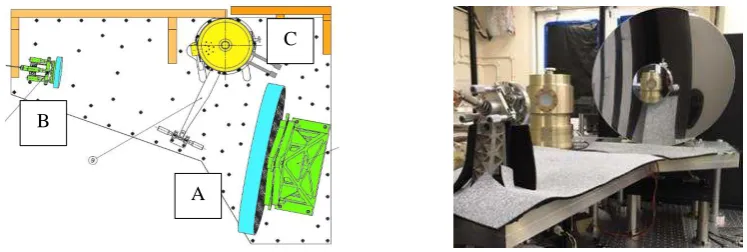
Fig. 1 (Left) Top-down CAD illustration of LOCUS breadboard: A, B = telescope optics, C = cryocooler. (Right) Photograph of fully-constructed system.
SYSTEM ARCHITECTURE
Figure 1 shows a CAD illustration and photograph of the LOCUS elegant breadboard system, which is constructed on a custom-machined aluminium supporting plate. A Cassegrain telescope configuration (A,B) is used for the fore-optics to yield a compact instrument envelope (< 1 m3). A 480-mm-diameter
diamond-A
C
[image:2.595.104.478.529.655.2]turned concave primary mirror, and 100-mm convex secondary were designed to yield 2-km atmospheric-layer resolution from an 800-km altitude, and onto a 25-mm focal plane diameter.
Fig. 2 (Left) Periscope arrangement of the horn receiver for an interim flight-usage of the breadboard. (Right): Low
[image:3.595.102.495.110.306.2]side-lobe performance of the overall beam with the periscope solution.
Figure 2 shows additional detail of the optical system design. Practical measures included within the design scheme include limiting the mirror aperture angle to 60° for compatibility with the available interferometers for system testing, limiting the bi-conical nature of the secondary mirror to avoid manufacturing complications during polishing, and introducing sufficient tilt into the optical path to allow placement of the cryostat for room-temperature tests. Although the outer cryostat enclosure would not be present within a final flight-model, the optical focal-plane in the test system lies within a compact, space-qualified Sterling-cycle cryocooler.
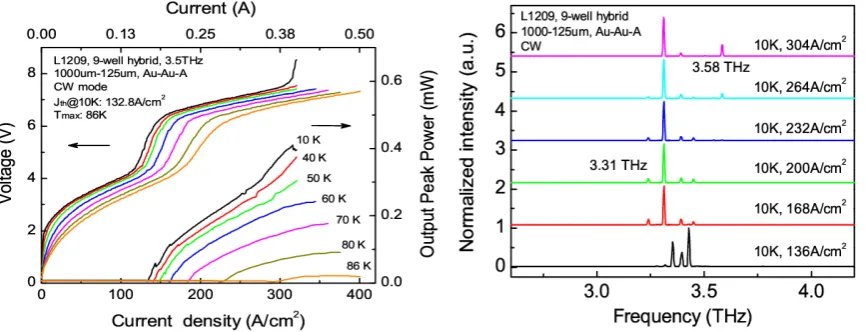
Fig. 3 (Left) THz output power and device voltage as a function of drive current-density for unmounted ~3.5-THz QCL. (Right) Measured emission spectrum, using Fourier-Transform Infrared (FTIR) spectrometer.
[image:3.595.85.518.447.613.2]emission spectrum was recorded using a Fourier-Transform Infrared (FTIR) spectrometer and a helium-cooled bolometric detector. A principal emission peak at 3.31-THz was found to dominate the spectrum, with ~15 dB side-mode suppression.
Fig. 4 (Left) 3.5-THz QCL mounted within a 150-µ m-wide waveguide channel. (Centre) Complete assembled QCL/waveguide enclosure, with diagonal feedhorn aperture visible. Inset: Simulated far-field beam pattern.
(Right) Far-field THz emission profile measured for the block-integrated QCL structure
A separate QCL was subsequently solder-mounted within a precision micro-machined 130-µm-wide × 75-µm-deep channel within an oxygen-free copper enclosure (Fig. 4:left), and ribbon-bonded to an integrated SMA connector. A second, symmetrical copper section was attached above the QCL to form a rectangular waveguide enclosure around the device. In contrast to our previous work [3], a single QCL ridge has been used, and a diagonal feedhorn (Fig. 4:centre) has been integrated into the waveguide structure to improve free-space coupling. The QCL waveguide block was mounted within the cryocooler and driven in continuous-wave (cw) operation using a dc current source. The cryocooler was found to provide sufficient heat-lift at the optimal QCL bias (3 W) and maintained a stable temperature of 60 K. The THz output power was measured using a photoacoustic power meter as > 8 mW, and the beamwidth was found to be 5–8°, using a raster-scanned Golay detector positioned in the far-field of the feedhorn antenna.
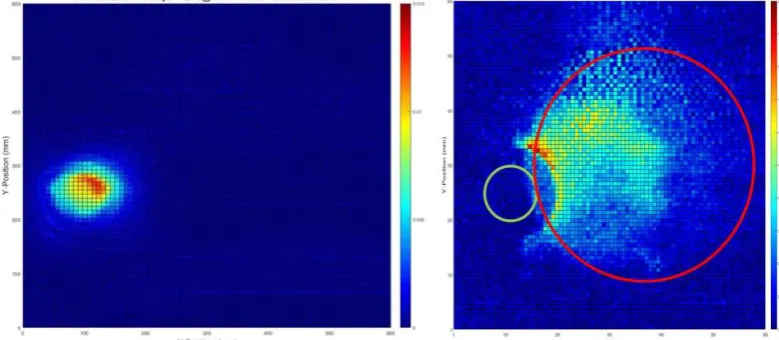
Fig. 5 (Left) Scan across breadboard optics, with secondary mirror removed. (Right) Measured near-field profile from Cassegrain optics showing location of primary and secondary mirrors (large and small circles, respectively).
[image:4.595.69.528.116.234.2] [image:4.595.101.491.442.612.2]CONCLUSIONS
In conclusion, we have integrated a 3.5-THz QCL local-oscillator, waveguide and feedhorn within a space-qualified cooler, and installed these within an “elegant breadboard” system containing a demonstration of the fore-optics for the LOCUS atmospheric sounder. The QCL emission profile has been optimised through the use of a waveguide-integration scheme and a diagonal feedhorn, resulting in an approximately symmetrical emission with 5–8° beam-width. We have demonstrated successful propagation of radiation through a custom-machined Cassegrain optical system, although additional alignment steps will be required to optimise performance. This is a key step in raising the technology-readiness level of core system components for the proposed LOCUS satellite instrument.
REFERENCES
[1] S. P. Rea et al., ‘The Low-Cost Upper-Atmosphere Sounder (LOCUS)’, in 26th international symposium on space terahertz technology, Cambridge, MA, 2015.
[2] G. Scalari et al., ‘Far-infrared ( ≈ 87 m) bound-to-continuum quantum-cascade lasers operating up to λ0 K’, Applied Physics Letters, vol. 82, no. 19, pp. 3165–3167, May 2003.
[3] A. Valavanis et al., ‘Mechanically robust waveguide-integration and beam shaping of terahertz quantum cascade