Featherston Military
Training Camp and
the First World War,
1915–27
Featherston Military Training Camp and the First World War, 1915–27
ISBN (web pdf) 978-0-478-18471-6
©
Crown copyright 2011
First published April 2011 by:
Manatū Taonga/Ministry for Culture and Heritage
PO Box 5364
Wellington
New Zealand
Permission to Reproduce this Report
Manatū Taonga/Ministry for Culture and Heritage, as the copyright owner, authorises
reproduction of this work, in whole or in part, so long as no charge is made for the
supply of copies, and the integrity and attribution of the work as a publication of
Manatū Taonga/Ministry for Culture and Heritage are not interfered with in any way.
Design and layout by Ahi Text Solutions, www.ahitextsolutions.co.nz
Contents
Preface 1
1 Featherston Camp and the camp system
3
A Wairarapa camp 3
Building Featherston Camp 6
2 Training
11
Infantry training 12
Mounted rifles training 14
Signallers and Engineers’ Signallers 15
Artillery and machine-gun training 15
Army Service Corps 18
Rimutaka march 18
3 How Featherston Camp worked
19
Camp administration 19
Food 20
Water supply and drainage 21
Showers and toilets 23
Motive power 25
Rubbish disposal 26
4 Health and hospitals
27
Camp hygiene 28
Hospitals 28
Tauherenikau Camp hospitals 34
1918 influenza pandemic 34
5 Camp life
36
Hutments and Canvas Camp 36
Church institutes 38
Soldiers’ Club and Officers’ Club 40
Canteen and shops 42
6 Featherston Camp after the Armistice
45
Hospital and prison, 1918–1920 45
Last years of Featherston Camp, 1920–1927 46
The site since 1927 48
7 The satellite camps
51
Tauherenikau Camp 51
Papawai Camp 54
Notes 57
Bibliography 68
Abbreviations 68
Published sources 68
Contemporary publications 68
Appendix to the Journals of the House of Representatives (AJHR) 68 Military manuals, regulations, and publications 69
New Zealand Gazette 69
Newspapers 69
Books, articles, chapters, reports, websites 69
Archival sources 70
Alexander Turnbull Library, Wellington 70
Archives New Zealand, Head Office, Wellington 70
Land Information New Zealand 74
Wairarapa Archive, Masterton 74
List of Figures
Figure 1: Featherston Camp land 6
Figure 2: Featherston Camp training ground leases 11
Figure 3: Deaths at Featherston Camp, 1916–1918 33
List of Maps
Map 1: Location map showing Featherston Camp, its training grounds,
and its satellite camps. v
Papawai Camp
226 acres (91.5 ha)
overflow camp 1915-16, extra training ground 1916, segregation camp 1917,
C1 camp 1917-18
repatriation farm 1919-1922
Jackson’
s Paddock
220 acres (89 ha)
Mounted training Ground Tauherenikau isolation camp
apx 10 acres (4 ha)
Papawai Rua mah an ga R iver Rimutaka Range Jury Hill To W ellington
State Highway 2
Bidwills Cutting Road
SH53
Boundary Road
State Highway 2
No. 1 Line
Lake W airarapa Camp Road To Martinborough To Masterton
State Highway 2
Papawai Road Fab ian s R oad Greens Road Morrison’ s Bush 0 1km Railwaysiding W ellington - Napier Railway
TAUHERENIKAU Tau her eni kau R ive r
Featherston Camp and training grounds
(see Map 2)
Tauherenikau Racecourse
GREYT
OWN
FEA
THERST
ON
Tauherenikau Camp and farm 570 acres (231 ha)
Burt’
s paddock
96 acres (38.9 ha)
Mounted training ground
Cundy’
s paddock
32.0.18 ac (13 ha) Artillery training
ground
Shops and
institutes block
52.2.24 acres (21.3 ha)
Railway siding
Canvas Camp 74 acres (29.9 ha)
25 y ar d rifle r ange W ells Camp Road FEA THERST ON Filt er -bed W at er -rac e Elgar ’s paddock
126 acres (51 ha)
Infantry training ground
Boundary Road
State Highway 2
Greens Road SH53 Ta uh ere nika u R ive r
Featherston Camp – 110.1.27 acres (44.6 ha)
1km
0
Tramway
Camp Road
Modern rest stop
hutment camp 1916-18, German
prisoner of war camp
and military
hospital 1918-19, ordnance depot 1919-26, Japanese prisoner of war camp
Preface
Featherston Camp was the largest of the military camps in New Zealand where reinforce-ments for the New Zealand Expeditionary Force trained during the First World War. Most army personnel trained at Trentham Camp from October 1914 until July 1915, when the Defence Department revised its training arrangements. From January 1916 Trentham and Featherston camps shared the bulk of New Zealand’s training needs, with Maori and Pacific Island troops based at Narrow Neck Camp in Auckland and medical reinforce-ments at Awapuni Camp in Palmerston North. Featherston Camp, together with its satel-lite camps at Tauherenikau and Papawai, could accommodate 9850 men in huts and tents. Its campsites and training grounds collectively covered 1861 acres (753 ha) of land in the Featherston–Greytown area.1 Around 60,000 New Zealand military personnel who
subse-quently served overseas spent time at Featherston Camp, about two-thirds of the total.2 The
government used the camp as a military hospital and German prisoner of war camp during 1919, and then as an ordnance depot until 1927. The army built a new Japanese prisoner of war camp there in 1942, which was closed in 1945.
This report is an offshoot of a book about First World War heritage sites in New Zealand currently being written by Imelda Bargas and myself for Manatū Taonga/Ministry for Culture and Heritage. The Ministry decided to utilise the research conducted for that pro-ject to create this more detailed report on the site’s First World War history. This reflects the Ministry’s role in commemorating New Zealand’s past military activities and the sites where they occurred. Featherston Camp is perhaps the most important surviving First World War-related site in New Zealand, in addition to its history as a prisoner of war camp in the Second World War.3 This report is not an exhaustive treatment of its subject, but
rather a first attempt to document the ‘whys’, ‘whens’ and ‘hows’ of the camp’s First World War history.
I’d like to thank Neill Atkinson, Imelda Bargas, Christine Barnett, Andy Dodd, Alec Dondertman, Damien Fenton, Neil Frances, David Green, John Hodder, Andrew Jourdain, Ian McGibbon, Natasha Naus, Adam Simpson and John Van Vliet for their assistance with this report and the ongoing heritage sites project. Morag Torrington created the maps, and Sarah-Jane McCosh carried out the design work.
1 Featherston Camp
and the camp system
A Wairarapa camp
Featherston Camp grew out of the need for a convenient, well-equipped, and safe place where the ever-increasing numbers of wartime recruits could receive their four or more months of military training before serving with the New Zealand Expeditionary Force overseas. In October 1914 the Defence Department had established Trentham Camp in the Hutt Valley near Wellington as a central training camp for all recruits. Initially this was a canvas camp for 2000 men. In January 1915 the Department decided to construct hut-ments for 120 officers and 3500 men, along with a few other buildings such as a military hospital. Work began in March, but overcrowding and wet weather delayed progress. New waves of recruits kept arriving at camp, pushing the numbers from 4000 men in January to 7000 in May, placing huge strain on the camp’s basic facilities. An outbreak of respiratory diseases, measles, and cerebro-spinal meningitis that hit Trentham between May and July 1915 overwhelmed the camp’s primitive medical facilities and killed 27 recruits. Trentham’s medical authorities called for the camp’s evacuation on 9 July. The recruits were relocated to overflow camps at Waikanae (on the coast north of Wellington), Rangiotu (17 km south-west of Palmerston North), Maymorn (5 km north-east of Upper Hutt), and Tauherenikau (between Featherston and Greytown in southern Wairarapa). A commission of enquiry blamed the outbreak on poor hygiene and overcrowding.1
Robin despatched Majors C.R. Macdonald and N.P. Adams in mid-July to inspect the Wairarapa district for a suitable site. The pair settled on a wide, flat open area of farmland near the small township of Featherston and the temporary training camp at Tauherenikau. The site had a number of advantages. It was near the railway line that connected the dis-trict with Hutt Valley and Trentham Camp, via the steep and windy Rimutaka Range. A short railway siding through adjacent farms would allow troops, equipment and goods to be delivered to the camp. The site’s gently sloping and stony ground would allow surface water to drain away easily – an important feature after the nightmarish mud and overflow-ing soak-holes at Trentham. The nearby Tauherenikau River would provide a ready source of water and roading metal. Perhaps most importantly, the men could be taught musketry at the nearby Papawai Rifle Range.3 On 24 July Robin formally recommended that the
govern ment purchase the site, and that it should allocate £50,000 (equivalent to $6.7 mil-lion in 2010) to buy the land and facilitate the camp’s construction.4 Cabinet agreed on 29
July.5
The campsite comprised several boulder-strewn and scrub-covered blocks of land straddling Tauherenikau Road, the main highway between Featherston and Greytown. Farmer Thomas McIvor accepted £1174 (equivalent to $156,400 in 2010) in compensa-tion for the loss of his 110 acre (45 ha) seccompensa-tion on the north side of the road. Ten absentee owners held title to small allotments of a 2.6 acre (1.1 ha) block adjoining McIvor’s farm, a hangover from a time when speculators hoped for close subdivision of the land around
Workmen building one of the Featherston hutments, 1915 (Stanbrook)
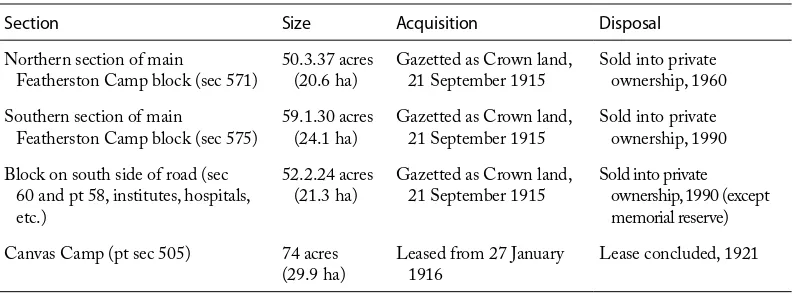
Featherston township. This block remained undeveloped, and the land purchase officer set to work purchasing the allotments. He presumed the sections could be taken under Public Works legislation if necessary. Mrs Margaret Burt owned a 52 acre (21 ha) block oppo-site the McIvor block which would be an ideal extension to the camp. She agreed to the Department’s offer of £684 9s ($91,200) as compensation. Charles R. Cundy and Alfred Tyer, two of Mrs Burt’s neighbours, were willing to lease paddocks to the government for the duration of the war.6 On 21 September 1915 the Governor gazetted the McIvor and
[image:14.595.100.498.274.421.2]Burt blocks as a camping-ground for defence purposes under section 225 of the Public Works Act 1908.7
Figure 1: Featherston Camp land
8Section Size Acquisition Disposal
Northern section of main
Featherston Camp block (sec 571) 50.3.37 acres (20.6 ha) Gazetted as Crown land, 21 September 1915 Sold into private ownership, 1960
Southern section of main
Featherston Camp block (sec 575) 59.1.30 acres (24.1 ha) Gazetted as Crown land, 21 September 1915 Sold into private ownership, 1990
Block on south side of road (sec 60 and pt 58, institutes, hospitals, etc.)
52.2.24 acres
(21.3 ha) Gazetted as Crown land, 21 September 1915 Sold into private ownership, 1990 (except
memorial reserve)
Canvas Camp (pt sec 505) 74 acres
(29.9 ha) Leased from 27 January 1916 Lease concluded, 1921
Building Featherston Camp
Robin reported that the Defence Department was too overworked to fix Trentham and build Featherston Camp on top of all its other work, and urged Allen to call in the Public Works Department to do the construction work instead.9 The Minister agreed, and on 22
July 1915 the government appointed Colonel E.H. Hiley, the current Director of Railway Transport and General Manager of the Railways, to act as director of a new Works Branch entrusted with camp construction. The role placed him in overall charge of a civilian work-force employed by the Public Works Department, under the management of Public Works Engineer-in-Chief R.W. Holmes, of Raurimu Spiral fame.10 Robin felt Hiley’s
appoint-ment would ‘ensure co-operation between the Public Works and Railway Departappoint-ment; and that the works are completed in accordance with the Military requirements.’11
The Defence Department initially intended Featherston Camp to be (as the Evening Post put it) ‘practically a replica of Trentham.’12 The earliest plans show a basic camp for
2500 men and 600 horses, with 50 hutments, latrines, cookhouses, a quartermaster’s store, a few administrative buildings, and space set aside on the south side of the road for a hos-pital, shops, and religious institutes.13 The broad concept changed little from start to finish,
self-sufficient administrative centre. On 11 August the Imperial government accepted New Zealand’s offer of two more infantry battalions for service overseas with the NZEF, and the Defence Department expanded the capacity of Featherston Camp from 2500 to 3500 men to accommodate the extra numbers.14 In mid-October it increased the capacity again
to 4500 men, meaning yet more hutments and administrative buildings, and a new Canvas Camp on an adjacent property – needing its own dining halls, ablution blocks, and other basic buildings.15 The number of hutments planned rose to 62 in September and 90 in early
November.16
These changing arrangements created a challenging working environment for Holmes and his men, who also had to contend with Hiley’s demands they work faster then they deemed possible. By 24 August 1915 there were 49 men on the site, preparing sleeping quarters for the main building workforce. The building materials had been ordered, and work had commenced on the railway siding and the surveying of drainage facilities.17 Hiley
grew anxious and frustrated by the slow progress, and urged Allen to complain to the Minister of Public Works. The 150 men on site by late September had completed (or nearly completed) only four hutments, two huts, one dining hall, one cookhouse, one wash-up, and one latrine.18 Progress had sped up by the beginning of October, with seven hutments,
two wash-ups, two officers’ huts, the quartermaster’s store, forge and shoeing shed, and two latrines completed. Two streets had been formed and half the drainage system built.19
Construction accelerated from October onwards as more workmen arrived at the site, with numbers peaking at more than 1000 in December.20
The high winds which would later plague recruits at Featherston made the construc-tion process difficult. The Defence Department had approved plans based on the ‘open air principle’: wide gaps were left in the eaves to ensure good ventilation (see Chapter 4). The workmen reported that the wind threatened to blow the semi-constructed hutments off their foundations and made life inside almost unbearable. Holmes reported to Hiley that even ‘with every door and window closed it is impossible to keep a kerosene lamp alight’ – let alone sleep.
In the officers’ hut used as an office, every paper had to be weighted to enable any work to be done; also the amount of rain driving up the eaves opening and falling into the rooms rendered them uninhabitable on the windward side. The wind, also, thus getting under the roofing material, causes it to flap so badly that it will soon be destroyed.21
The Defence Department eventually agreed that the ‘ventilation inlets’ could be blocked during wet or windy weather, but stipulated that they must be left open at all other times under the camp medical officer’s direction.22
The Public Works men met the Defence Department’s 23 January 1916 deadline for completion, and the 1400 men camped at Tauherenikau marched into Featherston Camp the following day.23 The Evening Post reported:
The camp, as might have been expected, was not quite finished yesterday when the troops entered. Some 300 men of the Public Works Department were still engaged in ham-mering and banging away, and it is anticipated that it will be three weeks or a month yet before they are finished. The administrative offices, shops, canteen, etc., are now receiving their final attention, and the hot showers will soon be ready. The cold showers, however, are already available. The electric light also should be turned on shortly, and the perma-nent canteen will be opened at the end of the month, a temporary one being run in the interim. The camp will not be fully occupied until Sunday next, when the 10th Infantry Reinforcements, who are at present enjoying their final leave, are due to return.24
The Department had also leased the 74 acre (30 ha) Tyer property, which adjoined the southern part of the camp, as a Canvas Camp to accommodate 2500 men, and this was ready for occupation shortly after the main camp. Tauherenikau Camp was empty after 24 January, but remained in use as a training ground. The Department also leased four pad-docks adjacent to Featherston Camp as training grounds and the Papawai rifle range for musketry training.25
towards a central gutter which carried surface water away. The Department gazetted the public highway as being part of a military camp from 12 March 1916, meaning it was ‘closed for traffic except with the consent of the military authorities’.27 The camp’s private
railway siding, which branched off the Wellington –Napier railway line near Featherston, allowed camp authorities to unload men and goods under covered awnings at the quarter-master’s and forage stores. The Works Branch extended the siding by building a tramway across the road to Canvas Camp.28
2 Training
The Defence Department trained all reinforcements (other than those earmarked for the Maori Contingent, the Medical Corps, and the New Zealand Tunnelling Company) at Trentham Camp between October 1914 and July 1915, but split the load between Trentham and Featherston camps from January 1916. Trentham and Featherston shared the training of infantry reinforcements, always the bulk of the NZEF’s fighting force, while Trentham retained the engineers. The mounted rifles, signallers, artillery and machine-gun specialists, and the Army Service Corps, all carried out their advanced training at Featherston. By 1918 the camp had 90 permanent instructors.1
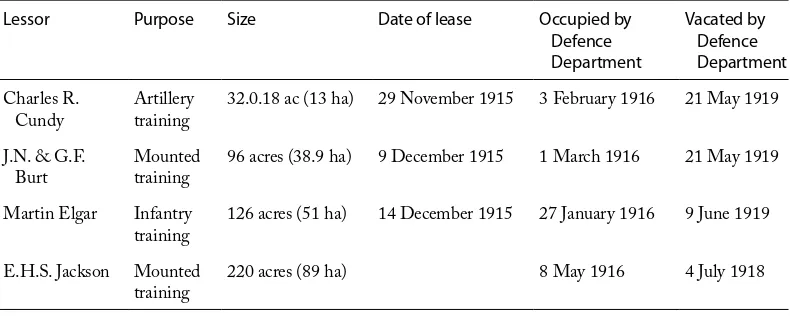
Training thousands of recruits at a time required a lot of space. Land purchase officer A.H. Kimbell leased five neighbouring paddocks from landowners, providing a total of more than 474 acres (191.8 ha) of training ground (824 acres / 333.5 ha, including the sometimes-vacant Tauherenikau Camp site). A 126 acre (51 ha) paddock adjoining the main camp, owned by farmer Martin Elgar, served as the main infantry training ground. The infantry and mounted men trained at the 96 acre (38.9 ha) Burt paddock, near the southern part of the camp and adjoining the 32 acre (13 ha) Cundy block used for artil-lery training.2 The camp authorities also used other local properties on an informal basis,
particularly for overnight camps. H. Morrison’s property at Morrison’s Bush (near Papawai Camp), in particular, saw regular use.3 The 226 acre (91.5 ha) Papawai Camp served the
[image:19.595.101.496.568.726.2]needs of the units requiring advanced musketry and machine-gun training (see Chapter 7).
Figure 2: Featherston Camp training ground leases
4Lessor Purpose Size Date of lease Occupied by
Defence Department
Vacated by Defence Department
Charles R.
Cundy Artillery training 32.0.18 ac (13 ha) 29 November 1915 3 February 1916 21 May 1919
J.N. & G.F.
Burt Mounted training 96 acres (38.9 ha) 9 December 1915 1 March 1916 21 May 1919
Martin Elgar Infantry
training 126 acres (51 ha) 14 December 1915 27 January 1916 9 June 1919
E.H.S. Jackson Mounted
Infantry training
The infantry made up more than half the NZEF’s overall strength throughout the war, with the proportion reaching 60% by 1918. In 1914 New Zealand worked to maintain a total of 4062 infantrymen in active service through a flow of reinforcements; by 1918 this number had more than tripled to 14,371.5 Infantry training imbued recruits with ‘soldierly spirit’,
improved their physical fitness, and taught them ‘the use of rifle, bayonet, and spade.’6 The
16-week infantry training programme began with three weeks of recruits’ drill and physi-cal training at Trentham, followed by four weeks – mostly spent at Featherston – of drill (from squad to platoon levels), physical training, bayonet-fighting, elementary musketry, individual training, and elementary night training. Final leave in the ninth and tenth weeks was followed by platoon and company drill, more night operations, physical training and bayonet-fighting, and advanced musketry.7 The other units shared many of these elements,
splitting off into more specialised training after their basic drill and musketry work was complete.8 More advanced training followed in England to flesh out the men’s
understand-ing of current conditions at the front.9
Drill helped instil ‘soldierly spirit’ by teaching the men to follow orders and act in unison. The infantry learnt most of the various phases of drill instruction on the Burt and Elgar training grounds. Drill in its most basic form consisted of learning to march in formation
with weapons, starting with small groups and moving to larger ones. Gradually the recruits moved into more advanced combat training, learning to attack and defend, and to engage in hand-to-hand combat. The main training grounds also featured a number of realistic west-ern-front-style trench networks. Recruits learnt to dig and reinforce these, and to attack from them.10
The recruits eventually left the camp neighbourhood for outpost work. Each reinforce-ment draft spent a night bivouacking in the open during a two-day march, at Morrison’s Bush, Papawai Camp, or ‘other broad, level fields somewhere in the intervening distance’.11
These expeditions taught the men how to make camp and put various aspects of training into practice. In some cases half the men defended Jury Hill while the other half attacked it at dawn.12
Most infantry musketry training took place on the long ranges at Trentham Camp. The lack of a full-scale rifle range at Featherston Camp was sometimes cited by critics as a failure on the part of the military authorities.13 The other units training at Featherston
mainly used the rifle range at Papawai Camp, though a 25 yard (22.9 m) rifle range was built at Featherston Camp’s northern extremity in early 1918. Captain J.A. Wallingford, reporting on musketry training at Featherston in April 1916, had recommended that the Defence Department build a 25 yard rifle range near the camp for ‘Miniature Rifle Work’ and ‘Landscape Target, Elementary Fire Direction and Machine Gun Training’. ‘I place great faith on this class of range’, Wallingford noted, ‘and go so far as to say that “A man can be trained for war thereon while we cannot train Machine Gunners without it.”’14 The
Defence Department built the Featherston range on the ‘sealed Hythe pattern’, with an 18 ft (5.5 m) high brick wall behind it to catch stray bullets. The Marlborough Express noted that the design was ‘the latest thing in rifle ranges’.15
Mounted rifles training
Mounted rifles units, which could move quickly, had played an important role in the South African (Boer) War of 1899–1902. As the Field Service Regulations put it, ‘Ability to move rapidly and to cover long distances in a comparatively short time gives cavalry power to obtain information and to obtain and to combine attack and surprise to the best advan-tage.’16 The realities of modern trench warfare diminished the value of mounted infantry
on the Western Front, and the numbers of mounted rifles declined as a proportion of the overall NZEF force. The mounted rifles stayed behind in Egypt to fight in the Middle East against the Ottoman Turks when the rest of the NZEF moved to France in 1916, so New Zealand continued to train mounted reinforcements at Featherston.17
Mounted recruits spent the first seven weeks of their course on the ground doing recruit training – drill, bayonet-fighting, attack and outposts, and musketry. The next four weeks covered basic training with horses, and the remainder was spent on the more advanced and strategic aspects of training (including a four-day mounted trek).18 ‘The mounted infantry
are the rovers of the camp’, noted journalist Will Lawson in 1917. ‘They may be met with in any part of the valley or hills, reconnoitring, scouting, map-making, or engaged in other of the many phases of their training.’19
Featherston Camp provided stable accommodation for 500 horses, along with a riding school and training grounds for mounted men. The camp’s designers laid the horse lines out along the camp’s eastern boundary, along with saddle rooms, harness rooms, guard rooms, and forage stores.20 The 20 open-sided stables, each housing 25 horses, featured concrete
floors, electric lighting, and waste-water drainage. Manure was collected in a ‘dung dump’ for incineration.21 The camp’s Veterinary Hospital treated horses for a variety of ailments
and illnesses. Each round of mounted recruits trained with the same horses, which lived at camp all year round.22
Signallers and Engineers’ Signallers
Signallers took charge of communication at the front, relaying messages between the com-manders and the front line. Trainee signallers moved around the district with a cable wagon, which allowed them to connect the camp with the training instructors, and the training men with each other, via field telephone. During artillery and machine-gun practice, signal-lers transmitted the order to fire and reported whether the shots had been successful. ‘The Signallers are always busy on the roads and hills’, Stanbrook wrote in 1917.
Their waggon, with its drum of insulated wire that is paid out by the roadside, is a famil-iar object to travellers in the district. From the waggon to stations, and from the flag-stations to the helios in the hills, headquarters keep in touch with all that is being done, and when the artillery and machine-guns are at battle practice the signallers of all grades keep the guns and targets in touch with the various signal centres, and with the camp.23
Though the Engineers trained at Trentham Camp, the Engineers’ Signallers trained at Featherston. They built an almost invisible underground labyrinth of trenches to practice signalling with flags, telephones and buzzers. Sections of trench had names such as Nesbit’s Nest, the Whispering Gallery, Hyde Park Corner, Lacey’s Lane, and Pall Mall. The under-ground parts of the trench system were lit only by lanterns.24
Artillery and machine-gun training
The Field Artillery provided the direct and indirect firepower the infantry and other units relied upon to suppress, disrupt or destroy their opponents, using both conventional artil-lery (such as 4.5-inch howitzers and 18-pounders) and later more specialised trench warfare
Artillery trainees shell Jury Hill, Papawai, c1917 (Stanbrook)
weapons such as trench mortars. Their 16-week training programme included instruction in the practicalities of handling larger weapons and their associated technology (communica-tions and signalling, digging trenches and building gun pits, etc.), in addition to the usual drill and musketry lessons. In their first three weeks recruits learnt foot and physical drill, rifle exercises, guard duties, and musketry. The next eight weeks were devoted to specialised technical training, animal management, mounted drill and signalling. Fire discipline, dig-ging, selection and occupation of positions, and gun practice kept them busy in the last five weeks.25
Cundy’s paddock, the main artillery training and parade ground, contained two lines of ‘properly constructed trenches’ by March 1917. An instructor demonstrated the devastating power of artillery that month by firing a trench mortar from one trench and destroying the other. ‘Subsequent inspection of the ground showed that considerable damage had been done,’ reported the Evening Post, ‘the stones being badly smashed. One of the bombs had landed fair in the trenches, and had proved very destructive.’26
The main gun practice was carried out on H. Morrison’s property at Morrison’s Bush near Papawai Camp, which backed onto Jury Hill (Pukengaki). There the larger artillery pieces, the howitzers and 18-pounders, were fired across the Ruamāhanga River at targets on Jury Hill around 3000 yards (2743 m) away. The Artillery Signallers viewed the shoot-ing from various vantage points and communicated with the gunners usshoot-ing flags, while the Engineers’ Signallers sent news back to the gunners via a portable telegraph that ran through a central cable wagon.27
Featherston Camp hosted a machine-gun section from mid-1916. A lack of instruc-tors had previously prevented machine-gun training, but the return to New Zealand of men who had used the weapons in action prompted the Defence Department to order six guns and establish a Machine Gun School.28 Recruits selected from the mounted rifles and
infantry received eight weeks’ specialist training in working the guns and associated tactical manoeuvres.29
Practical training took place at Papawai Camp, where eight machine-gun emplace-ments were laid out along the bank of the Ruamāhanga River facing Jury Hill (near the Morrison’s Bush property where the artillery trained). The flooded Ruamāhanga washed away the initial emplacements built by the 16th Reinforcements, but by September 1916 the 17th Reinforcements had constructed ‘model emplacements as good as any built within the same space of time … on the Western front’.30 Logs, sandbags and posts protected a
tunnel which opened into the circular gun chamber. The gunners received orders by field telephone from ‘headquarters’, a trench behind the emplacements.31 The men fitted out the
Army Service Corps
Recruits destined for the Army Service Corps, which supplied the forces with food, accom-modation and other necessaries of life, also trained at Featherston. Stanbrook noted in 1917: ‘The Army Service Corps waggon may rumble out … on a long trek, which will take them from camp for three days, during which they will go through every feature of their field training, even to recording in their note-books the crops available for fodder, the houses in which the troops might be billeted, and the food supplies available.’33 They
received their musketry training at Papawai Camp.34
Rimutaka march
The writer A.H. Reed recalled that as his period of training at Featherston drew to a close, ‘the prevailing topic of conversation was the impending “march over the hill”. Except for final leave this was the last big event of our New Zealand training.’35 Men packed their bags
on their final morning at Featherston Camp, then marched over the Rimutaka Range in full uniform and kit to complete their training at Trentham Camp. Columns of more than 1000 men marched the long arduous road over the hill, farewelled by the people of Featherston as they passed through the township. An ambulance followed the men up the hill, ready to take care of anyone who collapsed on the way. The ladies of the Wairarapa Patriotic Association prepared a hot meal at the summit, where a hut with tanks and boilers had been built for the purpose. The men bivouacked for the night at Kaitoke, at the southern foot of the range, where they could refresh themselves in the Hutt River. They marched to Maidstone Park for lunch the next morning, then carried out night operations in the Mangaroa Valley, near Upper Hutt. They marched into Trentham Camp the following day.36
3 How Featherston
Camp worked
Keeping Featherston Camp running was a major organisational feat. The camp could hold 7000 men at any given time, and the military authorities were responsible for housing them, feeding them, washing them, entertaining them, and disposing of their waste every day.
Camp administration
Colonel Noel P. Adams served as Featherston Camp commandant for the war’s duration, drawing experience from an earlier stint as Camp Adjutant at Trentham. Major Neville Newcomb and Captain J.W. Silcock acted as Adams’ adjutants, effectively the camp’s chief executive officers. Camp Quartermaster Major G.B. Banks, who reported to them, was in charge of clothing, equipment and sanitation.1 These men made up the camp executive,
and worked out of offices in the headquarters building along with a supporting team of clerks. They collectively managed most aspects of the camp’s daily administrative minutiae.2
The headquarters building also served as the hub of a precinct of administrative buildings located between the hutment camp and the railway siding adjoining Tauherenikau Road. The nearby camp records office managed the personnel files of all men in camp, and the
recruits called at the adjacent pay office to collect their weekly allowance. The building’s sturdy brick strongroom held the soldiers’ earnings.3
The eastern half of the camp’s administrative precinct consisted of a group of storage buildings and workshops. The railway siding terminated outside the camp’s forage store and quartermaster’s store, which served as an entrance-way to a courtyard of buildings hold-ing food, oil, disinfectant, and coal.4 The quartermaster’s store also housed equipment and
clothing.5 It was here that new recruits were issued with uniforms, bedding and other kit.6
The maintenance of camp facilities and gear was undertaken at the neighbouring work-shops, where the camp tailor, shoemaker, armourer, saddler, carpenter, blacksmith and elec-trician could all be found.7
‘Perhaps the most frequented place in camp’ according to Stanbrook, the post office was an important point of contact with the outside world. The men posted 1,134,140 items and received 1,250,650 during 1916, when it was the country’s fifth-busiest post office.8 The
‘compact and well-arranged building’ incorporated a ‘public office, with counters for parcel post, letters, money orders, savings bank, and … telegrams.’9
Food
Keeping the men fed was a daily challenge for the camp supply officer and his team.10 They
had to provide a daily ration of 6 lb 2¾ oz (2.8 kg) of food per man, amounting to around 21
tons (21,337 kg) of food for the whole camp. This included 9000 lb (4082 kg) of meat. The camp purchased fresh produce and bulk foods from the local markets, and sourced 400 gal-lons (1818 litres) of milk each day.11 Featherston Camp had its own bakery from August 1916,
which produced around 7000 lb (3175 kg) of bread every day by 1917 and as much as 9000 lb (4082 kg) in 1918.12 The brick bakery had four ovens capable of cooking 300 one-pound (454
g) loaves at a time. The ovens ran continuously, providing a constant supply of fresh bread. The bakery cost £800 (equivalent to $105,000 in 2010) to build, but was estimated to save the camp £3600 ($400,000) each year over what it would have paid a contractor.13
The camp cooks prepared meals in the six cookhouses at the centre of the hutment camp. Each cookhouse could cater for 1500 men in a single sitting using three cookers.14 The
eight dining rooms, each of which seated 600 men, were among the largest buildings in the camp.15 Shortly before mealtimes the men paraded beside their huts before being led into
the dining halls.16 The camp also had separate cooking and dining facilities for officers and
civilian workers. The officers’ mess contained a built-in kitchen and a dining room seating 200.17 The hospital block had its own cookhouses, dining halls and food storage buildings.18
Canvas Camp, too, had its own cooking and dining facilities.19
Water supply and drainage
The mud and drainage problems at Trentham ensured the Defence Department’s commit-ment to getting water into and out of Featherston Camp in an orderly fashion. The camp initially drew its drinking water drawn from two 40 ft (12.2 m) deep concrete-lined wells at its north-western extremity. An oil engine and an electric motor pumped the water up to a 13,000 gallon (59,100 litre) water tank on an elevated stand. Gravity created enough
pressure to propel the water into the cookhouses, medical buildings and other places where fresh water was required.20 Water use had to be restricted during dry periods when the level
in the wells dropped. This prompted the Works Branch to remodel the camp’s water sup-ply system towards the end of the war. The Branch constructed a concrete reservoir with settling tanks and sand-filters in a paddock adjoining the camp’s northern boundary. Water was diverted for 3 miles (4.8 km) to the reservoir from the Featherston–Longwood water race. By this means 160,000 gallons (727,360 litres) of filtered water could be provided to the camp each day.21
A network of watercourses carried water for ‘ablutions, stables, latrines, etc’ into the camp. Water was drawn from the nearby Tauherenikau River along a main water race which fed open watercourses that crossed the northern part of the camp and traced the western boundary. The water passed through filter beds before being piped around the camp.22 ‘In
all over 6¾ miles [4.2 km] of steel piping have been used in the reticulation of the camp, in sizes ranging from 8 inches [20 cm] downward, while nearly 700 taps have been connected’, wrote Stanbrook in 1917.23
The Public Works Department initially planned to have waste water (‘from the ablution-stands, cook-houses, showers, etc’) drain into four soak-holes at the camp’s southern end, but by December 1915 it had decided to pipe it through a central drain into a side-channel
of the Tauherenikau River.24 Rain ran into the concrete channels running down the centre
of the camp roadways, which helped to drain away surface water. Unlike those at Trentham, the buildings at Featherston were fitted with spouting which carried rainwater from roofs directly to drains.25 The Works Branch ‘remodelled and relaid’ the drainage system in the
main camp and Canvas Camp in 1918.26 The hospital block had its own septic tank,
ensur-ing that water polluted with medical waste wouldn’t enter the river system.27
Showers and toilets
Featherston Camp’s recruits washed in a single shower block situated in the south-western corner of the hutment camp. An eight-man shower cubicle for officers in the building’s centre divided two 50-man cubicles for the rank and file. The shower chambers ran length-wise, with dressing rooms between them and the external walls.28 Allowing 20 minutes for
each group to undress, wash, and dress again, 300 men could pass through the showers in an hour.29 The recruits could treat themselves to a cold shower any time between reveille and 5
p.m. daily, but hot showers were only offered in one of the shower chambers between 3 p.m. and 9 p.m. The men also had to shower on specific nights, as specified in Routine Orders.30
The shower block was beside the water race on the camp’s western boundary, allowing water to be drawn up easily into boilers at the rear of the bath-houses. The water supply and temperature could be monitored from the nearby powerhouse, meaning that – unlike at Trentham – the bath-house needed no dedicated staff.31
The camp’s toilet blocks lined the boundaries of both the hutment camp and Canvas Camp. Enclosed by a corrugated-iron wall, latrine blocks consisted of two rectangular toilet structures backing onto a narrow concrete cleaning channel.32 Men on latrine duty cleared
A bathing parade at the Ruamahanga River, Papawai Camp, c1917, with Jury Hill in the background (Stanbrook)
the ‘latrine drums’ from the toilet boxes twice daily, replacing them with clean drums lined with a little disinfectant. Men sprinkled a layer of sawdust into the drum after each visit. The cleaning crews cleaned the toilet seats and cubicles thoroughly, and replaced the mix-ture of sawdust and kerosene which lined the toilet box floors.33 The waste was carted off to
be incinerated or buried.34 Accounts of camp life suggest that waste was more often buried
in shallow trenches on neighbouring properties than incinerated.35 Free-standing urinals
also dotted the hutment camp, and there were ‘urine tubs’ on the end of each hutment for nocturnal calls of nature.36
Motive power
Featherston Camp used several forms of motive power. A powerhouse at the south-western corner of the hutment camp conveyed electricity (for lighting only) throughout the camp by overhead copper wires.37 The camp’s growth after January 1916 strained the capacity of
the original generators, leading the Works Branch to extensively overhaul the machinery. The camp met the cost of this work by selling electric current to the camp shopkeepers and neighbouring farmers.38 In 1917, a 125 BHP Westinghouse gas suction engine drove two
75 kilowatt Crampton generators, providing 3000 points of light across the camp.39 By
1919 three motors powered 5600 points of light.40 Coal and firewood fuelled the bakery
ovens, the incinerator, the cookhouses, and the various fireplaces around the camp. In 1917 the camp burned 60 tons (60,963 kg) of coal every week, along with 12 tons (12,193 kg) of coke and 32 cords (116 m³) of firewood.41 Oil engines and petrol pumps propelled water
into pipes and shower blocks (see page 23).
Rubbish disposal
Featherston Camp contained two incinerator blocks, built of brick and cement on a founda-tion of packed stone, with cast-iron doors and grates. The larger block, at the camp’s north-eastern corner, had four incineration chambers, including several traps designed for the disposal of faecal matter (though only sometimes used for that purpose).42 A smaller facility
served the needs of Canvas Camp. The incinerators appear to have had a dedicated staff, as Public Works draughtsmen drew up a plan for an ‘Ablution [building] for Incinerator Staff ’ in May 1916. This was to have two bathtubs and separate rooms for clean and dirty clothes.43 Men on incinerator fatigue kept the facilities ‘clean and wholesome’ by scrubbing
and spraying disinfectant. Camp standing orders forbade men on incinerator fatigue from wearing their normal clothes for this work, and they had to take a hot bath before visit-ing their hut or the dinvisit-ing halls.44 The Defence Department also established a pig farm at
4 Health and hospitals
The loss of life, expense and embarrassment caused by the Trentham epidemic in 1915 left the Defence Department anxious to keep the men in Featherston Camp as healthy as possible. Maintaining a constant flow of healthy reinforcements to the front also grew more important as the war progressed and the number of men left to enlist or be con-scripted declined. The military medics faced the complex task of keeping the huge num-bers of men in camp healthy, and, sometimes, of improving the health of men who were not quite healthy enough to enlist. The simple hygiene precautions and rudimentary camp hospitals described in the military manuals were clearly inadequate for camps of this size, scale and duration. The Defence Department increased the number, size and sophistica-tion of medical facilities at Featherston Camp as the war wound on. It also prescribed exacting standards of cleanliness to help keep illness and accident away. ‘The worst treated inhabitant of Featherston Camp is not the stray pup or the night duty man, but the disease germ’, wrote Stanbrook in 1917. ‘No housewife or sanitary staff wages such vigorous, scien-tific, and unremitting warfare against all bacteria harmful to the human body as is done at Featherston Camp.’1
Camp hygiene
The camp authorities rostered daily fatigue parties to take care of a variety of cleaning duties. One party scrubbed down the cookhouses, ensuring that grease-traps, gratings, taps, swill and refuse-tubs were spotless.2 ‘If a little grease is left in the corner of a tin, or a “rosy”
or “dixie” shows the least evidence of careless cleaning, the sergeant-cook knows what to expect,’ observed Stanbrook in 1917.3 A.H. Reed well recalled the exhaustive dining room
cleaning fatigue. ‘The tables, including table legs, and forms, were scrubbed. The concrete floor was swilled with water and scrubbed with long-handled brushes, the water being pushed out into the gutter, after which the floor was again scrubbed.’4 Another party
col-lected rubbish twice daily for incineration, their actions monitored by the camp’s ‘Sanitary Police’. Yet another collected rubbish from camp streets and kept the gutters clear.5 Latrine
fatigue, perhaps the bleakest job the camp had to offer, is described in Chapter 3.
The camp’s standing orders demanded that sleeping quarters be aired and cleaned every day. Hutment ventilation inlets had to remain open, except in wet weather, to ensure rooms were fresh and healthy. The hutments had to be washed out with hot water, soap and soda, at the direction of the Principal Medical Officer (PMO). Shelves were to be brushed off every day, and the huts thoroughly disinfected between groups of occupants. Tent doors were to be rolled up each fine morning to allow the maximum through-breeze, and their wooden bases were removed for cleaning once a week. Bedding and kits were to be aired outdoors as the PMO directed. Each soldier kept his own set of cutlery and was responsible for keeping it clean.6
In early 1916 H.B. Kirk, the Professor of Biology at Victoria University College, offered his services to help combat the spread of flies around the camp, noting that flies had spread dysentery at Gallipoli the previous year. Kirk reduced fly numbers significantly by placing fly-traps around the cookhouses, painting tree branches with insecticide and spraying the camp regularly.7 ‘There is no fermenting refuse about’, wrote Stanbrook, ‘and the places
[flies] usually frequent are veritable death-traps for them.’8
Hospitals
The district’s first military hospital opened at the Tauherenikau Racecourse on 12 July 1915, to treat the men at Tauherenikau Camp who were suffering from respiratory illnesses con-tracted at Trentham. Those more seriously ill were moved to Greytown Hospital for further treatment.9 The Works Branch laid out a wedge-shaped medical precinct at Featherston
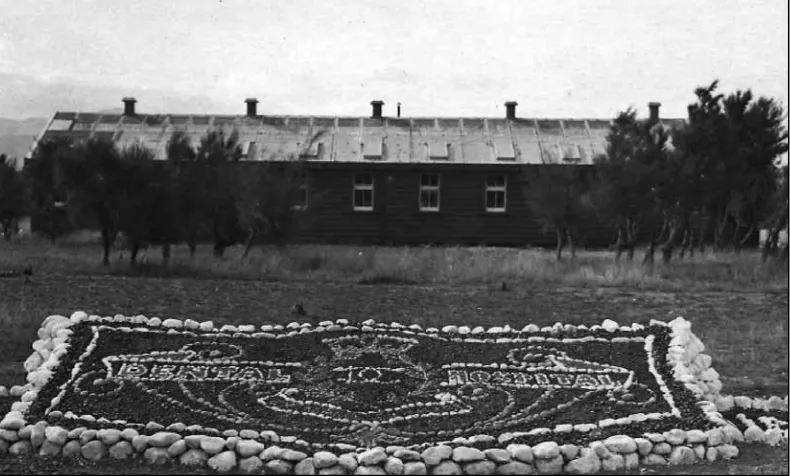
Camp in the spring of 1915. This included an octagonal ‘rotunda’ hospital, a medical inspec-tion block, and buildings for storage, food preparainspec-tion and accommodainspec-tion. The Branch preserved a belt of trees along the block’s eastern boundary, and laid out tidy pathways, neat lawns, shrubs and benches to provide a peaceful and attractive setting.10 A second rotunda
The camp hospital grounds, facing northwest towards the Salvation Army institute clock tower, c1917 (00-038-035, Wairarapa Archive)
The Featherston Camp medical section led a separate life from the rest of the camp, with its own accommodation, cookhouses and dining halls, and even its own drainage sys-tem. The two ‘partly open-air type’ rotunda hospital wards provided beds for 160 men.12
Each building consisted of an octagonal observation room with a rectangular ‘annexe’ wing attached to one side. The northern ward (Hospital No. 1) contained a treatment room, bathroom, kitchen and storage room, and a series of smaller wards. Hospital No. 2 con-tained an operating theatre and three other wards.13 These buildings embraced the
‘open-air’ treatment philosophy of the era, combating respiratory illnesses in part by ensuring a constant supply of fresh air. The rotunda wards featured ‘open sides that can be closed as desired, so that there is an abundance of fresh air for patients at all times.’14
Medical staff inspected all new recruits on arrival for signs of illness, and daily sick parades provided an opportunity for men in the ranks to step forward for treatment. An orderly corporal toured the huts and tents to note their names, and these men reported to the medical hut for inspection and treatment. ‘The total number attending sick parade each morning is considerable’, wrote Stanbrook, ‘because the men are impressed with the neces-sity of reporting sick if they have the slightest thing wrong with them.’15 In 1917, 6277 men
were admitted to hospital.16 Patients assembled at the medical inspection block to be seen
by a doctor in the examination room.17 The building was extended in 1916 to enlarge the
waiting rooms and provide an office for a camp chiropodist.18 The camp also provided an
inhaling-chamber in which men with colds could have their throats sprayed with the drug chloramine T, a treatment that was soon said to be achieving ‘remarkable results’.19 By 1917
The Defence Department established the New Zealand Dental Corps in November 1915 to treat soldiers’ teeth both before and during combat. Many recruits were turned away from service because of the state of their teeth, and the military dentists worked hard to provide basic treatment that would allow the men to enlist.21 Heavy demand for
dental treatment overwhelmed the camp’s six-chair dental surgery, and the Works Branch doubled its size in April 1916.22 By 1917 the camp surgery employed 13 officers and 39
NCOs.23
The prevalence of venereal disease (VD) amongst soldiers – both returned servicemen and recruits fresh from the civilian community – led to the establishment of a VD ‘lock hospital’ at Featherston Camp in mid-1916. As the war progressed and the supply of fresh recruits grew harder to maintain, the army committed itself to treating recruits with vene-real disease rather than turning them away on medical grounds. The 23-bed building, based on the hutment design, was fenced off from visitors and fitted with separate toilets, showers and drying rooms to isolate contagion.24 Hiley insisted that the lock hospital be surrounded
by an ‘insurmountable’ 7 ft (2.1 m) barbed wire fence, with only one gate for access.25 Those
who couldn’t be treated at Featherston were despatched to Quarantine Island in Otago Harbour for further treatment.26
W
ar
d f
or
‘v
ener
eal pa
tien
ts
’ a
t F
ea
therst
on C
amp
, sur
rounded b
y a sev
en f
oot high bar
bed wir
e f
enc
e
(PWD plan 40302, ABZK W5433 b
ox 31, A
rchiv
The Defence Department built an isolation ward complex at the southern end of the camp in early 1917. The Evening Post reported in January 1917 that the hospital was:
intended specially to provide for measles cases, and there will be an annexe for the recep-tion of cerebro-spinal meningitis patients whom it is considered desirable to isolate. The hospital should be erected within three months, and should thus be available before the winter months produce their normal increase in the amount of sickness among the troops.27
[image:41.595.101.496.508.746.2]Seasonal illness persisted despite these precautions, though outbreaks on the scale of the Trentham epidemic were avoided (at least until the 1918 influenza pandemic). Deaths remained relatively rare, given the large number of men passing through the camp:
Figure 3: Deaths at Featherston Camp, 1916–1918
28Year Disease Accident Suicide
1916 37 1 2
1917 17 5 7
1918 172 1 1
TOTAL 226 7 10
NB: around 60,000 men in total trained at Featherston Camp during these three years
Tauherenikau Camp hospitals
Several small hospital facilities monitored the health of those based at Tauherenikau Camp. The Tauherenikau Racecourse hospital remained open throughout the war, and the Department extended the racecourse totalizator building in 1916 to accommodate 30 patients.29 Tauherenikau Camp also had its own Isolation Camp on the opposite side of the
road. With a frontage of 8 chains (161 m) and covering about 10 acres (4 ha), this land was leased initially from landowner A.W. Wilkinson and subsequently from the Public Trust on behalf of his estate.30 The Isolation Camp centred on a medical hut which included an
inhaling room, an inspection room, a dispensary, and doctors’ and orderlies’ quarters. A two-bed ward could accommodate urgent cases before they were transported to the hos-pital at Featherston Camp.31 641 men passed through the Isolation Camp in 1917 alone.32
The Department’s use in 1917 of Tauherenikau as a segregation camp to separate new (and potentially ill) recruits from the rest of the troops is discussed in Chapter 7.
1918 influenza pandemic
The 1918 influenza pandemic which claimed around 8000 lives in New Zealand, killed 284 men in New Zealand training camps – including 172 at Featherston Camp.33 The first
signs of illness occurred at the Tauherenikau C1 Camp, where men who had arrived from Auckland on 24 October for fitness training (see Chapter 7) began to show signs of illness. Lieutenant-Colonel R.J. Makgill attributed this outbreak to overcrowding on the troop train that brought the men south. The numbers of the ill grew steadily in late October. The pandemic hit Featherston Camp with full force when the men returned from weekend leave on 4 November – the camp doctors recorded 137 new cases that day. The number of new cases climbed each day, peaking at 418 on the 7th, after an exceptionally stormy night on which many camp buildings and tents were wrecked by wind. This led to the men being crowded into small spaces, accelerating the spread of disease.34
Memorial to men who died at Featherston Camp, Featherston Cemetery, October 2010 (Bargas & Shoebridge/MCH)
were saved and illnesses averted by its use during the epidemic in camp’, wrote the camp’s Principal Medical Officer.35 The total number of ill men peaked at 2462 on 11 November,
and gradually declined thereafter.36 The camp hospitals treated 3174 men during November,
but admitted only six new cases in December (when most men had left).37 In late 1919 the
5 Camp life
Camp facilities had few home comforts, and this was not only in the interests of economy. The camp helped enforce the communal living and thinking of military life by ensuring men trained, ate, washed and slept at close quarters and in large numbers. Such conditions were not enforced on officers or civilians, who had partitioned sleeping quarters and rela-tively private dining, washing and ablution facilities.
Hutments and Canvas Camp
The hutments built at Trentham between March and July 1915 provided a basic template for those designed for Featherston Camp shortly afterwards. The Trentham hutments had been loosely based on photographs of hutments built by the British army in 1914. The Department employed a group of civil, medical and military experts to design a hutment for local conditions, briefing them to maximise space and ensure a healthy living environment. The Trentham huts, which were 140 ft (42.7 m) long by 22 ft (6.7 m) wide, were used to accommodate 100 men in two compartments of 50, despite contemporary British military thinking that each compartment was suitable for only 30. The huts were clad in corrugated iron. The men dined in the hutments and slept on the floor on straw-stuffed mattresses. A four-inch (10 cm) gap running the full length of the eaves ensured a constant supply of fresh air. The camp lacked drying facilities so clothes remained wet, and mud was walked into the huts onto the surfaces on which men slept. The Trentham Camp Commission
found that the overcrowded and unsanitary conditions had contributed to the men’s poor health and aided the rapid spread of respiratory disease.1
The Featherston plans drawn up in August 1915 showed that the Defence Department had absorbed the lessons from Trentham. The Featherston huts would be smaller – 120 ft (36.6 m) by 20 ft (6 m) – and house half the number of men. Each hut was divided into two 24-man sleeping compartments, with an NCO in a separate cubicle in the corner. Each man had a wooden stretcher lined with a straw-stuffed mattress. There was a shelf above his bed, and a space for a rifle and a pair of shoes beside it. A narrow central room fitted with a stove to dry wet uniforms bisected the sleeping compartments. In contrast to Trentham, the Featherston huts lacked trestle tables and chairs. Instead, the men ate in dining halls and spent their evenings in the church institutes.2 Each of the sleeping compartments was
considered a separate hut, so the hutments were numbered 1 to 180 despite there only being 90 separate buildings.3
The Works Branch painted the Featherston hutments cream with red facings, and fit-ted them with grey malthoid (tar matting) roofs.4 The huts were clad with unlined
tim-ber, which was thought to provide a warmer and more pleasant living environment than Trentham’s corrugated iron. The ventilation gaps in the eaves were reduced in size, and 12 large windows in each sleeping compartment allowed in plenty of light.5 The recruits
com-peted daily to have the cleanest and most orderly hut, with the reward of a silver cup and sometimes a small increase in their leave allowance.6
The layout of the sleeping quarters for other personnel was less concerned with familiar-ising the occupants with communal living and military discipline. Sixteen officers’ hutments on the boundaries of the hutment camp each accommodated 10 officers in separate sleeping cubicles. Each officers’ hut had an ablution room and showers.7 The accommodation for
orderlies fell between these two extremes, with sleeping quarters for 24 adjoining central ablution and shower rooms.8 Huts for civilian employees provided sometimes quite
spa-cious and private sleeping quarters.9
The camp authorities regarded Canvas Camp as a separate camp with its own amenities and leadership, even though it adjoined the main hutment camp. It had its own dining halls, cookhouses, ablution blocks, drying rooms, and ASC store.10 Recruits spent most of their
time at Featherston sleeping in hutments, before being shifted to tents for the last phase ‘to harden [them] up for the more strenuous work ahead.’11 Canvas Camp accommodated
2500 rank and file men in eight-man tents with wooden bases that kept them off the ground. Stanbrook noted in 1917 that the tents had been ‘laid out in the ordered exactness of a model township’.12 The men gathered and whitewashed large stones, which they used
to surround their tents, line pathways and create decorative rock gardens. The stones also helped to shelter the men from the prevailing high winds.13
Church institutes
Featherston Camp’s four church institutes provided the soldiers with a place to relax, write letters, play indoor games and attend concerts, lectures and religious services. The evan-gelical Young Men’s Christian Association (YMCA) had operated spaces for letter-writ-ing and recreation at pre-war Territorial trainletter-writ-ing camps, and got permission to establish a
facility at Trentham when this opened as a permanent camp in late 1914.14 By June 1915
Trentham could boast a further five institutes, operated by the Salvation Army, the Church of England, and the Catholic, Presbyterian and Methodist churches.15 These groups also
maintained institutes under canvas at Territorial training camps during the war.16 The
Defence Department agreed to construct buildings for each group with camp labour, pro-vided the churches covered the cost of construction and ongoing operational expenses.17
Several of the churches decided to extend their operations to Featherston Camp while it was being planned in the spring of 1915. The Church of England built a smaller version of a large new institute that was being built at Trentham.18 The Public Works draughtsmen drew
up a standard church institute plan for use at Featherston. The Salvation Army adopted this for its institute, which was built by the Works Branch in late 1915 or early 1916 (a clock-tower was added in mid-1917).19 The Catholic Church adopted the same stock plan for
its institute, which was built after the camp had opened.20 The YMCA combined with the
Church of Christ and the Presbyterian, Methodist, Baptist and Congregational churches to fund the construction of a huge three-halled building behind the three other institutes. This ‘United Institute’ opened in May 1916.21 The Defence Department agreed to carry
out ongoing maintenance work on the institute buildings, which had cost it £11,096 7s 5d (equivalent to nearly $1.1 million in 2010) by the end of the war.22
Men of any (or no) religious belief were welcome in all the institutes, though each housed a chaplain for the relevant denomination and a chapel for worship. The chaplains led church services and parades each Sunday, provided spiritual counsel to individuals, and visited the sick in hospital. Some men sought to reinvigorate their faith through confirmation before facing the front, while others asked the chaplains to witness their wills – or even granted them power of attorney in case they returned incapacitated.23 The institutes provided a
space for social activity and entertainment as well as quiet reflection. All offered a variety of indoor games ranging from billiards and playing cards to shuffleboard, draughts and ping-pong.24 Travelling musicians and local patriotic societies staged concerts in the institutes,
and visiting speakers lectured the men on a variety of religious, secular and military topics. The public donated books and magazines to the institute libraries, while the churches pro-vided writing paper and envelopes so the men could keep in touch with family and friends. They penned hundreds of thousands of such letters each year.25
Soldiers’ Club and Officers’ Club
In late 1915 the government agreed to split the cost of building extensive and well-equipped soldiers’ and officers’ clubs at Trentham and Featherston camps with local patriotic socie-ties. These clubs, which filled the same purpose as the church institutes, were operated by the YMCA. The Wairarapa Patriotic Association and the government each paid half of the £1200 ($157,000 in 2010) construction bill for the Featherston Soldiers’ Club, which opened with the rest of the camp in January 1916.26 Far larger than the church institutes,
the Soldiers’ Club comprised a concert hall, a reading and writing room, and a ‘social room’, and was managed by a live-in caretaker.27 The building was subsequently extended to
pro-vide separate spaces for noisy games such as billiards and ping-pong and quieter games like draughts and chess.28
The Officers’ Club was similarly spacious, and included the officers’ dining hall.29
Stanbrook described the building’s slightly different function from that of the men’s insti-tutes and Soldiers’ Club:
The spacious dining-room seats 200 officers comfortably, and the arrangement of the adjoining kitchen and pantries enables the staff to serve meals to this large number without any loss of time. Leading off the mess-room is the ante-room, with its easy chairs and open fireplace, and next to this is the billiard-room. Here there are three well-lighted tables and all the required fittings. The room also contains a piano and an abundance of easy chairs, while opening onto it is the bar, where soft drinks and smokes are on sale. The writing-room is in a small wing apart, and provides a quiet retreat to which the officers can retire after their strenuous day in the field and attend to their mail.30
Canteen and shops
The men could buy extra food and other goods at the camp canteen with their weekly allowance of 4s ($20–$25). At 208 feet (63.4 m) long by 52 feet (15.8 m) wide, the canteen was one of the camp’s largest and most conspicuous buildings.31 Stanbrook noted: ‘At the
canteen the soldier is able to buy clothing, toilet requisites, fruit, soft drinks, all kinds of tinned goods, cigarettes and various tobaccos, stationery, hot tea and coffee, cakes and meat pies – in short, the canteen has nearly everything for the man who has money to spend.’32
An on-site bakery provided fresh food.33 One thing the canteen could not sell was alcohol.
From February 1915 it was illegal to sell alcohol to soldiers in uniform except to drink on the premises where they were sold, and from November 1915 it was illegal for anyone to possess alcohol on the grounds of a military camp.34 The Defence Department initially
contracted private operators to run the canteen, but cancelled the contract early in 1918 so that it could be run by C2 men (those classified medically unfit for military service) on behalf of the Department. This both lowered prices for the soldier and generated some income for the Department.35
The Department also allowed private businesses to operate in the grounds of the camp. The shopkeepers paid both rent and trading rights to the Department, and opened at times prescribed by the camp authorities (7–8.30 a.m., 12–1.30 p.m. and 4.30–9.30 p.m. on week-days; 12–9.30 p.m. on Saturdays).36 This arrangement provided basic services to the recruits
and also helped meet the huge costs of operating a military camp.37 By May 1916 the
shop-keepers at Trentham and Featherston camps had collectively paid the Department £20,750 (equivalent to more than $2.6 million in 2010) in rent and trading rights.38 The shops at
Featherston included military outfitters, bootmakers, a laundromat, baths, a watchmaker and jeweller, a hairdresser, a bowling alley, and a recreational indoor rifle range.39
Camp and community
Recruits at Featherston Camp had many opportunities to interact with the outside world during their training. The camp opened its gates to visitors between 2 p.m. and 6 p.m. on Saturdays, and 11 a.m. and 6 p.m. on Sunday. Outside these times the permission of the camp headquarters was needed.40 The recruits could also apply for leave from camp on
cer-tain evenings and weekends, in addition to their week-long home leave in the final weeks of training. A special train carried men to Masterton on Wednesday evenings, Saturday afternoons, or for the weekend, and another took men to Wellington for the weekend.41
Masterton residents billeted soldiers on weekend leave, and Wednesdays featured weekly ‘evening entertainments’ at the Masterton Town Hall (Opera House).42
The men could similarly apply for weekend leave in Wellington. Camp rules allowed them to visit Featherston or Tauherenikau during their time off without applying for leave, so long as they were back in camp by the allotted hour.43 The men regularly visited Featherston
and other neighbouring towns for food, companionship and entertainment, generating a lively taxi trade centred on the camp. ‘Dozens of motor-cars ply for hire between the town-ship and the camp, carrying officers and men who are going on leave or returning’, observed the Evening Post in September 1916. ‘The taxi business is booming at Featherston.’44 The
camp standing orders strictly regulated the fares taxi drivers could charge, the authorities evidently fearing exploitation.45 The recruits were soon a familiar sight around the towns,
particularly Featherston.