This is a repository copy of
Recurrent cerebellar architecture solves the motor-error
problem
.
White Rose Research Online URL for this paper:
http://eprints.whiterose.ac.uk/1431/
Article:
Porrill, J., Dean, P. and Stone, J.V. (2004) Recurrent cerebellar architecture solves the
motor-error problem. Proceedings of the Royal Society B: Biological Sciences, 271 (1541).
pp. 789-796. ISSN 0962-8452
https://doi.org/10.1098/rspb.2003.2658
[email protected] https://eprints.whiterose.ac.uk/ Reuse
Unless indicated otherwise, fulltext items are protected by copyright with all rights reserved. The copyright exception in section 29 of the Copyright, Designs and Patents Act 1988 allows the making of a single copy solely for the purpose of non-commercial research or private study within the limits of fair dealing. The publisher or other rights-holder may allow further reproduction and re-use of this version - refer to the White Rose Research Online record for this item. Where records identify the publisher as the copyright holder, users can verify any specific terms of use on the publisher’s website.
Takedown
If you consider content in White Rose Research Online to be in breach of UK law, please notify us by
Published online4 March 2004
Recurrent cerebellar architecture solves the
motor-error problem
John Porrill
*, Paul Dean and James V. Stone
Department of Psychology, The University of Sheffield, Sheffield S10 2UR, UK
Current views of cerebellar function have been heavily influenced by the models of Marr and Albus, who suggested that the climbing fibre input to the cerebellum acts as a teaching signal for motor learning. It is commonly assumed that this teaching signal must be motor error (the difference between actual and correct motor command), but this approach requires complex neural structures to estimate unobservable motor error from its observed sensory consequences. We have proposed elsewhere a recurrent decorre-lation control architecture in which Marr–Albus models learn without requiring motor error. Here, we prove convergence for this architecture and demonstrate important advantages for the modular control of systems with multiple degrees of freedom. These results are illustrated by modelling adaptive plant compensation for the three-dimensional vestibular ocular reflex. This provides a functional role for recur-rent cerebellar connectivity, which may be a generic anatomical feature of projections between regions of cerebral and cerebellar cortex.
Keywords:cerebellum; motor control; vestibular
1. INTRODUCTION
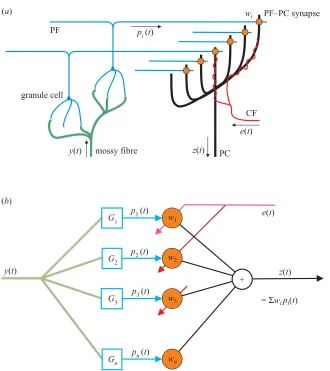
Investigations of the structure and plasticity of the cerebel-lar cortex have revealed a basic cerebelcerebel-lar microcircuit (Ito 1984), which is repeated throughout the cerebellar cortex, in which information about the current sensory and motor state of the organism is obtained from the mossy fibre inputs to the cerebellum and distributed across the parallel fibre (PF) inputs to Purkinje cells (PCs) (see figure 1a). PCs also receive an input from a single climbing fibre (CF) and in Marr–Albus models (Marr 1969; Albus 1971) this input can alter the efficacy of PF–PC synapses. This microcircuit has been interpreted as an adaptive filter (see figure 1b; Gilbert 1974; Fujita 1982), which can be used to correct or fine-tune future motor behaviour based on current errors in performance. One of its major roles is thought to be the translation of ‘simple’ motor commands into the detailed instructions required for accurate move-ments (Brindley 1964; Marr 1969), a task that entails the adaptive compensation of the time-varying biological motor plant (muscles, tendons, linkages, etc.). However, the neu-ral architecture required for an adaptive filter to perform plant compensation has proved difficult to identify.
Feedback error learning is the most complete current model of the role of the cerebellar microcircuit in plant compensation. It is based on the architecture shown in figure 2a, which corresponds to fig. 2aof Kawato (1990) and fig. 1bof Wolpertet al.(1998), and its properties can be derived informally as follows. The cerebellar filter C can be regarded as a single-layer neural net with adjustable weights, hence the training signal required for gradient descent learning is the errore˜(t) in the output of C. This is the difference between the actual and desired motor commands and is commonly called the motor error. How-ever, the motor-error signal is not directly observable because the output of C passes through the motor plant
*Author for correspondence ([email protected]).
Proc. R. Soc. Lond.B (2004)271, 789–796 789 2004 The Royal Society
DOI 10.1098/rspb.2003.2658
P before producing its sensory consequences. Only the sensory effects of motor error, which we will term sensory errore(t), are directly observable. However, sensory error would not be a satisfactory training signal for the same reason that the error at the output units of a multilayer artificial neural net is not a suitable training signal for units in the middle layers (the so-called ‘distal-error problem’). To solve this problem the feedback-error-learning archi-tecture ‘back-propagates’ sensory error through the motor plant to recover an estimate of the unobservable motor error. This back-propagation step is achieved by hypothes-izing neural ‘reference structures’ that approximate the inverse motor plant. These structures are shown as P⫺1
approxin figure 2a.
This approach has two major defects. First, the refer-ence structures required for stable learning are of similar complexity to the structures to be learned. Second, a motor-error teaching signal seems incompatible with cur-rent evidence suggesting a strong sensory component to CF discharge. Consequently, we refer to the need for a motor-error signal on the CFs as ‘the motor-motor-error problem’.
Our solution to the motor-error problem is based on the recurrent architecture shown in figure 2b. This architecture, which is consistent with anatomical and neu-rophysiological evidence (Optican et al. 1986; Bu¨ttner-Enneveret al.1996; Voogdet al.1996; Belton & McCrea 2000) (see § 3a for more details), has previously been shown in simulations to be capable of solving the one-dimensional vestibular ocular reflex (VOR) plant compensation problem (Deanet al.2002). Here, we prove convergence for the architecture in a very general setting and demonstrate its important advantages for the modular control of systems with multiple degrees of freedom.
2. PROPERTIES OF THE RECURRENT ARCHITECTURE
790 J. Porrill and others Cerebellar architecture and the motor-error problem
PF p
i (t)
granule cell
wi PF–PC synapse
y(t) mossy fibre z(t) PC
e(t) CF
w1
w2
w3
wn
+
p1(t)
p2(t)
p3(t)
pn (t)
G1
G2
G3
Gn
y(t) z(t)
e(t) (a)
(b)
[image:3.598.135.465.56.427.2]= Σw ipi(t)
Figure 1. Schematic diagram of the organization of the cerebellar microcircuit and its interpretation as an adaptable linear filter (Fujita 1982; Kawato 1995). (a) A mossy-fibre input signal is distributed over many granule cells whose axons form PFs that synapse on PCs. In models of the Marr–Albus type correlated firing of a PF and the single CF that winds around the PC alters the efficiencies of the PF–PC synapses. In decorrelation control, mossy-fibre inputs are predictor variables, to be decorrelated from the target variable specified by the CF signal (Brindley 1964; Deanet al.2002). (b) Processing of the MF input y(t) by the granule cell layer is interpreted as analysis by a bank of linear filtersGi so that the PFs carry signals
pi(t)=Gi∗y(t). PC output is modelled as the weighted sumz(t)= Σwipi(t) of these PF inputs, so the PC implements a linear filterC= ΣwiGi. The CF input is interpreted as a training signale(t), which adapts synaptic weightswi using the
hetero-synaptic covariance learning rule (Sejnowski 1977)␦wi=⫺具(pi⫺p¯i)(e⫺e¯)典. We will use this learning rule in the continuous-update formw˙i=⫺e pi (whereis a small positive learning rate and all signals are taken as differences from their tonic levels). Note: the bank of filtersGi must be sufficiently rich to represent all Cof interest but their exact nature is not critical.
going from left to righty(t) passes through the filterPto give xˆ=P y, while going from right to left y(t) passes through the filterB⫺1⫺Cto givex=(B⫺1⫺C)y(this can
be derived algebraically by solving the recurrent loop equ-ation y=B(x⫹C y) forx). Looked at from this point of
view, the errore(t)=xˆ⫺x=(P⫺B⫺1⫹C)y is measured
at the outputlayer of the linear network C and so might be expected to form a suitable teaching signal without the need to back-propagate the error through any intermedi-ate layers. The Lyapounov analysis presented in Appendix A confirms this heuristic reasoning, guaranteeing that syn-aptic weights become more accurate as long as output errors are made.
We now show that the two architectures we have described have very different implications for modularity in systems with many degrees of freedom (where the sig-nals are vector valued). In the feedback error model a PC contributing to theith component of motor output requires theith component of motor errore˜i= ΣjP⫺i j1ej as a teaching
Proc. R. Soc. Lond.B (2004)
signal. The connectivity between the sensory system and the cerebellum is thus specified by a tensorial structure P⫺1
i j , dependent on the motor plant, whose complexity
grows with that of the motor-command representation y(t). By contrast, in the recurrent model a PC contributing to theith component of inputxisimply receives CF
infor-mation about theith component of errorei. The
connectiv-ity required here is entirely independent of the motor plant and of the motor-command representation.
e(t)
e~(t)
C
B P
P– 1
x(t) x(t)
+ –
^ approx
C
B P
e(t)
x(t)
+ –
y(t)
x^(t)
[image:4.598.61.534.61.178.2](a) (b)
Figure 2. Alternative architectures for the cerebellar contribution to motor plant compensation. Task-space commandsx(t) must be converted into motor commands that will drive the plantP so as to set output errore(t)=xˆ(t)⫺x(t) to zero.
(a) Feedback-error-learning architecture:x(t) is processed by a fixed elementB(representing the brainstem in the case of the VOR) and by an adaptive elementC(representing the cerebellum and implemented as in figure 1b). Their combined output drives the motor plant. Output errore(t)=xˆ(t)⫺x(t) is processed by the approximate inverse plantP⫺1
approx(highlighted by a
light-grey box) to give a motor-error signale˜(t) suitable for trainingC. In the full modele˜(t) is also used in a conventional feedback loop to drive the plantP. This path is omitted here for clarity. (b) Recurrent architecture. This differs from (a) in the direction of the cerebellar arcs (highlighted by dark-grey lines and box). The cerebellum now receives copies of the motor command y(t) as its input, and its output is added to the input signalx(t). We show that output errore(t) is a suitable training signal in this architecture. It should be noted that this simplified diagram is not intended to suggest that: (i)y(t) necessarily comes from the same brainstem cells that receive projections from the cerebellar cortex (see § 3a); or (ii) the flocculus lacks a vestibular input. The vestibular input is not included in this diagram because decorrelation control does not need it to compensate for the plant.
+
CLR
CMR
CSR
CIR
CSO
CIO
B P
xhor
xver
xtor
xhor
xver
xtor ^
^
^ ehor
ever
etor eLR
eMR
eSR
eIR
eSO
eIO ~
~
~
~
~
~
LR MR SR IR SO IO +
+ ++
+
+ –
–
–
xhor
xver
xtor
ehor
ever
etor
xhor
xver
xtor ^
^
^ Chor
Cver
Ctor
B P
LR MR SR IR SO IO +
+
+
–
–
–
(a) (b)
P–1
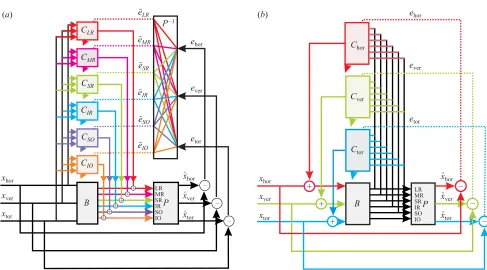
Figure 3. Alternative architectures applied to 3D VOR. The vestibular system recovers three componentsxhor,xverandxtor
(horizontal, vertical and torsional) of head angular velocity. These are processed by the brainstem and cerebellum to produce motor commands to the six extraocular muscles so as to stabilize the eyes’ rotational position in space. The motor plant is a 3×6 matrix transfer functionP and the brainstem contribution to the VOR is a 6×3 matrix transfer functionB.
(a) Feedback-error-learning architecture: the cerebellum takes the three vestibular signals as input and supplies corrections to the six motor commands. Colour is used to highlight the ‘motor space’ modularity. For example the green component shows those PCs that contribute to the superior rectus (SR) muscle command, and which require the corresponding motor-command errore˜SRas a training signal on their CFs. This signal must be reconstituted from the horizontal, vertical and
torsional components of retinal slip. (b) Recurrent architecture: the cerebellum takes the six motor commands as input and supplies corrections to the three vestibular signals. Colour is used here to highlight the ‘task space’ modularity. For example the green component shows PCs contributing to vertical eye motion; these require the vertical component of optic flow as a training signal.
[image:4.598.52.539.379.649.2]792 J. Porrill and others Cerebellar architecture and the motor-error problem
Figure 3a shows the ‘motor space’ modularity induced by the feedback error architecture. Complex processing is needed to transform retinal-slip signals into motor errors for individual muscles. By contrast the recurrent architecture has the ‘task space’ modularity shown in figure 3b. Here (i) the simulated cerebellar flocculus receives copies of the motor commands to the six extraocular muscles as input (Bu¨ttner-Enneveret al.1996; Belton & McCrea 2000); (ii) it is organized into three independent modules supplying corrections to the three components of head velocity obtained from the vestibular system (Voogd et al. 1996); and (iii) the teaching signal for a PC contributing to a given component of head velocity is simply the corresponding component of retinal slip (Grafet al.1988) (it can be shown that this correspondence need only be approximate). The organization of the simulated flocculus shown in figure 3b is close to that indicated by neuroanatomical and neurophy-siological evidence (e.g. Voogdet al.1996).
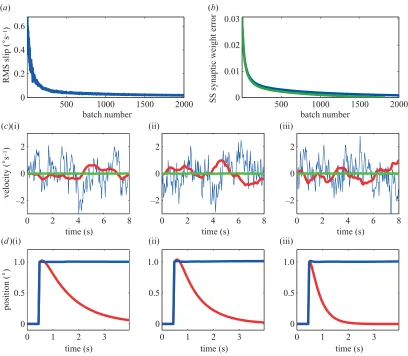
Figure 4 shows the results of a computer simulation of 3D VOR plant compensation using the recurrent architec-ture illustrated in figure 3b. The initial state corresponds to the absence of any cerebellar contribution to VOR. It can be seen that during training all three components of retinal slip are reduced to zero at the rate predicted by theory and that after training there is accurate compen-sation for step changes in head position.
3. DISCUSSION
We have previously proposed decorrelation control as a candidate algorithm for the cerebellar microcircuit, in which cerebellar plasticity acts to reduce the correlations between predictor variables (mossy fibre signals) and a target variable (CF signals) (Deanet al.2002). Our simul-ations indicated that the algorithm was effective and robust for oculomotor plant compensation in one dimen-sion, with retinal slip used as a training signal and a copy of the eye-movement command as a predictor variable (i.e. a recurrent architecture). Here, we have extended that finding in two important ways: first by proving the efficacy of the proposed recurrent architecture for the gen-eral motor plant compensation problem; and second by showing that the use of sensory error instead of motor error as a training signal leads to a simpler and more plausible modular architecture for problems with multiple degrees of freedom, such as 3D oculomotor plant com-pensation.
We now discuss the following aspects of our proposed algorithm: the evidence for recurrent architecture in the particular problem of oculomotor plant compensation; the relationship of our algorithm to previous models of the cerebellum; predictions made by the model; and the gen-eral role of recurrent cerebellar connectivity.
(a) Recurrent connectivity via the flocculus
The wealth of neurophysiological information about the oculomotor system and its relative simplicity make it the natural test-bed for cerebellar modelling. The main cerebellar region concerned with oculomotor plant com-pensation has been identified as the flocculus (Zee et al. 1981; Opticanet al. 1986; Grafet al. 1988; Voogdet al. 1996). It is well established that the flocculus receives vis-ual and vestibular information (Nodaet al.1987; Markert
Proc. R. Soc. Lond.B (2004)
et al.1988; Nagao 1990; Stone & Lisberger 1990). How-ever, it is clearly crucial to the proposed model that the floccular region does in fact receive a substantial mossy-fibre input related to eye movement. The experimental evidence appears conclusive on this point.
Most directly, extensive electrophysiological recording of mossy fibres or other granular-layer input elements (n=771) in the floccular regions of rhesus monkeys has
indicated that 53.6% of the elements modulated their dis-charge solely in relation to eye movements (Miles et al. 1980). A further 21.7% showed eye-movement-related fir-ing in addition to firfir-ing influenced by vestibular input. Thus, in total, 75.3% of floccular mossy-fibre-related inputs carry a signal related to eye movements. Other elec-trophysiological investigations of floccular mossy-fibre sig-nals have reached similar conclusions (Lisberger & Fuchs 1978; Noda & Suzuki 1979), and it has been asserted that ‘these oculomotor-related signals are generally assumed to represent some kind of efference copy signal’ (Miles 1991, p. 225).
Additional evidence comes from anatomical studies (reviewed by Voogdet al. 1996) indicating that much of the mossy-fibre input to the flocculus comes from brain-stem nuclei associated with eye movements, for example the medial vestibular nucleus, the nucleus prepositus hypoglossi, the abducens nucleus itself and the cell groups of the paramedian tracts (PMT). The last in particular have been proposed as candidates for providing a motor-feedback signal of extraocular-muscle activity to the floc-cular region (Deanet al. 2002). The properties of PMT cells in the cat are consistent with this proposal. Thus, electrophysiological recordings indicate that PMT neu-rons specifically identified as projecting to the flocculus carry signals relating to eye movements (Nakao et al. 1980; Cheron et al.1996; Escudero et al. 1996). More-over, inactivation of a subgroup of PMT cells that carry vertical eye-movement signals produces a gaze-holding impairment, consistent with a role in providing efference copy for plant compensation (Nakamagoeet al.2000).
In summary, the results of a variety of experimental approaches support the view that the flocculus receives a mossy-fibre signal related to the eye-movement command, and the integrity of both the flocculus and this floccular input signal is necessary for oculomotor plant compen-sation.
(b) Relationship to previous models of the
cerebellum
they have generally been applied to problems other than plant compensation and have often focused on specific rather than generic solutions (e.g. Kettner et al. 1997; Bartoet al.1999; Spoelstraet al.2000; Assad 2001; Eski-izmirlileret al.2002; Yamamotoet al.2002). This applies even to models that have specifically used feedback via efference copy signals (Quaia et al. 1999; Hirata & Highstein 2001).
As far as we are aware, there is only one other model architecture that has been specified well enough to allow a detailed comparison of performance. This is the feed-back error model described in § 1. The power of this archi-tecture has been demonstrated by a number of simulations and by formal proofs of convergence. However, there appear to be two major problems with the feedback error architecture.
First is the requirement for complex ‘reference struc-tures’ to recover a motor-error signal from the available sensory information, as seen in the example of 3D plant compensation (figure 3a). In the particular case of oculo-motor plant compensation in the 3D VOR, the resultant connectivity and organization of the cerebellar flocculus are at odds with experimental evidence (Voogd et al. 1996). By contrast, the connectivity required by decorre-lation control (figure 3b) is consistent with that evidence. For plant compensation in general, feedback error learn-ing requires an already existlearn-ing approximation to the inverse plant model it is trying to learn, so that ‘the most interesting and challenging theoretical problem is setting an appropriate inverse reference model in the feedback controller at the spinal and brainstem levels’ (Gomi & Kawato 1992, p. 112). The algorithm proposed here does not require a prior inverse plant approximation.
The second problem concerns the nature of the putative error signal conveyed by CFs. Feedback error learning requires this signal to approximate motor error—that is, the difference between actual and desired motor com-mand. However, experimental evidence indicates that CFs are primarily activated by sensory inputs, such as touch, pain, muscle sense or, in the case of the VOR, retinal slip (Simpson et al. 1996; De Zeeuw et al.1998). Insofar as these sensory inputs are modulated by movement-related signals (Gibson et al. 2002) or by the cerebellar output itself (Anderssonet al.1988), the resultant CF discharge appears to be related to the unpredicted sensory conse-quences of a movement, which is much closer to ‘sensory error’ as used here than to motor error as defined in § 1. Because errors in problems specified in task space can always be assessed by comparing sensory expectations with sensory reality, these findings support the simple assumption that the CF signal for motor adaptation is sen-sory error. The algorithm proposed here shows, for the first time to our knowledge, how a sensory-error signal could be used in the general case.
In summary, the present model is unique in its formally proven ability to solve the generic plant compensation problem. It does so using only physically obtainable sig-nals, and it exploits features of cerebellar architecture that are otherwise puzzling, namely recurrent mossy-fibre inputs and sensory CF inputs.
One final issue concerns the role of the visual and ves-tibular inputs to the flocculus, referred to in § 3a. These would appear to be useful for adaptation, not to changes
B (2004)
in the plant that affect all types of eye movement, but to changes in (for example) the signal from the semicircular canals, which concerns only a specific subset of eye move-ments. When it is the plant that needs compensation, these specific inputs will be more weakly correlated with retinal slip than will the inputs indicating eye-movement commands, and the latter will dominate learning.
(c) Predictions of the model
The most important feature of our algorithm is that it addresses a potential weakness in Marr–Albus models, namely their apparent reliance on the unavailable signal of motor error. The issue of getting these models to work in practice was apparent to Marr himself, when he com-mented ‘.. the [1969] study disappointed me, because even if the theory was correct, it did not much enlighten one about the motor system—it did not, for example tell one how to go about programming a mechanical arm’ (Marr 1982, p. 15). From this point of view the present study is explanatory rather than predictive, though it could be said to ‘predict’ the ubiquity of recurrent connections and the presence of sensory information in the putative teaching signal.
In the specific context of oculomotor plant compen-sation, the model predicts the presence of an eye-position-related output from floccular PCs. Such output has been identified in a subset of these cells (the flocculus has func-tions besides plant compensation, see references in Dean et al.(2002)). More detailed predictions of floccular out-put require precise specification of the brainstem control-lerBand the oculomotor plantP(figure 2). It is possible that the properties ofBandPcombined could be inferred from the effects of floccular inactivation; the properties of P, which are more complex than often assumed (Robinson 1981; Sklavos et al. 2003), require multiple techniques to identify.
(d) Functional role for recurrent connectivity
The importance of recurrent cerebellar connectivity was emphasized by Eccles (1969) who called this architecture the cerebellar ‘dynamic loop’. Experimental evidence for recurrent motor pathways has steadily accumulated (e.g. Holdefer et al. 2000) and they are widely regarded as a generic property of motor systems (Middleton & Strick 2000). For example one reviewer asserts that ‘...multiple closed-loop circuits appear to be a major functional unit of cerebrocerebellar circuitry’ (Dum & Strick 2003, p. 637) and another asserts that ‘we can now see closed cerebro-cerebellar loops that include sensorimotor regions, and prefrontal regions’ and remarks that ‘all we need to do now is work out what they are for!’ (Ramnani & Miall 2001, p. 136).
794 J. Porrill and others Cerebellar architecture and the motor-error problem
500 1000 1500 2000
0 0.2 0.4 0.6
500 1000 1500 2000
0 0.01 0.02 0.03
0 2 4 6 8
–2 0 2
0 2 4 6 8
–2 0 2
0 2 4 6 8
–2 0 2
0 1 2 3
0 0.5 1.0
0 1 2 3
0 0.5 1.0
0 1 2 3
0 0.5 1.0
(a) (b)
(c)(i) (ii) (iii)
(d)(i)
batch number batch number
time (s)
time (s)
time (s)
time (s)
time (s)
time (s)
SS synaptic weight error
RMS slip (
˚
s
–1
)
velocity (
˚
s
–1)
position (
˚
)
[image:7.598.95.503.59.415.2](ii) (iii)
Figure 4. 3D VOR simulation (MatLab code is available from the authors). The oculomotor plant was modelled as a 3×6
array of leaky integrator transfer functionsP(s)=P0s/(s⫹1/T) (pulling directions and strengths of individual muscles are
described by the matrixP0, their dynamic characteristics are described by the innervation-to-velocity transfer functions/(s⫹
1/T),T=0.2 s). The brainstem contribution was modelled as a 6×3 array of transfer functionsBi j=B0
i j⫹B1i j/(s⫹1/Ti j) with correct high frequency gain (soP0B0=1); time constantsT
i jwere randomly chosen between 0 and 1 s. This reproduced the characteristic low-frequency deficit of the VOR after cerebellar lesions (Zeeet al.1981). Granule cell transfer functions were modelled as delay linesGi(t)=␦(t⫺ti) with a maximum delay of 2 s. During training, head angular velocity was modelled as coloured noise with a spectral exponent of 1. The discretization time was 0.02 s and for efficiency weight update took place in 10 s batches. (a) Root mean square (RMS) retinal slip error plotted against batch number; this tends stochastically to zero as predicted by theory. (b) Sum of the squares (SS) of synaptic-weight error plotted against batch number (blue curve). This error decays monotonically at the rate predicted by theory (green curve) (the slight discrepancy between the two curves is caused by discretization and the use of batch rather than continuous updates). (c) The (i) horizontal, (ii) vertical and (iii) torsional components of response to a coloured-noise input. Head motion is shown in blue, retinal slip before training in red and after training in green. (d) The (i) horizontal, (ii) vertical and (iii) torsional responses to a step change in all three components of head position: before training (red) an initial change in head position of the correct magnitude is followed by a decay to the primary position; after training (blue) the correct step response is obtained.
ability perhaps relevant to learning how to use prostheses driven directly by neural activity (Nicolelis 2003).
Support for this work was provided by the Biotechnology and Biological Sciences Research Council (BBSRC). J.V.S. was the recipient of a Wellcome Mathematical Biology fellowship.
APPENDIX A
We present a proof of convergence in the linear case (although the proof extends, at least formally, for prob-lems whereB,PandGiare nonlinear operators). We use
the deterministic approach based on continuous update (Sastry & Bodson 1989) (proof using stochastic methods is also possible).
Proc. R. Soc. Lond.B (2004)
For multidimensional problems the cerebellar filter C= ΣwiGiis a matrix operator and the coefficients wiare
matrices. The learning rule (figure 1, legend) can be writ-ten in matrix form as
w˙i=⫺e pTi
(where the signalseand pi=Gi∗yare vectors). Following
the flow diagram in figure 2bfrom y toxwe see that, for all signals y in the range ofB:
x=(B⫺1⫺C)y=B⫺1y⫺
冘
wipi,
where B⫺1 is any left inverse of B(which we assume to
sufficiently rich that there are correct synaptic weights w∗
i for whichxˆ=x, so that
xˆ=(B⫺1⫺C∗)y=B⫺1y⫺
冘
w∗ i pi.Taking the difference of these last two equations allows us to relate output error to synaptic-weight error
e=xˆ⫺x=
冘
(wi⫺w∗i)pi.Introducing sum square synaptic weight error
V=1
2
冘
储wi⫺w∗i储2=1
2tr((wi⫺w∗i)(wi⫺w∗i) T),
as a Lyapounov function we find that
V˙ =
冘
tr((wi⫺w∗i)w˙Ti)=⫺
冘
tr((wi⫺w∗i)pieT) =⫺冘
tr(eT(wi⫺w∗i)pi)=⫺tr(eTe),
(where tr is the trace operator), so that
V˙ =⫺储e储2.
This remarkable equation shows that the rate of decrease of sum square synaptic weight error is directly proportional to sum square output error. That is synaptic weights are improved whenever errors are made. Its simple form allows us to derive a convergence lemma without appealing to the usual Lyapounov machinery (Sastry & Bodson 1989).
Lemma A.1. The root mean square sensory error
eT
rms(t)=
冪
1 T
冕
t⫹T
t
储e储2
over an interval[t,t⫹T]tends to zero as t→⬁.
Proof. If this were not the case then V(t)=V(0)⫺ 兰t
0储e储2 would eventually become negative, which is
impossible. 쮿
REFERENCES
Albus, J. S. 1971 A theory of cerebellar function.Math. Biosci.
10, 25–61.
Andersson, G., Garwicz, M. & Hesslow, G. 1988 Evidence for a GABA-mediated cerebellar inhibition of the inferior olive in the cat.Exp. Brain Res.72, 450–456.
Assad, C. 2001 An hypothesis for a novel learning mechanism in the cerebellar cortex.Autonomous Robots11, 285–290. Barto, A. G., Fagg, A. H., Sitkoff, N. & Houk, J. C. 1999 A
cerebellar model of timing and prediction in the control of reaching.Neural Comput.11, 565–594.
Belton, T. & McCrea, R. A. 2000 Role of the cerebellar floccu-lus region in cancellation of the VOR during passive whole body rotation.J. Neurophysiol.84, 1599–1613.
Brindley, G. S. 1964 The use made by the cerebellum of the information that it receives from sense organs.Int. Brain Res.
Org. Bull.3, 80.
B (2004)
Bu¨ttner-Ennever, J. A., Cohen, B., Horn, A. K. E. & Reisine, H. 1996 Pretectal projections to the oculomotor complex of the monkey and their role in eye movements.J. Comp. Neu-rol.366, 348–359.
Cheron, G., Escudero, M. & Godaux, E. 1996 Discharge properties of brain stem neurons projecting to the flocculus in the alert cat. I. Medial vestibular nucleus.J. Neurophysiol.
76, 1759–1774.
Dean, P., Porrill, J. & Stone, J. V. 2002 Decorrelation control by the cerebellum achieves oculomotor plant compensation in simulated vestibulo-ocular reflex. Proc. R. Soc. Lond.
B269, 1895–1904. (DOI 10.1098/rspb.2002.2103.) De Zeeuw, C. I., Simpson, J. I., Hoogenraad, C. C., Galjart,
N., Koekkoek, S. K. E. & Ruigrok, T. J. H. 1998 Microcir-cuitry and function of the inferior olive.Trends Neurosci.21, 391–400.
Dum, R. P. & Strick, P. L. 2003 An unfolded map of the cer-ebellar dentate nucleus and its projections to the cerebral cortex.J. Neurophysiol.89, 634–639.
Eccles, J. C. 1969 The dynamic loop hypothesis of movement control. InInformation processing in the central nervous system
(ed. K. N. Leibovic), pp. 245–269. New York: Springer. Escudero, M., Cheron, G. & Godaux, E. 1996 Discharge
properties of brain stem neurons projecting to the flocculus in the alert cat. II. Prepositus hypoglossal nucleus.J.
Neuro-physiol.76, 1775–1785.
Eskiizmirliler, S., Forestier, N., Tondu, B. & Darlot, C. 2002 A model of the cerebellar pathways applied to the control of a single-joint robot arm actuated by McKibben artificial muscles.Biol. Cybern.86, 379–394.
Fujita, M. 1982 Adaptive filter model of the cerebellum.Biol.
Cybern.45, 195–206.
Gibson, A. R., Horn, K. M. & Pong, M. 2002 Inhibitory con-trol of olivary discharge. Ann. N. Y. Acad. Sci. 978, 219– 231.
Gilbert, P. F. C. 1974 A theory of memory that explains the function and structure of the cerebellum.Brain Res.70, 1–8. Gomi, H. & Kawato, M. 1992 Adaptive feedback control mod-els of the vestibulocerebellum and spinocerebellum. Biol.
Cybern.68, 105–114.
Graf, W., Simpson, J. I. & Leonard, C. S. 1988 The spatial organization of visual messages in the flocculus of the rab-bit’s cerebellum. II. Complex and simple spike responses of Purkinje cells.J. Neurophysiol.60, 2091–2121.
Hirata, Y. & Highstein, S. M. 2001 Acute adaptation of the vestibuloocular reflex: signal processing by floccular and ventral parafloccular Purkinje cells. J. Neurophysiol. 85, 2267–2288.
Holdefer, R. N., Miller, L. E., Chen, L. L. & Houk, J. C. 2000 Functional connectivity between cerebellum and primary motor cortex in the awake monkey. J. Neurophysiol. 84, 585–590.
Ito, M. 1984 The cerebellum and neural control. New York: Raven Press.
Kawato, M. 1990 Feedback-error-learning neural network for supervised motor learning. InAdvanced neural computers(ed. R. Eckmiller), pp. 365–372. Amsterdam: Elsevier.
Kawato, M. 1995 Cerebellum and motor control. InThe
hand-book of brain theory and neural networks (ed. M. A. Arbib),
pp. 172–178. Cambridge, MA: MIT Press.
Kettner, R. E., Mahamud, S., Leung, H. C., Sitkoff, N., Houk, J. C., Peterson, B. W. & Barto, A. G. 1997 Prediction of complex two-dimensional trajectories by a cerebellar model of smooth pursuit eye movement.J. Neurophysiol.77, 2115–2130.
796 J. Porrill and others Cerebellar architecture and the motor-error problem
Markert, G., Bu¨ttner, U., Straube, A. & Boyle, R. 1988 Neu-ronal activity in the flocculus of the alert monkey during sinusoidal optokinetic stimulation. Exp. Brain Res. 70, 134–144.
Marr, D. 1969 A theory of cerebellar cortex.J. Physiol. 202, 437–470.
Marr, D. 1982 Vision: a computational investigation into the
human representation and processing of visual information. San
Francisco, CA: Freeman.
Middleton, F. A. & Strick, P. L. 2000 Basal ganglia and cer-ebellar loops: motor and cognitive circuits.Brain Res. Rev.
31, 236–250.
Miles, F. A. 1991 The cerebellum. In Eye movements (ed. R. H. S. Carpenter), pp. 224–243. Basingstoke, UK: Mac-Millan Press.
Miles, F. A., Fuller, J. H., Braitman, D. J. & Dow, B. M. 1980 Long-term adaptive changes in primate vestibuloocular reflex. III. Electrophysiological observations in flocculus of normal monkeys.J. Neurophysiol.43, 1437–1476.
Nagao, S. 1990 Eye velocity is not the major factor that deter-mines mossy fiber responses of rabbit floccular Purkinje cells to head and screen oscillation.Exp. Brain Res.80, 221–224. Nakamagoe, K., Iwamoto, Y. & Yoshida, K. 2000 Evidence for brainstem structures participating in oculomotor integration.
Science288, 857–859.
Nakao, S., Curthoys, I. S. & Markham, C. H. 1980 Eye move-ment-related neurons in the cat pontine reticular formation: projection to the flocculus.Brain Res.183, 291–299. Nicolelis, M. A. L. 2003 Brain–machine interfaces to restore
motor function and probe neural circuits.Nature Neurosci. Rev.4, 417–422.
Noda, H. & Suzuki, D. A. 1979 Processing of eye movement signals in the flocculus of the monkey. J. Physiol. 294, 349–364.
Noda, H., Warabi, T. & Ohno, M. 1987 Response properties and visual receptive fields of climbing and mossy fibers termin-ating in the flocculus of the monkey.Exp. Neurol.95, 455–471. Optican, L. M., Zee, D. S. & Miles, F. A. 1986 Floccular lesions abolish adaptive control of post-saccadic ocular drift in primates.Exp. Brain Res.64, 596–598.
Quaia, C., Lefe`vre, P. & Optican, L. M. 1999 Model of the control of saccades by superior colliculus and cerebellum.J.
Neurophysiol.82, 999–1018.
Proc. R. Soc. Lond.B (2004)
Ramnani, N. & Miall, C. 2001 Expanding cerebellar horizons.
Trends Cogn. Sci.5, 135–136.
Robinson, D. A. 1981 Models of the mechanics of eye move-ments. InModels of oculomotor behaviour(ed. B. L. Zuber), pp. 21–41. Boca Raton: CRC Press.
Sastry, S. & Bodson, M. 1989Adaptive control: stability,
conver-gence, and robustness. Englewood Cliffs, NJ: Prentice-Hall.
Sejnowski, T. J. 1977 Storing covariance with nonlinearly interacting neurons.J. Math. Biol.4, 303–321.
Simpson, J. I., Wylie, D. R. & De Zeeuw, C. I. 1996 On climb-ing fiber signals and their consequence(s).Behav. Brain Sci.
19, 384–398.
Sklavos, S., Dimitrova, D. M., Goldberg, S. J., Porrill, J. & Dean, P. 2003 Long time-constant elements in the oculomo-tor plant of barbiturate-anesthetised primate. Program no. 391.14. 2003 Abstract viewer/itinerary planner. Washington, DC: Society for Neuroscience. (Available online.)
Spoelstra, J., Schweighofer, N. & Arbib, M. A. 2000 Cerebellar learning of accurate predictive control for fast-reaching movements.Biol. Cybern.82, 321–333.
Stone, L. S. & Lisberger, S. G. 1990 Visual responses of Purk-inje cells in the cerebellar flocculus during smooth-pursuit eye movements in monkeys. I. Simple spikes.J.
Neurophy-siol.63, 1241–1261.
Voogd, J., Gerrits, N. M. & Ruigrok, J. H. 1996 Organization of the vestibulocerebellum. In New directions in vestibular
research, vol. 781 (ed. S. M. Highstein, B. Cohen & J. A.
Bu¨ttner-Ennever), pp. 553–579. New York: New York Academy of Sciences.
Wolpert, D. M., Miall, R. C. & Kawato, M. 1998 Internal models in the cerebellum.Trends Cogn. Sci.2, 338–347. Yamamoto, K., Kobayashi, Y., Takemura, A., Kawano, K. &
Kawato, M. 2002 Computational studies on acquisition and adaptation of ocular following responses based on cerebellar synaptic plasticity.J. Neurophysiol.87, 1554–1571. Zee, D. S., Yamazaki, A., Butler, P. H. & Gu¨cer, G. 1981
Effects of ablation of flocculus and paraflocculus on eye movements in primate.J. Neurophysiol.46, 878–899.