Retrospective Theses and Dissertations
Iowa State University Capstones, Theses and
Dissertations
1989
Ultrasonic attenuation estimation for tissue
characterization
Viren R. Amin
Iowa State University
Follow this and additional works at:
https://lib.dr.iastate.edu/rtd
Part of the
Analytical, Diagnostic and Therapeutic Techniques and Equipment Commons
,
Bioimaging and Biomedical Optics Commons
, and the
Biomedical Devices and Instrumentation
Commons
This Thesis is brought to you for free and open access by the Iowa State University Capstones, Theses and Dissertations at Iowa State University Digital Repository. It has been accepted for inclusion in Retrospective Theses and Dissertations by an authorized administrator of Iowa State University Digital Repository. For more information, please [email protected].
Recommended Citation
by
Viren R. Amin
A Thesis Submitted to the
Graduate Faculty in Partial Fulfillment of the Requirements for the Degree of
MASTER OF SCIENCE Interdepartmental Program:
"Major:
Signatures have been redacted for privacy
Biomedical Engineering Biomedical Engineering
Signatures have been redacted for privacy
Iowa State University Ames, Iowa
1989
11
TABLE OF CONTENTS
CHAPTER
1.INTRODUCTION . . . .
CHAPTER 2.
BASICS OF ULTRASONICS
Generation and Detection of Ultrasound . . .
Frequency Characteristics of the Transducer
Axial Resolution . . . .
Beam Pattern and Lateral Resolution
Transducer Selection . . .
Ultrasound/Tissue Interactions
Velocity . . . .
Acoustic Impedance and Reflection
Refraction
Scattering
Absorption.
Attenuation
Ultrasonic Instrumentation.
Pulser .
Receiver
."
1
4
4
6
8 8 10 11
11
12
13
15
16
17
18
18
Signal Processing
Display . . . .
Ultrasound Applications for Tissue Characterization.
CHAPTER 3. ULTRASONIC ATTENUATION: BACKGROUND
AND LITERATURE REVIEW
Mechanisms for Attenuation . . .
Units of Measured Attenuation
Frequency Dependence of Attenuation
Attenuation Data for Biological Tissues.
Clinical Significance of Attenuation
Methods of Attenuation Estimation
Frequency Domain Methods
Time Domain Methods . . .
Selecting a Method for Attenuation Estimation
19 19
23
26
26
27
28 2932
33
3.541
46
CHAPTER 4.
SYSTEM:
DATA ACQUISITION AND ANALYSIS 48
Scanning Apparatus
Tank . . . .
Transducer Movement by Stepper Motor
Pulser/Receiver . . . .
Ultrasonic Transducers
Tissue Samples/i\Iodels Used
Data Acquisition . . . .
Heath Oscilloscope
IV
Near/Far Depth Triggering . . . Software Control of Data Acquisition Data Analysis . . . .
Calculation of Power Spectra
Calculation of Coefficient and Slope of Attenuation Summary of Data Acquisition and Analysis
CHAPTER 5.
RESULTS AND CONCLUSIONS
Preliminary Results with Plexiglas Attenuation in the Tissue Samples
Effects of Transducer Characteristics Effects of Spectral Estimation Method Attenuation Along the Tissue Thickness Conclusions .
59
62
65
67
68
71
72
72
75
79
79
80
80
CHAPTER 6.
RECOMMENDATIONS FOR FURTHER STUDIES
83BIBLIOGRAPHY . . . "
. . .
85ACKNOWLEDGEMENTS
APPENDIX . . . .
Data Acquisition Programs Data Analysis Programs . .
91
92
92
Table 2.1:
Table 2.2:
Table 3.1:
Table 3.2:
Table 3.3:
Table 4.1:
Table 5.1:
Table .5.2:
LIST OF TABLES
Mean velocity values for selected biological tissues . . . .
Reflection coefficients (or amplitude ratios) and percentage
en-ergies reflected for normally incident ultrasonic waves at
typ-ical tissue interfaces
12
1.5
A verage attenuation for biological tissues by categories 30
Thicknesses of biological tissues required to attenuate intensity
of an ultrasound beam by half (-3 dB) . . . 31
Summary of in vivo measurements of ultrasonic attenuation
in liver using a variety of methods . . . . . 33
Function generator settings for generating triggering signal,
and corresponding tissue depths for digitizing a segment of
echo signal . . . . . 62
Attenuation results for Plexiglas cylinder at different settings
of ultrasonic pulser / receiver using the narrowband transducer 74
Attenuation slope values for tissue samples using the
Table 5.3:
Table 5.4:
Table 5.5:
VI
Attenuation slope values for tissue samples using the wideband
transducer . . . . . Ii
Attenuation at particular frequency (Ie = 2.2 MHz) for tissue
samples using the narrowband transducer
Attenuation at particular frequency for tissue samples using
the wideband transducer . . . . . . 78
Figure 2.1:
Figure 2.2:
LIST OF FIGURES
Basic transducer design for ultrasonic pulse-echo applications
Frequency characteristics of the transducer and pulsed
ultra-5
sound. . . . . i
Figure 2.3: Relationship between pulse duration and axial resolution for
the pulsed ultrasound . . . 8
Figure 2.4: The ultrasonic field of a plane disc transducer 9
Figure 2.5: Reflection and refraction for non-perpendicular incidence of
an ultrasound beam . . . . .
Figure 2.6: Scattering of sound at small interfaces
Figure 2.7: Block diagram of simplified pulse-echo instrument
Figure 2.8: The sequence of signal conditioning steps often implemented 14
16
18
in processing of the received ultrasonic echoes. . . 20
Figure 2.9: Elements of A-mode and B-mode pulse-echo instruments 22
Figure 2.10: Examples of mechanical and electrical sweeping of the beam
to obtain B-mode images . . . . . 24
Vlll
Figure 3.2: Approaches to obtain the reference and attenuated spectra for
log-spectral difference technique of attenuation estimation .. 37
Figure 3.3: Illustration of shift of the spectrum to lower frequencies as an
ultrasonic pulse propagates through an attenuating medium 39
Figure 3.4: Principle of gating at a depth and measuring the signal
am-plitudes across the defined plane for so called C-mode analysis 44
Figure 3.5: Typical graph showing decrease of zero crossings density along
the depth of the tissue mimicking phantom . . . 46
Figure 4.1: System set up for ultrasonic scanning of tissue samples 49
Figure 4.2: Left side view and top view of ultrasonic scanning tank .51
Figure 4.3: Impulse responses and power spectra of the ultrasonic
trans-ducers used in this study . . . .. 54
Figure 4.4: Relative fat/muscle contents and distribution for tissue
sam-ples used for attenuation measurements .56
Figure 4.5: Schematic of data acquisition system .57
Figure 4.6: Computer Oscilloscope screen, displaying the digitized signal
Figure 4.7:
Figure 4.8:
Figure 4.9:
and controls . . . 58
Typical waveforms at various stages of data acquisition
Flow-chart of data acquisition software . . . .
Flow-chart of data analysis for attenuation calculations
61
64
66
Figure .5.1: Echoes from two sides of the Plexiglas cylinder . . . . . 73
Figure 5.3: Plot of tissue thickness vs. attenuation, showing increase in
1
CHAPTER
1.INTRODUCTION
Ultrasound applications to the fields of medicine, agriculture, and food are
rela-tively recent developments which parallel rapid growth in electronic and signal
pro-cessing technologies. After the piezoelectric effect (upon which the generation and
detection of an ultrasound signal depend) was noted by Pierre and Jacques Curie in
1880, it was only in early 1940s when the first use of ultrasound in medical imaging
was reported. Since then, in last 45 years, ultrasonic techniques have become an
integral part of diagnostic imaging.
Ultrasound imaging techniques non-invasively obtain information about size and
structure of the tissues, and functions of the organs of the body. The interactions of
transmitted ultrasound with tissue structures give rise to the information which can
be visually displayed. This information is therefore directly related to acoustic
prop-erties of the tissues and is essentially different from that supplied by other diagnostic
tools such as an x-ray or isotope imaging. Because of its marked superiority
(particu-larly for safety, size and cost) over x-ray for soft-tissue visualization, ultrasonography
is rapidly supplementing, and in some instances, replacing x-ray for soft-tissue
visu-alization. Many applications in obstetrics, gynecology, hepatic. breast, cardiac, renal,
pancreatic, neurological, and vascular imaging are now standard. Work is in progress
and even to find parameters for pathology differentiation.
In recent years, many ultrasonic parameters have been found to have potential for
tissue characterization. These include attenuation, velocity, reflection, and scattering.
Advanced signal processing and pattern recognition techniques are applied to extract
information about particular parameters. Attenuation has been found to have
po-tential for characterizing the tissues because tissues differ in their attenuation values
for ultrasound. These might be used to differentiate the tissues, to diagnose various
pathologies, or to improve the ultrasonic images. In the meat industry, this could be
applied to differentiate (and ultimately, to grade) samples with varying contents and
distribution of fat and muscle tissues.
The purpose of this research was to develop a personal computer based system
by which the ultrasonic attenuation parameter for different tissue samples could be
estimated, and its potential for tissue characterization/ differentiation could be
deter-mined. Specifically, this involved the following objectives:
• Set up a simple hardware system that can take several A-scans of a tissue sample at varying angles, digitize the signal at varying depths of the sample and at high MHz sampling rate, and store it in a computer.
• Find an appropriate method for estimating attenuation of ultrasound in the tissue sample from the stored signal, and develop appropriate signal processing routines.
• Analyze the attenuation results in order to determine their correlations, if any, with relative fat/muscle contents in different tissue samples.
3
Chapter 2 reviews the basics of ultrasonics and describes some parameters useful
for tissue characterization. The attenuation as a tissue characterizing parameter is
discussed, in detail, in Chapter 3. It also reviews the attenuation data for normal and
pathological tissues, and their clinical significance. Recently developed techniques for
estimating attenuation in tissues is reviewed in detail, since finding the best suitable
method for fat/muscle differentiation was the first and perhaps crucial step in this
research.
The development of the personal computer based data-acquisition system is
de-scribed in Chapter 4. It also describes the developed software, implementing the log-spectral difference method of attenuation estimation. The results of this study
are presented in and discussed in Chapter 5. The attenuation was found to be an
CHAPTER 2.
BASICS OF ULTRASONICS
8
The phenomenon of ultrasound is the same as that of normal audible sound.
It occurs when mechanical vibrations in one region of a medium are transmitted
to another region by the mechanical interaction of the atoms and molecules of the
medium. Ultrasound is the term used to describe the sound when pitch is too high
for human ears to hear. The lower limit of the ultrasonic spectrum is usually taken as
about 20 KHz. The frequency range of ultrasound for medical applications is usually
between 1 MHz and 20 MHz. rJ
Generation and Detection of Ultrasound
There are several types of devices that can be used to generate and detect
ul-trasonic waves. The most common type of transducer used in medical ultrasound
employs the piezoelectric effect (Greek word piezein means to press). This is
the property of certain materials where an application of an electric field causes a
change in physical dimensions and vice versa. Commonly used (natural and
syn-thetic) piezoelectric materials are quartz, barium titanate, lead zirconate titanate
(PZT), or poly(vinylidine fluoride) (PVDF).
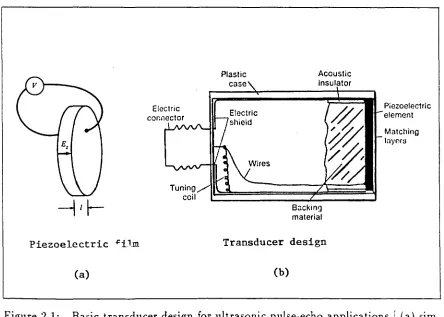
As shown in Figure 2.1a, two opposite faces of the transducer disc are plated with
.5
the thickness 1 of the transducer, whose magnitude is given by E:; = V/l (assuming
the diameter is much larger than 1).
The expansion or contraction of the transducer,~or this so called thickness mode
of orientation~ depends on the polarity of the signal. Oscillating signals cause the
transducer to vibrate, resulting in propagation of sound waves into the medium with
which the crystal is in contact. The most efficient transduction of energy occurs
at natural resonance frequency. This is determined by thickness of the piezoelectric
element; the thinner the element, the higher the frequency.
Piezoelectric -Fil.m
(a)
Plastic case
Acoustic insulator
Backing material
Transducer design
(b)
Piezoelectric element
Matching
[image:15.612.77.521.305.622.2]layP.r:J
Figure 2.1b shows the basic design of a single-element non-focused transducer.
Such a transducer is used both as transmitter and receiver. A flat, circular disc of
piezoelectric material is mounted coaxially in a cylindrical case. The backing material
plays a major role in damping out the transducer oscillations when excited by a pulse.
Acoustic impedance of the backing material is matched to that of the piezoelectric
element to reduce reflections at the interface. Also, it is filled with special
sound-absorbing material (e.g., aluminum-filled epoxy or tungsten-filled epoxy) to damp
the oscillations, resulting in the transmission of short duration acoustic impulses
into the medium. Attachment of impedance-matching layers to the front face of the
transducer provides more efficient transmission of sound waves from the transducer
element to soft tissue and vice versa.
Frequency Characteristics of the Transducer
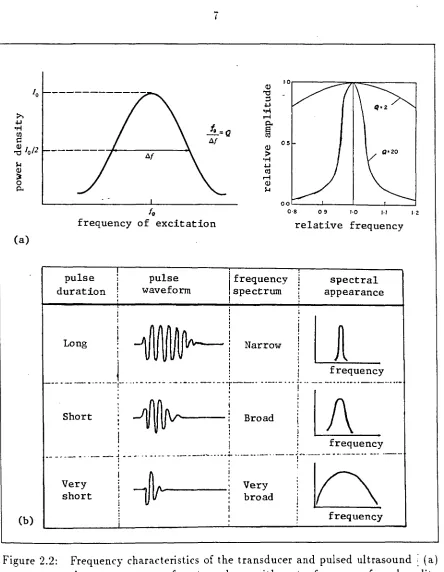
The frequency response of a transducer system is sometimes described by a term
called quality factor or Q-factor. It is defined as a ratio of resonance frequency
to bandwidth (for -3 dB power). As shown in Figure 2.2a! higher
Q
means narrowbandwidth. The magnitude of Q is mainly determined by the losses encountered in
the transducer.
For pulse-echo system, the bandwidth depends upon the pulse duration; the
(a)
(b)
i
1·0r----"="'~=_---~
~=Q
at
at
tg 09 1·0 1·1
frequency of excitation relative frequency
pulse duration
! pulse
waveform
I
,spectrum frequency \spectral appearance
Long
i
~
i
Narrowi
LL
1
1i
frequency'---!---
---t--
---j-
rl\·
f\'.' .... ' .. _ ... .Short
~!
BroadLLL
frequency
.
... --~ -_ .. -.- - i .. -~ -. _6 __ - ---... -- ... :- ---- .. -·-··---1~ ... · - ... - .. ----_ ... -.. -_.-Very
short
.
.
".
Very broad
frequency
1·2
[image:17.612.77.521.67.639.2]Axial Resolution
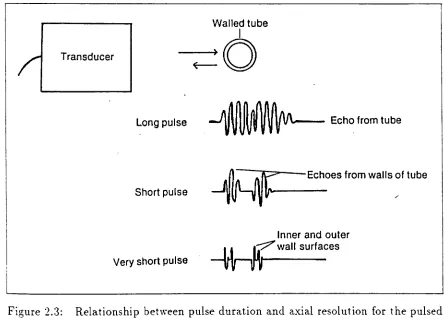
The transducer frequency characteristics are closely related to the axial resolution
of pulse-echo system. Axial resolution is limited by the pulse duration; the shorter
the pulse duration. the better is the axial resolution (Figure 2.3).
Transducer
Long pulse
Short pulse
Very short pulse
Walled tube
I
~O
\..--- Echo from tube
~n~ Echoes from walls of tube
-'~U~~r--Inner and outer
~es
Figure 2.3: Relationship between pulse duration and axial resolution for the pulsed ultrasound (the shorter the pulse duration. the better the axial resolu-tion)
Beam Pattern and Lateral Resolution
The sound beam produced by an unfocused circular transducer maintains the
[image:18.612.71.515.216.534.2]9
as near field or Fresnel zone. At larger distances, the natural divergence begins to
spread the transverse extent of the beam, referred to as far field or Fraunhofer zone
(Figure 2.4).
t
(a) 2a
-1,-,-r---+-__
L
l·OI-r-;.--k--+--~';""oo;;;;::----1r----t---+---I
(b) ~ 0·5
HtHH--t-r--J'----i'---t--.=o..;o;:::::---t--...
O~~-~---~--~---~---~--~
0·0 (i)
Axial distance (> • .1 aZ)
(c)
"0" '.' ,: ".,,-. \
@
"-···'···8:---0····
..
·-:",., __ , . ) .:"',, ", ['0." (,,)
.:.~
( i ) (ii) (iii) (iv) (v) (vi)
Figure 2.4: The ultrasonic field of a plane disc transducer [ (a) conventional textbook representation of the field, (b) relative intensity distribution along the central axis of the beam. and (c) ring diagrams showing the energy distribution of the beam sections at positions indicated in (b) 1
The lateral resolution for pulse-echo system is most closely related to the
transducer beam width at the depth of interest. The beam width from an unfocused
transducer is generally too wide to give adequate lateral resolution. Therefore, a lens
or other focussing scheme (such as a spherical reflector or focused annular array of
small spot at the focal plane. The size (i.e., lateral dimensions) and the depth (i.e.,
axial distance over which the beam maintains its approximate focused size) of focus
are important parameters determining lateral resolution. Recently the approach has
been to generate a moving focus for transmitter and receiver, using complex electronic
circuits, for maximum possible resolution.
Transducer Selection
We have seen that the transducers vary in frequency characteristics, focal zone,
and face diameter. Choosing the correct transducer for a specific scanning situation
is essential. The selection of the center frequency of the transducer is a trade off
between the penetration depth of ultrasonic beam and axial resolution. Visualizing
deep structures requires more penetration; therefore, a lower frequency transducer is
desired which, in turn, gives less axial resolution. As a general rule, it is best to use
the highest frequency that allows adequate penetration.
The focal zone of the transducer is the distance range at which the lateral
res-olution is best. It is selected according to the depth of the structure to be scanned.
The diameter of the transducer face is an important factor when the window, through
which the transducer scans the structure, is small; e.g., intercostal spaces. In such
sit-uations, it may not be possible to achieve proper focal zone. For abdominal scanning,
an array of transducers is widely used.
Thus, the transducer selection is a matter of compromise: frequency vs.
pene-tration, and focal zone vs. face size. It may be helpful to examine the same area with
11
Ultrasound/Tissue Interactions
When an ultrasonic pulse travels through the tissues of the body, it undergoes
continuous modifications, which depend on characteristics of sound waves as well
as tissues. This section describes some important parameters of ultrasound/tissue
interactions.
Velocity
The speed at which ultrasound travels through a medium depends on the density
and compressibility of the material. The more solid the material, the greater is the
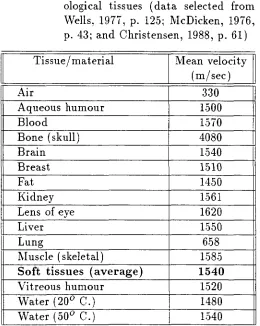
velocity of sound. Table 2.1 shows the values for biological tissues.
As seen from values for water at different temperatures, the velocity increases
with the temperature. It also depends on condition of the tissue, e.g., dead or living.
In ultrasonics for tissue characterization, there are a few situations, listed below, in
which the knowledge of the velocity is relevant.
1. For conversion of pulse-return time into the depth of tissue.
2. To calculate the acoustic impedance of tissue, which allows echo SIze to be estimated.
3. Refraction (deviation of ultrasonic beam) occurs at tissue interfaces when ve-locity differs in two tissues.
Table 2.1: Mean velocity values for selected bi-ological tissues (data selected from Wells, 1977, p. 125; McDicken, 1976, p. 43; and Christensen, 1988, p. 61) Tissue / material Mean velocity
(m/sec)
Air 330
Aqueous humour 1500
Blood 1570
Bone (skull) 4080
Brain 1.540
Breast 1510
Fat 1450
Kidney 1.561
Lens of eye 1620
Liver 1550
Lung 6.58
Muscle (skeletal) 1.58.5
Soft tissues (average) 1540
Vitreous humour 1.520
Water (200 C.) 1480
\Nater (500 C.) 1.540
Acoustic Impedance and Reflection
Acoustic impedance of tissue is the resistance exerted by tissue to the sound propagation; it is given by the product of tissue density (p) and the velocity of sound
[image:22.612.166.426.136.462.2]13
Specular reflector is the term used for a large, flat surface reflecting a perpen-dicularly (or normally) incident beam. Here, the reflected beam is also perpendicular
to the surface, so the same transducer can receive it. Specular reflection is very
com-mon in abdominal scanning; examples are capsules of the liver and kidney, the gall
bladder, and the aorta.
The size of echo due to reflection at a particular interface is expressed as the
ratio of reflected wave amplitude to the incident wave amplitude. This ratio is also
known as reflection coefficient (R).
where
R _ _ Pr _ _ Z.=....1 _-_Z-=:!.2
- Pi - Z1
+
Z2pressure amplitudes of the incident and the reflected beams,
impedances of the tissues making the interface.
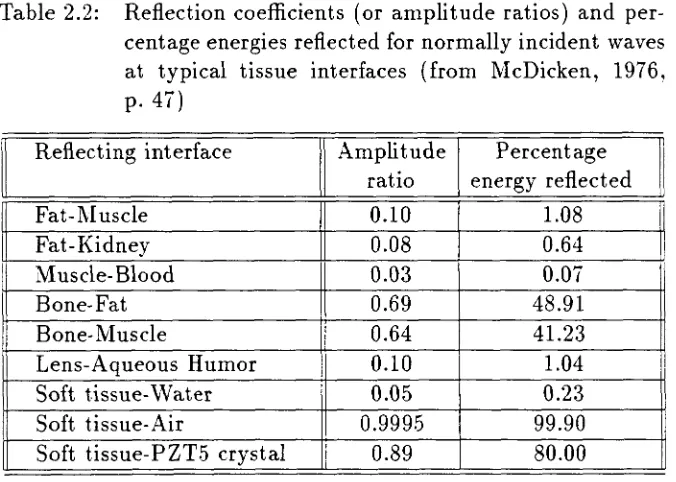
Amplitude ratios for boundaries of interest are shown in Table 2.2. The values
from the table explain why scanning through lung or gas in the bowel, or through
bone is difficult, and also why water is used as a coupling medium.
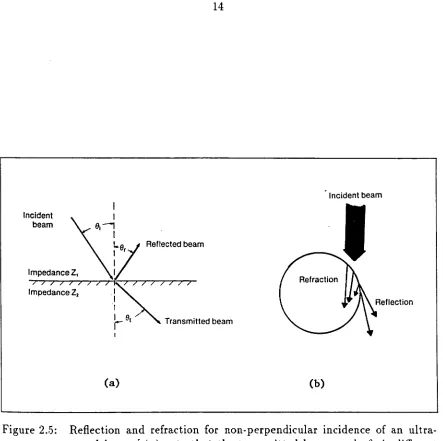
Refraction
For non-perpendicular sound beam incidence, the beam bends at the interface
if the speed of sound changes across the interface; this causes the transmitted beam
to emerge in a direction different from the incident beam. This is refraction and is
Incident beam
Z
Reflected beam I fJr'~~;n;e,z."" ~'"
Impedance Z. I~
e,
r .. n,mltted bo.m(a)
Incident beam
(b)
[image:24.612.74.517.76.517.2]15
Table 2.2: Reflection coefficients (or amplitude ratios) and per-centage energies reflected for normally incident waves at typical tissue interfaces (from McDicken, 1976, p.47)
Reflecting interface Amplitude Percentage ratio energy reflected Fat-l\Iuscle
II
0.10 1.08
Fat-Kidney
.
0.08 0.64M uscle- Blood 0.03 0.07
Bone-Fat 0.69 48.91
Bone-Muscle 0.64 41.23
Lens-Aqueous Humor 0.10 1.04
Soft tissue- \Vater 0.05 0.23
Soft tissue-Air 0.9995 99.90
Soft tissue-PZT5 crystal 0.89 80.00
Scattering
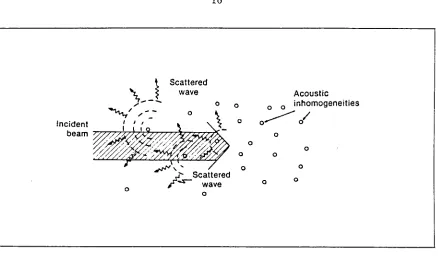
For smaller dimensions (about the magnitudes of wavelength of incident ultra-sonic pulse) of interfacing surface, the incident wave is reflected in all directions and is said to be scattered (Figure 2.6). When the dimensions of scattering objects are very much less than the wavelength, it is known as Rayleigh scattering. Since the scattered wave spread in all directions, echo signals detected from a volume containing small scatterers are not highly dependent on the orientation of individual scatterers. This is in contrast to the strong orientation dependence seen for specular reflectors.
Incident
Scattered wave
o o
Acoustic
o o 0 inhomogeneities
o
0--- /
beam ~77~7z~7077~~~~ o
o
o
o 0
~,' 0
,t... Scattered
,. -s- wave 0
o
o o
o
Figure 2.6: Scattering of sound at small interfaces (Hagen-Ansert, 1983. p. 8)
ultrasonic frequencies.
Backscatter coefficient is the term used to describe the ratio of energy
scat-tered back through 180 degrees to incident energy, per unit area. Examples of small
scatterers are red blood cells and multiple air-filled alveoli of lung tissue (where the
scattering is so severe that 1 MHz ultrasound wave is considered non-penetrating to
lung regions).
Absorption
Absorption of ultrasound is the process by which a portion of originally organized
acoustic energy is transferred to subsequent heat. (F nder ordinary circumstances
with diagnostic ultrasound. the amount of heat produced is too small to cause a
[image:26.612.78.516.85.341.2]17
frequency of sound; therefore it is said to exhibit dispersion.
Absorption and its mechanisms are rarely considered in isolation in routine
clin-ical techniques. Total attenuation, which includes a number of other factors as well,
is a more relevant quantity.
Attenuation
As a sound beam traverses through a medium, its amplitude and intensity are
reduced as an exponential function of distance; this is referred to as attenuation. It is
the result of interactions between ultrasound and tissue including absorption,
reflec-tion, and scattering. Mathematically, attenuation is defined in terms of attenuation
coefficient (a), in the expressions
where 1
Ao
n
A = Ao e- a1
acoustic path length in attenuating medium amplitude at I = 0
power of frequency dependence of a
ao a constant.
As seen from these equations, attenuation increases with increasing frequency,
which limits the maximum frequency that can be used to scan the particular depth of
tissue or region of body; the working frequency range is typically 1-5 MHz for scanning
the abdomen, heart, or head, and .5-20 MHz for eyes. Thus, by limiting the maximum frequency, attenuation also limits the range resolution indirectly. Since attenuation
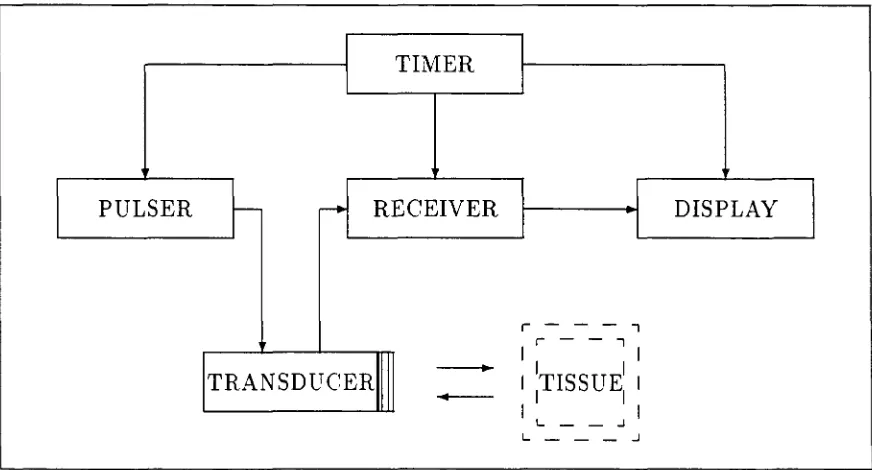
TIMER
PULSER t-- , . RECEIVER
-TRANSDUCER
-r - - - -, r - - -,
I I
I ITISSUEI I
I I I I
L _ _ .J
L _ _ _ .J
[image:28.612.76.512.142.377.2]DISPLAY
Figure 2.7: Block diagram of simplified pulse-echo instrument
Ultrasonic Instrumentation
Pulse echo ultrasound is widely used to localize and image structures in the body. The basic principle is that the distance between transmitter and reflector,
d,
isc/2t
where c is average speed of sound in the tissue and t is delay between transmitted pulse and received echo. The simplified block diagram of pulse echo instrument is shown in Figure 2.7.
Pulser
19
bandwidth of the transducer as mentioned earlier. The acoustic power is determined
by amplitude of the pulser output.
Receiver
The receiver detects and amplifies the echoes. If only one transducer is used, the
fraction of time that the transducer is actually emitting or receiving is indicated by
duty factor, which is the dimensionless product of the prf (pulses/sec) and the time
duration of each pulse (sec/pulse). Sound beam attenuation in tissue is compensated
by using swept gain (also called TGC for time gain compensation) in the receiver.
Signal Processing
Besides amplification, the echo signals are often processed by rectification,
com-pression and rejection to condition them for effective display. These basic steps are
illustrated in Figure 2.8.
Display
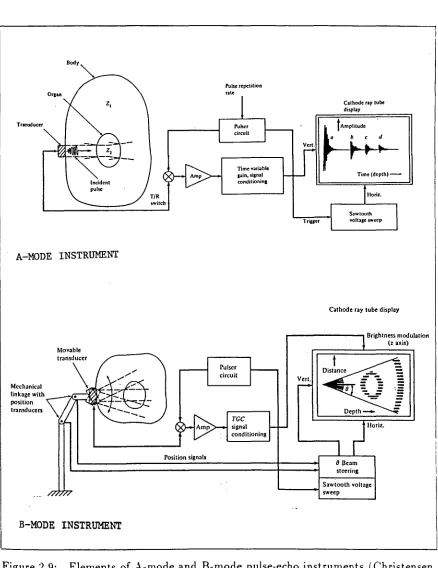
A-mode is a one-dimensional display of echo amplitude, as shown in Figure 2.9a.
This was widely used to diagnose midline shifting of brain (due to edema, hematoma,
etc.) by comparing the distance of midline of brain (i.e., echo from Fax cebrii) from
Figure 2.8: The sequence of signal conditioning steps often implemented in processing of the received ultrasonic echoes
(Modified from Christensen, 1988, p. 134)
(a) unprocessed, amplified echoes;
(b) after demodulation (rectification and smoothing), yielding the pulse envelop;
(c) time gain control (TGC) amplification; (d) logarithmic compression;
(e) elimination of signals below threshold setting; (f) sweeped B-scope; and
UNPROCESSED SIGNAL
(a)
(b)
/1\
AFTER DEMODULATION
1\
(c)
/f\
AFTER TIME GAIN CONTROL
.0,
}LA
(d)
AFTER NOISE REDUCTION
(e)
1\1\
(f)
SWEEPED B-SCOPE
~---
....
~--
- -
--~-
-..----
-.----TRIGGERED B-SCOPE
-_._--A-MODE INSTRUMENT
Movable
Mechanical
linkage with _---;"=-_'1\1' .. ~ ...
position transducen
B-MODE
INSTRUMENT
T/R
5witch
Position signals
22
Pulse repetition nte
Time variable cain. "iCnal condilioninl
TGC
signal
conditioning
Cathode ny tube display
tAmPlitude
d
Cathode ray tube display
o aeam
stcerin&
Sawtooth voltage
.... ----+1 sweep
'---_ _ _ ---J
[image:33.612.86.524.85.653.2]B-mode is two dimensional display where the echo amplitude is modulated
into brightness of the displayed beam (also called gray scale or z-axis modulation).
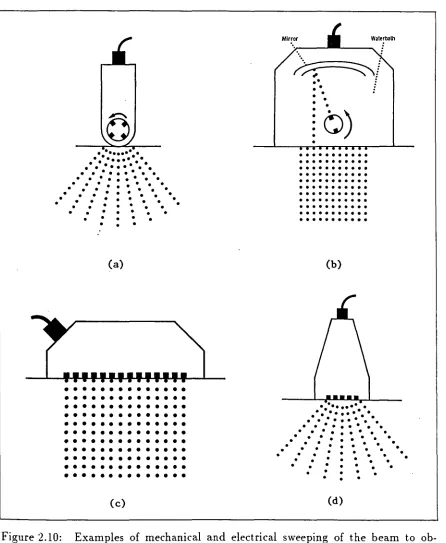
This is shown in Figure 2.9b. The image is constructed from several A-mode signals
taken at different angles. Most commercially available ultrasonic imaging systems use
a variety of scanning methods. These include mechanical (rotating, oscillating, etc.)
and electronic (linear array, phased array and annular array) scanners. Some examples
are illustrated in Figure 2.10. The advantages of these complex arrangements are real
time (therefore, also called real time scanner), precision scanning of larger area of
tissues with better axial, and in case of annular array, lateral resolution.
C-mode refers to through-transmission imaging in which the ultrasound pulse
IS transmitted from one side of the body through to receiving transducers on the
opposite side. Attenuation and velocity data may be obtained by this method.
Ultrasound Applications for Tissue Characterization
Ever since the use of ultrasound for tissue characterization began, it has grown
tremendously, almost as a separate discipline. It is the second most widely used
imag-ing technique, beimag-ing next only to radiology. Ultrasonic tissue characterization involves
the determination of propagation characteristics (velocity, attenuation, backscatter,
etc.) of ultrasonic energy in various tissues. In the medical field, tissue
charac-terization applications range from detecting a fetus in the uterus to differentiating
pathologies of liver, breast·, eye, etc., which can not be easily diagnosed by other
methods.
• • Figure 2.10:
.
• •.
-
...
:::
...
•• •• • • • • ••• •• ••
••••• ••
• • • • •• • • • •• •• • • •• • •• • • • • • •:
: :
.. ..
.
• • • • • ••
• (a)•
•
• • •
•
•
•
•
•
•
•
• •
•
•
•
• •
•
• •
•
•
• •
•
•
•
• • •
•
• • • •
• •
•
•
•
• • • •
•
•
•
•
•
•
•
•
•
•
• • • • •
•
• • • •
•
•
•
•
• • • • • • • •
• •
• •
•
•
• • • •
•
•
•
•
• • •
•
•
•
•
•••••••••••••
•
•••••••••••••
• •••••••••••••
• •••••••••••••
(c) 24 •••
•.
• ••
• •b)
•
• • • ••
••••••••••
•
•••••••••• • ••••••••••·
• ••••••••••... .
• •••••••••• • ••••••••••·
·
... .
... .
• •••••••••••
•••••••••• (b)-
... .
.
...
-
... .
..
...
..
• • • • • • • • •...
:
... .
• • • • • • • • •.
•.
••
• • • • • • • • • (d) • • •.
• •.
• • • • • • • •26
CHAPTER 3.
ULTRASONIC ATTENUATION:
BACKGROUND
AND LITERATURE REVIEW
As defined in the previous chapter, attenuation, in simple terms, is defined as
a loss in acoustic intensity (power per unit cross-sectional area) as a transmitted
ul-trasound wave passes through tissue or any other medium. This chapter describes
the attenuation phenomena. The data for biological tissues are given and clinical
significance of some primary encouraging results are discussed. It also reviews
var-ious methods of estimating attenuation in clinical situations and their potentials in
characterization of fat and muscle tissues.
Mechanisms for Attenuation
Attenuation is caused by number of processes such as absorption, scattering,
reflection, refraction and wavefront divergence.
In
addition, when an ultrasound beamexits from tissue, additional losses may be detected that depend on the characteristics
of the measurement apparatus, such as transducer aperture. For example, portions of
the incident beam may be refracted or scattered and may never reach the measurement
transducer.
A bsorption is the fundamental tissue parameter responsi bIe for attenuation
at-tenuation. Reflection, scattering and absorption contribute the most for measured
attenuation.
Units of Measured Attenuation
By definition, attenuation can be expressed in units of intensity (watts/ cm2 ) or
power (watts) lost per unit distance. Unfortunately, it is fairly difficult to interpret
and calibrate instruments absolutely, since power levels are very low and vary with
transducer selection. It is customary, therefore, to calibrate output levels by
com-paring them with a fixed arbitrary level using the decibel (dB) notation. Usually
the output power is compared to input power for measuring attenuation of whole
tissue; or recently the approach has been to compare powers at varying tissue depths
for statistically better estimates of attenuation, particularly for inhomogeneous
tis-sues. Attenuation can also be expressed as a ratio of wave echo amplitudes (pressure
amplitude in voltage) in decibel notation 1. Thus,
where
Power attenuation
Amplitude attenuation
10
10glO(~)
dB20 log 10
(4;;)
dBreference and new power levels reference and new amplitude levels.
The replacement of factor of 10 by 20 in amplitude attenuation is related to the fact that on conversion from power to voltage, the voltage (V) appears as a square (V2)
28
and 10 log10 V 2 = 20 loglO V.
When a wave is attenuated in a medium, the power levels and amplitude levels
decrease at the same rate if they are measured in dB with respect to the reference level.
It is therefore common practice to talk of attenuation in terms of dB per centimeter
depth of tissue, without specifying whether power or amplitude is being discussed.
Also, when measured thus, it is found to increase linearly with frequency, for most soft
tissues; so it is expressed per unit frequency (i.e., per MHz) or at specific frequency
(e.g., center frequency of transducer). Thus, the units of measured attenuation (i.e.,
a or aU) as defined in Chapter 2) are:
I
Units of Q :I
I
or dBcm- 1 at 2 .. 5I MHz
I
Since it is difficult to assess the individual contribution of mechanisms in routine
diagnostic techniques, it is quite preferable to estimate the more relevant quantity,
attenuation as a whole or total attenuation. In some literature, attenuation is
referred to for only a single mechanism (e.g., absorption); it is recommended that
these misleading terms should be avoided and the general term attenuation should be
reserved for total attenuation.
Frequency Dependence of Attenuation
The importance of the various mechanisms is dependent on the wave frequency;
therefore, the total attenuation is also a function of frequency. The attenuation of
soft tissues increases monotonically with frequency in low MHz range. This frequency
(Lele et al., 197.5; Narayana and Ophir, 1983a). The frequency derivative or slope
of this monotonically increasing function of frequency provides an useful index of
attenuation. It has been shown that this slope is quite independent of whether or not
the tissue attenuation exhibits a linear dependence on frequency (Jones and Behrens,
1981; Narayana and Ophir, 1983b).
Many investigators have worked to determine frequency dependence of
attenua-tion for various normal and pathologic tissues. In general, for most soft tissues, this
dependence is linear or almost linear (i .e., power of frequency dependence around 1)
for most practical purposes. Non-linear frequency dependence has been found for
blood, bone and lung tissues.
Attenuation Data for Biological Tissues
Biological tissues can be characterized ultrasonically by their attenuation,
ab-sorption, and velocity, which correlate well with the presence of major tissue
compo-nents of water and protein, particularly collagen (Johnston et al., 19(9). Compiled
data of average attenuation for tissues by categories are shown in Table 3.1. As seen
from the table, the structural tissues such as tendons and bones tend to be more
attenuating than visceral organs such as liver, brain and kidney. Also, note that the
frequency dependence of attenuation for blood, bone and lung is not linear, while
most soft tissues exhibit a linear dependence. Increasing attenuation also correlates
to decreasing water content, increasing protein content and increasing speed of sound
30
Table 3.1: Average attenuation for biological tissues by categories (data selected from Johnston et al., 1979; Dunn, 1975; and Goss et al., 1978 and 1980)
Tissue Attenuation , General trends
il
attenuation at f=1MHz Tissue Remarka water collagen sound
I'
categories (dB cm- 1 ) content content velocity I
Very low 0.026 serum
-
T
increa.sing increa.sing0.087 , blood , , I f 1."20 structura.l velocity
Low 0.61 fat I
@ 37°C. protein of sound
Medium 0.87 brain
-
conten'0.96 liver I
-0.7-1.4 I muscleb
!
-I
1.9 breast I
-i
I
2.0 heart ,
I
II
i
-2.6 kidney , i
-
;1High 4.3 tendon
I
-
increasing\1 Very high
>
8.7 bone\
f l . l H 2 O 1
- !
>
34 lungI
fU'o
1
iIi
- I cont~nt .~
a fn represents the power of frequency dependence for attenuation in the power law model aU) = aofn (spaces indicate a linear dependence, i.e., f1).
bStriated muscle; attenuation along the fibers is higher than that across the fibers.
Half-value Layer Thickness: To give some appreciation of the role of atten-uation in practice, the thicknesses of tissues required to reduce ultrasonic intensity by half (-3 dB) are listed in Table 3.2. Some interesting points can be noted from the table and related to practicabilities of imaging tissue structures.
1. Firstly, many soft tissues have similar attenuation characteristics, e.g., for brain and liver, the intensity of 2 MHz ultrasound is reduced by half in about 2 cm. Blood, on the other hand, is less attenuating and this helps the visualization of cardiac structures.
[image:41.612.85.522.150.397.2]Table 3.2: Thicknesses of biological tissues required to attenuate intensity of an ultrasound beam by half (-3 dB) (McDicken, 1976, p. 58)
Tissue / material Thickness (in cm.) of tissue at
1 MHz 2 MHz 5 MHz 10 MHz 20 MHz
Aqueous humour
-
-
6 3 1.5Air 0.25 0.06 0.01
-
-Blood 17 8.5 3 2 1
Bone 0.2 0.1 0.04 -
-Brain 3.5 2 1
-
-Caster oil 3 0.7.5 0.12
-
-Fat 5 2.5 1 0.5 0.25
Kidney 3 1.5 0.5
-
-I Lens of eye
-
-
0.3 0.15 0.07Liver 3 1.5 0.5
-
-I Muscle 1..5 0.7.5 0.3 0.15
-Perspex 1.5 0.7 0.3 0.1.5 0.07
Polythene 0.6 0.3 0.12 0.6 0.03
I Soft tissues (average) 3 1..5 0.5 0.3 0.1.5
i Vitreous humour
I
6 3 1.5
-
-II
WaterII
1360I
340I
54I
14 3.4to the uterus. \Vater itself is very useful because of it.s extremely low absorption; for most practical purposes, water can be regarded as lossless and can therefore be used in immersion scanning with no loss of sensitivity.
3. Muscle is of special note in that it is anisotropic and a difference of a factor of 2 .. 5 exists between the attenuation across and along its fibers.
4. The high attenuation in the bone, about 20 times that of soft tissues, creates many problems for ultrasonic scanning. B-scanning of the head is primarily difficult; bones also limit viewing access to the heart, eye and abdomen .
. 5. Gas bubbles in lung cause high attenuation by extremely strong scattering and absorption of t.he ultrasound and this makes it almost impossible to penetrate a normal lung with diagnostic ultrasound. Lung also limits examination of heart and much of the thorax.
[image:42.612.105.506.150.439.2]32
it is a convenient medium for constructing test and training phantoms.
7. Absorption in air is very high at diagnostic frequencies. Because of this and low acoustic impedance, transmission of ultrasound in air ceases to be practical above 0 .. 5 MHz (McDicken, 1976, p. 59).
Clinical Significance of Attenuation
Tissue attenuation has been measured in vitro and in vivo by many investigators
and some initial clinical results for several different estimation techniques have been
obtained, particularly for liver, breeast, eye, and uterus.
Some encouraging consistency has been noted among the results obtained using
several different methods of estimation. Attenuation has been found to have
poten-tial to become a clinically measurable parameter for differenpoten-tial diagnosis of certain
pathologies. Attenuation measurements in vivo and their correlation with biopsy and
autopsy results has enabled separation of normal from pathologic tissues. Most
in-vestigators have chosen the liver as the target organ, primarily because of its large
size, homogeneous nature of the backscatter, the ease of access and confirmation of
the results through easy liver biopsy. Table 3.3 shows the attenuation data for liver
pathology differentiation.
It should be noted that the ultrasonic attenuation may not serve as the only
pa-rameter for differential diagnosis, but it surely has potential to become an important,
Table 3.3: Summary of in vivo measurements of ultrasonic attenuation in liver using a variety of methods (Jones, 1984)
II
Patholog~Normal
I
Cirrhosis
II
HepatitisI
FattyAttenuation
• magnitude: 0.5 dB/cm @ 1 MHz (range 0.4 - O.i)
• frequency dependencea : 1.05 (range 0.95 - 1.15) • 50% - 60% higher than corresponding normal • slightly greater frequency dependence
• 30% - 40% lower than corresponding normal • high (when scattering dominates), or
low (when absorption dominates)
• higher frequency dependence (range 1.0 - 1.4)
aRepresents the power, n, in the power law model a(f) = Ctofn.
Methods of Attenuation Estimation
II
I
J
l.Tltrasonic attenuation has been measured in vitro by many investigators ever
since the field of diagnostic ultrasound began. In last fifteen years, there has been
good progress in this area and many in vivo methods, too, have been developed
to estimate attenuation in a clinically useful manner. The goal in measurement of
attenuation is to provide an objective and reliable index to quantitate the subjective,
equipment-dependent estimates of attenuation that clinicians have found useful in
interpreting ultrasonic images. Some uses for measurements of attenuation include:
• Improved time gain compensation for imaging (Melton and Skorton, 1981).
• Compensating backscatter measurements for the attenuation of intervening tis-sue (Cohen et al., 1982; and O'Donnell, 1983).
• Estimating local values of attenuation for purposes of tissue characterization (Shawker, 1984; Maklad. 1984; and Jones, 1984).
• As a long term goal, quantitate the backscatter and attenuation imaging
34
Qualitative estimation in B-mode On the standard B-mode image, the effects of
attenuation are subjectively observed by ultrasonographer. Attenuation of localized
lesions is judged by the appearance of the posterior echoes, i.e., amplitude of the
returning echoes from the far side of a lesion. Terms such as acoustic enhancement
(echo amplitude higher than the surrounding tissues) and acoustic shadowing (total
absence of the posterior echoes) are qualitative descriptions of this posterior echo
amplitude. This helps distinguish cystic and solid masses.
Attenuation in large masses or entire organs is generally estimated by the relative
difficulty of beam penetration. This is subjectively evaluated by noting the
transdu-cer frequency, the instrument gain, and the time-gain-compensation (TCG) settings
required to penetrate an organ or large mass, and to uniformly display the echoes in
near and far fields of the transducer.
Quantitative estimation in reflection Over the past several years, several pulse
echo techniques for quantitative estimation of attenuation have been developed, and
some initial clinical results have been obtained, particularly for the liver. These
methods can be grouped in time domain and frequency domain methods. In general,
time domain methods are adaptable to real time implementations, which feature speed
at the expense of flexibility. On the other hand, the frequency domain techniques
allow flexibility of implementation, but tend to require off-line processing.
An excellent review of these techniques could be found in literature (Miller, 1984;
and Flax, 1984). Since the part of this research was to select the best method for
application to fat and muscle characterization, some methods are discussed in detail
Frequency Domain Methods
These methods fall generally into two main kinds: spectral difference methods
and spectral shift methods. A relatively new approach of matched filter pulse
com-pression is also considered in this category.
1. Log Spectral Difference Techniques: In these techniques, the log-power
of the signal, attenuated by its path through the tissue, is compared with reference
log-power. As shown in Figure 3.1, the log-power difference is plotted against frequency
and least square slope over the transducer bandwidth is calculated. Dividing this
slope by the distance the signal traveled (in cm.), gives the coefficient of attenuation
in dB cm- 1 MHz-1. There are several approaches to obtain attenuated and
refer-ence spectra, as illustrated in Figure 3.2 and described below.
TRANSMISSION ApPROACH: Here, a broad band pulse passes through the tissue
of interest and is received by a second transducer (Figure 3.2a). The attenuation
is estimated by comparing the response obtained with only water (or physiological
saline) between transducers and the response obtained when tissue is substituted.
SHADOWED REFLECTOR ApPROACH: This represents a slight modification of
the transmission method, in which single transducer emits and receives a pulse that
passes through the tissue a second time after being reflected from a flat metal or glass
plate (Figure 3.2b).
BACKSCATTER ApPROACH: A conceptually simple approach for estimating
attenuation from backscatter signal is to compare spectra of echoes obtained from
E
1-1 oI-l () Q) P. til 1-1~ o
p. 00 o ...t shallow (reference) deep (attenuated) frequency (a) 36
slope of line 0:0
=
2 (shallow - deep)frequency
(b)
Figure" 3.1: Log-spectral difference technique for estimation of attenuation [ (a) ref-erence and attenuated log-power spectra, and (b) log-spectral diffref-erence and least square fit to calculate the slope and coefficient of attenuation]
of the irregular shapes of the surface of organs of interest and the specular echoes
that a"rise from tissue interfaces are highly dependent on geometrical factors that can
not be controlled.
It is difficult to adapt the techniques just described to in vivo situations, due to
the factors listed below (Ophir et al.. 1984).
1. Tissue does not contain reliable reference reflectors, and therefore estimates must be made from a noisy statistical ensembles of scatterers. This limits the precision and spatial resolution obtainable in the estimate.
2. Evidence indicates that the main contribution to attenuation is from absorption and not from scattering. The attenuation estimates, however, rely heavily on the properties of the scatterers, such that small changes in these properties could readily result in erroneously large changes in the attenuation estimates.
(a)
reflector
transmitter
~
& receiver
--1
114·
(b)
transmitter
& receiver ~
--4
II ••
~
shallow deep
(c)
Log-power spectra (reference and attenuated)
without
I'
~
withtissue( \issue
without
( ~ tissue
' / "with
. tissue
shallow segment
~deep
segment
[image:48.612.84.527.113.611.2]38
4. Various techniques estimate different quantities which are related to attenua-tion under certain assumpattenua-tions (e.g., tissue model of scatterers and specular reflection). The validity of these assumptions is difficult to ascertain.
5. Transmission and shaded reflector methods can not be adapted clinically for obvious reasons.
Consequently, most of the techniques proposed for estimating attenuation in
reflection concentrate on relatively weak backscattered signals emanating from the
interior of the tissue. Figure 3.2c illustrates steps in this method. A shallow and a
deep segment are extracted from rf A-mode signal and power spectra are obtained
using appropriate method. One common approach is to take the Fourier transform
using the Hanning window.
Assuming that the backscatter coefficient is the same in shallow and deep
seg-ments, log spectral difference can be obtained and attenuation coefficient (0:) and slope (Qo) can be calculated as described earlier. The following points should be
noted about this method.
• The mean slope exhibited by tissue volume is obtained by averaging axially (along A-mode signal) and laterally (adjacent A-mode signals). This reduces the variance (Fink et al., 1983; Lizzi and Laviola, 1976; and Kuc and Taylor, 1982).
• The optimal separation between shallow and deep pairs in rf A-mode data for axial averaging is suggested to be 2/3 of total length of the A-mode signal (Kuc et al., 1977; and Kuc and Schwartz, 1979).
• Smoothing the spectra (in frequency, autocorrelation, or cepstral domain) has some effect in improving the estimates (Robinson, 1979; and Fraser et al., 1979).
2. Spectral Shift Technique: This approach is based on the fact that soft
tissues exhibit transfer characteristics of a low-pass filter (because the ultrasonic
high frequency results in a decrease, with distance travelled, in the peak frequency,
the average frequency (centroid), and the bandwidth of the received signal in general.
This is illustrated in Figure 3.3.
[image:50.612.64.534.181.428.2]( a)
... \f
p
o
..
e rs
p e c
t r
u
m
Frequency
Figure 3.3: Illustration of the shift of the spectrum to lower frequencies as an ultra-sonic pulse propagates through an attenuating medium
In these methods. models for the transmitted pulse shape and for the frequency
dependence of attenuation are assumed to relate measured changes in the spectrum
to the attenuation. Usually, the spectrum is modelled as a Gaussian with variance 0'2;
then. the shape of the spectrum remains unchanged and the variance is preserved.
The shift in frequency
(.6.f)
is proportional to the slope of attenuation (ao), thedistance travelled (I) and the variance of the pulse as
'J
fe
=
fo - aolO'~ or (3.1 )40
has been shown that an estimate of the centroid provides a better measure of the
frequency shift than an estimate based on the peak frequency. The centroid «
1
> )
can be calculated asJh
I[E(f)[2dl
<
1
>
=_1--";1~
_ _
_
Jh
[E(f)[2dl
h
where [E(f)[2 is the power spectrum of the windowed rf segment.
3. Matched Filter Pulse Compression Technique: This new concept
was developed by Meyer (1979 and 1982). The motivation for this approach is the
limitations of time gated pulse echo ultrasound. Tissue segments from which received
power spectra are computed can not be made arbitrarily short, because reducing
the time windows blurs the power spectra (a trade-off between axial resolution and
spectral resolution). Also, interference effects resulting from the overlap of signals
emanating from adjacent regions of tissue compromise estimates of attenuation.
The matched filter pulse compression method (also called as matched filter
cross-correlation method) overcomesthese drawbacks. It is capable of providing results that
are independent of overlaping echo wave-trains from adjacent tissue regions separated
in time by
2/6.1,
where.6.1
is the system bandwidth. For example, for a bandwidth of .5 MHz, attenuation coefficient from tissue segments as small as 0.3 mm can bedetermined independently. This has potential of high resolution attenuation imaging.
It is beyond scope of this document to discuss this method any further, but the
interested reader is urged to refer the original li terat ure (Meyer, 1979 and 1982).
for attenuation estimation techniques.
A parametric method of analysis is one which
requires the transmitted ultrasonic pulse to be of convenient mathematical
param-eters, e.g., as a Gaussian shape pulse. In contrast, a non-parametric method does
not require such characteristics of transmitting pulse. For example, frequency shift
method is a parametric one, while log-spectral and matched filter pulse compression
methods are non-parametric ones.
Time Domain Methods
Just as the attenuation information in the frequency domain is carried in the
amplitude and center frequency of the rf spectrum, so is the attenuation information
in the time domain contained in the amplitude and rate of zero-crossings of the rf
signal itself. The important advantage of time domain methods is the possibility of
real time implementation.
1. Amplitude Difference Method: In this method, the difference in the
amplitudes of backscattered echoes from two planes in the tissue is measured. This
amplitude difference is related to the attenuation coefficient o:(f).
The relationship between frequency domain and time domain attenuation is
de-scribed by simple convolutional model for backscattered signal from a pulse
propa-gating through an attenuating medium (Flax et al., 1983; and Flax, 1984). The basis
for this model is given by Eq. (3.2), assuming the Gaussian spectral shape, linear
fre-quency dependence on attenuation, negligible frefre-quency dependence of the scatterers,
where
f
S(f)
IA(f)I~
ao
Z
fo
42
frequency
backscattered power density spectrum noise spectrum
attenuation coefficient (in dB em -1 MHz -1 ) depth of tissue traveled by ultrasound
transducer center frequency
characteristic width of transducer power spectrum.
(3.2)
Now, the total energy contained in the signal is integral over the power density
spectrum (Parseval theorem). Hence. the energy as a function attenuation and depth,
E( ao, Z), will be
E( ao, 1) = 2
10
00S(f) df.
However, since the spectrum is Gaussian and does not change shape with attenuation,
the energy will be simply proportional to the power density at the center frequency
(fe). Thus, the energy can be described by the proportionality
E(ao,l) IX S(fe).
Using Eq. (3.2)' the backscattered energy is given as
where Ao is the Gaussian envelop amplitude at the center frequency (fe). Substituting
Eq. (3.1) for fe,
{ 2 2 2 }
Thus, the spectral energy decays exponentially, but not as a simple linear function of
ao or I, but rather with an additional quadratic term (aolo-)2. However, if the pulse
bandwidth is narrow such that 0-2 can be approximated as zero, then the quadratic
term disappears leaving the desirable relationship
( 3.4)
It is therefore possible to estimate ao by measuring the amplitudes (or
inten-sities) of the echoes from the backscattered signals from two planes separated by a
distance I. Using a method termed C-mode analysis, Ophir et al. (1982) applied
this narrowband relationship to estimate attenuation coefficient for human skeletal
muscle in vivo. In this technique, a narrowband transducer and a gating mechanism
are used to detect the narrowband signal located at a specified distance from the
transducer face. By translating the transducer back and forth over a fiat (X- Y)
re-gion, an amplitude plane will be defined at the gated depth, as shown in Figure 3.4.
The average value of all the amplitude measurements across the plane is recorded,
to reduce the effect of beam profile. Next, the transducer (or gating) is repositioned
at a different axial depth and the procedure is repeated. By simply determining the
amplitude change occurring with axial translation (l) between planes, and noting
the transducer center frequency (fa), the attenuation coefficient (ao) can be readily
determined from Eq. (3.4).
One of the main factors that affects the amplitude measurements is the axial
beam sensitivity profile. So, a knowledge of the beam profile and appropriate