International Journal of Innovative Technology and Exploring Engineering (IJITEE) ISSN: 2278-3075,Volume-8, Issue-10, August 2019
Abstract: Current innovation in the field of Mobile and Wireless network will increase the use of mobile devices which procreated in an outburst of traffic passing through the internet. Due to the explosion of traffic mobility management has become a challenge in future mobile and wireless networks. To deal with such an explosion, mobile networks are becoming flatter as compared to previous hierarchical mobile networks. This paper presents a detailed survey of solutions for currently mobility management such as Centralized mobility management techniques for mobile and wireless networks, described the limitation of Centralized Mobility Management which is hierarchical and centralized in nature and discussed an approach which removes the limitation of Centralized mobility management called as Distributed mobility management. This paper also discussed two different approaches of Distributed mobility management such as Client based Distributed mobility management and Network based Distributed mobility management.
Keywords: IP Mobility Management, Centralized mobility management, Distributed Mobility Management, 5G Wireless Networks.
I. INTRODUCTION
s
ocietal Innovation will give rise to changes in the way mobile and wireless communication system is used. Applications and industries of today and the future such as E-banking, E-learning, Innovative health care services, Self-driving cars will continue to generate and becoming more mobile [1]. The today’s scenario of human to machine communication is expanding by a great increase in the numbers of communicating machines requiring more networks. In the future, it is moving towards machine to machine communication also called the Internet of things which will make our life more comfortable, efficient and safe [2]. Now a day’s consumers demand more amount of traffic which claim for low latency and more capacity. The mobile user’s access internet while moving from one place to another and the amount of traffic generated by the users are growing rapidly in the last few years. Now users can connect to various networks which are accessible and build different active sessions concurrently while moving. Due to these requirements, there is a need for a 5G wireless network that can afford more facilities to a user to apply his hold in a colossal way to make him realize the actual growth. The main contrast between the prevailing generation and expected 5G techniques according to a common user need to be somethingRevised Manuscript Received on August 05, 2019
Ujjawal, Computer Science and Engineering, Ansal University,
Gurugram, India.
Dr.Yogesh Chaba, Computer Science and Engineering, Guru
Jambeshwar University of Science and Technology , Hisar, India.
more than maximum throughput. Some other demands include:
1. High data rates and greater coverage should be there at cell edges.
2. Different parallel data transfer paths.
3. Data rate must be 1 Gbps or more while moving. 4. WWWW (World Wide Wireless Web) applications. 5. Lower battery consumption.
In 5G wireless networks due to the increase in number of mobile user and the merging internet and wireless communication mobility management emerges as serious problem for mobile and wireless network. Mobility management give the mechanism for maintaining for two services such as active session continuity and address reachability. During active session continuity it maintain current active session of MN by preserving the same IP address provided by local network for the whole session even though the mobile host is changing its point of attachment and during the address reachability it keeps the same IP address for a very long period of time [3]. The IP address will remain the same throughout and used for serving incoming packets. In this paper, firstly analyzed the techniques of mobility management like Centralized Mobility management and its limitation and then presents the new comprehensive scheme for mobility management called Distributed mobility management. The organization of the paper is as follows: Section II presents an overview of current Mobility management schemes in 5G. Section III gives us the review of the literature on Mobility Management. Section IV analyses and compares the different techniques of mobility management in 5G and summarizes the issues and challenges of the techniques. Finally, Section V concludes the paper.
II. MOBILITYMANAGEMENTIN5G
Mobility Management facilitates the current network to detect where a mobile user is currently attached for delivering the packets i.e Location management and it maintains a mobile user connection while it is changing its location or point of attachment i.e Handoff Management. Mobility management technique depends upon Centralized or Distributed networks.
A. Centralized Mobility Management:
Mobility Management Techniques in 5G
Wireless Networks
Fig.1 Mobile IPv6
Centralized mobility management, all traffic passes through the centralized mobility anchor. In this, the information about the location of the mobile user such as a session identifier and the IP address which is changing while moving is kept at a Centralized Mobility anchor [4]. Every communication goes through this mobility anchor. Currently protocols used for IP mobility depend upon Centralized Mobility anchor that provide support for mobility to all registered mobile nodes in a competent way because when these protocols were developed mobile networks were in centralized hierarchical form such as Third Generation Partnership Project (3GPP) Evolve Packet System(EPS) employ centralized with Packet data network Gateway(P-GW) and Serving Gateway (S-GW) [5-7].
It uses two different type of CMM approaches Mobile IPv6 (MIPv6) and Proxy Mobile IPv6(PMIPv6). MIPv6 protocol supports session continuity and address reachability of a Mobile Node(MN). Each Mobile Node gets its permanent IP address when it attaches to home network from the home agent (HA) and called Home address (HoA). While an MN is attached to some foreign network it acquires a temporary IP address from a foreign agent called a Care of Address(CoA). The Home Agent (HA) is centralized mobility anchor which is responsible for the reachability of Mobile Node (MN) when the MN is moving to some other network and redirects the packets destined for MN to the current point of attachment of MN as shown in fig 1. when an MN is moving in some foreign network it must inform the home agent about its current point of attachment by sending a Binding Update message [8]. For transferring the packets destined to and from an MN a bidirectional tunnel is created between the home agent and the MN. As MIPv6 requires the participation of MN in the mobility management it is called as client-based mobility protocol.
Another protocol that supports centralized mobility anchor is Proxy Mobile IPv6 (PMIPv6). As it doesn’t require the participation of the mobile node in the mobility management and signaling or it will not upgrade the MN software because the functions done by the MN is shifted to the network node called the Mobility access gateway (MAG) called as network-based mobility protocol. In PMIPv6, all communication takes place through Local mobility anchor (LMA) which replaces Home agent (HA) anchors the IP Prefixes (home network prefix) used by MN and is responsible for maintaining the MN reachability [9-11].
Fi g 2. Proxy Mobile IPv6
There are different Mobile Access Gateways (MAGs) as shown in fig 2 in a PMIPv6 domain which is used to support mobility. MAGs are implemented on access routers to track the movement of MN through different operations such as neighbor discovery and it signals mobile nodes LMA. It also updates the routing without taking any support from MN using Binding Updates (PBU) and Binding Acknowledgement(PBA). PBU and PBA are the request and reply messages sent by MAGs to mobile node LMA and reverse to establish a binding between the MNs Home Network Prefix and its current point of attachment (Proxy CoA) to acknowledge the procedure succeeded. Despite the mobility of a mobile node, it will communicate by using its original IP address for this bidirectional tunnels are built between the LMA and MAG [12].
B. Limitations of Centralized Mobility Management:
Despite several advantages of Centralized Mobility Management, there is also several limitations of CMM [13]:
Content Delivery Network: As more and more number of mobile users are using CDN increases the traffic which lay down more pressure on core mobile networks. So as to relieve the pressure and to support both traffic offloading and CDN the mobile networks should be developed with fewer hierarchy levels or mobile networks should be flattened which is not possible in CMM.
Non-optimal Routing: In CMM despite the changing location of MN the traffic destined for the MN will go through the home agent which leads to a longer path then direct path between MN and its correspondent node. So CMM provides non-optimal routes, affecting performance.
Scalability: There are several scalability problems in CMM because as the MN increases it will increase the pressure on the central anchor called as home agents for maintaining the context and route for all MN as traffic pass through this central anchor.
Dynamic Mobility: In some application, MN will remain attached to the home network for a longer period of time so mobility support is not needed all the time called as dynamic mobility. But in CMM there is no mechanism to determine whether mobility is needed or not.
International Journal of Innovative Technology and Exploring Engineering (IJITEE) ISSN: 2278-3075,Volume-8, Issue-10, August 2019
Single Point of Failure: As all traffic destined for MN goes through an anchor that is centralized which are generally more vulnerable to failure and attack, often requiring backups and duplication. A distributed approach removes the problem by distributing the agents locally.
C. Distributed Mobility Management
As the mobility and number of mobile users are increasing, mobile operators require an alternative solution that is more distributed in nature which is more reliable, efficient and cheaper in nature [14]. To remove the limitation of classical CMM approach and to meet the requirements of 5G wireless networks IETF has explored a recent standard called Distributed Mobility Management (DMM). In DMM different mobility anchors are positioned closer to the MNs to ideally distribute mobile user packets while removing the problem of dependency on centralized mobility anchor and single point of failure in classical CMM approach. Researchers are researching on two main approaches of DMM by distributing MIPv6 and PMIPv6 protocols. It introduced new approach of flat architecture where the mobility anchor such as HA in MIPv6 and LMA of PMIPv6 are placed closer to the Mobile node which is responsible for the reachability of mobile node. Two different approaches of DMM are Client-based DMM and Network-based DMM.
D. Client Based DMM
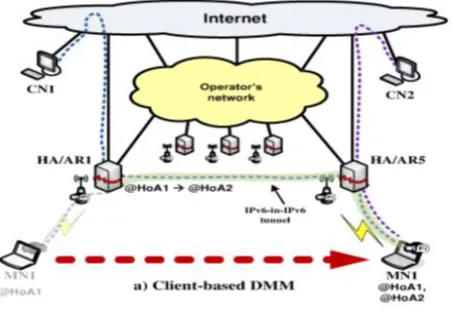
[image:3.595.311.545.51.227.2]Client-based DMM which is in common with MIPv6 in which the aim is to deploy the multiple home agent called mobility anchors at the edge of the network. When an MN first attaches the network it will be allocated an IP address called original IP address by the mobility anchor called as serving Mobility Anchor which is implemented on access route [16]. While moving to another network the MN will be provided a new IP address called as Serving IP address as shown in fig 3. The MN uses the IP address allocated by local serving mobility anchor to start a new communication while it maintains its previous active communication by binding each of the serving IP address with the original address. Session will continue with previous addresses by creating a bidirectional tunnel between the serving IP address with the previous address. It requires software upgradation on the MN as it is a client based DMM to manages multiple IP addresses with each Mobility anchor simultaneously by selecting which IP address need mobility support and perform the required binding, signaling and tunneling.
[image:3.595.54.281.616.774.2]Fig. 3 Client-based DMM
Fig.4 Network based DMM
E. Network Based DMM
Network based DMM is based on PMIPv6 in which no software upgrade is required in MN for Mobility management because mobility and signaling is done by distributed mobility anchors on behalf of MN. As compared to the host-based mobility, such as MIPv6, a network based mobility management such as PMIPv6 can reduce the handoff latency in terms of mobility [17]. In this function of LMA of PMIPv6 is distributed to multiple MAGs which are placed at the network boundary i.e closer to MN as shown in fig 4. All MAGs have the functionality of providing the IP address to the MN and Location management of the MN. When the MN attaches to the new MAG, the new MAG will provide a new IP address to the MN and perform location update function for prefixes of MN which were assigned by other MAGs by creating a bidirectional tunnel.
III. LITERATUREREVIEW
Researchers say that to fulfill the future requirements of the internet after the launch of the 4G wireless system, worldwide technologists start looking for a solution to build the next-generation wireless the system. So, from last few years’ research to build the fifth generation (5G), wireless system has started. This review will target the information which is provided by different researchers on the 5G wireless system and Distributed
Mobility Management done by analyzing the literature published in different areas of 5G.
In the coming future prime requirements or demands that should be marked are data rate improvement beyond 1Gbps, reduced latency, increase in capacity and better quality of service which are beyond the 4G wireless system. To fulfill these requirements, strong advancement needs to be made in the mobile network. Akhil et al [1] done the complete analysis of 5G wireless networks and their main focus is on the architecture of 5G wireless networks, working of Device to Device Communication (D2D) and applicability of Massive MIMO in 5G networks. Jong-Hyouk Lee et al presented the motivations, Challenges, and requirements of DMM. They presented two different approaches of DMM: host-based and network-based DMM and
performed exhaustive
comparison between
Management (CMM) and DMM [15]. Fabio Giust et al organized a systematic evaluation and conducted an experiment on a network-based DMM by using Linux-based prototype and derived analytic expressions of the cost of packet delivery, latency during handover, and the loss of packets during transmission and done a comparison with PMIPv6 which is one of a centralized solution. They concluded that the architecture of future mobile network will model the behaviour of a hybrid centralized-DMM which is a combination of the mobility management technique in which half traffic will be stored centralized, while another half will be distributed [17]. According to Fabio Giust et al for future 5G mobile networks DMM will be the relevant solution for mobility management. They had done analysis on DMM and given different solution for mobility management for future networks for flat architecture. The first solution is based on PMIPv6 protocol which is used in centralized mobility management approach, the second solution is based on Software-defined Networking (SDN), the third solution will be a routing-based solution [19]. Tien-Thinh Nguyen et al [21] introduced a new technique where DMM fails such as for supporting more no of mobile users is hybrid centralized-distributed mobility management (H-DMM). In this, an MN can choose a particular IP address to start a communication from the given addresses. Even if the MN is highly mobile the active addresses is put below a threshold value. They had done the performance analysis on following metrics such as the cost of delivering packets, latency due to handover, an end to end delay by comparing network based DMM and PMIPv6. Johanna Heinonen et al [22] prepared a model for a low latency 5G network in which the mobility management function such as attachment and handover has been adjusted to serve low latency services perfectly by calculating the mobility anchor optimality again and again during each handover and also executing a gateway relocation procedure. Tiago Condeixa et al [23] discussed and analyzed tunneling and host routing model for distributed mobility management and also evaluated the performance and scalability by simulating different scenarios. They determined that the scalability will be improved by the tunneling model as compared to host routing model and the data delivery will be improved by using host routing model then tunneling model. Ibrahim Elgendi et al [24] designed architecture for Distributed Mobility management for dense nets based on Software-defined networking(SDN) to solve mobility problems and handover in DenseNets such as femtocells. Their proposal reduces signaling overhead through the core network and increases throughput and decreases delay over other cellular networks. Tien-Thinh Nguyen et al [25] proposed a solution based on Software-defined networking called as S-DMM for 5G wireless network.
IV. ANALYSISOFMOBILITYMANAGEMENT
TECHNIQUEIN5G
As the demand for 5G networks of higher capacity, lowest latency and more consistent wireless connection, reliability and always-on connectivity demand require an efficient mobility management scheme. We have different mobility management schemes for 5G mobile and wireless networks
such as centralized and distributed mobility management. But centralized mobility management suffers from different problem such as scalability, nonoptimal paths etc. So for solving the problems of centralized mobility management and as our mobile network architectures are becoming more flattened we are moving towards distributed mobility management technique. Distributed mobility management is further divided into client-based and network-based DMM. Client based DMM uses MIPv6 as IP mobility protocol which requires MN should possess extra intelligence to manages multiple IP addresses with each Mobility anchor simultaneously for selecting which IP address need mobility support and perform the required functions such as signaling, binding, and tunneling. Network-based DMM uses PMIPv6 as IP mobility protocol in which MN does not need any up gradation in software because distributed mobility anchor will perform the handover on behalf of MN. Tunneling and Host routing models are also there for DMM for 5G wireless networks which help in better scalability and better data delivery. Software-defined networking (SDN) is another solution for Mobility management in 5G mobile networks. In SDN, an administrator program dynamically handles the behavior of traffic and the network. This can be accomplished by separating the control plane and data plane which reduces handover latency and end-to-end delay.
V. CONCLUSION
In this paper, a thorough analysis has been performed on different mobility management protocols for 5G mobile and wireless networks. We began our work by introducing 5G wireless networks, its features, and requirements. Then we have discussed various mobility management protocols for 5G wireless networks. We have given the overview of centralized mobility management technique and its limitation that it can’t support the future demands of the large volume of traffic and suffers from suboptimal routing, scalability, and reliability because in this all perception is fixed at one central point,
instead of being distributed over the internet. Then we have discussed distributed mobility management and its variants which removes all the limitation of centralized mobility management. DMM is developed to introduces the new concept of mobility management in which the central agents are distributed and placed near to mobile user by dispersing the data and control planes and flatter system architecture will be built for support. Then we analyzed the mobility management techniques for 5G wireless networks.
REFERENCES
1. Akhil Gupta, Rakesh Kumar Jha, “A Survey of 5G Network: architecture and Emerging Technologies”, IEEE Journals &Magazines, Vol. 3, pp. 1206-1232, July 2015.
2. “Looking ahead to 5G Building a virtual zero latency gigabit experience”, White Paper by Nokia Networks,2014.
3. Jaydip Sen, “Mobility and Handoff Management in Wireless Networks”, Trends in Telecommunications Technologies, Nov 2010. 4. H Anthony Chan, “Distributed Mobility Management with Mobile IP”,
International Journal of Innovative Technology and Exploring Engineering (IJITEE) ISSN: 2278-3075,Volume-8, Issue-10, August 2019
2 Photo 5. D. Liu, Z. Cao, P. Seite, and H. Chan, “Distributed mobility
management,” IETF draft-liu-distributed mobility - 02, July 2010.
6. H. Chan , D. Liu , P. Seite, H. Yokota, and J. Korhonen, “Requirements for Distributed Mobility Management” draft-ietf-dmm-requirements 04, May 2013.
7. H. Anthony Chan, “Distributed mobility management with mobile IP,” in International Communication Conference (ICC), Workshop on Telecommunications: from Research to Standards, 2012 IEEE, 2012, pp.6850-6854.
8. Liu Yu, Zhao Zhijun, Lin Tao, Tang Hui, “Distributed Mobility Management Based on Flat Network Architecture”, IEEEICST WICON, pp. 1-6, June 2010.
9. H Anthony Chan, Hidetoshi Yokota, Jiang Xie, Pierrick Seite, Dapeng Liu, “Distributed and Dynamic Mobility Management in Mobile Internet: Current Approaches and Issues”, Journal of Communications, Vol. 6, No.1, February 2011.
10. Carlos J. Bernardos, Juan Carlos Z´uniga, Alex Reznik, “Towards Flat and Distributed Mobility Management: a 3GPP Evolved Network Design”, IEEE International Conference on Communication, pp. 6855-6861, January 2012.
11. Jong-Hyouk Lee, Jean-Marie Bonnin, Pierrick Seite, H.Anthony, “Distributed IP Mobility Management from the Perspective of the IETF: Motivations, Requirements, Approaches, Comparison sand Challenges”, IEEE Wireless Communication, Vol. 20, Issue:5 , pp. 159-168, Oct 2013.
12. D. Liu, J. Zuniga, P. Seite, H. Chan, and C. Bernardos, “Distributed Mobility Management: Current practices and gap analysis,” 2014, draftietf-dmm-best-practices-gap-analysis-07.
13. Juan Carlos Zuniga, Carlos J. Bernardosy, TelemacoMeliaz, Antonio de la Olivay, RuiCostaz, Alex Reznikx, “Distributed Mobility Management: A Standards Landscape”, IEEE Communication Magazine,Vol. 51, Issue:3, pp 80-87, March 2013.
14. Dong-Hoon,Shin,Danny Moses and Muthaiah Venkatachalam, “Distributed Mobility Management for Efficient Video Delivery over All-IP Mobile Networks: Competing Approaches”, IEEE Network, Vol. 27, Issue:2, pp. 28-33, April 2013.
15. H. Chan et al., “Requirements for Distributed Mobility Management,” RFC 7333, Apr. 2014.
16. Jong-Hyouk Lee, Kamal Deep Singh,Jean-Marie Bonnin, Sangheon Pack, “Mobile Data Offloading: A Host-Based Distributed Mobility
Management Approach”, IEEE Internet Computing, Vol. 18, Issue:1,
pp. 20-30, June 2014.
17. P. Louin, and P. Bertin, “Network and Host Based Distributed Mobility,” International Symposium on Wireless Personal Multimedia Communications (WPMC), IEEE, Oct. 2011.
18. Fabio Giust, Luca Cominardi, and Carlos J. Bernardos, “Distributed Mobility Management for Future 5G Networks: Overview and Analysis of Existing Approaches”, IEEE Commun. Mag.,Vol. 53, Issue:1,pp. 142-149, January 2015.
19. C. J. Bernardos, A. De La Oliva, and F. Giust, “A PMIPv6-based solution for Distributed Mobility Management,” Jan. 2014, IETF draft, draft-bernardos-dmm-pmip-03.
20. Heeyoung JUNG, Moneeb GOHAR , Ji-In KIM,Seok-Joo KOH, “Distributed Mobility Control in Proxy Mobile IPv6 Networks”, IEICE Transaction on Communication Vol.E94-B No.8, pp.2216-2224, Aug 2011.
21. Ji In Kim, Seok Joo Koh , “Distributed Mobility Management in Proxy Mobile IPv6 using Hash Function”, The International Conference on Information Networking” p.p. 107 – 112, 2013.
22. Johanna Heinonen, Pekka Korjay, Tapio Parttiz, Hannu Flinckx and Petteri PöyhönenJi, “Mobility Management Enhancements for 5G Low Latency Services”, IEEE ICC 2016-Workshops: W01-Third Workshop on 5G Architecture (5GArch 2016).
23. Tiago Condeixa, Susana Sargento, “Distributed Mobility Management in Future Networks: Tunneling or Host Routing?”, IEEE Symposium on Computers and Communication (ISCC) 2016.
24. Ibrahim Elgendi, Kumudu S. Munasinghe, Abbas Jamalipour, “A Three-Tier SDN Based Distributed Mobility Management Architecture for DenseNets” IEEE ICC - Mobile and Wireless Networking Symposium, 2016.
25. Tien-Thinh Nguyen, Christian Bonnet, and Jerome Harri, “SDN-Based Distributed Mobility Management for 5G Networks”, IEEE Wireless Communications and Networking Conference (WCNC) 2016.
26. Shouman Barua, Robin Braun, “Mobility Management of D2D Communication for the 5G Cellular Network System: A Study and Result”, 17th International Symposium on Communications and Information Technologies (ISCIT),2017.
27. Yuanguo Bi, Guangjie Han, Chuan Lin, Qingxu Deng, Lei Guo, and Fuliang Li, “Mobility Support for Fog Computing: An SDN Approach”, IEEE Communications Magazine , May 2018.
AUTHORSPROFILE
Ujjawal is working as Assistant Professor in Department
of Computer Sc. & Engineering, Ansal University, Gurugram. She is pursuing her PhD in 5G Wireless Networks from Guru Jambeshwar University of Science and Technology, Hisar. She did her B.Tech and M.Tech in Computer Engineering from Maharshi Dayanand University, Rohtak. Her research area include Computer Network, Mobile and Wireless Communication, Artificial Intelligence and Machine Learning.
Dr Yogesh Chaba is working as professor in Department