The Importance of Foreign Language
Instruction in the Current Multicultural World
Alena Josefova1,*
1Univerzita Hradec Kralove, Rokitanskeho 62, 50003 Hradec Kralove, Czech Republic
Abstract. The current multicultural world is characterized, on the one hand, by the intense encounter of people from different cultures, and of various races and nationalities, and on the other hand, by a high degree of technological modernization in all aspects of our lives. The area of education plays, undoubtedly, an irreplaceable and crucial role nowadays. Language is not only about the mutual cooperation of people coming from different parts of the world, but especially in Europe, it is connected with the increase of problems connected with the integration of newcomers into the majority society of the new country. Foreign languages instruction and, in particular, its intensive support by individual countries becomes a necessity in today's diverse world. The author's research at universities in 2 countries confirms the importance of foreign language teaching promotion in the current globalized world.
1 Variability of languages
In today's multicultural world, only few people think about the emergence of languages. How did the language ever come into our world? There was no language at the time of the universe, it appeared gradually. The ancestors of human apes communicated with their hands and legs. The issue of language development and its variety, including foreign language learning, has been addressed by many authors around the world [1, 2, 3, 5, 6], from a variety of perspectives. Today, a bit of evolution is experienced by the smallest children - toddlers, who begin to communicate with the environment using sloppy words, and then combine them into sentences. This is a very individual process, depending on whether parents are bilingual, etc. It is advisable that foreign language learning starts from a very early age when children perceive much more information. And those who, in addition, grow up with more languages, learn to switch between different language systems [4].
absence of a common language is the language boundary between the German and the English languages or between the French and Italian languages. The similarity of the Czech language with Slovak and Polish is not accidental, as these are the so-called West Slavonic languages. Speakers of these languages are particularly close to East Slavic languages, such as Russian or Ukrainian, although they have a different Cyrillic written language that one has to learn. Among the South Slavic languages of Croatian, Serbian, Bulgarian, Slovenian or Macedonian, the Slavs are also somewhat understandable, i.e. their speakers are able to communicate with one another.
What causes Europeans troubles is learning distant languages such as Arabic or Chinese. E.g. the Chinese language sounds very musically but we can confirm from our own experience that although it is surprisingly simple in terms of grammar, the written form (existence of more than 50,000 Chinese characters) and especially intonation are a very difficult tasks for foreigners. Nowadays, the expansion of Chinese language around the world can be observed. Most recently China has invested tremendous sums of money in Chinese language teaching in Africa, where a new generation of Chinese-speaking young people is emerging opposed to the English-speaking ones.
It is clear that Czech or German are significantly different from Chinese, because these languages are not historically connected. Within the summer school program at the University of Hradec Kralove, we teach German for beginner students from Taiwan, Hong Kong, China, Malaysia and Japan. German language is very distant, especially in terms of grammatical phenomena and also pronunciations. In 1870 when trying to learn German language the American writer Mark Twain become almost mad. "My philological studies have satisfied me that a gifted person has to learn English in 30 hours, French in 30 days, and German in 30 years.”[7]. However, the German language is difficult not only for foreigners, but also the Germans have tried to overcome their own difficulties in language learning through a new reform of the written form of German [8]. Many adult Germans aged 18-64 are unable to read and write correctly. Of course, when it comes to our native language - the Czech language, it is a great challenge for most foreigners in terms of both morphology and phonetics.
1.1 Dialects
A specific group is made up of local dialects, for example, Bavarian is not any specific language, even though the German speakers claim it. Here we can talk about great patriotism, they are not just proud Germans, they are proud Bavarians. The German formal language covers all local dialects in Germany and allows communication beyond the dialects. E.g. the distinctive Saxon dialect, which may sound funny for the listener, is unrepeatable and is closely related to life and culture in Saxony. The local dialect, for example in Valencia, makes it difficult for foreigners to understand Spanish. The so-called valenciano is referred to as a spoken variation of the Catalan language used in the autonomous region of Valencia (3).
2 Universal language
absence of a common language is the language boundary between the German and the English languages or between the French and Italian languages. The similarity of the Czech language with Slovak and Polish is not accidental, as these are the so-called West Slavonic languages. Speakers of these languages are particularly close to East Slavic languages, such as Russian or Ukrainian, although they have a different Cyrillic written language that one has to learn. Among the South Slavic languages of Croatian, Serbian, Bulgarian, Slovenian or Macedonian, the Slavs are also somewhat understandable, i.e. their speakers are able to communicate with one another.
What causes Europeans troubles is learning distant languages such as Arabic or Chinese. E.g. the Chinese language sounds very musically but we can confirm from our own experience that although it is surprisingly simple in terms of grammar, the written form (existence of more than 50,000 Chinese characters) and especially intonation are a very difficult tasks for foreigners. Nowadays, the expansion of Chinese language around the world can be observed. Most recently China has invested tremendous sums of money in Chinese language teaching in Africa, where a new generation of Chinese-speaking young people is emerging opposed to the English-speaking ones.
It is clear that Czech or German are significantly different from Chinese, because these languages are not historically connected. Within the summer school program at the University of Hradec Kralove, we teach German for beginner students from Taiwan, Hong Kong, China, Malaysia and Japan. German language is very distant, especially in terms of grammatical phenomena and also pronunciations. In 1870 when trying to learn German language the American writer Mark Twain become almost mad. "My philological studies have satisfied me that a gifted person has to learn English in 30 hours, French in 30 days, and German in 30 years.”[7]. However, the German language is difficult not only for foreigners, but also the Germans have tried to overcome their own difficulties in language learning through a new reform of the written form of German [8]. Many adult Germans aged 18-64 are unable to read and write correctly. Of course, when it comes to our native language - the Czech language, it is a great challenge for most foreigners in terms of both morphology and phonetics.
1.1 Dialects
A specific group is made up of local dialects, for example, Bavarian is not any specific language, even though the German speakers claim it. Here we can talk about great patriotism, they are not just proud Germans, they are proud Bavarians. The German formal language covers all local dialects in Germany and allows communication beyond the dialects. E.g. the distinctive Saxon dialect, which may sound funny for the listener, is unrepeatable and is closely related to life and culture in Saxony. The local dialect, for example in Valencia, makes it difficult for foreigners to understand Spanish. The so-called valenciano is referred to as a spoken variation of the Catalan language used in the autonomous region of Valencia (3).
2 Universal language
Every language includes the mentality of the society. Once, Latin was a common language, but in the Middle Ages it was more or less differentiated in every country. As a consequence, the Spaniard does not understand what the French say, while the Spaniard and Italian can still understand each other because their languages are more conservative and have changed much less in the past centuries.
2.1 Johan Amos Comenius
Johann Amos Comenius was a Czech theologian, philosopher, teacher and writer of Latin, language teacher and social reformer. Comenius was thinking of life and the world in two levels: level religious-educational and the level of systematic thinking about the whole world, about its organization and knowledge. The image of the world is taken as an image of the school. Comenius longs to turn the 17th-century society into a community of people who will cooperate in peace. His philosophical work, "De rerum humanarum emendatione consultatio catholica" (in English, "The General Advise on the Correction of Human Issues"), proposed a renewal of philosophy, politics and religion.
It was a correction of the relationship not only to individuals but also to others, to the world and to God. Comenius wanted to give people a goal and show them the possible outcomes of the difficult personal and social labyrinths. His work should give not only individuals, but also the whole society and the Church a new hope, how to achieve better coexistence under certain conditions. He wanted people to realize everyone can be satisfied and prosperous if the whole society is satisfied and prosperous. Comenius felt the need to spread Latin as a tool of scientific work and means of versatile communication. During his latest work Comenius wished to introduce artificial language without any irregularities and without any learning difficulties. His efforts culminated in the idea of "PANGLOTTIE" ("General Classification of Languages").
Here he presents a demonstration of a common world language [9]. The multitude and confusion of languages in the world has been a barrier to versatile contact among the peoples. Comenius was characterized by efforts to understand and make the language easy to learn by removing irregularities and ambiguities, which eventually had a rather schematic effect. The word is to express itself as accurately as possible so as to impress an idea or an image of the same thing as quickly as possible in the mind of whoever hears the word. The attempt to create a universal language at the time of Comenius was nothing special, as great thinkers such as F. Bacon, R. Descartes, G. Leibnitz and others also dealt with this problem. Only Comenius, however, has made his reflections on the new universal language part of his corrective project of all human society.
3 Research
People with different cultural identities meet within the intercultural communication in today's globalized world. Ignorance of the foreign language as well as cultural differences is often the source of many misunderstandings and conflicts [10]. Research carried out at universities in the Czech Republic and Germany involved a total of 239 respondents. The questionnaire survey was completed by university students aged 18-29. Germany was chosen as an example of a modern multicultural state, which has been linked to the issue of immigration through its rich historical past. As part of its foreign policy, Germany has had to face the problems associated with the integration of newcomers into the majority society for decades. Here, education is an important factor, including the promotion of language education across cultures and age groups.
Fig. 1.Total number of respondents (students from the Czech Republic and Germany)
Fig. 2.Whish foreign languages do you speak? (Students from the Czech Republic and Germany)
From Fig.2 is clearly seen that the respondents' answers from the two countries differ to a certain extent, which is undoubtedly influenced by different ethnic composition of the country's population. The most students speak English and German, followed by Spanish, French and other languages.
Fig. 3. What methods are used in teaching a foreign language at your university? (Students from the Czech Republic and Germany)
[image:4.482.151.344.450.550.2]Fig. 1.Total number of respondents (students from the Czech Republic and Germany)
Fig. 2.Whish foreign languages do you speak? (Students from the Czech Republic and Germany)
From Fig.2 is clearly seen that the respondents' answers from the two countries differ to a certain extent, which is undoubtedly influenced by different ethnic composition of the country's population. The most students speak English and German, followed by Spanish, French and other languages.
Fig. 3. What methods are used in teaching a foreign language at your university? (Students from the Czech Republic and Germany)
According to the respondents the most often used teaching method is the direct contact with the teacher (in class method), followed by the blended learning method. The least used method is e-learning.
Fig. 4. Is foreign language instruction sufficiently supported in your country? (Students from the Czech Republic and Germany)
[image:5.482.170.341.281.445.2]In both countries, foreign language learning is largely supported, but more in the Czech Republic than in Germany. At present, there are problems with the integration of newcomers into the majority society, often linked to the lack of qualified professionals.
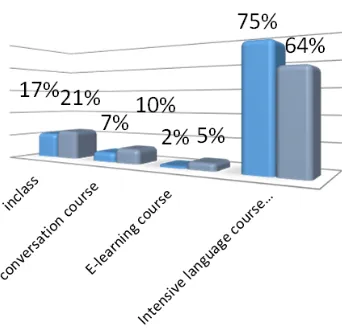
Fig. 5.What do you think are the most efficient methods of foreign language instruction? (Students from the Czech Republic and Germany)
Out of the traditional teaching methods (in-class, conversational language course, e-learning language course, intensive language courses abroad), as the most attractive appeared to surveyed group of student’s language courses abroad, however, they are very costly for many parents and not everyone can afford them. In class instruction and the conversational language course are also popular, the least effective seem to be an e-learning course.
4 Summary
The research conducted in the Czech Republic and Germany confirms the importance of teaching foreign languages in today's globalized world. Above all, frequent language inaccuracy and lack of information on the cultural diversity of newcomers into the majority society makes it difficult both for initial and for overall integration and this situation leads to the creation of parallel society and feared ghettos. Therefore, it is necessary to cultivate and support the diverse teaching of mother tongues and national languages by individual states. According to the local research, the combination of in-class instruction, e-learning and blended methods to the level B1 (according to the European Framework Program) are the most effective ways of teaching foreign languages, at higher levels of language competence intensive foreign language courses are recommended. The problem of intercultural communication, however, lies not only in the reliable knowledge of a foreign language, but also in the mutual knowledge of the participating cultures, including the elimination of all prejudices and stereotypes.
The acknowledgements: This research was conducted thanks to the project IGA 1903/2018 at the Faculty of informatics and management, University of Hradec Kralove.
References
1. H. Haarmann „Weltgeschichte der Sprache“, Verlag C. H. Beck (2006) 2. T. Steinfeld, Der Sprachverfuhrer“, Schriftenreihe Bd.112 (2012) 3. H. Bussmann, Lexikon der Sprachwissenschaft, Aufl.Stuttgart (1990)
4. P. Schroter, Visuelle Worterkennung bei Billingualen Kindern im Deutschen, Berlin (2016)
5. W. Butzkamm, Psycholinguistik des Fremdsprachenunterrichts, Tubingen, Francke Verlag (1993)
6. K.R. Bausch, H. Christ, W. Hullen, H. J. Krumm, Handtuch Fremdsprachenunterricht, Tubingen. Francle Verlag (1989)
7. M. Twain. The Awful German Language. s. 11, ( Fluter, Nr. 39 )
8. R. von Bredow, V. Hackenbroch. Die neue Schlechtschreibung. p. 96-104.(Der Spiegel 25/2013 )
9. J. A. Komenský, Obecná porada o nápravě věcí lidských, Svoboda, Praha (1992) J. A. Comenius, De rerum humanarum emendatione consultatio catholica, (1992)