International Journal of Innovative Technology and Exploring Engineering (IJITEE) ISSN: 2278-3075, Volume-8 Issue-7 May, 2019
Abstract: The study of oscillations occurring in mechanic systems is not only urgent but also vital issue, especially if the mechanic system operates under extreme conditions. A certain mechanical system is analyzed by designing of computations which account for possible variations of solution properties upon equivalent transformations. Generally, the subject matter of research upon such approach is comprised of ideal sign models of dynamic systems presented in the form of mathematical equations (sets of equations) relating physical variables describing qualitatively state of these systems. The research procedure is based on consideration of models of actual dynamic systems in various forms of recording of the relevant equations and determination of parameters, the minor variations of which can lead to variation of behavior quality of dynamic system. The main aim of this article is detection of parameters of the considered dynamic system which in the case of their minor variations can lead to loss of stability, overshoot or overcontrol of this system upon its operation. The obtained conclusions confirm once more on the basis of actual example the necessity to analyze model types of dynamic systems already at the stage of their mathematical simulation.
Index Terms: Model, engineering analysis, computations, stability, control, stabilization, ill-posed systems.
I.INTRODUCTION
Consideration of ideal sign models of dynamic systems, in particular mathematical ones, without their comprehensive analysis and idealization of mathematics as universal means of obtaining knowledge of the world can lead in real life to negative consequences in the form of emergencies and technogenic catastrophes [1], [2]. The reason of such cases, initially unexplainable, is attributed to human factor. We believe that such reason can be nearly completely excluded in most future cases, if mathematical models will be considered in combination with their modifications obtained by equivalent transformations [3]. Therefore, in future already at the stage of mathematical simulation of dynamic systems it will be possible to prevent the reason of most such cases. As it happens, in certain cases these equivalent transformations can change important properties of these solutions. Such properties are obviously continuous dependence of solutions on parameters, retention of solution stability upon minor variations of parameters, etc. Herewith, the solutions of
Revised Manuscript Received on May 06, 2019
A.Y. Murashko, St. Petersburg State University, Saint Petersburg, Russia.
V.B. Orlov, St. Petersburg State University, Saint Petersburg, Russia.
A.V. Zubov, St. Petersburg State University, Saint Petersburg, Russia.
L.A. Bondarenko, St. Petersburg State University, Saint Petersburg, Russia.
V.A. Petrova, St. Petersburg State University, Saint Petersburg, Russia.
original mathematical models of dynamic systems as such are not varied. Such mathematical models of dynamic systems are known, the solutions of which are modified to finite and even to higher values upon indefinitely small variations of parameters unavoidable in practice. Ill-posed systems are such systems, the solutions of mathematical models of which are modified to finite values upon indefinitely small variations of coefficients and parameters of these mathematical models [2]. Design procedure of engineering systems up to the late 1990-s was considered as developed and reliable but in two last decades there occurred unexplainable technogenic emergencies and catastrophes later attributed to human factor. This situation that classical design methods of engineering systems lead to erroneous results can be explained, for example, by the fact that at present engineering systems operate in over-extreme modes and their preset stability reserve has been thus exhausted. In addition, the issue of adequacy of applied models for description of designed dynamic systems is still open when the use of extended range of variables can transform linear or linearized systems into significantly non-linear systems. Even upon the use of existing mathematical models of dynamic systems the investigation into the causes of emergencies and catastrophes requires for thorough analysis of all stages of development and operation of engineering systems including its designing stage.
II. LITERATUREREVIEW
It has been demonstrated in [1], [2], [3] how dangerous is using of "ill-posed system" of developed controllable technical object, or this object with "ill-posed equivalent transformation". It should be mentioned that ill-posed objects and transformations occur more rarely than conventional ones, hence, they had not been considered for a long time as operation modes of such systems in practice had not lead to such number of emergencies and catastrophes. Despite this fact, some authors paid attention to such systems and possible negative consequences [4], [5], [6]. It is highly undesirable to come across publications about new emergencies and catastrophes, if already now, at designing stage, we can recognize possible problem and prevent it. This should be based on improved (up-to-date) computation methods considering for possible variations of solution properties upon equivalent transformations. In [7] the issue of investigation into well-posed, ill-posed and intermediate systems is considered most
completely in terms of
occurrence of these
Qualitative Analysis of the Behavior of One
Mechanical System
problems upon solution of sets of linear algebraic equations, sets of ordinary differential equations, partial-derivative equations and integral equations.
Additional analysis of ill-posed system, related with necessity to account for possible errors in computations, is referred to the theory of ordinary differential equations. It follows from this theory that there exist sets of equations, the solutions of which continuously depend on parameters; hence, minor variations in the parameters correspond to minor variations in solutions. However, there are other systems without such continuous dependence. Using such systems in designs of actual engineering subjects leads to computation errors and, as a consequence, to possible emergencies. In order to distinguish such systems, the well-known theorem on continuous dependence of solutions of differential equations on parameters is used included into practical applications. According to the theory of ordinary differential equations, it is necessary and sufficient that the right-hand members are constrained and satisfy the Lipschitz conditions. Unfortunately, in general case this theorem is not valid [8]. Let us exemplify the way to avoid such error upon designing specific engineering system.
III. PROPOSEDMETHODOLOGY
The cause of procedural error is that the proof of theorem on continuous dependence of solutions of differential equations on parameters is carried out for set of equations written in Cauchy normal form. In this case the theorem is obviously correct. Further on, most researchers, taking into account that nearly any system of differential equations can be equivalently transformed into this or that normal Cauchy form, erroneously conclude that the theorem of continuous dependence of solutions of differential equation on parameters is valid for all systems, including those written not in normal form. The point is that such equivalent transformation of set of differential equations into normal form can vary the property of continuous dependence of solutions on parameters and coefficients.
But what will occur with actual engineering subject described by mathematical models in the form of equivalent systems with equal solutions? This question is discussed in details in [3]. In practice it entirely depends on the fact which system reflects more accurately peculiarities of actual subject. If the subject, as in our case, has three simple feedbacks, then its behavior is better described by system in normal form. If the subject has one complex feedback (including derivatives of variables), then its behavior upon minor deviations of parameters from calculated values is described by source system. If in ideal case the parameters of engineering subject exactly equal to their calculated values, then both systems describe the system equally since they are equivalent. Transition to analysis of mathematical model in normal form creates unreasonable belief that the subject is stable. Following the aforementioned error such researcher is sure that the subject will be stable upon further operation even at unavoidable minor deviations of parameters from calculated values. Let us demonstrate that behavior of engineering subject in practice is more complicated than can be described by initial model. If actual value of the
considered parameter m does not equal to one (m = 1) but to m = 1- ε where ε is the small quantity (ε > 0), then the subject will be stable and operable, that is, can be used by customer. Since ε is the small quantity, its minor deviations upon operation are unavoidable. Hence, the value of ε can vary from ε > 0 to ε < 0 and then the subject becomes unstable, which can result in its incorrect operation or emergency, or even catastrophe.
Development of actual engineering systems using calculation of stability on the basis of the Lyapunov functions can lead to errors similar to the aforementioned. Only application of the above method upon solution of stability problem of dynamic systems will determine whether the considered system has possible unstable modes, because existence of the Lyapunov function for the considered set of differential equations does not obligatory guarantee actual stability. In general case the considered system requires for additional testing. Further articles devoted to solution of stability problem for dynamic systems [9-12] exemplify actual engineering systems. These engineering systems also require for the mentioned additional testing. Otherwise, without these tests, it is possible to obtain erroneous conclusion about retention of system stability at minor variations of parameters.
While solving stabilization problem of dynamic systems’ application of the above method will also have a peculiar feature. It is comprised of the fact that solution of stabilization problem of dynamic systems and their practical implementation should be corrected. Practical stabilization of dynamic systems discussed in [9, 13, 14] should be considered in combination with similar problems with regard to equivalent systems against the considered ones. Formulation of stabilization problem of program motion or kinematic path of dynamic system is of more general nature and, hence, has wider application than the Lyapunov stability. Despite this, the mentioned factors will influence the time of transition processes and periods of occurring oscillations. The necessity of additional tests according to the aforementioned procedure becomes obvious, provided that we use them first of all for clarification of regions of possible stabilization of actual dynamic systems and improvement of their accuracy, which later can also prevent emergencies or catastrophes.
Upon determination of oscillating and wave processes in dynamic systems, application of the aforementioned method will be based on occurrence of such processes both in dynamic systems and in their control systems. Oscillating and wave processes can occur also in the systems describing medical and biological subjects. In medical and biological subjects an oscillation about some average value is usually described, probably unachievable equilibrium for biological system or norm for medical subject, or this or that relevant pathology. In all these cases it is possible to apply the Lyapunov stability for systems in normal form and, as mentioned above, for obtaining of the aforementioned procedural error. While considering dynamic systems according to the models described in [15-19] it is also required to consider additional sets of differential equations
according to the
aforementioned procedure.
International Journal of Innovative Technology and Exploring Engineering (IJITEE) ISSN: 2278-3075, Volume-8 Issue-7 May, 2019
(wave) processes in these systems can exist physically (or analytically) without the Lyapunov stability.
Application of the aforementioned procedure for solution of optimization problem of dynamic systems will lead to consideration of mathematical models in the form of linear algebraic equations because the optimization problems are considered characterized by description of state in discrete instants of time. Similar to the problem of pseudo-inverse matrix, where one parameter varies, it is necessary to apply algorithms allowing to calculate influence of one or numerous variations of parameters of the considered subject. In [20, 21] mathematical models of actual dynamic systems are described, similar study of equivalent systems should be also carried out for them.
While solving problems of determination of various measures of dynamic systems, application of the aforementioned method will be defined by the fact that it will be necessary to use various types of measurements and, probably, various types of measure. This is defined by the fact that certain parameters of system cannot be measured directly, and it is still unknown which measurements will be required. Direct enumeration of parameter combinations upon designing of multidimensional systems, especially in real time mode, is impossible since the number of possible combinations of positive and negative variations equals to
) ( 2
2
nW
. Even at n = 10 this results in nearly unsolvable problem. In [22-28] various types of measures of dynamic systems are shown as well as the methods of their determination. It is required to develop such algorithms which on the basis of small number of calculations would permit to determine the most dangerous combination of variation signs for forecasting of the influence of simultaneous variations of parameters on the behavior of the considered subject upon its operation.Application of the above method for solution of optimization problem of organizational system is characterized by certain features. These features are defined by the fact that organizational systems contrary to mechanic
ones are not described directly by equations of mechanics. Interrelation among such parameters of dynamic systems as applied force or constraint reaction force, weight, spatial position for organizational system is often not apparent or not defined yet. Nevertheless, while describing organizational systems, it is necessary to consider the points of phase space, where they are located, and which characterize their state. Consideration of such organizational systems in discrete instants of time and development of linear functionals characterizing functioning of such systems lead to difference equations and even to differential ones upon decrease in observation time. In [29-38] organizational systems of various purposes are exemplified. Upon decrease in observation time and passing to the limit, we should consider a set of differential equations as a model. Procedure of analysis of the obtained differential equations is similar to the aforementioned one, and for consideration of difference equations – the same as in the case of algebraic equations
.
A. Algorithm
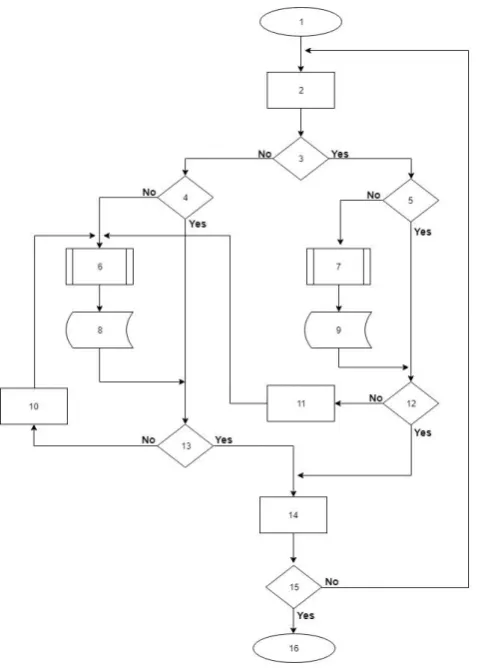
According to the above proposed method, two types of ordinary differential equations are investigated for the stability of a system - differential equation of an object model (DEOM) and differential equation of an object model in normal form (DEOM NF). After conducting a study on the stability of both systems, all the coordinates of the dynamical system under consideration are compared and it is decided whether they have the same stability parameters. If the stability parameters of one or several coordinates in both systems are different, then the algorithm returns to the consideration of the stage of choosing a system of ordinary differential equations for a model of a dynamic system. The algorithm finishes its work only in the case when all coordinates of the considered dynamic system in both cases (DEOM and DEOM NF) acquire the same stability parameters.
Fig. 1. Flow Chart of Algorithm Functional purpose of the circuit blocks:
1. Begin
2. The choice of the differential equation of the object model (DEOM or DEOM NF)
3. Selected differential equation in normal form (DEOM NF)?
4. Has the research been conducted on the sustainability of a DEOM?
5. Has the research been conducted on the sustainability of a DEOM NF?
6. Predefined Process: Conduct a study on the sustainability of the DEOM (DEOM NF)
7. Predefined Process: Conducting a study on the stability of DEOM NF
8. Stored Data 9. Stored Data
10. Conversion of DEOM to DEOM NF 11. Replacing DEOM NF with DEOM
12. Has the research been conducted on the sustainability of a DEOM?
13. Has the research been conducted on the sustainability of DEOM NF?
14. Comparison of the results of research on the sustainability of DEOM and DEOM NF
15. Do all the coordinates of DEOM and DEOM NF have the same stability parameters?
16. End
IV. RESULTANALYSIS
Let us consider the following system in order to exemplify
violation of theorem on continuous dependence of solutions of differential equations on parameters:
2 1
2
2 2 1
2 3
) 1 ( ) 5 4 (
) 1 ( ] 2 ) 4 ( ) 2 2 ( [
x D x D D
x D x D m D
m D
m
(1)
where dt
d
D
, m is the parameter.
Let us plot the characteristic polynomial for this system:
at m=1 the roots of the characteristic polynomial
International Journal of Innovative Technology and Exploring Engineering (IJITEE) ISSN: 2278-3075, Volume-8 Issue-7 May, 2019
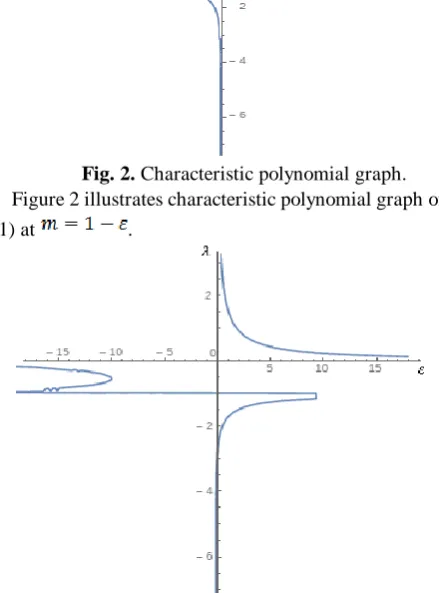
Fig. 2. Characteristic polynomial graph.
Figure 2 illustrates characteristic polynomial graph of Eq.
[image:5.595.51.271.123.420.2](1) at .
Fig. 3. Characteristic polynomial graph.
Figure 3 illustrates characteristic polynomial graph of Eq.
(1) at .
The solutions of equations (1) at m = 1 do not depend continuously on m. The given example was discussed frequently at various scientific conferences and had never been contested [8].
Let us consider a new system obtained by introducing new variables from set of equations Eq. (1) by equivalent transformations which can be presented in normal form:
(2)
(the second algebraic equation was derived from differential one).
Sets of equations (2) and (1) at m =1 have equal solutions:
t t
e
C
t
C
e
C
x
1
1 3
(
2
3)
(3)
However, these solutions (3) of set of equations (2), contrary to the solutions of set of equations (1), already depend on m continuously.
V. CONCLUSION
Upon consideration of mathematical models at the design stage of actual dynamic systems aiming at prevention of future possible emergencies and catastrophes, it is required:
1. To consider both the theorem of continuous dependence of solutions on parameters and an alternative approach upon designing of actual ones.
2. To analyze initial mathematical model of dynamic system for stability upon equivalent transformations.
3. At the stage of fabrication of sample dynamic system or its full-scale simulation among numerous equivalent forms of equations of the considered object, it is recommended to select such form which considers for peculiarities of its operation more exactly.
REFERENCES
1. V. B. Orlov, Yu. P. Petrov. On reliability of engineering computations and computer calculations. Problems of nonlinear analysis in engineering systems, 2010, Vol. 16(33), pp. 128-131.
2. Y. B. Danilevich, Y. P. Petrov, O neobkhodimosti rasshireniya poniatiya ekvivalentnosti matematicheskikh modeley [On the need to expand the concept of equivalence of mathematical models]. Doklady Akademii Nauk, 2000, vol. 371(4), pp. 473-475.
3. A. V. Zubov, A. Y. Murashko, L. G. Kolyada, E. A. Volkova, O. A. Zubova. Fidelity issue of engineering analysis and computer aided calculations in sign models of dynamic systems. Global Journal of Pure and Applied Mathematics, 2016, vol. 12(5), pp. 4203-4217.
4. J. N. Franklin. On Tikhonov’s method for ill-posed problems. Math. Comp., 1974, vol. 28, pp. 889-907.
5. M. M. Lavrentiev. Some improperly posed problems of mathematical physics. Berlin: Springer-Verlag, 1967
6. A. Tikhonov, V. Arsenin. Solutions of ill-posed problem. New York: Winston, 1977.
7. Yu. P. Petrov, V. S. Sizikov. Well-posed, ill-posed and intermediate problems with applications. Boston: Leiden, 2005.
8. A.V. Zubov, V.B. Orlov, V.A. Petrova, L.A. Bondarenko and G.I. Pupysheva. Engineering and computer aided calculations upon determination of quality characteristics of dynamic systems. International Journal of Pure and Applied Mathematics, 2017, vol. 117(22), pp. 137-141.
9. I. V. Zubov, A. V. Zubov. The Stability of Motion of Dynamic Systems. Doklady Mathematics, 2009, vol. 79(1), pp. 112-113.
10. D. V. Shiryaev, I. L. Litvinenko, N. V. Rubtsova, E. P. Kolpak, V. A. Blaginin, E. N. Zakharova. Economic Clusters as a Form of Self-Organization of the Economic System. International Journal of Economics and Financial Issues, 2016, vol. 6(1), pp. 284-288.
11. O. V. Grigorenko, D. A. Klyuchnikov, A. V. Gridchina, I. L. Litvinenko, E. P. Kolpak.The development of Russian-Chinese relations: Prospects for cooperation in crisis. International Journal of Economics and Financial Issues, 2016, vol. 6(1), pp. 256-260.
12. E. P. Kolpak, M. V. Stolbovaia, I. S. Frantsuzova. Mathematical models of single population. Global Journal of Pure and Applied Mathematics, 2016, vol. 12(4), pp. 3609-3619.
13. A. V. Zubov. Stabilization of program motion and kinematic trajectories in dynamic systems in case of systems of direct and indirect control. Automation and Remote Control, 2007, vol. 68(3), pp. 386-398. 14. L. A. Bondarenko, A. V. Zubov, A. F. Zubova, S. V. Zubov, V. B. Orlov.
Stability of Quasilinear Dynamic Systems with after Effect. Biosciences Biotechnology Research Asia, 2-15, vol. 12(1), pp. 779-788.
15. M. A. Gureva, S. V. Lyubimtseva, T. N. Tukhkanen, O. Y. Lyubimtseva, L. M. Simonova, E. P. Kolpak. Functioning of innovative territorial clusters. International Journal of Economics and Financial Issues, 2016, vol. 6(8), pp. 115-120.
16. E. P. Kolpak, S. E. Ivanov. On the Three-Dimensional Klein-Gordon Equation with a Cubic Nonlinearity. International Journal of Mathematical Analysis, 2016, vol. 10(13-16), pp. 611-622.
17. V. Mikheev, S.E. Miheev. Species trees forcing the parsimony to fail modelling evolution process, CEUR Workshop 2018 - Proceedings, 2254, pp. 206-213.
Applied Mathematics, 2016, vol. 12(4), pp. 3609-3619.
19.E. P. Kolpak, S.A. Kabrits. Round Flat Membrane at Great Deformations. Journal of Engineering and Applied Sciences, 2017, vol. 12(12), pp. 3152-3155.
20.A. V. Zubov, V. V. Dikusar, N. V. Zubov. Controllability criterion for stationary systems. Doklady Mathematics, 2010, vol. 81(1), pp. 6-7. 21.V. V. Dikusar, A. V. Zubov, N.V. Zubov. tructural minimization of
stationary control and observation systems. Journal of Computer and Systems Sciences International, 2010, vol. 49(4), pp. 524-528.
22.I. B. Tokin, I. I. Tokin, G. F. Filimonova, P. Hussar, V. M. Bure, Yu. M. Motusenko. Application of Morphometric Analysis For Quontitative Evaluation of Liver Biopsies in Therapeutic Trials. In: World Congress on Medical Physics and Biomedical Engineering IFMBE Proceedings 25(13) (Karlsruhe University, Munich, 2009), pp. 53-54.
23.E. Y. Pigul, G. F. Filimonova, I. B. Tokin, I. I. Tokin. Cluster analysis in assessing the interdependencies of clinical and morphological parameters of patients with mixed infections (pulmonary tuberculosis, chronic viral hepatitis, HIV infection) and heroin addiction. In: Stability and Control Processes in Memory of V.I. Zubov (SCP), (Saint Petersburg State University, Saint Petersburg, 2015), pp. 526-529.
24.S. E. Miheev. Estimates of the convergence rate with the help of half-derivatives. In: 2017 Constructive Nonsmooth Analysis and Related Topics (Dedicated to the Memory of V.F. Demyanov), (CNSA) (Saint Petersburg State University, Saint Petersburg, 2017), pp. 1-2.
25.S. E. Miheev. Statistical evaluation of the exact relaxation method. In: Constructive Nonsmooth Analysis and Related Topics (Dedicated to the Memory of V.F. Demyanov) (CNSA) (Saint Petersburg State University, Saint Petersburg, 2017), pp. 1-3.
26.M. A. Gureva, I. L. Litvinenko, R. A. Shichiyakh, E. P. Kolpak, N. N. Novoselova. Cluster-management as a technology for increasing the efficiency of territory resource exploitation in a region. International Journal of Economics and Financial Issues, 2016, vol. 6(8), pp. 143-147. 27.E. P. Kolpak, E. V. Gorynya, A. I. Shaposhnikova, K. E. Khasenova, N. S. Zemlyakova. Special Aspects of Leasing Activities and Its Meaning in Conditions of Enterprise Competitiveness. International Review of Management and Marketing, 2016, vol. 6(6), pp. 126-133.
28.I. A. Shchukina, I. I. Tokin, I. B. Tokin, G. F. Filimonova. Quantitative evaluation of the cell population structure of the liver biopsy specimens of patients with chronic hepatitis B. In: Stability and Control Processes in Memory of V.I. Zubov (SCP), (Saint Petersburg State University, Saint Petersburg, 2015), pp. 530-532.
29.V. N. Kolokoltsov, O. A. Malafeyev. Mean field game model of corruption. Dynamic games and applications, 2017, vol. 7(1), pp. 34 – 47.
30.O. A. Malafeyev, N. D. Redinskikh. Stochastic analysis of the dynamics of corrupt hybrid networks. In: "Stability and Oscillations of Nonlinear Control Systems" Proceedings of International Conference (Pyatnitskiy's Conference) (Institute of Electrical and Electronics Engineers Inc., New Jersey, 2016) pp. 1–4.
31.A. E. Eroyan, E. P. Kolpak, S. F. Litvinova, N. P. Gusakov, S. V. Ryazantsev. Spatial-Economic and Geopolitical Interests of Russia, The USA And China in Central Asia: Competition, Coincidence of Wants and Strategies in A Changing World. International Review of Management and Marketing, 2016, vol. 6(6), pp. 197-201.
32.O. A. Malafeyev, N. D. Redinskikh. Quality estimation of the geopolitical actor development strategy. In: 2017 Constructive Nonsmooth Analysis and Related Topics (Dedicated to the Memory of V.F. Demyanov) (CNSA) (Saint Petersburg State University, Saint Petersburg, 2017), pp. 201-203. 33.L. A. Bondarenko, A. V. Zubov, V. B. Orlov, V. A. Petrova, N. S. Ugegov.
Application in practice and optimization of industrial information systems. Journal of Theoretical and Applied Information Technology, 2016, vol. 85(3), pp. 305-308.
34.D. A. Klyuchnikov, R. A. Shichiyakh, E. P. Kolpak, V. A. Tupchienko, V. M. Volodin, A. K. Isaev, Features of Social and Economic Support of the Territorial Subjects of the Russian Federation. International Journal of Economics and Financial Issues, 2016, vol. 6(8), pp. 234-239.
35.A. I. Kirjanen, O. A. Malafeyev, N. D. Redinskikh. Developing industries in cooperative interaction: Equilibrium and stability in processes with lag. Statistics, Optimization and Information Computing, 2017, vol. 5(4), pp. 341-347.
36.O. A. Malafeyev, S. A. Nemnyugin, D. Rylow, E. P. Kolpak, A. Awasthi. Corruption dynamics model. In: International Conference of Numerical Analysis and Applied Mathematics AIP Conference Proceedings 1863 (Rhodes, 2017) 170013.
37.D. Shkurkin, E. P. Kolpak, T. V. Kormiltsyna, N. N. Novoselova. Regional clusters in the strategy of achieving technological leadership. International Journal of Applied Business and Economic Research, 2017, vol. 15(13), pp. 171-177.