https://doi.org/10.5194/angeo-36-595-2018 © Author(s) 2018. This work is distributed under the Creative Commons Attribution 4.0 License.
Quantifying the relationship between the plasmapause and the inner
boundary of small-scale field-aligned currents, as deduced from
Swarm observations
Balázs Heilig1,2and Hermann Lühr2
1Mining and Geological Survey of Hungary, Tihany Geophysical Observatory, 8237, Tihany, Hungary 2GFZ German Research Centre for Geosciences, Section 2.3 “Geomagnetism”, 14473 Potsdam, Germany Correspondence:Balázs Heilig ([email protected])
Received: 7 November 2017 – Revised: 9 March 2018 – Accepted: 12 March 2018 – Published: 5 April 2018
Abstract.This paper presents a statistical study of the equa-torward boundary of small-scale field-aligned currents (SS-FACs) and investigates the relation between this boundary and the plasmapause (PP). The PP data used for validation were derived from in situ electron density observations of NASA’s Van Allen Probes. We confirmed the findings of a previous study by the same authors obtained from the ob-servations of the CHAMP satellite SSFAC and the NASA IMAGE satellite PP detections, namely that the two bound-aries respond similarly to changes in geomagnetic activity, and they are closely located in the near midnight MLT sector, suggesting a dynamic linkage. Dayside PP correlates with the delayed time history of the SSFAC boundary. We interpreted this behaviour as a direct consequence of co-rotation: the new PP, formed on the night side, propagates to the dayside by rotating with Earth. This finding paves the way toward an ef-ficient PP monitoring tool based on an SSFAC index derived from vector magnetic field observations at low-Earth orbit. Keywords. Magnetospheric physics (plasmasphere)
1 Introduction
The plasmasphere is a torus of cold (∼1 eV) plasma frozen into the Earth’s magnetic field and co-rotating (e.g. Car-penter and Anderson, 1992) with the Earth. The plasmas-phere is filled from the dayside ionosplasmas-phere and emptied to the night side through ambipolar diffusion along field lines (e.g. Chiu et al., 1979; Sandel and Denton, 2007; Jorgensen et al., 2017). During geomagnetic disturbances the plasma-sphere shrinks due to the increased global magnetospheric
convection (e.g. Carpenter and Anderson, 1992; O’Brien and Moldwin, 2003), and the plasma of the outer shells is re-moved by medium-scale electric fields that drive plumes to-ward the magnetopause (e.g. Goldstein et al., 2003a; Mold-win et al., 2004; Darrouzet et al., 2008). The erosion pro-cesses take place dominantly on the night side. The eroded region appears hours later on the dayside as a consequence of co-rotation (e.g. Pierrard and Voiculescu, 2011; Katus et al., 2015; Zhang et al., 2017). Decreased convection and day-side refilling both play a role in the gradual expansion of the plasmasphere at quiet times, especially during the recovery phase of geomagnetic storms until the plasmasphere is sat-urated (e.g. Jorgensen et al., 2017). Hence, the shape of the plasmasphere depends more on the time history of geomag-netic activity (characterized e.g. by the Kp index) than on the concurrent disturbance level. Most of the previous mod-elling efforts have taken the memory effect of the plasma-pause (PP) into account by comparing its position with the maximum Kp taken from an interval preceding the time con-sidered (e.g. O’Brien and Moldwin, 2003). The length of the considered interval varies in the different models from a few hours to a few days. The end of the interval is typically a few hours before the model time. Recently, following the recom-mendation of Larsen et al. (2007), investigations of the PP response time take care of its MLT dependence (Katus et al., 2015; Zhang et al., 2017).
inten-sity around the Earth taken by the IMAGE satellite (Gold-stein et al., 2003b), or as an iso-surface at some density threshold value (e.g. Chappell, 1974). Both in situ obser-vations and remote-sensing techniques are applied to ob-tain information on plasma density or on the location of the plasmapause. Remote-sensing techniques include elec-tron density observations inferred from the dispersion of very low-frequency (VLF) whistlers observed on the ground (e.g. Lichtenberger et al., 2013), plasma mass density estimations from the ultra low-frequency (ULF) eigenfrequencies of ge-omagnetic field lines (Menk and Waters, 2013), the detec-tion of PP related boundaries in the topside total electron content (TEC) making use of dual frequency GPS receivers (Pedatella and Larson, 2010), locating the mid-latitude iono-spheric trough (MIT) (Grebowsky et al., 1976; Yizengaw et al., 2005) as well as the ionospheric light ion trough (LIT) (e.g. Anderson et al., 2008), and other techniques beyond the already mentioned EUV imaging.
Recently a new PP detection technique was proposed by Heilig and Lühr (2013) utilizing the magnetic signatures of small-scale field-aligned currents (SSFACs) validated by in situ night-side PP detections of the IMAGE RPI (radio plasma imager) instrument (Reinisch et al., 2000). Hence the equatorward boundary of SSFACs can be considered as a proxy for the night-side PP location. We call this proxy the SSFAC index. In this paper we derive the SSFAC indices from the field-aligned current (FAC) observations of ESA’s Swarm satellites. The SSFAC index is validated using PP po-sitions calculated from in situ electron density observations of NASA’s Van Allen Probes (VAPs). Furthermore, we ex-tend the validation involving VAP data from all MLTs.
The paper is organized as follows. First, the derivation of the SSFAC index from Swarm data is reviewed. In Sect. 2 the Swarm observations are presented along with some statis-tics, including the investigation of the connection between the SSFAC index and some geomagnetic indices, as well as interplanetary parameters. Afterwards in Sect. 3 an empirical climatological model of the SSFAC boundary is introduced, before in Sect. 4 the validation results are presented. Results are discussed in Sect. 5; finally, we summarize our findings and draw conclusions.
2 Data and analysis
The three Swarm satellites were launched into a polar low-Earth orbit (LEO) on 22 November 2013. During the com-missioning phase the three satellites flew on the same orbit, following each other with an increasing separation. Since 17 April 2014 Swarm A and C have orbited side-by-side (1.4◦east–west separation) at 460 km altitude and an inclina-tion of 87.4◦, while Swarm B orbits at 510 km altitude and an inclination of 87.8◦. The orbital planes of Swarm B relative to A and C drift away slowly (by 5–6 min day−1) in magnetic local time (MLT) due to the different inclinations. In this study we utilized the FAC data derived from vector magnetic
field data recorded by the fluxgate magnetometers with a res-olution of 10 pT between 1 January 2014 and 31 December 2017. By the end of the investigated interval the MLT sepa-ration between Swarm A and B increased to∼6 h. For inter-satellite comparisons Swarm A is preferred over Swarm C in this study, since the absolute scalar magnetometer instrument on the latter stopped working on 5 November 2014, resulting in a somewhat poorer calibration. However, we found no sig-nificant difference in the performance of Swarm A and C in monitoring the plasmapause.
Our plasmapause detection method is based on the lo-calization of the equatorward boundary of SSFAC activ-ity deduced from the transverse toroidal component of the geomagnetic field fluctuations observed at LEO. This new tool, which yields unprecedented details on the dynamic be-haviour of the plasmapause, was first introduced and de-scribed in detail by Heilig and Lühr (2013).
the density profiles, necessitating the use of a lower thresh-old for PP detection. For better consistency with earlier data, we also calculated the neighbourhood of the previously de-scribed innermost sharp gradient, where the density gradient exceeds a factor of 5 drop withindL=0.5RE, i.e. the tradi-tional threshold. The lower limit of this interval is then cho-sen as the location of the PP.
We also note that the VAP PP positions were derived from in situ density observations made at low latitudes. Since the detection relies on relative changes across L-shells, there is no significant impact of this choice on the results. This can be easily seen by combining the field-aligned distribu-tion of plasmaspheric electron density Ne
Ne0 =
r0
r , whereNe0 is the equatorial density,r0is the radial distance of the equa-torial point of the field line, r is the radial distance (Den-ton et al., 2006), and the equation of a dipole field line is
r=r0cos23. From these we get NNee(3(312))=cos
23 2
cos23
1 for the
ra-tio of the densities at two points along the field line. In the vicinity of the geomagnetic equator (3 <30◦)for closely separated (13 <3◦) points, this formula yields only a few percent difference in Ne that is negligible compared to the factor of 5 drop we look for. Hereafter, VAP observed PP will be referred to as PP_Ne to distinguish them from the SSFAC index derived from Swarm FAC observations.
The main steps of data processing applied to Swarm ob-servations are as follows. First, the field-aligned current (FAC) density, j//, available as the Swarm Level 2 prod-uct FACxTMS_2F (wherex stands for A, B or C identify-ing the satellite) for each satellite individually, is high-pass filtered by a third-order Butterworth with a −3 dB cut-off at 250 mHz. The chosen cut-off frequency ensuring precise boundary localization corresponds to a∼30 km spatial scale along the (quasi-meridional) orbit. Then the logarithm of the squared SSFAC density (in units µA m−2) is taken, and a boxcar averaging is applied to derive the SSFAC power level,
S, subsequently used as a detection signal:
S= hlog10j//2i20s. (1)
The detection of the SSFAC inner (equatorward) boundary is a multistep process. As a first step, each orbit is divided into four orbital segments including data from the magnetic equa-tor to the poles. Then all segments are scanned for the inner-most transition ofSbetween two pre-defined reference levels (an increase in S from Sc= −5.5 toSm= −2.5). The ap-plied reference values are found typically only inside/outside the nominal plasmapause (here the nominal plasmapause lo-cations are derived from the Kp-based model of O’Brien and Moldwin, 2003). The L-values related to the corre-spondingS reference levels are denoted byLc andLm, re-spectively, where the L-value is calculated from the modi-fied apex magnetic latitude assuming a dipole field geome-try (L=rref/cos2(mlat)), where rref≈1.02 is the geocen-tric distance of the E-region as reference height (110 km) in Earth’s radii (6371.2 km). In the next step the change in
Table 1. Detection parameters applied for CHAMP and Swarm data.
Sc Sref∗ Sm lag
CHAMP −6 −3.8 −2 1 h
Swarm −5.5 −4.1 −2.5 1 h
the SSFAC power level within the transition zone [Lc;Lm] is represented by a linear fit,S∗=aL+b, andσ, the RMS value of the residuals (S−S∗)in the [Lc; Lm] interval, is cal-culated. The width of the boundarydLis defined asLc−Lm. Finally, theL-value whereS∗ equals a threshold reference level,Sref∗ (∼ −4.0), is taken as the position of the boundary,
Lssfac. WheneverLssfaclies outside the interval [Lc;Lm], it is rejected. This typically happens when the boundary is not well defined, mostly on the dayside. The resulting detection of the equatorward boundary of intense SSFACs (the SSFAC index) is related to theL-value of the plasmapause in units of Earth radii (RE). The fit quality parameters,dL(the boundary width) andσ (characterizing the quality of the fit), are used to exclude less-defined transitions similarly as described in Heilig and Lühr (2013). The detection parameters (reference levels) applied at Swarm data analysis, and for comparison also for CHAMP, are given in Table 1.
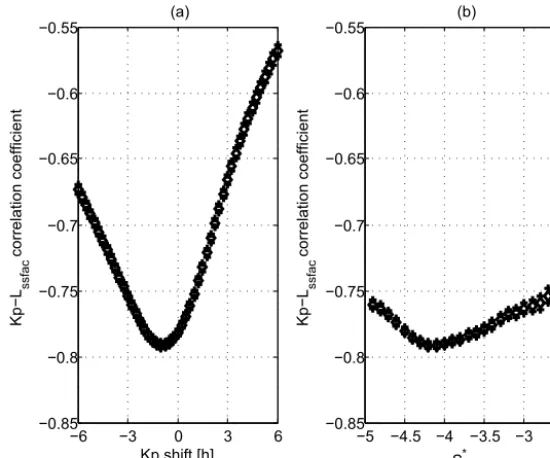
To optimize the quality of the detection results, a fine ad-justment of the reference value Sref∗ is needed. Following Heilig and Lühr (2013) we did it by maximizing the absolute correlation strength between the boundary position, Lssfac, and the geomagnetic index Kp. Allowing for comparisons on shorter timescales than the 3 h cadence of Kp, the Kp in-dex was linearly interpolated at UTs of the SSFAC inin-dex. The best correlation was found atSref∗ = −4.1 (corresponding to∼0.01 µA m−2 SSFAC density), very close to the value found for CHAMP (Table 1, Fig. 1b). During this and fur-ther calculations, Kp was delayed in time by 1 h. This value is inferred from a cross-correlation analysis between Kp and
Lssfac(Fig. 1a), and corresponds to the mean response time of the boundary to changes in geomagnetic activity.
−6 −3 0 3 6 −0.85
−0.8 −0.75 −0.7 −0.65 −0.6 −0.55
Kp−L
ssfac
correlation coefficient
Kp shift [h] (a)
−5 −4.5 −4 −3.5 −3 −2.5 −0.85
−0.8 −0.75 −0.7 −0.65 −0.6 −0.55
Kp−L
ssfac
correlation coefficient
S*ref (b)
Figure 1. (a)Lssfac–Kp cross-correlation, and(b)correlation betweenLssfacand Kp as a function of the reference levelSref∗ .
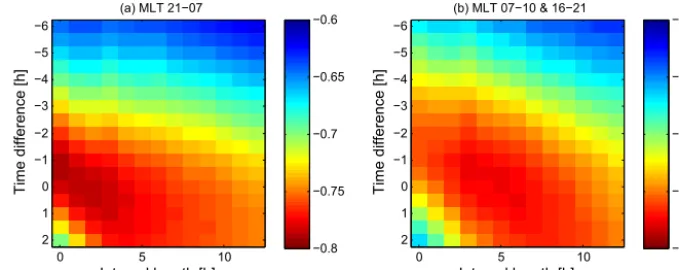
Similar correlation matrices were calculated separately for all the 24:00 MLT sectors (0..1, 1..2, 2..3, etc., not shown). We identified two distinct behaviours. On the night side (21:00–07:00 MLT) the response of the boundary is slightly faster than on the morning and dusk (07:00–10:00 and 16:00–21:00 MLT) sides. The variation of the bound-ary positions follows quite tightly any changes in Kp, with an average response time of 0.5–1 h (i.e. time difference or lag is between −0.5 and −1 h) in both Fig. 2a (night side case: 21:00–07:00 MLT) and b (07:00–10:00 and 16:00– 21:00 MLT). Positive lag is unphysical and can be attributed to the low (3 h) time resolution of Kp. The interval length yielding the strongest correlation (deepest red) depends on the lag. The absolute maximum on the night side/dayside is found at−1/−1 h lag and 0/3–4 h interval length, respec-tively, meaning that the SSFAC index is dependent mainly on the latest/latest two values of Kp. Nighttime response is practically immediate, and even on the dayside the memory of the SSFAC index does not exceed a few hours.
The observation that the∼1 h response time does not seem to depend on MLT can be interpreted as a synchronous re-sponse of the whole boundary to changes in geomagnetic activity. It means that the behaviour of the SSFAC index is different from that of the PP_Ne, which shows a local time dependent response time to magnetic activity (Katus et al., 2015; Zhang et al., 2017).
The correlation strength between the SSFAC index and Kp was found by Heilig and Lühr (2013) to vary with MLT, solar zenith angleχ, and the fit quality parameters. We repeated this analysis with Swarm data and the results confirm our previous findings: the correlation is stronger than 0.6
dur-ing nighttime conditions (χ> 90◦) (Fig. 3a) or between 18:00 and 06:00 MLT. On the dayside, the detection of the bound-ary is disturbed by other phenomena, such as shear Alfvén waves including geomagnetic field line resonances (Heilig et al., 2013). As another example, Fig. 3b clearly presents the decrease in the correlation strength with increasing boundary width,dL. The correlation is stronger than 0.65 for steeper slopes (“a” > 0.5 or dL< 3) on the night side. This finding suggests that the boundary can be detected easier and more accurately, when the boundary is sharper. This happens, as we will see, during increased geomagnetic activity.
3 Statistical dependence on geomagnetic and solar wind conditions
[image:4.612.159.434.68.297.2]empir-Interval length [h]
Time difference [h]
(a) MLT 21−07
0 5 10
−6
−5
−4
−3
−2
−1
0
1
2
−0.8 −0.75 −0.7 −0.65 −0.6
Interval length [h]
Time difference [h]
(b) MLT 07−10 & 16−21
0 5 10
−6
−5
−4
−3
−2
−1
0
1
2
[image:5.612.126.466.69.204.2]−0.8 −0.75 −0.7 −0.65 −0.6
Figure 2.Correlation strength between the SSFAC index and the peak Kp as a function of the length of the interval (horizontal axis), where the peak Kp is taken from the time difference (vertical axis) between the end of the interval and SSFAC index observation(a)in the sector (MLT 21:00–07:00), and(b)for morning (MLT: 07:00–10:00) and evening (MLT: 16:00—21:00) hours.
0 50 100 150
0 0.2 0.4 0.6 0.8 1
Correlation coefficient / 10x relative occurrence rate
χ [°] (a)
0 5 10
0 0.2 0.4 0.6 0.8 1
Correlation coefficient/ 10x relative occurrence rate
dL [RE] (b)
Figure 3. (a)Dependence of the Lssfac–Kp correlation on the solar zenith angle “χ” while “dL” < 3 (diamonds) with 95 % confidence
intervals (vertical lines) along with 10 times the relative occurrence rate of “χ” values (dashed line), and(b)the same correlation/occurrence rates in the same format as in(a)but as a function of the boundary width “dL” whileχ> 90◦.
ical model. However, it is still worth having a closer look at the dependences of all the indices.
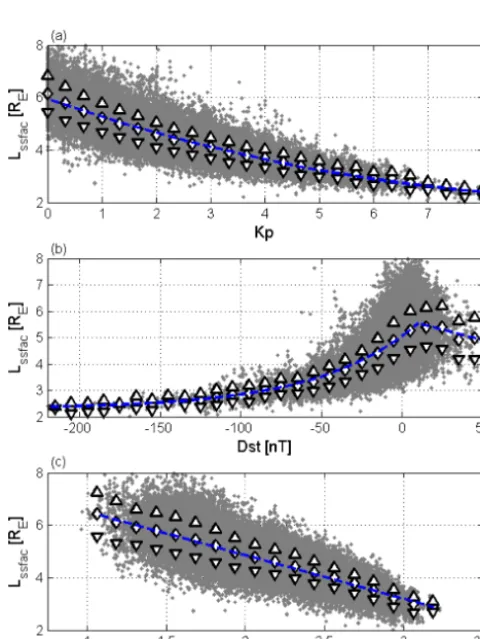
The Kp dependence (time-shifted) can be approximated quite well by a simple ratic function (Fig. 4a, Eq. 2), similar to that of Heilig and Lühr (2013):
Lssfac=5.95−0.711 Kp+0.0335 Kp2. (2) In Fig. 4a, and also in the following plots, triangles depict the mean±standard deviation values. The correlation strength between the observations and the Kp-based model is 0.81. As Fig. 4b shows, unlike the Kp dependence, the Dst index does not influence the SSFAC index evenly over its full range, mainly when Dst is negative, i.e. during the storm-time in-tensified ring current. For these values Eq. (3) presents an exponential fit accounting for the dependence. At the same time, positive Dst values typically occurring during the initial phase of geomagnetic storms as a consequence of the magne-topause current increase do not seem to have a strong impact.
A possible reason is that while the ring current is involved in the processes forming the new PP, the magnetopause current does not.
Lssfac=2.720·0.983−Dst+2.30 for Dst<0
Lssfac=5.68−0.0176 Dst, for Dst≥ (3) The relation to the AE index is shown in Fig. 4c. An im-proved linear dependence of the SSFAC index location was found for log(AE) (Eq. 4). Unlike the Dst, a monotone de-pendence extends over the full range of the AE index, indi-cating that auroral electrojets of any strength correlate with the SSFAC boundary position.
[image:5.612.130.465.265.429.2]Table 2.Summary of cross-correlation analyses between the SSFAC index and the considered parameters.
geomagnetic indices solar wind parameters
parameter Kp Dst AE log(AE) vsw Bz Em ϕ
r0 −0.80 0.65 −0.68 −0.74 −0.50 0.33 −0.50 −0.57
rmax −0.81 0.65 −0.72 −0.78 −0.53 0.42 −0.58 −0.65
lag (h) −1 +0.75 −1 −1 +8 ? −2 −2 −1.75
Figure 4. (a)Kp,(b)Dst, and(c)log(AE) dependence of the SS-FAC index.
the Kp-based model ranges fromL=2.3 (Kp=9) toL=6.0 (Kp=0). The Dst-based model estimates vary between
L=2.3 (Dst= −500 nT) andL=5.7 (Dst=10 nT), while the AE model yields values betweenL=2.9 (AE=1600 nT) and L=6.5 (AE=10 nT). In all three cases the range of
L variation accounted for by the model is nearly the same,
1L=3.5; however, the baselines are different. The Dst/AE-based model is capable of accounting for the lowest/highest extremes, respectively. From the stronger correlation and the 1 h response time it seems that the AE index (strength of the auroral electrojet) reflects more closely the processes that form the SSFAC boundary than the Dst index. At the same time, large Dst indices (developed ring current) tend to be concomitant with the inward motion of the SSFAC
bound-ary below theLssfac=3 limit. Indeed, during intense storms, when Dst<−100 nT,Lssfacstays below 3RE.
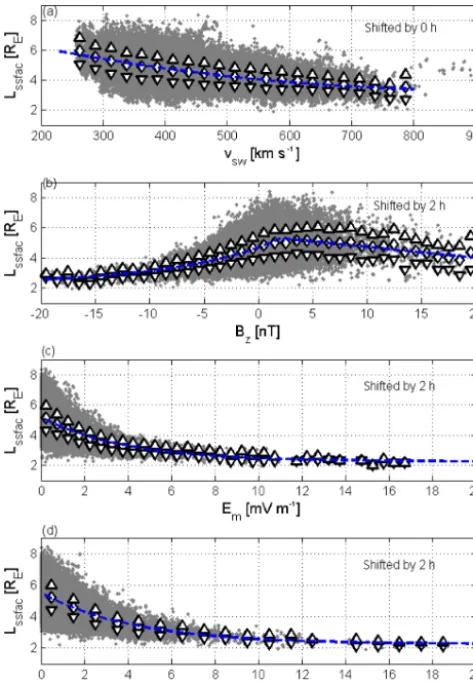
Since the geomagnetic activity is driven by Sun–Earth interactions, and the plasmapause location is controlled to first approximation by the magnetospheric convection, it is not surprising that there is a link between the SSFAC equatorward boundary and some interplanetary parameters accounting for the solar-wind–magnetosphere coupling, as well. We found a negative correlation (Table 2) with the solar wind speed (vsw), a weak positive correlation with the IMF GSM southward component (Bz), and again nega-tive correlations with two solar-wind–magnetospheric cou-pling parameters: the merging electric field (Kan and Lee, 1979) Em =vswBtsin2θ2, and the coupling parameter ϕ=
vswBsin2θ2 suggested by Larsen et al. (2007). HereBt/ Bis the IMF component perpendicular to the Sun–Earth line/the total IMF, respectively, andθ is the clock angle, i.e. the an-gle betweenBt andBz. Although the merging proxies give higher coefficients (−0.58 and−0.65), these are still weaker than the correlations with geomagnetic indices. Moreover, the time lags are typically 2 h, twice as large as for the Kp and AE indices. These are likely because of the less direct link between the SSFAC boundary dynamics and the solar wind conditions, compared to the more direct impact of the auroral dynamics and the ring current. We note here that the positive time lag found for solar wind speed is unphysical and was neglected during further analysis. Solar wind speed mostly changes on longer timescales than plasmasphere dy-namics and that is why the cross-correlation peak is rather flat, as can be seen from the similar correlation strength at
+8 h (−0.53) and at 0 h time lag (−0.50) in Table 2. This makes the determination of the response time less reliable.
[image:6.612.47.287.175.494.2]Figure 5.Dependence of the SSFAC index on the(a)solar wind speed, (b) Bz IMF south GSM component, (c) merging electric
field, and(d)coupling parameterϕ.
Lssfac=7.98−0.0103vsw+5.720·10−6vsw2 (5)
Lssfac=2.458·0.904−Bz+2.24,forBz≤2
Lssfac=5.44−0.0719Bz,forBz>2 (6)
Lssfac=2.909·0.773Em+2.25 (7)
Lssfac=3.206·0.797φ+2.25 (8)
4 An empirical model of the SSFAC inner boundary
Before starting to discuss the dynamics of the plasmapause we have a detailed look at the small-scale FAC boundary. In Fig. 6 the meanL-values of the SSFAC inner boundary cal-culated from all observations between 1 January 2014 and 31 December 2017 from all three Swarm satellites are pre-sented on a dial plot as a function of MLT. Individual cir-cles are drawn for different levels of geomagnetic activity (0≤Kp<1, 1≤Kp<2, 2≤Kp<3, etc.), while the po-lar histogram in the bottom right presents the MLT
distribu-tion of the sample numbers. Only the mean posidistribu-tions of the boundary are shown, where at least 10 observations are avail-able. For the above-mentioned reasons, the detection is re-stricted to times whenχ> 90◦, causing the asymmetric day– night MLT distribution of detections (see histogram). This is also the main reason for the dayside gap in the boundary determination, especially at high Kp.
The shape of the boundary in Fig. 6 closely resembles a circle inLversus MLT space for any level of geomagnetic activity. The radius of the circle scales inversely with Kp. The circles are not exactly geocentric, and the centres are slightly shifted toward noon. The standard deviation of the individualLssfacobservations is also a clear function of Kp, decreasing from∼0.7REat Kp=0 to∼0.2REat Kp=7; however, it hardly depends on MLT. The uncertainty of the means (SD/sqrt(N)) is 0.01–0.02REat each Kp level.
Not only the boundary position, but also the boundary width, is a function of Kp. The boundary gets narrower when geomagnetic activity increases, as shown in Fig. 7. At low activity, the mean width is around 2.5RE, but the scatter is large, while for Kp > 6 the boundary becomes narrower than 1RE. The overwhelming majority of the boundary observa-tions are made at relatively sharp boundaries, i.e. when the boundary width is lower than 3RE (see Fig. 3b). As stated before, in our statistical analysis only these sharper bound-aries were considered.
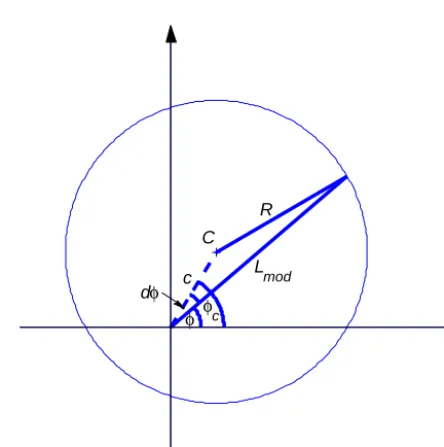
For a given level of Kp, we model the observed boundary inL space by an eccentric circle. The position of a point
P on the circle is given by its polar coordinatesLmod and
ϕ=2πMLT/24 as shown in Fig. 8. If the circle is centred atC (c, ϕc)and has a radiusR,Lmodcan be derived for any MLT by applying the formula
Lmod=c·cos dϕ+
q
R2−c2sin2dϕ, (9)
where dϕ=2π ((MLT−MLTc) /24) and MLTc=24 h·
ϕc/360◦.
Moreover, we suppose that the position ofC and the ra-dius of the circle R have a linear/ratic dependence on Kp, respectively, that is
R=R0+p1Kp+p2Kp2, c=c0+γcKp,
MLTc=MLT0+γmltKp, (10)
L = 2 L = 4
L = 6
2
14
4
16
6
18 8
20 10
22
12 0
(a) Swarm SSFAC boundary
0 ≤ Kp < 1
1 ≤ Kp < 2
2 ≤ Kp < 3
3 ≤ Kp < 4
4 ≤ Kp < 5
5 ≤ Kp < 6
6 ≤ Kp < 7
7 ≤ Kp < 8
2000 4000 6000 8000
14
4
16 6
18 8
20 10
22
12 0
2
(b)
Figure 6. (a)Mean boundary positions as a function of MLT at different levels of Kp (0–1, 1–2, 2–3, 3–4, 4–5, 5–6, 6–7, 7–8) and(b)the MLT distribution of the boundary crossings.
0 1 2 3 4 5 6 7 8
0 2 4 6
Kp
dL [R
E
[image:8.612.171.430.70.262.2]]
Figure 7.Average width of the transition zone (dL) as a function of Kp (χ> 90◦).
dence bounds) were obtained:
R0=6.12±0.07RE,
p1= −0.709±0.03RE,
p2=0.0313±0.003RE,
c0=0.286±0.09RE, MLT0=12.24±0.79 h,
γc= −0.031±0.018RE,
γmlt=0.193±0.31 h.
The corresponding model is presented in Fig. 9 as dashed circular curves. The centres of the circulars hardly move with increasing Kp. From Kp=0 to Kp=6, it moves from MLTc=12.2,c=0.3RE to MLTc=13.4,c=0.1RE. The mean residuals (observation–model) in each bin are between
−0.3 and 0.2REat all Kp levels between 1 and 6. At Kp=0 the mean residuals are in the range−0.6–0.2RE.
Any of the three Swarm satellites visits all the MLT sec-tors during every 132-day period. Five full years of data are needed for an even coverage of local time during all seasons.
C
c
R
L mod
φ φc
dφ
Figure 8.Sketch of the applied model for a fixed level of geomag-netic activity.
[image:8.612.319.541.321.544.2] [image:8.612.53.285.322.412.2]L = 2 L = 4
L = 6
2
14
4
16
6
18 8
20 10
22
12 0
Swarm SSFAC boundary
0 ≤ Kp < 1
1 ≤ Kp < 2 2 ≤ Kp < 3
3 ≤ Kp < 4
4 ≤ Kp < 5 5 ≤ Kp < 6
[image:9.612.328.525.66.265.2]6 ≤ Kp < 7 7 ≤ Kp < 8
Figure 9.Empirical model of the inner SSFAC boundary.
4.1 Extension ofLssfacobserved at some MLT to any other MLT
The model derived in the previous section can be used in var-ious ways. First, it can be used as a climatology model. When no boundary observations are available,Lmodcan be calcu-lated directly from MLT and Kp as inputs. However, if we have an observation ofLssfac=Lobsat a certain MLTobsand the geomagnetic activity given by the Kp index is known, we can, by combining the model (yielding the shape and the centre of the boundary) with the actual observation (provid-ing the actual radius), estimateLssfacat any other MLT. This is done by rescaling the size of the boundary based on the ac-tual observation, while taking the average circular shape and Kp-dependent centre position from the model:
R0= q
L2obs+c2−2cL
obscos dϕobs. (11)
Since the Kp dependence of both c and MLTc is found to be very weak, we can regard them as constant, e.g. c=
0.2RE,MLTc=12 h, while dϕobs=2π
(MLT
obs−MLTc)
24 h
=
πMLTobs
12 h −1
can be calculated from the model. This will cause less than 0.05REerror. NowLmodat any MLT can be computed by the direct use of Eq. (9), but substitutingR0into
R.
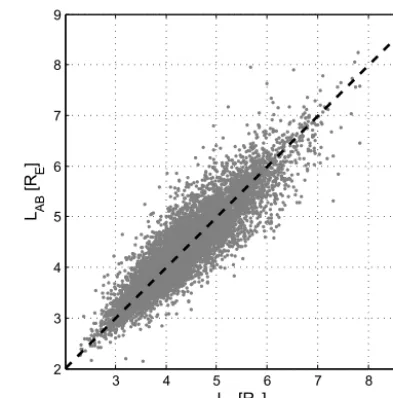
We verified our SSFAC index estimates by checking the consistency between the observations of the different satel-lites. By using the model and Swarm B observations we estimated the boundary locations at the MLT of Swarm A
(LAB)and compared the calculated positions with the actual Swarm A (LA)observations at that MLT. The UT difference of the boundary crossing between the original Swarm A and B observations was limited to 15 min. The result of this com-parison is shown in Fig. 10. A large range ofL-values (from 2 to 8Re) is covered. Predicted and observed values were found to be close to each other; see Eq. (12).
3 4 5 6 7 8 9
2 3 4 5 6 7 8 9
LA [RE]
L AB
[R
E
[image:9.612.53.289.69.246.2]]
Figure 10.Comparison of Swarm A SSFAC indices with indices predicted from simultaneous Swarm B observations.
LAB = 0.9993·LA (12)
In 90 % of all these cases their absolute difference was less than 0.59RE. It implies that at least for the MLT separation limited so far (0 to 6 h) between the spacecraft, the boundary can be well approximated by a circle not only on average, but also at any given moment. This behaviour is different from that of the plasmapause, which – due to the co-rotation of the plasmasphere with the Earth – has a memory of the Kp time history: i.e. the plasmapause position at some later MLT on the dayside depends more on the preceding Kp-values than on the actual Kp. Furthermore, this result also confirms our previous finding that the SSFAC boundary responds nearly simultaneously at all MLT. It directly follows from its con-stant circular shape.
5 Validation of the SSFAC index
53402 5350 5360 5370 5380 5390 5400 5410 4
6 8
L [R
E
]
53400 5350 5360 5370 5380 5390 5400 5410 6
12 18 24
MJD [days]
MLT [h]
53400 5350 5360 5370 5380 5390 5400 5410 2
4 6
Kp
SSFAC index
PP location
VAP Swarm
Figure 11. (a)Swarm SSFAC index (blue) and VAP PP_Ne(red) locations,(b)variation of the Kp index, and(c)MLT of the Swarm (blue)
and VAP (red) observations.
8 in the time interval considered, the comparison is limited to theL=2–6 range, due to the orbit apogee of VAP. The vari-ation of the SSFAC index follows very closely the PP_Ne variation. There are only two outliers of VAP observations in the whole interval. The other important thing to note is that Swarm observations yield a much more detailed and higher resolution picture of the boundary time evolution. They re-solve both fast expansion (e.g. modified Julian days (MJDs) 5363 and 5370) and rapid contraction (MJD 5352) (MJD: daynumber since 1 January 2000, 00:00 UT), and reflect well shorter-scale Kp variations (middle panel). Our method of-fers an unprecedented monitoring tool to study plasmasphere dynamics.
However, the correspondence is not always as perfect as in the above example, only when the VAP validation dataset is taken from the post-midnight MLT sector (00:00– 07:00 MLT; see bottom panel). The MLT of the Swarm ob-servations is less important since the SSFAC boundary is circular and the offset of its centre from the Earth’s centre is small. Comparison with VAP PP_Ne observations made at other MLTs gives a different result. The plasmasphere is well known for having a dusk-side bulge and its distance at different MLTs can be quite different, controlled by the past variation of magnetospheric convection. By contrast, the SSFAC boundary responds almost simultaneously at all MLTs (within about an hour) to changing conditions. The two boundaries are coupled only near midnight and in the early morning sector.
To confirm this, we calculated the cross-correlation be-tween the two boundaries. First, for each VAP PP_Ne po-sition we calculated the mean of all available SSFAC indices from the Swarm spacecraft within±1 h UT difference. Then
the correlation between the two time series was calculated separately for each 4 h long MLT interval centred at inte-ger MLT hours. Then the calculation was repeated with a time-shifted SSFAC index time series. The time shift var-ied from −6 to 48 h. The result is shown in Fig. 12. The maximum correlation is at 0–1 h lag from 22:00 to 06:00 h, while after 06:00 MLT, the lag increases more or less linearly with increasing MLT (marked by the overplotted slant dashed lines). We interpret this result as follows. Between 22:00 and 06:00 MLT the PP_Ne’s response is relatively fast and nearly simultaneous to changes in the SSFAC index. This MLT sec-tor is expected to be the region where the PP is formed. From about 06:00 to 18:00 MLT (and beyond) the MLT-dependent linear increase of the time lag (with slope 1/1 h) can be in-terpreted as a consequence of the co-rotation of the plasma-sphere with the Earth, i.e. the plasmapause formed on the nightside propagates by co-rotation into the daytime sector. Between 17:00 and 21:00 MLT, where the PP_Ne typically has a bulge, the correlation is the weakest. It seems that the memory of the PP_Neis longer in the morning and near dusk hours. There may be a secondary peak at around 24 h time lag; however, this is not very clear from the present data. It might also be the tail of an elongated peak. We extended this calculation up to 72 h time lag (not shown), but we could not identify further clear peaks.
[image:10.612.102.496.66.273.2]typi-Lag [h]
MLT [h]
−6 0 6 12 18 24 30 36 42 48 0
3 6 9 12 15 18 21 24
Correlation coefficient
[image:11.612.53.282.66.241.2]0 0.1 0.2 0.3 0.4 0.5 0.6 0.7 0.8 0.9 1
Figure 12.Cross-correlation between VAP PP_Neposition and the
SSFAC index as a function of MLT.
0 6 12 18 24
−1 −0.5 0 0.5
MLT [h]
∆
L [R
E
]
0 5 10 15 20
0 20 40 60 80 100 120
No. of cases
MLT [h]
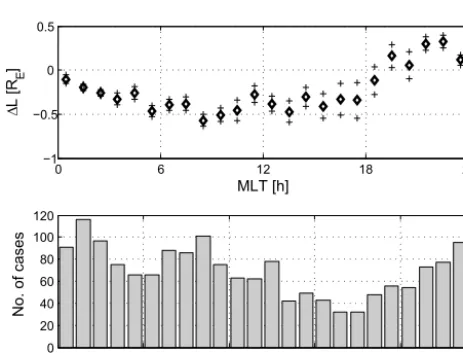
Figure 13. Mean difference between VAP PP_Ne position and
Swarm SSFAC index as a function of MLT.
cally poleward of the PP by∼0.2R. This result is very simi-lar to the obtained differences between CHAMP and IMAGE observations. However, for individual cases the location of the boundaries can be very different. While the PP_Neshape, due to its co-rotation with Earth and the localized erosion, is determined by the Kp evolution in the preceding days, the SSFAC index responds within a few hours simultaneously at all MLTs. This difference has important implications for the derivation of a future PP model that is based on SSFAC boundary detections.
6 Possible physical links between PP_Neand the SSFAC index
From our results it is clear that the PP_Ne does not follow closely the SSFAC boundary. The shape of the latter corre-sponds more to an equatorial cut of a drift shell, and soft electrons may precipitate from this drift shell into the sphere. Precipitation enhances the conductance of the iono-sphere, leading to increased current density. Indeed, Xiong and Lühr (2014) derived a model of the auroral oval bound-aries from SSFAC signatures observed at LEO. Their equa-torward boundary defined as the highest poleward gradient in log squared SSFAC density equatorward of the maximum is consistently poleward of our SSFAC boundary; since our fixed threshold is low, at 0.01 µA m−2, the mean FAC den-sity at their boundary is more than an order of magnitude higher. The PP typically maps to the sub-auroral ionosphere, where the conductance is smaller than in the auroral oval. Moving poleward from low latitudes, the first SSFACs ap-pear just outside the PP_Ne. We believe that this is the rea-son why the SSFAC boundary is collocated with the night side PP_Ne under quiet conditions. Our plan for the future is to investigate the dynamic linkage among the elements of this complex system.
7 Summary and conclusions
[image:11.612.52.284.296.472.2]location can be estimated from past SSFAC indices taking into account the co-rotation time passed since the formation of the new PP on the night side. This way the PP shape can be reconstructed from the past SSFAC indices. LEO satel-lites with high quality magnetic data provide a unique, effi-cient, and robust tool to monitor the dynamics of the PP. It can be used as a near-real-time monitoring tool in case mag-netic data from LEO satellites are available.
Data availability. Swarm FAC data are available through the ESA Earth Online platform, after registration for an ESA Earth Obser-vation Users’ Single Sign On account https://earth.esa.int/web/ guest/umsso?orig_request=/web/guest/picommunity/myearthnet (ESA, 2018). VAP electron density data are openly available at the ftp site of the Space Environment Modeling Group at UCLA (ftp://rbm.epss.ucla.edu/ftpdisk1/NURD/) (UCLA, 2016). Geomagnetic indices (Kp, Dst, AE) and the solar wind data were retrieved through the NASA OMNIWeb space physics data facility at http://omniweb.gsfc.nasa.gov/ (GSFC, 2018).
Competing interests. The authors declare that they have no conflict of interest.
Special issue statement. This article is part of the special issue “Dynamics and interaction of processes in the Earth and its space environment: the perspective from low Earth orbiting satellites and beyond”. It is not associated with a conference.
Acknowledgements. We are grateful to Yuri Shprits for fruitful scientific discussions and for providing the VAP NURD electron density dataset. We thank ESA for providing Swarm Level 1b mag-netic field data through project SSVO 2011 no. 10242 (PI:BH) and for Swarm Level 2 product FACxTMS_2F. We acknowledge the use of the NASA/GSFC’s Space Physics Data Facility’s ftp service pro-viding OMNI data. Balázs Heilig is funded by the Government of Hungary through an ESA contract under PECS (Plan for European Cooperating States) no. 4000114839/15/NL/NDe and the Bolyai Scholarship of the Hungarian Academy of Sciences. This study was performed as part of ESA-funded project “P2-SWE-XVI – Swarm Utilization Analysis” contract no. 4000117636/16/D/MRP and by DFG Priority Programme “DynamicEarth”, SPP-1788.
The article processing charges for this open-access publication were covered by a Research
Centre of the Helmholtz Association.
The topical editor, Claudia Stolle, thanks two anonymous referees for help in evaluating this paper.
References
Anderson, P. C., Johnston, W. R., and Goldstein, J.: Observations of the ionospheric projection of the plasmapause, Geophys. Res. Lett., 35, L15110, https://doi.org/10.1029/2008GL033978, 2008. Carpenter, D. L. and Anderson, R. R.: An ISEE/whistler model of equatorial electron density in the magnetosphere, J. Geophys. Res., 97, 1097–1108, 1992.
Chappell, C. R.: Detached plasma regions in the magnetosphere, J. Geophys. Res., 79, 1861–1870, https://doi.org/10.1029/JA079i013p01861, 1974.
Chiu, Y. T., Luhmann, J. G., Ching, B. K., and Boucher Jr., D. J.: An equilibrium model of plasmaspheric com-position and density, J. Geophys. Res., 84, 909–916, https://doi.org/10.1029/JA084iA03p00909, 1979.
Darrouzet, F., De Keyser, J., Décréau, P. M. E., El Lemdani-Mazouz, F., and Vallières, X.: Statistical analysis of plasmas-pheric plumes with Cluster/WHISPER observations, Ann. Geo-phys., 26, 2403–2417, https://doi.org/10.5194/angeo-26-2403-2008, 2008.
Denton, R. E., Takahashi, K., Galkin, I. A., Nsumei, P. A., Huang, X., Reinisch, B. W., Anderson, R. R., Sleeper, M. K., and Hughes, W. J.: Distribution of density along magnetospheric field lines, J. Geophys. Res., 111, A04213, https://doi.org/10.1029/2005JA011414, 2006.
ESA: Swarm FAC data, available at: https://earth.esa.int/web/guest/ umsso?orig_request=/web/guest/picommunity/myearthnet, last access: 5 April 2018.
Goldstein, J., Sandel, B. R., Hairston, M. R., and Reiff, P. H.: Control of plasmaspheric dynamics by both convection and sub-auroral polarization stream, Geophys. Res. Lett., 30, 2243, https://doi.org/10.1029/2003GL018390, 2003a.
Goldstein, J., Spasojevi´c, M., Reiff, P. H., Sandel, B. R., For-rester, W. T., Gallagher, D. L., and Reinisch, B. W.: Identify-ing the plasmapause in IMAGE EUV data usIdentify-ing IMAGE RPI in situ steep density gradients, J. Geophys. Res., 108, 1147, https://doi.org/10.1029/2002JA009475, 2003b.
Grebowsky, J. M., Maynard, N. C., Tulunay, Y. K., and Lanzerotti, L. J.: Coincident observations of ionosphere trough and the equa-torial plasmapause, Planet. Space Sci., 24, 1177–1185, 1976. GSFC: Geomagnetic indices (Kp, Dst, AE) and the solar wind data,
available at: http://omniweb.gsfc.nasa.gov/, last access: 5 April 2018.
Heilig, B. and Lühr, H.: New plasmapause model derived from CHAMP field-aligned current signatures, Ann. Geophys., 31, 529–539, https://doi.org/10.5194/angeo-31-529-2013, 2013. Heilig, B., Sutcliffe, P. R., Ndiitwani, D. C., and Collier, A.:
Sta-tistical study of geomagnetic field line resonances observed by CHAMP and on the ground, J. Geophys. Res.-Space, 118, 1934– 1947, https://doi.org/10.1002/jgra.50215, 2013.
Jorgensen, A. M., Heilig, B., Vellante, M., Lichtenberger, J., Reda, J., Valach, F., and Mandic, I.: Comparing the Dynamic Global Core Plasma Model with ground-based plasma mass density observations, J. Geophys. Res.-Space, 122, 7997–8013, https://doi.org/10.1002/2016JA023229, 2017.
from IMAGE EUV, J. Geophys. Res.-Space, 120, 5545–5559, https://doi.org/10.1002/2015JA021225, 2015.
Larsen, B. A., Klumpar, D. M., and Gurgiolo, C.: Cor-relation between plasmapause position and solar wind parameter, J. Atmos. Sol.-Terr. Phy., 69, 334–340, https://doi.org/10.1016/j.jastp.2006.06.017, 2007.
Lichtenberger, J., Clilverd, M., Heilig, B., Vellante, M., Manninen, J., Rodger, C., Collier, A., Jørgensen, A., Reda, J., Holzworth, R., and Friedel, R.: The plasmasphere during a space weather event: first results from the PLASMON project, J. Space Weather Space., 2013, A23, https://doi.org/10.1051/swsc/2013045, 2013. Menk, F. W. and Waters, C. L.: Magnetoseismology: Ground-based Remote Sensing of Earth’s Magnetosphere, Wiley, Weinheim, Germany, 244 pp., 2013.
Moldwin, M. B., Howard, J., Sanny, J., Bocchicchio, J. D., Rassoul, H. K., and, Anderson, R. R.: Plasmaspheric plumes: CRRES observations of enhanced density be-yond the plasmapause, J. Geophys. Res., 109, A05202, https://doi.org/10.1029/2003JA010320, 2004.
O’Brien, T. P. and Moldwin, M. B.: Empirical plasmapause mod-els from magnetic indices, Geophys. Res. Lett., 30, 1152, https://doi.org/10.1029/2002GL016007, 2003.
Pedatella, N. M. and Larson, K. M.: Routine determination of the plasmapause based on COSMIC GPS total electron content observations of the midlatitude trough, J. Geophys. Res., 115, A09301, https://doi.org/10.1029/2010JA015265, 2010.
Pierrard, V. and Voiculescu, M.: The 3D model of the plasmasphere coupled to the ionosphere, Geophys. Res. Lett., 38, L12104, https://doi.org/10.1029/2011GL047767, 2011.
Reinisch, B. W., Haines, D. M., Bibl, K., Cheney, G., Galkin, I. A., Huang, X., Myers, S. H., Sales, G. S., Benson, R. F., Fung, S. F., Green, J. L., Taylor, W. W. L., Bougeret, J.-L., Manning, R., Meyer-Vernet, N., and Moncuquet, D. M., Carpenter, L., Gal-lagher, D. L., and Reiff, P.: The Radio Plasma Imager investiga-tion on the IMAGE spacecraft, Space Sci. Revi., IMAGE special issue, 91, 319–359, 2000.
Sandel, B. R. and Denton, M. H.: Global view of refill-ing of the plasmasphere, Geophys. Res. Lett., 34, L17102, https://doi.org/10.1029/2007GL030669, 2007.
UCLA: VAP electron density data, available at: ftp://rbm.epss.ucla. edu/ftpdisk1/NURD/, last access: 5 April 2018.
Xiong, C. and Lühr, H.: An empirical model of the auroral oval derived from CHAMP field-aligned current signatures – Part 2, Ann. Geophys., 32, 623–631, https://doi.org/10.5194/angeo-32-623-2014, 2014.
Yizengaw, E., Wei, H., Moldwin, M. B., Galvan, D., Mandrake, L., Mannucci, A., and Pi, X.: The correlation between mid-latitude trough and the plasmapause, Geophys. Res. Lett., 32, L10102, https://doi.org/10.1029/2005GL022954, 2005.
Zhang, X.-X., He, F., Lin, R.-L., Fok, M.-C., Katus, R. M., Liemohn, M. W., Gallagher, D. L., and Nakano, S.: A new solar wind-driven global dynamic plasmapause model: 1. Database and statistics, J. Geophys. Res.-Space, 122, 7153– 7171, https://doi.org/10.1002/2017JA023912, 2017.