https://doi.org/10.5194/angeo-36-1027-2018 © Author(s) 2018. This work is distributed under the Creative Commons Attribution 4.0 License.
A possible source mechanism for magnetotail current sheet flapping
Liisa Juusola1,2, Yann Pfau-Kempf1, Urs Ganse1, Markus Battarbee1, Thiago Brito1, Maxime Grandin1, Lucile Turc1, and Minna Palmroth1,2
1University of Helsinki, Department of Physics, Helsinki, Finland 2Finnish Meteorological Institute, Helsinki, Finland
Correspondence:Liisa Juusola ([email protected])
Received: 17 May 2018 – Discussion started: 25 May 2018 Accepted: 12 July 2018 – Published: 27 July 2018
Abstract. The origin of the flapping motions of the cur-rent sheet in the Earth’s magnetotail is one of the most in-teresting questions of magnetospheric dynamics yet to be solved. We have used a polar plane simulation from the global hybrid-Vlasov model Vlasiator to study the charac-teristics and source of current sheet flapping in the center of the magnetotail. The characteristics of the simulated signa-tures agree with observations reported in the literature. The flapping is initiated by a hemispherically asymmetric magne-topause perturbation, created by subsolar magnemagne-topause re-connection, that is capable of displacing the tail current sheet from its nominal position. The current sheet displacement propagates downtail at the same pace as the driving magne-topause perturbation. The initial current sheet displacement launches a standing magnetosonic wave within the tail res-onance cavity. The travel time of the wave within the local cavity determines the period of the subsequent flapping sig-natures. Compression of the tail lobes due to added flux af-fects the cross-sectional width of the resonance cavity as well as the magnetosonic speed within the cavity. These in turn modify the wave travel time and flapping period. The com-pression of the resonance cavity may also provide additional energy to the standing wave, which may lead to strengthen-ing of the flappstrengthen-ing signature. It may be possible that the sug-gested mechanism could act as a source of kink-like waves that have been observed to be emitted from the center of the tail and to propagate toward the dawn and dusk flanks.
1 Introduction
The magnetotail current or neutral sheet is a relatively nar-row region of lobe magnetic field reversal within a broader plasma sheet region between the tail lobes. A satellite on an orbit passing through this region often observes multiple current sheet crossings, indicating that the sheet moves up and down relative to the spacecraft several times. This flap-ping motion of the current sheet is observed as up to tens of nT variations in the magnetic field geocentric solar mag-netospheric (GSM)Bx component, often associated with a change in polarity ofBx(Speiser and Ness, 1967).
The temporal scale of the flapping variations ranges from tens of seconds to tens of minutes (Sergeev et al., 1998). The variations are interpreted as up and down motion of the cur-rent sheet with respect to the stationary satellite, such that
∂Bx/∂tanticorrelates with the GSM north component of the plasma bulk velocity (Vz). Sergeev et al. (1998) show exam-ple events withVzvarying from some tens of km s−1to some hundreds of km s−1. The majority of the flapping events are observed during thin current sheets within±10 min around substorm onset or intensification (Sergeev et al., 1998). Laiti-nen et al. (2007) presented an event during which current sheet oscillations were timed to occur both before tail recon-nection and during it.
propagate toward the flanks from the center of the tail at ve-locities of some tens of km s−1(Sergeev et al., 2004).
The origin of the flapping motion has not been established, although several tentative explanations, including solar wind variations (e.g., Speiser and Ness, 1967; Sergeev et al., 2008; Shen et al., 2008; Forsyth et al., 2009) and internal sources (e.g., Sergeev et al., 2004; Golovchanskaya and Maltsev, 2005; Zelenyi et al., 2009; Davey et al., 2012; Wei et al., 2015), have been suggested. Bursty bulk flows (BBFs), pro-duced as outflows from tail reconnection, are among the sug-gested internal sources (Gabrielse et al., 2008; Erkaev et al., 2009). Statistical results have demonstrated that the occur-rence rate of flapping motions is similar to that of BBFs, and peak in the central part of the magnetotail (Sergeev et al., 2006). Empirical models (Petrukovich et al., 2008; Rong et al., 2010) have been constructed to describe the charac-teristics of flapping current sheets.
In this study, we analyze a two-dimensional (2-D) polar plane simulation produced using the global magnetospheric hybrid-Vlasov model Vlasiator1. The simulation is driven by steady solar wind, characterized by high solar wind speed and a southward interplanetary magnetic field (IMF). About half an hour after the start of the simulation, tail reconnection begins. The same run has been used earlier to analyze subso-lar magnetopause reconnection (Hoilijoki et al., 2017), onset of tail reconnection (Palmroth et al., 2017), and ion acceler-ation by flux transfer events in the magnetosheath (Jarvinen et al., 2018). Our aim is to examine the current sheet flap-ping signatures present in the simulation before and after the onset of tail reconnection, and to determine the driver of the flapping motions. Because the simulation is 2-D, we concen-trate on the characteristics and source of the waves in the center of the tail (i.e., waves in the x−zplane). We also discuss to possibility that in 3-D, they could drive the kink-like waves that are emitted from the center of the tail and propagate dawnward and duskward (i.e., waves in they−z
plane). The structure of the paper is as follows: the
Vlasia-1http://www.physics.helsinki.fi/vlasiator,
last access: 25 July 2018
The spatial resolution of the 2-D polar plane simula-tion is1x=1z=300 km or∼0.047RE(1RE=6371 km) and the velocity space resolution 1vx=1vy=1vz= 30 km s−1. The velocity space in each spatial grid cell cov-ers vx=vy=vz= ±4020 km s−1. The simulation box ex-tends from x=300 000 km or ∼47RE on the dayside to
x= −600 000 km or ∼ −94RE on the nightside. In the north–south direction the box covers z= ±360 000 km or ∼ ±57RE. The inner boundary of the simulation is at the distance of 30 000 km or∼5RE from the origin. The geo-magnetic field is modeled as a 2-D line dipole that is centered at the origin, aligned with thezaxis, and scaled to result in a realistic magnetopause standoff distance (Daldorff et al., 2014). Thus, the coordinate system is comparable to GSM.
Steady solar wind, characterized by Maxwellian distri-bution functions, proton density of 1 cm−3, temperature of 0.5 MK, velocity of−750 km s−1along thexaxis, and mag-netic field of −5 nT along the z axis (purely southward IMF), is fed into the simulation box from its sunward wall (+x). Copy conditions are applied to the other outer walls (−x,±z), and periodic boundary conditions to the out-of-plane (±y) directions. The inner boundary enforces a static Maxwellian velocity distribution and perfect conductor field boundary conditions. The simulation output (moments and fields) is saved every simulated 0.5 s.
3 Results
In this section, we start (Sect. 3.1) by examining the charac-teristics of the current sheet flapping signatures in the simu-lation and by comparing them with the observations cited in the Introduction. After that (Sect. 3.2), we suggest a mecha-nism that could explain how the flapping motion is initiated and maintained.
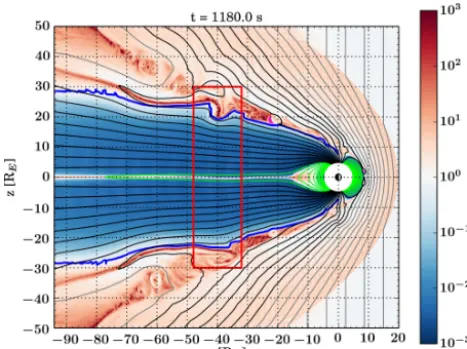
Figure 1.Ratio of ion thermal pressure perpendicular to the mag-netic field and magmag-netic pressure β⊥=Pthermal,⊥/Pmagneticand magnetic field lines in thex−zplane at 19:40 (1180.0 s). Closed field lines are drawn in green, semi-open field lines in black, and open field lines in gray. Field lines that are closed but not attached to the geomagnetic field are drawn in magenta. The tail lobes are estimated to lie between the blue curves. The curves indicate the innermost boundaries where β⊥>1 in the region|z|>5REand x <0. Inside the red box, a hemispherically asymmetric magne-topause perturbation compresses the northern tail lobe and expands the southern tail lobe, causing the current sheet between the tail lobes aroundx= −40REto shift slightly southward from its nom-inal position atz=0.
(with one footpoint at the inner boundary) as black curves, and open field lines as gray curves. Field lines that are closed but not attached to the geomagnetic field are drawn in magenta. The tail lobes are estimated to lie between the blue curves. These curves indicate the innermost boundaries whereβ⊥>1 in the region|z|>5REandx <0. This proxy is based on the assumption that while the magnetosheath is dominated by the plasma pressure, the tail lobes are mag-netically dominated. At the time shown, a hemispherically asymmetric magnetopause perturbation, created around the time when subsolar reconnection first started to add new semi-open flux tubes to the lobes, has reached the distance
x≈ −40RE(inside the red box). The significance of this per-turbation will be discussed further in Sect. 3.2.
3.1 Characteristics of current sheet flapping signatures
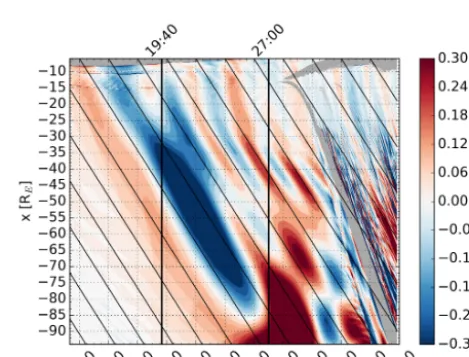
Figure 2 shows the earthward component of the magnetic field (Bx, color) at the nominal location of the magneto-tail current sheet (y=z=0) as a function of x and time (MM:SS, where MM indicates minutes and SS seconds). The tilted black lines indicate motion at the solar wind veloc-ityVx= −750 km s−1. The vertical black lines at 19:40 and 27:00 mark the time of Fig. 1 and the onset time of tail recon-nection atx≈ −14RE (Palmroth et al., 2017), respectively. The most striking feature in the plot is the alternating
posi-Figure 2.Earthward component of the magnetic field (Bx, color) at the nominal position of the tail current sheet (y=z=0) as a function ofxand time (MM:SS, where MM indicates minutes and SS seconds). The tilted black lines indicate motion at the solar wind velocityVx= −750 km s−1. The vertical black lines at 19:40 and 27:00 mark the time of Fig. 1 and the onset time of tail reconnection atx≈ −14RE, respectively.
tive and negative enhancements ofBx on the order of 10 nT in amplitude. The signatures first appear in the transition re-gion and subsequently propagate tailward at a velocity which is generally close to the solar wind velocity as indicated by the tilted black lines. TheBx enhancements can appear to be fairly regular for a while (e.g., aroundx= −40RE be-tween 24:00 and 30:00) or quite irregular (e.g., tailward of
x= −50RE). The durations of the enhancements at a given location vary from a few minutes to less than a minute, in agreement with Sergeev et al. (1998). The along-tail lengths of the signatures vary, but can be>10RE, in agreement with Runov et al. (2009). The enhancements occur for∼13 min before the onset of tail reconnection as indicated by the verti-cal black line, and can be observed at least for∼4 min after, in agreement with Sergeev et al. (1998) and Laitinen et al. (2007), before the signatures are disrupted by the spreading effects of tail reconnection. After this,Bxenhancements can still be observed between−30 and−10RE until the end of the simulation, i.e., 9 min after the onset of reconnection.
[image:3.612.49.283.67.242.2]Figure 3.The same as Fig. 2 except that the color shows the time derivative ofBx. The color scale has been saturated to better show the relevant structures.
x= −65RE, identified based on sign changes ofVz. Com-parison of Fig. 3 and Fig. 4 shows that Vz and∂Bx/∂t are anticorrelated (this can also be seen in Fig. 7 below), im-plying that the variations inBx are caused by up and down motion of the current sheet with respect to the z=0 plane (Sergeev et al., 1998). The amplitude ofVzis also in agree-ment with the observations of Sergeev et al. (1998).
Figure 4 illustrates that while the first significant signa-ture of downward ion bulk flow (blue) propagates all the way through the tail at a speed very close to the solar wind speed, the tailward propagation of the subsequent signatures is disrupted at somex distances (e.g., aroundx≈ −55REat 28:00). These x distances are not constant, but they appear to propagate tailward as well, although more slowly than the flapping signatures. Furthermore, the characteristic period of the flapping appears to change at these locations such that signatures closer to the Earth have a smaller characteristic period than those farther down the tail. The characteristic period within a given region also seems to decrease with increasing time. The cyan curves indicating isocontours of pressure reveal that the changes appear to be related to pres-sure, such that in regions of higher pressure the period of the signatures is smaller. The pressure increase with increasing time is caused by subsolar reconnection adding semi-open magnetic flux to the lobes before tail reconnection starts to close it efficiently enough (Palmroth et al., 2017).
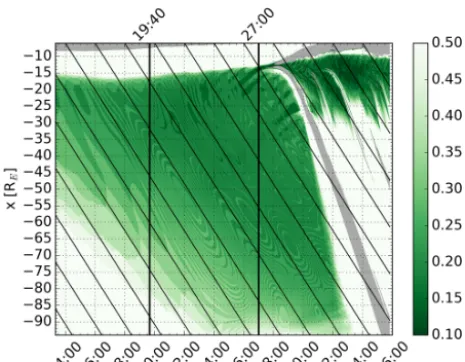
Figures 5 and 6 show the location and thickness of the plasma sheet in the z direction, respectively. The plasma sheet extent inzas a function ofxand time was identified as the region betweenz= ±10REwhere the ion thermal pres-sure perpendicular to the magnetic field is larger than mag-netic pressure (β⊥=Pthermal,⊥/Pmagnetic>1) (e.g., Wang et al., 2006). Thezcoordinate was obtained as the mean of the largest and smallest plasma sheetzvalue, and the
[image:4.612.310.546.66.246.2]thick-Figure 4.The same as Fig. 2 except that the color shows the north component of the ion bulk velocity (Vz). The cyan curves indicate isocontours of pressure in thezdirection (Pmagnetic,z+Pthermal,z) with a thicker curve indicating higher pressure: 0.05, 0.1, and 0.2 nPa. The magenta dots mark identified flapping half periods at x= −30RE,x= −40RE, andx= −65RE.
Figure 5.The same as Fig. 2 except that the color shows the location of the plasma sheet center in thezdirection. Gray areas indicate regions where the location could not be determined.
ness as their difference. Gray areas in the plots indicate re-gions where the conditionβ⊥>1 was not met anywhere
[image:4.612.311.546.349.527.2]Figure 6.The same as Fig. 5 except that the color shows the plasma sheet thickness.
Finally, before moving on to discuss the drivers of plasma sheet flapping, Fig. 7 shows a time series observed by a vir-tual satellite located at x= −40RE and y=z=0 in the simulation. From top to bottom, the parameters shown are
Bx,∂Bx/∂t,Vz, and plasma sheet z location. The vertical magenta lines identify flapping half periods based on sign changes of Vz, and they correspond to the magenta dots at
x= −40RE in Fig. 4. This plot further clarifies the mu-tual temporal behavior of the parameters and may be more straightforward to compare with real satellite observations (e.g., Sergeev et al., 1998) than the color map plots.
3.2 A driving mechanism for current sheet flapping
At the time shown in Fig. 1, a hemispherically asymmetric magnetopause perturbation, created around the time when subsolar reconnection first started to add new semi-open flux tubes to the lobes, has reached the distancex≈ −40RE (in-side the red box). The asymmetric perturbation consists of a simultaneous compression of the northern tail lobe and expansion of the southern tail lobe. The current sheet be-tween the lobes has been shifted slightly southward from its nominal position atz=0. This shift corresponds to the first strong flapping signature (red, starting around x≈ −15RE at∼16:00) in Fig. 2.
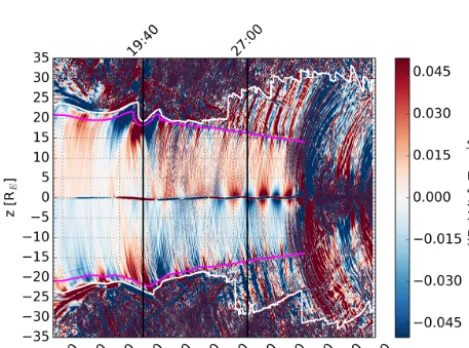
Figure 8 shows Vz as a function of zand time at y=0 and x= −40RE. The vertical black lines are the same as in Fig. 2. The white and magenta (only plotted until 31:00) curves indicate the innermost boundaries whereβ⊥>1 and β⊥>0.1 in the region|z|>5RE, respectively. The tail lobes are estimated to lie between the white curves (corresponding to the blue curves in Fig. 1).
Figure 8 shows that typically Vz is directed toward the plasma sheet in both lobes, close (roughly withinz= ±5RE) to the plasma sheet where the flapping produces
alternat-10 0 10
Bx
[
n
T
]
(-40.0, 0, 0) RE
1 0 1
d
B
/d
t
[n
T
s
]
x
200 1000 100 200
V
[
km
s
]
z
14:00 16:00 18:00 20:00 22:00 24:00 26:00 28:00 30:00 0.3
0.0 0.3
P
S
z
[
RE
]
-1
-1
(a)
(b)
(c)
[image:5.612.311.540.68.247.2](d)
Figure 7. Time series observed by a virtual satellite located at x= −40REandy=z=0 in the simulation. From(a)to(d), the parameters shown are earthward component of the magnetic field (Bx, cf. Fig. 2), time derivative ofBx (∂Bx/∂t, cf. Fig. 3), north component of the ion bulk flow (Vz, cf. Fig. 4), and location of the plasma sheet center in thezdirection (PSz, cf. Fig. 5). The vertical magenta lines identify flapping half periods based on sign changes ofVz, and they correspond to the magenta dots atx= −40REin Fig. 4.
ing positive and negative values ofVz in both hemispheres (∼24:00–30:00). Close to the magnetopause where localized compressions (e.g., aroundz=23RE at 14:00–16:00) and expansions (e.g., around z=23RE at 16:00–18:00) cause plasma flow toward and away from the plasma sheet, respec-tively. Furthermore, after 24:00 the magnetopause starts to expand outward due to the accumulation of magnetic flux re-cently opened by the subsolar reconnection. In these regions,
Figure 8.North component of the ion bulk velocity (Vz) as a func-tion ofzand time aty=0 andx= −40RE. The vertical black lines are the same as in Fig. 2. The white and magenta (only plotted un-til 31:00) curves indicate the innermost boundaries whereβ⊥>1
[image:6.612.313.539.67.241.2]andβ⊥>0.1 in the region|z|>5RE, respectively. The tail lobes are estimated to lie between the white curves and the magnetosonic wave resonance cavity between the magenta curves.
Figure 9.The same as Fig. 8 except that the color shows the time derivative ofBx.
[image:6.612.51.286.354.528.2]positive as the previously close to zeroBxof the current sheet is replaced by positive Bx as the sheet moves downward. For several minutes (∼20:00–24:00) after this clear initial signature the time derivative of Bx in the lobes consists of small-scale structures, until more coherent, larger-scale sig-natures associated with strong flapping are established after ∼24:00. The small-scale structure of ∂Bx/∂t in the lobes between the initial magnetopause driver and subsequent es-tablishment of the flapping strongly suggests wave activity between the plasma sheet and the magenta curves.
Figure 10.The same as Fig. 8 except that the color shows the mag-netosonic speed (Vms).
The magnetotail acts both like a waveguide and a reso-nance cavity (McPherron, 2005). Alfvén waves that tend to propagate down the tail waveguide along the background lobe magnetic field lines are eventually lost. Magnetosonic waves that propagate perpendicular to the background mag-netic field can form standing waves in the tail resonance cav-ity at a roughly constant distance from the Earth. A tailward propagating displacement of the boundary of the cavity pro-duces a disturbance inside the magnetosphere that stands in thex−zdirection while propagating down the tail. Figure 10 shows the magnetosonic speed (Vms) across the tail at the dis-tancex= −40RE. There is a distinct change in the magne-tosonic speed near the location of the magenta curves. This would explain why the waves in Fig. 9 appear to reflect there. We estimate that the magnetosonic wave resonance cavity lies between these curves.
14:0 0
16:0 0
18:0 0
20:0 0
22:0 0
24:0 0
26:0 0
28:0 0
30:0 0 0
1 2 3 4
T/2 [min]
[image:7.612.58.282.67.248.2]x = -30 RE x = -40 RE x = -65 RE
Figure 11. Travel time of magnetosonic waves across half of
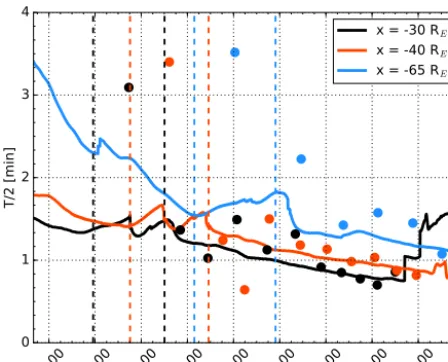
the magnetotail resonance cavity (T /2) at distances x= −30RE (black),x= −40RE(red), andx= −65RE(blue) as a function of time (solid curves). For example,T /2 atx= −40REhas been es-timated by integrating dt=dz/Vmsover the distance between the magenta curves marked in Fig. 10 and dividing by 2. The dots indi-cate tail flapping half periods with color indicating the correspond-ingxcoordinate. The flapping half periods have been obtained as the time differences between consecutive magenta dots indicated in Fig. 4, and they have been associated with a time stamp correspond-ing to the average of the two times. The dashed vertical lines show the start and end times of the first flapping signature at the three distances.
The travel time at a given distance decreases with increas-ing time as the increase in pressure due to the addition of flux tubes opened by subsolar reconnection compresses the lobes, decreasing the cross section of the cavity and increas-ing the magnetosonic speed within. The bumps in the travel time during the first flapping signature at all threexdistances are associated with the magnetopause perturbation that initi-ated the flapping. Apart from the first flapping signature at a given distance, there appears to be a good correspondence between the approximated local magnetosonic travel time across half of the resonance cavity and the observed flapping half period. Both Figs. 11 and 4 show that the period of the flapping signatures increases with increasing distance away from the Earth. At a given location, the period decreases with increasing time. These changes follow the structure and de-velopment of pressure indicated in Fig. 4 by the cyan curves. Higher pressure indicates a smaller cross section of the cavity and higher magnetosonic speed due to the higher magnetic field strength, which is in agreement with the suggestion that the local flapping period is determined by the bounce time of the magnetosonic waves within the cavity.
4 Discussion
We have examined current sheet flapping in Vlasiator and suggested a source mechanism that is capable of initiating and maintaining flapping in the central meridian of the mag-netotail before and during tail reconnection when the plasma sheet is thin. According to our suggested mechanism, the flapping is initiated by a hemispherically asymmetric per-turbation of the magnetopause that is capable of displacing the current sheet from its nominal position. The perturbation travels tailward along the magnetopause (close to the solar wind speed in this case), producing a current sheet displace-ment that propagates tailward at the same speed. As the first flapping signature is directly driven by the magnetopause perturbation, no correspondence between the duration of flapping signature and the local magnetosonic wave travel time in Fig. 11 is expected. The initial current sheet displace-ment launches a standing magnetosonic wave within the lo-cal resonance cavity. The travel time of the wave within the cavity determines the period of the subsequent flapping sig-natures, as shown in Fig. 11. Changes in the cross-sectional width of the cavity as well as the magnetosonic speed within the cavity affect the wave travel time and thus the local flap-ping period. The flapflap-ping signatures that can be produced by our suggested mechanism are compliant with the character-istics of plasma sheet flapping in the center of the tail cited in the Introduction.
We do not observe a damping of the current sheet flapping. On the contrary, after the initial displacement, the signature can even strengthen (e.g., atx= −40REin 24:00–28:00 in Fig. 2). The reason for this could be the continued compres-sion of the cavity that could provide additional energy to the standing wave.
1. The characteristics of the simulated flapping signatures agree with observations reported in the literature. 2. In the simulation, the flapping is initiated by a
hemispherically asymmetric magnetopause perturba-tion, created by subsolar reconnecperturba-tion, that is capable of displacing the tail current sheet from its nominal posi-tion. The current sheet displacement propagates down-tail together with the driving magnetopause perturba-tion.
3. As the initial current sheet displacement passes, it launches a standing magnetosonic wave within the local tail resonance cavity. The travel time of the wave within the cavity determines the period of the subsequent flap-ping signatures.
4. Increasing pressure in the tail lobes due to an increasing amount of open magnetic flux added by subsolar recon-nection can affect the cross-sectional width of the reso-nance cavity as well as the magnetosonic speed within the cavity. These in turn affect the wave travel time and flapping period. The compression of the resonance cav-ity may also provide additional energy to the standing wave, which may lead to strengthening of the flapping signature.
The suggested mechanism could act as a source of kink-like waves that are emitted from the center of the tail and propagate toward the dawn and dusk flanks. However, further research using a 3-D simulation will be needed to examine this suggestion.
Code availability. Vlasiator is an open source code released
un-der the GPLv2 license. The code is available at http://github.com/ fmihpc/vlasiator (last access: 25 July 2018, Palmroth and the Vlasi-ator team, 2018).
Author contributions. LJ carried out most of the analysis and
pre-pared the manuscript. YPK participated in running the simulation
results has been partially carried out in the Finnish Centre of Ex-cellence in Research of Sustainable Space (Academy of Finland grant number 312351). PRACE (http://www.prace-ri.eu, last ac-cess: 25 July 2018) is acknowledged for granting us Tier-0 comput-ing time in HLRS Stuttgart, where Vlasiator was run in the Hazel-Hen machine with project number 2014112573. The work of LT is supported by a Marie Sklodowska-Curie Individual Fellowship (no. 704681).
The topical editor, Anna Milillo, thanks two anonymous refer-ees for help in evaluating this paper.
References
Daldorff, L. K. S., Tóth, G., Gombosi, T. I., Lapenta, G., Amaya, J., Markidis, S., and Brackbill, J. U.: Two-way coupling of a global Hall magnetohydrodynamics model with a local im-plicit particle-in-cell model, J. Comput. Phys., 268, 236–254, https://doi.org/10.1016/j.jcp.2014.03.009, 2014.
Davey, E. A., Lester, M., Milan, S. E., and Fear, R. C.: Storm and substorm effects on magnetotail cur-rent sheet motion, J. Geophys. Res., 117, A02202, https://doi.org/10.1029/2011JA017112, 2012.
Erkaev, N. V., Semenov, V. S., Kubyshkin, I. V., Kubyshkina, M. V., and Biernat, H. K.: MHD model of the flapping motions in the magnetotail current sheet, J. Geophys. Res., 114, A03206, https://doi.org/10.1029/2008JA013728, 2009.
Forsyth, C., Lester, M., Fear, R. C., Lucek, E., Dandouras, I., Fazak-erley, A. N., Singer, H., and Yeoman, T. K.: Solar wind and sub-storm excitation of the wavy current sheet, Ann. Geophys., 27, 2457–2474, https://doi.org/10.5194/angeo-27-2457-2009, 2009. Gabrielse, C., Angelopoulos, V., Runov, A., Kepko, L., Glass-meier, K. H., Auster, H. U., McFadden, J., Carlson, C. W., and Larson, D.: Propagation characteristics of plasma sheet oscilla-tions during a small storm, Geophys. Res. Lett., 35, L17S13, https://doi.org/10.1029/2008GL033664, 2008.
hybrid-Vlasov simulation results, J. Geophys. Res.-Space, 122, 2877–2888, https://doi.org/10.1002/2016JA023709, 2017. Jarvinen, R., Vainio, R., Palmroth, M., Juusola, L., Hoilijoki,
S., Pfau-Kempf, Y., Ganse, U., Turc, L., and von Alfthan, S.: Ion acceleration by flux transfer events in the terres-trial magnetosheath, Geophys. Res. Lett., 45, 1723–1731, https://doi.org/10.1002/2017GL076192, 2018.
Laitinen, T. V., Nakamura, R., Runov, A., Rème, H., and Lucek, E. A.: Global and local disturbances in the magne-totail during reconnection, Ann. Geophys., 25, 1025–1035, https://doi.org/10.5194/angeo-25-1025-2007, 2007.
McPherron, R. L.: Magnetic Pulsations: Their Sources and Rela-tionto Solar Wind and Geomagnetic Activity, Surv. Geophys., 26, 545–592, https://doi.org/10.1007/s10712-005-1758-7, 2005. Palmroth, M. and the Vlasiator team: Vlasiator: hybrid-Vlasov sim-ulation code, Github repository, available at: https://github.com/ fmihpc/vlasiator/ (last access: 25 July 2018), 2018.
Palmroth, M., Honkonen, I., Sandroos, A., Kempf, Y., von Alfthan, S., and Pokhotelov, D.: Preliminary testing of global hybrid-Vlasov simulation: Magnetosheath and cusps under northward interplanetary magnetic field, J. Atmos. Sol.-Terr. Phy., 99, 41– 46, https://doi.org/10.1016/j.jastp.2012.09.013, 2013.
Palmroth, M., Archer, M., Vainio, R., Hietala, H., Pfau-Kempf, Y., Hoilijoki, S., Hannuksela, O., Ganse, U., Sandroos, A., von Alfthan, S., and Eastwood, J. P.: ULF foreshock under radial IMF: THEMIS observations and global kinetic simulation Vlasi-ator results compared, J. Geophys. Res.-Space, 120, 8782–8798, https://doi.org/10.1002/2015JA021526, 2015.
Palmroth, M., Hoilijoki, S., Juusola, L., Pulkkinen, T. I., Hietala, H., Pfau-Kempf, Y., Ganse, U., von Alfthan, S., Vainio, R., and Hesse, M.: Tail reconnection in the global magnetospheric context: Vlasiator first results, Ann. Geophys., 35, 1269–1274, https://doi.org/10.5194/angeo-35-1269-2017, 2017.
Petrukovich, A. A., Baumjohann, W., Nakamura, R., and Runov, A.: Formation of current density profile in tilted current sheets, Ann. Geophys., 26, 3669–3676, https://doi.org/10.5194/angeo-26-3669-2008, 2008.
Rong, Z. J., Shen, C., Petrukovich, A. A., Wan, W. X., and Liu, Z. X.: The analytic properties of the flapping current sheets in the earth magnetotail, Planet. Space Sci., 58, 1215–1229, https://doi.org/10.1016/j.pss.2010.04.016, 2010.
Rong, Z. J., Barabash, S., Stenberg, G., Futaana, Y., Zhang, T. L., Wan, W. X., Wei, Y., and Wang, X.-D.: Technique for diag-nosing the flapping motion of magnetotail current sheets based on single-point magnetic field analysis, J. Geophys. Res.-Space, 120, 3462–3474, https://doi.org/10.1002/2014JA020973, 2015. Runov, A., Nakamura, R., Baumjohann, W., Zhang, T. L.,
Volw-erk, M., Eichelberger, H.-U., and Balogh, A.: Cluster observa-tion of a bifurcated current sheet, Geophys. Res. Lett., 30, 1036, https://doi.org/10.1029/2002GL016136, 2003.
Runov, A., Angelopoulos, V., Sergeev, V. A., Glassmeier, K.-H., Auster, U., McFadden, J., Larson, D., and Mann, I.: Global properties of magnetotail current sheet flap-ping: THEMIS perspectives, Ann. Geophys., 27, 319–328, https://doi.org/10.5194/angeo-27-319-2009, 2009.
Sergeev, V., Angelopoulos, V., Carlson, C., and Sutcliffe, P.: Current sheet measurements within a flapping plasma sheet, J. Geophys. Res., 103, 9177–9187, https://doi.org/10.1029/97JA02093, 1998. Sergeev, V., Runov, A., Baumjohann, W., Nakamura, R., Zhang, T. L., Volwerk, M., Balogh, A., Rème, H., Sauvaud, J. A., An-dré, M., and Klecker, B.: Current sheet flapping motion and structure observed by Cluster, Geophys. Res. Lett., 30, 1327, https://doi.org/10.1029/2002GL016500, 2003.
Sergeev, V., Runov, A., Baumjohann, W., Nakamura, R., Zhang, T. L., Balogh, A., Louarn, P., Sauvaud, J.-A., and Réme, H.: Ori-entation and propagation of current sheet oscillations, Geophys. Res. Lett., 31, L05807, https://doi.org/10.1029/2003GL019346, 2004.
Sergeev, V. A., Sormakov, D. A., Apatenkov, S. V., Baumjo-hann, W., Nakamura, R., Runov, A. V., Mukai, T., and Nagai, T.: Survey of large-amplitude flapping motions in the midtail current sheet, Ann. Geophys., 24, 2015–2024, https://doi.org/10.5194/angeo-24-2015-2006, 2006.
Sergeev, V. A., Tsyganenko, N. A., and Angelopoulos, V.: Dynam-ical response of the magnetotail to changes of the solar wind direction: an MHD modeling perspective, Ann. Geophys., 26, 2395–2402, https://doi.org/10.5194/angeo-26-2395-2008, 2008. Shen, C., Rong, Z. J., Li, X., Dunlop, M., Liu, Z. X., Malova, H. V., Lucek, E., and Carr, C.: Magnetic configurations of the tilted current sheets in magnetotail, Ann. Geophys., 26, 3525–3543, https://doi.org/10.5194/angeo-26-3525-2008, 2008.
Speiser, T. W. and Ness, N. F.: The neutral sheet in the geomagnetic tail: Its motion, equivalent currents, and field line connection through it, J. Geophys. Res., 72, 131–141, https://doi.org/10.1029/JZ072i001p00131, 1967.
Sun, W.-J., Fu, S., Shi, Q., Zong, Q.-G., Yao, Z., Xiao, T., and Parks, G.: THEMIS observation of a magnetotail current sheet flapping wave, Chinese Sci. Bull., 59, 154–161, 2013.
von Alfthan, S., Pokhotelov, D., Kempf, Y., Hoilijoki, S., Honkonen, I., Sandroos, A., and Palmroth, M.: Vlasiator: First global hybrid-Vlasov simulations of Earth’s foreshock and magnetosheath, J. Atmos. Sol.-Terr. Phy., 120, 24–35, https://doi.org/10.1016/j.jastp.2014.08.012, 2014.
Wang, C., Lyons, L. R., Weygand, J. M., Nagai, T., and McEntire, R. W.: Equatorial distributions of the plasma sheet ions, their electric and magnetic drifts, and magnetic fields under different interplanetary magnetic fieldBz conditions, J. Geophys. Res., 111, A04215, https://doi.org/10.1029/2005JA011545, 2006. Wei, X. H., Cai, C. L., Cao, J. B., Rème, H., Dandouras, I., and
Parks, G. K.: Flapping motions of the magnetotail current sheet excited by nonadiabatic ions, Geophys. Res. Lett., 42, 4731– 4735, https://doi.org/10.1002/2015GL064459, 2015.