International Journal of Innovative Technology and Exploring Engineering (IJITEE) ISSN: 2278-3075,Volume-8 Issue-12, October 2019
Abstract: The Mobile Ad Hoc Networks (MANETs) are networks with unpredictable topology. The number of paths existing between a pair of nodes may change with time. Thus, discovered routes are not permanent in nature and are subject to change with movement of nodes. The constraints like limited energy life of nodes also influence the availability of paths. The flows of traffic or data load also influence the performance of network. Thus, load needs to be distributed among various possible paths. This can prevent overutilization of resources. Thus, a proper management of available resources is necessary for routing data packets efficiently in MANETs. In this paper, a Roulette wheel based load balancing approach has been presented. Further this approach has been applied to Ant colony based Energy Efficient Multipath Routing (ACBEEMR). The combined approach has been named as ACBEEMR-LB. The performance of ACBEEMR-LB has been evaluated and analyzed using the NS2 simulator. The results corresponding to the load balanced approach has been compared to the results of simple ACBEEMR and protocols like AOMDV. The results so obtained prove the benefits of using Load Balancing in case of multipath routing.
Keywords: Ant colony, MANET, Load Balancing, Reactive, Proactive, Unipath and Multipath.
I. INTRODUCTION
Mobile Ad hoc Networks (MANETs) [1] [2] are dynamic networks with number of mobile nodes moving randomly in a given area. The linkage among mobile nodes in case of wireless networks such as MANETs is not permanent in nature. This means an existing link among a pair of nodes may become invalid over the passage of time. There may exist any number of paths between a pair of nodes, depending on the kind of connectivity and vicinity of the intermediate nodes. On the basis of number of paths to be discovered between source and destination node, the protocols can be categorized as unipath and multipath routing protocols. The multipath routing protocols [3] unlike unipath routing protocols can discover multiple paths between a pair of nodes. The multiple paths discovered by using multipath routing protocols have different levels of robustness according to number of hops, energy utilization, available bandwidth and the vulnerability of nodes to failure. Thus to get the benefits of multipath routing, an effective management of the data traffic over these available paths is of foremost importance. This management of traffic among available paths is the core feature of the load balancing
Revised Manuscript Received on October 05, 2019.
Jaideep Atri, Department of Computer Science, S.A. Jain College,
Ambala city, India. Email: [email protected]
Shuchita Upadhyaya, Department of Computer science & Applications,
Kurukshetra University, Kurukshetra, India. Email:
approach. This paper presents a roulette wheel based load balancing approach that distributes the load or data packets in proportion to degree of effectiveness of different paths. This degree of effectiveness may be measured on the basis of different parameters [4]. This paper further proposed roulette wheel based load balancing approach which has been applied and tested over an earlier proposed Ant Colony Based Energy Efficient Multipath Routing approach [5]. The paper has been divided into five sections. Section II presents a number of works related to the field of load balancing in case of MANETs. The basic functionalities of Roulette wheel approach has been presented in Section III. The detailed approach of application of Roulette wheel to ACBEEMR i.e. Load Balanced ACBEEMR (ACBEEMR-LB) has also been described in this section. Section IV presents the results obtained corresponding to the simulation of ACBEEMR-LB over NS2 simulator. Section V concludes the findings of the paper.
II. RELATEDWORKS
Multipath routing protocols come with the benefit of having more than one path. But the key benefits of using multipath routing can be achieved only through the use of load distribution among available paths. This section presents few works related to the application of load distribution in MANETs. The section also provides for the need of load distribution in case of unipath routing protocols.
Saleh et al. [6] emphasized the requirement of load balancing for a multipath routing algorithm. It has been established that load balancing scheme leads to the effective utilization of energy of nodes. The ineffective utilization or an uncontrolled use of energy in a network leads to decrease in the reliability and lifetime of the network. Saleh et al. have focused on the development of a multipath scheme that may contribute towards the effective utilization of bandwidth together with energy-awareness. Scheme has been named as load balancing ad hoc on-demand multipath distance vector (LBAOMDV) Protocol to achieve the desired objectives. The results corresponding to average energy consumption also prove the effectiveness of LBAOMDV as compared to traditional protocols like AOMDV and other protocols namely PCRM, and AntHocNet.
The basic mechanism of discovering routes is same in case of LBAOMDV and AOMDV. The multiple paths discovered using the traditional approach is then subjected to the selection process for data transmission. The final set of routes for transferring the data is decided on the basis of energy utilization along those paths.
Roulette Wheel Based Load Balancing for
Multipath Routing in MANETs
After retrieving the set of suitable paths, selected paths are arranged on the basis of average unused bandwidth for a particular path. A complete message is distributed over the set of qualified paths in form of chunks of fixed lengths.
Jabbar et al. [7] have also introduced a load balancing approach for Mobile Ad hoc Networks (MANETs) taking into consideration the mobility and limited battery life of nodes. The mobility factor adds to the unpredictable nature of the MANETs, which result in instability of links in MANETs. The authors have proposed a Multipath Battery and Mobility Aware routing scheme (MBMA-OLSR). The study is mainly focused to develop a Multi-Criteria Node Rank (MCNR) metric that is designed by taking two factors into consideration i.e. the residual energy and the speeds of mobile nodes. The benefits of the approach have been demonstrated using various simulation scenarios with different mobility’s. The Prime benefit of the approach is its ability to deal with link failures arising due to movement of mobile nodes. The approach balances the load among available paths. The approach is aimed at the development of stable paths. This is achieved by providing lower importance to the nodes with high mobility and lower energy. The simulation results prove the effectiveness of approach in terms of lower number of dropped packets.
In another contribution toward introducing load balancing in MANETs, Pathak et al. [8] have proposed an approach for even distribution of load in case of AOMDV routing protocol. The major limitation with the traditional AOMDV protocol lies in the fact that even after discovering multiple paths, only a single path is utilized for the purpose of transmission of data. This increases the load on a single path and leads to the consumption of resources along that path till it becomes invalid. This area has been focused by pathak et al. to devise an approach that may distribute the load on the basis of traffic condition over different paths. The proposed approach i.e. Traffic Aware Load Balanced AOMDV (TALB-AOMDV) focuses on the queue length and the hop count along a route for the process of route selection. The main focus of the approach is to avoid the repeated use of single route. The results corresponding to the simulation over NS2 proves benefits of the approach over AOMDV. The authors have also suggested the scope of work that can be done by considering energy in the process of path selection.
Souihli et al. [9] also emphasized on efficient distribution of load through the network as the nodes with heavy load may degrade the performance of the network. The algorithms in case of MANETs mainly focus on the selection of the shortest route. The major limitation with the selection of the shortest route is associated with its repeated use. This leads to heavy load and congestion condition on nodes along the shortest route. Thus, authors have proposed a load-balancing mechanism to deal with such situation. This approach focuses to push the traffic away from the center of the network i.e. this process of routing tries to minimize average route centrality. Simulations results also support the contribution of the proposed mechanism in improving distribution of traffic.
Thus, from the survey of the literature it can be concluded that load distribution is of prime importance in case of wireless networks such as MANETs. Further it can also be inferred that energy is also a key area that needs to be given
weightage while distributing the load or the traffic along different available paths. The next section presents an approach for distributing the load in the network through the use of a traditional approach namely Roulette wheel selection. This approach has been applied to distribute the load in an earlier proposed Ant Colony Based Energy Efficient Multipath Routing (ACBEEMR).
III. APPLICATIONOFROULETTEWHEEL SELECTIONFORLOADDISTRIBUTIONIN
ACBEEMR
Roulette wheel selection is one of the most common traditional approaches that are employed for the population selection in genetic algorithms [10] [11]. In a roulette wheel selection [12] approach, the population with higher fitness value has more chances of getting selected as compared to a population of lower fitness value. The basics of the approach of roulette wheel selection approach can be summarized as below:
A. Roulette wheel selection:
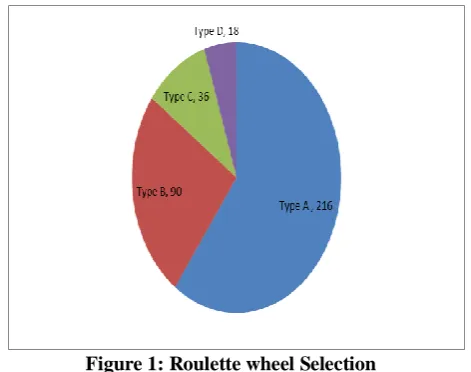
In Roulette wheel selection approach, each type of population is provided with a chance for selection according to its fitness value. For example, let there be four types of populations available i.e. Type A, B, C and D. Suppose Type A, B, C and D has a fitness value of 0.60, 0.25, 0.10 and 0.05. Then these can be represented over a roulette wheel as shown in the Figure 1.
i.e. portion of Type A over Roulette Wheel represented by the equation:
Fitness of Type A
* 360 (Fitness of Type A + Fitness of Type B + Fitness of Type C + Fitness of Type D)
Area for Type A on Roulette Wheel =(0.60/1) * 360= 216
Similar procedure can be followed for Type B, C and D.
International Journal of Innovative Technology and Exploring Engineering (IJITEE) ISSN: 2278-3075,Volume-8 Issue-12, October 2019
Figure 1: Roulette wheel Selection B. Application of Roulette wheel selection for Load distribution in ACBEEMR
The design of ACBEEMR [5], an earlier proposed protocol is based on the behavior of biological Ants in Ant colony optimization. The basic procedure of ACBEEMR can be summarized as:
The ACBEEMR mainly considers two factors namely Hop count and the proportionate energy change in the Residual energy of the neighbor node. The residual energy of neighbor nodes at any point of time is provided by energy ants coming from those nodes.
______________________________________________ Pseudo code for ACBEEMR Algorithm:
// Generation of Forward Ants //
Begin
Initially Forward Ants are broadcasted toward the destination. All intermediate Nodes are recorded on the stack by the Forward Ants
//Generation of Backward Ant//
After reaching the Destination Forward Ants are discarded and Backward ants are produced in the reverse direction.
Begin While (Node ≠Source Node)
Pheromone table at a node is updated by the Backward Ants based Number of Hops to destination through that node
1
1 1
(
)
*
(
)
kij i
kij n
i kij
i
H
RE
P
E
H
−
−
=
→
i.e. Pkij & Hkij represents the pheromone and Number of Hops at Node k
through neighbor i to destination j. REi and Ei represents residual energy in
current energy ant and energy level in last energy ant received from neighbor i respectively.
End While
// Updating Pheromone Table Using Energy Ants//
The Pheromone table is updated at a regular interval of time using the
Energy Ants from neighbor.
End
The ACBEEMR results in the generation of pheromone value corresponding to the different route that can be followed from the current node through various neighbor nodes. Now these pheromone values can be used for the purpose of load distribution and can be mapped on a roulette wheel. The complete procedure for distributing load over different paths can be summarized as pseudo code in next section. This approach favors the path with higher pheromone value by providing it with higher chances of getting selected. At the same time it also provides an opportunity to the path with low pheromone to have a chance in the selection.
________________________________________________
Pseudo code for Load Distribution Algorithm:
// Generation of Forward Ants // Begin
Find different pheromone values corresponding to different routes through various neighbor nodes.
//Generation of Backward Ant//
Generate the fitness value corresponding to different routes by dividing the pheromone value for a particular route from the sum of pheromone value of all the routes
Here Fkij represents the pheromone fitness corresponding to the
routes through node i to destination j
1 kij
kij n
kij i
P
F
P
=→
Now Map these value on scale of 100 by multiplying the value of Fkij corresponding to each route by 100.
/* As an example if value on scale of 100 for three possible routes i.e. route A is 33,B is 60 and C is 7 then assign the slot 0 to 33 to route A. followed by a slot of 34 to 93 to Route B and Slot of 94 to 100 to Route C*/
// Generation of random number//
For each newly arrived packet generate a random number from 0 to 100. And find the slot in which it lies.
Transmit the packet over the route selected through the random number generation.
End
The next section presents the simulation based comparison of the Load balancing approach with the traditional approach.
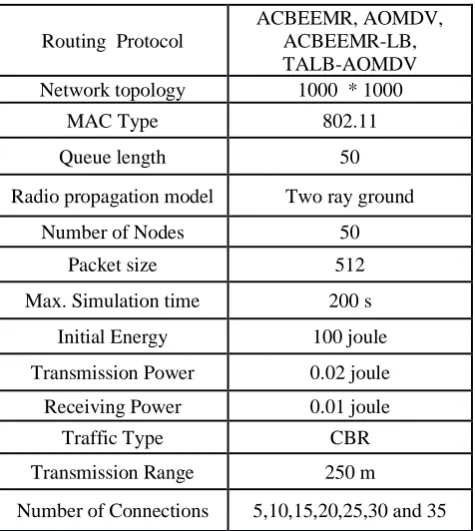
IV. SIMULATIONANDANAYSISOFRESULTS The roulette wheel is a useful approach for selection process. ACBEEMR-LB uses Roulette wheel selection to direct the packets on a path from the set of received multiple paths. Conceptually the approach looks sound. But it needs to be tested experimentally. This section presents simulation of proposed approach using NS2 simulator. Table 1 shows different simulation parameters.
The results corresponding to the proposed approach have been compared with original protocol i.e. ACBEEMR and other protocols such as AOMDV and TALB-AOMDV.
Table I Various simulation parameters
Routing Protocol
ACBEEMR, AOMDV, ACBEEMR-LB, TALB-AOMDV
Network topology 1000 * 1000
MAC Type 802.11
Queue length 50
Radio propagation model Two ray ground
Number of Nodes 50
Packet size 512
Max. Simulation time 200 s
Initial Energy 100 joule
Transmission Power 0.02 joule
Receiving Power 0.01 joule
Traffic Type CBR
Transmission Range 250 m
Number of Connections 5,10,15,20,25,30 and 35
Packet delivery ratio is a useful metric to judge the effectiveness of routing mechanism used in protocol. It provides the ratio of number of data packets delivered at a destination to the number of data packets sent from source. Figure 2 shows the results corresponding to the packet delivery ratio. The results show that load balancing does improve the performance of a protocol. The results corresponding to ACBEEMR-LB are better than ACBEEMR protocol. Further, results of both ACBEEMR and ACBEEMR-LB are consistently better than other two protocols with a significant difference. In case of 25 connections, packet delivery ratio is 0.51 for ACBEEMR and 0.54 for ACBEEMR-LB, which is much better than the values of other two protocols i.e. approximately 0.3 in case of AOMDV and TALB-AOMDV.
Figure 2 Packet Delivery Ratio vs Number of Connections
Figure 3: Throughput vs. Number of connections Throughput provides the rate at which data is delivered at the destination and is measured in kbps. The results corresponding to throughput also proves the dominance of ACBEEMR-LB over other protocols. However for large number of connections i.e. for 35 connections the performance of both ACBEEMR and ACBEEMR-LB is approximately same. It can also be seen from Figure 3 that ACBEEMR-LB and ACBEEMR have better results than other two protocols.
[image:4.595.47.289.131.400.2]Figure 4: Average End to End Delay vs. Number of Connections
Figure 4 presents the results corresponding to Average End to End delay. The results prove the effectiveness of ACBEEMR-LB over other protocols. As an example, the End to End delay for 25 connections is nearly 551 ms for ACBEEMR-LB as compared to 568.6 ms for ACBEEMR and approximately 2000 ms for AOMDV and TALB-AOMDV. The results in Figure 4 prove that ACBEEMR-LB has lower end to end delay as compared to other protocols. ACBEEMR-LB proves its effectiveness in terms of metrics such as Packet delivery, throughput and End to End delay. But it needs to be tested for energy efficiency. The main objective of designing the ACBEEMR approach is to deal with the energy
[image:4.595.49.287.133.399.2] [image:4.595.312.543.385.564.2] [image:4.595.53.287.593.749.2]International Journal of Innovative Technology and Exploring Engineering (IJITEE) ISSN: 2278-3075,Volume-8 Issue-12, October 2019
to ACBEEMR i.e.
ACBEEMR-LB, it should not compromise with the energy consumption in the network.
To verify this, the performance of ACBEEMR-LB has been compared to ACBEEMR and AOMDV using different packet sizes [13] i.e. from 64 byte to 1024 byte. For this purpose a topology of 1500*1500 has been taken. The results shown in Figure 5 prove that ACBEEMR-LB is a better protocol in terms of energy consumption. This means the energy consumption of ACBEEMR has not degraded due to introduction of a load balancing approach to it.
Figure 5: Energy Consumption (joules) vs. Packet Size V. CONCLUSION
The paper presented a load balanced variant of ACBEEMR i.e. ACBEEMR-LB. Roulette wheel based load balancing has been used in ACBEEMR-LB. The simulation of ACBEEMR-LB with other multipath protocols i.e. ACBEEMR, AOMDV and TALB-AOMDV proves the efficiency of using load balancing. The protocols have been tested for different number of connections for various metrics i.e. Packet Delivery Ratio, Throughput and Average End to End delay. ACBEEMR-LB provides better results in terms of all metrics. Further it has also been demonstrated that while using a load balancing approach, it does not compromise on the ground of energy consumption. The results in terms of energy consumption are nearly same or even better in case of ACBEEMR-LB as compared to ACBEEMR. Further, it can be established that load balancing in multipath routing is an effective method, if used with the concept of energy efficiency through the introduction of nature inspired techniques such as ACO.
REFERENCES
1. S. Corson and J. Macker, "Mobile Ad hoc Networking (MANET): Routing Protocol Performance Issues and Evaluation Considerations," Jan. 1999, Available: https://datatracker.ietf.org/doc/rfc2501/
2. G. Mahalakshmi, A.Suresh. “A Trust Based Multipath Routing for Black Hole Attacks with Group Search Optimization Routing”
International Journal of Innovative Technology and Exploring Engineering (IJITEE), Vol 8 no. 11, 2019, pp. 3536-3543.
3. S. Mueller, R.P. Tsang, D. Ghosal, “Multipath Routing in Mobile Ad Hoc Networks: Issues and Challenges”. In: Calzarossa M.C., Gelenbe E. (eds) Performance Tools and Applications to Networked Systems. MASCOTS 2003. Lecture Notes in Computer Science, vol 2965. ,2004, Springer, Berlin, Heidelberg.
4. M. K. Gulati and K. Kumar, "A review of QoS routing protocols in
MANETs," 2013 International Conference on Computer Communication and Informatics, Coimbatore, 2013, pp. 1-6.
5. J. Atri and S. Upadhyaya, "Ant Colony Based Energy Efficient Multipath Routing," IJARCCE, vol. 5, no. 5, may 2016, pp. 676-680. 6. Saleh A. Alghamdi, "Load balancing ad hoc on-demand multipath
distance vector (LBAOMDV) routing protocol," EURASIP Journal on Wireless Communications and Networking , 2015:242.
7. W. A. Jabbar, Mahamod Ismail, and Rosdiadee Nordin, "Energy and mobility conscious multipath routing scheme for route stability and load balancing in MANETs," Simulation Modelling Practice and Theory, vol. 77, 2017, pp. 245-271.
8. G. Pathak and K. Kumar, "Traffic aware load balancing in AOMDV for mobile Ad-hoc networks", Journal of Communications and Information Networks, Vol. 2, Issue 3, 2017, pp. 123–130.
9. O. Souihli, M. Frikha, and M. B. Hamouda, "Load-balancing in MANET shortest-path routing protocols," Ad Hoc Networks, vol. 7, Issue 2, 2009, pp. 431-442.
10. S.N Sivanandam and S.N. Deepa, “Introduction to genetic Algorithm”.,
Springer-Verlag Berlin Heidelberg, 2008.
11. D. Goldberg, “Genetic Algorithm in search, optimization and Machine Learning”, Addison Wesley, 1989.
12. Noraini Mohd Razali and John Geraghty, "Genetic Algorithm Performance with Different Selection Strategies," in World Congress on Engineering, 2011.
13. A. Taha, R. Alsaqour, M. Uddin, M. Abdelhaq and T. Saba, "Energy Efficient Multipath Routing Protocol for Mobile Ad-Hoc Network Using the Fitness Function," in IEEE Access, vol. 5, 2017, pp. 10369-10381.
AUTHORSPROFILE
Jaideep Atri received his B.tech degree in Computer
Science and Engineering from Kurukshetra University, India in 2010. He received his M.tech degree in computer science in 2012 from Kurukshetra University. He is currently working as Assistant Professor in the Dept. of Computer science, S.A Jain College, Ambala City. His research interests include Ad Hoc networks and Swarm Intelligence.
Dr. Shuchita Upadhyaya bhasin working as a