
Rochester Institute of Technology
RIT Scholar Works
Theses Thesis/Dissertation Collections
2013
Investigation on solid-phase crystallization
techniques for low temperature polysilicon
thin-film transistors
Qinglong Li
Follow this and additional works at:http://scholarworks.rit.edu/theses
This Thesis is brought to you for free and open access by the Thesis/Dissertation Collections at RIT Scholar Works. It has been accepted for inclusion in Theses by an authorized administrator of RIT Scholar Works. For more information, please [email protected].
Recommended Citation
Investigation on Solid-Phase Crystallization Techniques
for Low Temperature Polysilicon Thin-film Transistors
A thesis submitted in
partial fulfillment of requirements of the degree of
Master of Science in
Microelectronic Engineering
By
Qinglong Li
Electrical and Microelectronic Engineering Department
August 2013
Approved by:
Dr. Karl D. Hirschman __________________________ Date __________
(Thesis Advisor)
Dr. Sean Rommel __________________________ Date __________
(Committee Member)
Dr. Ivan Puchades __________________________ Date __________
(Committee Member)
Dr. Robert Pearson ___________________________Date __________
(Program Chair)
DEPARTMENT OF ELECTRICAL AND MICROELECTRONIC ENGINEERING
KATE GLEASON COLLEGE OF ENGINEERING
ii
Abstract
Low-temperature polysilicon (LTPS) has emerged as a dominant technology for high
performance thin-film transistors (TFTs) used in mobile liquid crystal display (LCD) and organic
light emitting diode (OLED) display products. As users demand higher quality in flat panel
displays with a larger viewing area and finer resolution, the improvement in carrier mobility of
LTPS compared to that of hydrogenated amorphous silicon (a-Si:H) makes it an excellent
candidate as a channel material for TFT. Advantages include improvements in switching speed
and the ability to incorporate peripheral scan and data driver circuitry onto a low cost display
substrate.
Solid-phase crystallization (SPC) is a useful technique to realize polysilicon films due to
its simplicity and low cost compared to excimer-laser annealing (ELA), which has many
challenges in back-plane manufacturing on large glass panels. Metal induced crystallization
(MIC) results in polycrystalline silicon films with grain size as large as tens of microns.
Flash-lamp annealing (FLA) is a new and novel method to crystallize a-Si films at high temperature
without distortion of the glass substrate by performing an annealing within millisecond range.
This work investigates SPC, MIC and FLA techniques to realize LTPS films. In addition, TFTs
were designed and fabricated to characterize the device quality of the semiconductor layer, and
iii
Table of Contents
Abstract ... ii
Table of Contents ... iii
Lists of Figures ...v
Lists of Tables ... vii
Acknowledgements ... viii
CHAPTER 1 Introduction ...1
1.1 Background ...1
1.2 Motivation and Objectives ...4
CHAPTER 2 Channel Materials of Thin Film Transistors ...5
2.1 Introduction ...5
2.2 Hydrogenated amorphous silicon thin film transistors ...5
2.3 Low temperature polysilicon technology ...9
CHAPTER 3 Techniques Used for LTPS Thin Film Transistors ...11
3.1 Solid phase crystallization and rapid thermal annealing ...11
3.1.1 Introduction ...11
3.1.2 Dynamics of films growth ...11
3.1.3 Defects in SPC films ...13
3.1.4 SPC TFT performance ...15
3.2 Metal induced crystallization ...18
3.2.1 Introduction ...18
3.2.2 Nickel induced crystallization ...18
3.2.3 MIC TFT performance ...21
3.3 Flash lamp annealing ...23
3.3.1 Introduction ...23
3.3.2 Excimer laser anneal...23
3.3.3 FLA system ...25
3.3.4 Analytical model ...27
iv
CHAPTER 4
Fabrication and Testing of SPC TFTs ...30
4.1 Substrate preparation ...30
4.2 Dopant activation ...30
4.3 SPC thin film transistors ...34
4.3.1 Ring Structure of TFTs ...34
4.3.2 Electrical test results of Ring TFTs ...35
4.3.3 RTA effect on electrical performance ...37
4.3.4 Process integration of top gate, bottom gate and dual gate TFTs ...42
4.3.5 Electrical results comparison ...46
CHAPTER 5 Polysilicon Films Formed by MIC and FLA ...49
5.1 MIC Polysilicon films ...49
5.1.1 Substrate preparation ...49
5.1.2 Nickel deposition ...49
5.1.3 Nickel induced crystallization ...50
5.2 Flash Lamp Annealing of a-Si films ...54
5.2.1 Equipment of flash lamp annealing ...54
5.2.2 Dopant activation by flash lamp annealing ...54
5.2.3 Flash lamp crystallization ...56
CHAPTER 6 Conclusion ...60
Appendix ...63
v
List of Figures
Figure 1 Cross-sectional and plan view of the first TFT reported by Weimer ... 1
Figure 2 Planar view of TFT matrix. Pixel size is 200×200 µm, TFT channel is 20×30 µm. ... 2
Figure 3 Cross-section of a picture element (pixel) ... 2
Figure 4 Operation principle of a LCD pixel (source: German Flat Panel Display Forum) ... 3
Figure 5 Coplanar (a) (c) and staggered (b) (d) structure of a-Si TFTs; Top gate (a) (b) and bottom gate (c) (d) [6] ... 7
Figure 6 Cross section view of an a-Si:H TFT ... 8
Figure 7 Current-voltage characteristics of a typical a-Si:H TFT ... 9
Figure 8 Free energy of amorphous and crystalline states ... 13
Figure 9 I-V characteristics of a SPC polysilicon PMOS TFT. (a) Drain current (Id) vs gate voltage (Vg) curves at various drain voltage (Vd); (b) Id vs Vds family of curves [23] ... 16
Figure 10 Id-Vg curves of polysilicon NMOS TFTs showing the influence of RTA and ECR hydrogenation [25] …17 Figure 11 Crystalline structure of (a) NiSi2 and (b) Silicon ... 19
Figure 12 Migration of NiSi2 leads to the formation of Si. The arrow points the NiSi2 dot ... 20
Figure 13 MILC crystallization diagram in a TFT structure... 21
Figure 14 Transfer characteristic comparison of nanowire TFT with MILC and with SPC ... 22
Figure 15 Schematic diagram of a Xenon flash lamp system ... 25
Figure 16 (a) Dependence of output light energy density on the lamp input energy, (b) xenon flash lamp spectrum and absorption coefficient of a-Si ... 26
Figure 17 Transfer characteristic of TFT with Vds=-0.1V ... 29
Figure 18 Transient activation characteristics for (a) B and (b) P implanted samples. Note that time axis for P only covers a 12 hour period at 630 °C which followed 600 °C annealing intervals totaling 24 hours [37] ... 32
Figure 19 (a) typical ringFET layout with source (S), gate (G) and drain (D); (b) Prober mark after testing ... 34
Figure 20 I-V characteristics ringFET TFTs fabricated (a) n-channel (b) p-channel ... 36
Figure 21 AG 610 system in SMFL at RIT ... 37
Figure 22 Transmission of eagle XG glass ... 38
Figure 23 Diagram of heat transfer strategy ... 38
vi
Figure 25 NFET Id-VG curves of Group A, B (Vds=1 V for linear and 20 V for saturation, VG from 0~40 V). The discontinuity of low drain bias curve in group B is due to measurement noise (positive current reading) at
measurements less than 10pA. ... 40
Figure 26 Electrical comparison of NMOS TFTs processed with RTP (group A) and without RTP (group B) in combination with furnace annealing... 41
Figure 27 Process flow of the top gate structure TFTs ... 42
Figure 28 Images of RingFET (left) standard top-gate TFT (right) ... 42
Figure 29 Process flow of the bottom gate structure TFTs ... 43
Figure 30 Images of a BG TFT with 24/12 µm (W/L) ... 44
Figure 31 Schematic of dual gate structure of a TFT ... 45
Figure 32 Process flow of the DG TFTs (start from step 5 in Fig.29) ... 45
Figure 33 Top view of BG and DG structures (W=24/L=12 µm) ... 46
Figure 34 Overlay of TG, BG & DG configured SPC TFTs showing n-channel (a) and p-channel (b) devices. Note that the magnitude of the low and high drain bias conditions was 1V and 20V, respectively. ... 47
Figure 35 Substrate preparation for MIC ... 49
Figure 36 PE4400 sputter tool ... 50
Figure 37 Image of wafer#2 after 8 hour anneal. Ni thickness was ~ 56nm... 51
Figure 38 Comparison of wafer#2(a) and wafer#1(b) ... 52
Figure 39 Magnified optical image of MIC region in wafer#1 (9nm Ni source) ... 53
Figure 40 Raman spectra of a-Si and MIC films ... 53
Figure 41 PulseForge 3300 in Brinkman Lab in RIT ... 54
Figure 42 (a) FLA sample after anneal (b) microscopic optical image of the sample ... 56
Figure 43 Optical microscopic images of three FLA samples (10X, 20X are magnification number) ... 58
vii
List of Tables
Table I. Split condition for dopant activation ... 31
Table II. Extracted electrical parameters of ring FET ... 36
Table III. Extracted electrical parameters of Group A, B ... 40
Table IV. Extracted parameters comparison between TG,BG,DG ... 48
Table V. Split table for MIC ... 50
Table VI. Flash lamp tool setting parameters ... 55
Table VII. Rs value for each setting on SiOG samples ... 55
viii
Acknowledgements
I would like to sincerely acknowledge all those who helped me in various ways to
complete this study. First and foremost I would like to thank my advisor, Dr. Karl Hirschman,
for all of his support throughout this project. I would like to thank my committee members, Dr.
Sean Rommel and Dr. Ivan Puchades for guidance and support. I especially acknowledge
Corning Incorporated for financial support and technical guidance, particularly by Dr. Robert
Manley. I would like to thank the members of Team Eagle for their support and assistance in
processing and data analysis: Patricia Meller, Tarun Mudgal, Wilkie Olin-Ammentorp, Seth
Slavin and Harold Mendoza. Additionally, I would like to thank the Electrical and
Microelectronic Engineering faculty and SMFL staff at RIT, especially Dr. Robert Pearson and
Dr. Lynn Fuller; without their support this project would not have been possible. This
- 1 -
CHAPTER 1
Introduction
1.1 Background
Complementary metal oxide semiconductor (CMOS) technology has been a dominate
technology for one half of a century for constructing integrated circuits. In fact, what might be
unrealized is that TFTs have a history almost as long as that of MOS filed-effect transistors
(MOSFETs). Paul K. Weimer proposed the first TFTs back in 1962 [1]. Fig. 1 illustrates basic
[image:10.612.160.425.345.650.2]structure of the first TFT.
- 2 -
The primary application of TFTs involves active matrix addressed flat panel display
(FPD) where a display is composed of a grid of picture elements (pixels) with millions of which
create an image. TFTs serve as a switch to turn on or off each pixel. Fig.2 shows a SEM picture
of part of an hydrogenated amorphous silicon (a-Si:H) TFT matrix, and Fig. 3 shows a cross
section of a single pixel [2]. The TFTs switch according to the addressing frequency which must
consider how fast a cell-capacitor can be accessed and charged, and then how quickly the process
can be repeated by the next cell [3]. Thus, the TFT performance has a large impact on display
operation.
[image:11.612.177.436.299.491.2]Fig. 2 Planar view of TFT matrix. Pixel size is 200×200 µm, TFT channel is 20×30 µm. [2]
- 3 -
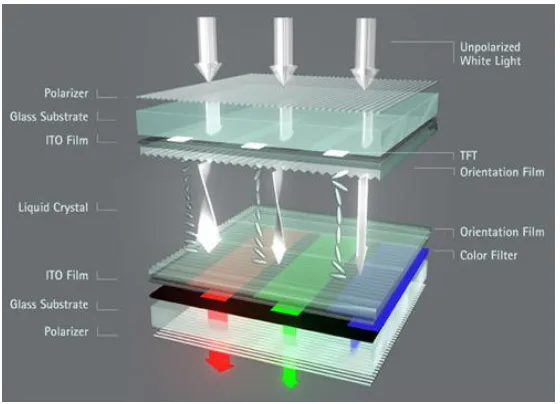
In a liquid-crystal display (LCD), back light must go through the substrate materials to
reach the viewer for image creation. Thus opaque silicon wafers are obviously not suitable for
LCD applications. Glass is the most commonly used substrate material for FPD because it is
highly transparent in visible light, compatible with a majority of conventional semiconductor
processes, and is relatively low cost in contrast to single crystal silicon. Fig. 4 illustrates the
sandwich structure of LCD. Two layers of glass, which are transparent, act as color filter and
substrate of TFTs. The voltage applied on TFTs controls the amount the liquid crystal will twist,
[image:12.612.167.447.301.503.2]and thus allows varying levels of light to pass through, resulting in different levels of gray [4].
Fig. 4 Operation principle of a LCD pixel (source: German Flat Panel Display Forum)
Currently, the development of channel materials has been extensively investigated. In
order to be compatible with glass substrates (a fragile material that has a low temperature
tolerance), an ideal channel material for TFTs must have certain properties such as low
temperature processing, and high carrier mobility. Numerous semiconductor materials have been
studied for TFTs including compound semiconductor materials and silicon-based thin films.
- 4 -
TFTs have dominated the FPD industry for decades due to advantages in low cost manufacturing,
good uniformity on large area substrates, and appropriate optical properties [5]. The desire to
pursue new generations of faster, higher resolution FPDs has triggered the emergence of
polysilicon, specifically LTPS for increased integration of electronics on glass.
1.2 Motivation and Objectives
This thesis project is motivated by the thrust to realize high quality LTPS films for large
panel displays in active-matrix LCD or OLED using a process scalable to large panel
manufacturing up to generation 10 or 12 (glass size). The goal of the study is to investigate
solid-phase crystallization techniques and understand the importance of process input factors on
material properties and electrical TFT performance. Major objectives of this thesis project
include:
a) Establish implant and annealing processes for low-resistance p+ & n+ source/drain
regions using furnace annealing SPC.
b) Use furnace annealing and rapid-thermal annealing (RTA) to perform experiments
investigating SPC TFTs
c) Investigate metal-induced crystallization (MIC) and flash-lamp annealing (FLA) for
crystallization of a-Si on glass substrates.
d) Investigate integration strategies for improved gate control and lower interface trap
- 5 -
CHAPTER 2
Channel Materials for Thin Film Transistors
2.1 Introduction
TFT channel materials for display should satisfy several requirements. First, materials
themselves are supposed to have low defect densities in the bulk area and also a low intrinsic
conductivity. In addition to that, an ideal channel material should form a neat and durable
interface with gate dielectric, resulting in a low level of fixed charge or interface traps [6].
Furthermore, materials preparation should be simple and compatible with the glass substrate,
limited to relative low temperatures compared to conventional silicon processes. Additionally, a
desirable film has to be deposited in a way with good uniformity across large area for FPD
manufacture considerations [2,3]. In this section, two types of common materials will be mainly
discussed including amorphous silicon and polysilicon.
2.2 Hydrogenated amorphous silicon thin film transistors
In the past several decades, extensive studies of a-Si:H films have been carried out for a
variety of technological applications, especially in field of FPD. Even now, a-Si:H TFTs are still
dominating the display industry due to unique properties like low cost, good uniformity across
large area substrates, and excellent off-state (low leakage). Through those investigations, it turns
out that a-Si:H properties depend strongly on the preparation conditions. Most of the techniques
for preparation of a-Si:H belongs to chemical vapor deposition (CVD), including conventional
low pressure CVD (LPCVD), and plasma enhanced CVD (PECVD) with a precursor gas such as
- 6 -
LPCVD for a-Si deposition occurs under thermal activation at a moderate temperature of
around 500~580 °C. LPCVD films usually contain hydrogen concentration <0.1 % [7]. However,
the deposition rate is fairly low which impacts the throughput of mass production, and the
relative high temperature prohibits the practical use of this method for a-Si deposition. The ideal
technique for a-Si deposition is PECVD in which free electrons in plasma can gain sufficient
kinetic energy to activate processes of excitation, ionization and dissociation, greatly reducing
the process temperature. What makes PECVD more attractive for producing a-Si based materials
is the first demonstration of the ability to dope amorphous silicon in a glow discharge by Chittick
in 1969 [8], after which this technique has been intensively studied.
Hydrogen content plays a critical role in the viability of amorphous silicon films.
Theoretically, a-Si contains numerous unsaturated dangling bonds (DBs) which trigger the
electronic states generated inside the band gap, therefore, resulting in a deterioration of materials
properties. Hydrogen serves as the passivation of DBs to restore a clean energy gap and maintain
semiconducting properties [9]. The a-Si:H achieved by PECVD normally contains a hydrogen
content > 10%. Low hydrogen content may not be able to passivate all the DBs. On the contrary,
high content of hydrogen may lead to the formation of void-rich material once films experience
thermal processes [10].
Typical TFTs have two basic configurations; coplanar structure and staggered structure,
as seen in Fig. 5 [6]. Another way to classify the configuration of TFTs is determined by the
location of gate electrode. Top-gate structures have the gate materials directly on the top
dielectric, whereas bottom-gate structures place the metal on the substrate beneath the
semiconductor. Fig.5 also shows the structures of top-gate and bottom-gate devices. The benefit
- 7 -
the top gate could serve as a hard mask. Actually in industry, because of advantages in device
uniformity the bottom-gate staggered structure (Fig. 5d) is usually implemented. TFTs with
these structures can be simply fabricated using two to three masking levels.
a c
[image:16.612.81.534.165.366.2]b d
Fig. 5 Coplanar (a) (c) and staggered (b) (d) structure of a-Si TFTs; Top-gate (a) (b) and bottom-gate (c) (d) [6]
The a-Si:H fabrication processes for typical inverted staggered bottom gate device are
fairly simple, and thus display companies can have a low cost of ownership with high throughput
for mass production using a-Si:H TFTs for LCD or OLED. Fig. 6 shows a cross section of a
typical bottom-gate TFT reported by J.L. Lin [11]. Normally, a thick metal layer is sputtered or
evaporated first as the bottom-gate electrode on glass substrate, followed by patterning and
etching to define the gate electrode. Then a gate dielectric such as silicon dioxide or silicon
nitride is deposited by CVD process. A densification anneal sometimes may be performed at a
low temperature in forming gas ambient to get rid of bulk charge in the insulator [11]. Next will
be the formation of a thin contact layer of in-situ doped n+ a-Si:H on top of a thicker intrinsic
a-Si:H layer, both deposited by PECVD. A second layer of metal is deposited, patterned and
- 8 -
the n+ a-Si:H layer above the intrinsic channel region. Finally in order to form a good ohmic
[image:17.612.165.462.157.274.2]contact, a sinter step is performed as the last step before electrical testing.
Fig. 6 Cross section view of an a-Si:H TFT [11]
Extensive efforts have been aimed at improving the device performance of a-Si:H TFTs
by techniques such as manipulating deposition condition for a-Si films [12], introducing thermal
annealing to improve the gate dielectric and interface quality [11], or utilizing a high-k dielectric
and varying deposition conditions to suppress the interface charge level [13,14]. A typical
transfer characteristic (Idrain vs. Vgate) of an a-Si:H TFT is illustrated in Fig. 7. The range of
mobility in a-Si TFTs reported in the literature falls between 0.5~1.5 cm2/V·sec. Although this
number is significantly smaller than that of crystal silicon, it is still high enough for backplane
switching to obtain good display performance comparable to cathode ray tube (CRT) displays
[15]. However, the demand for increased pixel density for higher resolution is pushing the limits
of the inferior field-effect mobility that a-Si:H TFTs offers. The FPD industry is pursuing
- 9 -
Fig. 7 Current-voltage characteristics of a typical a-Si:H TFT [15]
2.3 Low Temperature Polysilicon Technology
Polysilicon TFTs have been attracting a great deal of attention for use as pixel switching
devices and driving elements for AMLCD and AMOLED in the substitution of a-Si:H TFTs,
with its benefit in higher carrier mobility and compatibility with conventional Si process
technology. However for FPD, the use of polysilicon TFTs requires a process that provides a
high quality semiconductor film within the temperature constraints presented by glass substrates.
Many low temperature approaches have been explored.
To begin with, an early method of realizing polysilicon was to deposit a silicon layer on
quartz and heat it up ~1000°C, resulting in a uniform film on the substrate. The major drawback
- 10 -
substrate. Due to this reason, this high temperature polysilicon (HTPS) did not prevail. However,
HTPS does have its advantages in film uniformity, low defect density and higher carrier mobility.
For cost reduction, it is desirable to achieve high quality polysilicon film on cheaper substrate,
like glass or plastic. As laser processes were invented to replace the high temperature annealing,
low temperature polysilicon (LTPS) with comparable carrier mobility as that of HTPS was
enabled. In addition, LTPS has added benefit of being compatible with either glass or plastic
substrates [3].
The methods of formation of polysilicon films can be divided into two groups involving
either direct deposition of polycrystalline material, or crystallization of an a-Si precursor layer.
Polysilicon film can be deposited by LPCVD at temperature T > 580°C. The resulting films have
a quite uniform film thickness and low defect density. However, a major issue of deposited films
by LPCVD is the low deposition rate which has a huge impact on production throughput. In
contrast, crystallization of a-Si has a practical significance in the formation of polysilicon film.
Crystallization of a-Si can be done using liquid-phase or solid-phase techniques. Liquid-phase
involves melting the a-Si, followed by the formation of a polycrystalline layer as the material
cools and solidifies. Excimer laser annealing (ELA) is a common liquid-phase crystallization
method with demonstrated benefits of high electron mobility and cleaner films. Nevertheless, the
high cost of equipment and its limited scaling capability has prohibited it from being used in
large panel display manufacturing. Solid-phase crystallization (SPC) is another way to realize
polysilicon film with many advantages including simple handing, low cost, good reproducibility
and large panel compatibility. Material properties of SPC LTPS films and transistor
- 11 -
CHAPTER 3
Techniques Used for LTPS Thin Film Transistors
3.1 Solid Phase Crystallization and Rapid Thermal Annealing
3.1.1 Introduction
Solid phase crystallization of a-Si is a convenient and practical way of realizing
polysilicon films for TFTs on glass substrates. The transformation is usually carried out through
a simple furnace annealing of a-Si films at a temperature around 600°C. Rapid thermal
annealing (RTA) can also be utilized for crystallization to occur within a shorter time period at
higher temperature.
3.1.2 Dynamics of films growth
Crystallization from amorphous phase to polycrystalline phase proceeds mainly through
two processes; nucleation and grain growth. Amorphous silicon, which is considered to be a
meta-stable phase, lacks long range order of Si atoms [16]. When a-Si experiences a thermal
process rapidly, it will undergo a fist-order transformation during certain period of time called
incubation. The incubation time varies from hours to tens of hours in conventional furnace
annealing, strongly depending on the annealing condition (temperature) and the deposition of the
original a-Si precursor. Within that period of time, small clusters will be formed randomly across
the amorphous matrix. According to classical theory, there exists a critical cluster size due to an
energy barrier (the free energy of the critical nucleus) that must be overcome for nucleation to
initiate. Exceeding the critical nucleus, a cluster can survive and continue grow to become a
- 12 -
the clusters, they will shrink and disappear. Likewise, nucleation occurs through the evolution of
these survival clusters that begin to grow in size. After these stable nuclei have been formed,
grain growth process will dominate for the rest of time during which grains will grow bigger and
bigger until outward grain boundaries of adjacent grains impinge each other. The crystallization
process ends when all of the amorphous material has been fully transformed into polysilicon.
Hence, the transformation kinetics of solid phase crystallization from amorphous silicon to
polysilicon can be interpreted in terms of nucleation and grain growth.
For decades, theoretical models of phase transformation from a-Si to polysilicon have
been investigated by research groups [17,18]. An analytical model published by R.B. Iverson
and R. Reif in 1987 described the re-crystallization behavior of polysilicon amorphized by
implantation [19]. Two-dimensional models were usually assumed in papers since grain size is
always larger than film thickness in most of the cases. Nucleation and grain growth is analyzed
using steady state nucleation rate and growth rate.
A steady state nucleation rate rns can be usually expressed as
(
)
Where ΔG1 is the energy barrier from amorphous phase to crystalline; ΔG* denotes the free
energy of forming a nucleus.
Grain growth rate is expressed as
(
) (
- 13 -
where ν is the vibrational frequency of an atom jumping from amorphous (a-) to crystalline (c-)
phase; P is the probability of one atom jumping between the interface of amorphous and
crystalline; f is the filling fraction of atoms at the interface; n is the atomic density at the
interface; ΔGac is the free energy difference between amorphous and crystalline phase. Fig. 8
shows the free energy diagram of both amorphous and crystalline phase. In the diagram, γ
represents the flux of atoms exchanging between these two phases at the a-c interface; from
a-to-c (+) and c-to-a (-). Experiments have been done in which extracted activation energies
[image:22.612.186.408.304.518.2]from Arrhenius plot characteristics have provided empirical values for ΔG1 and ΔGac [18,19].
Fig.8 Free energy of amorphous and crystalline states [18]
3.1.3 Defects in SPC films
The electrical performance of polysilicon TFTs is strongly influenced by the
microstructure of polysilicon films. Increased leakage current in polysilicon TFTs is attributed to
a large number of defects, in comparison to a-Si TFTs with the benefit of hydrogen passivation.
- 14 -
most of which congregate in grain boundaries. Other defects also exist such as intra-grain defects,
typically microtwin and dislocations that are generated during the heterogeneous nucleation and
twin-assisted grain growth regime [20]. Grain boundaries that have numerous dangling bonds
and stained bonds, together with intra-grain defects can act as potential barriers and scattering
sites in the channel. These barriers and scattering sites dramatically reduce the carrier mobility.
Likewise, they can also serve as mid-gap states and band-tail states which promote leakage
current. Therefore, all these defects mentioned above contribute to the overall degradation in
electronic properties of polysilicon TFTs.
One effective way to minimize grain boundaries effect is to enlarge the size of each grain
that reduces total areas of the grain boundaries in thin films. At the same time, the channel region
of TFTs will have a minimal number of grains which is close to the case of crystal silicon. To
make this a reality is the goal of many researchers pursuing LTPS technology. As for intra-grain
defects, some research groups attempt to minimize defect densities by manipulation of the
Si/SiO2 interface which is believed to be the preferred site for SPC nucleation [21]. In 1994, Y.
Morimoto demonstrated the formation of a defect-free crystalline silicon film by performing
lateral solid-phase epitaxy of a-Si with removal of the underlying oxide layer before annealing
[22]. He also illustrated the suppression of intra-grain defect density by implementing an oxygen
thinning process after SPC, which resulted in a reduction in dislocation density. Inspired by
Morimoto, X.Z. Bo in Princeton investigated a suspended cantilever structure in the formation of
polysilicon film by SPC without underlying silicon dioxide and resulted in a significant
reduction of intra-grain defects, confirmed by transmission electron microscopy (TEM) and
- 15 - 3.1.4 SPC TFT performance
A conventional top-gate SPC TFT fabrication starts with a-Si:H film deposition on glass
substrate by PECVD process, similar to a-Si:H TFTs. In contrast to a-Si:H TFTs which require
hydrogen passivation to remove the dangling bonds in films, the precursor of polysilicon usually
experiences a dehydrogenation anneal before SPC. This avoids inhibition of the SPC process by
hydrogen, as well as agglomeration of hydrogen causing voids. The dehydrogenation anneal is
usually performed around 450°C for a couple of hours. The SPC process is then conducted in a
furnace at a temperature range from 580°C to 650°C, for a time period ranging from a couple of
hours to tens of hours depending on the temperature. Subsequent processes are insulator
deposition, gate definition and source/drain formation by implantation. Another anneal usually
follows at similar temperature range for dopant activation and damage repair caused by ion
implantation. The TFT fabrication is completed by contact formation, metallization and sinter
processes. Fig. 9 shows electrical transfer characteristics of a typical SPC PMOS TFT [23]. High
threshold voltage (VT), large sub-threshold swing (SS) and kink effect are observed in these
- 16 -
(a) (b)
Fig.9 I-V characteristics of a SPC polysilicon PMOS TFT. (a) Drain current (Id) vs gate voltage
(Vg) curves at various drain voltage (Vd); (b) Id vs Vds family of curves [23]
In order to improve the TFT electrical performance of conventional SPC, a two-step
process that incorporates a rapid thermal annealing (RTA) was developed to keep a low thermal
budget. In this way, it helps to achieve a larger polysilicon film grain size than that done with
conventional furnace annealing [24] [25]. The incorporation of RTA enables the nucleation to
start at a higher temperature for very short time for the purpose of minimizing the total numbers
of nuclei. Then, the nuclei begin to grow at a lower temperature (suppression of further
nucleation) in a furnace, ultimately resulting in a bigger grain size. The major fabrication
difference between RTA & furnace SPC and furnace-only SPC is the inserted RTA step right
before furnace annealing.
Rapid thermal processing is usually performed in a closed RTA system that mainly
consists of heat source, usually a number of tungsten halogen lamps, and a controlled inert
ambient, typically nitrogen/argon environment. The heating rate of a typical RTA system is ~
- 17 -
demonstrated improved electrical performance in terms of lower VT, smaller SS and higher field
effect mobility than those prepared by only conventional furnace annealing. Fig. 10 shows
NMOS TFT transfer characteristics with improved performance by using combination of RTA
with furnace annealing [25]. It also demonstrates that hydrogen passivation following SPC using
electron cyclotron resonance (ECR) plasma process at 250°C can improve the electrical
[image:26.612.189.410.246.497.2]propertiesdramatically.
- 18 -
3.2 Metal Induced Crystallization
3.2.1 Introduction
For AMLCD or AMOLED industrial applications, it is necessary to grow high quality
polysilicon films at low temperature, adhering to the thermal limitations of glass substrates. At
the same time, it is also desirable to fabricate films with high throughput. The main disadvantage
of SPC by conventional furnace annealing is the required crystallization time which can be
several hours and presents a production throughput challenge. An improvement in the SPC
polysilicon grain size and a reduction in process time during the phase transformation can be
obtained by employing SPC process in the presence of a metal catalyst called metal induced
crystallization (MIC).
In 1992, Speapen proposed two different mechanisms in metal induced crystallization of
silicon among various kinds of metal catalysts [26]. Certain metals form eutectic mixes with
silicon (e.g. Al, Au, Ag) where the covalent bonds in a-Si become weakened at the interface with
a metal layer. This creates free Si atoms from the interface region that are highly mobile and
diffuse, thus serving as an agent for initiation of crystallization of a-Si at low temperatures [26].
Other metals, such as Pt, Co, and in particular Ni, can form a silicide with Si by thermal
annealing, and then act as nucleate sites. Migration of metal silicide through disordered a-Si, at
moderate temperature, leaves behind a trail of needle like crystallites in its wake.
3.2.2 Nickel Induced Crystallization
Ni-silicide mediated crystallization has been widely investigated for decades. The NiSi2
silicide can be formed at a temperature as low as 350°C, which is much lower than SPC
- 19 -
following sequences from Ni2Si to NiSi, to finally NiSi2. It is believed that the similar atomic
arrangement of NiSi2 and c-Si with lattice constants of 5.406 Å and 5.430 Å, respectively,
facilitates the diffusion of Si and subsequent covalent bonds breaking and rearrangement of a-Si
to an ordered structure. Fig.11 illustrates the lattice structures of NiSi2 and Si [27].
Fig.11 Crystalline structure of (a) NiSi2 and (b) Silicon [27]
In the initial stage of NiSi2 induced crystallization, it is believed that nucleation occurs
randomly at {111} faces of NiSi2 for the reason that {111} surfaces have the lowest surface
energy compared to that of any other orientation. As NiSi2 migrates, it leaves a trail of
polysilicon in its wake, with the presence of a Ni rich region at the leading edge of needlelike
crystallites. In Fig.12, one can observe the interesting behavior described above with NiSi2
leading a wave of crystallization. As the crystallization time elapses, crystallites continue to
- 20 -
Fig.12 Migration of NiSi2 leads to the formation of c-Si. The arrow points to the NiSi2 dot [27]
Although there are certain advantages of using MIC instead of furnace SPC to realize
LTPS, drawbacks still exist in MIC method. Among them, metal contamination has always been
a critical concern for its potential degradation of TFT off-state performance. Researchers have
found a novel way of crystallizing a-Si called metal induced lateral crystallization (MILC),
aimed at minimizing the metal concentration in the TFT channel region and improving the
device performance. The first polysilicon TFT formed by MILC was made with Ni as the metal
catalyst and reported in 1996 [28]. As shown in Fig.13, Ni was deposited everywhere except the
TFT channel region where the gate block the metal. A complete vertical crystallization on the
source/drain region was done after a short period of time, and then crystallization began to
propagate into the lateral direction resulting in larger grain size with low metal concentration in
the channel region. It was also demonstrated that these channel Si crystallites contain less
- 21 -
Fig.13 MILC crystallization diagram in a TFT structure [28]
3.2.3 MIC TFT performance
TFTs fabricated by MILC usually exhibit improved electrical performance than that by
conventional SPC. C.W. Chang reported a high performance nanowire TFT with MILC
polysilicon channel [29]. Fig.14 shows a comparison of transfer characteristics of nano-wire
TFTs fabricated using MILC and SPC. Both the on-state (current drive) and subthreshold
characteristics of the MILC TFTs are significantly better than that of SPC TFTs. Gate induced
drain leakage (GIDL) current is also suppressed by one order of magnitude by using MILC
method. It is believed that improved device performance can be attributed to the fact that growth
of grains in MILC is parallel to the current flow direction which subdues the negative effect of
grain boundaries. In contrast, SPC polysilicon films have randomly oriented grain boundaries
resulting in higher defect densities which results in lower carrier mobility and increase leakage
- 22 -
- 23 -
3.3 Flash Lamp Annealing
3.3.1 Introduction
Flash-lamp annealing (FLA) is a new promising way of producing high quality
polysilicon films with less thermal impact on a glass substrate. FLA can be done in millisecond
(ms) time scale, filling the gap between RTA and excimer laser annealing (ELA). Major
advantage of FLA is the high throughput by using a large high-intensity xenon light source with
suitable pulse duration. Conventional RTA has an annealing time in seconds time scale that may
have a significant thermal impact on a glass substrate. On the other hand, ELA with pulse
duration on the order of tens of nanoseconds has a very small coverage area due to the laser
beam width, limiting the backplane size and resulting in low production throughput.
3.3.2 Excimer Laser Anneal
Laser crystallization of a-Si is currently the best technique to achieve high mobility LTPS
TFTs on an inexpensive glass substrate. The most widely used laser sources are either KrF with
wavelength of 248 nm, or XeCl with wavelength of 308 nm. These are all pulsed mode lasers
with pulse duration in the range of 10-50 ns. The energy output of typical excimer laser is in the
range of 0.6-2 J [30]-[32].
ELC of a-Si films can be classified into three categories which occur at low, medium and
high laser fluence separately. When the incident laser fluence is sufficient enough to induce the
melting of the Si film on the surface, with continuous Si layer remaining underneath, partial
melting regime occurs at this low laser fluence. This regime can be characterized by explosive
- 24 -
liquid relative to the crystalline phase. The solidification of silicon liquid releases latent heat
which melts the adjacent amorphous phase, and triggers the crystallization process over again
[32]. High laser fluence regime relates to the situation when the energy of the irradiant is high
enough to completely melt the entire a-Si layer. In this case, abundant nucleation takes place in
the melted Si liquid due to a deep under-cooling condition, which implies a liquid existing at a
temperature lower than its melting point. Numerous small nucleates generated initially result in
a smaller grain sizes in this regime. Another regime has been proved to exist which lies in
between the two regimes described, which occurs at moderate laser fluence. Although it has a
very narrow process window, it provides superior film quality among the three. The
crystallization mechanism involves the creation of near-complete-melting Si films, where
discrete small islands of survival Si are surrounded by completely melted Si. In this case, the
solid phase silicon islands provide the crystallization seeds from which the lateral-growth can
propagate. Large grain polysilicon has been achieved using ELA [32], with small format display
backplanes in production. However it is difficult to control the process due to small variations in
the laser fluence leading to either the partial or complete melting regimes.
The principle advantage of ELA over SPC is that the liquid to solid phase transition
results in polysilicon growth with low probability of generating intra-grain defects, such as
dislocation and micro-twins, resulting in superior device characteristics. However, there are also
significant challenges in the ELA process. Material uniformity is challenging due to pulse to
pulse variation and exposure scanning control which must avoid significant crossover with
adjacent crystallized regions during annealing. There can also be issues with surface roughness
if hydrogen escapes from the film during crystallization. Finally the high cost of equipment and
- 25 -
that ELA will be used for large panel display products. However other techniques have been
investigated over the past few years that may provide a solution, including use of a glow
discharge from a xenon flash-lamp.
3.3.3 FLA system
The FLA technique involves crystallization of thin-film a-Si using a Xenon flash lamp
system, as shown in Fig.15. The FLA system consists of an array of xenon gas-filled discharging
lamps, a reflector on top and substrate holder on bottom with a scanning system incorporated.
During the process, samples are mounted on the holder and exposed to the flash beam emitted
from the lamp directly and simultaneously reflected through the reflector indirectly.
Fig.15 Schematic diagram of a Xenon flash lamp system [33]
The utilization of a reflector is necessary for intensity output and maintaining good
process uniformity. Since power consumption during flash lamp exposure is fairly high in
general, it plays a significant role of minimizing energy loss that does not contribute to the
- 26 -
and elliptic. The goal of the reflector design is to provide a spatially uniform “top-hat” intensity
profile as well as to minimize the radiation loss during the process.
The electric power for the lamp is supplied by discharging from a capacitor-inductor
system. The light output energy density (J/cm2) of the xenon lamp is almost proportional to the
input energy, as showed in Fig.16 (a). The light input energy W (J/flash) can be calculated by
where Cm and Vm are the main discharge capacitor and voltage, respectively [33]. Therefore, by
adjusting the discharge voltage (power supply voltage), the light energy density distributed on
the samples is controlled. The typical output xenon light exhibits a broad spectrum with an
intensity maximum at 400 to 500 nm wavelength, most of which can be absorbed by thick a-Si as
seen in Fig.16 (b).
(a) (b)
- 27 - 3.3.4 Analytical model
The heating rate during the FLA process is in the order of 1-10 kW/cm2 in general, which
is much higher than the convective and radiant heat losses on the order of 1-10 W/cm2 [34].
Therefore, the total losses can be ignored in comparison to the conduction heat transfer. The
thermal model for heat flow during the FLA can be estimated by enthalpy equation:
(
)
where ρ, K are density and thermal conductivity of film layer, respectively; Q denotes the
absorption of the energy from flash lamp; h is the enthalpy and be expressed as
Cprepresents the heat capacity. Due to physical parameters such as K, Cp being temperature and
time dependent, an analytical solution to Eq. (4) is not available; finite element analysis must be
used for a numerical solution.
The Q term in the Eq. (4), which represents the heat absorption of the film from the flash-lamp,
is dictated by a combination of spatial distribution of output light and the optical properties of
film, given by
where P denotes the radiation power per unit area and can be expressed as
- 28 -
where ε0 and c are the permittivity and wave speed, respectively; E and B represent the electrical
and magnetic fields based on the following assumptions: (1) one dimensional radiant heating; (2)
planar electromagnetic waves are normally-incident on the samples [35].
3.3.5 Polysilicon TFTs fabricated by FLA
Despite a number of investigations on the FLA technique to form high quality polysilicon
film, very few researchers have reported high performance TFTs fabricated by FLA thus far. In
2010, Prof. Jin Jiang’s group at Kyung Hee University in Seoul, South Korea, published
successful fabrication of TFTs using the FLA technique [36]. They used a 50 nm a-Si thin film
as the channel layer, deposited by PECVD on a 150 nm SiO2 buffer layer on glass. Then, the
precursor PECVD a-Si film experienced a dehydrogenation anneal at 550 °C in an N2 ambient.
In their experiments, two 100 µs pulses were used to provide an output energy of 5.2 J/cm2 each
to the a-Si material. The substrate temperature was kept at 450 °C during the flash lamp
irradiation. Normal fabrication processes were followed after FLA, including the gate dielectric
deposition (100 nm SiO2), gate electrode definition, source/drain doping and metallization. The
average grain size they estimated based on the number of grains in an area to be around 15 µm.
Fig. 17 shows the transfer characteristics of p-channel FLA polysilicon TFTs with a channel
width of 4 µm and a channel length of 8 µm. The polysilicon TFT demonstrates a field-effect
mobility of 138 cm2/V·s, low VT and SS of −1.3 V and 400 mV/dec. The field-effect mobility
was estimated by maximum trans-conductance gm, given by
- 29 -
where W, L represent the channel width and length, Vgs, Vds are the gate and drain voltages, and
Cox denotes the gate insulator capacitance.
The TFT fabricated by FLA has a superior electrical performance; better than that typical
of transistors fabricated by ELA technique. Therefore, this method appears promising for low
cost manufacturing of LTPS TFT backplanes for high-resolution large-area displays. However
note that the transfer characteristics shown in Fig. 17 are limited to low drain bias, and only
[image:38.612.173.441.299.533.2]demonstrate PMOS operation.
- 30 -
CHAPTER 4
Fabrication and Testing of SPC TFTs
4.1 Substrate Preparation
Hydrogenated amorphous silicon was deposited using a PECVD process on 150 mm
Corning EAGLE XG® display glass wafers with a 100 nm SiNx barrier layer and a 250 nm SiO2
buffer layer. The deposition was performed using SiH4 and H2 at 400 °C, 1 Torr pressure and 30
W RF power, with a resulting deposition rate of 2.9 Å/sec. Deposition time was adjusted to
provide film thicknesses (Xsi) of either 60 nm or 100 nm. A dehydrogenation anneal was done at
450 °C for 2 hrs at 200 mTorr.
4.2 Dopant activation
An experiment was set up to investigate the influence of the implant and anneal process
arrangement on the activation of heavily doped boron and phosphorus in SPC films. Four-point
probe sheet resistance (Rs) measurements were used as a comprehensive assessment of the
electrical properties.
Prepared samples were implanted with boron and phosphorus at 35 keV and 75 keV,
respectively, with a dose of 2×1015 cm-2 through a 100 nm screen oxide using a Varian 350D ion
implanter with a 7° tilt angle. Process variables included the option of a SPC pre-anneal (100
hours at 600 °C) prior to implantation, and variations in post-implant annealing time and
temperature. After the implant processes, samples went through annealing intervals at 600 °C
totaling 24 hours, followed by annealing intervals at 630 °C totaling 12 hours. Experimental
- 31 -
Table I. Split condition for dopant activation
The transient activation characteristics for samples implanted with boron are shown in
Fig.18a. The activation behavior at 600 °C for SPC pre-annealed samples showed an earlier
onset of activation for 100 nm Xsi compared to 60 nm Xsi. The 630 °C annealing following the 24
hours at 600 °C did not increase the activation of boron in either sample; rather, the apparent
increase in sheet resistance supports dopant deactivation. The sample without an SPC pre-anneal
did not demonstrate activation after 24 hours at 600 °C. While the introduction of low
concentrations of boron has been reported to induce crystallization, these results suggest that the
introduction of a high boron concentration suppresses the SPC and dopant activation processes at
this temperature. After an additional 4 hours at 630 °C the electrical activity of boron matched
the pre-annealed sample.
Thickness (nm) SPC P31 B11 Activation Anneal
- 32 -
Fig.18 Transient activation characteristics for (a) B and (b) P implanted samples. Note that time axis for P only covers a 12 hour period at 630 °C which followed 600 °C annealing intervals totaling 24 hours [37].
The suppression of the SPC and dopant activation processes appears to be more
pronounced in phosphorus implanted samples for both pre-annealed and non-pre-annealed
conditions as evidenced by optical characteristics and electrical sheet resistance measurements.
Visual observations of pannealed and non-pannealed samples indicated differences in
re-crystallization behavior; however the appearance of each sample was similar following extended
annealing at 630 °C. Only samples which were pre-annealed exhibited any measurable electrical
activity. The transient activation characteristics for samples implanted with phosphorus are
shown in Fig.18b. Only the 100 nm Xsi sample demonstrated any electrical activation over the
entire 24 hour time period at 600 °C. The 630 °C activation transient of the 60 nm Xsi film lagged
behind the 100 nm Xsi film, with both showing increased activation over time. There was no
- 33 -
These transient behaviors demonstrated that at high concentration, each impurity
inhibited crystallization and activation processes if samples were not pre-annealed prior to ion
implantation. Transient behaviors also showed a faster activation response on 100 nm Xsi
treatments in comparison to 60 nm Xsi treatments for both boron and phosphorus samples. Boron
treatments with pre-annealing exhibited electrical activation at 600 °C, with treatments without
pre-annealing showing similar activation levels at 630 °C. Pre-annealed phosphorus treatments
- 34 -
4.3 SPC Thin Film Transistors
4.3.1 Ring structure of TFTs
RingFETs were initially designed and utilized for TFT fabrication. The transistors consist
of many “rings”, where the gate in the middle ring surrounds the drain that leads to the formation
of isolation from source to drain, as shown in Fig.19a. This closed loop of TFT structure does not
require mesa isolation, and thus shortens the fabrication process by eliminating the mesa
lithography and etch steps.
(a) (b)
Fig.19 (a) typical ringFET layout with source (S), gate (G) and drain (D); (b) Prober mark after testing
The ringFET process utilized a top-gate design with self-aligned implanted source/drain
regions. Process starts by furnace annealing the substrates with precursor layer (dehydrogenated
a-Si) on top for 12 hrs at 630 °C in N2 for the SPC process. A 100 nm PECVD SiO2 layer was
deposited as the gate dielectric followed by molybdenum gate metal sputter deposition, gate
pattern and etch processes. A self-aligned high-dose boron or phosphorus implant ( = 4x1015cm
-2
) was then performed to establish the respective p+ or n+ source/drain regions. A PECVD SiO2
inter-level dielectric layer was deposited, followed by annealing for dopant activation. Contact
[image:43.612.128.486.294.492.2]- 35 -
patterning and etching was followed by aluminum sputter deposition, pattern and etch. Finally,
the wafers were sintered in forming gas (5% H2 in N2) for 30 min at 425 °C. The designed
ringFET structures can be directly probed without using metal jumpers, as shown in Fig.19b.
4.3.2 Electrical test results of Ring TFTs
Electrical testing was conducted on a wafer probe station using a HP4145 parameter
analyzer. Current-Voltage (I-V) characteristics for representative ringFETs are shown in Fig.20,
along with electrical parameter extraction results in Table II. The SS is evaluated by taking the
reciprocal of the maximum slope of the curves, calculated by the following equation:
(
)
Electron channel mobility values can be extracted from the maximum transconductance (gm_max)
as shown in Eq.8, and the slope of square root of IDS versus VG for linear-mode and
saturation-mode conditions, respectively. Due to the continuously increasing gm as a function of gate bias
- 36 -
[image:45.612.99.515.346.451.2](a) (b)
Fig.20 I-V characteristics ringFET TFTs fabricated (a) n-channel (b) p-channel Table II. Extracted electrical parameters of ring FET
Although the subthreshold swing (SS) and threshold voltage (VT) values are relatively
high, the on-state of the n-channel TFT demonstrated a near-ideal linear-mode transfer
characteristic, and an electron channel mobility of ~ 11 cm2/V·sec in both linear and saturation
modes of operation. Similar to the n-channel devices, the p-channel TFTs also demonstrated high
SS and VT values. However, the linear-mode transfer characteristic for PFET exhibited a
continuously increasing gm as a function of gate bias, which prevents a valid extraction of hole
channel mobility due to an artificially enhanced slope at a higher gate bias. The linear-scale
saturation-mode transfer characteristic (not shown) also showed a similar super-linear behavior.
The dependence of hole channel mobility on the gate bias, or surface potential, indicates that 0 10 20 30 40 50 60 70 1.E-10 1.E-09 1.E-08 1.E-07 1.E-06 1.E-05 1.E-04 1.E-03
0 10 20 30 40
Dr ai n Cu rr e n t (µ A ) Dr ai n Cu rr e n t (A )
Gate voltage (V)
Vd=1V Vd=20V 1.E-11 1.E-10 1.E-09 1.E-08 1.E-07 1.E-06 1.E-05 1.E-04 1.E-03 0 5 10 15 20
-40 -30 -20 -10 0
Dr ai n Cu rr e n t (A ) Dr ai n Cu rr e n t (µ A )
Gate voltage (V)
Vd=-1V
- 37 -
potential barriers are being overcome at higher levels of inversion. The hole channel mobility
values provided in Table II were estimated by the current drive capability at high gate bias.
4.3.3 RTA effect on electrical performance
RTA has potential benefits of improvements in nucleation uniformity and grain growth
when in combination with SPC. In our experiment, the RTA system is an AG 610A Rapid
Thermal Processor. A picture of the system is shown in Fig. 21.
Fig.21 AG 610 system in SMFL at RIT
The processing chamber has both top and bottom light banks, with 10 top lamps and 11
bottom lamps. Each W-halogen lamp is rated 1200W, for a total of 25,200W. Nitrogen flows
into the chamber via a quarter-inch inlet hole at a rate of 3 liters per minute. Emission from
W-halogen lamp does not contain wavelengths less than 300nm. Figure 22 shows the optical
transmission of the glass in visible light range (400 nm ~ 800 nm) to be ~93%, and thus has
- 38 -
Fig.22 Transmission of eagle XG glass
Similarly, for very thin layer of a-Si (<100 nm) precursor, there is also negligible
absorption that was confirmed by our initial experiment in which we used only 60 nm a-Si films
and did not obtain any phase transformation. Therefore, a strategy of implementing a heat
transfer medium (molybdenum) to absorb heat first and then transfer the heat to a-Si layer during
the RTA process was investigated. As illustrated in Fig.23, molybdenum absorbs the radiation
[image:47.612.117.498.71.327.2]from the heat lamps, transferring heat through conduction to underlying materials.
- 39 -
COMSOL simulation tool was used to simulate temperature variability in the localized
metal region. The forced convection feature of the conjugate heat transfer module in COMSOL
was utilized as the dominant heat transfer mechanism from ambient to the molybdenum. RTA
was simulated in 15 sec duration. According to the simulation results in Fig.24, the closer the
area located to the Mo region, the higher temperature that region would be. It was identified that
higher temperature during the RTA process can initialize small nucleates within short time,
[image:48.612.172.445.280.499.2]potentially resulting in larger grain size at low temperature in furnace SPC following RTA.
Fig.24 Temperature gradient of SPC wafer (with Mo) from simulation
The RTA system was set up with 80% of the lamp power, 15 sec duration for each cycle and 2
min cool down between cycles. Two experiments were conducted for measuring the RTA
influence on transistor performance.
The first experiment contained two groups of wafers. Group A experienced a 5-cycle
pre-furnace RTA process before the standard pre-furnace SPC (12 hours 630°C); Group B only went
through standard furnace SPC. All of the transistors fabricated utilized a top gate ringFET
- 40 -
along with the extracted parameters in Table III. Results of group A demonstrated some
improvement in device performance. Maximum current at high drain bias are almost three times
higher for those transistors with RTA prior to the SPC furnace anneal. This suggests a reduction
of defects in the channel region, further supported by the extracted field effect electron mobility
of 4.7 cm2/V·sec, which is 30% higher than that from group B. The reduced threshold voltage
and sub-threshold swing also signifies lower interface trap states and defects obtained in the bulk
polysilicon films with RTA.
Fig. 25 NFET Id-VG curves of Group A, B (Vds=1 V for linear and 20 V for saturation, VG from 0~40 V). The discontinuity of low drain bias curve in group B is due to measurement noise (positive current reading) at measurements less than 10pA.
Table III. Extracted electrical parameters of Group A, B
The second experiment was an investigation of both pre- and post-furnace RTA influence
on the device performance. It is suggested that the RTA process post furnace SPC approaching
850ºC has benefits of reducing micro-twin defects that contribute to excessive trapping states in
- 41 -
than the ringFET design. Similarly, the wafers were divided into two groups. Group A
experienced one cycle of RTA prior to the furnace anneal, and then 10 cycles of RTA after
furnace SPC. Group B only underwent standard furnace SPC. From the testing results in Fig.26,
transistors that received RTA processes demonstrated consistent behavior and good device yield.
Whether or not the devices from group A exhibit superior performance is not conclusive.
However, post-furnace RTA process shows improvements in the consistency of device
performance, which is significant for the large panel display manufacturing. It is suspected that
the one cycle pre-furnace RTA did not serve the purpose of initiating nucleation. Therefore,
increased number of pre-furnace RTA cycles may provide enough nucleates, resulting in better
polysilicon film quality. From these two experiments it can be surmised that proper pre-furnace
RTA may enlarge the film grain size by generating enough nucleates at high temperature,
whereas post-furnace RTA may reduce the defect states in polysilicon films, resulting in better
[image:50.612.154.464.440.657.2]material uniformity and yielding consistent device performance.
- 42 -
4.3.4 Process integration of top gate, bottom gate, and dual gate TFTs
Top-gate (TG) TFTs were first developed and fabricated. Four lithography steps were
required for the process sequence. Fig.27 shows the fabrication process flow for TG TFTs. The
ringFET is a type of TG TFT, which does not require mesa isolation. For this process a silicon
mesa was defined for the active region to realize a standard TFT design (see Fig. 28). Aside
from the mesa definition, the fabrication process of these two types of TG devices is the same.
Fig.27 Process flow of the top gate structure TFTs
- 43 -
Bottom-gate (BG) devices, in which gate metal lies underneath the channel and gate
dielectric, were also designed and fabricated. BG devices have certain benefits compared to TG
devices. Usually, metal gate materials (e.g. Mo) is realized by physical vapor deposition (PVD)
in which plasma is generated which may damage the underlying layers during deposition. This
plasma-induced damage inflicted on the gate dielectric of TG devices can be avoided by putting
the Mo gate electrode first. Another advantage is that any Mo over-etch during reactive-ion
[image:52.612.87.511.294.561.2]etching (RIE) has no impact on the gate dielectric. A bottom gate process flow is illustrated in
Fig.29.
Fig.29 Process flow of the bottom gate structure TFTs
Starting with Corning Eagle XG display glass substrate, Mo is sputter deposited and then
patterned and etched to form the buried gate electrode. The gate dielectric and channel materials
(a-Si:H) are deposited, followed by dehydrogenation anneal for 2 hours at 450°C and solid phase
- 44 -
photoresist is coated and a backside exposure is performed to provide a self-aligned mask for the
source/drain ion implantation, as shown at step 3 in Fig.29. An activation anneal is then
performed at 630°C for 12 hours in a furnace. The process is completed with the formation of
contact cuts, metallization and sinter. Fig.30 shows a typical BG TFT with a channel width and
length of 24 µm and 12 µm, respectively. The rectangular pink area overlying the gate electrode
[image:53.612.162.452.246.465.2]is the defined channel region.
Fig.30 Images of a BG TFT with 24/12 µm (W/L)
The development of a dual-gate (DG) TFT is based on the BG TFT structure. DG TFTs,
as seen in Fig.31, appears as a sandwich structure such that top and bottom electrodes provide
dual gate control over the channel region. Top and bottom gates are connected to each other by a
- 45 -
Fig.31 Schematic of dual gate structure of a TFT
Indium tin oxide (ITO), which is a transparent conductive material, is utilized as the TG
electrode. ITO has been widely used as pixel electrodes in FPD, and is an excellent choice for
DG TFT process integration. An ITO layer is sputter-deposited on top of the BG TFTs, and the
backside exposure technique used previously is used to realize a photoresist mask to define an
ITO gate (TG) that is self-aligned to the original underlying Mo gate (BG), as illustrated in
Fig.32.
![Fig. 1 Cross-sectional and plan view of the first TFT reported by Weimer [1]](https://thumb-us.123doks.com/thumbv2/123dok_us/107022.9940/10.612.160.425.345.650/fig-cross-sectional-plan-view-tft-reported-weimer.webp)
![Fig. 3 Cross-section of a picture element (pixel) [2]](https://thumb-us.123doks.com/thumbv2/123dok_us/107022.9940/11.612.177.436.299.491/fig-cross-section-picture-element-pixel.webp)
![Fig. 5 Coplanar (a) (c) and staggered (b) (d) structure of a-Si TFTs; Top-gate (a) (b) and bottom-gate (c) (d) [6]](https://thumb-us.123doks.com/thumbv2/123dok_us/107022.9940/16.612.81.534.165.366/fig-coplanar-staggered-structure-si-tfts-gate-gate.webp)
![Fig. 6 Cross section view of an a-Si:H TFT [11]](https://thumb-us.123doks.com/thumbv2/123dok_us/107022.9940/17.612.165.462.157.274/fig-cross-section-view-si-h-tft.webp)
![Fig. 7 Current-voltage characteristics of a typical a-Si:H TFT [15]](https://thumb-us.123doks.com/thumbv2/123dok_us/107022.9940/18.612.192.416.72.361/fig-current-voltage-characteristics-of-typical-tft.webp)
![Fig.8 Free energy of amorphous and crystalline states [18]](https://thumb-us.123doks.com/thumbv2/123dok_us/107022.9940/22.612.186.408.304.518/fig-free-energy-amorphous-crystalline-states.webp)
![Fig.10 Id-Vg curves of polysilicon NMOS TFTs showing the influence of RTA and ECR hydrogenation [25]](https://thumb-us.123doks.com/thumbv2/123dok_us/107022.9940/26.612.189.410.246.497/fig-curves-polysilicon-nmos-tfts-showing-influence-hydrogenation.webp)
![Fig.14 Transfer characteristic comparison of nanowire TFT with MILC and with SPC [29]](https://thumb-us.123doks.com/thumbv2/123dok_us/107022.9940/31.612.166.442.78.319/fig-transfer-characteristic-comparison-nanowire-tft-milc-spc.webp)
![Fig.17 Transfer characteristic of FLA LTPS TFT with Vds=-0.1V [36]](https://thumb-us.123doks.com/thumbv2/123dok_us/107022.9940/38.612.173.441.299.533/fig-transfer-characteristic-fla-ltps-tft-vds-v.webp)
