International Journal of Innovative Technology and Exploring Engineering (IJITEE) ISSN: 2278-3075, Volume-8 Issue-6, April 2019
Abstract: In recent years, Wireless sensor Network (WSN) node localization techniques play a significant role in several domains in censorious condition for instance tracking and monitoring of events. Distance vector hop algorithm is found to be the best among other localization algorithms due to its simplicity, low cost and less complexity. Whereas the localization accuracy is reduced at the point of least anchor node count. For the purpose of improvisation of localization accuracy, an Enhanced Received Signal Strength Indicator (ERSSI) based Advanced DV-hop (ADV) algorithm is proposed. The origin node and terminal node distance is calculated depending upon the hop length and hop to the beacon nodes using ADV algorithm. Better estimation result is achieved by using least square method. The received signal strength is estimated using projected ERSSI algorithm to enhance the stability and low power consumption. This proposed approach improves localization accuracy when compared with existing techniques. Moreover, localization accuracy is estimated based on localization error and localization error variance.
Index Terms: Wireless sensor networks, Localization, ADV hop, RSSI, Localization Accuracy.
I. INTRODUCTION
A Wireless Sensor Network is an emerging technology, which consists of nodes that predicts its neighborhood environment [1]. It has potential applications in different fields like health care, surveillance, military, astronomy, and agriculture. Major benefits of WSN are least power utilization, inexpensive, added to better versatility to the neighborhood [2]. Major issue of WSN is the estimation of the sensor nodes and it also known as localization problem. The localization is used to determine the node position via localization process [3]. Moreover, it is an indispensable part of WSN. In order to locate the performance of WSN precisely, effective localization techniques are needed. Traditional approaches similar to Global Positioning System (GPS) based scheme are displeasing due to immense cost particularly in huge extent sensor network. Usually, the WSN nodes are erratically dispersed except anchor nodes that are equipped with GPS [4]. This anchor node could get own position after getting spread out. Whereas, the balance unrevealed nodes don’t grasp its own locations. Usually, the anchor node should aid
Revised Manuscript Received on April 08, 2019.
M.Vasim babu, Department of ECE, KKR and KSR Institute of Technology and sciences. Guntur, Andhra Pradesh, India..
C.N.S.Vinoth Kumar, Department of CSE, SRM Institute of Science and technology, Chennai, Tamilnadu, India.
M.Venu, Department of ECE, KKR and KSR Institute of Technology and sciences. Guntur, Andhra Pradesh, India..
unrevealed nodes by making link among the nodes with switching numerous hop routing facts for self-locating.
For this purpose, node localization methodologies of sensor network can be classified as range free and range based localization. A typical range based algorithm namely, a RSSI approach for placing sensor nodes in WSN, which attains precise location. However, this approach is sensitive to environmental noises [5]. In addition, a Distance Vector (DV) hop algorithm is a traditional variety liberated localization algorithm that stays as a better selection but it shows poor performance when lacking anchor nodes. The proposed approach is developed to overcome these drawbacks.
Therefore, in this proposed approach, the range based wireless localization depends on an Enhanced Received Signal Strength Indicator (ERSSI) scheme due to low cost, Admits the present range free localization techniques, few are algorithmic easy and executed in distributed environment. In addition, traditional range free localization depends on Advanced Distance Vector (DV) hop algorithm, which is a better heuristic in a hardware based restricted surroundings due to its ease during accomplishment. In order to provide better result while executing the localization for unknown nodes, the ERSSI scheme is integrated with the ADV hop algorithm. Moreover, it provides better performance result when compared with other existing approaches.
II. RELATED WORKS
Xiao, Zhang et al. proposed a biased DV-Hop algorithm depends on obtained signal potency notifier to develop the accuracy. However, the DV-Hop algorithm was more sensitive to ranging error [6]. Xu, et al. presented a innovative neural system base node localization proposal in the course of the exploit of DV-Hop, RSSI added to regularized correntropy standard based intense knowledge mechanism algorithm to reduce the location error without additional hardware consumption. Moreover, it reduced the distance error, but it was not suitable for real world like optimizing the scheme with unknown transmission power [7]. Singh, et al. introduced a method called mobile beacon depended range free localization for WSN depending on the analytical geometry of arc to improve the localization accuracy. However, this approach is not suitable for real sensor platform [8].
Improvisation of Localization Accuracy using
ERSSI Based on ADV-Hop Algorithm in
Wireless Sensor Network
Li, Peng, et al. proposed localization based on trust valuation, and also the robustness of the proposed approach was verified by analyzing three important factors such as attack intensity and localization error [9]. Zhang, et al presented an algorithm namely an improved three dimensional DV-Hop localization algorithm which is optimized by adaptive cuckoo seek algorithm. This algorithm reduced the localization by controlling the network topology. However, the localization accuracy of the uneven distribution of the anchor node is low [10].
Sujatha, et al introduced hybrid optimization method using dynamic weight Particle Swarm Optimization (PSO) and linearization method to achieve better localization accuracy [11]. Kumar, et al. presented an evaluation of localization added to tracking algorithms in WSNs. The experimental setups for the specific applications such as localization and tracking are also included in this survey [12].
Alomari, et al introduced a original vibrant fuzzy-logic dependent course scheduling for mobility-assisted localization in WSNs with limited mobile anchor movement. This model is designed for densely deployed network if it was insufficient numerous sensor nodes, the inputs of the fuzzy scheme may be exaggerated [13]. Singh, et al. presented the application of PSO based computation intelligence algorithm, which was used for distributed optimal localization of randomly moving target node. But, it was not suitable for assortment liberated multi-hop localization for portable anchors [14].
Sharma, et al. introduced a vibrant series usual bisector, that was a dispersed range-free localization technique to enhance the localization accuracy [15].Gaurav Kumar, et al. presented an energy-efficient modified DV hop algorithm by means of teaching learning based optimization. This algorithm achieves high positioning coverage, and has better localization accuracy and less energy consumption [16].
Yan, et al. analyzed the blunder through the progression of transforming hop distance to substantial distances to achieve exact distance conversion model [17]. Singh, et al. proposed a novel range free localization algorithm for WSN depending on swarm intelligence to boost the localization accurateness. It also increased the stability and precision of the localization process. However, the computational time is high because of the usage of PSO [18].
Kim, Sunyong, et al. introduced a two hop distance evaluation technique to improve the estimation accuracy, and also it reduced the distance assessment inaccuracy over a extensive sort of node compactness [19]. Rout, et al., proposed energy efficient algorithm for node localization in WSN using small amount of anchor nodes to enhance the energy efficiency and accuracy [20]. The drawbacks encountered in this survey are rectified by presenting this proposed approach.
III. PROPOSED ERSSI ALGORITHM BASED ADV HOP LOCALIZATION APPROACH
In this section, the ERSSI algorithm based ADV hop localization is clearly explained. The basic flowchart of the proposed methodology is shown in Figure 3.1. The flow of the proposed approach is clearly explained below,
A. DV hop algorithm
There are three basic steps in a traditional DV hop algorithm,
Fig.3.1. Basic Flow Diagram of Proposed ERSSI Algorithm based ADV Hop Localization Approach
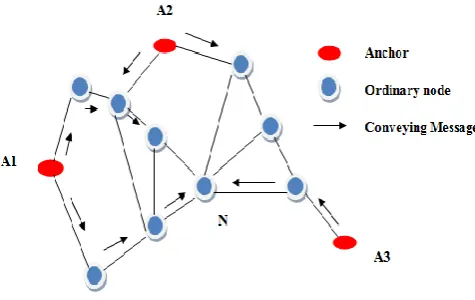
Step 1: Initially, a beacon is broadcasted by the individual anchor nodes all over the network that possess the location of the anchors using the hop count value which is initialized to one. A least hop count is maintained by the individual receiving node. The obtained hop count is for each anchor node to the overall received beacon.
International Journal of Innovative Technology and Exploring Engineering (IJITEE) ISSN: 2278-3075, Volume-8 Issue-6, April 2019
These anchor nodes convey the basic information such as location and hop count to all other nodes in network. After receiving information, the nodes update it in their hop count table. Depending upon this table, the minimal hop count value is determined.
[image:3.595.52.290.156.306.2]Step 2: On one occasion when an anchor node receives the hop count value from other anchor nodes, an
Fig. 3.2. Example of DV hop algorithm
average size of the hop is determined, those are then swamped to the overall network. The blindfolded nodes multiplies the hop range to the hop count value after receiving the hop size. The main objective is to obtain the physical distance of the anchor node. The equation below is used for the estimation of the average hop size (Ha)
(3.1)
Where, (la, ma), (lb, mb) determines the anchor a coordinatesand anchor b coordinates, sab is the hops amid the beacon a added to beacon b.
Step 3: By using controlled flooding, each and every anchor node broadcasts its own hop size to the system. Hereafter, indefinite nodes obtain information of hop size, and store the primitive one. At the similar occasion, it transmits the information to the neighbourhood nodes. This algorithm possibly will guarantee that the majority of the anchor node receives the hop size from the beacon node in order to know the least hop among them. At the conclusion of this step, the expanse to the beacon nodes depending upon the hop extent and hop to the beacon nodes is computed by using trilateration strategy.
B. ADV hop algorithm
In this proposed approach, the focus of the traditional DV hop algorithm is based on step 2 and step 3. In second step, the hop size is broadcasted by the anchor node to the network as a modification after obtaining the hop size. Each broadcast message contains, where Id is identifier and is is said to be the average size for a single hop. Atonce the node receives this message, it updates the information in the routing table and also broadcasts to its neighbouring nodes.
After that, the identifier of the particular memorandum will be dropped. In this stage, entire node
gets the , that is anticipated by the anchor node using first pace of traditional DV hop algorithm. The following formula is used to calculate the Average hop size of the variety of anchor nodes
(3.2)
Where, number of anchor nodes is denoted by N, is estimated by using equation 3.1. At this stage, the distance between the beacon node depending upon the hop length and hop to the beacon nodes are estimated through the formula below
(3.3)
In final stage, the position location of the source node is estimated in a traditional two dimensional (2D) model using M anchor nodes is developed. Let as consider ( , ) be a location of source node and ( , ) be the known location of ath anchor node recipient. The distance is anticipated by means of the subsequent equation:
(3.4)
In this traditional DV hop approach, an estimated physical distance with anchor positions are used to perform a triangulation process to achieve final localization results. Instead of using triangulation process, two-dimensional hyperbolic location algorithm is used in this proposed methodology. Therefore, a least square method is used to provide better estimation result of a initial point.
By following the equation (3.4), we get the subsequent expressions,
(3.5)
+V (3.6)
Where, and V are attributes, which estimated by using the following equation,
(3.7)
(3.8)
Equation (4.6) is in the form of,
(3.9)
(3.10)
(3.11)
By using Least Square (LS) algorithm, from equation (3.11) we can get,
(3.12)
The unknown node coordinates p and q are expressed as,
(3.13)
This proposed ADV hop algorithm the network area is divided into equivalent subareas in order to increase the location accuracy and to decrease the error. In the subarea the individual nodes estimates its own position using anchor nodes. Hence, the hop size can be obtained using anchor nodes in the similar subarea. In order to get the signal strength of received signal, the proposed ERSSI algorithm is used.
C. ERSSI algorithm
RSSI values of all the nodes in WSN are collected, and the RSSI value is converted into distance. With the increase of distance, wireless signal is gradually attenuated. For improving the accuracy of RSSI positioning, a free space propagation model is used. This model is expressed as follows:
(3.14)
Where, Loss denotes the channel attenuation, d represents distance between the test point and source distance, f is signal frequency, and k denotes attenuation factor. A signal is attenuated as it activities as of sender and receiver. Longer the distance the signal has to travel, as the attenuation is greater the potency of the expected signal estimates the distance between the source and recipient. Parameters needed to estimate the distance is transmitted power of the signal, path loss model and received signal strength.
The expected signal power transmitted from node a to node b at time t, can be expressed as by using the above mentioned parameters
(3.15)
Where, is represented as the power of the received signal at receiver node b transmitted from node a at time t, denotes the power transmitted by the signal transmitted from node a, denotes attenuation constant, is the space amid the transmitted node a added to the receiver node b, and is uncertainty factor, which is based on multipath fading added to shadowing. This ERSSI algorithm improves the network stability, and has low power consumption.
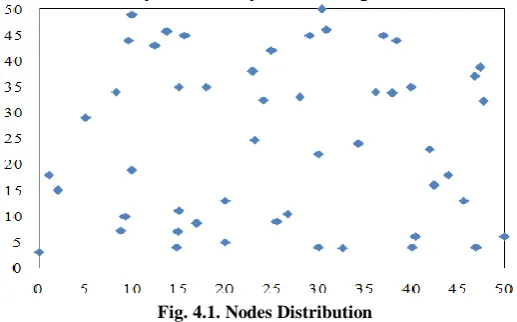
IV. RESULTS AND PERFORMANCE EVALUATIONS In this segment, a clear analyzation of simulation results are presented. DV hop and proposed methodology. The experimental area of this proposed approach is the square region along with preset size of 50 *50 m2 added to the radio array of the sensor node (S) is lay down to 30 meter.
[image:4.595.306.565.324.485.2]The deployment of 50 sensor node is done erratically in a two dimensional space is clearly shown in Figure 4.1.
Fig. 4.1. Nodes Distribution
The localization stability and accuracy is achieved by utilizing the performance metrics such as error variance and localization error. The above mentioned performance parameters are estimated as follows,
A. Localization Error
Localization error is estimated as follows,
(4.1) Where, represents the evaluated positions of
International Journal of Innovative Technology and Exploring Engineering (IJITEE) ISSN: 2278-3075, Volume-8 Issue-6, April 2019
(4.2)
[image:5.595.50.302.151.293.2]LE represents the Localization Error, n denotes the value of indefinite nodes, represents the expected value, and R represents the sensor nodes radio range. Figure 4.2 shows the localization error of existing PSO algorithm and proposed ERSSI based ADV hop algorithm.
Fig. 4.2. Localization Error with number of nodes
It clearly reveals to facilitate the localization error of the proposed methodology is lower than the existing PSO algorithm. Moreover, the localization error is inversely relative to the localization accuracy.
B. Localization Error Variance
The variance of the LE is estimated as follows,
(4.3)
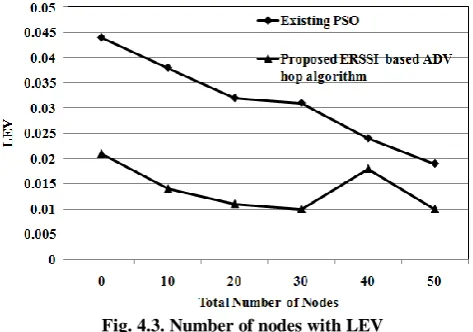
The estimated Localization Error Variance (LEV) of existing PSO algorithm and the proposed ERSSI based ADV hop algorithm is clearly shown in Figure 4.3.
Fig. 4.3. Number of nodes with LEV
Here, the comparison is made between the LEV of both existing PSO algorithm with proposed ERSSI based ADV hop algorithm. The LEV of the projected algorithm is low while comparing to the presented PSO algorithm. The value of LEV is also inversely proportional to the localization accuracy.
C. Localization Accuracy
The accuracy of the localization process is estimated as follows,
(4.4)
[image:5.595.306.551.190.353.2]Here, n denotes the value of unfamiliar nodes. Figure 4.4 shows the localization accuracy of the existing PSO and proposed ERSSI based ADV hop algorithm.
Fig. 4.4 Number of Nodes with Localization Accuracy According to the result, the localization exactness of the projected algorithm is high when compared to the existing PSO algorithm. If the number of nodes increases then simultaneously the accuracy of localization is also increases. The stability of the localization is inversely proportional to both localization error and the localization error variance. Moreover, the stability is directly proportional to the localization accuracy. Therefore, the stability of the localization is increased automatically.
V. CONCLUSION
[image:5.595.47.284.507.673.2]REFERENCES
1. Buratti, C., et al., An overview on wireless sensor networks technology and evolution. Sensors, 2009. 9(9): p. 6869-6896. 2. Bhattacharyya, D., T.-h. Kim, and S. Pal, A comparative study of
wireless sensor networks and their routing protocols. Sensors, 2010.
10(12): p. 10506-10523.
3. Khan, H., M.N. Hayat, and Z.U. Rehman. Wireless sensor networks free-range base localization schemes: A comprehensive survey. in
International Conference on Communication, Computing and Digital Systems (C-CODE). 2017. IEEE.
4. Jain, N., S. Verma, and M. Kumar, Adaptive locally linear embedding for node localization in sensor networks. IEEE Sensors Journal, 2017. 17(9): p. 2949-2956.
5. Anup Kumar Paul, T.S., Localization in Wireless Sensor Networks: A Survey on Algorithms, Measurement Techniques, Applications and Challenges. Journal of owSensor and Actuator Networks, 2017.
6(24): p. 1-23.
6. Xiao, H., et al. An RSSI based DV-hop algorithm for wireless sensor networks. in Communications, Computers and Signal Processing (PACRIM), 2017 IEEE Pacific Rim Conference on. 2017. IEEE. 7. Xu, Y., et al., Efficient DV-HOP localization for wireless
cyber-physical social sensing system: a correntropy-based neural network learning scheme. Sensors, 2017. 17(1): p. 135.
8. Singh, M. and P.M. Khilar, Mobile beacon based range free localization method for wireless sensor networks. Wireless Networks, 2017. 23(4): p. 1285-1300.
9. Li, P., et al., Research on secure localization model based on trust valuation in wireless sensor networks. Security and Communication Networks, 2017. 2017.
10. Zhang, L., et al., An improved three-dimensional DV-Hop localization algorithm optimized by adaptive cuckoo search algorithm. International Journal of Online Engineering (iJOE), 2017.
13(02): p. 102-118.
11. Sujatha, S. and M. Siddappa, Node localization method for wireless sensor networks based on hybrid optimization of particle swarm optimization and differential evolution. IOSR J Comput Eng, 2017.
19(2): p. 07-12.
12. Kumar, S. and R.M. Hegde, A Review of Localization and Tracking Algorithms in Wireless Sensor Networks. arXiv preprint arXiv:1701.02080, 2017.
13. Alomari, A., et al., Dynamic fuzzy-logic based path planning for mobility-assisted localization in wireless sensor networks. Sensors, 2017. 17(8): p. 1904.
14. Singh, P., et al., A novel approach for localization of moving target nodes in wireless sensor networks. International Journal of Grid and Distributed Computing, 2017. 10(10): p. 33-44.
15. Sharma, G. and A. Kumar, Dynamic Range Normal Bisector Localization Algorithm for Wireless Sensor Networks. Wireless Personal Communications, 2017. 97(3): p. 4529-4549.
16. Sharma, G. and A. Kumar, Modified energy-efficient range-free localization using teaching–learning-based optimization for wireless sensor networks. IETE Journal of Research, 2018. 64(1): p. 124-138.
17. Yan, X., et al., DV-hop localisation algorithm based on optimal weighted least square in irregular areas. Electronics Letters, 2018.
54(21): p. 1243-1245.
18. Singh, S.P. and S. Sharma, An improved localization algorithm for error minimization in wireless sensor networks. International Journal of Grid and Distributed Computing, 2017. 9(1): p. 179-191. 19. Kim, S., et al., Two-hop distance estimation in wireless sensor
networks. International Journal of Distributed Sensor Networks, 2017.
13(2): p. 1-8.
20. Rout, S.K., A.K. Rath, and C. Bhagabati, Energy Efficient Dynamic Node Localization Technique in Wireless Sensor Networks. Indian Journal of Science and Technology, 2017. 10(15).
AUTHORSPROFILE
Dr. M. Vasim Babu received his B.E. degree in the discipline of Electronics and Communication Engineering from Sethu Institute of Technology, India, M.E Degree in the discipline of Communication Systems from K.L.N college of engineering, India, Ph.D. degree in the discipline of Information and Communication Engineering from Anna university, India. His area of interest is in Wireless Sensor Networks , Adhoc network, ANFIS and Signal processing. He is active member of International Association of Engineers, Seventh sense research group, International Association of Computer Science and Information Technology, Universal Association of Computer and Electronics Engineers and the institute of engineers. Currently he is working as associate professor, Department of ECE in KKR and KSR Institute of Technology and Sciences, Guntur, AP.
Dr. C.N.S Vinoth Kumar received his B.E. degree in the discipline of Information Technology from Annamalai University, India, M.E Degree in the discipline of Computer Science Engineering from Annamalai University, India, Ph.D. degree in the discipline of Computer Science and engineering from Annamalai University.His area of interest is Wireless Sensor Networks, Cryptography & Network Security, Artificial Intelligence, and Graphics. He is the lifelong member of computer society of India and International associations of engineers. Currently he is working as Assistant professor, Department of CSE in SRM Institute of Science and technology, Chennai, Tamilnadu, India.