360° VR for Qualifying Daylight Design
Anette Kreutzberg1,* and Emanuele Naboni21Institute of Architecture and Design, The Royal Danish Academy of Fine Arts, School of Architecture (KADK), Copenhagen, Denmark.
2Institute of Architecture and Technology, The Royal Danish Academy of Fine Arts, School of Architecture (KADK), Copenhagen, Denmark.
1 Introduction and background
Thermal delight is an important factor within architectural design [1]. Daylight influences thermal parameters like brightness and temperature and is important for thermal delight, but daylight can also cause thermal discomfort with glare and overheating if poorly designed or not properly regulated. Simulation tools can help in the design process to meet building regulation requirements with established metrics to quantify daylighting from a quantitative stand while the visually perceived daylight quality is purely subjective and challenging to envisage.
There has been a broad focus on light simulation, e.g. illuminance studies or glare studies, but the separation between quantitative daylighting studies and qualitative perceptual studies is evident in the influential Lighting Handbook of the Illuminating Engineering of North America [2], with only one chapter about Quality of the visual Environment and 28 chapters about Quantitative aspects. It is true that a quantitative assessment yields a fixed level, whereas a qualitative assessment of perceived daylight qualities reflects subjective interpretations, difficult for creating reproducible outcome, but it is never the less important to include these assessments in the design process.
Full-scale mock-ups are well-proven tools in architectural design to assess the aesthetic qualities of surfaces as well as to study daylight distribution and reflection. Virtual Reality can act as a digital substitute or supplement to full-scale mock-ups, simulating a bodily presence in space and is widely used in evaluating and communicating the perception of architectural space [3]. For evaluating thermal comfort, VR cannot simulate all climatic behaviour, but can provide a supplementary visual representation of daylight and its visual qualities in space based on several studies [4] indicating the potential of using VR in experimental daylight studies.
The present contribution focuses on qualitative daylight perception as material for daylighting design by evaluating perception of daylight quality and ambiance in 360° photographed panoramas and time-lapse videos viewed in VR compared to a real world scenario. The final aim in this ongoing project is to transfer the findings to 360° renderings of daylighting design, establishing a matrix for daylight quality and ambiance assessment in the digital model at any phase in the design process.
2 Methods
2.1 Mock-up
The test room used in this research is an existing 1:1 daylight studio used as mock-up equipped with a paper façade pattern for the Thermal Delight study.
1 Introduction and background
Thermal delight is an important factor within architectural design [1]. Daylight influences thermal parameters like brightness and temperature and is important for thermal delight, but daylight can also cause thermal discomfort with glare and overheating if poorly designed or not properly regulated. Simulation tools can help in the design process to meet building regulation requirements with established metrics to quantify daylighting from a quantitative stand while the visually perceived daylight quality is purely subjective and challenging to envisage.
There has been a broad focus on light simulation, e.g. illuminance studies or glare studies, but the separation between quantitative daylighting studies and qualitative perceptual studies is evident in the influential Lighting Handbook of the Illuminating Engineering of North America [2], with only one chapter about Quality of the visual Environment and 28 chapters about Quantitative aspects. It is true that a quantitative assessment yields a fixed level, whereas a qualitative assessment of perceived daylight qualities reflects subjective interpretations, difficult for creating reproducible outcome, but it is never the less important to include these assessments in the design process.
Full-scale mock-ups are well-proven tools in architectural design to assess the aesthetic qualities of surfaces as well as to study daylight distribution and reflection. Virtual Reality can act as a digital substitute or supplement to full-scale mock-ups, simulating a bodily presence in space and is widely used in evaluating and communicating the perception of architectural space [3]. For evaluating thermal comfort, VR cannot simulate all climatic behaviour, but can provide a supplementary visual representation of daylight and its visual qualities in space based on several studies [4] indicating the potential of using VR in experimental daylight studies.
The present contribution focuses on qualitative daylight perception as material for daylighting design by evaluating perception of daylight quality and ambiance in 360° photographed panoramas and time-lapse videos viewed in VR compared to a real world scenario. The final aim in this ongoing project is to transfer the findings to 360° renderings of daylighting design, establishing a matrix for daylight quality and ambiance assessment in the digital model at any phase in the design process.
2 Methods
2.1 Mock-up
The test room used in this research is an existing 1:1 daylight studio used as mock-up equipped with a paper façade pattern for the Thermal Delight study.
[image:3.482.61.428.79.178.2]The daylight studio is part of the Architectural Lighting Lab located in the campus of KADK (Royal Danish Academy of Fine Arts), Copenhagen (Fig. 1). The daylight studio faces East-Southeast 115°, and is located at top floor in a three storeys building hosting various types of research laboratories with specific functions, as opposed to standard design studios.
Fig. 1. KADK Campus and studio location (Image from Google Earth) (left), View from the daylight studio (middle) and view of the balcony (on the right).
The studio dimensions are W5,5 x L8,0 x H2,7 meters, and the window façade face East-Southeast and has an area of 14,85 m² with a small balcony in galvanized metal placed outside the window.
The studio has a grey linoleum floor and walls and ceiling are coated with white paint. The textile curtain covering the West-Northwest wall of the room is also white. The windows have glossy painted, white metal frames. The studio room is for this experiment set up with only one daylight opening facing East-Southeast. The studies are based on daylight only; no additional artificial light was used.
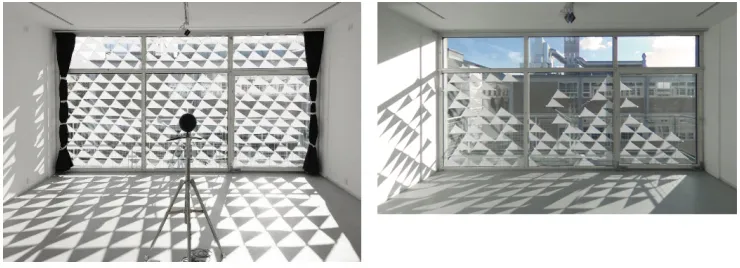
In the ongoing stage of the Thermal Delight research, the paper was chosen as a working material for implementation of design patterns in the façade. The modules designed are derived from a basic A4 paper, with the margins in the size of 210 mm x 297 mm. The elementis half of an A4 paper, rotated in order to have the longest side (which is of 364m, the size of the A4 diagonal) on the bottom.
Fig. 2. First pattern - Full Grid (left) and third iteration (right).
The first iteration represents the introduction of the triangle pattern. As a first trial, the facade was covered with a grid of triangles, all of the same size (Fig. 2). A simple culling occurred, using a “true-false” logic, always removing every second module. The proposal took into consideration no optimisation strategy, but only aimed at physically simulating the behaviour of the decided-upon module on the architectural premises. However, the layout contributed to the observation of light patterns, shadow patterns, maximum glare points and, most important, human perception.
[image:3.482.57.427.389.523.2]2.2 360° Photographic recordings
Sequential 360° panorama recordings were made with a ThetaS [5] camera and compiled to 360° Time-lapse videos [6] to supply the Thermal Delight study with a bodily and visual representation of the changing daylight.
The 360° recordings were captured over a period of one month between the 27th of September and the 23rd of October 2018. The initial recording was set up with five-second intervals (smallest possible interval) and an image size of 2048 x 1024 pixels (largest possible with 5 sec. intervals). AUTO shunter speed and ISO value was chosen since the ThetaS camera has a fixed aperture of F-stop 2.
Ten hours of recording compiled into a 1 min 22 sec time-lapse video, 25 fps (frames per second) with H265 encoding [7] and was uploaded to Vimeo [8] for sharing and displaying via the Vimeo App [9].
[image:4.482.62.426.337.383.2]The first recording was made during a windy and partly cloudy weather condition, resulting in heavy flickering in the compiled time-lapse. It was evident that the daylighting condition in the room changed dramatically over time and at high speed (Fig. 3). Watching the time-lapse in mobile VR with the headset was somewhat uncomfortable due to the heavy flickering. Watching the time-lapse in 2D on mobile VR without the headset though was comfortable and still very informative.
Fig. 3. Extracts from sequential 360° recordings revealing direct sunlight patterns, diffuse reflected skylight and reflections from nearby buildings all within a diurnal loop.
Based on findings from the first time-lapse recording, new time-lapse recordings were set up testing various exposure parameters. With extensive light variation due to natural skylight typologies during a diurnal recording, it was necessary to vary shutter speed or ISO values to balance the brightness levels with the fixed aperture of F-stop 2. The maximum shutter speed of 1/6400 provided the best results together with ISO set to AUTO.
2.2 360° Photographic recordings
Sequential 360° panorama recordings were made with a ThetaS [5] camera and compiled to 360° Time-lapse videos [6] to supply the Thermal Delight study with a bodily and visual representation of the changing daylight.
The 360° recordings were captured over a period of one month between the 27th of September and the 23rd of October 2018. The initial recording was set up with five-second intervals (smallest possible interval) and an image size of 2048 x 1024 pixels (largest possible with 5 sec. intervals). AUTO shunter speed and ISO value was chosen since the ThetaS camera has a fixed aperture of F-stop 2.
Ten hours of recording compiled into a 1 min 22 sec time-lapse video, 25 fps (frames per second) with H265 encoding [7] and was uploaded to Vimeo [8] for sharing and displaying via the Vimeo App [9].
[image:5.482.56.204.242.324.2]The first recording was made during a windy and partly cloudy weather condition, resulting in heavy flickering in the compiled time-lapse. It was evident that the daylighting condition in the room changed dramatically over time and at high speed (Fig. 3). Watching the time-lapse in mobile VR with the headset was somewhat uncomfortable due to the heavy flickering. Watching the time-lapse in 2D on mobile VR without the headset though was comfortable and still very informative.
Fig. 3. Extracts from sequential 360° recordings revealing direct sunlight patterns, diffuse reflected skylight and reflections from nearby buildings all within a diurnal loop.
Based on findings from the first time-lapse recording, new time-lapse recordings were set up testing various exposure parameters. With extensive light variation due to natural skylight typologies during a diurnal recording, it was necessary to vary shutter speed or ISO values to balance the brightness levels with the fixed aperture of F-stop 2. The maximum shutter speed of 1/6400 provided the best results together with ISO set to AUTO.
The initial five-second intervals were increased to 10 seconds and eventually 20 seconds with the benefit of being able to capture images at an increased size of 5376 x 2688 pixels and at the same time not exceeding the internal storage capacity of 7GB within a 10-hour recording period.
2.3 360° Test renderings and time-lapse animation rendering
The digital Rhino [10] model of the studio room used for thermal simulations was refined and optimised for rendering with V-Ray [11] in 3dsMax [12].
A 360° diurnal time-lapse animation of the 3D test room model was rendered for comparison with the recorded time-lapse. The animation revealed a slight rotation mismatch between the digital model and the real test room; the light patterns did not match!
Several output variations were tested concerning level of abstraction as well as render quality and image size to minimize the total render time for time-lapse animations. Further studies will focus on the abstraction and aesthetics of 360° daylight renderings.
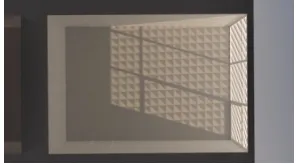
An alternative POV was used in a top/down 2D animation for a diagrammatic overview of the daylight movement in the room showing all walls at the same time (Fig. 4).
Fig. 4. Diagrammatic top/down 2D animation.
360° test renderings with varying level of abstractions like separated sunlight and reflected skylight were continuously made to explore new ways to utilise the digital model (Fig. 5).
Fig. 5. 360° panorama renderings. Combined Daylight (left), Separated Direct Sunlight (middle), Separated Reflected Skylight (right).
2.4 360° Exposure tests
[image:5.482.57.427.383.444.2] [image:5.482.59.426.579.625.2]Fig. 7. 360° photos Position A, Sunny weather converted for 2D perspective view (view direction B).
2.5 Screen and VR headset
For the comparative experiment a Samsung Galaxy S8 [13] mobile phone with Homido Mini VR Glasses (clip-on) (Fig. 8)[14] were used.
Fig. 8. Homido Mini.
The ideal VR headset for light evaluation is one fully covering the eyes letting no false light interfere with the screen display. A not-so-perfect solution with real-world light interference was chosen because of the compact design and portability – and in the realisation of its potential use in daily studio work. Testing with real-world light interference might also provide valuable unforeseen input to the study.
2.6 Comparative Experiment
Comparative experiments with a small sample of participants were conducted on three occasions (12th, 16th and 19th of October 2018) in the test room and once at another location.
The motivation for the comparative experiments was to make initial calibration of the perception of daylight quality in 360° photographic recordings viewed in VR compared to a real-world scenario, with the purpose of transferring the findings to 360° panorama renderings in further studies.
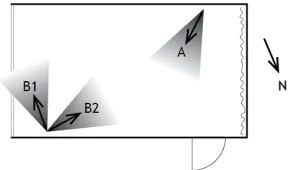
[image:6.482.59.206.443.528.2]Two Point of Views (POV) with three view directions (Fig. 9) covered the main differences in direct sunlight and shadow in the test room.
Fig. 9. Test room with two Point of Views and three view directions.
• Standing in the shaded area A looking in the direction of the directly lit area B.
• Standing in the directly lit area B looking in the direction of the shaded area A (B2).
• Standing in the directly lit area B looking in the direction of the light source (B1 the window).
Fig. 7. 360° photos Position A, Sunny weather converted for 2D perspective view (view direction B).
2.5 Screen and VR headset
For the comparative experiment a Samsung Galaxy S8 [13] mobile phone with Homido Mini VR Glasses (clip-on) (Fig. 8)[14] were used.
Fig. 8. Homido Mini.
The ideal VR headset for light evaluation is one fully covering the eyes letting no false light interfere with the screen display. A not-so-perfect solution with real-world light interference was chosen because of the compact design and portability – and in the realisation of its potential use in daily studio work. Testing with real-world light interference might also provide valuable unforeseen input to the study.
2.6 Comparative Experiment
Comparative experiments with a small sample of participants were conducted on three occasions (12th, 16th and 19th of October 2018) in the test room and once at another location.
The motivation for the comparative experiments was to make initial calibration of the perception of daylight quality in 360° photographic recordings viewed in VR compared to a real-world scenario, with the purpose of transferring the findings to 360° panorama renderings in further studies.
Two Point of Views (POV) with three view directions (Fig. 9) covered the main differences in direct sunlight and shadow in the test room.
Fig. 9. Test room with two Point of Views and three view directions.
• Standing in the shaded area A looking in the direction of the directly lit area B.
• Standing in the directly lit area B looking in the direction of the shaded area A (B2).
• Standing in the directly lit area B looking in the direction of the light source (B1 the window).
A total of 15 participants, age 23 to 60, students and employees at KADK, viewed the 360° photos in VR with four different Exposure settings displayed in random order for each
On location, sunny sky compared to 360° recorded sunny sky On location, overcast compared to 360° recorded overcast Different time and location compared to 360° recorded sunny sky Different time and location compared to 360° recorded overcast
2.7 Survey
A questionnaire distributed on paper at the comparative experiment was designed to map the perceived visual qualities and ambiance of a real-world site at a given time and date compared to perceived visual qualities and ambiance of daylight in 360° photographic panoramas of the same location with identical weather condition, sunny sky or overcast, viewed in VR. Subjective visual evaluations of the virtual as well as the real space were recorded based on 15 people answering to a questionnaire. The participants at a different location tested both weather conditions.
Not all the participants in the experiment answered questions concerning the general quality and ambiance in the test room.
[image:7.482.48.416.140.186.2]Participants were experiencing two series of 360° photographic panoramas in four different exposures in random order. After each series, participants filled out the corresponding questions in the questionnaire.
Fig. 12. Answers from participants in sunny or partly sunny weather.
[image:7.482.57.426.466.583.2]3 Results and discussion
The time-lapse videos based on 360° photographed panoramas were very informative showing the impact of the façade patterns on direct sunlight during the day as well as the variation of luminous conditions in various weather conditions, clarifying the dynamics and complexity of daylight.
The corresponding 360° rendered animations were likewise informative with a stable skylight eliminating flickering. Render time was an issue though, even when lowering the image quality to a render time of five minutes per frame – a one-minute animation with only 25 fps would render for 125 hours! For practical use in the design studio, a low-resolution “preview” quality is proposed for time-lapse animations with the supplement of single frame panoramas of select times rendered in high quality and high resolution.
Only few of the participants in the experiment answered questions concerning the general quality and ambiance in the test room but they indicate a variety in perception of daylight probably caused by the ever changing and very dynamic light during the survey, which the comment sections of the questionnaire reflected. A larger sample in future surveys will provide more sufficient data.
While this study is still on-going, analysis of the questionnaires show a reasonable uniform perception of daylight brightness in the 360° photos compared with the real site. A small sample of 15 persons in total participated in the comparative experiment. Nine persons on site in sunny weather, three persons on site in partly sunny weather and three persons on a different site outside the studio in overcast weather. The daylight brightness was primarily matched with the second lightest exposure value in both sunny and overcast weather, on and off site. Position B standing in the direct sunlight was secondarily matched with darker exposures whereas position A in sunny weather as well as both positions A and B in overcast weather were secondly matched with the lightest exposures.
Although the results can be transferred to tone mapping of 360° renderings for assessment of luminous conditions in a virtual model, further studies with a larger sample must be done. Extreme brightness values from the sun must correspond to varying maximum brightness levels on different mobile screens – which influences the displayable contrast range. Contrast is important in understanding light, since the eye automatically adapts to different brightness levels. Further experiments with display on various mobile screens might result in findings of alternative tone mappings and should include image analysis to address problems with large variation in brightness level displayed in a single 360° panorama.
In further studies, the results from the survey will be compared to thermal measurements made by the Thermal Delight Project investigating the impact temperature might have on the perception of daylight brightness as well as quality and ambiance.
3 Results and discussion
The time-lapse videos based on 360° photographed panoramas were very informative showing the impact of the façade patterns on direct sunlight during the day as well as the variation of luminous conditions in various weather conditions, clarifying the dynamics and complexity of daylight.
The corresponding 360° rendered animations were likewise informative with a stable skylight eliminating flickering. Render time was an issue though, even when lowering the image quality to a render time of five minutes per frame – a one-minute animation with only 25 fps would render for 125 hours! For practical use in the design studio, a low-resolution “preview” quality is proposed for time-lapse animations with the supplement of single frame panoramas of select times rendered in high quality and high resolution.
Only few of the participants in the experiment answered questions concerning the general quality and ambiance in the test room but they indicate a variety in perception of daylight probably caused by the ever changing and very dynamic light during the survey, which the comment sections of the questionnaire reflected. A larger sample in future surveys will provide more sufficient data.
While this study is still on-going, analysis of the questionnaires show a reasonable uniform perception of daylight brightness in the 360° photos compared with the real site. A small sample of 15 persons in total participated in the comparative experiment. Nine persons on site in sunny weather, three persons on site in partly sunny weather and three persons on a different site outside the studio in overcast weather. The daylight brightness was primarily matched with the second lightest exposure value in both sunny and overcast weather, on and off site. Position B standing in the direct sunlight was secondarily matched with darker exposures whereas position A in sunny weather as well as both positions A and B in overcast weather were secondly matched with the lightest exposures.
Although the results can be transferred to tone mapping of 360° renderings for assessment of luminous conditions in a virtual model, further studies with a larger sample must be done. Extreme brightness values from the sun must correspond to varying maximum brightness levels on different mobile screens – which influences the displayable contrast range. Contrast is important in understanding light, since the eye automatically adapts to different brightness levels. Further experiments with display on various mobile screens might result in findings of alternative tone mappings and should include image analysis to address problems with large variation in brightness level displayed in a single 360° panorama.
In further studies, the results from the survey will be compared to thermal measurements made by the Thermal Delight Project investigating the impact temperature might have on the perception of daylight brightness as well as quality and ambiance.
Results from the comparative experiment will also be transferred to tone mapping of rendered 360° panoramas and animations with various abstractions in further studies, and thus continue to unfold various ways rendered 360° VR output might inform daylighting design from conceptual to final phases in the design process.
References
1. L. Herschong, Thermal Delight in Architecture, MIT (1979).
2. The Lighting Handbook, 10th Edition, Illuminating Engineering Society (2011) 3. A. Heydarian, J. P. Carneiro, D. Gerber, B. Becerik-Gerber, T. Hayes & W. Wood.
Immersive virtual environments versus physical built environments: A benchmarking study for building design and user-built environment explorations. Automation in Construction, 54, 116-126 (2015)
4. K. Chamilothori, J. Wienold & M. Andersen. Adequacy of Immersive Virtual Reality for the Perception of Daylit Spaces: Comparison of Real and Virtual Environments. Leukos, 1-24 (2018)
5. Ricoh Theta, https://theta360.com/en/
6. Adobe Premiere Pro CC, https://www.adobe.com/dk/products/premiere.html 7. HEVC/H.265, https://www.divx.com/en/software/technologies/hevc/ 8. Vimeo, https://vimeo.com
9. Vimeo app,
https://play.google.com/store/apps/details?id=com.vimeo.android.videoapp&hl=en_US 10. Rhino 6 for Windows, https://www.rhino3d.com/ [Accessed].