European Signal Processing Conference, 2008-08-25 - 2008-08-29. ,
This version is available at
https://strathprints.strath.ac.uk/14911/
Strathprints is designed to allow users to access the research output of the University of Strathclyde. Unless otherwise explicitly stated on the manuscript, Copyright © and Moral Rights for the papers on this site are retained by the individual authors and/or other copyright owners. Please check the manuscript for details of any other licences that may have been applied. You may not engage in further distribution of the material for any profitmaking activities or any commercial gain. You may freely distribute both the url (https://strathprints.strath.ac.uk/) and the content of this paper for research or private study, educational, or not-for-profit purposes without prior permission or charge.
Any correspondence concerning this service should be sent to the Strathprints administrator: [email protected]
The Strathprints institutional repository (https://strathprints.strath.ac.uk) is a digital archive of University of Strathclyde research outputs. It has been developed to disseminate open access research outputs, expose data about those outputs, and enable the
A CM BASED EQUALIZER FOR SPACE-TIME SPREADING OVER CHANNELS
WITH INTER-SYMBOL INTERFERENCE
Samir Bendoukha and Stephan Weiss
Institute of Communications and Signal Processing, University of Strathclyde Glasgow, UK
phone: + (44) 141 548 2808, email: [email protected]
ABSTRACT
Space-time block coding (STBC) and a number of deriva-tive techniques have been developed to maximize the diver-sity gain of a multi-input multi-output (MIMO) channel. This was later generalized for multi-user DS-CDMA sys-tems through space-time spreading (STS), [3] and [4], which assumed flat fading as well as the availability of full channel state information (CSI) at the receiver. This paper focuses on the development of a blind chip-rate method for the equalization of STS over channels with inter-symbol in-terference (ISI). Simulation results are presented to demon-strate the convergence and noise resilience of the derived algorithm.
Keywords: Space-time spreading, multi-user, constant modulus algorithm, blind equalization, frequency selective channels.
1. INTRODUCTION
Multi-input multi-output (MIMO) channels are known to in-crease the capacity of a transmission link. This can be ex-ploited to increase either the multiplexing gain or the diver-sity gain, which leads to a higher data throughput or a better resilience of the link to fading, respectively.
In the pioneering work by Alamouti [2], a transmitter di-versity scheme, named Space-Time Block Coding (STBC), was derived which maximizes the level of diversity obtained in flat fading channels. Inspired by STBC, a transmit diver-sity scheme referred to as space-time spreading (STS) was derived in [4] for the downlink of DS-CDMA systems. Un-like most other algorithms, STS only requires one orthogonal code per user, which makes it an attractive technique. How-ever, in [4] it is assumed that the MIMO channel matrix is non-dispersive and perfectly known at the receiver. For dis-persive channels, a few schemes have been proposed in the literature. These are mainly block based and introduce re-dundancy as well as assuming block stationarity of the chan-nel. Knowledge of the channel can be obtained through the injection of training sequences but the channel is assumed staionary during the transmission of data. This assumption is not always valid, thus a blind equalizer appears advanta-geous.
The most widely used blind equalizer is the constant modulus algorithm (CMA), first introduced in [6], which adapts the weight vectors based on the assumption that the transmitted constellation has a constant modulus. In a multi-user scenario, this property is not preserved. In [1], a Con-stant Modulus (CM) algorithm was derived for the blind equalization of DS-CDMA systems, named FIRMER-CMA. The algorithm operates at the chip rate and forces the var-ious user signals onto a constant modulus without any
ad-ditional requirements such as minimizing the mutual cross-correlation between the multiple users.
In this paper, a similar CM algorithm for the blind equal-ization of STS systems over frequency selective channels is derived. The new algorithm forces the despread signals to have a constant modulus.
In the following, we introduce the data model for STS and the proposed equalisation algorithm. A derrivation of the algorithm is detailed in section 3. In order to assess the performance of the novel algorithm, the zero-forcing solution has been chosen as a benchmark. The inverse of the polyno-mial channel matrix is calculated in frequency domain, as in [5]. Simulation results are presented in section 5 to demon-strate the convergence and error performance of the STS-CM algorithm.
2. DATA MODEL
Inspired by STBC coding, STS was introduced in [4] as a transmit diversity scheme for wideband-CDMA systems. Similar to STBC, the source data is split into odd and even symbol sequences,b1[n]andb2[n], respectively. The indexn
is referred to as symbol time, whereas the transmission will be at a chip rate Ktimes higher than the symbol rate, with chip indexm. The chip rate signals transmitted from the two antennas,s1[m]ands2[m], are defined as
s1[m] = √1 2
∞
∑
n=−∞(c1[m−nK]b1[n] +c2[m−nK]b∗2[n])
s2[m] = √1 2
∞
∑
n=−∞(c1[m−nK]b2[n]−c2[m−nK]b∗1[n]),
where(·)∗ denotes complex conjugation and c1[m] and
c2[m]are orthonormal codes of lengthK, whose coefficients in the following are arranged in vectorsci∈RK,i={1,2}. The code length defines the CDMA spreading gain asK/2. If only one code,c, is assigned to every user, then the two codes can be defined as
c1=
c c
and c2=
c −c
. (1)
Note that the orthonormality of the user codes is preserved, i.e. cH
1c2=0, where superscripts (·)T and(·)H denote the transpose and Hermitian transpose operations, respectively.
W i -i i i 6 6 6 ?
-a1[m]
a2[m]
cH 1 cH 2 cH 1 cH 2
y2[n]
y1[n] d1,1[n]
d1,2[n]
d2,1[n]
d2,2[n]
(.)∗
(.)∗
v1[m]
v1[m]
s2[m]
s1[m]
[image:3.612.67.272.72.291.2]H
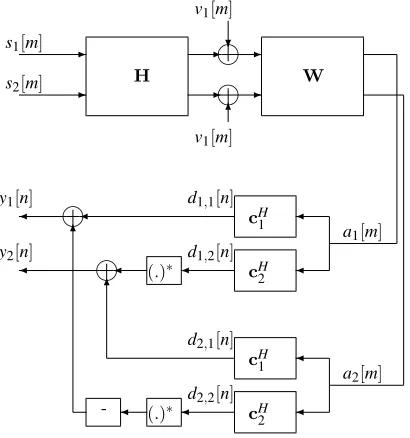
Figure 1: Space-Time equalization for STS.
by
Rm =
rT 1 rT 2 =
N−1
∑
ν=0
HνSm−ν+Vm. (2)
whereSmis the matrix of transmitted data
Sm=
s1[m] ··· s1[m−L+1]
s2[m] ··· s2[m−L+1]
. (3)
MatrixHν is theνth time slice of the channel transfer function and is defined as
Hν=
h1,1[ν] h1,2[ν]
h2,1[ν] h2,2[ν]
, (4)
where hi,j is the frequency selective channel from the jth transmit antenna to the ith receive antenna. The channels have a maximum length of N. The transfer function of the dispersive MIMO channel can be written as
H(z) =
N−1
∑
ν=0
Hνz−ν. (5)
Additive white Gaussian noise (AWGN),Vm, with zero mean and EVVH =Lσ
rI2×2 is assumed to corrupt the signals at the receiver.
As shown in Fig. 1, a MIMO equalizer is used, whereby each of the four subfilters has lengthL. It was proven in [7] that perfect Zero-Forcing (ZF) equalization of the p-by-u
MIMO channel can be achieved if the length of the sube-qualizers,Lsatisfies
L≥L=
N(p−1)
u−p
, (6)
where⌈·⌉denotes rounding operation to the next larger inte-ger.
3. THE STS-CMA ALGORITHM
Due to its simplicity and low requirements, the constant mod-ulus algorithm (CMA) is the most commonly used blind equalizer. The algorithm, first introduced in [6], assumes a constant modulus constellation set at the transmitter and works by forcing the received signal to have the same mod-ulus. A MIMO-CMA algorithm was derived in [8] which in addition explicitly forces the cross-correlation between the outputs to zero in order to avoid multiple extractions of the same source.
As shown in Fig. 1, the equalizer outputs a1[m] and
a2[m] will ideally identify the transmitted sequencess1[m] and s2[m], respectively. Due to the fact that the transmit-ted signals are not constant modulus and the fact that multi-ple users are present in the system, the conventional MIMO-CMA cannot be used. In [1], a CM algorithm was derived for the equalization of a single antenna DS-CDMA system based on the orthogonality of the match filtered outputs. To exploit the STS scenario similar to [1], we consider the cost function
ξ=E
(
2
∑
i=12
∑
l=1(|di,l[n]|2−γ2)2
)
, (7)
whereγis the modulus of the source constellation anddi,l[n] are the despread signals as shown in Fig. 1. Due to the ex-plicit orthogonality of the despread outputs, the proposed cost function is simply the CM criterion calculated over the four signals. The despread outputs are defined as
di,l[n] =cHl ·
ai[nK] .. .
ai[nK−K+1]
, (8)
where the output of theithspace-time equalizer is given by
ai[nK] =wHi ·
r1[nK] .. .
r1[nK−L+1]
r2[nK] .. .
r2[nK−L+1]
withwi=
wi,1 wi,2
.
(9) Expanding (8) yields:
di,l[n] =cHl ·Wi·
r1[nK] .. .
r1[nK−K−L+2]
r2[nK] .. .
r2[nK−K−L+2]
, (10)
whereWi is the convolutional matrix for the ith equalizer defined by
Wi=
wH
i,1 0 wiH,2 0
. .. . ..
0 wH
i,1 0 wiH,2
Table 1: Summary of the STS-CMA equalization algorithm.
1: Updatexl[n] =Cl·rnK, forl=1,2.
2: di,l[n] =wHi [n]·xl[n], fori,l=1,2.
3: ei,l[n] =di,l[n]· |di,l[n]|2−γ2,i,l=1,2.
4: wi[n+1] =wi[n]−µ·∑2
l=1e∗i,l[n]xl[n],i=1,2.
The terms of Equation (10) can be rearranged to produce:
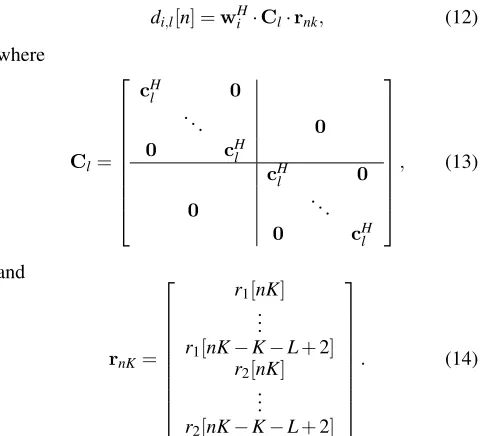
di,l[n] =wiH·Cl·rnk, (12)
where
Cl=
cH
l 0
. .. 0
0 cH
l
cH
l 0
0 . ..
0 cH
l
, (13)
and
rnK=
r1[nK] .. .
r1[nK−K−L+2]
r2[nK] .. .
r2[nK−K−L+2]
. (14)
Estimating the instantaneous gradient ofξ through omit-ting the expectation operator in (7), the stochastic gradient descent for the new algorithm is defined as
wi[n+1] =wi[n]−µ· ▽w∗ i
ˆ
ξ1,fori=1,2. (15)
The instantaneous gradient ofξ for theithspace-time equal-izer is calculated similar to the conventional CMA as follows:
▽w∗
i ˆ
ξ1= 2
∑
l=1e∗i,l[n]ClrnK
, (16)
where
ei,l[n] =di,l[n]· |di,l[n]|2−γ2
, fori,l=1,2. (17)
A summary of the iterative STS-CM algorithm is detailed in Tab. 1.
4. ZERO-FORCING EQUALIZATION
The Zero-Forcing (ZF) equalizer has been chosen as a bench-mark for the derived STS-CMA algorithm. The ZF receiver pre-multiplies the received data matrix with the inverse of the channel matrix. The transfer function of the equalizer is given by
W(z) =
w1,1(z) w1,2(z) w2,1(z) w2,2(z)
[image:4.612.51.284.90.207.2]
(18)
Table 2: Frequency domain inversion of the polynomial ma-trixC.
1: Dis a 2×2×Nmatrix withDν=Ifor allν.
2: G(ejΩi) =DFT(Gi),
whereΩi=2πi
L fori=0,···,NDFT−1
3: D(ejΩi) =DFT(Di)
4: fori=1,2, ...
G−1(ejΩi) =D(ejΩi)∗G†(ejΩi)
5: G−1=IDFT(W(ejΩi))
With a 2-transmit and p receive antenna configuration, the polynomial channel matrix H(z) may be rectangular, which makes it non-invertible. In order to overcome this problem, the pseudo inverse is used as follows:
W(z) = H†(z)
= H˜(z)H(z)−1H˜
(z)
= G−1H˜(z), (19)
where ˜(·)denotes the para-Hermitian operator.
In [5], a frequency domain approach was proposed for the inversion of a polynomial matrix. After taking the Discrete Fourier Transform (DFT) of the channel matrix, the algo-rithm performs a bin-wise pseudo-inverse operation. A reg-ularization matrixDis used to ensure that the optimal filters decay away quickly enough to minimize the circular convo-lution effect. A summary of the inversion algorithm is given in Tab. 2.
5. SIMULATION RESULTS
Computer simulation results are presented in this section to provide insight into the propose scheme and to demonstrate the convergence of the derived STS-FIRMER-CMA algo-rithm. A 2×2 MIMO model as indicated in Figure 1 is used for simulations with k=4 users. QPSK modulation is used at the transmitter with a modulus equal to √2. At the receiver, signals are corrupted by AWGN at a Signal-to-Noise Ratio (SNR) of 20 dB. The length of the subequalizers is set toL=7. The step size is initialized toµ=3·10−3, and the coefficient vectors for the four subequalizers are set to all zeros except the first entries ofw11andw21, which are set to unity. Figure 2 shows the pole-zero diagrams of the dispersive channels used in the simulations.
Fig. 3 shows the symbol values at the output of the adapted MIMO equalizer, indicating that the equalizer has correctly extracted the transmitted sequences of the user of interest. A residual rotation is present at the output due to the CMA’s phase invariance.
[image:4.612.50.292.239.457.2]Figure 2: Pole-zero diagrams for the dispersive channels.
[image:5.612.55.281.88.445.2]Figure 3: Equalizer outputs and their cross-correlation with the source signals, SNR = 20dB.
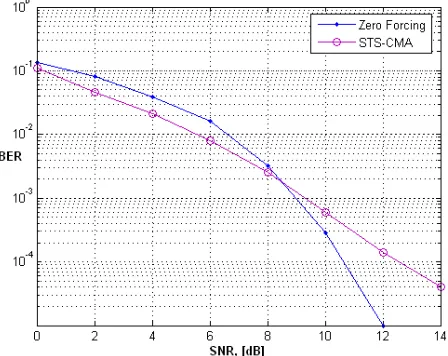
Figure 4: BER curve for the derived STS-CM Algorithm.
subchannel impulse responses to define a power profile, from
[image:5.612.56.281.274.470.2]which 50 Rayleigh distributed ensemble probes are drawn. The BER performance of the proposed algorithm and the Zero-Forcing receiver averaged over the 50 runs is shown in Fig. 4 over a range of SNR values. It can be clearly observed that the new algorithm performs better over low SNR values. This is due to the noise amplification inherent in the matrix inversion operation of the Zero-Forcing algorithm. When the SNR increases beyond 8dB, the performance of the derived algorithm drops in comparison to that of the Zero-Forcing receiver, which can be expected since the former assumes no knowledge of the channel.
6. CONCLUSION
In this paper, a novel algorithm based on the Constant Modu-lus (CM) criterion has been derived for the blind equalization of STS systems over frequency selective channels. Similar to FIRMER-CMA derived in [1], the new algorithm forces the constant modulus property of the matched filtered signals of the user of interest rather than the immediate equalizer out-puts, and therefore implicitly achieves orthogonality of the extracted signals.
Extensive computer simulations have been performed to highlight the stability of the algorithm, whereby some rep-resentative results have been presented here. The noise per-formance of the derived algorithm has been compared to that of the Zero-Forcing equalizer. Over low SNRs, the derived algorithm achieves better performance without the need for any Channel State Information (CSI).
REFERENCES
[1] M. Hadef, S. Weiss, and M. Rupp, “Adaptive blind mul-tiuser DS-CDMA downlink equaliser,” Electronics Let-ters,41(21): 1184–1186, 2005.
[2] S.M. Alamouti, “A Simple transmit Diversity Technique for Wireless Communications,” IEEE Journal on Se-lected Areas in Commus,16(8): 1451–1458, 1998. [3] R.M. Buehrer, R. Soni, and J., -A. Tsai, “Downlink
Di-versity in CDMA Using Walsh Codes”,Engineer’s Note JW9 111 000-990 218-01EN, : Feb 1999.
[4] B. Hochwald, T.L. Marzetta, and C.B. Papadias, “A Transmitter Diversity Scheme for Wideband CDMA Systems Based on Space Time Spreading,” IEEE Jour-nal on Selected Areas in Comms.,19(1): 48–60, 2001. [5] O. Kirkeby, P.A. Nelson, H. Hamada, and F.
Orduna-Bustamante, “Fast Deconvolution of Multichannel Sys-tems Using Regularization,”IEEE Trans. on Speech and Audio Processing,6(2): 189–195,1998.
[6] Dominique N. Godard, “Self-Recovering Equalization and Carrier Tracking in Two-Dimensional Data Commu-nication Systems,”IEEE Trans. on Comms. [legacy, pre-1988],28(11): 1867–1875, 1980.
[7] D.T.M. Slock, “Blind joint equalization of multiple syn-chronous mobile users using oversampling and/or mul-tiple antennas,” Proc.28th Asilomar Conf. on Signals, Systems and Computers,,2: 1154–1158, 1994.
[image:5.612.58.282.511.689.2]