City, University of London Institutional Repository
Citation
:
Geng, Y., Chen, J., Jimenez-Ruiz, E. ORCID: 0000-0002-9083-4599 and Chen,
H. Human-centric Transfer Learning Explanation via Knowledge Graph [Extended Abstract].
Paper presented at the AAAI-19 Workshop on Network Interpretability for Deep Learning, 27
- 28 January 2019, Honolulu, Hawaii, USA.
This is the accepted version of the paper.
This version of the publication may differ from the final published
version.
Permanent repository link:
http://openaccess.city.ac.uk/id/eprint/22934/
Link to published version
:
Copyright and reuse:
City Research Online aims to make research
outputs of City, University of London available to a wider audience.
Copyright and Moral Rights remain with the author(s) and/or copyright
holders. URLs from City Research Online may be freely distributed and
linked to.
Human-centric Transfer Learning Explanation via Knowledge Graph
[Extended Abstract]Yuxia Geng
1, Jiaoyan Chen
2, Ernesto Jim´enez-Ruiz
3,4, Huajun Chen
1,51College of Computer Science, Zhejiang University, China
2Department of Computer Science, University of Oxford, UK
3The Alan Turing Institute, London, UK
4Department of Informatics, University of Oslo, Norway
5ZJU-Alibaba Joint Lab on Knowledge Engine, China
Abstract
Transfer learning which aims at utilizing knowledge learned from one problem (source domain) to solve another different but related problem (target domain) has attracted wide research attentions. However, the current transfer learning methods are mostly uninter-pretable, especially to people without ML expertise. In this extended abstract, we brief introduce two knowl-edge graph (KG) based frameworks towards human un-derstandable transfer learning explanation. The first one explains the transferability of features learned by Con-volutional Neural Network (CNN) from one domain to another through pre-training and fine-tuning, while the second justifies the model of a target domain predicted by models from multiple source domains in zero-shot learning (ZSL). Both methods utilize KG and its reason-ing capability to provide rich and human understandable explanations to the transfer procedure.
Introduction
Machine learning (ML) systems such as deep neural net-works are becoming increasingly complex for more power. It costs big data and much time for training. Transfer learn-ing refers to a series of ML methods that aim to utilize sam-ples, models or model parameters gained while solving one problem (source domain) to solve another related but
differ-ent problem (target domain) (Panet al.2010). It now has
attracted wide research attentions in reusing learned models in new contexts, dealing with training data shortage, etc.
Transfer learning has shown its effectiveness and effi-ciency in many applications such as using satellite image
features to predict global poverty (Jeanet al. 2016).
How-ever, an arbitrary transfer might decrease the performance in the target domain, which is called a negative transfer. Some work analyze the theoretical or empirical principles to guide the transfer, but do not explain a specific positive or negative transfer. Some other work develop methods to transform the samples or model parameters from source domains towards a target domain, but they are often black-box models.
On the other hand, ML explanation, including model in-terpretation and prediction justification is now becoming a more and more urgent requirement, especially in making critical or safety-sensitive decisions. Among them, human-centric explanation, which is enriched by human
under-standable common sensne and background knowledge (Bi-ran and McKeown 2017), is especially important for none ML experts to optimize a learning system or understand the prediction. However, there are currently few human-centric explanation studies for transfer learning problems.
Knowledge graph (KG), which originally refers to a knowledge base used by Google to enrich its searching re-sults with different data sources, now often means a wide range of semantic data including RDF (Resource Descrip-tion Framework) graph, OWL (Web Ontology Language) ontology, Linked Data and so on. It’s widely used to model common sense or background knowledge with the potential of knowledge representation and reasoning. In this paper, we introduce our idea and framework that utilize KGs to support human-centric explanation of transfer learning with two case studies. The first case study is pair-wise feature transferability explanation. We infer evidences from explicit ontology axioms (facts) to understand the transferability of features learned by Convolutional Neural Networks (CNNs).
The second case study iszero-shotlearning eXplanation
(X-ZSL). We use external knowledge to justify the CNN of a new class (i.e., class unseen in the training data) predicted by a Graph Convolutional Network (GCN) with CNNs of training classes.
Feature Transferability Explanation
We assume features learned by a CNN is transferred from a
source domainDαto a target domainDβ, whereDαhas a
large training sample set whileDβhas a small training
sam-ple set. A feature transfer fromDαtoDβ, denoted asFα→β
includes three steps:(i)pre-train a CNN with samples from
Dα,(ii)transfer (reuse) the parameters from the input layer
to a specific convolutional layer, which corresponds to a
spe-cific feature, and(iii)fine tune the CNN with samples from
Dβ. The model trained withFα→β is denoted asMα→β,
while the model trained with samples inDβalone is denoted
as Mβ.Fα→β is defined as apositive transfer if Mα→β
outperformsMβon the testing sample set fromDβ, and a
negative transferotherwise.
We use OWL ontologies (expressive KGs) to model the background knowledge and data for human-centric expla-nation. In particular, each domain has an ontology
com-posed of a terminology axiom setT and an assertion
A models the data. Each ontology axiom is equal to a fact of the domain. Considering a case of flight de-parture delay forecasting in US, and a domain identi-fied by the carrier Delta Airline (DL), the original airport LAX and the target airport ORD, the domain’s
terminol-ogy axioms include concept definitions e.g., Carrier �
∃hasStockP rice.F loat � ListCarrier, relation
defini-tions e.g., hasCarrier ◦ hasCarHub � hasDepHub,
etc., while its assertion axioms include individuals e.g.,
LAX,DL anddep(representing a flight departure),
indi-vidual classifications e.g.,Airport(LAX), individual
rela-tionslocatedIn(LAX, CA), etc. Such an ontology has the
capability of reasoning , namely inferring underlying axioms
e.g.,hasDepHub(dep, LAX), and can be aligned with
ex-ternal KGs for knowledge enrichment.
We use explanatory evidences to interpret the
transfer-ability of features. An explanatory evidence is an ontol-ogy axiom or a combination of ontolontol-ogy axioms whose co-existence in the source and target domains is highly corre-lated with the transferability of a feature. We aim at discov-ering a set of positive (negative) explanatory evidences that can explain the positive (negative) transferability of a spe-cific transfer (cf. Example 1).
Example 1. (Explanatory Evidence)In the above case of
flight departure delay forecastsing, considering three learn-ing domains:D(DL,ORD,LAX)for Delta Airlines from ORD to LAX, D(B6,LAX,J F K) for JetBlue from LAX to JFK
andD(AA,ORD,SF O) for American Airlines from ORD to
SFO, for a specific CNN feature, let axiom combination
“locatedIn(ori, East)” and “ListCarrier(car)” be an
example of positive explanatory evidence, let axiom combi-nation “hasOri(dep, ORD)” and “locatedIn(des, CA)” be an example of negative explanatory evidence, human be-ings can understand the feature’s transferability as “the transfer fromD(DL,ORD,LAX)toD(AA,ORD,SF O)is posi-tive as the original airport of both source and target domains is located in the east part of US and the carrier of both is list airline company” and “the transfer fromD(DL,ORD,LAX) toD(B6,LAX,J F K)is negative as the original airport of both source and target domains is ORD and the destination air-port of both is located in California”.
Framework and Technical Challenges
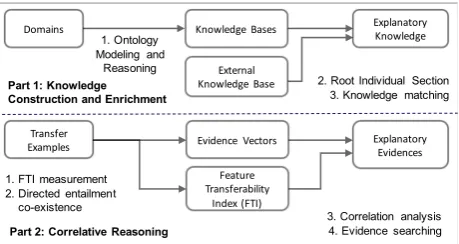
Figure 1 presents the computation framework for explana-tory evidences of feature transferability. It mainly includes
two parts:(i)knowledge construction and enrichment, and
(ii)correlative reasoning for evidence inference.
Knowledge construction refers to the modeling of back-ground knowledge and data of a domain with an ontol-ogy, while knowledge enrichment refers to align individ-uals of initial ontology with instances of external KGs like DBPedia so as to importing more background and common sense axioms. This part finally leads to a com-plete ontology mentioned above. For example, axioms
hasDepHub(dep, LAX) and ListCarrier(DL) depend
on some external knowledge about DL’s stock price and DL’s relationship with LAX.
In this part, one technical challenge is selecting a part of
indviduals (calledroot individuals) instead of all the
indi-Domains Knowledge Bases Explanatory Knowledge External
Knowledge Base
1. Ontology Modeling and
Reasoning
Part 1: Knowledge Construction and Enrichment
2. Root Individual Section 3. Knowledge matching
Transfer Examples
Feature Transferability
Index (FTI)
Evidence Vectors Explanatory Evidences
Part 2: Correlative Reasoning
3. Correlation analysis 4. Evidence searching 1. FTI measurement
[image:3.595.313.543.87.209.2]2. Directed entailment co-existence
Figure 1: The Computation Framework for Explanatory Ev-idences for Feature Transferability
viduals to match, in order to keep the completeness of ex-planatory evidences but reduce the computation and storage.
Our previous work (Chenet al.2018) presents a solution. It
selects effective and important axioms according to the pre-diction task, and adopts the individuals involved in such ax-ioms. Another challenge is ensuring accuracy in matching, which is under work now.
Correlative reasoning is an algorithm that infers the cor-relation between a feature’s transferability and a candidate evidence’s co-existence in source and target domains from a set of given transfers. An axiom or axiom combination is selected as a positive (negative) evidence if the correla-tion coefficient exceeds a positive (negative) threshold and is significant in statistic testing.
In correlative reasoning, one challenge is measuring the transferability of a feature. We consider the feature’s
sep-cificity and generality according to (Yosinski et al.2014).
Another challenge is searching axiom combinations for ex-planatory evidences. We search from low dimension to high dimension, and propose an early stop mechanism and fast extension mechansim for acceleration. More details of cor-relation reasoning and our solutions to the challenges are
presented in (Chenet al.2018).
With such human understandable explanations to the transferability of CNN features, none ML experts can
opti-mize a transfer learning procedure by(i)finding out when to
transfer (i.e., at which convolutional layer) for given source
and target domains, and(ii)selecting what source domains
to transfer for a given target domain. However, the evalua-tion of explanatory evidences, such as their generalizaevalua-tion (i.e., performance in applying evidences inferred from one set of transfers to another set of transfer) and quality, is still an open problem.
Zero-shot Learning Justification
Zero-shot learning (ZSL) is to categorize samples of new classes (i.e., classes unseen in the training data) by trans-ferring features from seen classes (i.e., classes of the train-ing data) without any additional sample annotation effort
(Palatucciet al.2009). However, the transferring process is
Felidae Felinae subclass Pantheriinae Felis Cat Serval Cheetah Tiger Lion subclass subclass subclass subclass subclass subclass subclass Leopard subclass White Tiger subclass Manchurian Tiger subclass Cat Cheetah Serval
ZSL Class Entity (i.e., ZSL Class) Properties
Entity(i.e., ZSL Class) Description (e.g., anchor text)
Seen Class
Cat (Cat, ear_shape,Sharp)
The domestic cat (Felis catus or Felis silvestris catus, informally Felis domesticus) is a small, usually furry, domesticated, carnivorous mammal.The cat species is commonly kept as a pet.
Cheetah
(Cheetah, coat_color, Golden yellow)
This is a large cat of the subfamily Felinae. It has several distinctive features – a slender body, spotted pelage, a small rounded head, long thin legs and a long spotted tail.
Unseen Class Serval
(Serval, ear_shape, Sharp)
(Serval, coat_color, Golden yellow)
[image:4.595.115.483.86.204.2]The serval, Leptailurus serval or Caracal serval, known in Afrikaans as Tierboskat, "tiger-forest-cat", is a medium-sized African wild cat. Facial features include the round eyes, white whiskers on the snout and near the ears, ears as large as those of a domestic cat.
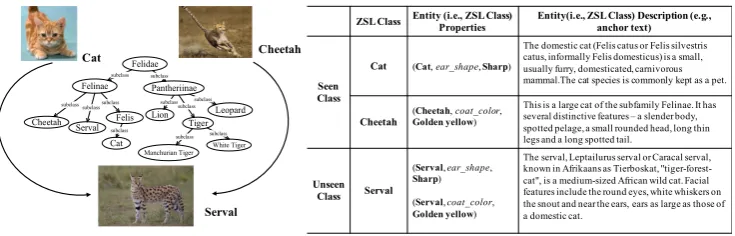
Figure 2: An example of KG-based ZSL, whereServal, a kind of animal with a cat-like face and a cheetah-like body is an
unseen class, whileCatandCheetahare two of the seen classes. A ZSL algorithm is to automatically generate the classification
model forServal, by transferring features from other seen classes using entity relations (graph structure), entity properties and
descriptions of a KG (e.g., (Wanget al.2018; Kampffmeyeret al.2018)). Each class in ZSL is equivalent to an entity in KG.
without ML expertise.
[image:4.595.309.544.276.449.2]An example of KG-based ZSL classification is shown in
Figure 2, where testing samples of an unseen classServalis
to be classified. We first assume that a ZSL method builds
a model forServal by transferring the feature knowledge
from a set of seen classes, according to their internally im-plicit and close relationships in semantics of class (KG en-tity) name, description, property and hierarchical structure. The target of our X-ZSL method is to find out some evi-dences to justify why the generated prediction model for the
unseen classServalis reasonable, with the help of common
sense and background knowledge of these classes. One
ex-ample to justify this model is ”the two seen classesCatand
Cheetahplay an import role in transferring features to
Ser-val, while they share the same ancestorsFelinae.” It utilizes
thesubClassOf relation between entities in the KG.
An-other justification example is “the two seen classesCatand
Cheetahtransfer their local features to the visual features of
Serval, as the ear shape ofServalandCatare bothSharp, andServal has the sameGolden yellowcoat asCheetah.” These evidences are supported by the shared properties of
SharpandGolden yellowin the KG.
Technical Framework
Our ZSL justification framework includes two modules: a KG-based ZSL classifier and an justification generator, as shown in Figure 3. The classifier learns to predict the model of unseen classes with a Graph Attention Network (Velick-ovicet al.2017). It is able to learn the attentions of the seen classes, from which we can select impressive ones. The ex-planation generator extracts convincing justifications from the KG according to the impressive seen classes, using class name to entity matching, SPARQL queries and reasoning.
KG-based ZSL Classifier We first build a hierarchy
structure among all classes via knowledge graph, where each entity models one class. With the graph input, we use a kind of Graph Neural Network called Graph Attention Network
(GAT) (Velickovicet al.2017) to transfer the features from
different unseen classes (entities) to each seen class with convolutional layers and attention layers. With the transfer,
K G G ra p h C o n v L ay er A tte n tio n L ay
er 𝛼"
𝛼#𝛼$ 𝛼% Entity Matching & SPARQL queries KG (e.g. DBPedia) entities, e.g., dbr:Cat,
dbr:Cheetah
triples, e.g, (dbr:Cheetah, rdfs:subClassOf
dbr:Felinae
Explanation
Explanation Generator KG-based ZSL Classifier
Attentions & Impressive Seen Classes
Figure 3: The technical framework for ZSL justification. The KG-based ZSL classifier learns the attention weight of seen
classes (αi) w.r.t. an unseen class. Those with high
atten-tions are selected as justification evidences. The explanation generator utilizes the KG (e.g., DBPedia) to obtain common sense and background knowledge to enrich the justification evidences so that common people can understand.
we eventually use logistic regression to predict a CNN clas-sifier for an unseen class (i.e., the combination parameters of pre-trained CNN features).
For each convolutional operation, GAT leverages a self-attention mechanism to update the features distribution of entities in the graph, where one entity includes features from its neighborhoods. So we can assign different weights to dif-ferent entities in a neighborhoods. We also realize that not all seen classes contributes equally to the transferring to an un-seen class. Thus the attention-weighted un-seen classes in the transferring process are extracted. Those seen classes with
high attention weights in transferring are calledimpressive
classes. They are selected as evidences for justification. Current KG-based ZSL methods utilize the graph
2018), but ignore the semantics from properties. To fully uti-lize the semantics of a KG, we transform some entity
proper-ties from the KG to so calledanonymous entities, which is a
knowledge representation and reasoning technique. Besides improving the accuracy of ZSL classifier, this will provide additional justification evidences.
Explanation Generator Some external KGs contains rich
common sense and background knowledge. For example, DBPedia includes knowledge extracted from Wikipedia, with 4.58 million entities. We utilize such KGs to enrich the extracted justification evidence so that common people can understand.
Each class name is matched with an entity of the ex-ternal KG by lexical index, which is built based on en-tity descriptions. For example, we can use the lookup
ser-vice provided by DBPedia1. As shown in Figure 3, Cat
and Cheetah are matched the KG entity �dbr:Cat� and
�dbr:Cheetah�respectively2. The triples composed of
en-tities and their relationships can form a hierarchical struc-ture among entities that paired with same relations, e.g.
�dbr:Cheetah,rdfs:subClassOf, dbr:F elinae� is a
sin-gle unit in hierarchical graph in Figure 2. On the other hand, the rich triples also contain some properties about entities,
such as theEntity Propertycolumn in the table of Figure 2.
We then access moreentitiesandtriplesof the external
KG, that are related to the impressive seen classes (justifica-tion evidences), using an SQL-like query language for RDF called SPARQL which can support knowledge reasoning. With returned entities and triples, we enrich the evidence to justify the generation of the classifier of each unseen class, during which some hand-crafted templates may be needed. The challenge here is to select and evaluate the returned en-tities for high quality explanation.
Text description of the returned entities from the external KG can also be used to enrich the explanation. However, the noise of text description is a challenge to deal with.
Conclusion and Outlook
Transfer learning is playing a more and more important role in building complex ML systems, but the methods are still uninterpretable, especially to none ML experts. In this pa-per, we introduce our KG-based methods to provide human-understandable evidence for feature transferability explana-tion and ZSL justificaexplana-tion. For the former, we infer evi-dences from axioms of OWL ontologies to explain the trans-ferability of features learned by a CNN, while for the later, we use entity relations and properties (RDF triples) to jus-tify the classification model generated for an unseen class. Different KG techniques, including ontology modeling, se-mantic reasoning, knowledge matching, sese-mantic query and so on are incorporated for high quality explanations.
Although the solutions to the two transfer learning prob-lems are different and there are quite a few challenges to deal with, two core and common technical problems for
1https://github.com/dbpedia/lookup
2dbr represents http://dbpedia.org/resource, a URI prefix of
DBPedia.
human-centric transfer learning explanation in our mind are knowledge matching and explanation evaluation. Knowl-edge matching refers to matching ML data (often in tabular format) with KG e.g., classes in ZSL with entities in DBPe-dia, or matching one KG with another KG. It significantly impacts the quality of explanations. In the future work, we will apply a hybrid matching approach combing lexical in-dex, semantic reasoning and deep learning (cf. our work
ColNet (Chenet al.2019) and BootOX/LogMap
(Jim´enez-Ruizet al.2015)). While for explanation evaluation, we will feed human knowledge back to the transfer learning system through the explanation.
Acknowledgments
The work is supported by NSFC 91846204/61673338 and the SIRIUS Centre for Scalable Data Access (Research Council of Norway, project 237889).
References
Or Biran and Kathleen R McKeown. Human-centric
justi-fication of machine learning predictions. InIJCAI, pages
1461–1467, 2017.
Jiaoyan Chen, Freddy L´ecu´e, Jeff Z Pan, Ian Horrocks, and Huajun Chen. Knowledge-based transfer learning
explana-tion. InKR, 2018.
Jiaoyan Chen, Ernesto Jim´enez-Ruiz, Ian Horrocks, and Charles Sutton. Colnet: Embedding the semantics of web
tables for column type prediction. InAAAI, 2019.
Neal Jean, Marshall Burke, Michael Xie, W Matthew Davis, David B Lobell, and Stefano Ermon. Combining satellite
imagery and machine learning to predict poverty. Science,
353(6301):790–794, 2016.
Ernesto Jim´enez-Ruiz, Evgeny Kharlamov, Dmitriy
Zheleznyakov, Ian Horrocks, Christoph Pinkel, Martin G Skjæveland, Evgenij Thorstensen, and Jose Mora. Bootox:
Practical mapping of rdbs to owl 2. In International
Semantic Web Conference, pages 113–132. Springer, 2015. Michael Kampffmeyer, Yinbo Chen, Xiaodan Liang, Hao Wang, Yujia Zhang, and Eric P Xing. Rethinking knowledge
graph propagation for zero-shot learning. arXiv preprint
arXiv:1805.11724, 2018.
Mark Palatucci, Dean Pomerleau, Geoffrey E Hinton, and Tom M Mitchell. Zero-shot learning with semantic output
codes. InNIPS, pages 1410–1418, 2009.
Sinno Jialin Pan, Qiang Yang, et al. A survey on transfer
learning. IEEE Transactions on knowledge and data
engi-neering, 22(10):1345–1359, 2010.
Petar Velickovic, Guillem Cucurull, Arantxa Casanova, Adriana Romero, Pietro Lio, and Yoshua Bengio. Graph
attention networks.arXiv preprint arXiv:1710.10903, 2017.
Xiaolong Wang, Yufei Ye, and Abhinav Gupta.
Zero-shot recognition via semantic embeddings and knowledge
graphs. InCVPR, pages 6857–6866, 2018.
Jason Yosinski, Jeff Clune, Yoshua Bengio, and Hod Lipson. How transferable are features in deep neural networks? In