Conway, Alastair and Ion, William and Lynn, Andrew (2009) Knowledge
Enhanced Notes (KEN). In: International Conference on Engineering
Design 2009, 2009-08-24 - 2009-08-27, Stanford University. ,
This version is available at
https://strathprints.strath.ac.uk/30576/
Strathprints is designed to allow users to access the research output of the University of Strathclyde. Unless otherwise explicitly stated on the manuscript, Copyright © and Moral Rights for the papers on this site are retained by the individual authors and/or other copyright owners. Please check the manuscript for details of any other licences that may have been applied. You may not engage in further distribution of the material for any profitmaking activities or any commercial gain. You may freely distribute both the url (https://strathprints.strath.ac.uk/) and the content of this paper for research or private study, educational, or not-for-profit purposes without prior permission or charge.
Any correspondence concerning this service should be sent to the Strathprints administrator:
The Strathprints institutional repository (https://strathprints.strath.ac.uk) is a digital archive of University of Strathclyde research outputs. It has been developed to disseminate open access research outputs, expose data about those outputs, and enable the
INTERNATIONAL CONFERENCE ON ENGINEERING DESIGN, ICED’09
24 - 27 AUGUST 2009, STANFORD UNIVERSITY, CALIFORNIA, USA
K N OWLEDGE EN H AN CED NOT ES (K EN )
A P Conway, W J Ion & A Lynn
Department of Design, Manufacture & Engineering Management, University of Strathclyde
ABSTRACT
To aid the creation and through-life support of large complex engineering products, organisations are placing a greater emphasis on constructing complete and accurate records of design activities. Current documentary approaches are not sufficient to capture activities and decisions in their entirety and can lead to organisations revisiting and in some cases reworking design decisions in order to understand previous design episodes. This paper presents an overview of the challenges in creating accurate, re-usable records of synchronous design activities, enhancing the through-life support of engineering products, followed by the development of an information capture software system to address these challenges. The main objectives for the development of the Knowledge Enhanced Notes system are described followed by the techniques chosen to address the objectives, and finally a description of a use-case for the system. Whilst the focus of the KEN System was to aid the creation and through-life support of large complex engineering products through constructing complete and accurate records of design activities, the system is entirely generic in its application to synchronous activities.
Keywords: design information, information capture, knowledge capture, synchronous working
1 I N T RODU CT I ON
Much of human history and what we know of how the world has been shaped over the centuries has come from surviving written accounts, paintings or documents constructed from witness’s recollections. However, as new and advanced scientific technology becomes available, the accuracy of much of these recollections and records of events are increasingly thrown into question. Reliance upon human memory and opinion can often lead to inaccuracies and distorted viewpoints, and as one of the 20th century’s greatest thinkers is reputed to have stated:
"(Human) memory is deceptive because it is coloured by today's events." (Albert Einstein)
It was not until 1825 that the first entirely accurate, permanent record of an instance in time was successfully captured, in what was to be the world’s first photograph. Since then the use of audio-visual technology has greatly enhanced the capture of historical events, and our understanding of what occurred in recent history. One only has to enter phrases such as “World War”, “Apollo Moon Mission” or “Berlin Wall” into an internet search engine and we are provided with an array of documents, reports, images and video which captured these events as they occurred, providing future generations with entirely accurate representations of many of these significant events in human history.
not simply on the artefact being developed but on the process through which this development occurs. However, previous studies show that current documentary approaches are ineffective in documenting activities and decisions accurately [6, 7, 8, 9], leading to organisations revisiting and even reworking design decisions in order to fully understand previous design rationale.
2 BACK GROU N D
When undertaking large collaborative engineering design projects, the effective use and understanding of working synchronously becomes critical to the success of the project. In engineering design, working synchronously involves individual designers and/or team members working on the same activity at the same time. Synchronous design episodes involve key activities such as communication, negotiation and team learning. Efficient communication is critical to achieving better co-operation and co-ordination among members of a design team and creating accurate and reusable records of decisions and activities become fundamental. During the undertaking of design and development activities, greater emphasis must be put upon capturing the design activities in their entirety, allowing richer, more accurate records to be constructed. Achieving efficient processes of sharing product and process data within collaborative teams is also a key factor in influencing the successful implementation of design teams. Fruchter [10] made the following observation on conventional synchronous design activity records;
Information in the form of text, calculations, graphics and drawings is captured in paper or computer based forms. Unfortunately, much of the design intent in a design dialogue is lost because it is partially documented. The final decision tends to be recorded but much of the interaction and developmental thinking of a design discussion is not.
As highlighted by Fruchter, throughout the undertaking of the design process, a large quantity of information and data is generated, not only on the object being designed, but on the decisions, the rationale, the reasoning and also the application of past experience. The challenge is to make this information explicit so that it can be captured and re-used in future projects and activities as well as during the product life. Further more, once information has been captured it must be stored in a form that allows uncomplicated and rapid retrieval within collaborative environments, whether for synchronous or asynchronous use. As highlighted previously, activities such as synchronous design meetings are forums where valuable information and knowledge is communicated between participants, quickly and sometimes informally, making both the recognition and accurate documenting of these information exchanges extremely difficult. In many cases subsequent decisions are directly linked to this knowledge and information, therefore much of the rationale behind these decisions are lost.
In the past decade, a significant body of work has been undertaken on aiding the capture of information within synchronous engineering design episodes. For this paper, we categorise this body of work as either conforming to the record everything and analyse later method or the analyse and document at the time method. The latter of these approaches utilises emerging technology such as Issue-Based Information Systems (IBIS), documenting the decisions made and the issues resolved using structured argumentations in real-time. However, the IBIS approach fails to record much of the critical dialogue which precedes decisions being taken and thus valuable information goes undocumented. A key element within current live capture approaches is the structuring of the information in a way which can be easily visualised and followed by the users, as it occurs in real time [11]. This is the area in which most IBIS based tools excel [12, 13, and 14]. The structuring of information according to the argumentation effectively provides a ‘road map’ to the design episode, allowing users to follow the development process and understand how the design evolved to the final state, including the right and wrong ‘turns’ which were discussed throughout. However, the real-time display of this information throughout a synchronous design episode could also ‘steer’ the discussion, thus IBIS technologies can be considered to be much more than simply documentation tools, they could be considered as tools which aid the actual development process and influence the direction in which the episode progresses.
recognition. However, this approach results in masses of information being captured, some of which can be regarded simply as noise, resulting in extensive post processing time. Rather than storing everything and attempting to subsequently split the information into smaller subsets, it is proposed that it is more efficient to be selective in the capture of information during the design activity. However, as Moran et al. [6], Huet [8] and Conway et al. [9] highlight during various studies of engineering meetings, the use of multimodal technologies are the most effective method of ensuring accurate, transparent records are created. The key issue therefore is the need to bridge the gap between current live capture and post processing systems by utilising a combination of principles from both.
The issue of documenting meetings accurately is a well defined and researched topic and as a result, a number of commercially produced software systems are available which claim to fulfil this need. For reasons of brevity, this paper will focus on the two key developments as seen by the authors; Microsoft’s Office OneNote system and the Quindi Corporation’s Quindi Meeting Companion software.
OneNote is a software package integrated within Microsoft’s (MS) Office suite of tools and is aimed at providing free-form information gathering and multi-user collaboration in the form of a digital notebook [16]. Core functionality of the system allows users to ‘cut and paste’ multimodal elements of information into a series of ‘pages’ allowing users to quickly record webpages, text, images and video currently in use. However, as the system is integrated within the MS Office suite, OneNote relies upon predefined meeting templates, which are not customisable, limiting the user’s ability to structure the information captured. In addition, the system is specific to Windows operating systems and thus cannot be used on non Windows machines, inhibiting the shareability and usability of the documents. The Quindi Meeting Companion [17] is a dedicated meeting capture tool that has the ability to record and integrate audio, video, notes, and data, including PowerPoint slides, screenshots, and whiteboards into a meeting record file. The system can be configured to unobtrusively record meetings using a combination of video, audio and screen capture technologies, resulting in the creation of a single file automatically indexed by time. A key aspect of the Quindi application is its ability to capture and bookmark individual PowerPoint slides automatically and as the system uses timestamps to organise the data objects, the individual slides are coordinated with corresponding audio and video recordings. Quindi also has the ability to save meeting records as a web page allowing shareability through a standard web browser. However, as with OneNote, the application is specific to Windows operating systems, thus only users with a software license and access to the Quindi file for the meeting can edit make further annotations, hampering the usability.
3 I N FORM AT I ON CAPT U RE AN D ST ORAGE SY ST EM DEV ELOPM EN T
3.1 System requirements
From reviewing existing technology and current research activities in the domain of information capture, it is apparent that easy and unobtrusive capture of information as it is being generated is the key to constructing a comprehensive and accurate project memory. As highlighted previously, the integration of multimodal technologies and the visualisation of data are key elements which further strengthen the development of potential solution. The specific interest within this paper is on the capture and storage of process information and context within a synchronous environment, thus through reviewing and analysing both research literature and commercial systems available, the key requirements can be identified, which would make up the basis of an effective information capture system architecture. Four key requirements are proposed for an effective system:
Distributed Working
Information & Knowledge Capture
The key difference must be the capturing of data as it being generated and the association of metadata with minimal additional effort on the part of the user. In order to allow for more effective data capture solutions, consideration must be given to the physical environment and the use of ancillary devices such as audio and video equipment, mobile devices, laptop computers, digital pens and paper along with desktop computers and various meeting room technologies. Devices such as those highlighted can provide the necessary mechanisms to record information and knowledge as it is generated during the many different design activities as they take place; from the corridor meeting or sketching designs on the train, to the group discussions and design review meetings taking place in designated rooms.
Storage of Data Objects
To turn a repository or database into an effective project memory, key metadata such as time, date, size and file type must be captured and associated with the relevant data. In order to create more effective project memories which can be used 5, 10 or even 30 years into the future, the system must generate as much metadata as possible at the point of capture. By doing this, the system can create data objects constructed from the data file and the associated metadata. These data objects can then be used to construct a comprehensive project memory, i.e. a representation of the activities undertaken throughout the duration of a project.
Creation and Retrieval of Object Views
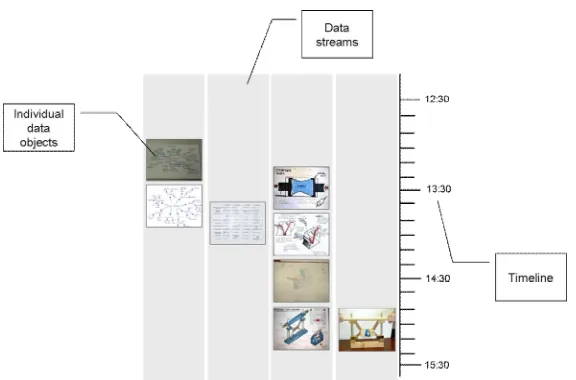
[image:5.595.155.443.426.616.2]An essential factor in the creation of project memories is the retrieval and visualisation of the data. The use of object views within the system would allow for various methods of viewing the data. Any system developed must have the ability to query the database and retrieve data objects, thus a search / query environment must be incorporated. The system should allow project memories to be interrogated from multiple perspectives. For example, the use of timelines linking together sets of data objects would allow the user to view all activities captured between certain periods in the project. By way of illustration, an object view of concept sketches (Figure 1) generated within a certain period of time during a design episode, would give a perspective on the range and scope of concept exploration undertaken by the design team at that point in time.
Figure 1. Object View Illustration - Concept sketches
3.2 System Architecture
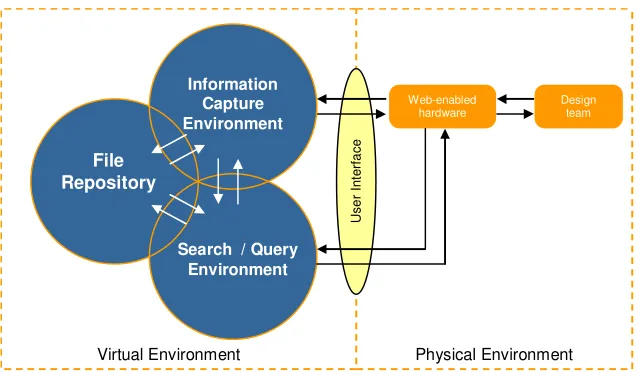
The identification of key requirements for the system provides a platform upon which to develop the system architecture. The system requirements can be grouped into two areas, physical and virtual. Only if the system can adequately support both environments will it become effective in use.
programming languages such as Java, PHP (Hypertext Pre-Processor) or C++ are viable options for developing the necessary software interface.
Web-enabled hardware
Design team
Virtual Environment Physical Environment
Information Capture Environment File Repository U s e r In te rf a c e
[image:6.595.137.456.98.284.2]Search / Query Environment
Figure 2. Information capture and storage system architecture
The virtual environment by contrast should be entirely computationally based, consisting of an information capture environment, a search / query environment and a file repository or storage facility. The information capture environment will be dynamic in nature in that allows the user to create and capture information and knowledge as and when it occurs in a live environment and support the editing and updating of the information at a later instance. Incorporated within the virtual environment is a file repository linked to a database. This repository enables the users to store and access their information irrespective of their location and provides the underlying basis for the system. In order for the user to search and retrieve data objects from the repository, a search and query environment must be included, bridging the gap between the user interface and the repository. The search environment also allow the users to return various views on the data objects contained in the repository, generating multiple perspectives on the data, whether it be by date, user id, title or any other associated metadata. Utilising already available and prominent technologies, the system architecture proposed in Figure 2 satisfies all the necessary system requirements previously highlighted. As well as proposing a viable solution to the problem, this architecture provides a framework upon which software development can be performed, laying down the foundations for the development of an information capture and storage system.
To this end, work has been performed on developing the Knowledge Enhanced Notes (KEN) system, a prototype software system to be used as an effective meeting capture and review tool. KEN possesses the ability to quickly and unobtrusively create richer representations of meetings by displaying and organising multi-modal data objects generated during the meeting, thus providing users with the ability to view meeting records and all associated data utilised. Using pre-defined meeting structure templates and drag and drop file upload facilities, the user has the ability to record not only the decisions and actions specified during meetings, but also to document the rationale generation and exploration activities which in effect led to the decisions and actions being taken.
3.3 Knowledge Enhanced Notes
processing’ where the key factor is that a complete and accurate record of the meeting can be captured using video and audio. The key goal of this work is to enhance the record of activities and decisions made collaboratively and in social situations to allow them to be revisited at later stages in the design process, but without creating additional work for the participants
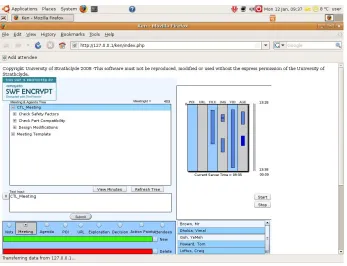
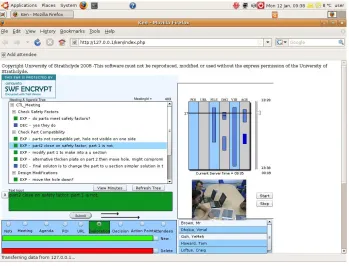
[image:7.595.126.473.190.456.2]The KEN tool itself is web-based software linked to a repository, allowing the user to easily and rapidly create a record of the meeting at the time as opposed to creating digital or paper-based minutes retrospectively. Essentially the software has a three layered structure, an underlying relational database, hypertext pre-processor (PHP) scripts to interrogate the database and a Flash™ based user interface (UI) (Figure 3) to input, retrieve and display objects using the PHP scripts as the data translator.
Figure 3. KEN User Interface
Data objects such as images, video, audio and documents are uploaded to the database using a Flash-based ‘drag and drop’ upload form (Figure 4) and metadata such as time, date, meeting identifier, agenda item etc. automatically associated with the data, relative to the specific point in the meeting at which upload occurs. The PHP scripts convert the object URLs into xml format, allowing the UI to display the data object links as data ‘blocks’ on the meeting timeline. This approach allows users to quickly and easily visualise what objects were presented or used at any given point in the meeting, and as the blocks are directly linked to the relational database, user’s can simply click on the block within the timeline and the relative data file is returned. The KEN interface also possesses the ability to display the data objects in individual data streams with the potential to be fully customisable to specific user’s requirements. By way of example, the prototype KEN system shown in figure 3 was configured to display six individual data streams:
1. Agenda Item 2. Video (.flv format), 3. Images (jpeg format),
4. File (slides, text documents, CAD drawings etc.) 5. Urls (direct links to webpages)
6. POI (points of interest, e.g. user identified key discussion points)
Figure 4. KEN User Interface incorporating drag and drop
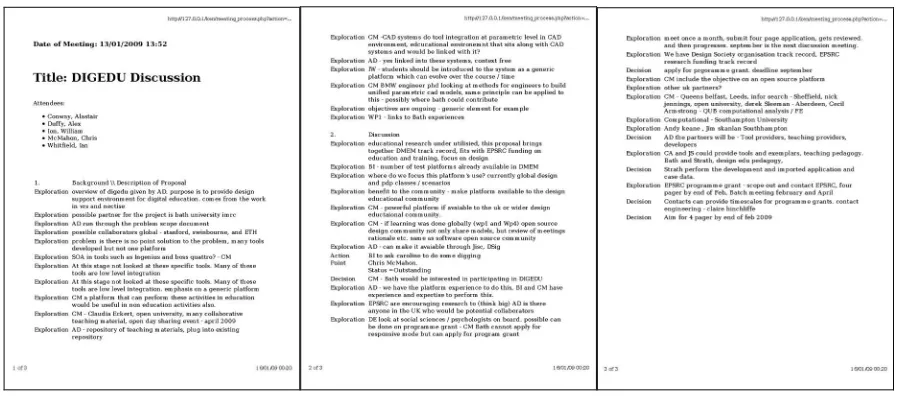
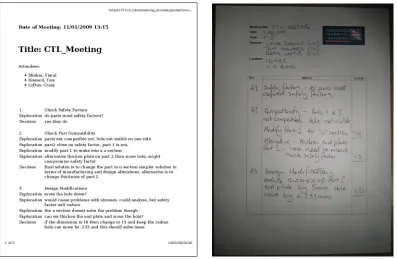
In addition, functionality has been developed which allows the user to create an entirely shareable textual record of the meeting based upon a generic meeting minute template (Figure 5). At any point during the meeting or post meeting, the user has the ability to create and view the current meeting record in a ‘standard minute’ based format. Upon the user selecting the View Minutes function in the KEN UI (Figure 4), the system automatically populates a predefined template document with all recorded data within the database relative to the current meeting. This record displays all the exploration, decision and action points recorded throughout the meeting incorporating metadata such as meeting title, time, date, attendees and agenda points, in effect, replicating a traditional text based meeting record with no additional effort or post processing required by the user.
Figure 5. Meeting ‘minute’ document
[image:8.595.69.518.475.679.2]al. [14, 16] to name but a few. The ability to view all media associated with the meeting at a later date enhances the overall record of the meeting and draws on the principle employed by systems such as Informedia and the Ferret browser whose key selling point is that a richer representation of meeting activities can be captured using video and audio. The key goal of the KEN development is to enhance the record of activities and decisions made collaboratively and in synchronous situations to allow them to be revisited at latter stages in the design process, whilst also supporting the need to document real-time synchronous activities.
4 U SE CASE – SN OWM OBI LE DRI V E SH AFT DESI GN
To demonstrate the potential of the KEN system a series of design episodes were undertaken. Each episode was performed by post graduate engineering design students within the Innovative Design and Manufacturing Research Centre (IdMRC) at the University of Bath. The use case presented within this paper is part of a broader case study, where the embodiment and detail stages of a snowmobile drive shaft design were undertaken for the purposes of testing and validating the system being used within a design episode.
The focus of the design episode presented in this paper was the consideration of the stress values calculated on a beam with respect to material properties and design factors, which would allow an informed decision to be reached on the validity of the design. Within this episode, previously generated documentation such as spreadsheets, calculations, and drawings were used as evidence in the discussions leading to the decision. To analyse the effectiveness of KEN and allow direct comparisons to be formulated, traditional paper-based minutes were also created throughout the activity.
[image:9.595.125.474.474.740.2]Analysis of the traditional and the KEN meeting records highlighted significant differences in the level of information retained as well as benefits of using the software approach. The use of the KEN software to document the activity allowed for the data sources such as images, documents and files to be uploaded and incorporated into the meeting record using the Flash-based drag and drop upload form at the point in the discussion at which they were utilised. As is shown in Figure 5, this allowed these data sources such as the drawings to be synchronised and displayed against the meeting timeline. The addition of information sources such as audio, video and text records created during the activity ensured that a more accurate, browseable, and significantly richer representation of the discussions leading to each decision made was created allowing users to revisit these decisions and gain greater insights into the decision rationale.
In addition to the richer representation of the meeting, a shareable meeting minute document was generated by the KEN system, comparable with the paper-based traditional minute record in structure, information content and also level of detail. However, the key difference between the two records lies in the fact that users were able to generate the KEN minute document automatically and in digital form, ensures the document is inherently more shareable than the paper-based minute which would need post processing to produce the same digital record.
Figure 5. KEN ‘Minute’ Record vs. Traditional Paper-based Minute Record
Overall, the application of the Knowledge Enhanced Notes prototype within case studies such as the episode presented above has served to validate the system’s key objective of providing a more complete depiction of synchronous design activities. The case studies also demonstrate the immediate benefits gained from using the system with respect to post processing and shareability of the design records
5 FU T U RE WORK
A significant area of interest to the authors is the coordination of synchronous and asynchronous design records, where engineers may work as part of a group or as individuals and where different forms of record are necessary to adequately capture the processes and rationale employed in each mode. Further work will explore complimentary approaches to information and knowledge capture within each mode of working with the intention to integrate the synchronous records of activities generated within the KEN system with other asynchronous records created through other, similarly prototypal systems. The combination of information and knowledge capture performed during both asynchronous and synchronous activities has the potential to create a significantly enhanced overall design process model and record, enhancing not only the through-life support of the product but also subsequent projects.
In addition to the use cases presented within this paper, the Knowledge Enhanced Notes prototype system has been piloted within several synchronous design related meetings within a large UK defence contractor. Validation and testing of the system within the current industrial context will continue with further iterations of the prototype expected throughout the validation process.
6 CON CLU DI N G REM ARK S
create richer and more accurate records of synchronous design activities. The development of enhanced documentary systems complimented with multi-modal data objects such as audio and video has the potential to improve the recording of knowledge and information for re-use at latter instances in the product lifecycle. The aim is to assist design engineers to record more information than traditionally documented, providing a much richer product history and allowing the design process to be revisited and subsequently reused. If design engineers are to capture information and knowledge with a view to re-use at later stages in the product lifecycle then the focus must be on developing rapid, effective methods of capturing information at the point at which it is generated rather than through retrospective analysis.
The prototypal Knowledge Enhanced Notes (KEN) system introduced within this paper was developed specifically to enhance the capture of discursive and collaborative aspects of synchronous design activities, and in doing so, document not only the discussions and decisions made therein, but also the information resources utilised within such design situations. Through the undertaking of design based case studies, the records generated by the KEN system serve to highlight the possibility of providing a more complete depiction of activities undertaken, and in doing so, provide positive direction for future development of such documentary activities.
7 ACK N OWLEDGEM EN T S
The work presented in this paper is part of a larger investigation on knowledge and information management funded primarily by the Engineering and Physical Sciences Research Council (EPSRC) and the Economic and Social Research Council (ESRC). The “Knowledge and Information Management (KIM) Through-Life Grand Challenge Project” [18] brings together a team of some 70 academics and researchers from 11 UK based universities to look at the knowledge management challenges associated with a move towards through-life product support.
REFERENCES
[1] Ding, L., A. Ball, et al. (2007). Product Representation in Lightweight Formats for Product Lifecycle Management (PLM). Digital Enterprise Technology (DET). Bath, UK.
[2] Davies, A., Brady, T. and Tang, P. (2003). Delivering Integrated Solutions. SPRUCENTRIM, Brighton.
[3] Oliva, R. and Kallenberg, R. (2003) Managing the transition from products to services. International Journal of Service Industry Management, 14(2), 160-172.
[4] Prencipe, A (2003) The Business of Systems Integration, Andrew Davies and Mike Hobday (Eds.); Oxford University Press, ISBN 0-19-926322-1.
[5] Morelli, N. (2003) ‘Product-Service Systems: a Perspective Shift for Designers. A Case Study: the Design of a Telecentre’, in Design Studies.
[6] Moran, T., L. Palen, et al. (1997). “I’ll Get That Off the Audio”: A Case Study of Salvaging Multimedia Meeting Records. CHI'97. Atlanta, GA, USA.
[7] Lalanne, D., A. Lisowska, et al. (2005). The IM2 Multimodal Meeting Browser Family. Joint IM2 Technical Report.
[8] Huet, G. (2006). Design Transaction Monitoring: Understanding Design Reviews For Extended Knowledge Capture. Mechanical Engineering, University of Bath. Doctor of Philosophy: 298 [9] Conway, A. P., A. J. Wodehouse, et al. (2007). A Study of Information and Knowledge
Generated During Engineering Design Meetings. International Conference on Engineering Design (ICED). Paris, France.
[10] Fruchter, R. (1996). Interdisciplinary communication medium in support of synchronous and asynchronous collaborative design. International Conference of Information Technology in Civil and Structural Engineering Design. University of Strathclyde, Glasgow.
[11] Conklin, J. (2003). Dialog Mapping: Reflections on an Industrial Strength Case Study.
Visualising argumentation:software tools for collaborative and educational sense-making. P. A. Kirschner, S. J. Buckingham-Shum and C. S. Carr. London, Springer-Verlag.
[12] Bracewell, R. H., S. Ahmed, et al. (2004). DRed and design folders: a way of capturing, storing and passing on knowledge generated during design projects. ASME International Design Engineering Technical Conferences & Computers and Information in Engineering Conference. Salt Lake City, Utah, USA,.
Chichester, John Wiley & Sons, Ltd.
[14] Bracewell, R. H., M. Gourtovaia, et al. (2007). Extending Design Rationale to Capture an Integrated Design Information Space. International Conference on Engineering Design (ICED), Paris, France.
[15] Hauptmann, A. G. (1995). Speech Recognition in the InformediaTM Digital Video Library: Uses and Limitations. 7th IEEE International Conference on Tools with Artificial Intelligence. Washington DC USA.
[16] Microsoft OneNote (2007) Retrieved 15th December, 2008 from http://office.microsoft.com/en-us/onenote/default.aspx
[17] Quindi Corporation (2008) “Getting the Word Out: Improving Team Communication Through Captured Meetings” White Paper, available online from http://www.quindi.com/whitepaper.htm [18] McMahon, C., G. Burt, et al. (2006). "Knowledge and Information Management (KIM) Grand
Challenge Project." Retrieved 15th April, 2007, from http://www-edc.eng.cam.ac.uk/kim/
Contact: Alastair Conway University of Strathclyde
Advanced Forming Research Centre DMEM Research Suite
75 Montrose Street Glasgow, G1 1XJ United Kingdom
Phone: +44(0) 141 548 2374 e-mail: [email protected]