Export to Expand: A conceptual examination of branding as a
deterministic parameter in export performance.
1. Introduction
Branding is seen as critical and decisive within the marketing literature (De Chernatony, 2010; Keller, 2012; Sundar & Noseworthy 2014) Though with the exception of Zou et al. (2003) work relating to the effects of marketing capabilities on export performance and Spyropoulou et al’. (2009) work providing an examination of branding advantage within export ventures; international brand management, antecedents of branding advantage and the cultivation of brand equity in foreign markets as a prerequisite for sustained export
performance has been overlooked. Particularly when considering branding in the context of business-to-business (B2B), there is a complete absence of international B2B branding research (Mudambi, 2002; Van Riel et. al. 2005; Chen et. al. 2011). Despite the fact that globally over 95% of all businesses are considered to be SMEs (OECD, 2014), there is a striking discrepancy in previous research relating to brand management and brand equity, which focuses, only on LOs (large organisations) and multinationals (Krake, 2005).
There are a number of gaps that can be identified in the extant literature. Firstly, low exporting performance for B2B SMEs may relate to a limited scope of academic
investigation, which has failed to address the impact of international brand management skills and the cultivation of brand equity in foreign markets. Secondly given buyers reliance on the brand as a cue for uncertainty avoidance associated with the purchase decision (Swait & Erdum, 2007) the extant literature has yet to provide evidence regarding the extent to which international B2B buyers with differing cultural backgrounds rely on and use brands as signals of quality and trustworthiness to reduce the uncertainty associated with the
transaction. A third gap is the deficiency within previous literature to identify and distinguish criteria for international branding capabilities that differ from their antecedent generic
capabilities. Finally a fourth very important gap in extant literature is the failure to
incorporate the views and perceptions of actual and potential international customers within the research agenda.
We seek to further interest within this area by conceptualizing the key constructs. Our method is discovery led, essentially drawing on literature and previous frameworks from marketing and other business related disciplines. Yadov (2010) indicates a decline in conceptual research and appearance in top publications is damaging to advancement in the field of Marketing since conceptual papers not only provide new ideas but also they are disproportionately more influential. Hence, the purpose of this paper is to advance the extant conceptualization regarding the antecedents of brand performance in the hope to: 1) To uncover and explore key parameters such as branding that are important for export performance but yet have previously been ignored in the literature. Thus allowing future researchers to guide their efforts towards addressing the impact of branding to improve both the academic investigation and the resulting understanding of export performance.
perspectives used to explain export variations across firms, followed by a brief literature review and a set of propositions. Recommendations for further research conclude this paper. 2. Theoretical Perspective of Export Performance
Commonly held views within marketing literature decree that the RBV (Resource based view) or the CP (contingency paradigm) or a combination of both can be used to explain export performance. RBV in particular has become prevalent and there is a broad consensus in the literature (Kaleka 2002; Zou et al 2003; Morgan et al 2004) that resources’ and capabilities are fundamental drivers of competitive advantage and performance in export markets (Spyropoulou et al. 2011). The CP approach posits there is no one best strategy related to performance (Hofer, 1975; La et al, 2009) and therefore export strategies should align resources depending on specific target export markets (Xu, Cavushil, & White, 2006).
The Resource Based View of The Firm (RBV)
The Resource Based View of the firm (Penrose 1959; Makadok 2001;Barney, 2014)
underlies and justifies the importance of the internal determinants of export performance. In brief, under the RBV a firm represents a collection of heterogeneous physical and human resources as well as capabilities. This heterogeneity in the resources and capabilities explains variations in firm performance (Makadok 2001; Barney & Hesterly 2012). Superior
performance relative to other firms in the same market is then possible through the
acquisition and/or development of unique resources and capabilities (Dhanaraj and Beamish 2003). Barney (1991) argues that only those resources which are simultaneously valuable and rare can generate competitive advantage and for this competitive advantage to be sustained, the resources must be both hard to imitate and impossible to substitute, since otherwise the advantage could be competed away over time.
The Contingency Paradigm (CP)
The Contingency Paradigm, with origins in the Structure-Conduct-Performance framework of industrial organisation (Cavusgil and Zou 1994), drives the identification of external drives of exporting performance. According to the CP, companies are dependent on their
environments for resources (Pfeffer and Salancik 1978); and try to manage this dependence by developing and maintaining appropriate strategies (Hofer and Schendel 1978). Clegg & Lardy (1999) assert that contingency factors such as strategy, size, task uncertainty and technology are organisational characteristics, which reflect the influence of the environment in which the company is located. Exporting activity can therefore be viewed as a company’s strategic reaction to such environmental forces as, for example diminishing domestic sales coupled with intensified competition at home or favourable exchange rates (Katsikeas, Piercy & Ioannidis 1996),which can impede or stimulate the performance of the company.
Advancing the RBV & CP Framework
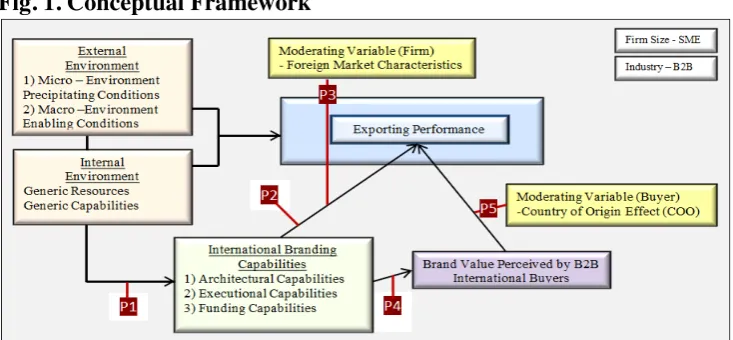
Fig. 1. Conceptual Framework
Fig. 1. Illustrates the key constructs and their interrelationships set within the context firm size SME and industry B2B. Examples of each construct include: External environment offers both the precipitating conditions, such as intensified competition at home or
unsolicited orders from abroad, and the enabling conditions, such as favorable legislation or government export incentives. Internal environment includes generic resources such as human resources or physical resources, and generic capabilities such as manufacturing or innovative capabilities. International branding capabilities include architectural marketing capabilities such as marketing planning and market information acquisition and
interpretation. Executional capabilities involves the ability to enter and grow new markets abroad and managing relationships with new clients acquired in foreign markets, lastly funding capabilities include the size of financial resources devoted to the export venture and the ability to find additional financial resources when needed. The firm moderating variable foreign market characteristics involves cultural similarities and market volatility within the export market. Brand value as perceived by B2B international buyers includes the firm delivered what was required and expected and overall the firm provided better value
compared with other firms with similar offerings. The buyer moderating variable country of origin effect (COO) includes this country is friendly towards the buyers country in
international affairs and products from this country are unreasonably expensive. Finally exporting performance includes market and both financial / non-financial performance.
3. Branding as a Deterministic Parameter of Export Performance
this also applies to their brand management (Krake, 2005). We assert that to successfully export and compete with local overseas competitors SMEs must build their brand on values that are inherently global. Symbolic values are more sustainable in terms of differentiation than functional values (De Chernatony et. al, 2000).
4. International Branding capabilities and Export Performance
There is undoubtedly agreement in the literature that resources and capabilities are central drivers of export performance in export markets (Spyropoulou et al. 2011). In particular, export ventures regularly monitor their performance with regard to desired customer attitudes and behaviors (Katsikeas et. al. 2000), which correlates to strategic brand management practices. An extensive review of literature revealed three international branding capabilities which could be considered as distinctly different to a firms generic capabilities and necessary to build their international branding, namely architectural capabilities, executional
capabilities and funding capabilities.
Architectural Marketing Capabilities - Morgan et al. (2003) assert that architectural
marketing capabilities are the most vital organizational capabilities that can be created from an export venture’s knowledge base (Cavusgil & Zou, 1994; Katsikeas, et. al. 1996).
According to Morgan et al. (2003) architectural marketing capabilities are defined in the literature as the processes by which firms plan suitable combinations of available knowledge and other resources to deploy into their marketplace(s) and execute these planned resource deployments, transforming them into realized value offerings for target market(s) (e.g. Madhaven & Grover, 1998; Vorhies & Morgan, 2003).
Executional Capabilities - Executional capabilities involve the ability to execute brand supportive programs Beverland et. al. (2006). This is connected to Aaker and
Joachimsthaler’s (2000) “achieving brilliance” sub-component of brand building programs. While previous literature has included an executional element within architectural
capabilities (e.g. Vorhies & Morgan, 2003; Chang et al. 2010) we assert executional capabilities are a prominent part of a firm’s overall international branding capabilities and thus should be specifically identified in their own context. Beverland et. al. (2006) suggest executional capabilities are achieved by placing a high degree of importance on
implementation at all stages of the planning process. General marketing strategy suggests that effective implementation of planned marketing strategy is essential to linking marketing efforts with firm performance (Olson et al. 2005; Morgan et. al. 2011).
Funding Capabilities - Internationalisation is a process that demands substantial resources and capabilities, with access to capital “funding capabilities” being a crucial component (Wright et. al. 2007). Spyropoulou et al. (2011) determined superior export venture funding resources and capabilities are an important determinant of greater export performance. Banno et. al. (2014) argue that access to capital allows firms to develop tangible and intangible resources and capabilities that support internationalisation. International funding capabilities therefore constitute part of our overall conceptual international branding capabilities.
5. Research Propositions
The following five propositions fit the framework depicted in Fig 1. Note that the moderator variables discussed are labeled firm and buyer side variables.
Generic Resources and capabilities and International branding Capabilities
of multiple forces and factors that are predominantly internal to the firm (De Chernatony & Cottam, 2006; Keller & Lehmann, 2006). We then suggest that international branding capabilities are a higher order of capabilities that can only be achieved and properly developed provided there are adequate generic resources and capabilities, therefore:
Proposition 1. SME international Branding Capabilities are positively associated with firm generic resources and capabilities
SME International Branding Capabilities and Export performance
Export venture performance is defined as the outcomes of ventures’ activities in the focal export market (Katsikeas et. al. & Spyropoulou et al. 2011). The brand can shape business development by effecting an alignment between the generic capabilities of a firm and the outside environment (Wong & Merrilees, 2007), thereby international branding capabilities provide an extension to generic capabilities and can be effective in effecting the outside environment by directly influencing export performance. Accordingly managers need to expertly utilise their aforementioned International Branding Capabilities and actively develop these capabilities in order to advance unique methods of conveying superior value to
customers therefore realising a favourable export branding position (Keller & Lehmann, 2006; O’Cass & Ngo, 2007), which will lead to increased export performance (Spyropoulou et al. 2011). Accordingly: Proposition 2. There is a positive association between SME International Branding Capabilities and Export performance in International B2B settings.
Foreign Market Characteristics moderation effect
In foreign markets buyer attitude toward risk and risk tolerance is particularly relevant since people from different countries are characterised by different uncertainty avoidance
(Hofstede, 1991; 2001). Therefore when buyers from different countries with varying levels of uncertainty avoidance consider the same quandary to choose between a local and a foreign good or service provider, the impact of each alternative brand image and brand power will likely to be different (Melnyk et al. 2012). The existing literature on internationalisation suggests a key driver is firms’ knowledge about how to compete in foreign markets (Lyles & Salk, 2007; Barkema & Drogendiij, 2007; Banerjee et al. 2015). Consequently it can be determined firms experience and experience of specific foreign market characteristics will contribute to their strategy and how they utilize their international marketing capabilities. Thus although there is a positive association proposed between SME international branding capabilities and export performance it’s been recognized that the strength of this association will be moderated by foreign market characteristics and the firms experience of dealing with these characteristics: Proposition 3. The relationship between SME international branding capabilities and exporting performance is moderated by foreign market characteristics
Perceived Brand Value and International Branding Capabilities
Brand value is ultimately determined by buyers’ perception (Aaker, 1991; Keller 2012). The creation of value is therefore central to firms marketing activities as emphasised by the American Marketing Association (AMA) definition of marketing “the activity, set of
institutions, and processes for creating, communicating, delivering, and exchanging offerings that have value for customers, clients, partners, and society at large” (Gundlach & Wilkie, 2010, p.90). Leek and Christodoulides (2012) assert that in a B2B context supplier
perceived value to overseas customers and thus simultaneously reduce the complexity involved in the buying decision making process. Therefore this leads to the fourth
proposition: Proposition 4. Brand Value perceived by International Partners is positively associated with SME international branding capabilities in international B2B settings.
Country of Origin (COO) moderation effect.
Verlegh & Steenkamp (1999) indicate that COO plays an essential role in pre-purchase attitude formation, customer perception of quality and performance, and crucially purchase intention. Buyers associate some nations expertise with producing certain types of products such as French wine or Japanese electronics when assessing product quality and perceptions, especially when brand names are not well known (La et al. 2009). COO origins lie within the business to consumer domain (B2C) and thus there has been a lack of research specifically targeted at B2B (Veloutsou, 2010) however recent studies suggest the effects of COO as advised by B2C studies also apply in a B2B context. La et al. (2009) developed and tested a model based drawing from both RBV and Contingency approaches to Internationalisation; their focus was B2B clients perceived performance and value contingent upon COO as the critical moderator, albeit in a service environment. They link a firm’s resources to being able to present a positive perception in the eyes of international buyers but find that the perception of the firm and service provided is subject to COO. Therefore it can be reasonably assumed a B2B firm’s entire brand would also be subject to this COO perception. Chen et. al. (2011), assert the COO effect has been a key theoretical and empirical issue related to brand equity in international marketing. “Favourable country perceptions lead to favourable inferences about product attributes and subsequent favourable evaluations” (Gurhan-Canli & Maheswaran, 2000). COO significant influence with regards to international B2B decision-making process thereby leads to the final proposition: Proposition 5. The relationship between Perceived Brand Value by B2B International buyers and exporting Performance; is moderated by COO.
6. Conclusion & recommendations for further research
This study has synthesized various streams of literature from both theoretical and empirical research leading to the identification of several key characteristics, which define the construct international branding capabilities and the significant associations with perceived brand value and exporting performance. The propositional inventory and integrative conceptual
framework establishes a foundation for the systematic development of theory relating to international branding capabilities. Theoretically the conceptual framework in Fig 1 facilitates parsimonious conceptualisation, therefore importantly provides the potential for extending research by identifying additional constructs that could either fit within the broad categories (brand value perceived as functional, emotional attributes etc.) or be added to extend research within a more focused area of the framework (international brand capabilities - export orientation, export strategy, export implementation etc.).
The propositions in this paper have direct implications for further research. This study is dyadic in nature and implies both the exporter and importer contribute to building firms international brand equity. Therefore it is recommended further primary research is necessary to examine the constructs and the interrelationships. Firstly a series of in-depth interviews are recommended to produce a preliminary picture of all variables presented within the
framework. Then a large-scale survey is suggested to examine the research framework among SMEs in a B2B context within a given country. A novel and original approach is then
recommended, a further set of surveys would gather perceived brand value by the international buyers from the original survey and thereby providing all the required
References
Aaker, D (1991), Managing Brand Equity: Capitalizing on the Value of a Brand Name, Free Press, New York, NY.
Aaker, D. & Joachimsthaler, E. (2000). Brand Leadership. Free Press New York
Banerjee, S., Prabhu, J & Chandy, R. (2015). Indirect learning: How Emerging-Market Firma Grow in Developed Emerging-Markets. Journal of Emerging-Marketing Vol.79. 10-28.
Bannò, M., Piscitello, L. & Varum, A. (2014) The Impact of Public Support on SMEs’ Outward FDI: Evidence from Italy. Journal of Small Business Management 2014 52(1), pp. 22–38
Barkema, H. & Drogendijk, R. (2007), Internationalising in Small, Incremental or Larger Steps? Journal of International Business Studies, 38 (7), 1132-48.
Barney J. (1991). Firm resources and sustained competitive advantage. Journal of Management 17(1): 99-120
Barney, J., & Hesterly, W. (2012). Strategic management and competitive advantage: Concepts and cases (4th ed.). New Jersey: Pearson.
Barney, J. (2014). How marketing scholars might help address issues in resource based theory. Journal of the Academy of Marketing Science. 42:24-26
Beverland, M., Napoli, J. & Lindgreen, A. (2007). Industrial Global Brand
Leadership: A Capabilities View. Industrial Marketing Management. Vol. 36. Iss 8, 1082-1093
Cavusgil, S. & Zou, S. (1994) Marketing Strategy-Performance Relationship: An Investigation of the Empirical Link in Export Market Ventures; Journal of Marketing Vol. 58, No. 1 (Jan., 1994), pp. 1-21 Published by: American Marketing Association
Chen, Y., Su, Y. & Lin, F. (2011). Country-of-origin effects and antecedents of industrial brand equity. Journal of Business Research. 64, 1234-1238
Clegg, S. & Hardy, C. (1999) Studying Organization: Theory and Method: v. 1 (Handbook of Organization Studies, Vol. 1). SAGE
De Chernatony, L. Harris, F. & Dall’Olmo Riley, F. (2000). Added value: its nature, roles and sustainability, European Journal of Marketing, Vol. 34 Issue: 1 pp. 39 – 56
De Chernatony, L. & Cottam, S. (2006), Internal brand factors driving successful
financial service brands, European Journal of Marketing, Vol. 40 No. 5/6, pp. 611‐33.
Dhanaraj, C & Beamish, P. (2003). A Resource-Based Approach to the Study of Export Performance. Journal of Small Business Management: Volume 41, Issue 3, pages 242–261, July 2003
Gundlach, G. & Wilkie, W. (2010). Stakeholder marketing: Why stakeholder was omitted from the American marketing association's official 2007 definition of marketing and why the future is bright for stakeholder marketing Journal of Public Policy & Marketing, 29 (1) (2010), pp. 89–92
Gürhan-Canli, Z., & Maheswaran, D. (2000). Cultural variations in country of origin effects. Journal of Marketing Research, 37(3): 309–317.
Hofer, C. (1975). Toward a contingency theory of business strategy. Academy of Management Journal. 18, 784-810.
Hofer, C. & Schendel, D. (1978). Strategy formulation: Analytical concepts. St. Paul, MN: West Pub. Co.
Hofstede, G. (1991). Cultures and organizations: Software of the mind: London: McGraw-Hill
Hofstede, G. (2001). Culture’s Consequences: Comparing Values, Behaviours, Institutions and Organisations Across Nations. 2nd Edition. Sage. Thousand Oaks. (CA)
Homburg, C. Klarmann, M. & Schmitt, J. (2010). Brand awareness in Business Markets: When is it related to firm performance? International Journal of Research in Marketing
Inskip, I. (2004). Corporate branding for small and medium-sized businesses – a missed opportunity or an indulgence? Journal of Brand Management, Vol. 11. No 4, pp358-65
Kaleka, A. (2002) Resources and capabilities driving competitive advantage in export markets: guidelines for industrial exporters: Industrial Marketing Management, Volume 31, Issue 3, 15 April 2002, Pages 273-283
Katsikeas, C. Piercy, N. & Ioannidis, C. (1996) Determinants of export performance in a European context. European Journal of Marketing. 30(6), 6-35.
Katsikeas, C. Leonidou, L. & Morgan, N. (2000). Firm-Level Export Performance Assessment: Review, Evaluation, and Development. Journal of The Academy of Marketing Science. 28(4), 493-511.
Keller, K. & Lehmann, D. (2006), Brands and branding: research findings and future priorities, Marketing Science, Vol. 25 No. 6, pp. 740‐59.
Keller, K. (2012) Strategic Brand Management: Global Edition 4th Edition. Pearson. UK
Kotler, P. & Pfoertsch, W. (2007). Being known or being one of many: the need for brand management for business-to- business (B2B) companies. Journal of Business & Industrial Marketing, Vol. 22 Issue 6 pp. 357 – 362
Krake, F. (2005). Successful brand management in SMEs: a new theory and practical hints: Journal of Product & Brand Management, Vol. 14 Issue: 4, pp.228 – 238
La, V., Patterson, P. & Styles, C. (2009). Client-perceived performance and value in professional B2B services: An international perspective. Journal of International Business Studies. 40, 274-300
Leek, S. & Christodoulides, G. (2012) A framework of brand value in B2B markets: The contributing role of functional and emotional components. Industrial Marketing Management. Volume 41, Issue 1. P. 106-114.
Lyles, M.A. and Salk, J.E. (2007), Knowledge acquisition from foreign parents in
international joint ventures: an empirical examination in the Hungarian context,
Journal of International Business Studies, Vol. 38 No. 1, pp. 3‐18.
MacInnis, D. (2011). A Framework for Conceptual Contributions in Marketing. Journal of Marketing. Vol. 75 136-154.
Madhavan, R. & Grover, R. (1998). From embedded knowledge to embodied knowledge: new product development as knowledge management. Journal of Marketing, Vol. 62 No. 4, pp. 1-12.
Makadok R. (2001). Toward a synthesis of the resource-based and dynamic-capability views of rent creation. Strategic Management Journal 22: 387-401
Melnyk, V. Klein, K. & Volckner, F. (2012). The Double-Edged Sword of Foreign Brand names for Companies from Emerging Countries. Journal of marketing. Vol. 76 (Nov 2012), 21-37.
Morgan, N.A., Zou, S., Vorhies, D.W. & Katsikeas, C.S. (2003), Experiential and
informational knowledge, architectural marketing capabilities and the adaptive performance of export ventures: a cross‐national study, Decision Sciences, Vol. 34
No. 2, pp. 287‐322.
Morgan, N. A., Kaleka, A., & Katsikeas, C. S. (2004). Antecedents of export venture
performance: A theoretical model and empirical assessment. Journal of Marketing ,
Morgan, N. Katsikeas, C. & Vorhies, D. (2011). Export marketing Implementation, export marketing capabilities, and export venture performance. Journal of The Academy of marketing Science. 40: 271-289
Mudambi, S. (2002). Branding Importance in business-to-business markets Three Buyer clusters. Industrial marketing management. 31. 525-533
O'Cass, A. and Ngo, L.V. (2007), Market orientation versus innovative culture: two
routes to superior brand performance, European Journal of Marketing, Vol. 41 Nos
7/8, pp. 868‐87.
OECD (2014), Small and Medium-Sized Enterprises in Global Markets: A differential Approach for services? OECD Trade Policy Papers, No. 165, OECD Publishing.
Olson, E., Slater, S., & Hult, G. (2005). The importance of structure and process to strategy implementation. Business Horizons, 48, 47–54
Pappu, R., Quester, P.G. and Cooksey, R.W. (2006), Consumer‐based brand equity
and country‐of‐origin relationships, European Journal of Marketing, Vol. 40 Nos 5/6,
pp. 696‐717.
Park, H.J. and Rabolt, N.J. (2009), Cultural value, consumption value, and global
brand image: a cross‐national study, Psychology & Marketing, Vol. 26 No. 8, pp.
714‐35.
Penrose, E. (1959). The Theory of the Growth of the Firm. New York: John Wiley.
Pfeffer, J. & Salancik, G. (1978) The external control of organizations: A resource dependence perspective; Harper & Row (New York)
Sheth, J, Newman, B. & Gross, B. (1991). Why We Buy What We Buy: A Theory of Consumption Values, Journal of Business Research 22(2): 159–70.
Spyropoulou, S. Skarmeas, D. & Katsikeas, C. (2011). An examination of branding advantage in export venture: European Journal of Marketing, Vol. 45, No. 6, pp.910-935,
Sundar, A. & Noseworthy, T. (2014). Place the Logo High or Low? Using
Conceptual Metaphors of Power in Packaging Design. Journal of Marketing Vol. 78 (Sept 2014), 138-151.
Swait, J. & Erdem, T. (2007) Characterizing Brand Effects on Choice Set Formation and Preference Discrimination under Uncertainty: Marketing Science26 (5), 679-697.
Van Riel, A. De Mortanges, C. & Streukens, S. (2005). Marketing antecedents of industrial brand equity: An empirical investigation in specialty chemicals. Industrial Marketing Management, 34. pp. 841-847
Veloutsou, C. (2010). Country of origin for B2B brands: The views of various players. Thought Leaders International Conference in Brand Management 2010 Lugano, Switzerland.
Verlegh, P. & Steenkamp, J. (1999). A review and meta-analysis of country-of-origin research. Journal of Economic Psychology. Volume 20, Issue 5. Oct. 1999, Pages 521-546
Vorhies, D.W. & Morgan, N.A. (2003). A configuration theory assessment of
marketing organization fit with business strategy and its relationship with marketing performance, Journal of Marketing, Vol. 67, January, pp. 100-15.
Wong, H. & Merrilees, B. (2007). Multiple roles for branding in international marketing. International Marketing Review. Vol. 24. No.4.
Wright, M., Westhead, P. & Ucbasaran, D. (2007). Internationalization of Small and Medium-Sized Enterprises (SMEs) and Inter- national Entrepreneurship: A Critique and Policy Implications, Regional Studies 41(7), 1013–1030.
Xu, S. Cavusgil, T. & White, C. (2006). The Impact of Strategic Fit Among Strategy, Structure, and Processes on Multinational Corporation Performance: A Multimethod Assessment. Journal of International Marketing: June 2006, Vol. 14, No. 2, pp. 1-31.
Yadov, M.S. (2010). The Decline of Conceptual Articles and Implications for Knowledge Development. Journal of Marketing Vol. 74, No. 1, pp. 1-19
Zou, S., Fang, E. and Zhao, S. (2003), The effect of export marketing capabilities on
export performance: an investigation of Chinese exporters, Journal of International