The relationship between information processing style and information
seeking, and its moderation by affect and perceived usefulness: Analysis
vs. procrastination
Emma Soane
a,⇑, Iljana Schubert
a,1, Rebecca Lunn
b,2, Simon Pollard
c,3 aLondon School of Economics and Political Science, Houghton Street, London WC2A 2AE, United Kingdom b
University of Strathclyde, John Anderson Campus, 16 Richmond Street, Glasgow, G1 1XQ Scotland, United Kingdom c
Centre for Environmental Risks and Futures, Cranfield University, School of Applied Sciences, Bldg. 61, 2nd Floor, Bedfordshire MK43 0AL, United Kingdom
a r t i c l e
i n f o
Article history: Received 12 June 2014
Received in revised form 20 August 2014 Accepted 21 August 2014
Available online 16 September 2014
Keywords: Information seeking Information processing Dual process theory RISP theory Decision making
a b s t r a c t
We examined the relationship between information processing style and information seeking, and its moderation by anxiety and information utility. Information about Salmonella, a potentially commonplace disease, was presented to 2960 adults. Two types of information processing were examined: preferences for analytical or heuristic processing, and preferences for immediate or delayed processing. Information seeking was captured by measuring the number of additional pieces of information sought by partici-pants. Preferences for analytical information processing were associated positively and directly with information seeking. Heuristic information processing was associated negatively and directly with infor-mation seeking. The positive relationship between preferences for delayed decision making and informa-tion seeking was moderated by anxiety and by informainforma-tion utility. Anxiety reduced the tendency to seek additional information. Information utility increased the likelihood of information seeking. The findings indicate that low levels of anxiety could prompt information seeking. However, information seeking occurred even when information was perceived as useful and sufficient, suggesting that it can be a form of procrastination rather than a useful contribution to effective decision making.
Ó2014 The Authors. Published by Elsevier Ltd. This is an open access article under the CC BY license (http:// creativecommons.org/licenses/by/3.0/).
1. Introduction
Information seeking is a critical component of effective decision making (Griffin, Dunwoody, & Neuwirth, 1999), yet information seeking can be a mechanism for delaying decisions (Jepson & Chaiken, 1990). Hence, a process model must be applied to under-stand the difference between information seeking as an analytical strategy versus information seeking as procrastination. This study examined the relationship between information processing styles (how decisions are made) and information seeking (the extent to which information is sought), and its moderation by anxiety and information utility. We integrate insights from the risk and infor-mation seeking and processing theory (RISP,Griffin et al., 1999), dual process theory (Epstein, 1990; Epstein, Pacini, Denes-Raj, &
Heier, 1996), and broaden-and-build theory (Fredrickson, 1998, 2001) to develop and test a model that accounts for individual-level information seeking behaviour, and the contingencies that lead to information seeking as a form of procrastination.
1.1. Information processing styles
Information processing styles, typically characterised as ten-dencies to use analytical or intuitive (heuristic) approaches to choice (Dane & Pratt, 2007) influence decision processes and out-comes. Analytical processes are required for novel, complex prob-lems whereas intuitive or heuristic processes are applied to numerous daily choices (Bargh, Chen, & Burrows, 1996; Epstein, Lipson, Holstein, & Huh, 1992). Theories of analytical and heuristic thinking rest on the dual-process concept which proposes two par-allel, interactive systems of thinking (Epstein, 1990; Epstein et al., 1996). System 1 is intuitive, affect-laden and rapid. System 2 is cognitive, resource intense and requires time. Both systems yield positive outcomes. Analytical thinking is associated with effective decision making due to logical reasoning and fewer decision biases (Stanovich & West, 2002), and ability to focus on important aspects
http://dx.doi.org/10.1016/j.paid.2014.08.029
0191-8869/Ó2014 The Authors. Published by Elsevier Ltd.
This is an open access article under the CC BY license (http://creativecommons.org/licenses/by/3.0/).
⇑Corresponding author. Tel.: +44 (0)20 7955 7030.
E-mail addresses:[email protected](E. Soane),[email protected] (I. Schubert), [email protected] (R. Lunn), s.pollard@cranfield.ac.uk (S. Pollard).
1
Tel.: +44 (0)20 7405 7686. 2
Tel.: +44 (0)141 548 2826. 3 Tel.: +44 (0)1234 754101.
Contents lists available atScienceDirect
Personality and Individual Differences
of information relevant to decisions rather than non-relevant con-textual information (McElroy & Seta, 2003). Intuitive thinking is associated with expertise (Dreyfus & Dreyfus, 2005) and effective-ness in solving everyday problems (Todd & Gigerenzer, 2007).
1.2. Individual differences in information processing and information seeking
While the dual-process model has universal application, the extent to which System 1 and System 2 are applied, and the situa-tional contingencies that influence their use, are subject to individ-ual differences (Epstein et al., 1996). Therefore, theories that rest on dual-process modelling need to take into account individual-level antecedents and moderating factors. Employing this approach,Griffin et al. (1999)developed the risk information ing and processing (RISP) model. They proposed information seek-ing is driven by individual differences in perceived information sufficiency, and continues until the point of sufficiency is reached. Griffin et al. (1999)placed information seeking and information
processing together as the dependent variables in their
model, and proposed that they combine to produce four decisions styles relating to routine/non routine and heuristic/systematic processing.
However, recent research into decision processes, also building on dual process models, has added a second information process-ing style: regulatory processes that influence whether a decision should be made immediately or delayed Dewberry, Juanchich, and Narendran (2013a)proposed both cognitive information cessing (rationality vs. intuition) and regulatory information pro-cessing have direct effects on decision outcomes. For example, when faced with a decision about whether to eat food that could harbour harmful bacteria, there are choices about whether to go with past experience, i.e. if eating the food has been alright before then it will be alright at this decision point (heuristic processing); or, whether to find out more about the likelihood of bacteria being present in the food product (analytical processing). There are also choices regarding whether to find out the relevant information now (preference for immediate decision making), or whether to put off information seeking until a later date (preference for delayed decision making). Therefore, we propose that perceived information sufficiency, and preferences for analytical and delayed decisions will be associated directly and positively with informa-tion seeking. Conversely, we propose that preferences for heuristic and immediate decisions will be associated directly and negatively with information seeking.
Individual differences in age and gender also influence decision processes. Older adults are more likely to draw on their history of life experiences when making choices (Finucane, Mertz, Slovic, & Schmidt, 2005), and this increases the likelihood of greater infor-mation seeking. Moreover, women tend to be more risk averse when making decisions, and less confident in their choices than men (Graham, Stendardi, Myers, & Graham, 2002), thus increasing tendencies for information seeking. Thus we expect that older adults and women will be more likely to seek information than younger adults and men.
1.3. Moderators of the relationship between information processing and information seeking
Dewberry et al. (2013a) and Dewberry, Juanchich, and Narendran (2013b)suggested that anxiety could increase informa-tion seeking in order to delay decision making, because the point of choice causes anxiety, so putting off a decision reduces current experiences of anxiety. In a more complete modelling of the rela-tionship between affect and behaviour, Frederickson’s broaden-and-build theory (Fredrickson, 1998, 2001) proposed that positive
affect has a broadening and building effect, increasing effectiveness of decisions made. Conversely, anxiety reduces thought-action rep-ertoires and constricts decision processes by limiting access to memory and the cognitive strategies necessary for problem solv-ing. In addition, Fredrickson’s (1998)model suggests that affect moderates the relationship between preferences, perceptions and actions, and this has been confirmed empirically (Soane et al., 2013). Hence, we propose that anxiety moderates the relationships between information processing styles and information seeking because it increases tendencies to search for information that could allay anxiety, and the process delays the pressure of choice. We also propose that information perceptions influence the relationship between information processing style and information seeking. Griffin et al. (1999)suggested that information will be sought when current information is believed to be insufficient. However there will be contingencies that influence this process. Specifically, information utility moderates the relationship between antecedent factors and information seeking (Griffin et al., 1999). Examining this contingency is important to distinguish between information seeking as analytical information processing, and information seeking as a strategy to delay decision making (Bohner, Chaiken, & Hunyadi, 1994; Dewberry et al., 2013a, 2013b). We suggest that perceptions of context-specific informa-tion utility will moderate the relainforma-tionship between informainforma-tion processing style and information seeking.
1.4. Summary of the current study
The current study tested a model of information seeking We hypothesised that the relationship between analytical information processing style and information seeking will be positive, and moderated by anxiety, and the information utility. We also hypoth-esised that the relationship between heuristic information process-ing style and preference for delayprocess-ing decisions will be negatively associated with information seeking, and that the negative rela-tionship will be strengthened by anxiety and information utility. Finally, we hypothesised that preferences for delayed decisions will be associated negatively with information seeking, and that the relationship will be moderated by anxiety and information usefulness.
2. Method
2.1. Research context
To test the research model, we examined a widespread disease, Salmonellosis, that continues to be a threat to human health and a financial burden on society. In Europe, Salmonellosis is the second most common zoonotic disease in humans (after Campylobacter) (European Food Safety Authority, 2010). The most common way of contracting Salmonellosis is through the consumption of raw egg and raw egg products. Although Salmonella bacteria need not cause disease, the incidence of Salmonellosis indicates that changes in domestic behaviour are required to reduce its impact on society. Hence examining decision making in the context of Sal-monellosis contributes to practical strategies regarding disease management as well as to understanding decision processes.
2.2. Participants and procedure
excluded from the analysis because they stated that they had an allergy to either chocolate or eggs and would not eat the chocolate mousse. Fourteen were excluded due to missing data. The final sample was 2960 (96.8% of completions). The mean age was 40.59 (range 18–82, SD = 12.95). There were 1613 men (54.5%) and 1347 women (45.5%). 1102 (37.2%) had a degree or above; 362 (12.2%) had other higher education; 580 (19.6%) had A levels or equivalent; 618 (20.9%) had GSCEs or equivalent (20.8%); 125 (4.2%) had other qualifications; the remaining 111 (3.8%) had no qualifications.
2.3. Materials
We focused on a food product, home-made chocolate mousse containing eggs, a common source of Salmonellosis and a widely consumed food item.
Agewas assessed by asking participants to write their age.
Genderwas assessed by self-rating ‘male’ or ‘female’.
Effect of past experiencewas measured by one item adapted from Miles and Frewer (2001) which asked participants to rate the extent to which past experience has provided them with informa-tion about salmonella preveninforma-tion. There was a 5-point response range from 1 ‘strongly disagree’ to 5 ‘strongly agree’.
Anxietywas assessed based on Watson and Tellegen’s (1985) emotion circumplex. Items were ‘I am anxious about being infected with salmonella from eggs’ and ‘I am worried about being infected with salmonella from eggs.’ There was a 5-point response range, 1 ‘strongly disagree’ to 5 ‘strongly agree’.
Information sufficiencywas measured by two items measuring perceived sufficiency of current information, and adapted from Trumbo and McComas (2003). ‘The information I have at this time meets all of my needs for knowing about how to protect myself from salmonella from eggs’; ‘I have been able to make a decision about how concerned I am about the risk of salmonella in eggs to me by using my existing knowledge’. There was a 5-point response range, 1 ‘strongly disagree’ to 5 ‘strongly agree’.
Information utilitywas assessed using items developed for this study. Participants were presented with four pieces of information: (1) A description of the likelihood of the prevalence of Salmonella in eggs. (2) A description of the reduction of the prevalence of Sal-monella in eggs in England between 1995 and 2003. (3) Percent-ages describing the likelihood of the prevalence of Salmonella in eggs. (4) A graph format showing the reduction of the prevalence of Salmonella in eggs in England between 1995 and 2003. After each piece of information, participants were asked how useful the information was to evaluating whether to eat the mousse or not. There was a 5-point response range from 1 ‘Not at all useful’ to 5 ‘Very useful’. The scale is a mean score of all four items.
Information processing styles were measured as four distinct constructs rather than as two bipolar continua following
recom-mendations from Hodgkinson, Sadler-Smith, Sinclair, and
Ashkanasy (2009). Four types of information processing style were assessed using scales fromDewberry (2008). All items were in the form of a statement followed by a three-point response range: 1 ‘Disagree’, 2 ‘Uncertain’, 3 ‘Agree’. A sample item from each scale is included with permission from the author (Dewberry, 2008).
Analytical information processing was assessed using a three-item scale. Items assessed the extent to which information is sought prior to making a decision, for example, ‘When deciding on something important, I usually stick with the information I already have rather than looking for more’.
Heuristic information processingwas measured using a three-item scale. Items assessed tendencies to use current knowledge to make a decision rather than information search strategies. A sample item is ‘When making an important decision, I tend to go
on the facts I have before me rather than looking around for more information’.
Preference for making immediate decisionswas assessed using a two-item scale. For example, ‘If I have to make a decision, I start thinking about it straight away.’
Preference for delaying decisionswas measured using two items. An example is ‘If I have difficult decision to make, I tend to put it off’.
Information seekingbehaviour, the dependent variable, was cap-tured by offering participants four extra pieces of information which they could choose to look at. The options were: information concerning health effects of Salmonella; prevalence of Salmonella; national attempts to control Salmonella in eggs; and, individual risk reduction. Items were developed for this study. Participant access to each piece of information was recorded and used to cre-ate an index ranging from 0 to 4.
3. Results
Table 1shows the means, standard deviations, Cronbach’s alpha where appropriate and inter-scale correlations.
3.1. Confirmatory factor analysis
We then examined the model using SEM Confirmatory Factor Analysis in Amos 19. Data indicated that the model fit was accept-able (Hair, Black, Babin, & Anderson, 2009):
v
2= 537.4;df= 114; CFI = .98; NFI = .98; RMSEA = .04; SRMR = .04, apart from thev
2/dfvalue which is 4.7. However, thev
2/dfvalue is sensitive to large sample sizes (Hair et al., 2009) so we proceeded with hypothesis testing.3.2. Hierarchical linear regression
Next we used hierarchical multiple regression for the first stage of hypothesis testing. All continuous variables were standardized using theZtransformation prior to analysis. Model 1 examined direct effects of age, gender, experience, information processing, anxiety, information utility and sufficiency. Model 2 added interac-tion terms (anxiety, utility and sufficiencyeach of the informa-tion processing styles). Data are shown inTable 2.
Model 1 data showed main effect positive associations between preferences for analytical thinking, tendency to delay decision making, information sufficiency, information utility and informa-tion seeking. There were negative associainforma-tions between heuristic information processing style, anxiety, and information seeking. Thus there was some initial support for our hypotheses concerning information processing style and information seeking. Moreover, women and older adults were more likely to seek information, as expected.
3.3. Testing for moderation
computed for the indirect effect. There were two significant inter-actions: affectpreferences for delaying decision making, and utilitypreferences for delaying decision making. Data are shown inTable 3.
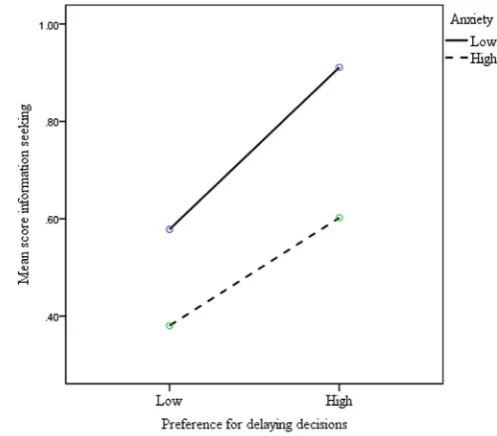
Fig. 1shows the interaction between affect and preferences for delaying decision making. There was a positive association between preferences for delaying decisions and information seek-ing, although there was less information seeking for people experi-encing anxiety. As anxiety increased, preferences for putting off decisions reduced the likelihood of information seeking.
There was a positive association between information utility and preferences for delaying decision making. Information seeking is most likely for people who perceive the information as useful, yet have a tendency to put off decision making. The relationship is depicted inFig. 2.
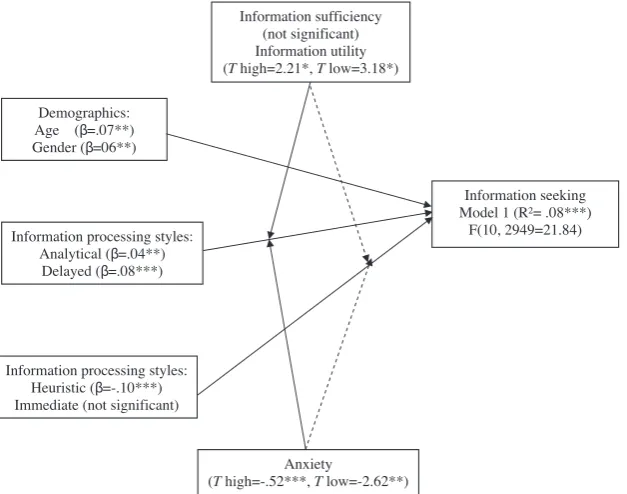
Fig. 3summarises the direct effects and moderation effects.
4. Discussion
[image:4.595.43.562.85.200.2]Integrating dual process theory; (Epstein, 1990; Epstein et al., 1996) with RISP theory (Griffin et al., 1999) and broaden-and-build theory (Fredrickson, 1998, 2001), provides insights into the infor-mation seeking process. The current study has demonstrated the importance of individual differences in information processing styles on information seeking, and the susceptibility of information seeking to anxiety and information perceptions in a food-related
Table 1
Means, standard deviations, Cronbach’s alpha and inter-scale correlations.
Mean SD Cronbach’s alpha 1 2 3 4 5 6 7 8 9 10
1. Age 40.59 12.96 –
2. Gender 1.54 .50 – .16***
3. Past experiences 3.05 1.12 – .18*** .02
4. Analytical style 2.58 .53 .76 .10*** .06** .09***
5. Heuristic style 1.70 .64 .80 .08*** .04* .02 .50***
6. Immediate decision 2.33 .59 .81 .12*** .03 .07*** .15*** .04*
7. Delayed decision 1.85 .77 .81 .12** .06** .00 .04 .08*** .56**
8. Anxiety 2.22 1.03 .95 .08*** .07*** .09*** .07** .15*** .06*** .12***
9. Utility 2.30 .97 .86 .11***
.03 .13***
.02 .04*
.01 .06**
.35***
10. Sufficiency 3.77 .84 .79 .19*** .02 .28*** .21*** .14*** .13*** .07*** .27*** .05**
11. Information seeking .54 1.29 – .08*** .06** .07*** .14*** .15*** .01 .06** .09*** .07*** .16***
[image:4.595.308.557.258.476.2]N= 2960. * p< .05. ** p< .01. *** p< .001.
Table 2
Results of hierarchical linear regression of information seeking on affect, information perceptions and information processing styles.
Variable Standardized beta values
Model 1 Model 2
Age .07**
.06**
Gender .06** .05**
Past experience .02 .03
Analytical style .04* .02
Heuristic style .10*** .03
Immediate decision .00 .04
Delayed decision .08*** .12
Anxiety .10*** .06
Information utility .12*** .07
Information sufficiency .10*** .14
Analytical styleutility .06
Analytical styleanxiety .16
Analytic stylesufficiency .03
Heuristic styleutility .23**
Heuristic styleanxiety .20*
Heuristic stylesufficiency .05
Immediate decisionutility .33**
Immediate decisionanxiety .21*
Immediate decisionsufficiency .03
Delayed decisionutility .19*
Delayed decisionanxiety .21*
Delayed decisionsufficiency .04
R .26 .28
R squared .07 .08
F statistic 21.84***
10.99***
Df 10, 2949 10, 2949
N= 2960. * p< .05. ** p< .01. *** p< .001.
Table 3
Bootstrapped moderation results.
Moderator Level Conditional effect SE T p
Anxiety High .13 .03 .52 .00
Low .07 .03 2.62 .01
Utility High .06 .03 2.21 .03
[image:4.595.41.292.288.556.2]Low .09 .03 3.18 .02
[image:4.595.42.293.628.684.2]decision context. In examining these processes, we make two con-tributions to the literature.
First, we proposed that analytical information processing styles would be associated positively with information seeking. Data con-firmed this proposal, and showed that there was a direct effect of analytical information processing style on information seeking that was not influenced by anxiety or information utility. Hence, for people with preferences for analytical information processing styles, information seeking is likely to form part of their strategy for finding and evaluating information systematically prior to mak-ing a choice. We also hypothesised that preferences for heuristic decision making would be associated negatively with information
seeking, and that this relationship would be influenced by anxiety and information utility. Data showed that there was a main effect, but did not support moderation. Thus heuristic preferences were associated directly with low levels of information seeking. These findings show partial fit withGriffin et al.’s (1999)RISP model. We showed that information processing style was associated with information seeking, but there was no evidence for the complex association between the variables proposed in the RISP model. Fur-thermore, the data indicate that different information processing styles require specific modelling.
Our second contribution concerns the application of the regula-tory dimension of information processing styles: preferences to make an immediate or delayed decision. Delaying decisions can serve a specific purpose which is to avoid choice, and this is differ-ent from the application of heuristics, a process that is concerned with making decisions faster and with less effort. Data showed that preferences for delaying decisions were associated positively with information seeking, and that this relationship was moderated by both anxiety and information utility. Participants sought more information when they experienced lower levels of anxiety. Fur-thermore, participants sought more information when they per-ceived what they had read during the study to be useful. Together, these findings suggest that, for people who find it diffi-cult to regulate the decision process, information seeking is a strat-egy to delay decisions that becomes more likely when information is perceived to be useful, and less likely under conditions of anxiety.
[image:5.595.36.277.63.278.2]The research has several practical implications for policy mak-ers and food safety risk managmak-ers. Research into risk communica-tion has moved towards bottom-up development of informacommunica-tion that takes lay concerns into account (Bickerstaff, Lorenzoni, Jones, & Pidgeon, 2010; Stern & Fineberg, 1996). This practical strategy could have the benefit of influencing the balance of affect and information perceptions that have a critical influence on infor-mation seeking behaviour such that people are motivated enough to read information, e.g. on websites, and educated about how to act on it to change domestic practices and reduce the risk of
Fig. 2.Information utility moderated the relationship between preferences for delaying decision making and information seeking.
information utility Demographics: Age (β=.07**) Gender (β=06**)
Information processing styles: Analytical (β=.04**)
Delayed (β=.08***)
Information seeking Model 1 (R²= .08***)
F(10, 2949=21.84) Information sufficiency
(not significant) Information utility (Thigh=2.21*,Tlow=3.18*)
Anxiety
(Thigh=-.52***,Tlow=-2.62**) Information processing styles:
Heuristic (β=-.10***) Immediate (not significant)
[image:5.595.137.451.480.727.2]infection from Salmonella. Such an approach could also avoid rais-ing anxiety levels to the point where people avoid food safety information.
Future research could examine further the relationships between information processing styles and information seeking, and the moderating roles of anxiety and information utility. In par-ticular, further examination of the processing that underlies delayed decision making would enable more complete modelling of the relationship, and it is possible that there are other situational moderators that interact with information processing styles. Future research could consider the relationship between informa-tion seeking and effective decision making to test for the positive and negative impact of different information processing styles, and do so in different decision contexts. There could also be further examination of the effects of age and gender on decision processes and information seeking.Epstein et al. (1996), for example, found some differences between men and women’s preferences for ana-lytical and heuristic thinking, although the findings were not con-sistent across studies. It is also possible that decision processes develop with age (Mata, Schooler, & Rieskamp, 2007), thus future research could consider how these demographic factors function in relation to information seeking.
The current study has some strengths, notably the assessment of information seeking behaviour rather than information process-ing (Kahlor, Dunwoody, Griffin, Neuwirth, & Giese, 2003) or inten-tion (ter Huurne, Griffin, & Gutteling, 2009; Yang, 2012). However, while attempts have been made to develop a theory-driven model and test it on a large sample of adults, the current study has acknowledged limitations. We examined information seeking behaviour using online survey technology, however, a laboratory study would enable more complex information seeking behaviour to be assessed. Moreover, an experimental approach could be used to examine whether information processing styles can be influ-enced by priming or other contextual variables, thus providing more opportunities to examine moderation effects. Finally, differ-ent decision contexts, e.g. other kinds of everyday decisions as well as infrequent decision, or decisions with more serious conse-quences, would add to theoretical and practical developments.
In conclusion, this study suggests that individual differences in preferences for analytical and heuristic information processing style have a direct effect on information seeking, and influence the extent to which information is sought. In contrast, regulatory information processing styles have an indirect association with information seeking. Preferences for delaying decisions were exac-erbated by information utility and attenuated by anxiety. These findings contribute to a more complete understanding of the deci-sion processes that lead to information seeking. Moreover, the findings suggest that information campaigns could be made effec-tive by providing sufficient information to generate an emotional need to make timely decisions.
Acknowledgment
We are grateful to the EPSRC for funding the current study (Grant number EP/E01951X/1).
References
Bargh, J. A., Chen, M., & Burrows, L. (1996). Automaticity of social behavior: Direct effects of trait construct and stereotype-activation on action. Journal of Personality and Social Psychology, 71(2), 230–244.http://dx.doi.org/10.1037/ 0022-3514.71.2.230.
Bickerstaff, K., Lorenzoni, I., Jones, M., & Pidgeon, N. (2010). Locating scientific citizenship: The institutional contexts and cultures of public engagement. Science, Technology & Human Values, 35(4), 474–500.http://dx.doi.org/10.1177/ 0162243909345835.
Bohner, G., Chaiken, S., & Hunyadi, P. (1994). The role of mood and message ambiguity in the interplay of heuristic and systematic processing.European Journal of Social Psychology, 24(1), 207–221. http://dx.doi.org/10.1002/ ejsp.2420240115.
Dane, E., & Pratt, M. G. (2007). Exploring intuition and its role in managerial decision making.The Academy of Management Review, 32(1), 33–54.http:// dx.doi.org/10.5465/AMR.2007.23463682.
Dewberry, C. (2008).The Decision making and self-regulation assessor (DASA) manual. West Sussex: Decision Dimensions Ltd..
Dewberry, C., Juanchich, M., & Narendran, S. (2013a). The latent structure of decision styles.Personality and Individual Differences, 54(5), 566–571.http:// dx.doi.org/10.1016/j.paid.2012.11.002.
Dewberry, C., Juanchich, M., & Narendran, S. (2013b). Decision-making competence in everyday life: The roles of general cognitive styles, decision-making styles and personality.Personality and Individual Differences, 55(7), 783–788.http:// dx.doi.org/10.1016/j.paid.2013.06.012.
Dreyfus, H. L., & Dreyfus, S. E. (2005). Expertise in real world contexts.Organization Studies, 26(5), 779–792.http://dx.doi.org/10.1177/0170840605053102. Epstein, S., Lipson, A., Holstein, C., & Huh, E. (1992). Irrational reactions to negative
outcomes: Evidence for two conceptual systems. Journal of Personality and Social Psychology, 62(2), 328–339. http://dx.doi.org/10.1037/0022-3514. 62.2.328.
Epstein, S., Pacini, R., Denes-Raj, V., & Heier, H. (1996). Individual differences in intuitive-experiential and analytical-rational thinking styles. Journal of Personality and Social Psychology, 71(2), 390–405. http://dx.doi.org/10.1037/ 0022-3514.71.2.390.
Epstein, S. (1990). Cognitive-experiential self-theory. In L. A. Pervin (Ed.),Handbook of personality theory and research(pp. 165–192). New York: Guilford Press. European Food Safety Authority. (2010).The community summary report on trends
and sources of zoonoses, zoonotic agents and food-borne outbreaks in the European Union in2008.
Finucane, M. L., Mertz, C. K., Slovic, P., & Schmidt, E. S. (2005). Task complexity and older adults’ decision making competence.Psychology and Aging, 20(1), 71–84. http://dx.doi.org/10.1037/0882-7974.20.1.71.
Fredrickson, B. L. (1998). What good are positive emotions?Review of General Psychology, 2(3), 300–319.http://dx.doi.org/10.1037/1089-2680.2.3.300. Fredrickson, B. L. (2001). The role of positive emotions in positive psychology. The
broaden-and-build theory of positive emotions. The American Psychologist, 56(3), 218–226.http://dx.doi.org/10.1037/0003-066X.56.3.218.
Graham, J. F., Stendardi, E. J., Jr., Myers, J. K., & Graham, M. J. (2002). Gender differences in investment strategies: An information processing perspective. International Journal of Bank Marketing, 20(1), 17–26.http://dx.doi.org/10.1108/ 02652320210415953.
Griffin, R. J., Dunwoody, S., & Neuwirth, K. (1999). Proposed model of the relationship of risk information seeking and processing to the development of preventive behaviors. Environmental Research, 80(2), S230–S245. http:// dx.doi.org/10.1006/enrs.1998.3940.
Hair, J. F., Black, W. C., Babin, B. J., & Anderson, R. E. (2009).Multivariate data analysis (7th ed.). New Jersey: Pearson Prentice Hall.
Hayes, A. F. (2013).Introduction to mediation, moderation, and conditional process analysis: A regression-based approach. New York: Guilford Press.
Hodgkinson, G. P., Sadler-Smith, E., Sinclair, M., & Ashkanasy, N. M. (2009). More than meets the eye? Intuition and analysis revisited.Personality and Individual Differences, 47(4), 342–346.http://dx.doi.org/10.1016/j.paid.2009.03.025. Jepson, C., & Chaiken, S. (1990). Chronic issue-specific fear inhibits systematic
processing of persuasive communications. Journal of Social Behavior and Personality, 5(2), 61–84.http://dx.doi.org/10.1111/j.1559-1816.2001.tb01412.x. Kahlor, L., Dunwoody, S., Griffin, R. J., Neuwirth, K., & Giese, J. (2003). Studying heuristic–systematic processing of risk communication. Risk Analysis: An International Journal, 23(2), 355–368. http://dx.doi.org/10.1111/1539-6924.00314.
Mata, R., Schooler, L. J., & Rieskamp, J. (2007). The aging decision maker: Cognitive aging and the adaptive selection of decision strategies.Psychology and Aging, 22(4), 796–810.http://dx.doi.org/10.1037/0882-7974.22.4.796.
McElroy, T., & Seta, J. J. (2003). Framing effects: An analytic–holistic perspective. Journal of Experimental Social Psychology, 39(6), 610–617. http://dx.doi.org/ 10.1016/S0022-1031(03)00036-2.
Miles, S., & Frewer, L. J. (2001). Investigating specific concerns about different food hazards – Higher and lower order attributes.Food Quality and Preference, 12(1), 47–61.http://dx.doi.org/10.1016/S0950-3293(00)00029-X.
Preacher, K. J., Rucker, D. D., & Hayes, A. F. (2007). Addressing moderated mediation hypotheses: Theory, methods, and prescriptions. Multivariate Behavioral Research, 42(1), 185–227.http://dx.doi.org/10.1080/00273170701341316. Soane, E., Shantz, A., Alfes, K., Truss, C., Rees, C., & Gatenby, M. (2013). The
association of meaningfulness, wellbeing and engagement with absenteeism: A moderated mediation model.Human Resource Management, 52(3), 441–456. http://dx.doi.org/10.1002/hrm.21534.
Stanovich, K. E., & West, R. F. (2002). Individual differences in reasoning: Implications for the rationality debate? In T. Gilovich, D. Griffin, & D. Kahneman (Eds.), Heuristics and biases the psychology of intuitive judgment (pp. 421–440). New York: Cambridge University Press.
Stern, P., & Fineberg, H. V. (1996). Understanding risk: Informing decisions in a democratic society. Washington, DC: National Research Council.
seeking and processing. Science Communication, 31(2), 215–237. http:// dx.doi.org/10.1177/1075547009332653.
Todd, P. M., & Gigerenzer, G. (2007). Environments that make us smart: Ecological rationality.Current Directions in Psychological Science, 16(3), 167–171.http:// dx.doi.org/10.1111/j.1467-8721.2007.00497.x.
Trumbo, C. W., & McComas, K. A. (2003). The function of credibility in information processing for risk perception.Risk Analysis, 23(2), 343–353.http://dx.doi.org/ 10.1111/1539-6924.00313.
Watson, D., & Tellegen, A. (1985). Toward a consensual structure of mood. Psychological Bulletin, 98(2), 219–235. http://dx.doi.org/10.1037/0033-2909.98.2.219.