A Framework for Design Engineering Education in a Global Context Authors:
Wodehouse, A.J.1, Grierson, H.J.1, Breslin, C.2, Eris, O.3, Ion, W.J.1, Leifer, L.J.4,
Mabogunje, A.4
1
Department of Design, Manufacture and Engineering Management, 2 Department of
Learning Services, University of Strathclyde (UK)
3
Franklin W. Olin College of Engineering (USA)
4
Center for Design Research, Stanford University (USA)
Corresponding author: Andrew Wodehouse
Department of Design, Manufacture and Engineering Management (DMEM)
James Weir Building
75 Montrose Street
Glasgow G1 1XJ
United Kingdom
Tel: 0141-548 2628
Fax: 0141-552 7986
Email: [email protected]
Number of pages: 30
Number of tables: 1
Abstract
This paper presents a framework for teaching design engineering in a global context using
innovative technologies to enable distributed teams to work together effectively across
international and cultural boundaries. The DIDET Framework represents the findings of a
5-year project conducted by the University of Strathclyde, Stanford University and Olin
College which enhanced student learning opportunities by enabling them to partake in global,
team based design engineering projects, directly experiencing different cultural contexts and
accessing a variety of digital information sources via a range of innovative technology. The use of innovative technology enabled the formalization of design knowledge within
international student teams as did the methods that were developed for students to store, share
and reuse information. Coaching methods were used by teaching staff to support distributed
teams and evaluation work on relevant classes was carried out regularly to allow ongoing
improvement of learning and teaching and show improvements in student learning.
Major findings of the 5 year project include the requirement to overcome technological,
pedagogical and cultural issues for successful eLearning implementations. The DIDET
Framework encapsulates all the conclusions relating to design engineering in a global
context. Each of the principles for effective distributed design learning is shown along with
relevant findings and suggested metrics. The findings detailed in the paper were reached
through a series of interventions in design engineering education at the collaborating
institutions. Evaluation was carried out on an ongoing basis and fed back into project
development, both on the pedagogical and the technological approaches.
Keywords
1 Introduction
1.1 Background
In design engineering, there has been a shift from strongly empirical forms of design theory
towards more learner-centered approaches which take account of human and social factors in
the design activity (Love, 1999). This is concomitant with the general educational trend
where social interaction (in this case in the design studio) is thought to be fundamental in
developing internal knowledge (Palincsar, 1998; Prosser & Trigwell, 1999). While still
assuming there is a process of assimilation from the instructor or coach, this recognizes a
‘joint enterprise’ (Atherton, 2004) with respect to creating new meanings. In product design
engineering, this involves the application of knowledge in creative thoughts and ideas in the
development of new product configurations. In the educational setting, project work is
increasingly used to help students integrate, apply and expand on knowledge gained from
theoretical classes in their curriculum. This approach has been formalized in educational
literature as project-based learning: working in teams, students explore problems, develop
solutions and create presentations to share what they have learned. According to Curtis
(Curtis, 2001), compared with traditional teaching methods project-based learning has many
benefits, including deeper knowledge of subject matter, increased self-direction and
motivation, and improved research and problem-solving skills.
Project-based learning is similar, but not identical, to problem-based learning. They are both
instructional strategies that are intended to engage students in ‘real world’ tasks to enhance
learning; they are both student-centered approaches; and both include the instructor in the
plan and design to reach this goal, problem-based learning uses an inquiry model where students are presented with a problem, gather information and summarize their new
knowledge – there may or may not be an end product. Both are authentic, constructivist
approaches to learning, but for the purposes of product design engineering, project-based
learning (from here on referred to as PBL) and its focus on the content, knowledge and skills
acquired during the production process is the more appropriate method. Examples of its
application in the area of design engineering across a range of institutions (Dym et al., 2005;
Frank et al., 2003; Mills & Treagust, 2003) have shown it to be an effective way to prepare
students for the challenges of working in industry, particularly with regards to teamwork.
This work specifically addresses how the learning mechanisms associated with PBL can be
supported through the use of digital technologies, with particular focus on enhancing use of
information across teams.
The Design Knowledge model (Eris & Leifer, 2003) developed at Stanford (Figure 1)
illustrates the interactions between a design team, coaches and the product development
activity. This framework also effectively illustrates the educational issues within
collaborative design projects. Whether working alone or in formal design teams, students in
the design studio still work in a social context whereby they learn from their peers in an
informal manner, and team-mates and coaches in a more formal project context. A key
element of the framework is the distinction between the formal and informal aspects of
practice and knowledge. The instructor, product development history and product
development process (the essential structure and core teaching material of the class) are
considered to be predominantly formal elements. Coaches, teams and product development
practice are considered to be informal elements. The arrows represent the ‘acquisition’ or
Figure 1: Three opportunities for technological intervention in enhancing design team learning performance.
The application of the Design Knowledge model within design learning contexts has led to
the identification of three learning loops associated with any design activity. Eris and Leifer
describe these loops as follows:
• Learning Loop 1 – Supporting the Design Process: Teams apply the product
development process contextualized for them by coaches in their design practice.
They utilize the information embodied in the process, and in doing so, generate new
information.
• Learning Loop 2 – Coaching: Coaches observe the design practices of teams, and use
the understandings they gain in contextualizing the product development process for
them. Based on the needs of teams, coaches selectively extract information from the
product development process and contextualize it for the teams.
• Learning Loop 3 – Formalizing and Reusing Content: Coaches retain a history of the
new knowledge generated during design practice, and extract new elements from it in
order to improving the product development process. Instructors manage the capture,
indexing, and publishing of the new information that teams generate.
In empowering the student and creating a constructivist learning environment, three distinct
opportunity areas were identified for technological intervention to improve the learning
mechanisms in design activity. The following section describes the pedagogical aims of the
DIDET (Digital Libraries for Global Distributed Innovative Design, Education and
Teamwork) project and the resulting development of the LauLima (Polynesian for ‘a group of
people working together’) digital library and groupware system to facilitate their
1.2 Aims and objectives of DIDET
The central goal of the DIDET Project was to enhance student learning by enabling them to partake in global, team based design engineering projects, in which they directly experience different cultural contexts and access a variety of digital information sources via a range of appropriate technology.
1.3 Methodology
In order to achieve its aims, DIDET methodology was two-fold. Firstly, the project planned
to implement a digital library at the partner institutions to improve learning in design
engineering by providing a repository for students to create, store share, use and reuse
information resources for design engineering team work. Secondly, the project planned to
develop a new Global Design Project that fitted the curriculum of both the University of
Strathclyde and Stanford University, allowing the students at both institutions to work across
geographical and cultural boundaries in global design teams. The digital library (and other
technologies) would be used to support this global team work. After the first two years of the
project, it became apparent that due to differences in course structures, timetables and credit
for assessment at each institution it would not be possible to develop a single class suitable
for both. Rather than abandon this part of the methodology it was decided that it would prove
more effective to run a joint elementrather than an entire module shared between the
institutions. In practice, this meant developing a new global project for UK-USA student
teams that would be an assessed element of new classes at Strathclyde and Olin, and part of
1.4 Implementation
The key stages of implementation of the DIDET Project were the development of the digital
library, its deployment and evaluation in student classes, and the development of a
pedagogical framework. Each of these are discussed in more detail below.
2 Development of DL
2.1 Library specification
Early specification of the project digital library involved evaluation of existing groupware
and digital library products; a pilot exercise in information seeking at Stanford University;
examination of other digital library products; and extensive studies in the classroom of
student use of project information and resources. The following key findings relating to the
DIDET digital library emerged during specification:
• The need for two related repositories: A student-shared workspace where academic
staff and students working on projects can upload and develop content to share with
others, and a formal digital library – a managed repository containing evaluated and
validated resources.
• Dublin Core metadata standards (Dublin Core Metadata Initiative, 2009) were
identified as the best choice for the repositories with additional fields as required by
the project. Recording of educational context and use of content emerged as an
additional important need.
• The INSPEC Thesaurus (Inspec, 2009) was identified to provide a controlled
vocabulary for keywords; selected terms were made available to students and staff
and the full thesaurus was available to uploading staff and the Librarian/Information
• A workflow was required for uploading content to the library system and applying
metadata.
• An investigation into UK Intellectual Property Rights (IPR) and Digital Rights
Management (DRM) led to a redefinition of the student agreement and strict
guidelines for content uploading.
2.2 Library development and implementation
Following its specification, the LauLima System was developed at the Department of Design
Manufacture and Engineering Management (DMEM) by extensively customizing the
open-source groupware TikiWiki (The Tiki Community, 2009) to best suit project requirements.
Whilst providing the standard document management facilities including file and image
storage, web linked galleries and wiki pages, our studies identified the need for two
interdependent components to the LauLima System (Figure 2) to accommodate the needs of
design engineering practice. These system components are the informal ‘LauLima’ Learning
Environment (LLE), and the more formal LauLima Digital Library (LDL) (Breslin et al.,
2007; McGill et al., 2005). The LLE is an informal shared workspace, which has a file storage
area (file galleries) and allows the creation of dynamic wiki pages which students can use to
document their design process, rationale and the developing outputs, to share with others. As
well as a suite of integrated communication tools, the system includes a highly controllable
permissions system, allowing teams to effectively manage and document their design project
work. The more formal LDL is a digital repository of learning resources used to support
design engineering students in the classroom and complements other information sources
available to students (e.g. books, documents, institutional library resources, and websites).
Modifications to the TikiWiki groupware include: the incorporation of a granular permissions
system to facilitate the sharing of folders and files with individuals or groups, meaning that
rights to pages and objects in the system can be controlled on a world, group or individual
level; the development of a hierarchical file storage mechanism to enable students to organize
and manage their information as they upload to the groupware; a digital library component to
store, categorize and aid retrieval of materials; administrative tools to help with the
workflow, and; integration with the central university login system to negate the need for an
additional username and password.
A key implementation was the workflow for uploading content to the system and applying
appropriate metadata (Grierson et al., 2006b). Resources created by students, in the form of
sketches, photographs, models, calculations, concept maps, reflective logs, reports, etc. are
initially stored in the LLE during their design projects. These resources provide a rich record
of the design process and of the students’ knowledge structures. At this stage metadata is
applied automatically by the system (file type, date added, depositor name and team) and
additional metadata can be applied by the depositor (title, format, source, citation, keywords).
Teaching staff then harvest the most useful resources from these student LLE workspaces on
an ongoing basis and submit them for inclusion in the LDL. Externally created resources, or
references to them, can also be stored in the LDL. At this stage further metadata is added in
the form of additional keywords and educational context information. The third stage
involves an information specialist checking content for appropriateness, quality and legality,
and applying final stage metadata (rights information, additional keywords). At this stage
content is officially uploaded into the LDL and is made available for other students and staff
The LDL differs from existing design engineering resource collections, e.g. SMETE
(http://www.smete.org/smete) and EEVL (http://www.eevl.ac.uk), in that it contains more of
the unique informal and tacit information and knowledge created by students during the
design process (e.g. ideas, decisions and design rationale), and it gives students access to
specific project-related ‘hard-to-access’ formal information and resources (e.g. standards,
patents and company reports), which can often take considerable time to source or need
copyright clearance.
In addition, five case studies have been developed to demonstrate the range of uses of the
LauLima system, or selected elements of it, and cover the use of LauLima for teaching and
learning, to support research and for other information systems (University of Strathclyde,
2009).
3 Student use of DL in classes
3.1 Overview of classes
One of the primary goals of the DIDET project was to integrate digital resource collections
(digital libraries) into the classroom by integrating resource creation and re-use into class
activities, thereby providing opportunities for students to improve information literacy skills
and develop team-based design process skills. In classes where LauLima supports learning,
students receive an induction in the use of the LLE including its technical features. They then
engage in a team design project and use the LLE to store and share resources and links to
resources that have been created or discovered as part of the design process in one place.
Other functionality within the LLE helps students to keep track of different versions of
documents created collectively by members of the team and to collectively manage the team
(e.g. sketches, images, descriptive text), stored project documentation and links to resources
help to capture students’ tacit and developing understanding of the design process.
Additionally, at different points in the design process, students use the LLE and the
interlinked wiki pages to deliver presentations to staff and peers for feedback. Classroom
activities are designed to encourage students to engage in analysis and reflection on their own
understanding and to help them create new and more elaborate knowledge structures (McGill
et al., 2005).
3.2 Evaluation methods
Key to the research philosophy of DIDET is the interpretivist paradigm. As a result, the
majority of studies were of an empirical nature within the classroom setting in an attempt to
provide insight and deeper understanding of design information processes and experiences.
Studies of this kind have gained more importance and are becoming more commonly used in
design engineering research since the widening of its view from prescribing to describing
design activities (Foltz et al., 2002).
Strathclyde studied the use of LauLima in three key classes over a period of four years. Each
of the classes had a particular evaluation focus: the Integrating Design Project evaluation
focused on the use of information storing and sharing and on the use of digital libraries
(Grierson et al., 2004; Nicol et al., 2005); the Product Development Project focused on
gathering students' feedback on the use of Laulima to support project management and
reflection in industry related team projects (Grierson et al., 2006a); and the Global Design
Project focused on the logistics of running a distributed class - the teaching and learning;
collaboration; technologies; all in the context of global product development (Grierson et al.,
A range of quantitative and qualitative methods were used to the evaluate studies in the
different projects. Quantitative methods such as surveying class opinion via questionnaires
and polls, and weekly analysis of file galleries, wiki pages, emails and blogs were
undertaken. The need for a rich and detailed understanding of how and why various
phenomena occurred, and how processes might be improved through change, also
necessitated a greater use of qualitative methods, e.g. observation, interviews, reflective
sessions, focus groups and the examination of student reflective reports. Evaluation was both
formative, to improve the project and inform the development of the infrastructure as it
progressed, and summative, to determine the success of the project on an annual basis. It
included the collation of both staff and student views with year-on year results fed back to the
students to support and improve their learning. The use of student feedback material in
project management and reflective work sessions allowed students to make improvements
based on previous students’ work. Objective data was also collected from the system data
logs, showing login details, resources collected, stored, accessed, and the frequency of use.
3.3 Integrating Design Project
Working in teams of four, 3rd year product design engineering students taking part in
Strathclyde’s Integrating Design Project (IDP) class have six weeks to design and model a
crushing device. Each year the type of crushing device is changed (can crusher, ice crusher,
fruit squeezer etc). Teams meet face-to-face but tasks and assessment encourage online
storing and sharing of information and resources in the LauLima system. These studies focus
on information management, team working, and use of an online support tool.
Evaluation (McGill et al., 2005) in this class found many students relying heavily on the
Internet and library as sources for information rather than using a digital library, as they were
repositories not to be useful to engineering students, with students additionally requiring
considerable guidance on organizing, editing and structuring information, and searching with
key words. Additional support and training in these aspects showed improvement in
subsequent classes. As well as this, the use of interlinked wiki pages to organize design
information and to document the design process positively influenced the way students used
information to develop concept work through the emphasis of relationships between
information items, the construction of design concepts and navigation of the overall design
process. After three years of running the class there were just over 50 resources selected for
inclusion in the LDL by academic staff on crushing devices. By 2006-07 however, over 400
resources were available, 182 of which were specifically related to crushing projects – a
sufficient number and range of quality resources to engage students. These included
examples of student project work, including market research, sketches, photographs, videos,
mind maps, concept ideas, prototypes and diagrams. Throughout the latter two studies
students’ interactions with the LDL were logged by the system and a short questionnaire and
staff and student focus groups were undertaken. Students used the LDL most at the beginning
and end of project work, valuing the contextual material (resources that gave rationale and
detailed why things were done) and stimulus for idea generation (building on existing
knowledge). Academic selection ensured resource quality, with staff finding the LLE
generated valuable resources and exemplars for class teaching and setting standards for
students (Grierson et al., 2008).
3.4 Product Development Project
Strathclyde’s Product Development Project (PDP) class enables industry companies to realize
projects through collaboration with teams of 4th and 5th year students. One of its main
objectives is to encourage professional, independent thinking in a project context by
of a project. Teams are required to maintain a presence on the web using the LauLima
system, create a team site, a project log, online minutes and a project file of project related
documents. These technological interventions are designed to support the processes of PBL
by giving students opportunities to reflect on the design process, and to raise awareness and
skills in solving complex problems.
Evaluation was through analysis of team wiki sites, project logs, polls, student reflective
blogs and observation in class (Grierson et al., 2005). Students confirmed previous findings
using digital repositories and shared workspaces that having all project information in one
central location allows more flexible working patterns for teams, reduces document loss by
offering a secure store and reducing the need for hard copies, and saves time in subsequent
searching for information.
3.5 Global Design Project
The experience of the IDP and PDP classes supported the development of a collaborative
Global Design Project (GDP) run across the institutions, one of the DIDET project’s key
aims (Figure 3). The intention of the GDP was to give students experience with distributed
design teams, allowing them to gain an understanding of the logistical problems that can arise
and exposing them to cultural differences, utilizing a variety of different collaborative design
tools, including video conferencing, shared workspaces and digital repositories.
Before implementing the GDP, a series of collaborative experiments took place between
small groups of Strathclyde and Stanford students. Consisting of exercises to design
paper-based products, the purpose of these was to streamline the pedagogical approach, to establish
the logistics of running such classes and to gain feedback on the use of digital libraries
of video in digital libraries was undertaken at Stanford with a view to optimizing the
students’ interaction with library materials (Sonalkar et al., 2007). The path of development is
summarized in Figure 3.
Figure 3: Working towards the collaborative Global Design classes and global team design project
The GDP was run in 2006-07 for the first time across Strathclyde, Stanford and Olin (where
one of the DIDET research team was now based). The class at Strathclyde focused on product
development in a global context, with students putting the theory of distributed design
management into practice through the GDP experience. This was a three-week collaborative
element where students worked together on a design brief to design a coffee cup holder.
Teams were expected to explore the issues related to this task that would apply in their
respective countries to develop a design solution to carry multiple cups effectively and safely.
Strathclyde, Stanford and Olin used the development space on the LauLima system to share
plans for their individual classes and the collaborative GDP. Coaches also used LauLima to
collate feedback before sending to student teams after each milestone deliverable was
submitted. All institutions shared teaching and class plans before and during the first
semester.
The global design teams were expected to use a range of technologies to support their
collaborative work. All students participating in the class signed up to LauLima and teams
were encouraged to create a homepage using the wiki technology, and the LDL was
configured to allow students to access the resources in the digital libraries in LauLima across
video conferencing e.g. FlashMeeting (http://flashmeeting.open.ac.uk) and Skype
(http://www.skype.com) and used a range of technologies e.g. the LauLima Learning
Environment and Digital Library
(http://onlinelearning.dmem.strath.ac.uk/laulima/tiki-index.php). They also used information sharing tools such as YouTube
(http://www.youtube.com) and Google Documents (http://docs.google.com); messaging tools
such as MSN Messenger (http://www.msn.com); real-time collaboration tools such as
Campfire (http://www.campfirenow.com) and Thinkature (http://thinkature.com); as well as
other wiki systems. To facilitate access to necessary technology, classes at Strathclyde were
held in its Digital Design and Manufacture Studio (Mair et al., 2007).
The project was evaluated using confidence logs, reflective class sessions, analysis of
students’ archived project work and focus groups with students. The students who
participated not only achieved the learning objectives of developing an understanding of the
organization and management of distributed design but also gained valuable experience for
future employment. For further information on this first implementation of the GDP, see
Wodehouse et al. (2007).
In 2007-08, following development work on the Global Design class, a ‘task-based’ approach
where students undertook weekly global design tasks with different global partners over three
separate weeks was undertaken, rather than one 3-week long project. Students were
encouraged to reflect on various aspects of the different design tasks, comparing and
contrasting different cultures, technologies and methods of communication. They were able
to directly experience and compare synchronous and asynchronous working and relate the
theory of the lectures to the case studies given in class (Wodehouse et al., 2008). Continuing
University of Malta and Swinburne University of Technology in Australia) as appropriate for
each project topic, and provides on-going flexibility in the class format.
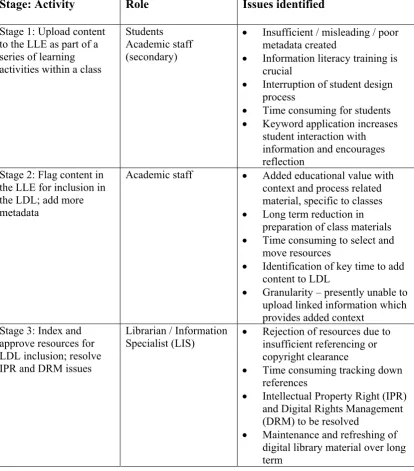
It should be noted that the first three stages of this implementation, i.e. Library Specification,
Library Development and Implementation and Student Use of Library, were iterative, with
several versions of the LDL being specified, developed, implemented, used, evaluated then
being re-specified and redeveloped based on evaluation results and feedback. Some of the
issues (those relating to information input) used to guide this development process are
illustrated in Table 1, with full details of evaluation and key findings for each class linked
from the project website (University of Strathclyde, 2008).
Table 1: Summary of issues when populating the LDL
4 Framework development and discussion
The project team has developed the ‘DIDET Project Framework’ to encapsulate all findings
relating to the use of digital libraries in collaborative design education as shown in Figure 4.
The framework consists of six principles relating to information resources, teamwork, and the
design task, with metrics suggested for each. The principles are outlined in more detail
below.
4.1 Information resources
4.1.1 Resource range and utilization
The first aspect of the library in the framework to consider is the range of resources and their
utilization. A key approach used during the development of the LDL was to use primarily
sustainable. One of the main issues with digital resource collections is that they take a large
amount of effort to populate and quickly become obsolete. Asking library users to upload
content as part of their work ensures that material is constantly being added. As well as this,
the contextual information added by users makes the information resources more meaningful
to others. Finally, retention of past student work, with the addition of educational context
from staff, provides a good indicator of the expected standards. For the library to be a
success, sharing of resources across teams must be strongly encouraged, and the
technological support required cannot be underestimated. Ideally, all students would have
remote access to the digital library through laptops or other wireless devices while still being
situated in the typical design studio-based environment. It is also necessary to augment the
technological support with Information Literacy training at the outset to familiarize users
with the benefits of using the library as well as the mechanics of effective search and
retrieval.
Use of video is a rapidly evolving area of development in online resources. The Stanford
team explored several aspects regarding the uploading, browsing and use of video for
learning. The addition of appropriate metadata was identified as a critical issue: blocks of
video require to be resolved into relevant segments for ease of access. The addition of this
kind of granularity is possible but labor-intensive and time consuming, making it problematic
for large video collections. Regarding the browsing of collections themselves, the concept of
‘power browsing’ was introduced, whereby users would be able to rapidly understand some
of the key features of a group of videos without having to open and watch each one.
Suggested ways to do this included small moving thumbnails and appropriate display of
metadata. It should be noted that different media types have different affordances for student
informal knowledge, and this should be a consideration for digital library architectures going
forward.
4.1.2 Process and information connectivity
It is critical that there is a strong link between the design process undertaken and the
information used in its execution. The use of narrative during the course of projects delivered
through the working environment is important in helping the student designer to understand
where in the process they lie and what information is applicable. Holistic, analytical thinking
is therefore required, with students expected to use rich information sources, which are better
described as information resources rather than ‘libraries’.
4.2 Teamwork
4.2.1 ‘Contingent coaching’
We recommend that coaching is provided at the point of need as a supportive mechanism
rather than being overt, didactic and constraining for students. This encourages independent
thinking and utilizes the social learning engendered by team-orientated, studio-based projects
where possible. It is still necessary, however, for targeted coaching where required:
monitoring progress and adapting coaching time accordingly can ensure that any major
learning issues are addressed.
Placing suitable information resources prominently in the learning environment is an
effective way to help students support themselves and should be perceived as a fundamental
coaching responsibility. A key way to engender willingness to engage with such an
information resource is to allow the user a measure of control in how items are organized and
stored. Project wiki pages which document project activity provide such an opportunity. It is
of use and continuing usefulness throughout the project, and to support this with formative
feedback that is deployed when it is needed most. The levels of interaction, rate of
construction and consistency of use of such resources can assist coaches with this
deployment. It should be noted that we are advocating that the coaches not only add value by
providing information resources and technologies to the students, but also by demonstrating
and instilling sound information handling behaviors.
4.2.2 Collaborative design
Information and project management are closely related to the team situation. In order to
ensure that teams work effectively, it is important to encourage equal contribution during the
course of projects. To this end, in global projects discipline is as big a cultural barrier as
location, and should be considered in how repositories are structured: visibility for example
can be useful in ensuring that all team members access and use the shared environment.
When teams are required to communicate synchronously, alternative media such as video
conferencing may be used and even integrated into the information resource infrastructure.
Similarly, ice-breakers and team formation techniques can be useful to promote cross-cultural
understanding and effective working. In many cases, the student teams that failed to develop
and adhere to an information management framework and norms, also failed to manage their
projects effectively, and, thus, collaborate.
4.3 Design task
4.3.1 Embedded digital libraries
The principle of embedded digital libraries relates closely to the recommendations on
coaching: the libraries should be available at the point of need, supporting design activity in
conveniently located desktop machines, the libraries must be embedded as an integral part of
the course to ensure optimal uptake. Delivery of course materials and assessment through the
online environment can be an effective way to highlight the proximate resources of the digital
library.
Additionally, increased ownership is afforded by self-constructed collaborative environments
– something which is a recognized problem with distributed projects. It was found that
encouraging teams to personalize their resource collections with front pages often engendered
greater enthusiasm and buy-in. The familiarity and confidence with reference material
derived from sourcing, linking and using items in the construction of these collections can
also help students cope with the disparities in skills, expectations and culture which
inevitably form part of global projects. In terms of assessment, system activity provides a
clear picture of how heavily individuals use any library which is provided for them. This can
then be correlated with student and team performance during project work.
4.3.2 Regular reflection
The team recognized the importance of students undertaking regular reflection during their
project work. The provision of contingent coaching allows teams the opportunity to formulate
questions, a process that can be useful in helping them recognize where in the design process
they lie and what the obstacles are to progression. A task-based approach to the set-up of
projects breaks the design process into more manageable sections, and these ‘mini-projects’
give students a sufficient focus while still allowing them freedom to explore and learn
autonomously. It is important in projects, and particularly the global projects described in this
context, that uncertainty and ambiguity are embraced to illustrate differences in approaches
organizations. Finally, an emphasis on recording and uploading material to digital
repositories as projects progress can replace traditional report writing as a means of project
documentation. This strengthens student understanding of the process of creating a digital
library as well as providing valuable resources for possible future use by other cohorts. This
behavior is reinforced if the students experience benefits from re-using the information that
has been created by other cohorts early on in their projects, and recognize the significance of
5 Conclusions and implications
This section outlines the project conclusions in terms of technology, pedagogy and
culture and has been adapted from a previous DIDET paper on embedding eLearning
(Breslin et al., 2007).
5.1 Technology
Any new technology introduced to the educational environment requires adequate
technical support and staff training on an appropriate scale; departmental, faculty,
institution, etc. Integration with existing and new systems may be required, and
interoperability may also be an issue. There must be consideration of hardware and
peripheral resources and services for the benefits of a system to be maximized. In the
case of DIDET this meant scanners, digital cameras, etc. to capture design material.
5.2 Pedagogy
Despite potential benefits of introducing new technology, it has been shown that such
innovation must be led by the pedagogy (Bates, 2000; Twigg, 2003). In the case of
DIDET, the discipline itself was a factor; the unique requirements of Design
Engineering led to the development of the digital library system which allows even
tacit design knowledge to be created, captured, stored, shared and reused. The use of
LauLima was embedded into the curriculum of classes in which it was used. The
requirement for Information Literacy education in conjunction with elearning
projects such as DIDET is very apparent. This was developed initially by an
Information Specialist and is being handed over to DMEM staff who now have
sufficient experience. There is a strong argument that all staff should now have these
Page 25 of 35
skills. In terms of delivery, evaluation is required on an ongoing basis to inform
project activity and development. This allows regular improvements in teaching and
learning and associated systems to be made. Finally, having a sufficient number of
high quantity and quality of resources is critical to the uptake of use of a digital
library. Student questionnaires were issued regularly to examine use of LauLima
along with system use logs. The LauLima workflow introduced by the then Project
Manager has ensured a high standard of quality of resources and their metadata.
Time and resource is a major issue for ongoing population of any digital library and
DMEM is currently examining this workflow to investigate if it can be streamlined
further.
5.3 Implications
Time to effect change was important in the DIDET project – true embedding of
pedagogical change was enabled by its 5-year length. To implement major changes
such as those described here, senior buy-in is necessary not only to help ensure
commitment to make change, but to ensure that required support is in place.
Although many changes can take place from the ‘bottom up’, buy in at other levels
may still be required to ensure that sufficient support is in place to embed and sustain
transformational change.
A cross-discipline team can provide the range of skills required, however human
factors can become an issue and strong leadership is required. “While challenges
Page 26 of 35
projects, it is the attention to human factors and behaviors that moved the DIDET
Project forward” (McGill et al., 2005). DIDET adopted a ‘course team approach’
whereby all of the core project team was involved in team coaching. This gave those
not traditionally involved in classroom a greater understanding of how the pedagogy
and technology was applied.
The experience of DIDET has shown that there are many cultural issues not only
with location but also with academic discipline e.g. those with backgrounds in
mechanical engineering often approached work differently from those with
backgrounds in design engineering. Additionally, uptake and acceptance of new
methods and technologies can be difficult to encourage with both staff and students.
In global projects, each site tends to favor their own chosen or developed
technologies, for cultural and practical reasons, e.g. familiarity and availability of
support. Different methods can be used to overcome cultural issues for team work,
including preparatory work to clarify aims and objectives, ice breaker exercises to
establish good working relationships, and effective project management to ensure
on-going team effectiveness. Dynamic digital information environments with “inward”
facing elements such as LauLima provide an opportunity for facilitating the
communication, synthesis, and, thus, negotiation of the different perspectives
associated with diverse cultural and disciplinary backgrounds; negotiation does not
take place in the absence of characterization and synthesis of perspectives. These
experiences therefore provide students with the necessary communication and
Page 27 of 35
5.4 Conclusions
Through wide dissemination, the findings from the DIDET Project have been
propagated to professionals in the fields of Pedagogy, Design Engineering,
Engineering Education and Educational Technology. Having presented and
published findings related to Global Design, the team has developed guidelines for
those institutions who may wish to implement similar projects or classes. During the
experiments and also when running the new Global Design class at Strathclyde, it
became apparent that the logistics of coordinating global activities were much more
complicated and time consuming than first expected. As expected, these logistical
issues became easier to deal with year-on-year as staff became more experienced and
processes became more streamlined. The Global Design Project also changed in
format based on experience and was run in its second year using a ‘task-based
approach’ (Wodehouse et al., 2008). The team feels that there would be value in
further exploring potential enhancement in coaching models and perhaps exploring
global coaching models where the staff-student relationship is distributed.
More research and evaluation could be carried out related to system use, e.g.
investigating its use relating to assessment and assessment of global team work. One
major finding of the DIDET Project’s work on the reuse of student created resources
was that students are keen to view previous work in the context of assessment.
Already, the project evolved to allow for this, and the ‘Educational Context’ field of
each resource in the LauLima Digital Library gives information on why a particular
Page 28 of 35
metadata could explain weaknesses which could be improved. While students would
always be encouraged to maximize their learning, not only focusing on assessment,
there is potential for students and student teams being able to ‘self assess’ by using
available resources in the digital library with a range of marks, and judging how their
own project outputs compare.
During the 5 years of the DIDET Project technology and its availability has moved
on. The wiki technology adopted was emerging at that time and is now well
established, even in teaching and learning contexts. There may be further potential
in now exploring new emerging technologies and their potential for use in the
classroom.
Please also refer to the DIDET Project video for a short overview of the project
which features student interviews:
http://www.jisc.ac.uk/media/avfiles/programmes/dlitc/didet.wmv
References
Atherton, J.S. (2004). Teaching and Learning: Constructivism in learning.
http://www.learningandteaching.info/learning/constructivism.htm Accessed on: 13 July 2005.
Bates, T. (2000). Managing technological change. San Francisco:Jossey-Bass. Breslin, C., Nicol, D., Grierson, H., Wodehouse, A., Juster, N., & Ion, W.J. (2007).
Embedding an integrated learning environment and digital repository in design engineering education: lessons learned for sustainability. British Journal of Educational Technology 38(5), 805-816.
Curtis, D. (2001). Start With the Pyramid.
http://www.edutopia.org/php/article.php?id=Art_884&key=037 Accessed on: 14th July 2005.
Page 29 of 35
Dym, C.L., Agogino, A.M., Eris, O., Frey, D.D., & Leifer, L.J. (2005). Design engineering Thinking, Teaching, and Learning. Journal of Engineering Education, 103-120.
Eris, O., & Leifer, L. (2003). Facilitating product development knowledge acquisition: interaction between the expert and the team. International Journal of Engineering
Education, special issue on the Social Dimensions of Design engineering 19(1), 142-152.
Foltz, C., Schmidt, L., & Luczak, H. (2002). Not Seeing the Woods for the Trees - Empirical Studies in Design engineering. In Workshop on the Role of Empirical Studies in
Understanding and Supporting Design engineering, NIST. Gaithersburg.
Frank, M., Lavy, I., & Elata, D. (2003). Implementing the Project-Based Learning Approach in an Academic Engineering Course. International Journal of Technology and Design
Education 13, 273-288.
Grierson, H., Ion, W., & Juster, N. (2006a). Project Memories: Documentation and much more for Global Team Design. Engineering and Product Design Education (E&PDE06). Salzburg, Austria.
Grierson, H., Nicol, D., Littlejohn, A., & Wodehouse, A. (2004). Structuring and sharing information resources to support concept development and design learning. Networked
Learning Conference, pp. 572-579. Exeter, U.K.
Grierson, H., Wodehouse, A., Breslin, C., Ion, W., & Juster, N. (2006b). Building a design engineering Digital Library: the workflow issues. Engineering and Product Design
Education Conference (E&PDE06). Salzburg, Austria.
Grierson, H., Wodehouse, A., Breslin, C., Ion, W., Nicol, D., & Juster, N. (2008). An evaluation study of a digital library of ideas: Workflow Model and classroom use.
International Journal on Digital Libraries 9(1), 29-39.
Grierson, H., Wodehouse, A., Ion, W.J., & Juster, N. (2005). Supporting reflection and problem-based learning through the use of LauLima. Engineering and Product Design
Education (E&PDE05). Edinburgh, UK.
Inspec. (2009). http://www.theiet.org/publishing/inspec/ Accessed on:12th June.
Love, T. (1999). Design engineering education: some implications of a post-positivist theory of design cognition. In In The Continuum of Design Education, (Juster, N., Ed.), pp. 33-42. Bury St Edmunds, England: Professional Engineering Publishing Ltd.
Mair, G., Cunningham, D., Grierson, H., & Ion, W. (2007). An Integrated Digital Design and Manufacture Studio for Educating Future Product Designers. Engineering and Product
Design Eductaion (E&PDE07). Newcastle, UK.
McGill, L., Nicol, D., Littlejohn, A., Grierson, H., Juster, N., & Ion., W.J. (2005). Creating an information rich learning environment to enhance design student learning: challenges and approaches. British Journal of Educational Technology 36(4), 629-642.
Mills, J.E., & Treagust, D.F. (2003). Engineering education - is problem-based or project-based learning the answer? Australian Journal of Engineering Education,
http://www.aaee.com.au/journal/2003/mills_treagust2003.pdf.
Nicol, D.J., Littlejohn, A., & Grierson, H. (2005). The importance of structuring information and resources within shared workspaces during collaborative design learning. Open
Learning: The Journal of Open and Distance Learning 20(1), 31-39.
Palincsar, A.S. (1998). Social constructivist perspectives on teaching and learning. Annual
Review of Psychology 49(31), 345-364.
Prosser, M., & Trigwell, K. (1999). Understanding Learning and Teaching: The Experience in Higher Education. Milton Keynes, UK:Open University Press.
Page 30 of 35
ASME 2006 International Design Engineering Technical Conferences & Computers and
Information in Engineering Conference. Philadelphia, PA.
Sonalkar, N., Mabogunje, A., Leifer, L., Eris, O., & Jung, M. (2007). Powerbrowsing - a method to accelerate designers' familiarity with video information in digital libraries.
International Conference on Design engineering. Paris, France.
The Tiki Community. (2009). The TikiWiki Project Community Site. http://tikiwiki.org/tiki-index.php Accessed on:29th April.
Thomas, J.W. (2000). A review of research on project-based learning.
http://www.k12reform.org/foundation/pbl/research Accessed on: 10th September 2009. Twigg, C. (2003). Improving learning and reducing costs: New models for online learning.
EDUCAUSE Review 35(5), 28-38.
University of Strathclyde. (2008). The DIDET Project. http://www.didet.ac.uk/ Accessed on:17th April
University of Strathclyde. (2009). DIDET Case Studies.
http://www.didet.ac.uk/system/case_studies/ Accessed on:1st May.
Wodehouse, A., Breslin, C., Eris, O., Grierson, H., Ion, W., Jung, M., Leifer, L., Mabogunje, A., & Sonalkar, N. (2007). A reflective approach to learning in a global design project. In
Engineering and Product Design Education Conference (E&PDE 07). Newcastle, UK.
Wodehouse, A., Breslin, C., Farrugia, P., Grierson, H., Ion, W., Sonalkar, N., & Vere, I.d. (2008). A task-based approach to global design education. International conference of
Page 31 of 35
Authors’ Biographies
Andrew Wodehouse is a Lecturer in Design at the Department of Design Manufacture and Engineering Management at University of Strathclyde since
September 2003. He graduated as an MEng in Product Design Engineering at the
University of Glasgow/ Glasgow School of Art and Ing from the Hanzehogeschool
Groningen, the Netherlands, before working as a product design engineer for a
number of design consultancies, including Cambridge Consultants Ltd. Research
projects include the Digital Libraries for Distributed Innovative Design Education
and Teamwork (DIDET), and Knowledge and Information Management Through
Life (KIM), and his PhD focuses on digital information support for concept design.
Hilary Grierson studied Architecture and Design at University of Strathclyde, Glasgow, UK and Graduate School of Design, Harvard University, MA. Currently
Lecturer in Design at Department of Design Manufacture and Engineering
Management at University of Strathclyde; teaching Design engineering in project
work and Global Design. Research active in areas of Design Education; Distributed
Design and Information Management. Most recently, worked on the DIDET project
with the Center for Design Research at Stanford University, investigating digital
libraries for global distributed design education and team working. PhD work on
distributed information storing. Published over 30 national and international journal
Page 32 of 35
Caroline Breslin is Principal Innovation Officer for the Department of Learning Services at the University of Strathclyde. She is responsible for research,
development and consultancy work relating to innovative technologies and
approaches for education. This involves working collaboratively with academic and
support departments within Strathclyde as well as with external agencies. Caroline
has a BSc in Laser Physics and Optoelectronics and an MSc in Information
Management and was previously employed as a Development Engineer in the
defence industry. Her role on the DIDET Project included project management and
provision of information specialist support.
Ozgur Eris is an Assistant Professor of Mechanical Engineering and Design at Franklin W. Olin College of Engineering. His interests include design engineering
theory, design cognition, and design informatics. He received a B.S. from the
University of Washington, and an M.S. and a Ph.D. in Mechanical Engineering from
Stanford University. He has published on the role of inquiry in design, design
knowledge and capture, and interdisciplinary aspects of creativity. He is the author of
Effective Inquiry for Design engineering, Kluwer, 2004.
William Ion is a Professor in the Department of Design, Manufacture and
Engineering Management at the University of Strathclyde. He graduated from the
University of Glasgow with an Honours degree in Mechanical Engineering. Prior to
appointment at the University of Strathclyde in 1985 he spent periods with Barr and
Page 33 of 35
projects in the areas of design tools and techniques and computer supported working
in design, design education and rapid prototyping, and is Operations Director of the
newly created Advanced Forming Research Centre (AFRC).
Larry Leifer is Professor of Mechanical Design engineering and founding Director of the Center for Design Research (CDR) at Stanford University. A faculty member
since 1976, he teaches the industry sponsored master's course ME310,
"Project-Based Design engineering, Innovation, and Development;" a thesis seminar, "Design
Theory and Methodology Forum;" and a freshman seminar "Designing the Human
Experience." Research themes include: 1) creating collaborative design engineering
environments for distributed product innovation teams; 2) instrumenting that
environment for design knowledge capture, indexing, reuse, and performance
assessment; and 3), design-for-sustainable-wellbeing. His top priority is the Hasso
Plattner Design-Thinking-Research Program and d.school.
Ade Mabogunje is the associate director of the Stanford Center for Design
Research, and the associate director of the Real-time Venture Design Laboratory. He
has published in the areas of design theory and methodology, design knowledge
management, concurrent engineering, design protocol analysis, design education, and
simulation studies of design teams. He consults regularly with several groups in
industry on the subject of innovation and the use of computers for improving design
Page 34 of 35
Table 1: Summary of issues when populating the LDL
Stage: Activity Role Issues identified
Stage 1: Upload content to the LLE as part of a series of learning activities within a class
Students Academic staff (secondary)
• Insufficient / misleading / poor metadata created
• Information literacy training is crucial
• Interruption of student design process
• Time consuming for students • Keyword application increases
student interaction with information and encourages reflection
Stage 2: Flag content in the LLE for inclusion in the LDL; add more metadata
Academic staff • Added educational value with context and process related material, specific to classes • Long term reduction in
preparation of class materials • Time consuming to select and
move resources
• Identification of key time to add content to LDL
• Granularity – presently unable to upload linked information which provides added context
Stage 3: Index and approve resources for LDL inclusion; resolve IPR and DRM issues
Librarian / Information Specialist (LIS)
• Rejection of resources due to insufficient referencing or copyright clearance
• Time consuming tracking down references
• Intellectual Property Right (IPR) and Digital Rights Management (DRM) to be resolved
Page 35 of 35
Figure 1: Three opportunities for technological intervention in enhancing design team learning performance.
Figure 2: LauLima system architecture
Figure 3: Working towards the collaborative Global Design classes and global team design project